Rethinking Token-Level Policy Optimization for Multimodal Chain-of-Thought
Authors: Yunheng Li*, Hangyi Kuang*, Hengrui Zhang, Jiangxia Cao, Zhaojie Liu, Qibin Hou†, Ming-Ming Cheng Affiliations:
- VCIP, School of Computer Science, Nankai University
- Kuaishou Technology Notes: * Equal Contribution; † Corresponding author arXiv: 2603.22847 GitHub: xzxxntxdy/PEPO
1. Motivation(研究动机)
这篇论文关注的是 LVLM 在 Multimodal Chain-of-Thought(CoT)中的 token-level 强化学习优化。作者认为,现有 Reinforcement Learning with Verifiable Rewards(RLVR)方法虽然已经可以提升多模态推理性能,但大多仍把整条 reasoning trajectory 当成一个整体来优化:只给整条回答一个 sequence-level advantage,再把同一个 advantage 平均地施加到所有 token 上。
问题在于,多模态 CoT 里不同 token 的作用明显不一样:
- 有些 token 直接锚定视觉证据,比如几何图中的 angle、segment、parallel、intersection 等;
- 有些 token 则更像 reasoning transition,例如 “therefore / check / alternatively / suppose”等,承担探索、修正和转折作用;
- 还有不少 token 对最终正确性贡献很小,如果给它们与关键 token 相同的优化强度,会稀释实际有效的学习信号。
作者进一步指出,两类已有细粒度方法都有局限:
- 纯 entropy-based token weighting 可以鼓励探索,但它相关反映 textual uncertainty,对视觉语义的感知很弱;
- perception-aware RL 虽然尝试引入视觉信息,但常依赖额外 masking branch 或 attention-based 模块,推理/训练开销更大,也不够容易嫁接到现有高效 RL 框架里。
因此,这篇论文关注的重点问题是:能否在不引入额外监督、额外分支和明显额外开销的前提下,把 sequence-level RL 信号改造成适合 LVLM 的 token-level 优化信号?
这个问题关系到多模态 RL 是否能从“整句级别的粗粒度奖励”走向“与视觉 grounding 和 reasoning dynamics 对齐的细粒度 credit assignment”。如果这一点做不好,模型会继续出现两类常见失败:
- reasoning token 很长,但实际和图像相关的关键 token 没有被突出优化;
- entropy 被过度利用或过度压缩,导致训练要么塌缩、要么过于随机。
2. Idea(重点思想)
论文的重点思想可以概括为一句话:把多模态推理中的 token-level 优化分成 perception 与 exploration 两条信号,再通过平滑门控把二者融合成 token weight,用来重分配 sequence-level advantage。
更具体地说,作者先通过 token-level 分析证明:
- 正确回答通常依赖一小部分 high visual similarity tokens,这些 token 的 hidden state 与 vision tokens 更接近,说明它们承担了视觉 grounding;
- 同时,高 entropy token 往往出现在 reasoning 的转折、验证、修正、选择阶段,反映探索与不确定性;
- 因而多模态 CoT 的关键,不是只看 perception,也不是只看 entropy,而是要同时建模二者的互补性。
在此基础上,作者提出 Perception-Exploration Policy Optimization(PEPO):
- 用 response token 与 vision token hidden states 的相似度构造 perception prior;
- 用输出 logits 的 token entropy 构造 exploration signal;
- 对二者做 per-response min-max normalization,再通过一个 smooth gate 融合;
- 把融合得到的 token weight 乘到原本的 sequence-level advantage 上,形成 token-level advantage;
- 最终把这个机制插入 DAPO - An Open-Source LLM Reinforcement Learning System at Scale / GRPO 风格的 RLVR 训练里,得到
PEPO_G与PEPO_D。
与已有方法相比,一个区别在于:PEPO 不直接把视觉信息当 reward,也不额外学一个 token mask 分支,而是利用 policy model 自身 hidden states 中已经存在的视觉对齐结构来构造 perception prior。 这一设计保留了视觉信息,并保持了相对轻量的实现形式。
3. Method(方法)
3.1 整体框架
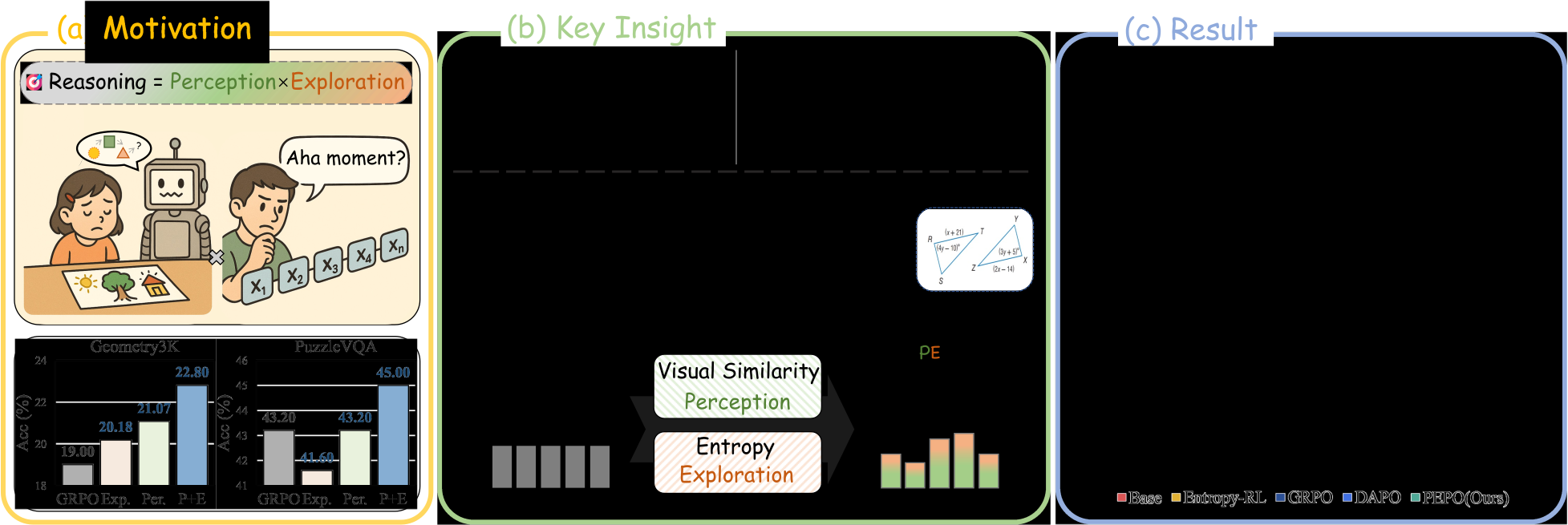
Figure 1 解读:这是论文的总览图(paper Figure 1)。左侧说明作者的判断:有效的 multimodal reasoning 不是单独依赖 perception,也不是单独依赖 exploration,而是两者的乘积关系。中间对比了传统 sequence-level optimization 与 PEPO:传统做法把同一个 advantage 均匀施加到所有 token;PEPO 则先计算 visual similarity 和 entropy,再生成 token-level reweighting。右侧给出结论性结果:无论接到 GRPO 还是 DAPO 上,PEPO 都能带来一致增益。Figure 1 的组织方式对应论文的方法主线:先分析 token dynamics,再把分析结果转成训练算法。
PEPO 的完整流程可以概括为四步:
- 先按 GRPO/DAPO 的方式,对每个 query 采样一组回答并计算 sequence-level reward / advantage;
- 对每个 response token,计算它与 vision tokens 的 hidden-state visual similarity;
- 再计算对应 token 的 entropy,并和 perception prior 通过 smooth gate 融合,得到 token weight;
- 用这个 token weight 去重分配原本均匀的 advantage,使 policy gradient 更聚焦于“视觉锚定 + 推理探索”兼具的 token。
从公开代码看,作者并不是单独实现一套新 RL 框架,而是把这个机制嵌进现有 Swift RLHF runtime:
src/pepo/train/rlhf.py通过install_pepo_runtime()把grpotrainer 映射到pepo.train.grpo_trainer.PepoGRPOTrainer;src/pepo/train/args.py增加了gate_alpha、gate_temperature、img_token、use_vision_weights、vision_score_type等参数;- 实际的 token reweighting 逻辑集中在
src/pepo/train/grpo_trainer.py。
3.2 Token-level 分析:为什么 perception 与 entropy 是互补的?
3.2.1 Visual similarity 分布分析
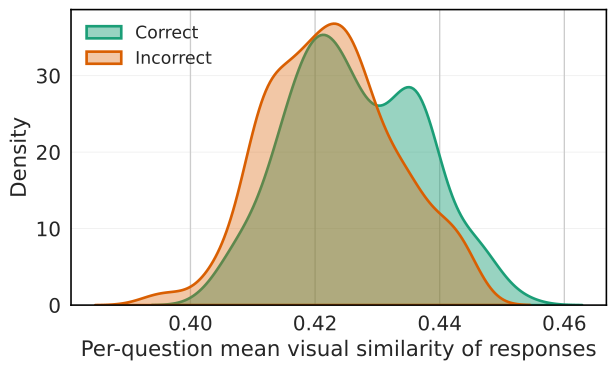
Figure 2 解读:这是论文 Figure 2(a),展示按问题聚合后的全局 visual similarity 分布 。正确回答对应的分布整体向右偏移,说明正确回答的 token 整体上与视觉 token 更接近。也就是说,正确推理并不是“纯语言链条”,而是更强依赖视觉证据支持的语言链条。
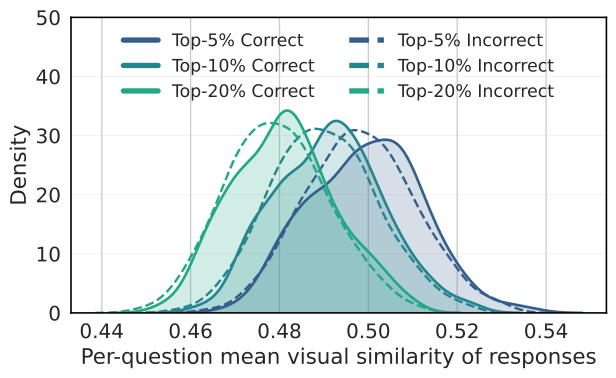
Figure 2 解读:这是论文 Figure 2(b),只看每个回答里 top-K visual similarity tokens 的分布 。正确回答相较错误回答的右移更明显,表明与推理正确性关系更强的并不是“所有 token 都更视觉相关”,而是一小簇 highly grounded tokens。
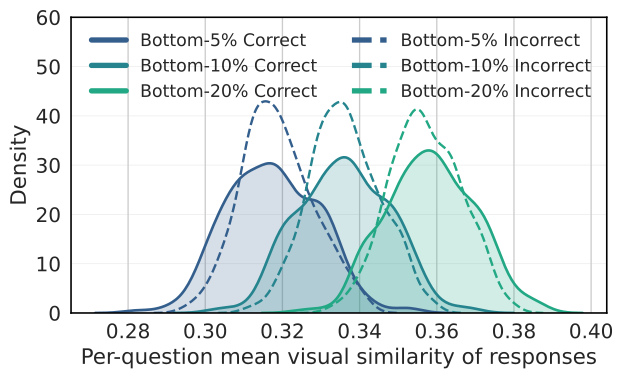
Figure 2 解读:这是论文 Figure 2(c),只看 bottom-K visual similarity tokens 的分布 。正确与错误回答之间几乎没有明显分离,这进一步支持作者的结论:实际重要的是高 visual similarity 的那部分 token,而不是整条响应中所有 token 都要同等重视。
论文把 response token 的 visual similarity 定义为:
其中:
- 是 transformer 层数;
- 是 vision tokens 数;
- 是第 层第 个 response token 的 hidden state;
- 是第 层第 个 vision token 的 hidden state。
这个定义有两个特点:
- 完全不需要额外 supervision;
- 直接复用模型内部已有的跨模态表示结构。
公开代码中,对应实现就是 src/pepo/train/grpo_trainer.py 里的:
_compute_vision_scores_cosine()_compute_vision_scores_l2()_compute_vision_scores_l1()_compute_vision_scores_dot()
公开代码默认使用 cosine similarity,这也与论文附录 Table 4 的结果一致;在该表中,cosine 的表现高于 L1/L2。
3.2.2 Hidden-state shift 与 word cloud 分析
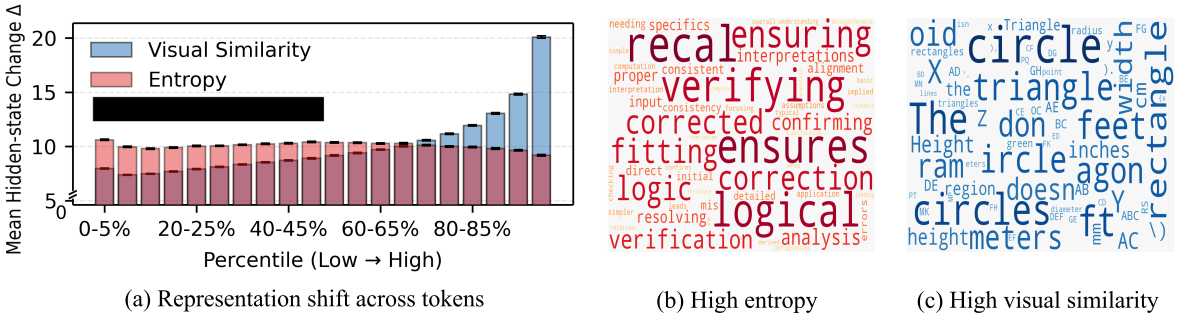
Figure 3 解读:这是论文 Figure 3。左侧柱状图比较了“去掉图像输入”前后 token hidden states 的变化幅度,发现 high visual similarity token 的 representation shift 更大,说明它们依赖图像内容,而不是偶然和视觉 token 相似。中间和右侧的词云则进一步解释了两类 token 的语义角色:高 entropy token 更多是 verification、analysis、correction 之类的推理转折词;高 visual similarity token 更多是 angle、line、triangle、parallel 等带几何/空间含义的 perceptual terms。因此,Figure 3 把作者的经验结论变成了可视化证据:entropy 管探索,visual similarity 管 grounding。
论文附录里把 hidden-state shift 定义为:
这表明作者除了比较回答正确性外,还引入了更细粒度的 counterfactual probe:在相同问题与回答下移除图像输入时,高 visual similarity token 的 hidden-state shift 更明显。
3.3 PEPO 的重点机制
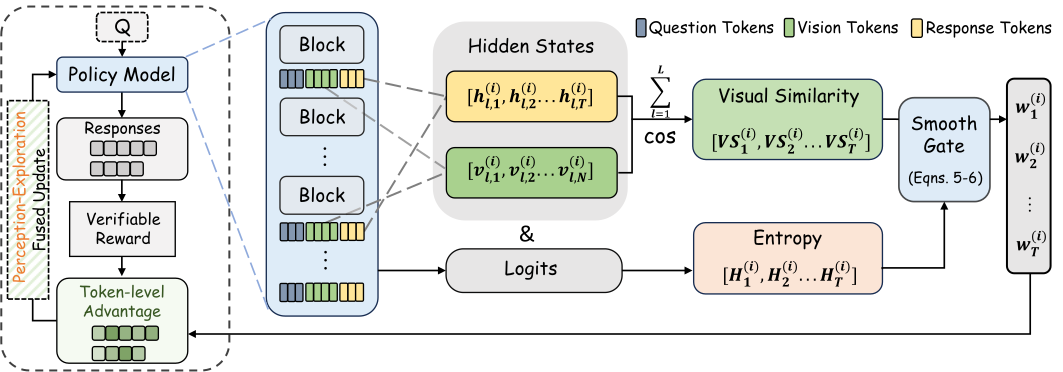
Figure 4 解读:这是论文 Figure 4,也是 PEPO 的详细算法框架图。上半部分显示 policy model 会输出 response tokens、vision tokens 对应的 layer-wise hidden states,以及 logits;中间部分计算 visual similarity 与 entropy;右侧通过 smooth gate 生成 token-wise weight;下半部分再把这个 weight 乘到 verifiable reward 诱导出的 advantage 上,形成最终 token-level update。Figure 4 相比 Figure 1 更偏“工程实现图”,它与公开代码里的 PepoGRPOTrainer 逻辑关系较为接近。
3.3.1 Background:GRPO 的 sequence-level advantage
PEPO 不是凭空构造一个新 RL objective,而是在 GRPO 上继续细化。GRPO 的 advantage 是:
这里 是第 个 response 的 group-relative advantage。传统 GRPO 会把这个 同样施加到该 response 的所有 token 上,这正是论文要改进的粗粒度 credit assignment。
3.3.2 Exploration modeling
token entropy 定义为:
其中 是词表, 是第 个 response 在 token 位置 的预测分布。高 entropy 往往对应模型还在犹豫、分支选择、验证或修正的位置。
公开代码里 entropy 由 swift_grpo.entropy_from_logits(logits) 直接计算,然后在 _get_pepo_per_token_outputs_single() 中与 visual similarity 一起送入后续门控。
3.3.3 Perception-exploration fusion
论文先在每个 response 内分别对 visual similarity 和 entropy 做 min-max normalization,得到 与 。接着构造 centered joint score:
再通过平滑门控生成 token weight:
其中:
- 控制 gate strength;
- 用来把 softmax 权重重新缩放到 unit-mean,使权重平均值为 1;
- 这种设计保证了 entropy 只是在 visual grounding 的基础上做 modulation,而不是无差别放大所有高 entropy token。
公开代码里的实现更接近以下形式:
- 先得到
v_norm与h_norm; - 再令
mixed = v_norm + h_norm; gate = 1 + gate_alpha * tanh(mixed_centered);gated_logits = vision_scores * gate / gate_temperature;- 最后
softmax后乘上valid_counts,得到均值约为 1 的vision_weights。
这部分对应 src/pepo/train/grpo_trainer.py 的 _get_pepo_per_token_outputs_single()。从公式与代码对照来看,公开实现与论文在这一点上的主线是一致的:softmax 前都使用了 perception score 与 gate 的组合作为权重构造依据;代码中再通过 gate_temperature、mask 处理和张量实现细节完成具体计算。
3.3.4 Token-level advantage 与 progressive scheduling
论文将 token-level advantage 写成:
其中 会从 0 线性增大到 1。这个设计的含义是:
- 训练初期更接近原始 GRPO,先保持稳定;
- 训练后期逐渐让 token weight 充分主导 credit assignment。
公开代码没有直接显式构造 A_t,而是采用等价的 loss reweighting 方式:
- 先按 GRPO / BNPO 的方式得到
per_token_loss; - 再根据训练进度
progress = global_step / max_steps,乘上1 - progress + progress * vision_weights; - 这样就在 loss 层完成了从 uniform weighting 到 PEPO weighting 的平滑过渡。
对应代码位置是 src/pepo/train/grpo_trainer.py:436-453。
3.4 Pseudocode(基于公开代码整理的说明性伪代码)
下面的伪代码是根据公开仓库 https://github.com/xzxxntxdy/PEPO 已发布实现整理出的说明性伪代码,相关对应 src/pepo/train/grpo_trainer.py、src/pepo/train/args.py 和训练脚本。它保留了公开实现的重点数据流与模块关系,但为了可读性做了适度简化,因此不应被理解为源码逐行转写。
组件 A:计算 perception prior(对应 _compute_vision_scores_*)
import torch
import torch.nn.functional as F


def compute_visual_similarity(hidden_states, input_ids, img_token_id, logits_to_keep, score_type="cosine"):
    token_ranges = []
    for ids in input_ids:
        idxs = (ids == img_token_id).nonzero(as_tuple=True)[0]
        if idxs.numel() == 0:
            idxs = torch.arange(1, ids.numel(), device=ids.device)
        token_ranges.append(idxs)

    batch_size = input_ids.shape[0]
    device = hidden_states[0].device
    dtype = hidden_states[0].dtype
    scores = [torch.zeros(logits_to_keep, device=device, dtype=dtype) for _ in range(batch_size)]

    for layer_hidden in hidden_states:
        for row_idx, idxs in enumerate(token_ranges):
            vision_hidden = layer_hidden[row_idx].index_select(0, idxs)
            gen_hidden = layer_hidden[row_idx, -logits_to_keep:]

            if score_type == "cosine":
                gen_hidden = F.normalize(gen_hidden, dim=-1)
                vision_hidden = F.normalize(vision_hidden, dim=-1)
                sim_matrix = gen_hidden @ vision_hidden.T
                scores[row_idx] += sim_matrix.mean(dim=1)
            elif score_type == "dot":
                sim_matrix = gen_hidden @ vision_hidden.T
                scores[row_idx] += sim_matrix.mean(dim=1)
            elif score_type == "l2":
                dist = torch.cdist(gen_hidden, vision_hidden, p=2)
                scores[row_idx] += -dist.mean(dim=1)
            elif score_type == "l1":
                dist = torch.cdist(gen_hidden.float(), vision_hidden.float(), p=1)
                scores[row_idx] += -dist.mean(dim=1).to(dtype)
            else:
                raise ValueError(score_type)

    return torch.stack(scores, dim=0) / max(1, len(hidden_states))
组件 B:融合 perception 与 exploration,生成 token weights(对应 _get_pepo_per_token_outputs_single)
import torch
import torch.nn.functional as F


def build_pepo_weights(model, inputs, temperature, gate_alpha, gate_temperature, img_token_id):
    logits_to_keep = inputs["logits_to_keep"]
    outputs = model(return_dict=True, output_hidden_states=True, **inputs)
    logits = outputs.logits[:, -(logits_to_keep + 1):-1, :] / temperature
    hidden_states = outputs.hidden_states
    input_ids = inputs["input_ids"]
    completion_mask = inputs["completion_mask"].bool()

    token_logps = F.log_softmax(logits, dim=-1).gather(
        dim=-1,
        index=input_ids[:, -logits_to_keep:].unsqueeze(-1),
    ).squeeze(-1)
    entropies = -(F.softmax(logits, dim=-1) * F.log_softmax(logits, dim=-1)).sum(dim=-1)

    vision_scores = compute_visual_similarity(
        hidden_states=hidden_states,
        input_ids=input_ids,
        img_token_id=img_token_id,
        logits_to_keep=logits_to_keep,
        score_type="cosine",
    )

    eps = 1e-6
    valid_counts = completion_mask.sum(dim=1, keepdim=True).clamp(min=1)

    v_min = vision_scores.masked_fill(~completion_mask, float("inf")).min(dim=1, keepdim=True).values
    v_max = vision_scores.masked_fill(~completion_mask, float("-inf")).max(dim=1, keepdim=True).values
    v_norm = (vision_scores - v_min) / (v_max - v_min).clamp(min=eps)
    v_norm = torch.where(completion_mask, v_norm, torch.zeros_like(v_norm))

    h_min = entropies.masked_fill(~completion_mask, float("inf")).min(dim=1, keepdim=True).values
    h_max = entropies.masked_fill(~completion_mask, float("-inf")).max(dim=1, keepdim=True).values
    h_norm = (entropies - h_min) / (h_max - h_min).clamp(min=eps)
    h_norm = torch.where(completion_mask, h_norm, torch.zeros_like(h_norm))

    mixed = v_norm + h_norm
    mixed_mean = (mixed * completion_mask).sum(dim=1, keepdim=True) / valid_counts
    mixed_centered = mixed - mixed_mean
    gate = 1.0 + gate_alpha * torch.tanh(mixed_centered)

    gated_logits = vision_scores * gate / gate_temperature
    masked_logits = torch.where(completion_mask, gated_logits, torch.full_like(gated_logits, -float("inf")))
    weights = torch.softmax(masked_logits, dim=1)
    vision_weights = weights * valid_counts.to(weights.dtype)
    return token_logps, entropies, vision_weights
组件 C:把 token weights 注入 policy loss(对应 _compute_loss_and_metrics)
import torch


def compute_pepo_loss(
    per_token_logps,
    old_per_token_logps,
    advantages,
    completion_mask,
    vision_weights,
    epsilon_low,
    epsilon_high,
    beta,
    progress,
    ref_per_token_logps=None,
    loss_type="grpo",
):
    log_ratio = per_token_logps - old_per_token_logps
    coef_1 = torch.exp(log_ratio)
    coef_2 = torch.clamp(coef_1, 1 - epsilon_low, 1 + epsilon_high)

    per_token_loss1 = coef_1 * advantages.unsqueeze(1)
    per_token_loss2 = coef_2 * advantages.unsqueeze(1)
    per_token_loss = -torch.min(per_token_loss1, per_token_loss2)

    # PEPO scheduling: gradually move from uniform weighting to token weighting
    per_token_loss = per_token_loss * (1 - progress + progress * vision_weights)

    if beta != 0.0 and ref_per_token_logps is not None:
        per_token_kl = torch.exp(ref_per_token_logps - per_token_logps) - (ref_per_token_logps - per_token_logps) - 1
        per_token_loss = per_token_loss + beta * per_token_kl

    if loss_type == "grpo":
        loss = ((per_token_loss * completion_mask).sum(-1) / completion_mask.sum(-1).clamp(min=1.0)).mean()
    elif loss_type == "bnpo":
        loss = (per_token_loss * completion_mask).sum() / completion_mask.sum().clamp(min=1.0)
    else:
        raise ValueError(loss_type)

    return loss
组件 D:训练入口与 recipe 注册(对应 rlhf.py + scripts/train/*.sh)
import os
import subprocess
import sys
from swift.trainers.trainer_factory import TrainerFactory
from swift.llm.train.rlhf import SwiftRLHF


def install_pepo_runtime():
    TrainerFactory.TRAINER_MAPPING["grpo"] = "pepo.train.grpo_trainer.PepoGRPOTrainer"
    TrainerFactory.TRAINING_ARGS_MAPPING["grpo"] = "pepo.train.args.PepoGRPOConfig"


class PepoSwiftRLHF(SwiftRLHF):
    args_class = PepoRLHFArguments


def _maybe_launch_with_torchrun(argv):
    nproc_per_node = os.getenv("NPROC_PER_NODE")
    if nproc_per_node is None:
        return
    cmd = [
        sys.executable,
        "-m",
        "torch.distributed.run",
        "--nproc_per_node",
        nproc_per_node,
        "--module",
        "pepo.train.rlhf",
        *argv,
    ]
    subprocess.run(cmd, check=True)
    raise SystemExit(0)


def main(argv):
    _maybe_launch_with_torchrun(argv)
    install_pepo_runtime()
    PepoSwiftRLHF(argv).main()
从公开 recipe 看,Qwen 的 Geometry3K 训练脚本 scripts/train/train_pepo_geometry3k_qwen25vl_3b.sh 里明确设置了:
--num_generations 8--temperature 1.0--top_p 1.0--deepspeed zero2--per_device_train_batch_size 2--gradient_accumulation_steps 4--img_token '<|image_pad|>'--gate_alpha 0.10--gate_temperature 1.8--use_vision_weights true
这表明公开代码不只是概念性示例,而是给出了可直接运行的 release recipe。
3.5 Code-to-paper mapping table
| Paper Concept | Source File | Key Class / Function | 说明 |
|---|---|---|---|
| PEPO runtime 注入 Swift RLHF | src/pepo/train/rlhf.py | install_pepo_runtime, PepoSwiftRLHF, _maybe_launch_with_torchrun | 把公开实现注册为 grpo trainer,并兼容 torchrun |
| PEPO 专属参数 | src/pepo/train/args.py | PepoRLHFArguments, PepoGRPOConfig | 增加 gate_alpha、gate_temperature、img_token、use_vision_weights、vision_score_type |
| Perception prior 计算 | src/pepo/train/grpo_trainer.py | _compute_vision_scores_cosine, _compute_vision_scores_l2, _compute_vision_scores_l1, _compute_vision_scores_dot | 对应论文里的 visual similarity / perception prior |
| Perception + exploration 融合 | src/pepo/train/grpo_trainer.py | _get_pepo_per_token_outputs_single, _get_pepo_per_token_outputs_chunked | 对应论文里的 Eq. (4)-(6) 和 smooth gate |
| Token-level loss 重加权 | src/pepo/train/grpo_trainer.py | _compute_loss_and_metrics | 用训练进度 progress 把 uniform weighting 平滑过渡到 PEPO weighting |
| Format / accuracy reward | src/pepo/rewards/plugin.py | Format, QA_Accuracy | Geometry3K 公开训练依赖的 verifiable rewards |
| Geometry3K 数据路径重写 | src/pepo/data/resolve_image_paths.py | resolve_path, rewrite_record | 把 JSONL 中相对图像路径重写为绝对路径 |
| Geometry3K avg@N 评估 | src/pepo/evaluation/evaluate_geometry3k.py | batched_generate, majority_vote, qa_accuracy | 对应论文中的 avg@8 评估逻辑 |
| MathVista / MathVerse / LogicVista 评估 | src/pepo/evaluation/*.py | evaluate_mathvista.py, evaluate_mathverse.py, evaluate_logicvista.py | 公开 release 覆盖了跨域 reasoning benchmark |
| 公开训练 recipe | scripts/train/*.sh | train_pepo_geometry3k_*, train_pepo_d_geometry3k_* | 给出 Qwen / InternVL 的具体超参与入口;但 train_pepo_d_geometry3k_internvl3_2b.sh 实际设置了 --use_vision_weights false,需与论文中的完整 PEPO_D 设定区分 |
| Visual grounding / few-shot / puzzle / ViRL39K 全训练管线 | 代码搜索未找到开源实现 | 代码搜索未找到开源实现 | 当前公开仓库未完整包含 RefCOCO、FGVC Aircraft、Flower102、PuzzleVQA、AlgoPuzzleVQA、ViRL39K 的训练脚本与完整 pipeline |
| Hidden-state shift 分析与词云生成脚本 | 代码搜索未找到开源实现 | 代码搜索未找到开源实现 | 论文展示了 Figure 3 与相关分析,但当前公开仓库未提供对应分析脚本 |
4. Experimental Setup(实验设置)
4.1 模型与基线
作者使用两种开源 LVLM 作为 backbone:
Qwen2.5-VL-3B-InstructInternVL3-2B-Instruct
对比方法包括:
- Base (zero-shot)
- High-Entropy RL
- GRPO
- DAPO
PEPO_G(把 PEPO 接到 GRPO 上)PEPO_D(把 PEPO 接到 DAPO 上)
4.2 数据集与任务设置
论文覆盖五类任务:
- Geometry / logic reasoning
- 训练:Geometry3K
- 测试:Geometry3K val/test,MathVista-mini,MathVerse-mini,LogicVista
- Visual grounding
- 训练:RefCOCO 2K samples
- 测试:RefCOCO val/testA/testB + LISA-Grounding
- Few-shot classification
- FGVC Aircraft 与 Flower102 的 1-shot / 2-shot / 4-shot
- Visual puzzle reasoning
- 训练:PuzzleVQA 1.5K
- 测试:PuzzleVQA 0.5K + AlgoPuzzleVQA OOD
- Scalability
- 训练:ViRL39K
- 测试:Geometry3Ktest、MathVista、We-Math、MathVerse、LogicVista、SuperClevr Counting、MMMU-Pro
4.3 评估指标
- Geometry / math / logic reasoning:
avg@8 accuracy - Visual grounding:
IoU@50 - Few-shot classification:classification accuracy
- Puzzle reasoning:top-1 accuracy
- 训练效率:迭代吞吐、平均 response length、额外权重计算开销比
4.4 训练配置
论文附录给出的共享 RLVR 配置包括:
- Optimizer:AdamW
- Precision:bfloat16
- Train type:full fine-tuning
- Gradient checkpointing:开启
- Responses per question:8
- Temperature:1.0
- Top-p:1.0
- DeepSpeed:ZeRO-2
- Attention:FlashAttention2
- 训练硬件:8 × NVIDIA A40 GPUs
部分任务特定超参:
- Learning rate:Task 1/4/5 用 ;Task 2/3 用
- Max completion length:Task 1/5 为 1024;Task 2/3/4 为 512
- KL coefficient :Task 1-4 为 0.001;Task 5 为 0.01
4.5 公开代码 release 与论文实验的对应关系
这一部分需要单独说明,因为公开代码并不完全等同于论文的全部实验范围:
README.md明确写了当前 release 相关聚焦 Geometry3K-centered training/evaluation pipeline;- 公开仓库包含
Geometry3K训练脚本,以及MathVista / MathVerse / LogicVista评估脚本; - 论文中 visual grounding、few-shot classification、PuzzleVQA、ViRL39K scaling 的完整训练/eval pipeline 并未在当前公开仓库里完全展开;
- 这意味着:当前公开仓库提供了部分可运行实现,但 release scope 比论文中的 full experiment suite 更窄。
另外,论文正文、附录与公开脚本在 gate_alpha 上并不完全一致。
- 附录 A 的文字说明写成:Task 1/4/5 使用
0.1;Task 2 使用0.05;Task 3 使用0.02; - 但 Appendix Table 1 写成了:Task 4/5 使用
0.1;Task 1/2 使用0.05;Task 3 使用0.02; - 附录关于 geometry 的 gate-strength 消融里,又把
0.05标为 default; - 公开 Qwen Geometry3K recipe 用的是
0.10; - 公开 InternVL Geometry3K recipe 用的是
0.18; - 另外,公开
train_pepo_d_geometry3k_internvl3_2b.sh还设置了--use_vision_weights false,说明 release 中某些 PEPO_D recipe 与论文中完整启用 perception-exploration weighting 的设定并不完全一致。
因此对复现实验来说,alpha 的“默认值”以及是否实际启用 vision-based weighting,在论文与公开 release 之间都存在不一致,需要特别注意。
5. Experimental Results(实验结果)
5.1 主结果:Geometry / math / logic reasoning
| Backbone | Method | Geometry3K val | Geometry3K test | MathVista-mini | MathVerse-mini | LogicVista | Avg |
|---|---|---|---|---|---|---|---|
| Qwen2.5-VL-3B | Base | 11.58 | 14.25 | 50.19 | 37.66 | 32.22 | 29.18 |
| Qwen2.5-VL-3B | High-Entropy RL | 15.58 | 18.26 | 50.69 | 39.84 | 32.59 | 31.39 |
| Qwen2.5-VL-3B | GRPO | 19.00 | 23.79 | 51.56 | 40.54 | 28.30 | 32.64 |
| Qwen2.5-VL-3B | PEPO_G | 21.91 | 27.27 | 54.45 | 45.42 | 34.45 | 36.70 (+4.06 vs Table 1 GRPO; 引言另写为 +3.67,论文未详细说明差异原因) |
| Qwen2.5-VL-3B | DAPO | 22.63 | 27.00 | 53.68 | 44.44 | 33.13 | 36.18 |
| Qwen2.5-VL-3B | PEPO_D | 22.38 | 27.89 | 54.75 | 44.23 | 33.89 | 36.63 (+0.45) |
| InternVL3-2B | Base | 7.88 | 9.03 | 23.00 | 23.36 | 28.36 | 18.33 |
| InternVL3-2B | High-Entropy RL | 10.89 | 8.30 | 35.24 | 20.70 | 17.18 | 18.46 |
| InternVL3-2B | GRPO | 22.08 | 26.33 | 49.36 | 42.09 | 28.84 | 33.74 |
| InternVL3-2B | PEPO_G | 25.84 | 31.28 | 52.36 | 44.89 | 31.88 | 37.25 (+3.51) |
| InternVL3-2B | DAPO | 20.94 | 21.57 | 50.40 | 41.11 | 28.52 | 32.51 |
| InternVL3-2B | PEPO_D | 28.12 | 31.18 | 51.49 | 45.24 | 32.25 | 37.66 (+5.15) |
关键信息:
- 结果显示,PEPO 在两个 backbone 上的平均结果都高于 GRPO;
- 对 Qwen 来说,PEPO_G 与 PEPO_D 都有效,且
PEPO_D比DAPO还高+0.45; - 对 InternVL 来说,
PEPO_D的增益达到+5.15; - 相对增幅较大的任务包括 MathVerse / LogicVista 这类需要视觉和符号推理联合发挥的 benchmark。
5.2 Visual grounding 与 few-shot classification
Visual grounding(IoU@50)
| Method | RefCOCO val | testA | testB | LISA | Avg |
|---|---|---|---|---|---|
| Base | 89.10 | 91.70 | 84.00 | 56.51 | 80.33 |
| High-Entropy RL | model collapsed | model collapsed | model collapsed | model collapsed | - |
| GRPO | 90.12 | 92.29 | 85.55 | 62.42 | 82.60 |
| PEPO_G | 90.44 | 92.40 | 85.75 | 65.26 | 83.46 (+0.86) |
| DAPO | 90.10 | 92.40 | 85.08 | 62.48 | 82.52 |
| PEPO_D | 90.03 | 92.72 | 85.42 | 64.23 | 83.10 (+0.58) |
这里一个现象是:High-Entropy RL 在 grounding 上直接 collapse,而 PEPO 保持了稳定结果。按论文的解释,这说明仅依赖 entropy 的 token-level weighting 不足以支撑 multimodal RL,视觉 grounding prior 是必要补充。
Few-shot classification
| Dataset | Method | 1-shot | 2-shot | 4-shot | Avg |
|---|---|---|---|---|---|
| FGVC Aircraft | SFT | 36.24 | 40.86 | 55.48 | 44.19 |
| FGVC Aircraft | GRPO | 48.72 | 55.60 | 63.94 | 56.09 |
| FGVC Aircraft | PEPO_G | 51.13 | 57.31 | 75.79 | 61.41 (+5.32) |
| Flower102 | SFT | 33.98 | 44.50 | 52.33 | 43.60 |
| Flower102 | GRPO | 53.23 | 57.94 | 66.22 | 59.13 |
| Flower102 | PEPO_G | 54.81 | 59.44 | 67.52 | 60.59 (+1.46) |
结果也表明,PEPO 不只在 chain-of-thought benchmark 上有效,在少样本视觉分类这类更偏 perception 的任务上也有收益。
5.3 Visual puzzle 与 scalability
PuzzleVQA / AlgoPuzzleVQA
| Backbone | Method | PuzzleVQA | AlgoPuzzleVQA | Avg |
|---|---|---|---|---|
| Qwen2.5-VL-3B | Base | 31.80 | 21.72 | 26.76 |
| Qwen2.5-VL-3B | High-Entropy RL | 35.00 | 24.61 | 29.81 |
| Qwen2.5-VL-3B | GRPO | 43.20 | 25.44 | 34.32 |
| Qwen2.5-VL-3B | PEPO_G | 45.00 | 26.94 | 35.97 (+1.65) |
| Qwen2.5-VL-3B | DAPO | 44.60 | 25.33 | 34.97 |
| Qwen2.5-VL-3B | PEPO_D | 46.80 | 26.56 | 36.68 (+1.71) |
| InternVL3-2B | Base | 31.80 | 23.00 | 27.40 |
| InternVL3-2B | High-Entropy RL | 32.60 | 25.22 | 28.91 |
| InternVL3-2B | GRPO | 43.20 | 26.17 | 34.69 |
| InternVL3-2B | PEPO_G | 45.20 | 27.22 | 36.21 (+1.52) |
| InternVL3-2B | DAPO | 44.80 | 27.72 | 36.26 |
| InternVL3-2B | PEPO_D | 45.20 | 28.61 | 36.91 (+0.65) |
ViRL39K scalability
| Method | Geometry3K test | MathVista | We-Math | MathVerse | LogicVista | Counting | MMMU-Pro | Avg |
|---|---|---|---|---|---|---|---|---|
| GRPO | 28.72 | 59.34 | 58.90 | 55.25 | 38.14 | 55.81 | 25.66 | 45.97 |
| PAPO_G | 30.95 | 61.38 | 60.09 | 57.14 | 38.67 | 62.56 | 27.11 | 48.27 |
| PEPO_G | 29.85 | 63.48 | 60.98 | 56.49 | 39.85 | 70.75 | 27.47 | 49.84 (+3.87 vs GRPO) |
PEPO 在大规模训练数据上仍有增益,而且在 Counting 这类 perception-intensive benchmark 上提升幅度也较大。
5.4 训练效率与额外开销
| Metric | Method | Geometry3K | PuzzleVQA | RefCOCO | FGVC Aircraft |
|---|---|---|---|---|---|
| Iter/s | GRPO | 0.022 | 0.066 | 0.080 | 0.071 |
| Iter/s | PEPO_G | 0.022 | 0.074 | 0.084 | 0.083 |
| Mean length | GRPO | 273 | 104 | 77 | 92 |
| Mean length | PEPO_G | 270 | 85 | 64 | 77 |
| PEPO_G | 0.0039 | 0.0065 | 0.0061 | 0.0048 |
作者定义的额外开销比:
实验表明 。这意味着:PEPO 的额外计算相关是 hidden-state similarity、entropy 和权重归一化,对总训练开销的影响较小。
5.5 消融实验
组件消融(paper Table 7)
| Variant | Geometry3K val | PuzzleVQA |
|---|---|---|
| GRPO | 19.00 | 43.20 |
| Exploration-only | 20.18 | 41.60 |
| Perception-only | 21.07 | 43.20 |
| PEPO_G | 22.80 | 45.00 |
这张表说明:
- 只用 entropy 会不稳定,甚至在 PuzzleVQA 上比 GRPO 差;
- 只用 perception 也能提高 Geometry3K;
- 在这组消融结果中,perception + exploration 的结合对应最高结果。
Gate strength 敏感性(paper Appendix Table 3)
| Geometry3K val | Geometry3K test | MathVista-mini | MathVerse-mini | LogicVista | Avg | |
|---|---|---|---|---|---|---|
| 0.00 (Perception-only) | 21.07 | 26.73 | 52.81 | 45.31 | 34.93 | 36.17 |
| 0.02 | 20.60 | 25.87 | 53.88 | 44.99 | 34.73 | 36.01 |
| 0.05 (Default in this ablation table) | 21.91 | 27.27 | 54.45 | 45.42 | 34.45 | 36.70 |
| 0.10 | 22.80 | 26.81 | 53.58 | 44.12 | 34.26 | 36.31 |
| 0.15 | 21.45 | 26.52 | 53.54 | 43.99 | 34.62 | 36.02 |
从该表可以看到,小到中等强度的 gate 对应的结果相对更高,entropy 更适合作为补充调制信号,而不是主导信号。
Perception prior 度量方式(paper Appendix Table 4)
| Measure | Geometry3K val | Geometry3K test | FGVC Aircraft (4-shot) |
|---|---|---|---|
| L1 distance | 19.00 | 24.50 | 60.85 |
| L2 distance | 20.90 | 26.08 | 67.33 |
| Cosine similarity | 22.80 | 26.81 | 75.79 |
这也是公开代码默认 vision_score_type="cosine" 的直接依据。
5.6 定性结果与训练动态
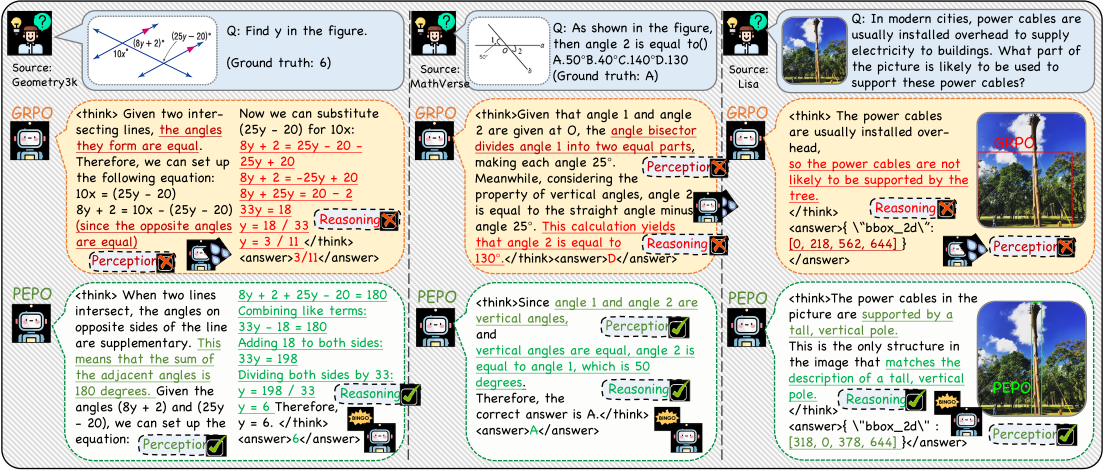
Figure 5 解读:这是论文 Figure 5。它给了 Geometry3K、MathVerse、LISA 三类案例。图中示例显示,GRPO 在“看图”与“推理”之间会出现脱节:例如读错几何关系、在中间推导里出现不一致,或者 bounding box 指向错误目标。相对地,PEPO 生成的中间 reasoning step 与视觉证据一致性更高,并给出正确答案。Figure 5 同时展示了最终答案差异和 reasoning trajectory 内部结构的变化。
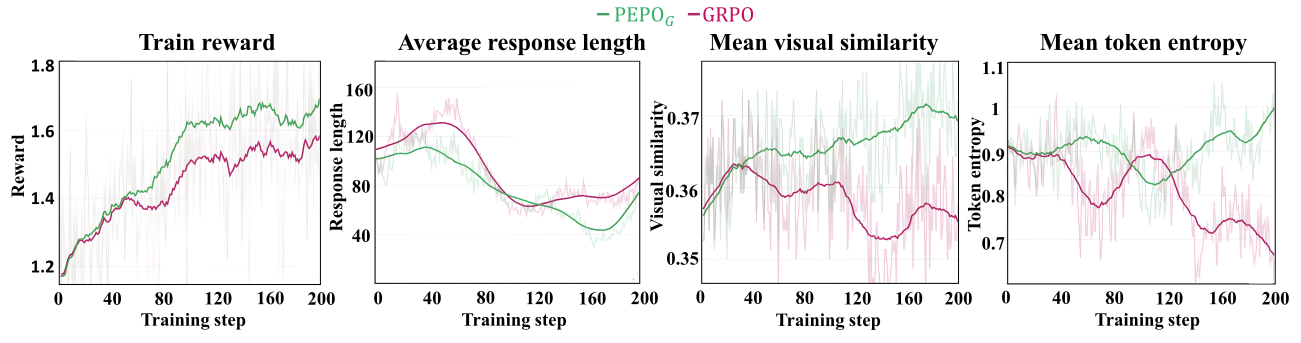
Figure 6 解读:这是论文 Figure 6,对比 GRPO 与 PEPO_G 在 FGVC Aircraft 4-shot 上的训练曲线。图中显示 PEPO_G 对应较高的训练 reward、较平滑的 response length 下降趋势、持续上升的 mean visual similarity,以及较温和的 mean token entropy 下降。按论文的解释,这反映了 PEPO 在保持 exploration 的同时提升了视觉对齐度。
5.7 局限性
论文明确承认了几项限制:
- 只在 2B / 3B 级别 LVLM 上验证,没有扩展到 7B+;
- 没系统测试更长 context setting;
- 评测任务虽然多,但依然是 curated benchmark 集合;
- 更广泛的视频理解、tool-augmented reasoning 尚未验证。
结合公开仓库,还可以再补一条“release 级别”的现实限制:
- 开源代码已经公开,但当前 release 相关覆盖 Geometry3K 为中心的训练/评估路径,和论文 full experiment suite 不是完全一一对应。
5.8 总结
综合论文与当前公开代码,可以整理出几个结论:
- PEPO 的重点贡献是把 visual grounding 与 reasoning exploration 同时纳入 token-level credit assignment;
- 在论文报告的 geometry reasoning、visual grounding、few-shot classification、visual puzzle 与 scalability 实验中,PEPO 相比 GRPO / DAPO 都表现出一致增益;
- 训练效率实验表明,这种 token-level reweighting 的额外计算开销较低,论文报告的 始终低于 ;
- 当前公开仓库已经提供了可运行的 Geometry3K-centered release,但并未完整覆盖论文中的全部训练与分析 pipeline,因此“论文结果”和“当前 release 范围”需要分开理解。
论文最后给出的后续方向相关包括:在更大规模 backbone 上验证该方法,以及把类似的 token-level multimodal RL 机制扩展到更广的视觉理解与推理任务。