DAPO: An Open-Source LLM Reinforcement Learning System at Scale
Authors: Qiying Yu, Zheng Zhang, Ruofei Zhu, Yufeng Yuan, Xiaochen Zuo, Yu Yue (Algorithm), Weinan Dai, Tiantian Fan, et al. (Infrastructure), Jiaze Chen, et al. (Dataset) Affiliations: ByteDance Seed, Institute for AI Industry Research (AIR), Tsinghua University, The University of Hong Kong, SIA-Lab of Tsinghua AIR and ByteDance Seed arXiv: 2503.14476 Project Page: dapo-sia.github.io GitHub: BytedTsinghua-SIA/DAPO
1. Motivation (研究动机)
这篇论文研究的是 大规模 LLM 强化学习训练系统。作者指出,尽管 test-time scaling(如 OpenAI o1、DeepSeek R1)通过 RL 训练出长 Chain-of-Thought 推理能力,但实际的训练细节一直被隐藏:
- 作者在 Qwen2.5-32B 上用 naive GRPO 训练,AIME 2024 只达到 30 分,远低于 DeepSeek-R1-Zero 的 47 分;
- 深入分析后发现 naive GRPO 存在 entropy collapse(策略熵快速下降)、reward noise(截断样本的 reward 不准确)、和 training instability(训练不稳定)等问题;
- 社区也普遍反映难以复现 R1 的结果,说明关键训练细节可能被遗漏。
因此,这篇论文的目标是:公开一个完整的、可复现的、达到 industry-level 性能的大规模 LLM RL 训练系统,包括算法、代码和数据。
2. Idea (核心思想)
DAPO(Decoupled Clip and Dynamic sAmpling Policy Optimization)的核心思想是:在 GRPO 框架上引入四个关键技术改进,解决 long-CoT RL 训练中的 entropy collapse、zero-gradient、loss imbalance 和 reward noise 问题。
四个技术分别是:
- Clip-Higher:解耦上下 clip 阈值,放宽上限让低概率 token 有更大提升空间,防止 entropy collapse;
- Dynamic Sampling:过滤掉 accuracy=0 和 accuracy=1 的 prompt,保证每个 batch 都有有效梯度;
- Token-Level Policy Gradient Loss:按 token 而非 sample 聚合 loss,避免长序列被低估;
- Overlong Reward Shaping:对超长截断样本用软惩罚替代硬惩罚,减少 reward noise。
与 DeepSeek-R1-Zero 的根本区别是:DAPO 不依赖 KL 惩罚项(因为 long-CoT 场景下模型需要大幅偏离初始分布),而是通过上述四个技术共同维持训练稳定性。
3. Method (方法)
3.1 DAPO 目标函数
DAPO 的完整目标函数如下:
其中:
约束条件 表示一个 prompt 的 个回复中,必须既有正确又有错误的才参与训练(Dynamic Sampling 的核心约束)。
3.2 Clip-Higher
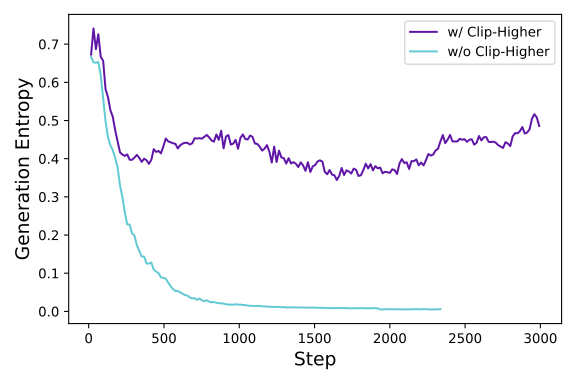
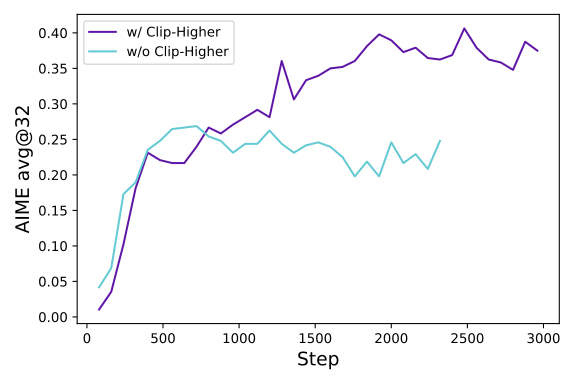
Figure 2 解读:左图是 AIME 准确率,右图是 actor model 的生成熵。没有 Clip-Higher 时(紫线),entropy 在约 500 步后快速降到接近 0,说明策略崩溃为几乎确定性输出;有 Clip-Higher 后(蓝线),entropy 保持在合理范围内持续上升,准确率也更高。
问题:标准 PPO/GRPO 使用对称 clip 。当 时,一个概率为 0.01 的 token 最多只能被提升到 ,而概率为 0.9 的 token 可以被提升到 (截断到 1)。上限 clip 严重限制了低概率 “exploration” token 的概率提升空间。
解决方案:解耦上下 clip 阈值:,。放宽上限给低概率 token 更多空间,同时保持下限不变以避免不确定 token 概率被压到 0。
3.3 Dynamic Sampling
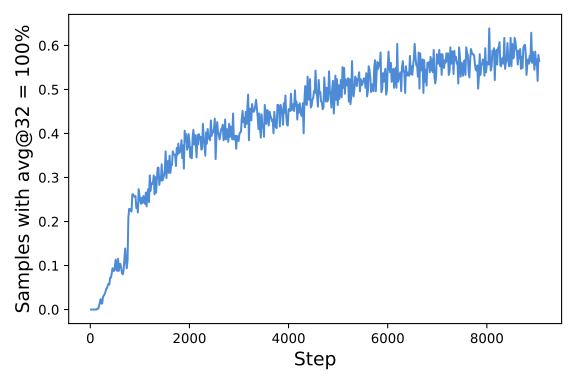
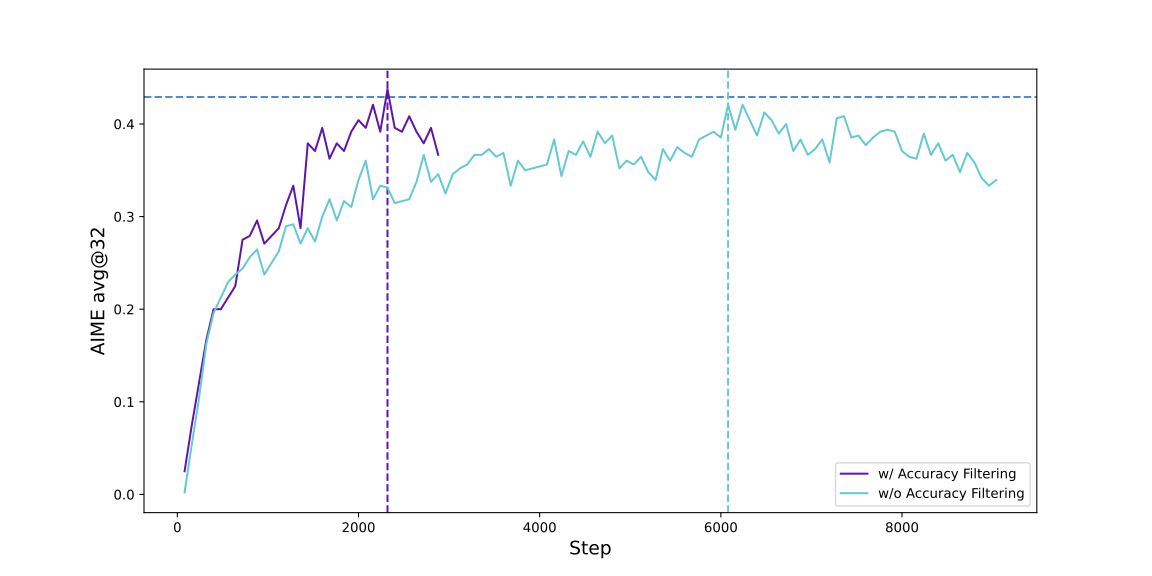
Figure 3 解读:左图是被 up-clip 的 token 的平均概率(都低于 0.2,验证了 Clip-Higher 的直觉);右图是 accuracy=1 的样本比例随训练增长到 60%+,意味着越来越多 prompt 的 G 个回复全部正确,advantage 为零,产生零梯度。
问题:GRPO 用组内 reward 归一化算 advantage。如果一个 prompt 的 个回复全部正确(reward 相同),advantage 全为零,这个 prompt 不产生梯度。训练中这种 prompt 比例不断增长,有效梯度信号越来越稀疏。
解决方案:过采样 + 过滤。在采样时持续生成直到 batch 被 accuracy 既非 0 也非 1 的 prompt 填满。这保证了 batch 中每个 prompt 都有有效梯度。
3.4 Token-Level Policy Gradient Loss
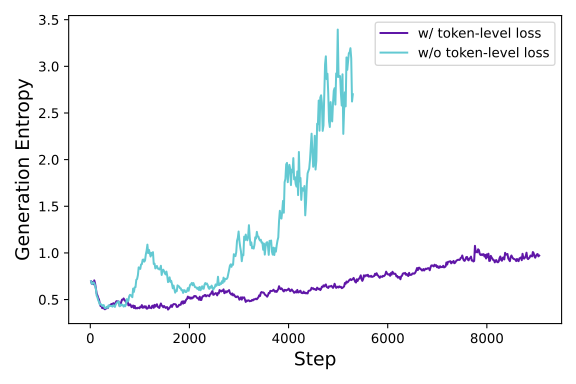
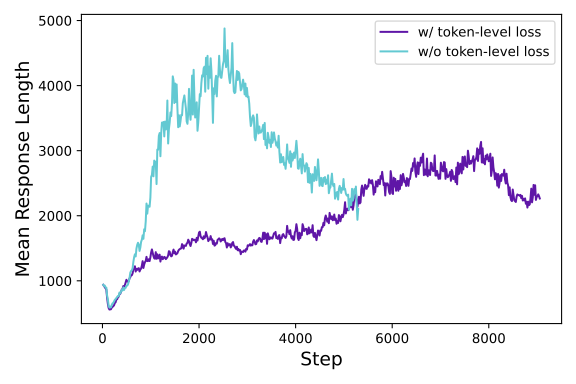
Figure 4 解读:左图是生成熵,右图是平均回复长度。没有 token-level loss 时(紫线),entropy 不稳定,回复长度在 2000-4000 之间剧烈波动;有 token-level loss 后(蓝线),entropy 稳定上升,长度增长更健康。
问题:原始 GRPO 先按 token 对每个 sample 内部取平均,再按 sample 取平均。这意味着不管序列长短,每个 sample 权重相同。长序列中的 token 贡献被稀释,短序列中的 token 贡献被放大。
解决方案:改为按 token 总数做全局平均(分母从 变成 )。这样长序列的 reasoning pattern 有更大影响力,同时长序列中的 gibberish/repetitive pattern 也会被更有效地惩罚。
3.5 Overlong Reward Shaping
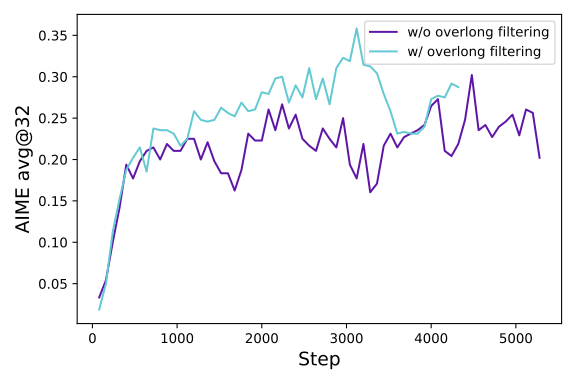
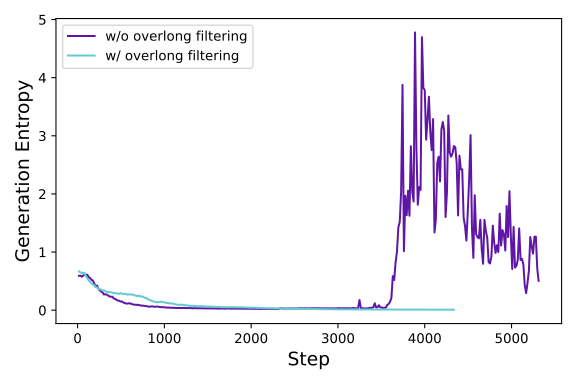
Figure 5 解读:左图是 AIME 准确率,右图是 entropy。没有 overlong filtering 时(蓝线),准确率震荡且 entropy 爆炸到 4+;有了之后(紫线),训练稳定得多。
问题:RL 训练通常设置最大生成长度 ,超过的样本被截断。截断样本默认被判为错误并给 reward,但实际上其推理过程可能是正确的,只是太长。这引入了 reward noise。
解决方案:先做 Overlong Filtering(mask 掉截断样本的 loss),再加 Soft Overlong Punishment:
其中 是软惩罚缓冲区长度。当回复接近最大长度时,施加渐进惩罚,避免突然切断。
3.6 Algorithm 1: DAPO 完整算法
Algorithm: DAPO
Input: initial policy π_θ, reward model R, task prompts D, hyperparams ε_low, ε_high
1: for step = 1, ..., M do
2:     Sample batch D_b from D
3:     Update old policy π_θ_old ← π_θ
4:     Sample G outputs {o_i}_{i=1}^G ~ π_θ_old(·|q) for each q ∈ D_b
5:     Compute rewards {r_i}_{i=1}^G for each o_i via R
6:     Filter out o_i and add remaining to dynamic sampling buffer  (Eq.11)
7:     if buffer size n_b < N:
8:         continue  # keep sampling until batch is full
9:     For each o_i in buffer, compute Â_{i,t} for each token (Eq.9)
10:    for iteration = 1, ..., μ do
11:        Update π_θ by maximizing DAPO objective (Eq.8)
Output: π_θ
3.7 Pseudocode(基于 verl 公开实现)
组件 A:Clip-Higher (decoupled clip ratios)
# Source: verl/trainer/ppo/core_algos.py
# Corresponds to: actor.clip_ratio_low, actor.clip_ratio_high in config

def compute_policy_loss_with_clip_higher(log_prob, old_log_prob, advantages,
                                          clip_ratio_low, clip_ratio_high):
    ratio = torch.exp(log_prob - old_log_prob)
    # Decoupled clipping: different lower and upper bounds
    clipped_ratio = torch.clamp(ratio, 1 - clip_ratio_low, 1 + clip_ratio_high)
    pg_loss1 = ratio * advantages
    pg_loss2 = clipped_ratio * advantages
    loss = -torch.min(pg_loss1, pg_loss2)
    return loss
组件 B:Dynamic Sampling (filter accuracy=0 and accuracy=1 groups)
# Source: verl/trainer/ppo/ray_trainer.py (training loop)
# The dynamic sampling buffer continues sampling until batch is full

def dynamic_sampling_step(policy, prompts, G, batch_size):
    buffer = []
    while len(buffer) < batch_size:
        batch = sample_batch(prompts)
        for q in batch:
            outputs = [policy.generate(q) for _ in range(G)]
            rewards = [reward_fn(q, o) for o in outputs]
            n_correct = sum(1 for r in rewards if r > 0)
            # Filter: keep only prompts with 0 < n_correct < G
            if 0 < n_correct < G:
                buffer.append((q, outputs, rewards))
    return buffer[:batch_size]
组件 C:Token-Level Policy Gradient Loss
# Source: verl/trainer/ppo/core_algos.py
# loss_agg_mode="token-mean" in config

def token_level_loss_aggregation(per_token_loss, response_mask):
    # Instead of: mean over tokens per sample, then mean over samples
    # Do: sum all token losses, divide by total token count
    total_loss = (per_token_loss * response_mask).sum()
    total_tokens = response_mask.sum()
    return total_loss / total_tokens
组件 D:Overlong Reward Shaping (Soft Overlong Punishment)
# Source: verl reward manager (reward.reward_manager.name=dapo)

def compute_overlong_penalty(response_length, max_resp_len, buffer_len, penalty_factor):
    cache_start = max_resp_len - buffer_len
    if response_length <= cache_start:
        return 0.0
    elif response_length <= max_resp_len:
        return penalty_factor * (cache_start - response_length) / buffer_len
    else:
        return -1.0 * penalty_factor
3.8 Code-to-paper mapping table
| Paper Concept | Source File | Key Class/Function |
|---|---|---|
| DAPO 训练主入口 | verl/trainer/main_ppo.py | Main entry point |
| GRPO advantage 计算 | verl/trainer/ppo/core_algos.py | compute_grpo_outcome_advantage |
| Clip-Higher (decoupled clip) | verl/trainer/ppo/core_algos.py | clip_ratio_low, clip_ratio_high; torch.clamp(ratio, 1-cliprange_low, 1+cliprange_high) |
| Token-Level Loss | verl/trainer/ppo/core_algos.py | agg_loss(), loss_agg_mode="token-mean" |
| Dynamic Sampling (Filter Groups) | verl/trainer/config/algorithm.py | FilterGroupsConfig(enable=True, metric="seq_reward") |
| Overlong Reward Shaping | verl/workers/reward_manager/dapo.py | DAPORewardManager.__call__(), overlong_buffer_cfg |
| 数学答案验证 | verl/utils/reward_score/math_dapo.py | Rule-based reward |
| DAPO 训练脚本 | examples/gmpo_trainer/test_dapo_7b_math.sh | 完整超参配置 |
| Ray 分布式训练 | verl/trainer/ppo/ray_trainer.py | RayPPOTrainer |
| DAPO 论文/数据/模型 | github.com/BytedTsinghua-SIA/DAPO | Paper, eval scripts, DAPO-Math-17K dataset |
4. Experimental Setup (实验设置)
4.1 模型与数据
- Base model: Qwen2.5-32B(预训练模型,非 instruct 版本)
- 训练数据: DAPO-Math-17K,从 web 和竞赛主页爬取并经 LLM 转换为整数答案格式的数学题
- Reward: Rule-based, if correct, otherwise(无 reward model,直接判对错)
4.2 训练配置
- Optimizer: AdamW, lr = , 20 step linear warmup
- Rollout: prompt batch size = 512, 每个 prompt 采样 16 个回复 ()
- Mini-batch: 512, 即 16 次梯度更新 per rollout step
- Max length: tokens(16K 期望 + 4K 软惩罚缓冲)
- Clip-Higher: ,
- 评估: AIME 2024, temperature=1.0, top_p=0.7, 重复 32 次取 avg@32
- 框架: verl (HybridFlow),基于 Ray 分布式
4.3 Baselines
- DeepSeek-R1-Zero-Qwen-32B: 47 on AIME 2024(之前 SOTA)
- Naive GRPO: 30 on AIME 2024(作者的 baseline)
5. Experimental Results (实验结果)
5.1 主结果:逐步添加技术的 ablation
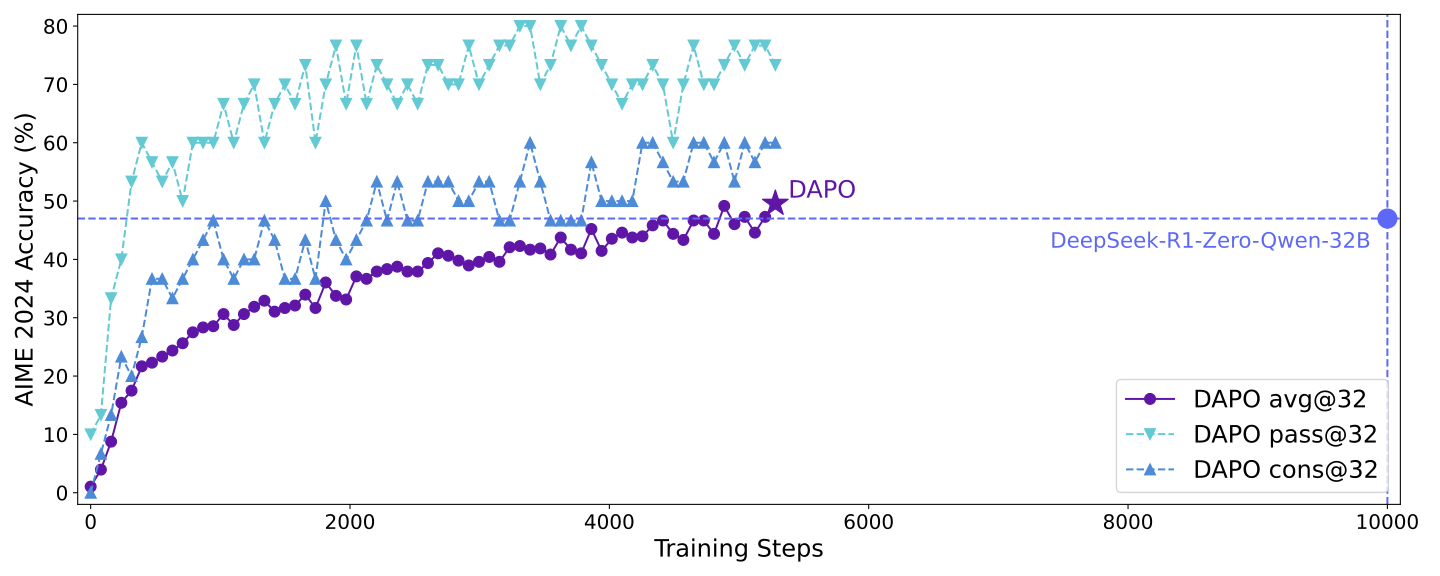
Figure 1 解读:DAPO 在 Qwen2.5-32B 上的 AIME 2024 训练曲线。avg@32(蓝线实线)在约 6000 步达到 50,超过 DeepSeek-R1-Zero-Qwen-32B 的 47(虚线),且只用了约 50% 的训练步数。pass@32 和 cons@32 也在持续提升。
| Model | AIME24 avg@32 |
|---|---|
| DeepSeek-R1-Zero-Qwen-32B | 47 |
| Naive GRPO | 30 |
| + Overlong Filtering | 36 |
| + Clip-Higher | 38 |
| + Soft Overlong Punishment | 41 |
| + Token-level Loss | 42 |
| + Dynamic Sampling (DAPO) | 50 |
每个技术都有正向贡献,从 naive GRPO 的 30 逐步提升到 DAPO 的 50。
5.2 Training Dynamics 分析
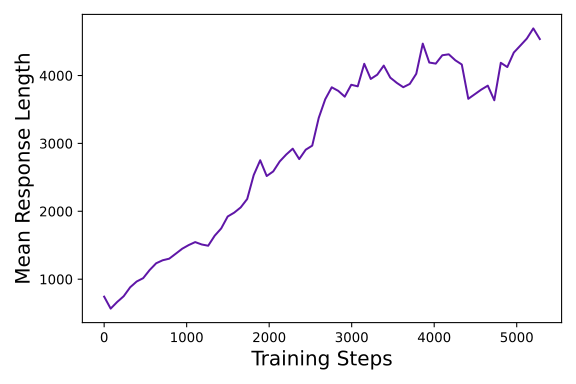
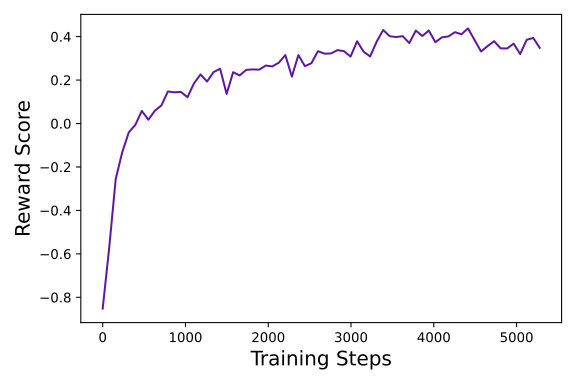
Figure 7 解读:左图是平均回复长度,右图是 reward score。回复长度在 1000-4000 之间波动但整体上升,说明模型在学习更长的推理链。Reward 则相对稳定上升,没有明显的 reward hacking。
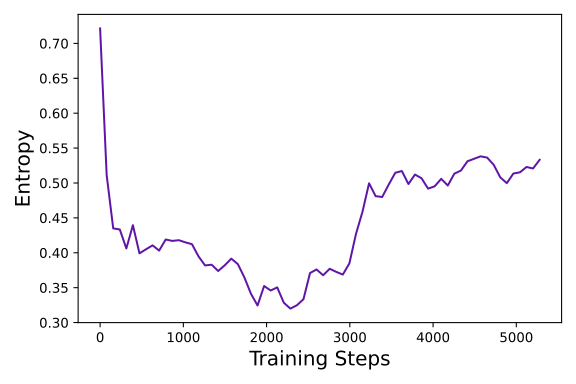
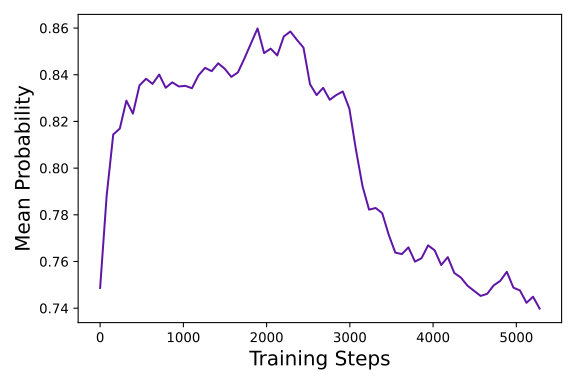
Figure 7c-d 解读:左图是生成熵,右图是平均生成概率。Entropy 保持在 0.3-0.7 的健康范围内缓慢上升;生成概率从 0.84 下降到 0.74,说明模型在探索更多样的 token 选择。
5.3 Dynamic Sampling 的效率
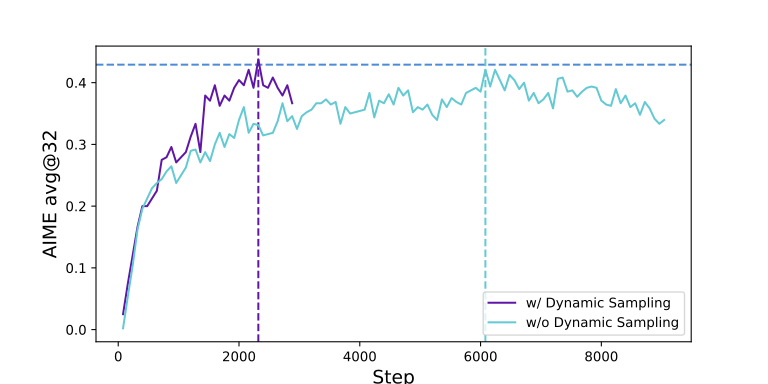
Figure 6 解读:有无 Dynamic Sampling 的对比。虽然 Dynamic Sampling 需要更多采样次数(因为要过滤掉 accuracy=0/1 的 prompt),但它到达相同性能所需的训练步数更少。总训练时间基本不受影响,因为采样时间在 RL 系统中通常不是瓶颈。
5.4 涌现行为
论文发现在训练过程中,模型逐渐出现了反思和回溯行为——这在训练初期几乎不存在。例如,模型会输出 “However, wait a moment, let’s rethink…” 这样的自我修正模式,说明 RL 训练不仅在强化已有的推理模式,还在涌现全新的推理能力。
5.5 Limitations
- 论文只在数学任务上验证,未展示代码、科学推理等其他领域的结果;
- DAPO 的四个技术虽然各自有效,但它们之间的交互效应没有被系统分析;
- 训练成本仍然很高(512 prompt × 16 responses = 8192 次生成/step),对小团队不够友好。
总体来说,DAPO 的最大贡献是:把一个 industry-level 的 LLM RL 系统从算法到代码到数据全部开源,填补了 DeepSeek-R1 和 OpenAI o1 之间的可复现性空白。