Video Generation with Predictive Latents
1. Motivation (研究动机)
现有 Video VAE 的核心问题不是“能不能重建视频”,而是“重建出来的 latent 是否适合后续 Diffusion/Flow 生成”。主流做法通常从 Image VAE 膨胀到 3D causal convolution,再继续用 video reconstruction 训练;这能得到不错的 PSNR/LPIPS/rFVD,但论文指出继续优化 reconstruction 并不必然带来更好的 generation performance。也就是说,latent 可以保存像素细节,却未必形成对 motion、temporal dynamics、future evolution 有结构的表示,导致 latent diffusability 受限。
本文要解决的具体目标是:在不大改 Video VAE 架构、不新增复杂训练目标的前提下,让 VAE latent 同时保留视觉重建能力和对未来帧的预测能力,从而更适合 latent video generation。它把 VAE 训练从完整输入到完整重建,改成“只看过去一部分帧,但仍要重建完整视频”的 partial-to-complete reconstruction。
这个问题值得研究,因为 Video VAE 是 Latent Video Diffusion Models 的底座。若 latent 本身更 motion-aware、更 temporally coherent,后续 DiT/Latte 生成模型可以在更有结构的空间中学习视频分布,训练更快、FVD 更低,并可能在 optical flow、tracking、next-frame prediction 等 video understanding probe 上表现更好。
2. Idea (核心思想)
核心 insight:一个好的 video latent 不应只是“当前帧像素的压缩包”,而应包含“从过去推断未来”的 temporal predictive structure。PV-VAE 通过随机丢弃未来 frame groups,让 encoder 只能编码 observed past,decoder 却必须 reconstruct observed frames 并 predict dropped future frames,从而把 motion prior 注入 latent space。
关键创新是 Predictive Reconstruction (PR):在 VAE 训练中按 temporal compression group 随机截断未来帧,用 padding latent 补齐长度后交给 decoder 还原完整视频;再加 motion-aware objective,让模型学习 adjacent-frame temporal differences,避免静态背景的 copy-shortcut 主导训练。
与 Wan2.2 VAE / CogVideoX VAE 这类主要依赖 full-video reconstruction 的方法相比,PV-VAE 的根本区别在于 supervision 的信息不对称:baseline encoder 能看到完整视频,优化目标主要驱动 reconstruction;PV-VAE encoder 看不到被丢弃的未来帧,因此 latent 必须编码可外推的动态结构。这也是它在 reconstruction 指标略不占优时仍能显著改善 generation FVD 的原因。
3. Method (方法)
3.1 Overall framework
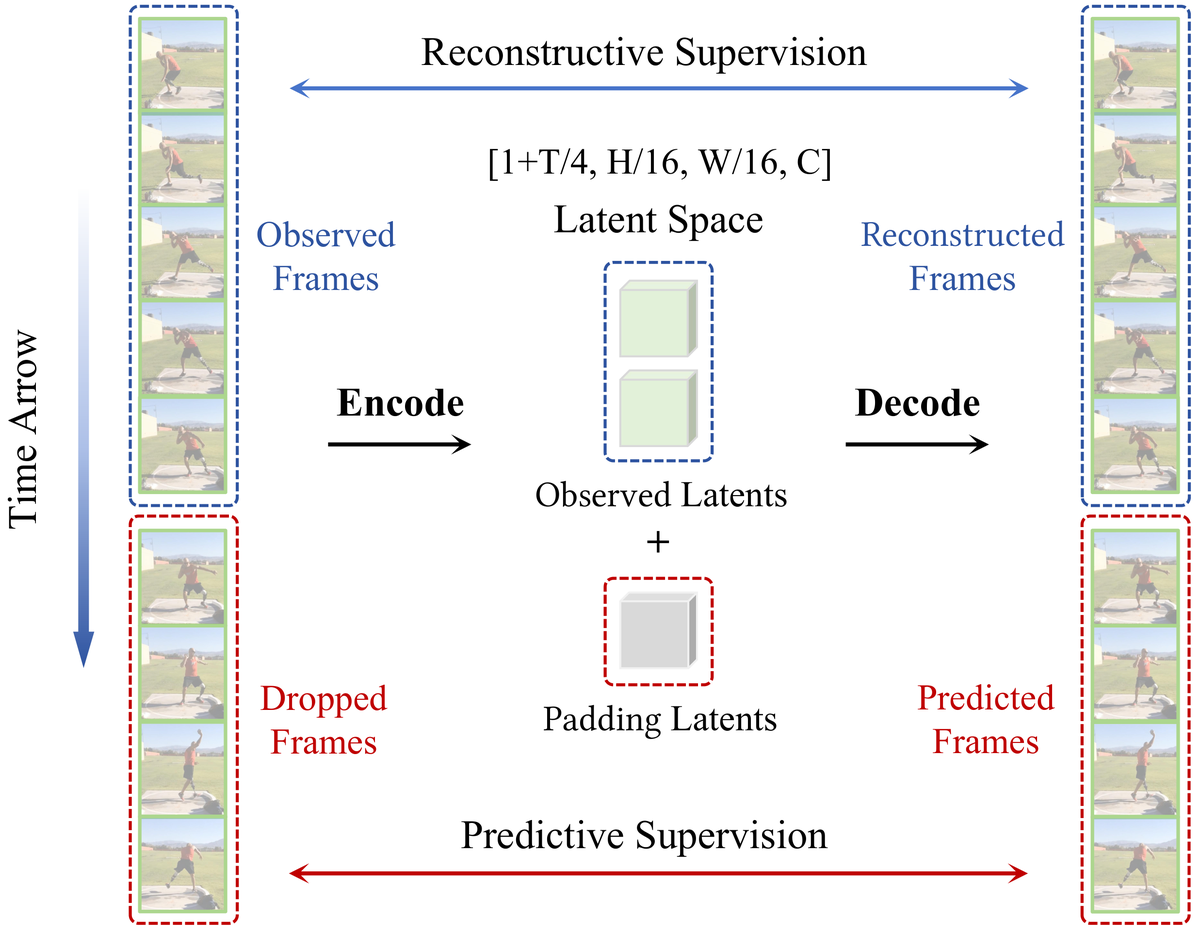
Figure 2 解读:图中上半部分是 reconstructive supervision:observed frames 被 encoder 压到 observed latents,decoder 输出 reconstructed frames;下半部分是 predictive supervision:future frames 在 encoder 输入侧被 dropped,模型只能用 observed latents 加 padding latents 组成完整 latent sequence,再预测 dropped frames。中间的 latent space 形状标为 ,对应 PV-VAE 的 temporal compression 与 spatial compression。这个图的关键是“输入不完整、输出完整”:decoder 在训练时被迫从过去 latent 推断未来内容。
给定视频 clip ,采样 latent 。空间压缩率为 ,时间压缩率为 ,额外的首帧用于统一 image/video 处理。PV-VAE 把视频沿时间切成 个 groups,其中第一个 group 是首帧,后续每组包含 帧。
训练时采样 dropped groups 数:
其中 是 maximum dropping ratio。保留前缀帧:
encoder 得到 observed latents:
由于 decoder 需要完整长度 latent,模型把 与 在时间维拼接。 来自 uninformative prior,可以是 Gaussian,也可以是 learnable tokens;主实验使用 learnable padding。完整 latent 被 decoder 还原为完整视频 。
3.2 Key components
组件 A:Predictive Reconstruction objective。 训练目标把 reconstruction 和 prediction 合成同一个 decoder task:observed part 是标准重建,dropped part 是未来预测。直觉上,这相当于把 video VAE 从“压缩器”转成“带未来外推约束的压缩器”。如果 latent 只记住局部 texture 或静态背景,decoder 无法可靠恢复被遮掉的未来动作;因此优化会推动 encoder 把运动趋势、对象位移、动作阶段等 temporal cues 写进 latent。
组件 B:3D causal convolution VAE architecture。 PV-VAE 使用 3D causal convolutions,latent config 是 t4s16c64。Encoder 先做两阶段 spatiotemporal downsampling,把时间和空间都降 ;之后保持时间长度,再做两次 spatial downsampling,最终空间总降采样 。Decoder 与 encoder 对称:先两阶段 spatial upsampling,再两阶段 spatiotemporal upsampling。
组件 C:Motion-aware objective。 论文认为预测任务容易被静态区域 copy-shortcut 稀释,因此额外要求模型重建 adjacent-frame temporal differences。这个 loss 会弱化静态背景主导的梯度,把优化压力集中到 motion boundary、relative position shift、object deformation 等真正体现 temporal evolution 的区域。
总损失为:
其中 是 temporal difference reconstruction,GAN loss 从 step 5,000 开启,并在 decoder fine-tuning 阶段全程开启。
组件 D:Multi-stage training。 PV-VAE 先在 256/384/512 分辨率 image data 上 pretrain 300K steps;再用 predictive reconstruction 在 256/512 video data 上 train 50K steps;最后 freeze encoder、关闭 random dropping,只 fine-tune decoder 50K steps 做标准 video reconstruction。最后一步解决训练时 decoder 常见 padding latent、推理时 latent 完整输入之间的 gap,并且不破坏已经学到的 latent diffusability。
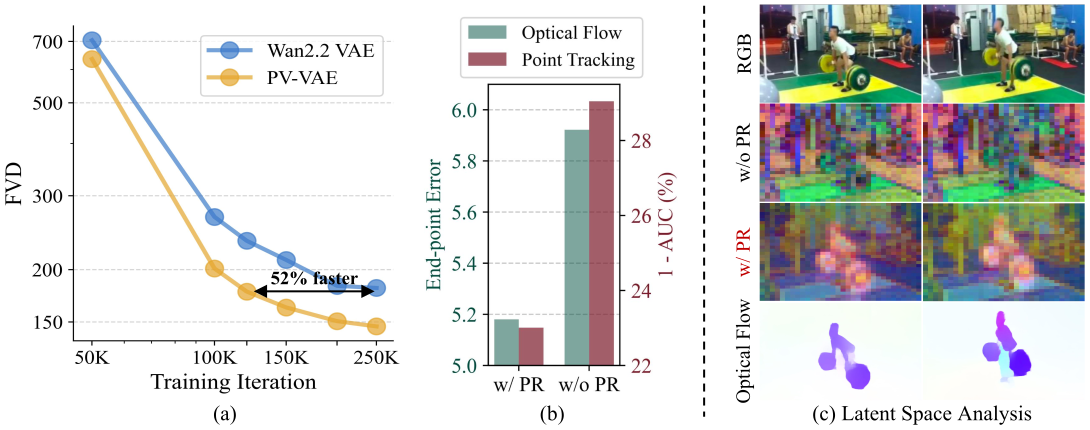
Figure 1 解读:左侧显示 PV-VAE 在 UCF101 上相对 Wan2.2 VAE 获得 52% faster convergence 和 34.42 FVD gain;中间用 optical flow 和 point tracking probing 说明 PR 让 latent 更懂 motion;右侧 latent visualization 与 optical flow 对齐,说明 PV-VAE 的 latent 激活不只是纹理分布,而是跟视频动态结构强相关。
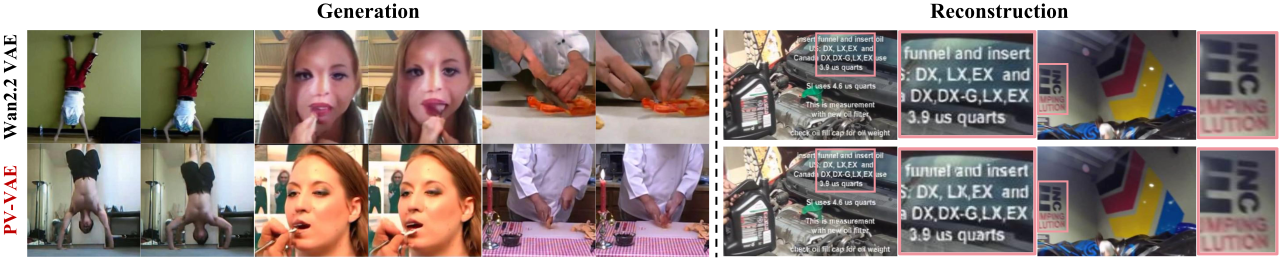
Figure 3 解读:上半部分比较 generation,PV-VAE 相比 Wan2.2 VAE 有更少 motion artifact、更好的 temporal coherence;下半部分比较 reconstruction,PV-VAE 保持可竞争的重建质量,但论文也指出 dense text reconstruction 仍有差距,可能来自 text-heavy samples 不足。
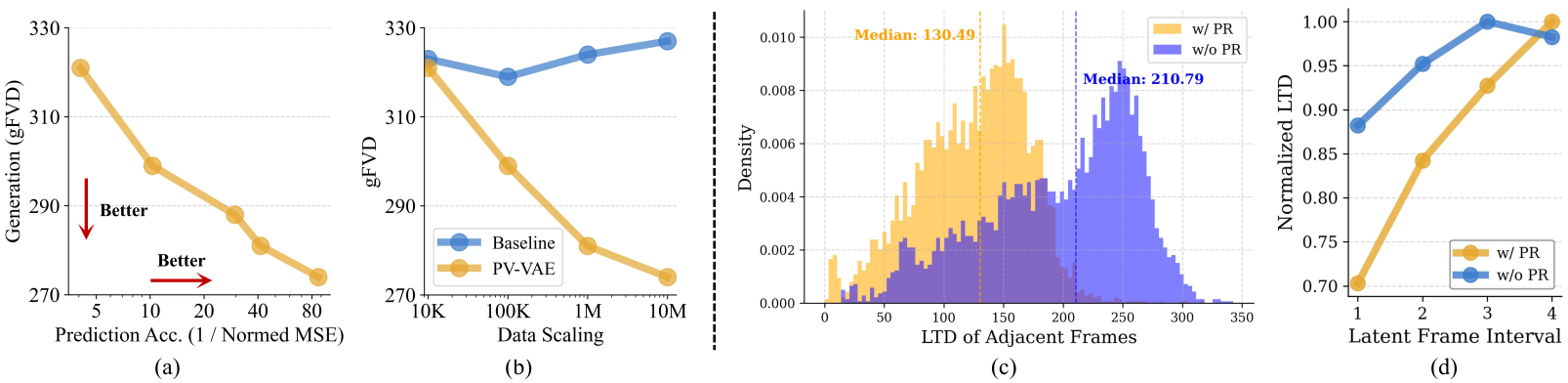
Figure 4 解读:该图沿 latent channel 做 PCA,并把前三个主成分可视化成 RGB。PV-VAE 的高激活区域更贴近 RAFT optical flow 中的运动区域,例如 push-up、long jump、cello hand motion、playing-card arm motion;背景区域噪声更低。这说明 PR 把 representational bandwidth 从静态背景转移到动态前景。
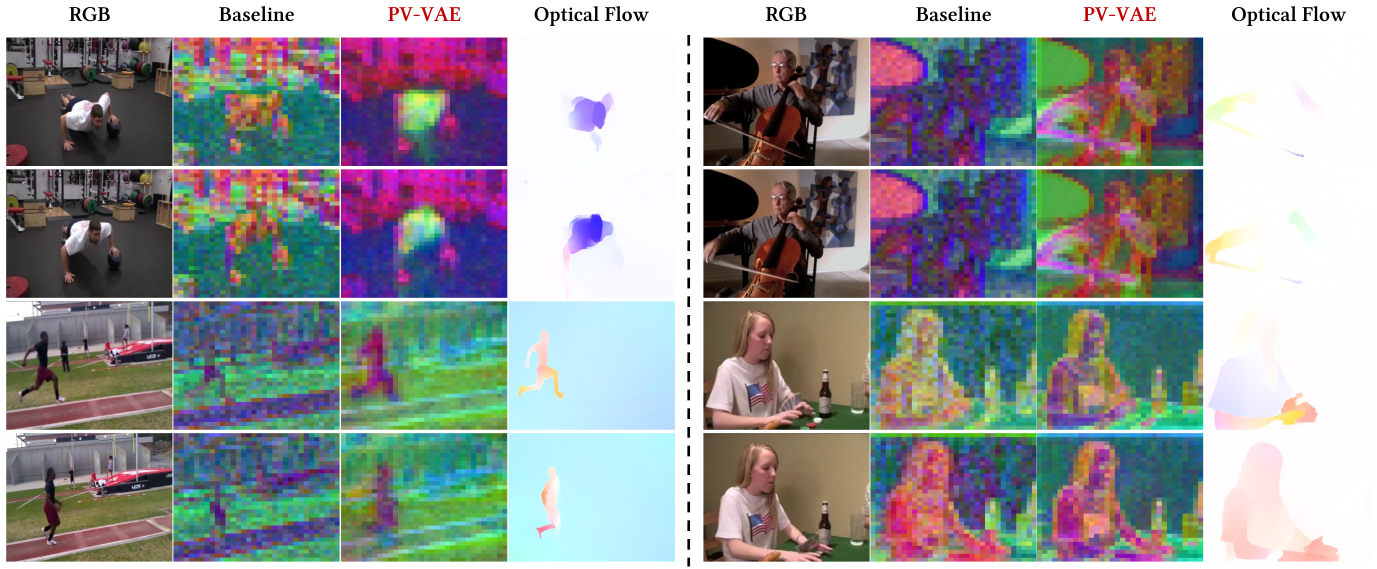
Figure 5 解读:Figure 5(a) 显示 frame prediction accuracy 与 generation performance 相关,支持“更会预测未来的 latent 更适合生成”;Figure 5(b) 显示 PR objective 随数据规模增大持续收益,而 pure reconstruction 没有同样趋势;Figure 5(c) 的 adjacent-frame Latent Temporal Distance 更集中、更低,表示短期更平滑;Figure 5(d) 随 frame interval 增大 LTD 单调增长,说明 latent trajectory 能表达长期 temporal dynamics。
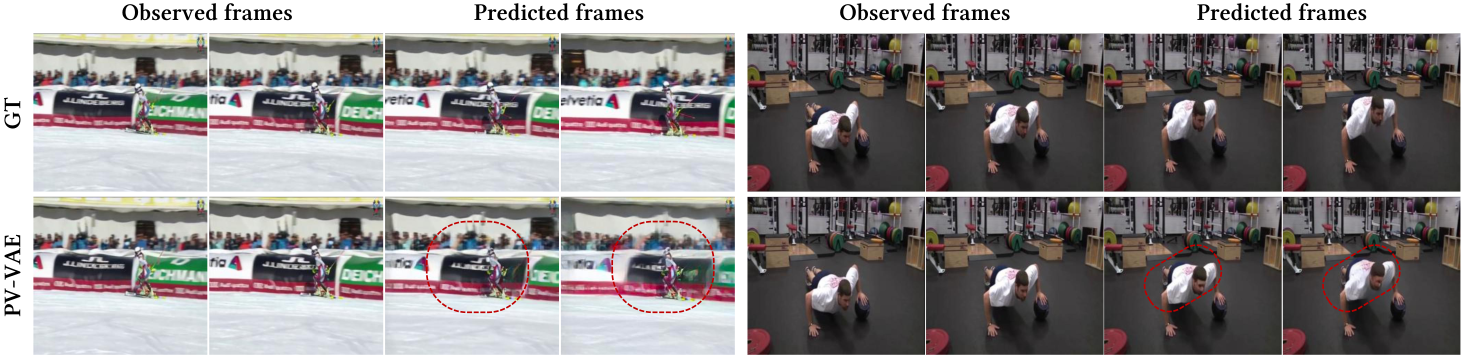
Figure 6 解读:模型只看 observed half,却要生成完整 sequence。图中 PV-VAE 能预测被遮住未来帧的相对位置变化,红色虚线圈标出 object/background 的 relative shift。它不是简单复制最后一帧,而是在 latent 中建模动作进展。
3.3 Paper-level pseudocode
代码搜索未找到官方开源实现;以下伪代码严格按论文的 Algorithmic description、loss 与 training stages 写成,不能视为官方代码复刻。
import torch
import torch.nn.functional as F


def sample_observed_video_groups(video, pt=4, max_drop_ratio=1.0):
    # video: [B, 1 + T, C, H, W], where the first group has 1 frame
    B, total_frames, C, H, W = video.shape
    T = total_frames - 1
    G = 1 + T // pt
    max_k = int((G - 1) * max_drop_ratio)
    k = torch.randint(low=0, high=max_k + 1, size=(1,)).item()
    keep_frames = 1 + (G - k - 1) * pt
    x_obs = video[:, :keep_frames]
    x_drop = video[:, keep_frames:]
    return x_obs, x_drop, k
class PredictiveReconstructionVAE(torch.nn.Module):
def __init__(self, encoder, decoder, latent_shape, padding="learnable"):
super().__init__()
self.encoder = encoder
self.decoder = decoder
self.padding = padding
if padding == "learnable":
self.pad_token = torch.nn.Parameter(torch.zeros(1, 1, *latent_shape))
def pad_latents(self, z_obs, k):
if k == 0:
return z_obs
B = z_obs.shape[0]
if self.padding == "gaussian":
z_pad = torch.randn(B, k, *z_obs.shape[2:], device=z_obs.device, dtype=z_obs.dtype)
else:
z_pad = self.pad_token.expand(B, k, *z_obs.shape[2:])
return torch.cat([z_obs, z_pad], dim=1)
def forward_predictive(self, video, pt=4, max_drop_ratio=1.0):
x_obs, _, k = sample_observed_video_groups(video, pt, max_drop_ratio)
z_obs, posterior_stats = self.encoder(x_obs)
z_full = self.pad_latents(z_obs, k)
recon_full = self.decoder(z_full)
return recon_full, posterior_stats, kdef temporal_difference_loss(pred_video, target_video):
pred_diff = pred_video[:, 1:] - pred_video[:, :-1]
target_diff = target_video[:, 1:] - target_video[:, :-1]
return F.mse_loss(pred_diff, target_diff)
def pv_vae_loss(pred_video, target_video, posterior_stats, perceptual_fn, discriminator=None, step=0,
lambda_rec=1.0, lambda_lpips=1.0, lambda_gan=1.0, lambda_kl=1e-6):
loss_mse = F.mse_loss(pred_video, target_video)
loss_diff = temporal_difference_loss(pred_video, target_video)
loss_lpips = perceptual_fn(pred_video, target_video).mean()
loss_kl = posterior_stats.kl().mean()
if discriminator is not None and step >= 5000:
loss_gan = -discriminator(pred_video).mean()
else:
loss_gan = pred_video.new_tensor(0.0)
return lambda_rec * (loss_mse + loss_diff) + lambda_lpips * loss_lpips + lambda_gan * loss_gan + lambda_kl * loss_kldef train_pv_vae(vae, image_loader, video_loader, optimizer, perceptual_fn, discriminator):
# Stage 1: image pretraining, 300K steps at 256/384/512 resolutions
for step, images in enumerate(image_loader):
pred, stats = vae.forward_standard(images)
loss = pv_vae_loss(pred, images, stats, perceptual_fn, discriminator, step)
loss.backward(); optimizer.step(); optimizer.zero_grad()
if step + 1 == 300_000:
break
# Stage 2: predictive video training, 50K steps at 256/512 resolutions
for step, videos in enumerate(video_loader):
pred, stats, _ = vae.forward_predictive(videos, pt=4, max_drop_ratio=1.0)
loss = pv_vae_loss(pred, videos, stats, perceptual_fn, discriminator, step)
loss.backward(); optimizer.step(); optimizer.zero_grad()
if step + 1 == 50_000:
break
# Stage 3: decoder fine-tuning, freeze encoder and disable dropping, 50K steps
for p in vae.encoder.parameters():
p.requires_grad_(False)
for step, videos in enumerate(video_loader):
with torch.no_grad():
z, stats = vae.encoder(videos)
pred = vae.decoder(z)
loss = pv_vae_loss(pred, videos, stats, perceptual_fn, discriminator, step=5000)
loss.backward(); optimizer.step(); optimizer.zero_grad()
if step + 1 == 50_000:
break3.4 Code-to-paper mapping
Code reference: 代码搜索未找到官方开源实现;已检查论文 Project Page
https://zhao-yian.github.io/PVVAE/(页面标注 Code unavailable,原因是 confidentiality constraints)、arXiv source、GitHub repository search("Video Generation with Predictive Latents"、"PV-VAE" "Predictive Video VAE"、"PVVAE" "zhao-yian"),截至 2026-05-06 未找到可锚定的 public repo,因此不设置github_ref。
| Paper Concept | Source File | Key Class/Function |
|---|---|---|
| Predictive Reconstruction | 未开源 | 论文 §3.1;上方 sample_observed_video_groups / forward_predictive 为 paper-level pseudocode |
| Motion-aware Objective | 未开源 | 论文 §3.2;上方 temporal_difference_loss 对应 |
| Multi-stage Training | 未开源 | 论文 §3.2;上方 train_pv_vae 对应 image pretrain / video PR training / decoder fine-tuning |
| Latte generation evaluation | 未开源 | 论文 §4.1;仅说明移除 patchify downsampling、rectified flow 250K steps |
4. Experimental Setup (实验设置)
Datasets and scale. Generation 使用 UCF101 做 class-conditional generation,RealEstate10K 做 unconditional generation;所有训练和测试视频转换为 17-frame、 clips。Generation metrics 在 2,048 generated samples 上计算。Reconstruction 使用 Kinetics-400 validation 中随机采样的 2,048 videos,取每个视频前 17 frames,并在 与 两个分辨率评测。Latent Temporal Distance 使用 1,000 Kinetics-400 validation videos。Probing tasks 使用 Sintel(optical flow)、Kinetics-400(next-frame prediction)、TAP-Vid-DAVIS(30 videos with query points and trajectories)。
Baselines. Generation/reconstruction 主要比较 CogVideoX VAE (CogX-VAE)、IV-VAE、WF-VAE-L、HunyuanVideo VAE、Wan2.1 VAE、Wan2.2 VAE、SSVAE。Ablation 比较 Baseline、+ Predictive Reconstruction、+ Motion-aware Objective、+ Decoder Fine-tuning。Architecture discussion 中额外比较 CNN-based PV-VAE 与 Transformer-based PV-VAE♣。
Evaluation metrics. FVD / KVD 衡量 generated video distribution 与真实视频分布距离,越低越好;IS 用 C3D model 评估 UCF101 class-conditional generation 的可辨识性和多样性,越高越好;rFVD 是 reconstruction setting 下的 FVD;PSNR/SSIM 衡量像素级重建质量,越高越好;LPIPS 衡量 perceptual distance,越低越好;EPE 是 optical flow endpoint error,越低越好;MSE 是 next-frame prediction error,越低越好;AUC 是 point tracking 在 0–10 pixels threshold 下的 tracking accuracy area,越高越好;LTD 是 latent temporal distance,用 latent 的平均 L2 distance 衡量时间连续性。
Training config. PV-VAE 使用 AdamW,base learning rate ,linear warmup,cosine schedule 中学习率衰减 10 倍;random dropping 固定保留首帧,maximum dropping ratio 。VAE image pretraining 300K steps,video predictive training 50K steps,decoder fine-tuning 50K steps。Generation model 使用 Latte architecture,移除 patchify downsampling,rectified flow 训练 250K steps,learning rate ,global batch size 64,Euler sampler 100 steps。速度/显存指标在 17-frame clips、batch size 4 下测量,100 steps 平均,前 50 warm-up steps。论文正文未详细说明 GPU 型号/数量;项目页版本的 snippet 提到实验使用 16 NVIDIA H800 GPUs,速度显存用 single NVIDIA H20 GPU 测量,但 arXiv PDF 正文未保留该句,因此这里以 PDF 为准标记为“论文未详细说明”。
5. Experimental Results (实验结果)
Main generation results (Table 1, 17-frame ).
| Method | Latent config | UCF101 FVD↓ | UCF101 KVD↓ | UCF101 IS↑ | RealEstate10K FVD↓ | RealEstate10K KVD↓ | TSpeed it/s | TMem GiB | Param M |
|---|---|---|---|---|---|---|---|---|---|
| CogX-VAE | t4s8c16 | 176.90 | 16.47 | 64.19 | 94.12 | 10.41 | 0.76 | 85.93 | 216 |
| IV-VAE | t4s8c16 | 175.74 | 22.32 | 64.51 | 92.37 | 8.35 | 1.28 | 88.34 | 242 |
| WF-VAE-L | t4s8c16 | 188.19 | 33.01 | 67.49 | 107.26 | 12.56 | 2.52 | 87.36 | 317 |
| Hunyuan-VAE | t4s8c16 | 210.30 | 52.81 | 66.40 | 83.45 | 13.23 | 1.64 | 87.36 | 246 |
| Wan2.1 VAE | t4s8c16 | 167.10 | 11.54 | 66.04 | 83.84 | 10.64 | 1.88 | 86.44 | 127 |
| Wan2.2 VAE | t4s16c48 | 180.79 | 17.80 | 67.32 | 87.15 | 10.11 | 4.96 | 30.90 | 705 |
| SSVAE | t4s16c48 | 168.68 | 19.71 | 66.39 | 79.08 | 8.79 | 3.92 | 34.00 | 315 |
| PV-VAE | t4s16c64 | 146.37 | 14.52 | 69.72 | 72.50 | 4.06 | 4.40 | 33.34 | 661 |
PV-VAE 在 UCF101 FVD 上比 Wan2.2 VAE 低 34.42,比 SSVAE 低 22.31;比 Hunyuan-VAE 低 63.93,同时 training speed 提升到 4.40 it/s(相对 Hunyuan-VAE 2.68×),TMem 从 87.36 GiB 降到 33.34 GiB。RealEstate10K 上 PV-VAE 也取得最低 FVD 72.50 和最低 KVD 4.06。
Reconstruction results (Table 2, Kinetics-400 validation).
| Method | 17×256 rFVD↓ | PSNR↑ | SSIM↑ | LPIPS↓ | 17×512 rFVD↓ | PSNR↑ | SSIM↑ | LPIPS↓ | ISpeed it/s | IMem GiB |
|---|---|---|---|---|---|---|---|---|---|---|
| CogX-VAE | 4.90 | 33.78 | 0.97 | 0.027 | 1.79 | 36.00 | 0.99 | 0.024 | 0.46 | 13.64 |
| IV-VAE | 2.78 | 34.08 | 0.96 | 0.019 | 0.97 | 37.24 | 0.96 | 0.016 | 0.32 | 5.39 |
| WF-VAE-L | 3.06 | 33.48 | 0.96 | 0.023 | 1.08 | 35.93 | 0.96 | 0.023 | 0.87 | 5.00 |
| Hunyuan-VAE | 2.96 | 34.30 | 0.97 | 0.016 | 0.90 | 37.13 | 0.97 | 0.015 | 0.50 | 22.00 |
| Wan2.1 VAE | 2.92 | 33.21 | 0.95 | 0.018 | 1.02 | 36.15 | 0.97 | 0.017 | 0.60 | 6.77 |
| Wan2.2 VAE | 3.42 | 33.78 | 0.96 | 0.015 | 1.22 | 36.75 | 0.97 | 0.015 | 0.58 | 9.36 |
| SSVAE | 7.50 | 31.18 | 0.96 | 0.036 | 2.16 | 34.45 | 0.97 | 0.028 | 0.64 | 7.63 |
| PV-VAE | 3.45 | 32.26 | 0.95 | 0.020 | 1.88 | 35.03 | 0.97 | 0.020 | 0.69 | 7.97 |
Reconstruction 不是 PV-VAE 的单点最优:它在 256 rFVD 上接近 Wan2.2 VAE(3.45 vs. 3.42),但 PSNR/LPIPS 略低;相比 SSVAE 则稳定更好。论文强调这正说明 generation-ready latent 不等于 reconstruction-optimal latent。
Latent/video understanding probing (Table 3).
| Method | EPE↓ | MSE↓ | AUC(%)↑ |
|---|---|---|---|
| w/o PR | 5.9223 | 0.0314 | 70.95 |
| w/ PR | 5.1805 (+12.5%) | 0.0289 (+8.0%) | 76.99 (+8.5%) |
第 14 层(共 28 层)LVDM diffusion features 用于 optical flow、next-frame prediction、point tracking 三个 probe。PV-VAE 在三项任务均提升,说明 PR 改善的不是单纯的 FVD trick,而是 latent 中的 video dynamics representation。
Ablation results (Tables 4–6).
| Configuration | gFVD↓ | rFVD↓ | PSNR↑ | SSIM↑ | LPIPS↓ |
|---|---|---|---|---|---|
| Baseline | 174.81 | 3.03 | 33.44 | 0.96 | 0.017 |
| + Predictive Reconstruction | 156.33 | 5.66 | 31.47 | 0.94 | 0.026 |
| + Motion-aware Objective | 150.10 | 5.79 | 31.38 | 0.94 | 0.026 |
| + Decoder Fine-tuning | 146.37 | 3.45 | 32.26 | 0.95 | 0.020 |
PR 直接把 gFVD 从 174.81 降到 156.33,但牺牲 reconstruction;motion-aware objective 继续把 gFVD 降到 150.10;decoder fine-tuning 把 rFVD 从 5.79 拉回 3.45,并进一步把 gFVD 降到 146.37。
| MDR | gFVD↓ | KVD↓ | IS↑ |
|---|---|---|---|
| 50% | 159.82 | 14.67 | 69.35 |
| 75% | 154.06 | 16.93 | 70.27 |
| 100% | 146.37 | 14.52 | 69.72 |
更大的 maximum dropping ratio 带来更强 predictive regularization,UCF101 gFVD 最优出现在 100%。
| Padding | gFVD↓ | KVD↓ | IS↑ |
|---|---|---|---|
| Gaussian | 150.68 | 11.87 | 68.01 |
| Learnable | 146.37 | 14.52 | 69.72 |
Learnable padding 在 gFVD/IS 上更好,但 Gaussian padding 的 KVD 更低;主结果选择 learnable padding。
Transformer VAE discussion (Table 7).
| Model | UCF101 gFVD↓ | KVD↓ | IS↑ | Kinetics rFVD↓ | PSNR↑ | SSIM↑ | LPIPS↓ | ISpeed it/s |
|---|---|---|---|---|---|---|---|---|
| PV-VAE | 146.37 | 14.52 | 69.72 | 3.45 | 32.26 | 0.95 | 0.020 | 0.69 |
| PV-VAE♣ | 178.86 | 20.66 | 69.80 | 4.03 | 33.02 | 0.95 | 0.022 | 1.29 |
Transformer-based variant 有 12-layer encoder、12-layer decoder、16 heads、128 head_dim、约 1.2B parameters,推理速度 1.29 it/s,比 CNN PV-VAE 快 87%,但 generative capability 仍明显弱于 CNN 版本(gFVD 178.86 vs. 146.37)。作者把它作为未来方向,而非当前最佳设计。
Limitations. 作者明确提到 PV-VAE 在 dense text reconstruction 上有 subtle limitations,可能因为当前数据分布中 text-heavy samples 较少;另外 Transformer-based video VAE 虽然更快,但 generation gap 仍大。论文也暗示 reconstruction/generation trade-off 仍是 tokenizer 设计核心矛盾:高维丰富 latent 有利于细节,但如果没有结构化先验,会使生成更困难。
Overall conclusion. PV-VAE 证明 video VAE 的目标不应只追求 reconstruction fidelity,而应让 latent 学到 temporal predictive structure。Predictive Reconstruction、motion-aware objective 和 decoder fine-tuning 组合后,模型在 UCF101 / RealEstate10K generation 上显著优于现有 Video VAEs,并在多项 video understanding probes 中展现更强 motion-aware representation。