Self-Forcing++: Towards Minute-Scale High-Quality Video Generation
Authors: Justin Cui, Jie Wu, Ming Li, Tao Yang, Xiaojie Li, Rui Wang, Andrew Bai, Yuanhao Ban, Cho-Jui Hsieh Affiliations: UCLA, ByteDance Seed, University of Central Florida GitHub: guandeh17/Self-Forcing
1. Motivation (研究动机)
现有自回归长视频生成方法面临两层 train-inference mismatch,导致超出训练时长后质量急剧下降:
- Temporal mismatch(时间维度不对齐):训练时 student 只生成 ≤5 秒的短片(teacher 的最大能力),推理时需要生成远超 5 秒的长视频。Self-Forcing 虽然部分缓解了 CausVid 的 over-exposure 问题,但仍然被 teacher 的 5 秒极限所束缚
- Supervision mismatch(监督维度不对齐):训练时 teacher 对每一帧都提供密集监督,student 几乎不接触误差;推理时 student 必须在自身不完美的输出上持续 rollout,误差不断复合。表现为 motion stagnation(运动停滞)、scene freezing(场景冻结)、catastrophic fidelity loss(质量崩溃)
- 关键观察:虽然长 rollout 质量退化,但视频往往保留了结构连贯性——错误主要是可恢复的退化(如运动停滞、曝光异常),而非结构崩溃。这说明自回归机制本身没坏,teacher 具有从退化视频中纠正错误的能力
此外,论文发现 VBench 评估长视频存在 bias——它倾向于给 over-exposed 和退化的帧更高的 Image Quality 和 Aesthetic 分数,导致评估不可靠。
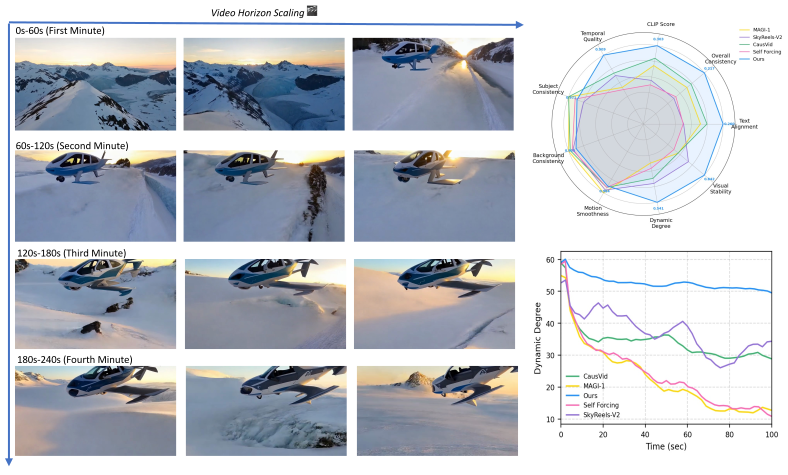
Figure 1 解读:左侧展示 Self-Forcing++ 生成的 4 分钟视频截帧(每分钟一组),画面在整个 4 分钟内保持高质量和动态运动。右上角雷达图对比各方法在 CLIP Score、Temporal Quality、Overall Consistency 等维度的表现——Self-Forcing++ 全面领先。右下角动态度曲线显示其他方法(CausVid、MAGI-1、SkyReels-V2、Self-Forcing)的 Dynamic Degree 在 20-40 秒后急剧下降(运动停滞),而 Self-Forcing++ 在 100 秒内始终保持高动态度。
2. Idea (核心思想)
Self-Forcing++ 的核心 insight:短时长 teacher 虽然不能直接生成长视频,但它拥有从退化视频中纠正错误的知识——利用这种纠错能力来训练 student 应对长 rollout 中的误差累积。
具体做法极其简洁(三个组件):
- Backward Noise Initialization:不从随机噪声起步,而是将 student 自身 rollout 的退化输出重新加噪作为起点,确保 DMD 训练的 trajectory 保留了历史上下文
- Extended DMD:将 DMD 的监督范围从固定 5 秒窗口扩展到 student rollout 的任意位置——在 的长 rollout 中均匀采样窗口进行蒸馏
- GRPO with Optical Flow Reward:用光流幅度作为 reward 信号,通过 Group Relative Policy Optimization 微调 student,抑制滑动窗口带来的突变和运动不连续
与 LongLive 等方法的根本区别:不需要 attention sink、frame sink 或特殊的 KV cache 管理,只需简单地扩展训练时的 rollout 长度和 DMD 采样范围。
3. Method (方法)
3.1 整体框架
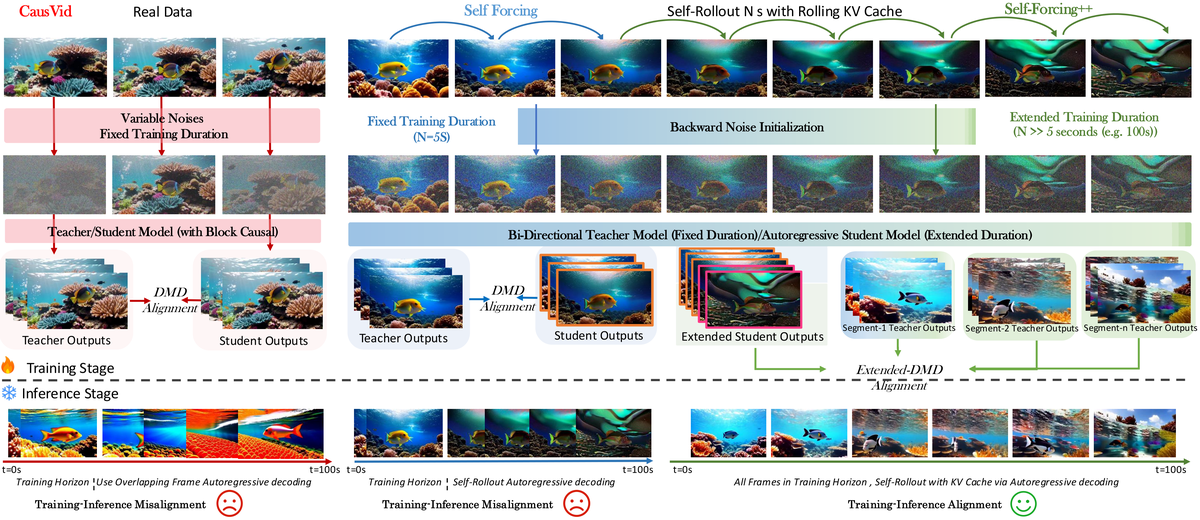
Figure 2 解读:对比三种方法的训练流程。左(CausVid):用真实数据训练,固定训练时长,推理时用 overlapping frame 做自回归解码——存在严重的 train-inference mismatch。中(Self-Forcing):student self-rollout + backward noise initialization,但 DMD 监督仍限制在固定 5 秒窗口内,推理超出 5 秒后质量崩溃。右(Self-Forcing++,本文):student self-rollout 到 (如 100 秒),用 rolling KV cache 保持上下文,然后在长 rollout 的任意位置均匀采样 帧窗口进行 Extended DMD。底部时间线:CausVid 和 Self-Forcing 都存在 mismatch(红色叉),Self-Forcing++ 实现了完全的 train-inference alignment(绿色勾)。
Self-Forcing++ 基于 Wan2.1-T2V-1.3B,通过三步训练:
- Stage 0 (Init):ODE 初始化 + Self-Forcing 短视频蒸馏(继承 Self-Forcing 基线)
- Stage 1 (Extended DMD):长 rollout + Backward Noise Init + Extended DMD 扩展训练
- Stage 2 (GRPO, 可选):用光流 reward 微调,提升长程平滑性
3.2 Backward Noise Initialization
短视频蒸馏中,student 从随机噪声 起步预测 ,teacher 直接在同一噪声上提供监督。但长视频中,每个新 chunk 的起始状态不是随机噪声,而是前一个 chunk 的自回归延续。如果训练时从随机噪声起步,就割裂了与历史上下文的依赖关系。
解决方案:将 student 自身 rollout 的干净输出 按 diffusion noise schedule 重新加噪:
这保证了:(a) 噪声 trajectory 保留了 student 的历史生成轨迹,(b) teacher 评估的是在正确上下文下的分布差异。
def backward_noise_initialization(student_clean_frames, noise_schedule, noise):
    """Re-inject noise into student's clean rollout to create training trajectories."""
    # student_clean_frames: (N, C, H, W) - student's self-generated clean frames
    # noise_schedule: {sigma_t} for each diffusion timestep
    # noise: epsilon ~ N(0, I)

    x_t = {}
    for t in noise_schedule.timesteps:
        sigma_t = noise_schedule.sigma(t)
        # Linear interpolation between clean frame and noise
        x_t[t] = (1 - sigma_t) * student_clean_frames + sigma_t * noise

    return x_t  # noisy trajectories for DMD training
3.3 Extended Distribution Matching Distillation
Self-Forcing 将 DMD 限制在前 帧(≤5 秒)。Self-Forcing++ 将 student rollout 扩展到 帧,然后均匀采样窗口位置进行蒸馏:
其中 从 student 长 rollout 的 中均匀采样, 是 teacher 能可靠监督的窗口大小(通常 )。
核心 insight:teacher 虽然只能生成 5 秒视频,但它在海量训练数据上学到了视频的分布。任何 5 秒片段都可以视为长视频边缘分布的一个样本。因此 teacher 可以在 student 长 rollout 的任意位置提供可靠监督。
def extended_dmd_training_step(student, teacher, cache_size, rollout_length, window_size):
    """One training step of Self-Forcing++ with extended DMD."""
    # Step 1: Student self-rollout to N >> T frames with rolling KV cache
    V = student.rollout(length=rollout_length, cache_size=cache_size)  # N clean frames

    # Step 2: Uniformly sample a window position from the long rollout
    i = random.randint(0, rollout_length - window_size)  # uniform sampling
    W = V[i : i + window_size]  # K-frame window

    # Step 3: Backward noise initialization on the sampled window
    t = sample_timestep(noise_schedule)
    x_t = backward_noise_init(W, t)  # re-inject noise

    # Step 4: Compute DMD loss (student vs teacher distributions)
    L_DMD = dmd_loss(
        student_output=student(x_t, t),
        teacher_output=teacher(x_t, t),
    )

    # Step 5: Update student
    L_DMD.backward()
    optimizer.step()
源码参考:推理代码与 Self-Forcing 相同。训练代码尚未发布。
Rolling KV Cache:训练时使用与推理完全相同的 rolling KV cache——student rollout 时维护固定大小的 cache,每生成一个 chunk 就更新 cache。不需要 CausVid 的 overlapping frame 重计算,也不需要 Self-Forcing 的 latent frame masking。
3.4 Improving Long-Term Smoothness via GRPO
滑动窗口 + sparse attention 可能导致窗口边界处的突变(abrupt scene transitions)。Self-Forcing++ 使用 Group Relative Policy Optimization (GRPO) 进行后处理微调:
- Reward: 光流幅度(optical flow magnitude)作为 temporal smoothness 的代理指标
- Policy: student 生成器 ,其 log probability 通过 diffusion noise prediction 计算
- Importance weight:
def grpo_update(student, student_old, generated_video):
    """GRPO fine-tuning with optical flow reward."""
    # Compute optical flow reward between consecutive frames
    R = optical_flow_reward(generated_video)  # scalar reward

    # Compute importance weights (policy ratio)
    for t, i in all_timesteps_and_frames:
        rho = student.log_prob(a_t_i, s_t_i) / student_old.log_prob(a_t_i, s_t_i)

    # GRPO objective (clipped policy gradient)
    L_GRPO = -E[min(rho * advantage, clip(rho, 1-eps, 1+eps) * advantage)]

    L_GRPO.backward()
    optimizer.step()
3.5 Visual Stability 评估指标

Figure 3 解读:左图展示 VBench 的 Image Quality 偏差——退化的后期帧(77.13 分)反而比正常早期帧(69.03 分)得分更高。右图展示 Aesthetic Quality 偏差——over-exposed 帧(64.01 分)比正常曝光帧(50.88 分)得分更高。这说明 VBench 对长视频评估不可靠。Self-Forcing++ 提出 Visual Stability 指标:使用 Gemini-2.5-Pro 评估 over-exposure 和 error accumulation,输出 0-100 分。
3.6 Training Budget Scaling
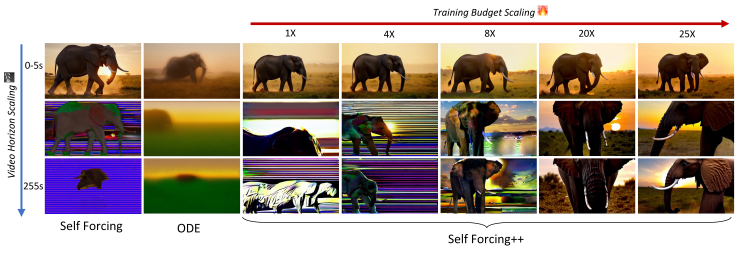
Figure 6 解读:横轴为训练预算(1x-25x),纵轴为视频时长(0-255 秒)。左列(Self-Forcing 和 ODE 初始化)只能生成低质量短片。随着训练预算增加,Self-Forcing++ 的视频质量和可达时长同步提升:4x 时保持语义一致性,8x 时生成详细背景,20x 时生产高保真 50+ 秒视频,25x 时生成 255 秒视频且质量损失极小。这是首次展示训练计算可以直接兑换为视频时长的 scaling property。
3.7 代码-论文映射
| 论文概念 | 源码/参考 | 说明 |
|---|---|---|
| ODE 初始化 | Self-Forcing | 继承 Self-Forcing 的初始化流程 |
| Self-Forcing 基线训练 | Self-Forcing | DMD + rolling KV cache |
| Backward Noise Init | 论文 Eq. 1, Algorithm 1 line 5 | 对 student rollout 重新加噪 |
| Extended DMD | 论文 Eq. 2, Algorithm 1 lines 3-6 | 均匀采样长 rollout 中的窗口 |
| Rolling KV Cache | 推理代码同 Self-Forcing | 训练和推理完全一致 |
| GRPO + 光流 reward | 论文 Section 3.3, Algorithm 1 line 9 | 可选的后处理微调 |
| Visual Stability 指标 | 论文 Section 3.4 | Gemini-2.5-Pro 评估 |
4. Experimental Setup (实验设置)
- 基础模型: Wan2.1-T2V-1.3B(16 FPS,832×480)
- 训练流程: ODE Init → Self-Forcing → Self-Forcing++(Extended DMD)→ GRPO(可选)
- Rollout 长度: 帧,从 50s 扩展到 100s(论文实验),scaling 到 255s(4min15s)
- Window 大小: (teacher 的 5 秒窗口)
- 吞吐量: 17.0 FPS(与 Self-Forcing 相同,推理代码不变)
- Baselines: NOVA (0.6B), Pyramid Flow (2B), MAGI-1 (4.5B), SkyReels-V2 (1.3B), CausVid (1.3B), Self-Forcing (1.3B), LTX-Video (1.9B), Wan2.1 (1.3B)
- 评估设置:
- 短视频: VBench 标准 946 prompts × 16 dimensions
- 长视频: 128 prompts(MovieGen),50s/75s/100s 三个时长
- 指标: Text Alignment, Temporal Quality, Dynamic Degree, Visual Stability (新), Framewise Quality
- 训练预算: 1x = 生成 5s 视频所需的计算量;论文测试 1x-25x
5. Experimental Results (实验结果)
短视频(5s, VBench)
| Model | Params | FPS↑ | Total↑ | Quality↑ | Semantic↑ |
|---|---|---|---|---|---|
| LTX-Video | 1.9B | 8.98 | 80.00 | 82.30 | 70.79 |
| Wan2.1 | 1.3B | 0.78 | 84.67 | 85.69 | 80.60 |
| NOVA | 0.6B | 0.88 | 80.12 | 80.39 | 79.05 |
| Pyramid Flow | 2B | 6.7 | 81.72 | 84.74 | 69.62 |
| CausVid | 1.3B | 17.0 | 82.46 | 83.61 | 77.84 |
| Self-Forcing | 1.3B | 17.0 | 83.00 | 83.71 | 80.14 |
| Self-Forcing++ | 1.3B | 17.0 | 83.11 | 83.79 | 80.37 |
- 短视频上 Self-Forcing++ 与 Self-Forcing 持平(83.11 vs 83.00),说明长视频训练不损害短视频质量
长视频(50s/75s/100s)
50s:
| Model | Text Align↑ | Temporal Quality↑ | Dynamic Degree↑ | Visual Stability↑ | Framewise Quality |
|---|---|---|---|---|---|
| CausVid | 25.25 | 89.34 | 37.35 | 40.47 | 61.56 |
| Self-Forcing | 24.77 | 88.17 | 34.35 | 40.12 | 61.06 |
| SkyReels-V2 | 23.73 | 88.78 | 39.15 | 51.25 | 54.13 |
| MAGI-1 | 26.04 | 88.34 | 28.49 | 51.25 | 54.20 |
| Ours | 26.37 | 91.03 | 55.36 | 90.94 | 60.82 |
75s:
| Model | Text Align↑ | Temporal Quality↑ | Dynamic Degree↑ | Visual Stability↑ | Framewise Quality |
|---|---|---|---|---|---|
| NOVA | 23.37 | 86.32 | 31.24 | 34.06 | 31.53 |
| MAGI-1 | 24.95 | 87.89 | 24.82 | 43.28 | 52.04 |
| SkyReels-V2 | 22.70 | 88.99 | 39.89 | 55.47 | 51.55 |
| CausVid | 24.76 | 89.14 | 35.82 | 39.84 | 60.96 |
| Self-Forcing | 23.39 | 87.79 | 29.15 | 35.00 | 60.02 |
| Ours | 26.31 | 91.00 | 55.62 | 86.10 | 60.67 |
100s:
| Model | Text Align↑ | Temporal Quality↑ | Dynamic Degree↑ | Visual Stability↑ | Framewise Quality |
|---|---|---|---|---|---|
| CausVid | 24.41 | 89.06 | 34.60 | 39.21 | 61.01 |
| Self-Forcing | 22.00 | 87.39 | 26.41 | 32.03 | 58.25 |
| SkyReels-V2 | 22.05 | 88.80 | 38.75 | 56.72 | 50.48 |
| Ours | 26.04 | 90.87 | 54.12 | 84.22 | 60.66 |
关键发现:
- Dynamic Degree:Self-Forcing++ 在 100s 时仍达 54.12,而 Self-Forcing 仅 26.41(运动停滞),CausVid 34.60
- Visual Stability: 90.94(50s)和 84.22(100s),远超所有 baselines(最高 56.72)
- Text Alignment: 100s 时 26.04,超越 CausVid(+6.67%)和 Self-Forcing(+18.36%)
消融实验
Attention Window Size(Table 3, Visual Stability on 50s):
| CausVid | Self-Forcing | Attn-15 | Attn-12 | Attn-9 | Ours |
|---|---|---|---|---|---|
| 40.47 | 40.12 | 44.69 | 42.19 | 52.50 | 90.94 |
- 缩小 attention window(Attn-9)有一定帮助(52.50 vs 40.12),但远不如 Self-Forcing++(90.94)
- Extended DMD 是主要贡献,window 大小只是辅助手段
GRPO 效果(Figure 5):
- 无 GRPO:光流曲线存在尖锐峰值(窗口边界处的突变),variance≈24.52(Figure 5 中标注)
- 有 GRPO:光流曲线平滑,variance≈20.82(Figure 5 中标注),峰值被有效抑制
Training Budget Scaling:
- 1x:只能生成低质量短片
- 4x:保持语义一致性
- 8x:详细背景 + 准确主体
- 20x:50+ 秒高保真视频
- 25x:255 秒(4min15s)视频,利用了 99.9% 的 position embedding 容量