SANA-WM: Efficient Minute-Scale World Modeling with Hybrid Linear Diffusion Transformer
Paper: arXiv:2605.15178v1 Code: NVlabs/Sana Code reference:
main@1bfb9352(2026-04-14)
1. Motivation (研究动机)
SANA-WM 研究的是 camera-controlled world modeling:给定首帧、文本和连续 6-DoF 相机轨迹,生成 1 分钟、720p、遵循相机运动且保持场景身份的视频。现有开放世界模型已经能做分钟级 rollout,但通常依赖更大的模型、更多数据、更长训练和多 GPU 推理;短视频生成器蒸馏又缺少长时场景保持与轨迹遵循监督。
本文的核心问题是:能否在数据、训练、推理成本都可接受的条件下,原生训练一个高保真、相机可控、分钟级 720p world model?SANA-WM 的答案是把长上下文建模、相机条件、数据标注和视觉 refinement 全部按效率约束重新设计。
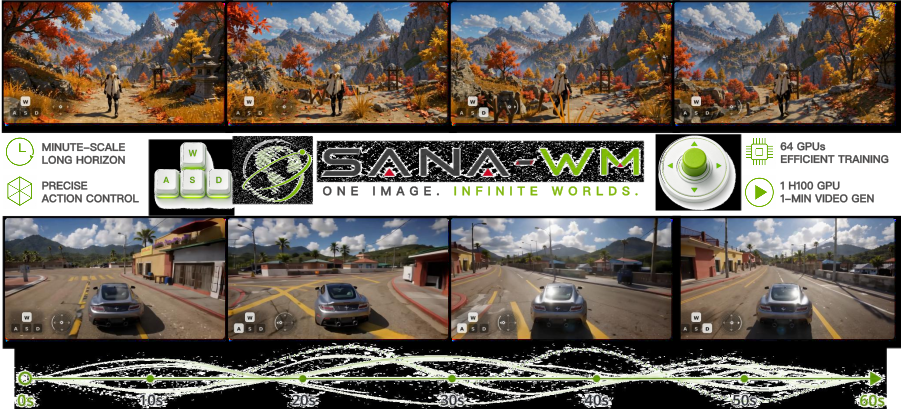
Figure 1 解读:从一个初始图像和相机 action trajectory 出发,SANA-WM 生成分钟级 720p world rollout;论文强调 64-GPU 训练与单 GPU 推理,使它区别于多 GPU 工业闭源基线。
2. Idea (核心思想)
SANA-WM 的关键不是单纯扩大 DiT,而是把 长时序状态压缩 与 周期性精确回忆 结合:大多数 block 用 frame-wise Gated DeltaNet 递推地携带上下文,少数 block 插入 softmax attention 锚定长程空间一致性;同时用双分支相机控制把 6-DoF 轨迹分别注入 latent frame rate 与 raw frame rate。最终用第二阶段 long-video refiner 修补第一阶段在细节、结构和时间一致性上的退化。
整体 pipeline 可以理解为:先把公开视频重新标注为带 metric-scale pose 的长视频训练集,再用 LTX2 VAE + Hybrid Linear DiT 训练 stage-1 world model;推理时先用便宜的 stage-1 搜索轨迹和初稿,再对有价值结果进行 long-video refinement。
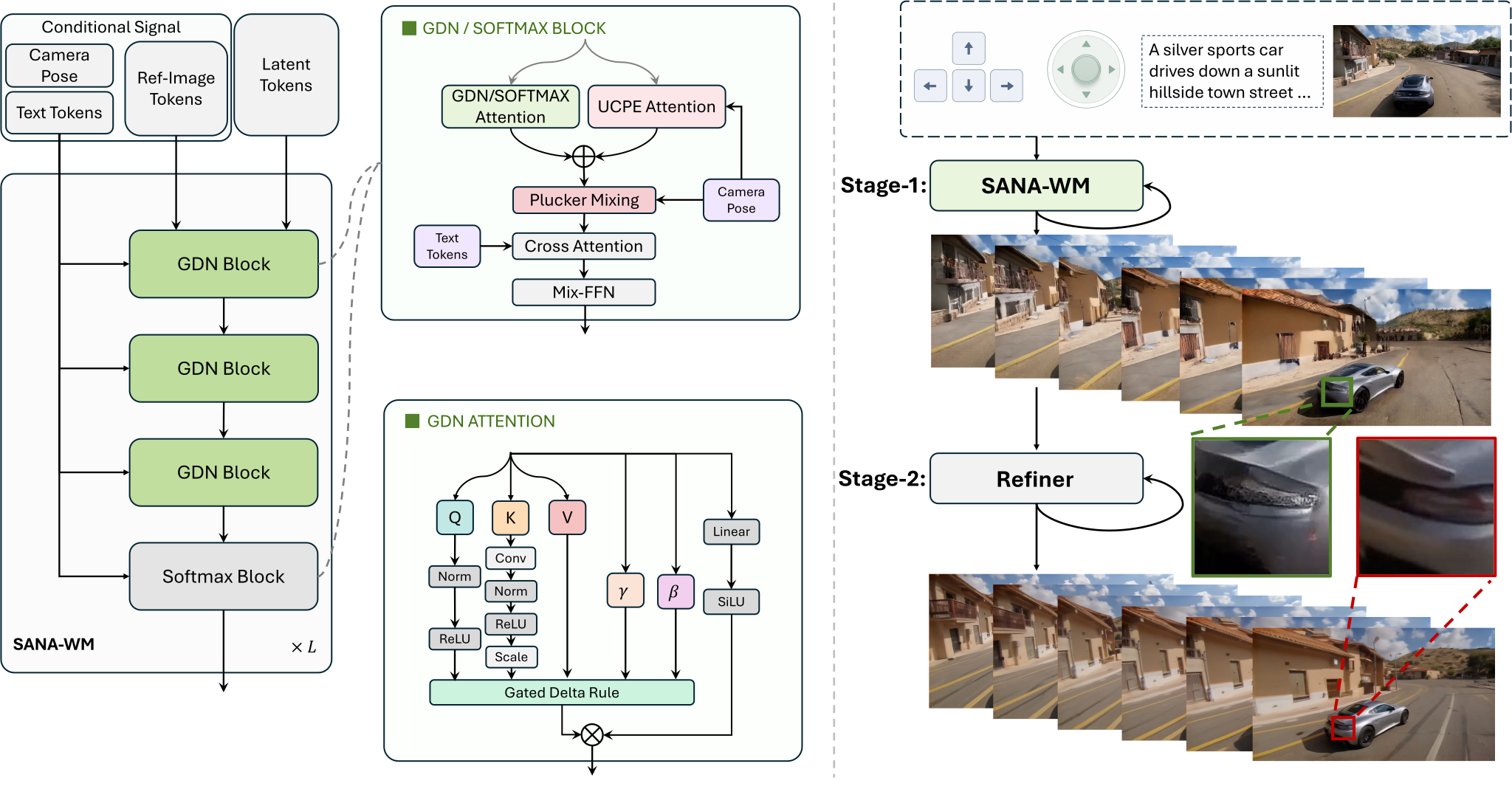
Figure 2 解读:模型侧由 LTX2 tokenizer、Hybrid GDN/softmax backbone、dual-branch camera control 和 refiner 组成;系统侧提供 bidirectional、chunk-causal autoregressive、few-step distilled autoregressive 三种单 GPU 推理形态。
3. Method (方法)
3.1 Progressive Training Strategy
训练按四个阶段推进,避免直接在 1 分钟 720p 序列上端到端硬训:
- Efficient VAE Adaptation:把 baseline VAE 换成 LTX2-VAE,重新初始化 patchify 和 final projection,并用约 50K steps 适配 latent 分布;LTX2 表示比 ST-DC-AE 小约 2×,比 Wan2.1-VAE 小约 8×。
- Hybrid Architecture Adaptation:先在 5s 短 clip 上把 SANA-Video backbone 适配到 Hybrid GDN-Softmax 架构,低成本暴露稳定性问题。
- Minute-Scale Extension + Action Conditioning:扩展到 1 分钟序列,引入 Dual-Branch Camera Control 支持 metric 6-DoF trajectory conditioning。
- SFT:用约 50K 高质量 clips 对分钟级生成做最后的 supervised fine-tuning。
import torch


def progressive_sana_wm_training(model, ltx2_vae, datasets):
    # Stage 0: adapt VAE and model I/O to LTX2 latent space.
    model.replace_vae(ltx2_vae)
    model.reinit_patchify_and_output_projection()
    train(model, datasets.sana_video_sft_5s, steps=50_000, lr=5e-5)

    # Stage 1-2: stabilize frame-wise GDN and hybrid GDN/softmax on short clips.
    model.enable_frame_wise_gdn()
    train(model, datasets.sana_video_sft_5s, steps=30_000, lr=5e-5)
    model.interleave_softmax_blocks(indices=[3, 7, 11, 15, 19])
    train(model, datasets.sana_video_sft_5s, steps=30_000, lr=5e-5)

    # Stage 3-4: scale to 1-minute videos with camera control and SFT.
    model.enable_dual_branch_camera_control()
    train(model, datasets.sana_wm_pose_60s, steps=31_000, lr=1e-5, cp_size=2)
    train(model, datasets.high_quality_60s_50k, steps=10_000, lr=1e-5, cp_size=2)
    return model
3.2 Hybrid Linear Attention for Long Context
原始 cumulative linear attention 用一个 状态累积所有历史 frame 的 key-value 外积,内存常数但缺少衰减和显著性选择,分钟级时 stale feature 会不断堆积。SANA-WM 改成 frame-wise GDN:在每个 latent frame 上聚合 spatial tokens,然后用 decay gate 与 delta-rule 更新状态;再周期性插入 softmax block 做精确长程回忆。
直觉上,GDN 负责“便宜地向前滚动世界状态”,softmax block 负责“偶尔回看关键 token 来校准空间一致性”。论文实现细节给出:20 个 transformer blocks,head dim ,其中 15 个 frame-wise GDN blocks,softmax blocks 位于 。
import torch
import torch.nn.functional as F


def frame_wise_gdn_step(state, q_t, k_t, v_t, decay_t, beta_t):
    """Paper-level reconstruction of the frame-wise GDN update.
    q_t/k_t/v_t: [spatial_tokens, dim]; state: [dim, dim].
    """
    # Aggregate spatial tokens before the recurrent state update.
    k_bar = F.normalize(k_t, dim=-1).mean(dim=0)
    v_bar = v_t.mean(dim=0)
    decay = torch.sigmoid(decay_t).mean()
    beta = torch.sigmoid(beta_t).mean()

    prediction = state @ k_bar
    delta = (v_bar - prediction).unsqueeze(-1) @ k_bar.unsqueeze(0)
    state = decay * state + beta * delta
    out = q_t @ state.T
    return out, state


def hybrid_long_context_block(tokens, blocks):
    state = torch.zeros(tokens.dim, tokens.dim, device=tokens.device)
    for block_id, block in enumerate(blocks):
        if block_id in {3, 7, 11, 15, 19}:
            tokens = block.softmax_attention(tokens)       # exact long-range recall
        else:
            tokens, state = block.frame_wise_gdn(tokens, state)  # efficient recurrent scan
    return tokens
3.3 Dual-Branch Camera Control
SANA-WM 使用双速率几何条件:
- Coarse branch: Ray-local UCPE:对 latent frame/token 计算世界空间 ray,构造 ray-local basis,并把 camera-branch attention head 的几何通道做 ray-local transform;它捕捉全局 6-DoF pose。
- Fine branch: raw-frame Plücker mixing:由于一个 latent token 汇总 8 个 raw frames,latent-rate 条件会丢失 stride 内的细相机运动;因此在 raw frame/pixel 上计算 Plücker ray embedding,再混合回 latent 表示,补偿高频运动。
这个设计的关键直觉是:粗分支保证轨迹大方向和全局几何正确,细分支把 VAE temporal stride 内的相机变化补回来,避免“文本上对了、相机运动不贴轨迹”。
import torch


def dual_branch_camera_condition(latent_tokens, raw_frames, camera_poses, intrinsics):
    # Coarse latent-rate UCPE.
    latent_rays = unproject_latent_cells(camera_poses.latent_rate(), intrinsics.latent_rate())
    ray_local_basis = build_ray_local_basis(latent_rays)  # x/y/z basis per token
    coarse_tokens = apply_ucpe_to_attention_heads(latent_tokens, ray_local_basis)

    # Fine raw-frame Plücker mixing.
    raw_rays = unproject_pixels(camera_poses.raw_rate(), intrinsics.raw_rate())
    plucker = torch.cat([raw_rays.direction, torch.cross(raw_rays.origin, raw_rays.direction)], dim=-1)
    fine_features = mix_raw_frame_plucker(plucker, raw_frames)

    return coarse_tokens + project_to_latent_rate(fine_features)
3.4 Two-Stage Long-Video Refiner
Stage-1 模型负责快速生成长视频 latent;refiner 用 paired latents 学习从 stage-1/degraded latent 修到高保真 target。论文使用 truncated-flow matching:从较大起始噪声 开始,鼓励模型做 refinement 而不是完整重建;refiner 条件包括文本、相机和参考图像,参考图像被拼接进序列但不计入 loss 以保留 stage-1 外观。
def long_video_refiner(refiner, stage1_latents, target_latents, text, camera, reference):
    noisy_source = add_flow_noise(stage1_latents, sigma_start=0.9)
    sequence = concat_reference(noisy_source, reference)
    pred = refiner(sequence, text=text, camera=camera)
    loss = flow_matching_loss(pred.without_reference(), target_latents)
    return loss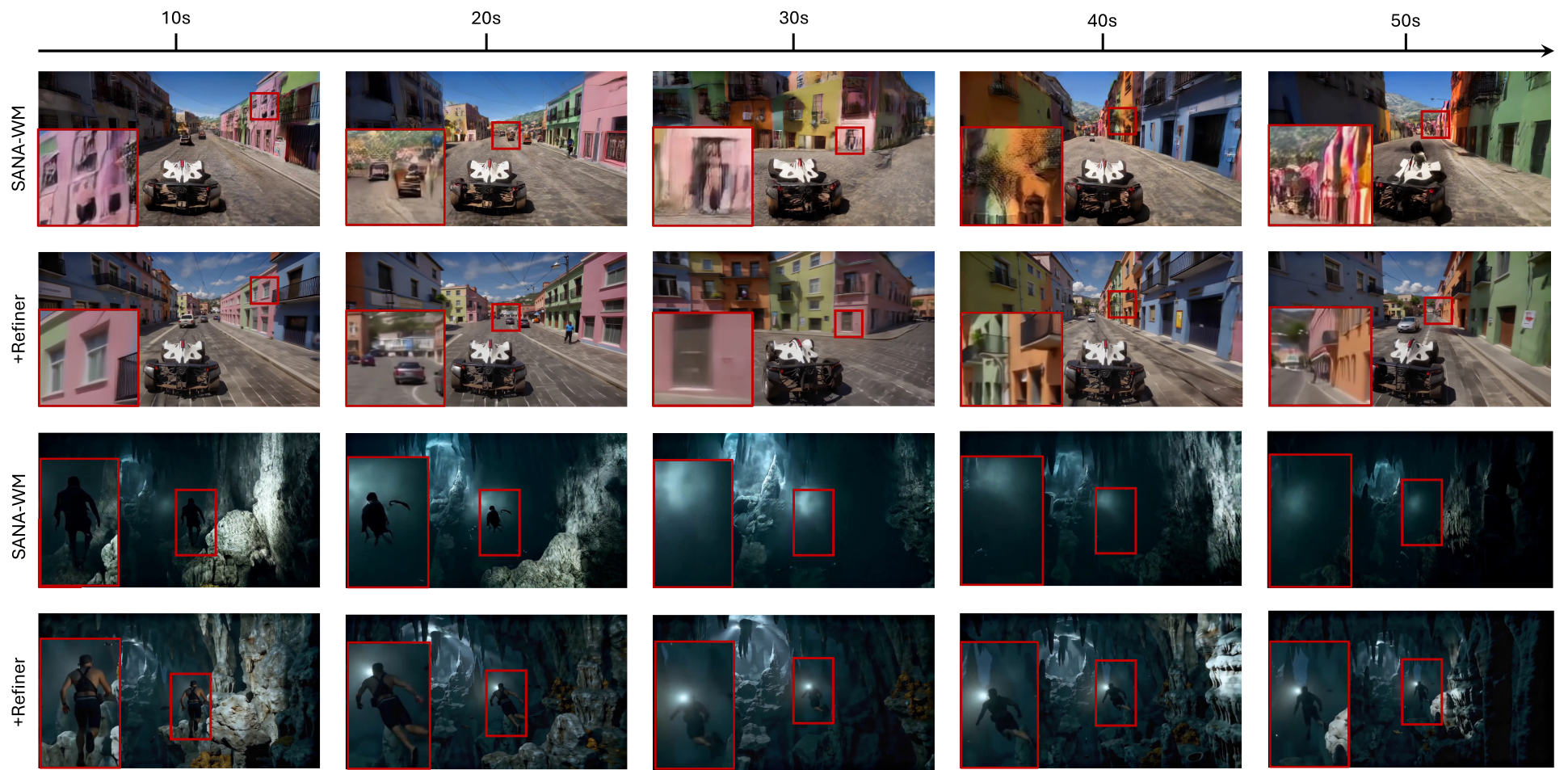
Figure 3 解读:refiner 对 10s 到 50s 的长程 rollout 局部区域进行修补,改善物体结构、清晰度和时间一致性;它不是改变大轨迹,而是提升 stage-1 已生成结果的视觉质量。
3.5 Data Construction Pipeline
论文构建了约 213K clips 的训练语料:从公开视频和静态 3D source 出发,重新估计 metric-scale camera pose,并对 DL3DV 做 3DGS rendered trajectory augmentation。VIPE 的深度后端被替换/增强为 Pi3X 与 MoGe-2,分别提供长序列一致深度和逐帧 metric scale;caption 则刻意不写“pan left / move forward”等相机动作,防止文本泄漏轨迹监督。
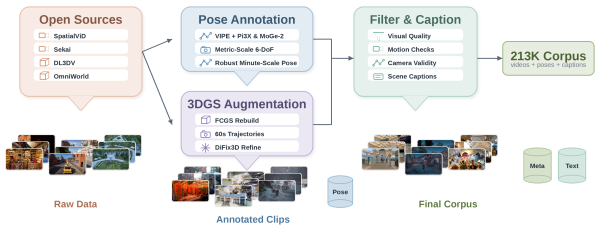
Figure 4 解读:数据 pipeline 的价值在于把公开视频变成带 metric-scale 6-DoF pose 的 action-conditioned corpus;这使 SANA-WM 不依赖专有仿真或闭源 action label。
3.6 Code-to-Paper Mapping
Code reference:
main@1bfb9352(2026-04-14)
项目页的 GitHub 链接指向 NVlabs/Sana。我在 main@1bfb9352 检索了 SANA-WM、GDN、DeltaNet、Plucker/Plücker、camera trajectory 等字符串;当前公开仓库主要覆盖 SANA/SANA-Video/LongSana 基座和 LTX2-720p 配置,未暴露论文中 SANA-WM 专用的 frame-wise GDN、dual-branch camera-control、benchmark/refiner 训练代码。因此下表只把已公开代码映射到可验证的相邻组件,GDN/UCPE/Plücker 伪代码按论文公式重建。
| Paper Concept | Source File | Key Class/Function |
|---|---|---|
| SANA-Video/DiT video backbone | diffusion/model/nets/sana_multi_scale_video.py | SanaMSVideo, SanaVideoMSBlock, forward_frame_aware |
| Linear attention building block | diffusion/model/nets/fastlinear/modules/lite_mla.py | LiteMLA.attn_matmul, LiteMLA.forward |
| 720p LTX2 VAE config | configs/sana_video_config/Sana_2000M_720px_ltx2vae_AdamW_fsdp.yaml | SanaMSVideo_2000M_P1_D20, linear_head_dim: 112, vae_type: LTX2VAE_diffusers |
| LongSana sequence pipeline | diffusion/longsana/pipeline/sana_training_pipeline.py | SanaTrainingPipeline.setup_sequence |
| LongSana trainer loop | diffusion/longsana/trainer/longsana_trainer.py | LongSANATrainer.fwdbwd_one_step_streaming |
| Flow-prediction training loss | diffusion/longsana/utils/loss.py | FlowPredLoss |
| SANA-WM-specific GDN + dual camera control | not found in public NVlabs/Sana@main@1bfb9352 | paper-only reconstruction in this note |
4. Experimental Setup (实验设置)
4.1 Training Data
| Source | Type | Duration | Clips | Pose Source |
|---|---|---|---|---|
| SpatialVID-HQ | Real | 10s | 158,369 | VIPE + Pi3X/MoGe-2 |
| DL3DV | Real | 10s | 5,691 | GT pose + Pi3X |
| DL3DV GS Refined | Synthetic | 60s | 14,881 | GT pose + Pi3X |
| OmniWorld | Synthetic | 60s | 1,720 | VIPE + GT depth |
| Sekai Game | Synthetic | 60s | 3,560 | GT pose + Pi3X |
| Sekai Walking-HQ | Real | 60s | 9,767 | VIPE + Pi3X/MoGe-2 |
| MiraData | Real | 60s | 18,987 | VIPE + Pi3X/MoGe-2 |
| Total | 212,975 |
4.2 Training Config
| Item | Stage 1 | Stage 2 | Stage 3 | Stage 4 |
|---|---|---|---|---|
| Purpose | Frame-wise GDN | Hybrid Attention | Minute-Scale Video + CamCtrl | SFT |
| Data | SANA-Video SFT | SANA-Video SFT | SANA-WM data | ~50K high-quality clips |
| Clip duration | 5s | 5s | 1 min | 1 min |
| Batch/GPU | 1 | 1 | 0.5 | 0.5 |
| CP size | — | — | 2 | 2 |
| Effective global batch | 64 | 64 | 32 | 32 |
| Learning rate | 5e-5 | 5e-5 | 1e-5 | 1e-5 |
| Training steps | 30K | 30K | 31K | 10K |
| Compute budget | ~2.75 days | ~2 days | ~8 days | ~2.5 days |
补充:LTX2 VAE 适配约 50K steps,约 3.5 days on 64 H100;主 DiT/backbone 合计约 15 days on 64 H100。所有 stage 使用 AdamW、BF16 mixed precision、gradient clipping 0.5;Stages 3–4 预计算 VAE latents 以去掉在线编码成本。
4.3 Evaluation Benchmark and Metrics
Benchmark 从 80 个 1280×720 first-frame conditioning images 开始,覆盖 game-style、indoor、outdoor-city、outdoor-nature 四类场景,每类 20 个;每个场景配两个 revisit trajectories,构成 Simple 与 Hard split。
评价包括:Pose Acc.(rotation error R、translation error T、camera-motion consistency CMC,越低越好)、VBench 8 个维度(SC/BC/TF/MS/AQ/IQ/DD/OC 及 Overall,越高越好)、效率(peak memory GB、8 H100 videos/hour)、revisit memory(same-pose PSNR/SSIM/LPIPS)和 temporal IQ drop。
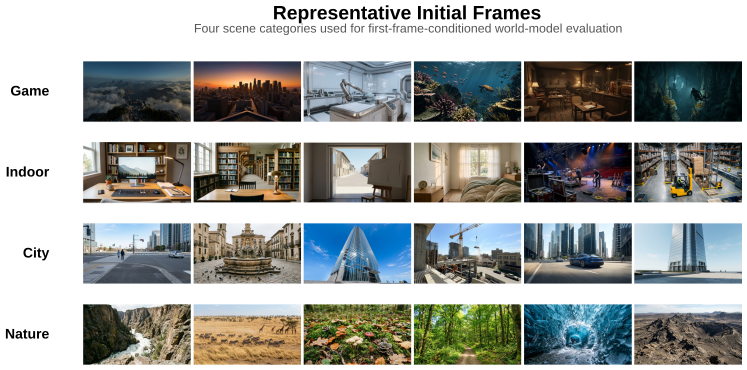
Figure 5 解读:benchmark 首帧覆盖几何、光照、视觉风格多样性,用来测试模型是否能在不同场景里保持身份和控制轨迹。
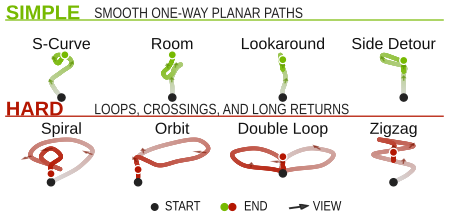
Figure 6 解读:轨迹模板包含 revisit、loop closure、pitch-heavy、vertical motion;这类轨迹专门暴露世界模型在长时空间记忆与相机控制上的漂移。
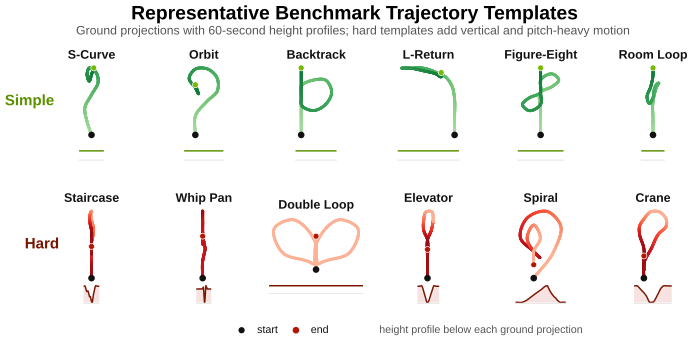
Figure 7 解读:Hard split 不只在 BEV 平面转弯,还包含高度变化和视角 pitch;下方 height profile 说明单看俯视轨迹会低估难度。
5. Experimental Results (实验结果)
5.1 Main Quantitative Results
| Split | Method | Param | Res | G | R↓ | T↓ | CMC↓ | VBench Overall↑ | Mem↓ | Tput↑ |
|---|---|---|---|---|---|---|---|---|---|---|
| Simple | Infinite-World | 1.3B | 480p | 1 | 16.55 | 1.98 | 2.08 | 79.18 | 53.5 | 5.9 |
| Simple | LingBot-World | 14B+14B | 480p | 8 | 10.47 | 2.01 | 2.05 | 81.82 | 454.1 | 0.6 |
| Simple | HY-WorldPlay | 8B | 480p | 8 | 17.89 | 2.36 | 2.45 | 68.82 | 215.5 | 1.1 |
| Simple | Matrix-Game 3.0 | 5B | 720p | 8 | 12.96 | 1.83 | 1.92 | 78.53 | 106.2 | 3.1 |
| Simple | SANA-WM | 2.6B | 720p | 1 | 7.59 | 1.59 | 1.63 | 79.29 | 51.1 | 24.1 |
| Simple | SANA-WM + refiner | 2.6B+17B | 720p | 1 | 4.50 | 1.39 | 1.41 | 80.62 | 74.7 | 22.0 |
| Hard | LingBot-World | 14B+14B | 480p | 8 | 18.99 | 1.65 | 1.81 | 81.89 | 454.1 | 0.6 |
| Hard | Matrix-Game 3.0 | 5B | 720p | 8 | 18.79 | 1.67 | 1.82 | 78.79 | 106.2 | 3.1 |
| Hard | SANA-WM | 2.6B | 720p | 1 | 10.02 | 1.66 | 1.72 | 79.60 | 51.1 | 24.1 |
| Hard | SANA-WM + refiner | 2.6B+17B | 720p | 1 | 8.34 | 1.39 | 1.44 | 81.89 | 74.7 | 22.0 |
核心结论:SANA-WM 用 2.6B 参数和单 GPU generation,在 Simple/Hard 两个 split 上显著降低 pose error;refiner 版本把 Hard split Overall 提到 81.89,与 LingBot-World 相当,但吞吐从 0.6 videos/hour 提升到 22.0 videos/hour,约 36×。
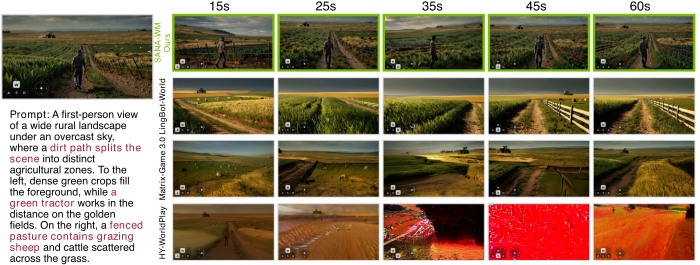
Figure 8 解读:Hard trajectory qualitative comparison 中绿色边框为 SANA-WM,action overlay 显示它在复杂轨迹上保持较强控制与场景连续性。
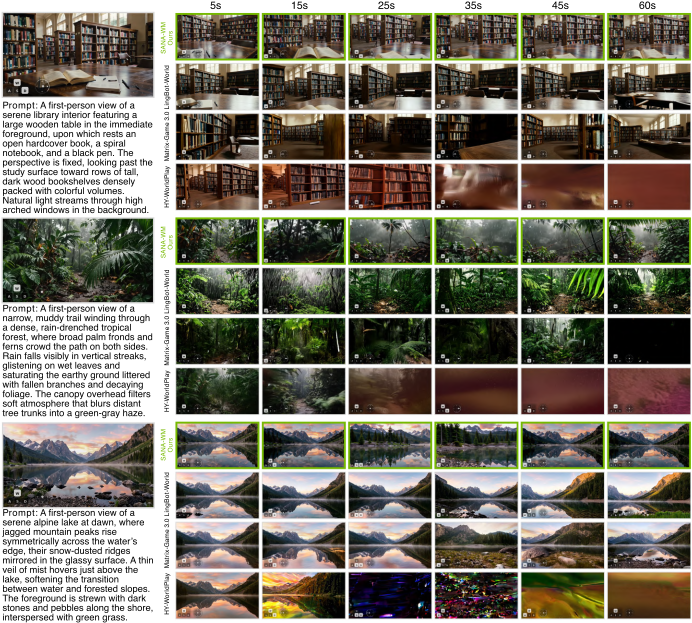
Figure 9 解读:附录 qualitative comparison 扩展到更多 Hard videos,主要观察点是长时视角变化下场景是否崩坏、是否跟随 overlay action。
5.2 Ablation and Efficiency
| Model | Attention | Tokenizer | Quality↑ | I2V↑ | Total↑ | Mem GiB↓ | Lat ms↓ | Tput steps/s↑ |
|---|---|---|---|---|---|---|---|---|
| Sana-Video | cumulative linear | Wan 2.1 / 480p | 0.7683 | 0.9073 | 0.8378 | 8.90 | 1266.6 | 0.79 |
| + LTX2 VAE | cumulative linear | LTX2 / 720p | 0.7697 | 0.9082 | 0.8390 | 5.40 | 371.7 | 2.69 |
| + Hybrid attn. | GDN + softmax | LTX2 / 720p | 0.7834 | 0.9226 | 0.8530 | 5.68 | 433.2 | 2.31 |
Ablation 说明 LTX2 VAE 主要带来内存/延迟收益,Hybrid GDN+softmax 在略增计算的情况下明显提升 Quality/I2V/Total,是“效率优先但不牺牲质量”的关键组件。
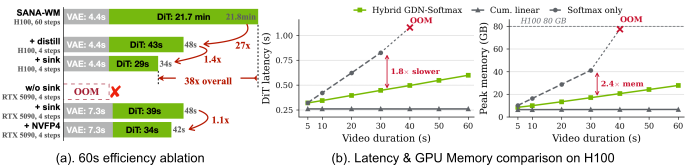
Figure 10 解读:VAE/DiT stage 的延迟与显存随时长扩展;recurrent variants 在 60s 下仍能保持紧凑,而 all-softmax 在 60s 出现 OOM,直接支撑 Hybrid Linear Attention 的必要性。
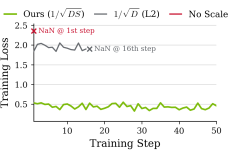
Figure 11 解读:训练稳定性与 scale/condition 的 ablation 用来说明直接扩展长时序不稳定,必须逐步引入高压缩 tokenizer、GDN/softmax 和 camera condition。
5.3 Refiner and 3D-Aware Qualitative Results
Refiner ablation 显示,Simple split 上 long-video refiner 的 Overall 为 80.62,高于 Original LTX-2.3 refiner 的 71.37;R/T/CMC 从 8.65/2.32/2.35 降到 4.50/1.39/1.41,IQ 从 35.70 提升到 72.21,IQ 从 3.73 降到 1.17。说明 refiner 不只是提升单帧清晰度,也改善最后 10 秒的时间稳定性。
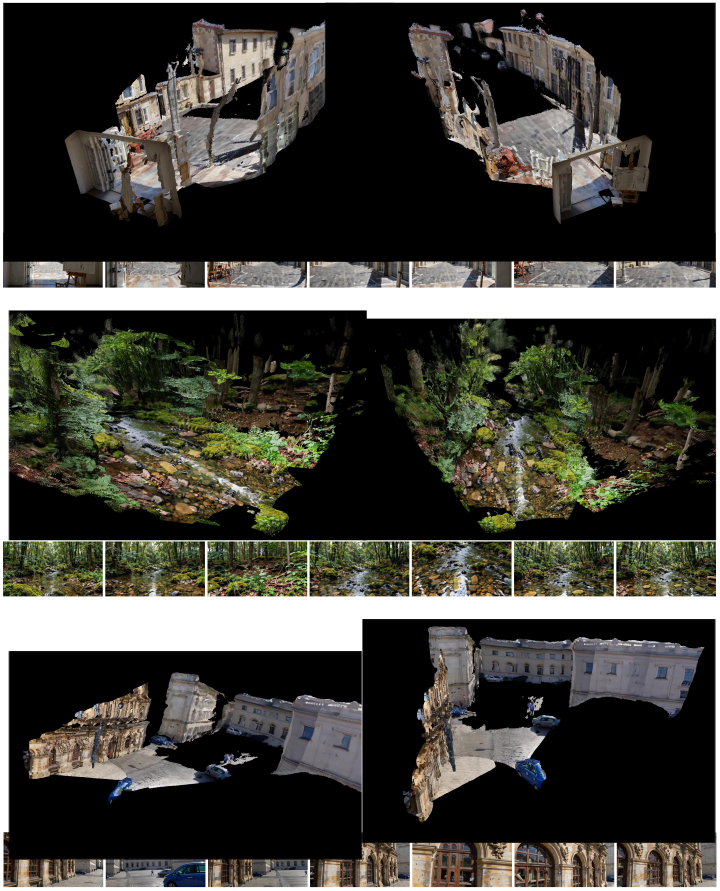
Figure 12 解读:用 Pi3X 对生成视频做 3D reconstruction,间接检验 rollout 是否保留可重建几何;如果视频只是纹理连续但几何漂移,重建会明显不稳定。
5.4 Limitations
作者明确指出 SANA-WM 仍然 scale-limited,没有显式 3D scene memory;在 dynamic scenes、rare viewpoints 或更长 rollout 下仍可能漂移。实际应用时需要记录数据来源、模型 scope 与 evaluation setting;后续方向包括扩大模型/数据、引入 robot action 或 point-tracking controls、增强持久场景记忆,以及开发更鲁棒的 real-time/streaming refiner。