Rolling Forcing: Autoregressive Long Video Diffusion in Real Time
Authors: Kunhao Liu, Wenbo Hu, Jiale Xu, Ying Shan, Shijian Lu Affiliations: Nanyang Technological University, ARC Lab Tencent PCG Year: 2026
1. Motivation (研究动机)
现代视频扩散模型(如 Sora、Wan、Movie-Gen)在短视频生成上表现出色,但交互式应用(世界模型、神经游戏引擎、XR 环境)需要实时流式生成长视频——逐帧输出、低延迟、长时间保持视觉一致性。
现有自回归视频扩散方法面临的核心矛盾如下:
| 方法范式 | 一致性 | 流式能力 | 长视频能力 | 代表工作 |
|---|---|---|---|---|
| History Corruption | 受损 | 支持 | 支持 | SkyReels-V2, Diffusion Forcing |
| Planning Generation | 支持 | 不支持 | 支持 | Zhang & Agrawala 2025 |
| Self Forcing | 支持 | 支持 | 严重退化 | Self Forcing (Huang et al.) |
| Rolling Forcing (本文) | 支持 | 支持 | 支持 | 本文 |
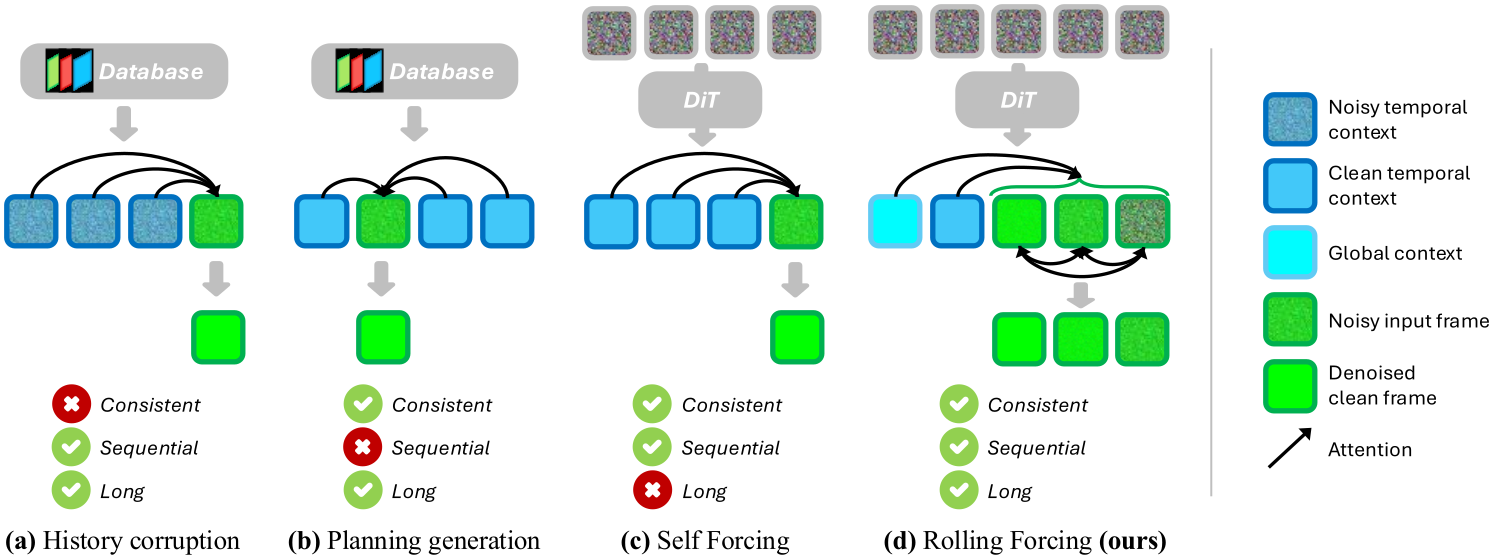 Figure 2 解读:四种自回归视频生成范式对比。(a) History Corruption 通过向历史帧注入噪声来减少对历史的过度依赖,但会破坏时序一致性;(b) Planning Generation 先生成关键帧再插值,打破了严格的顺序输出要求,不适合实时流式;(c) Self Forcing 逐帧因果生成,能保持一致性和流式,但随着生成长度增加,误差严重累积;(d) Rolling Forcing 通过滚动窗口联合去噪,同时满足一致性、流式性和长视频生成三个需求。
Self Forcing(CausVid 的后续改进)将预训练的双向视频扩散模型蒸馏为快速因果自回归生成器。其核心是 Distribution Matching Distillation (DMD) 损失:
其中 和 分别是在真实数据和生成数据上训练的 score function。Self Forcing 通过在训练时以自生成历史为条件来缓解 exposure bias,但当生成长度超出训练窗口时,误差仍然严重累积。
Figure 1 (Teaser)
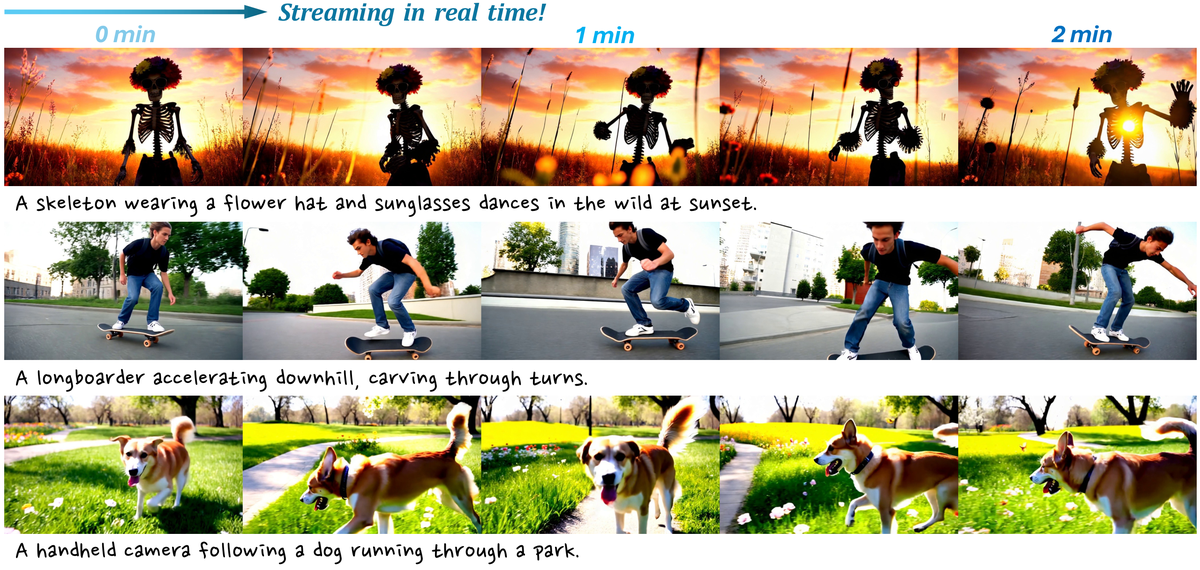 Figure 1 解读:Rolling Forcing 在单 GPU 上以约 16 fps 实时流式生成多分钟视频。三个示例 prompt 的生成结果展示了从 0 到 2 分钟的连续输出,视觉质量和时序一致性均保持良好。
2. Idea (核心思想)
Rolling Forcing 的核心可以概括为三点:滚动扩散窗口(Rolling Diffusion Window)、时序与全局历史上下文(Temporal & Global Context)、以及高效训练算法。
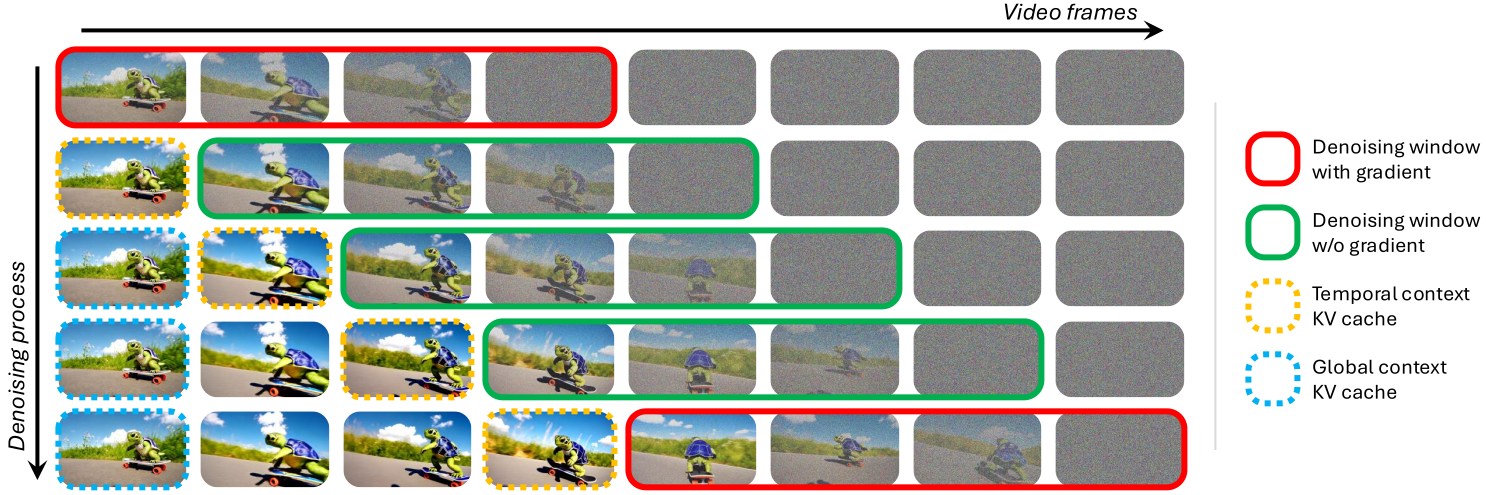 Figure 3 解读:Rolling Forcing 去噪过程示意图(T=4)。每一行代表一个去噪步骤,每一列代表一个视频帧。红色框表示需要计算梯度的去噪窗口,绿色框表示不计算梯度的窗口。关键观察:(1) 每个去噪窗口包含连续多帧,且噪声水平递增;(2) 每次前向传播后输出一帧干净帧(最左侧帧),窗口向右滚动一帧;(3) 最近帧的 KV cache(橙色虚线圆)作为时序上下文,初始帧的 KV cache(蓝色虚线圆)作为全局上下文锚点。
从直觉上看,Rolling Forcing 不是让每一帧孤立地完成全部去噪,而是让一个包含多帧的窗口一起参与联合修正:窗口内帧之间通过双向注意力交换信息,左侧帧先完成去噪并输出,随后窗口右移,新的高噪声帧补入。这样做的直接目标,是在保持因果流式输出的同时,减少逐帧生成带来的误差累积。
3. Method (方法)
3.1 Rolling Diffusion Window
核心思想:将 Self Forcing 的单帧去噪扩展为多帧联合去噪窗口。
在 Self Forcing 中,第 帧的去噪过程为:
每帧独立经历完整的去噪步骤,严格的因果关系导致误差逐帧传播。
Rolling Forcing 将单帧扩展为包含 帧的滚动窗口,窗口内各帧被赋予递增的噪声水平:
关键设计要点:
- 窗口长度 (等于去噪步数)
- 窗口内帧通过双向注意力连接,允许相互修正局部误差
- 每次前向传播后,最左侧帧完成去噪并输出,窗口右滚一帧,新帧从纯高斯噪声开始
- 通过 DMD 蒸馏将去噪步数 压缩到仅 5 步,使窗口足够小以在单 GPU 上实时运行
噪声时间表:
3.2 Temporal & Global Context(Attention Sink)
随着生成进行,干净历史帧 不断增长,直接处理计算开销过大。Rolling Forcing 采用 KV cache 机制:
时序上下文(Temporal Context):缓存最近 帧的 KV 状态,保持短期时序一致性。
全局上下文(Global Context / Attention Sink):缓存初始 帧的 KV 状态作为全局锚点,类似于 LLM 中的 attention sink 机制。
总注意力窗口:(与双向 teacher 模型匹配)
Dynamic RoPE 调整:直接缓存初始帧会导致位置编码溢出(因为随着 增大,初始帧与当前帧的相对距离超出训练范围)。解决方案:
- 缓存全局上下文帧的 key states 时不应用 RoPE
- 推理时动态应用 RoPE,将全局上下文帧的位置索引设为
- 即视全局上下文帧为紧接在时序上下文之前,保持相对位置不变
实现参数: latent frames
3.3 Efficient Training Algorithm
问题:训练时需要对每个窗口做反向传播来计算 DMD 损失,但总共有 个窗口( 为视频帧数),全部反向传播内存不可承受。
解决方案:从每 个连续窗口中随机选一个进行梯度计算,其余窗口仅做前向传播。这样梯度计算量从 降至 。
Mixed Training Strategy:以等概率交替使用两种训练目标:
- Self Forcing 训练(Eq. 3): 每帧从同一噪声水平 去噪,作为正则化项鼓励自然的相机运动
- Rolling Forcing 训练(Eq. 5): 每帧从不同噪声水平去噪,但仅在非重叠窗口上计算梯度
3.4 Python 伪代码
import torch

def rolling_forcing_inference(
    generator,       # G_θ: AR diffusion model (returns KV embeddings)
    noise_schedule,  # [t_1, t_2, ..., t_T], e.g., [200, 400, 600, 800, 1000]
    num_frames,      # N: total frames to generate
    forward_diffusion,  # Ψ: adds noise to clean frames
):
    T = len(noise_schedule)  # denoising steps = window length
    t_list = [0] + noise_schedule  # t_0=0, t_1, ..., t_T

    # === Phase 1: Initialize first window ===
    # Generate initial T frames via full denoising from pure noise
    x_noisy = torch.randn(T, C, H, W)  # [T frames, all at t_T noise level]
    kv_cache = initialize_kv_cache()
    output_frames = []

    # Initialize: denoise first window with generator
    x_clean = generator(x_noisy, t_list[1:T+1], kv_cache)

    # === Phase 2: Rolling generation ===
    for i in range(num_frames):
        # Step 1: Sample fresh noise for new frame
        new_noise = torch.randn(1, C, H, W)  # pure Gaussian at t_T

        # Step 2: Construct denoising window
        # Window contains T frames with noise levels [t_1, t_2, ..., t_T]
        # - Frames 0..T-2: carried from previous step (noise re-injected to next level)
        # - Frame T-1: fresh pure noise
        window_noisy = torch.cat([
            forward_diffusion(x_clean[1:], t_list[1:T]),  # re-noise T-1 previous frames
            new_noise                                       # append new frame at t_T
        ], dim=0)  # shape: [T, C, H, W]

        # Step 3: Joint denoising with bidirectional attention
        x_clean = generator(window_noisy, t_list[1:T+1], kv_cache)
        # x_clean[0] is at noise level t_0=0 (fully denoised)

        # Step 4: Emit clean frame and update KV cache
        output_frames.append(x_clean[0])

        # Update temporal context KV cache (recent L_tem frames)
        kv_cache.update_temporal(generator.get_kv(x_clean[0], t_0=0))

        # Keep global context KV cache (initial L_glo frames, with dynamic RoPE)
        # Global context keys stored WITHOUT RoPE, applied dynamically at attention time

    return torch.stack(output_frames)
def rolling_forcing_training_step(
generator, # G_θ: student model
score_data, # s_data: score function on real data
score_gen, # s_gen: score function on generated data
forward_diffusion, # Ψ
video_length, # N: number of frames in training video
T, # number of denoising steps (= window length)
):
# Step 1: Randomly choose training mode (50/50 mix)
use_rolling_forcing = (torch.rand(1) > 0.5)
# Step 2: Random exit point for gradient (which window gets gradient)
j = torch.randint(0, T, (1,)) # random noise level index
# Step 3: Autoregressively generate full video
kv_cache = initialize_kv_cache()
predicted_clean_video = []
for i in range(video_length):
if use_rolling_forcing:
# Rolling Forcing: construct window with progressive noise levels
window_noisy = build_rolling_window(prev_clean, t_list[1:T+1])
# Gradient only for windows where i ≡ j (mod T)
if i % T == j:
x_clean = generator(window_noisy, t_list[1:T+1], kv_cache) # with grad
else:
with torch.no_grad():
x_clean = generator(window_noisy, t_list[1:T+1], kv_cache)
# Select frame at position j within window as prediction for frame i
predicted_clean_video.append(x_clean[0])
else:
# Self Forcing: standard single-frame denoising
noise_level = t_list[j + 1] # same noise level for all frames
x_noisy_i = forward_diffusion(generator_output_i, noise_level)
x_clean_i = generator(x_noisy_i, noise_level, kv_cache)
predicted_clean_video.append(x_clean_i)
# Update KV cache with self-generated history (NOT ground truth)
kv_cache.update(x_clean_i)
# Step 4: Compute DMD loss on predicted video
predicted_video = torch.stack(predicted_clean_video)
# DMD: match distribution of generated video to real data distribution
loss = compute_dmd_loss(predicted_video, score_data, score_gen, forward_diffusion)
loss.backward()
return loss3.5 Dynamic RoPE for Attention Sink
def apply_dynamic_rope_for_global_context(
    global_kv_cache,    # KV states of initial L_glo frames (stored WITHOUT RoPE)
    temporal_kv_cache,  # KV states of recent L_tem frames (stored WITH RoPE)
    current_window,     # current denoising window frames
    current_frame_idx,  # i: index of current denoising window start
    L_tem, L_glo,       # temporal and global context sizes
    rope_freqs,         # RoPE frequency table
):
    # Global context frames: assign positions immediately before temporal context
    # Positions: [i - L_tem - L_glo, ..., i - L_tem - 1]
    global_positions = range(current_frame_idx - L_tem - L_glo,
                            current_frame_idx - L_tem)

    # Apply RoPE to global context keys at query time (not at cache time)
    global_keys_roped = apply_rope(global_kv_cache.keys, global_positions, rope_freqs)

    # Temporal context already has correct RoPE from when it was cached
    # Current window frames get RoPE at positions [i, i+1, ..., i+T-1]

    # Concatenate for attention: [global | temporal | current_window]
    all_keys = torch.cat([global_keys_roped, temporal_kv_cache.keys, current_window_keys])
    all_values = torch.cat([global_kv_cache.values, temporal_kv_cache.values, current_window_values])

    return all_keys, all_values
3.6 代码仓库映射
GitHub 仓库: TencentARC/RollingForcing
核心文件结构
| 论文概念 | 代码文件 | 说明 |
|---|---|---|
| Rolling Forcing 推理 (Algorithm 2) | pipeline/rolling_forcing_inference.py | CausalInferencePipeline.inference_rolling_forcing() — 滚动窗口推理主循环 |
| Rolling Forcing 训练 (Algorithm 1) | pipeline/rolling_forcing_training.py | RollingForcingTrainingPipeline — 滚动窗口训练,含梯度采样和混合训练 |
| Attention Sink + Dynamic RoPE (Sec 3.3) | wan/modules/causal_model.py | CausalWanSelfAttention — KV cache 管理、sink token 保留、causal_rope_apply() 动态 RoPE |
| DMD Loss (Eq. 1) | model/dmd.py + utils/loss.py | DMD 损失计算,score function 差值 |
| 训练入口 | train.py → trainer/distillation.py | ScoreDistillationTrainer — 支持 DMD/SiD/GAN 多种蒸馏模式 |
| 推理入口 | inference.py | 加载 checkpoint,调用 inference_rolling_forcing() |
| 基础模型封装 | utils/wan_wrapper.py + wan/modules/model.py | Wan2.1 DiT 模型封装 |
| 因果注意力模型 | wan/modules/causal_model.py | 因果 attention mask、KV cache 逻辑 |
| VAE 编解码 | wan/modules/vae.py | 视频 latent 编解码 |
| 配置文件 | configs/rolling_forcing_dmd.yaml | 超参数配置 |
关键代码片段对应
滚动窗口构建 (pipeline/rolling_forcing_inference.py):
window_num = num_blocks + rolling_window_length_blocks - 1
for window_index in range(window_num):
    start_block = max(0, window_index - rolling_window_length_blocks + 1)
    end_block = min(num_blocks - 1, window_index)
梯度采样 (pipeline/rolling_forcing_training.py):
exit_flag = torch.randint(high=rolling_window_length_blocks, ...)
require_grad = window_index % rolling_window_length_blocks == exit_flag
Attention Sink 实现 (wan/modules/causal_model.py):
sink_tokens = 1 * self.block_length  # 保留第一个 block
# 溢出时驱逐旧 token 但保留 sink tokens
kv_cache["k"][:, sink_tokens:sink_tokens + num_rolled_tokens] = \
    kv_cache["k"][:, sink_tokens + num_evicted_tokens:...].clone()
Dynamic RoPE (wan/modules/causal_model.py):
# 全局上下文: 缓存时不应用 RoPE
if local_start_index == 0:
    kv_cache["k"][:, :block_length] = k[..., :block_length]  # unroped
# 注意力计算时动态应用 RoPE
input_key = torch.cat([
    causal_rope_apply(kv_cache["k"][:, :block_length], ..., start_frame=adjusted_pos),
    working_cache_key,
    roped_key
], dim=1)
4. Experimental Setup (实验设置)
4.1 训练配置
- 基础模型:Wan2.1-T2V-1.3B
- 每 chunk:3 latent frames
- 去噪步数 / 窗口长度:
- 训练窗口:27 latent frames
- batch size:8
- 训练步数:3,000
- 优化器:AdamW
- 学习率:generator lr = ,fake score lr =
4.2 评测配置
- 对比模型:SkyReels-V2、MAGI-1、CausVid、Self Forcing
- 定量指标:Throughput (FPS)、Latency (s)、Temporal、Subject、Background、Motion、Aesthetic、Imaging、
- 定性场景:跑步者场景、乌龟赛车场景、珊瑚礁水下场景、交互式 prompt 切换
- 推理设定:单 GPU 实时流式生成,关注长时间一致性与质量漂移
5. Experimental Results (实验结果)
5.1 定量比较
| Model | Params | Throughput (FPS) | Latency (s) | Temporal | Subject | Background | Motion | Aesthetic | Imaging | |
|---|---|---|---|---|---|---|---|---|---|---|
| SkyReels-V2 | 1.3B | 0.49 | 112 | 97.43 | 89.23 | 93.45 | 98.76 | 61.55 | 62.90 | 5.59 |
| MAGI-1 | 4.5B | 0.19 | 282 | 98.21 | 90.86 | 93.25 | 99.20 | 59.91 | 59.87 | 2.15 |
| CausVid | 1.3B | 15.38 | 0.78 | 96.84 | 87.99 | 89.99 | 98.09 | 60.95 | 66.38 | 2.18 |
| Self Forcing | 1.3B | 15.38 | 0.78 | 97.49 | 86.48 | 90.29 | 98.47 | 60.54 | 68.68 | 1.66 |
| Rolling Forcing | 1.3B | 15.79 | 0.76 | 97.61 | 92.80 | 93.71 | 98.70 | 62.39 | 70.75 | 0.01 |
关键发现:Rolling Forcing 在几乎所有质量指标上都取得最优,特别是 仅为 0.01(Self Forcing 为 1.66),说明其在抑制长视频误差累积方面具有明显优势。
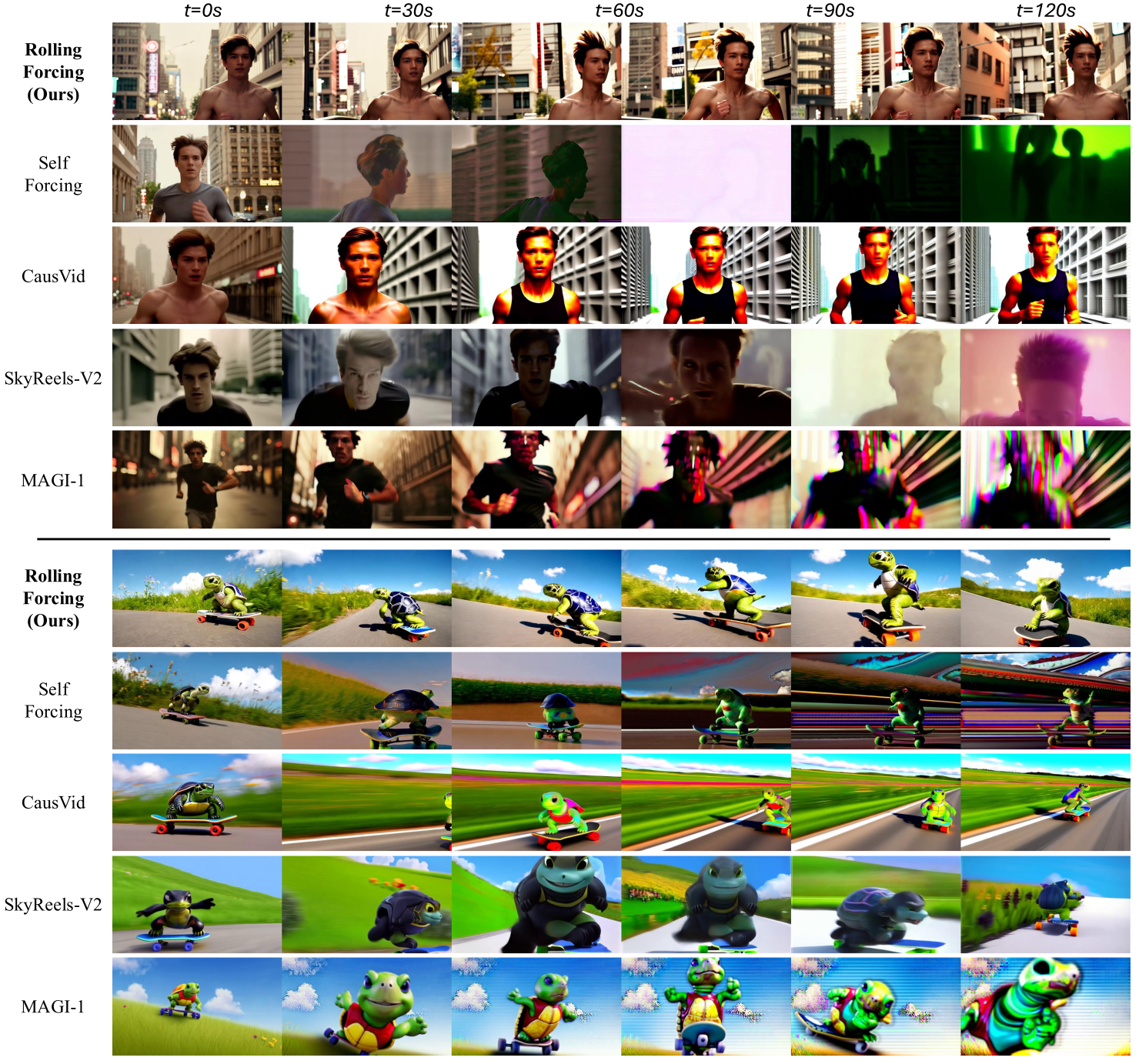 Figure 4 解读:定性对比。上半部分展示 120 秒生成结果(跑步者场景),Rolling Forcing 在 2 分钟内保持高保真度,而 Self Forcing 在 60s 后出现严重退化,CausVid 和 SkyReels-V2 更早崩溃。下半部分展示另一个场景(乌龟赛车),Rolling Forcing 的色彩、细节、运动一致性显著优于其他方法。
5.2 消融实验
| Model | Temp. | Subj. | Back. | Mot. | Aes. | Img. | |
|---|---|---|---|---|---|---|---|
| w/o RF inference | 95.45 | 86.01 | 89.94 | 97.36 | 57.59 | 65.19 | 5.53 |
| w/o RF training | 95.91 | 87.50 | 90.86 | 98.05 | 60.41 | 69.24 | 0.89 |
| w/o SF training | 90.83 | 83.27 | 88.14 | 95.63 | 55.30 | 62.00 | 1.62 |
| w/o attention sink | 97.53 | 83.22 | 87.99 | 98.56 | 58.99 | 67.30 | 4.63 |
| Ours full | 97.61 | 92.80 | 93.71 | 98.70 | 62.39 | 70.75 | 0.01 |
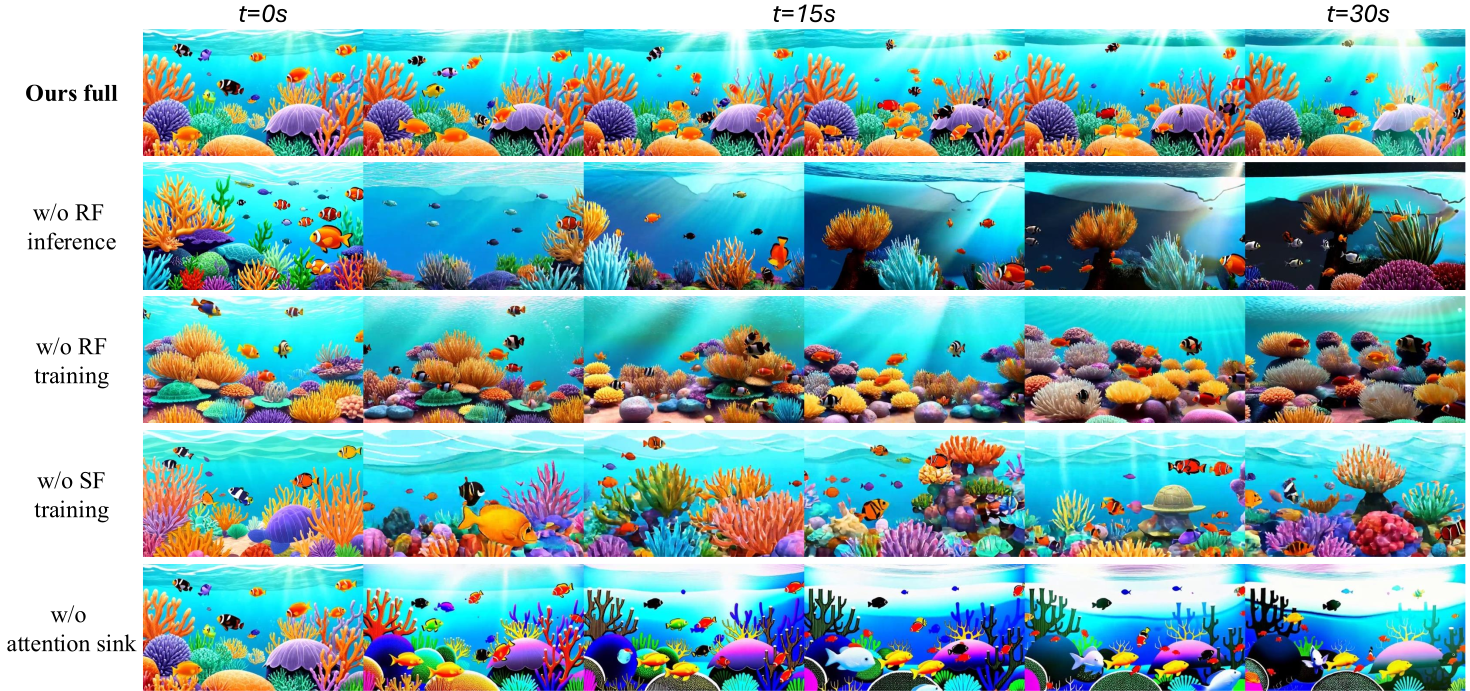 Figure 5 解读:消融实验可视化(珊瑚礁水下场景,30 秒)。(1) 去除 RF 推理(仅用逐帧去噪)导致 30s 内即出现明显退化;(2) 去除 RF 训练(用逐帧范式训练)质量漂移虽有改善但仍存在;(3) 去除 SF 训练(移除混合训练中的正则化项)导致不自然的相机运动和一致性下降;(4) 去除 attention sink 导致色彩偏移和全局一致性丧失。
5.3 交互式视频流
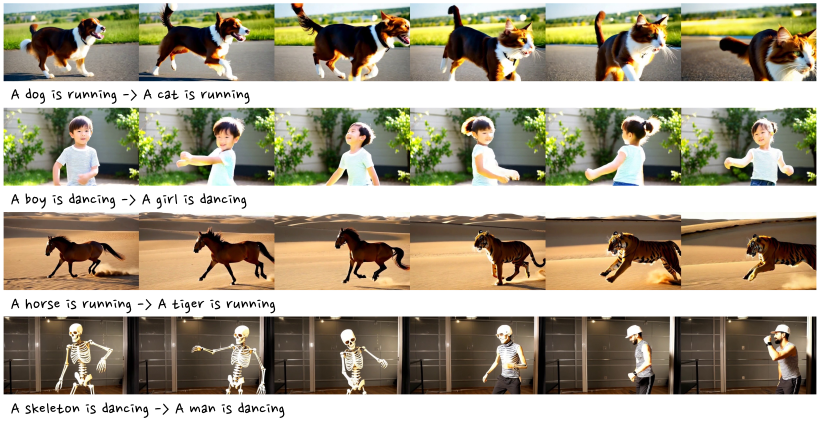 Figure 6 解读:Rolling Forcing 支持交互式视频流——用户可在生成过程中实时更换 prompt。实现方式很简洁:丢弃 cross-attention cache 中的旧 prompt,换入新 prompt 的 embeddings 即可。
5.4 小结与局限
- Rolling Forcing 通过滚动窗口联合去噪,在长视频场景下有效抑制误差累积。
- Attention sink 与 Dynamic RoPE 让长期上下文缓存更稳定。
- 依赖 DMD 蒸馏,训练阶段需要维护 teacher score function。
- 全局上下文仅锚定初始帧,对于场景剧烈变化的超长视频可能不够。
- 的结果很强,但也可能部分受益于评测指标的局限性(仅比较首尾 5 秒)。