1. Motivation (研究动机)
核心问题: Autoregressive 视频扩散模型的 Exposure Bias
自回归(AR)视频扩散模型通过逐帧生成来模拟视频的因果结构,具有天然的世界模型潜力。但其训练和推理存在严重的 train-test mismatch:
- 训练时 (Teacher Forcing): 模型以 ground truth 历史帧为条件预测当前帧
- 推理时: 模型以自己生成的(不完美的)历史帧为条件
这导致 error accumulation — 模型误差在自回归 rollout 中逐帧累积放大,最终造成视频质量崩溃(颜色失真、纹理退化、内容漂移)。
现有方案的局限
| 方案 | 代表工作 | 局限性 |
|---|---|---|
| 后训练蒸馏 | Self Forcing, CausVid, LongLive | 依赖 14B 双向 teacher 模型,无法从头训练;teacher 泄露未来信息,破坏因果性 |
| 在线判别器 | 对抗训练方法 | 训练不稳定,扩展性差 |
| 噪声注入 | noise augmentation | 噪声分布与真实模型误差不匹配 |
| 滑窗注意力 | sliding window | 丢失长程依赖,加剧 drift |
核心 Motivation: 能否设计一种 无需 teacher、无需判别器 的端到端训练方法,从头训练出鲁棒的 AR 视频扩散模型?
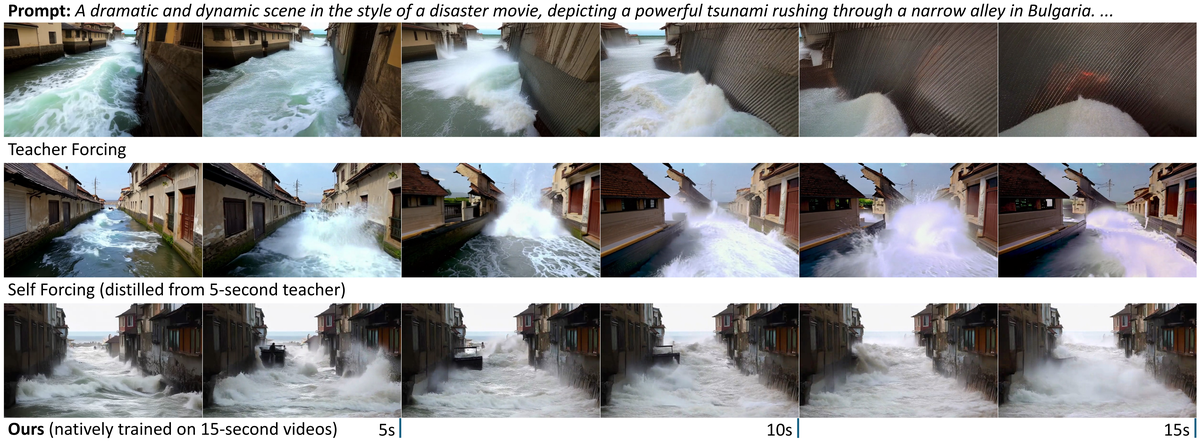
Figure 1 解读: 对比三种训练策略在生成 15 秒长视频时的效果。Top: Teacher Forcing 训练的模型随时间积累误差,最终视频崩溃。Middle: Self Forcing 从 5 秒 bidirectional teacher 蒸馏,在长视频上质量退化。Bottom: Resampling Forcing 原生在 15 秒视频上训练,全程保持稳定的视觉质量和时间一致性。
2. Idea (核心思想)
核心思想: Self-Resampling 模拟推理误差
Resampling Forcing 的核心洞察非常简洁:
训练时主动在历史帧上引入模型自身的误差,然后让模型学会在这些”退化”历史帧条件下仍能正确预测干净目标。
具体而言:
- Self-Resampling: 用在线模型对 ground truth 历史帧进行部分去噪重采样,模拟推理时的模型误差
- Autoregressive Error Propagation: 重采样过程是自回归的 — 每一帧的退化依赖于前面已退化帧的条件,准确模拟推理时的误差累积模式
- Clean Target, Degraded Condition: 条件(历史)是退化的,但预测目标始终是干净的 ground truth
这使得模型学会了 error correction 而非 error amplification,从而在推理时将误差控制在近似恒定水平。
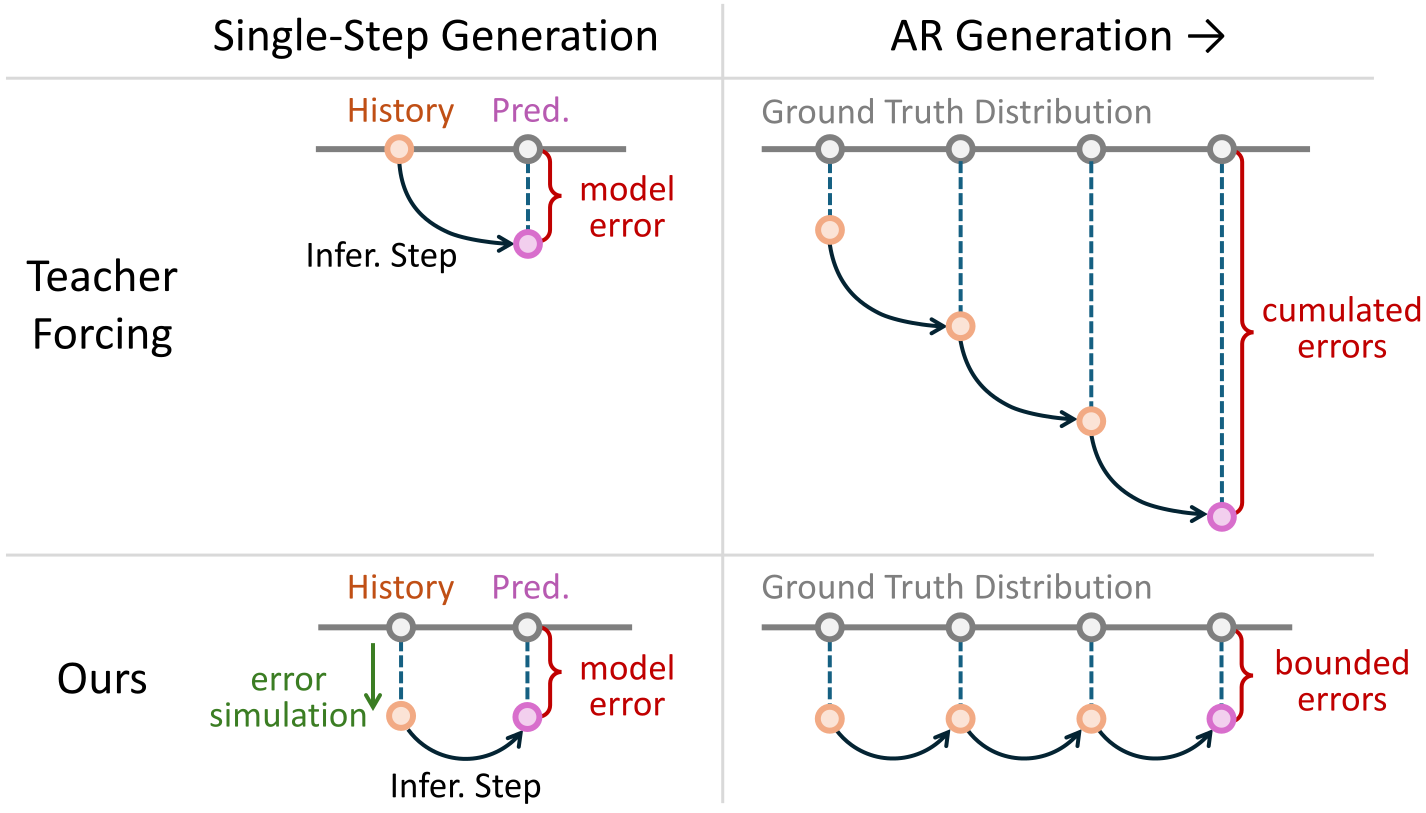
Figure 2 解读: 误差累积机制对比。Top (Teacher Forcing): 训练时用完美输入,推理时模型误差逐帧累积放大,分布偏移越来越严重。Bottom (Ours): 训练时用含模拟误差的历史帧,模型学会修正输入误差,推理时误差被限制在近似恒定范围内,不再累积。灰色圆圈代表 ground truth 分布中的最近匹配点。
3. Method (方法)
3.1 背景: AR 视频扩散模型
给定条件 , 帧视频 的联合分布分解为自回归形式:
每帧通过求解反向 ODE 从噪声 生成:
其中 是 velocity field 网络 (DiT 架构),使用 Flow Matching 训练。
3.2 Teacher Forcing 训练
在 Flow Matching 框架下,时刻 的样本为:
训练目标为回归 velocity :
通过 causal mask 实现所有帧的并行训练。
3.3 Resampling Forcing 核心方法
3.3.1 Autoregressive Self-Resampling
为模拟推理时的两类误差 — (1) 帧内去噪不完美导致的高频细节误差,(2) 帧间自回归累积误差 — 提出 autoregressive self-resampling:
对每帧 ground truth :
- 采样 simulation timestep ,将其加噪到
- 用在线模型 从 完成剩余去噪,得到退化帧
关键设计:
- 自回归条件: 重采样时以已退化的 为条件,精确模拟推理时误差累积
- 在线权重: 使用当前训练中的模型权重,使误差分布随训练动态演化
- 梯度截断: 重采样过程 stop gradient,防止模型学会捷径(shortcut learning)
3.3.2 Simulation Timestep 采样策略
控制重采样强度的 trade-off:
- : 退化帧接近 ground truth (退化为 teacher forcing)
- : 退化强但可能导致内容漂移
采样分布选择 Logit-Normal:
并应用 timestep shifting (参数 ) 偏向低噪声区:
实验中 ,即适度偏向低噪声(弱退化)。
3.3.3 Sparse Causal Mask 并行训练

Figure 3 解读: Resampling Forcing 方法全览。(a) Autoregressive Resampling: 对 ground truth 帧加噪到 ,然后用在线模型自回归地完成去噪,生成含模型误差的退化帧,通过 KV Cache 实现高效推理。(b) Parallel Training: 退化帧作为历史条件 (stop gradient),所有帧在一次前向传播中并行计算 frame-level diffusion loss。(c) Causal Mask: 稀疏因果掩码确保每帧只能 attend 到自身的噪声版本和前面帧的干净版本,维持因果性。
训练流程分两步:
- 重采样阶段 (no gradient): 自回归生成退化历史
- 训练阶段 (with gradient): 以 为条件,并行计算所有帧的 diffusion loss
3.3.4 Teacher Forcing Warmup
训练初期模型尚未收敛,self-resampling 产生的误差无意义。因此先用 Teacher Forcing 预热 10K steps,再切换到 Resampling Forcing。
3.4 History Routing: 动态稀疏注意力
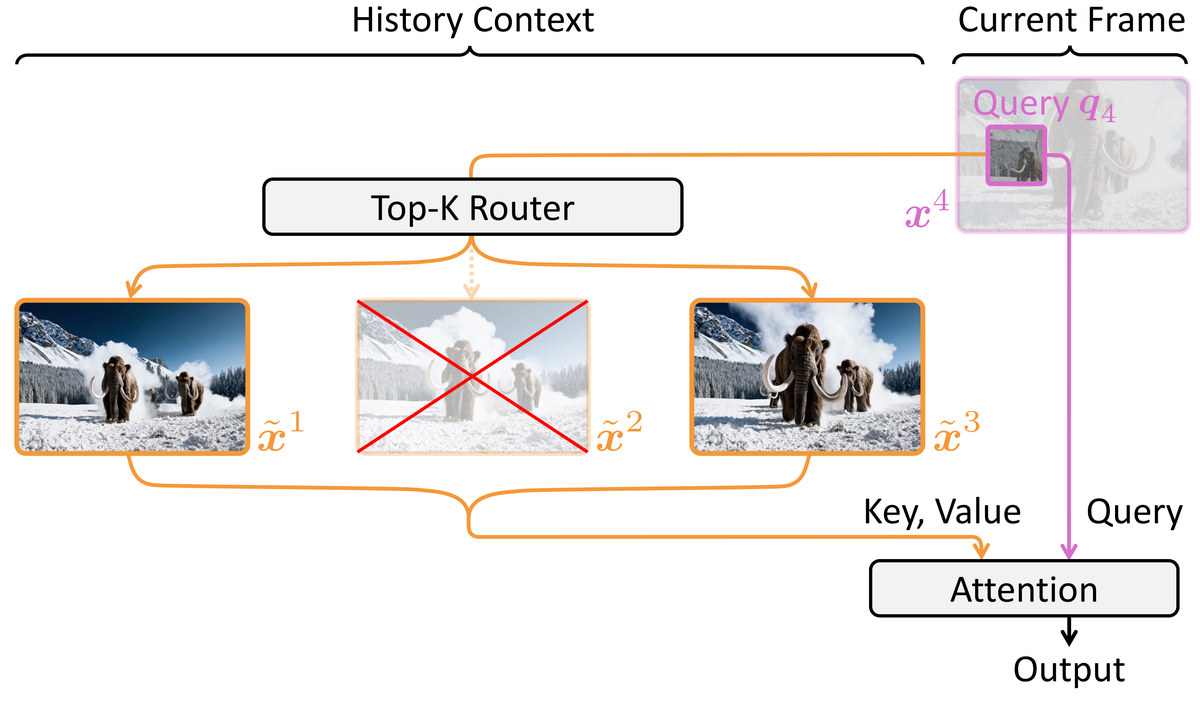
Figure 4 解读: History Routing 机制。当生成第 4 帧时,不是 attend 到所有历史帧 (dense causal attention),而是通过 Top-K Router 动态选择最相关的 帧 (图中 ,选择了第 1、3 帧)。每个 query token 独立路由,不同 head 和位置可选择不同的历史帧,实际有效感受野远大于 。
随着生成帧数增长,dense causal attention 的 KV 数量线性增长,计算量暴增。提出 History Routing 替代:
对 query token ,动态选择 top- 最相关历史帧:
其中 是为 query 选择的 个历史帧索引集合:
为 mean pooling (无参数),将每帧的 KV 池化为 frame descriptor。
实现细节:
- 采用 MoBA 风格的双分支注意力: intra-frame branch + history branch
- 通过 global log-sum-exp 融合两个分支输出
- 使用
flash_attn_varlen_func()高效实现 - 注意力稀疏度 , 时对 20 帧历史实现 75% 稀疏度
- 路由是 head-wise 和 token-wise 的,不同 head/position 可选不同帧
3.5 完整算法伪码
# Resampling Forcing

> **Authors**: Yuwei Guo, Ceyuan Yang, Hao He, Yang Zhao, Meng Wei, Zhenheng Yang, Weilin Huang, Dahua Lin
> **Affiliations**: The Chinese University of Hong Kong, ByteDance Seed, ByteDance
> **GitHub**: [guandeh17/Self-Forcing](https://github.com/guandeh17/Self-Forcing)
> **Venue**: ICCV 2025

while not converged:
    t_s = sample_logit_normal()
    t_s = shift_timestep(t_s, s)
    clean_video, condition = sample_batch(dataset)
    noisy_video = add_noise(clean_video, t_s)

    with no_grad():
        degraded_history = autoregressive_self_resampling(
            model=v_theta,
            clean_video=clean_video,
            t_s=t_s,
            condition=condition,
        )

    sampled_steps = sample_training_steps(num_frames=len(clean_video))
    loss = 0.0
    for frame_idx, t_i in enumerate(sampled_steps):
        eps_i = torch.randn_like(clean_video[frame_idx])
        x_t_i = add_noise(clean_video[frame_idx], t_i, noise=eps_i)
        target = eps_i - clean_video[frame_idx]
        pred = v_theta(x_t_i, degraded_history[:frame_idx], t_i, condition)
        loss += mse(pred, target)

    loss /= len(clean_video)
    optimize(loss, params=theta)

return theta
3.6 Resampling 过程伪码
def autoregressive_self_resampling(model, clean_video, t_s, condition):
    """
    模拟推理时的模型误差
    Args:
        model: 在线 v_θ 模型
        clean_video: ground truth x^{1:N}, shape [N, C, H, W]
        t_s: simulation timestep (scalar)
        condition: text condition c
    Returns:
        degraded_video: 退化视频 x̃^{1:N}
    """
    N = clean_video.shape[0]
    noise = torch.randn_like(clean_video)

    # 加噪到 t_s
    noisy_video = (1 - t_s) * clean_video + t_s * noise  # [N, C, H, W]

    degraded_video = []
    kv_cache = None

    with torch.no_grad():  # 关键: stop gradient
        for i in range(N):
            # 1-step Euler 近似从 t_s 到 0
            x_t = noisy_video[i]
            history = degraded_video  # 已退化的前置帧

            velocity = model(x_t, history, t_s, condition)
            x_clean = x_t + (0 - t_s) * velocity  # Euler step

            degraded_video.append(x_clean)
            # 更新 KV cache

    return torch.stack(degraded_video)
3.7 History Routing 伪码
def history_routing_attention(query, kv_cache, k=5):
    """
    动态 Top-K History Routing
    Args:
        query: 当前帧的 query tokens, shape [num_tokens, d]
        kv_cache: 历史帧 KV, list of (K_j, V_j) each [tokens_per_frame, d]
        k: 选择的历史帧数
    Returns:
        attention output
    """
    num_history = len(kv_cache)
    if num_history <= k:
        # 历史帧不够 k 个,使用全部
        return dense_attention(query, kv_cache)

    # Step 1: 计算 frame descriptors (mean pool, 无参数)
    frame_descriptors = []
    for K_j, V_j in kv_cache:
        phi_j = K_j.mean(dim=0)  # [d], mean pooling
        frame_descriptors.append(phi_j)
    frame_descriptors = torch.stack(frame_descriptors)  # [L, d]

    # Step 2: Per-token routing score
    scores = query @ frame_descriptors.T  # [num_tokens, L]

    # Step 3: Top-K selection (per token)
    _, topk_indices = scores.topk(k, dim=-1)  # [num_tokens, k]

    # Step 4: Gather selected KVs and compute attention
    # 实际使用 flash_attn_varlen_func 高效实现
    output = sparse_attention(query, kv_cache, topk_indices)

    # Step 5: 融合 intra-frame 和 history 分支 (log-sum-exp)
    intra_output = intra_frame_attention(query)
    final_output = logsumexp_fusion(intra_output, output)

    return final_output
4. Experimental Setup (实验设置)
4.1 模型配置
| 配置项 | 详情 |
|---|---|
| 基础模型 | WAN2.1-1.3B (DiT 架构) |
| 分辨率 | 480 x 832 |
| 原始能力 | 5 秒 (81 帧) 双向注意力 |
| Chunk size | 3 latent frames (自回归单元) |
| Causal mask | torch.flex_attention() 实现,无额外参数 |
| Timestep conditioning | 修改为支持 per-frame noise level |
4.2 训练配置
| 阶段 | 视频长度 | Steps | 说明 |
|---|---|---|---|
| Stage 1: Teacher Forcing warmup | 5s | 10K | 切换为 causal attention 后预热 |
| Stage 2: Resampling Forcing | 5s | 15K | 开始 self-resampling |
| Stage 3: Resampling Forcing | 15s (249 帧) | 5K | 原生长视频训练 |
| Stage 4: Fine-tune w/ History Routing | 15s | 1.5K | 启用 sparse attention |
| 超参数 | 值 |
|---|---|
| Batch size | 64 |
| Optimizer | AdamW |
| Learning rate | 5e-5 |
| Timestep shift | 0.6 |
| History routing | 5 |
| Resampling solver | 1-step Euler |
4.3 推理配置
| 配置项 | 值 |
|---|---|
| Sampler | Euler, 32 steps |
| Timestep shifting factor | 5.0 |
| CFG scale | 5.0 |
4.4 评测
- Benchmark: VBench
- 视频长度: 15 秒,分三段 (0-5s, 5-10s, 10-15s) 分别评测
- 指标: Temporal Quality, Visual Quality, Text Alignment
- Baselines: SkyReels-V2 (1.3B), MAGI-1 (4.5B), NOVA (0.6B), Pyramid Flow (2.0B), CausVid (1.3B), Self Forcing (1.3B), LongLive (1.3B)
5. Experimental Results (实验结果)
5.1 定量结果 (VBench, 15s 视频)
Table 1: 主要对比结果
| Method | Param | Teacher Model | 0-15s Temp | 0-15s Vis | 0-15s Text | 5-10s Temp | 10-15s Temp |
|---|---|---|---|---|---|---|---|
| SkyReels-V2 | 1.3B | - | 81.93 | 60.25 | 21.92 | 84.63 | 87.50 |
| MAGI-1 | 4.5B | - | 87.09 | 59.79 | 26.18 | 89.10 | 86.66 |
| NOVA | 0.6B | - | 87.58 | 44.42 | 25.47 | 88.40 | 84.94 |
| Pyramid Flow | 2.0B | - | 81.90 | 62.99 | 27.16 | 84.45 | 84.27 |
| CausVid | 1.3B | WAN2.1-14B(5s) | 89.35 | 65.80 | 23.95 | 89.59 | 87.14 |
| Self Forcing | 1.3B | WAN2.1-14B(5s) | 90.03 | 67.12 | 25.02 | 84.27 | 84.26 |
| LongLive | 1.3B | WAN2.1-14B(5s) | 81.84 | 66.56 | 24.41 | 81.72 | 84.57 |
| Ours (75% sparsity) | 1.3B | - | 90.18 | 63.95 | 24.12 | 89.80 | 87.03 |
| Ours | 1.3B | - | 91.20 | 64.72 | 25.79 | 90.44 | 89.74 |
关键发现:
- 无需 teacher 模型即达到与蒸馏方法 (CausVid, Self Forcing) 可比的质量
- Temporal Quality 全面领先 (91.20 vs Self Forcing 90.03),尤其在长视频段 (10-15s) 优势显著 (89.74 vs 84.26)
- 75% 稀疏度下质量几乎无损 (90.18 vs 91.20 Temporal)
- 蒸馏方法在长视频段 temporal 指标显著下降 (Self Forcing: 90.03→84.26),说明短 teacher 泄露的未来信息导致因果性问题
5.2 定性对比
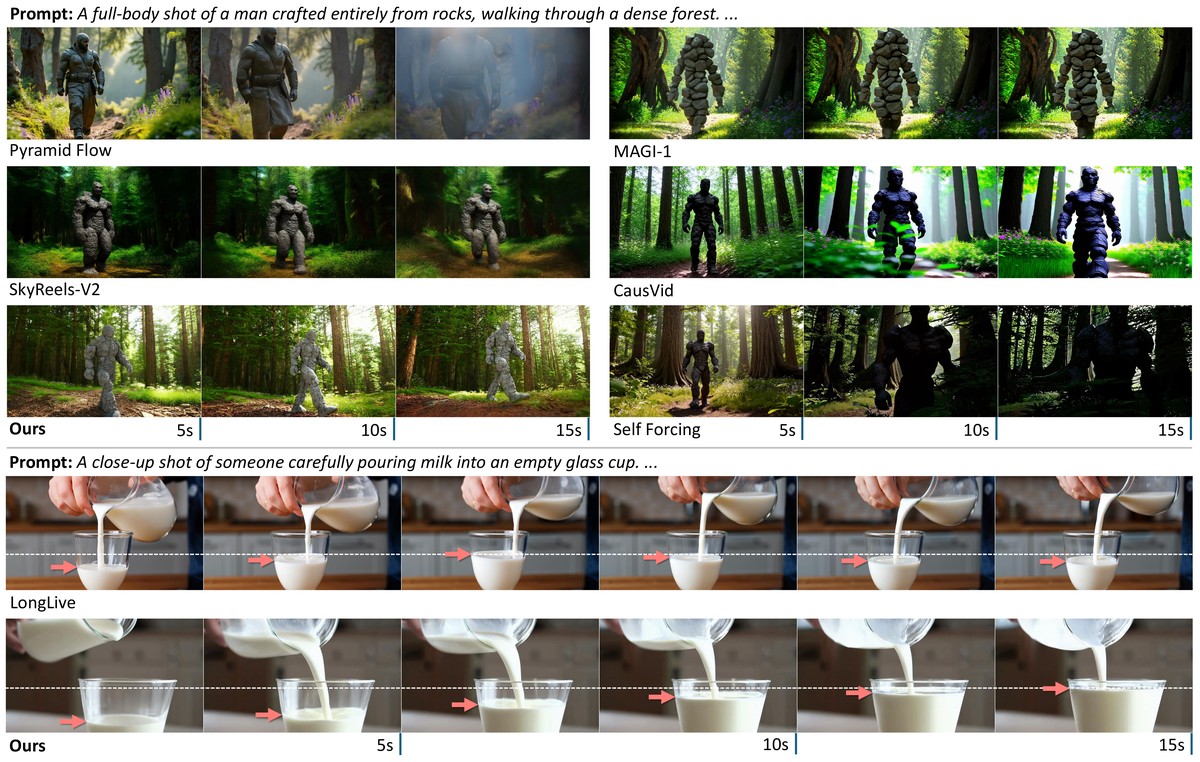
Figure 5 解读: 定性比较。Top panel: 在 “岩石人行走” prompt 上,Pyramid Flow/CausVid/Self Forcing 均出现颜色/纹理退化,而本方法 15 秒全程质量稳定。MAGI-1 和 SkyReels-V2 虽然长视频退化较轻,但牺牲了严格因果性。Bottom panel: 在 “倒牛奶” prompt 上,从 5 秒 bidirectional teacher 蒸馏的 LongLive 出现液位先升后降的非因果现象 (红色箭头),违反物理规律。本方法严格因果训练,液位单调上升,符合物理一致性。
5.3 消融实验
误差模拟策略 (Table 2)
| Strategy | Temporal | Visual | Text |
|---|---|---|---|
| Noise augmentation | 87.15 | 61.90 | 21.44 |
| Resampling - parallel | 88.01 | 62.51 | 24.51 |
| Resampling - autoregressive | 90.46 | 64.25 | 25.26 |
结论: 自回归重采样显著优于并行重采样和噪声增强,因为它准确模拟了推理时误差的 累积模式。
Timestep Shifting 因子
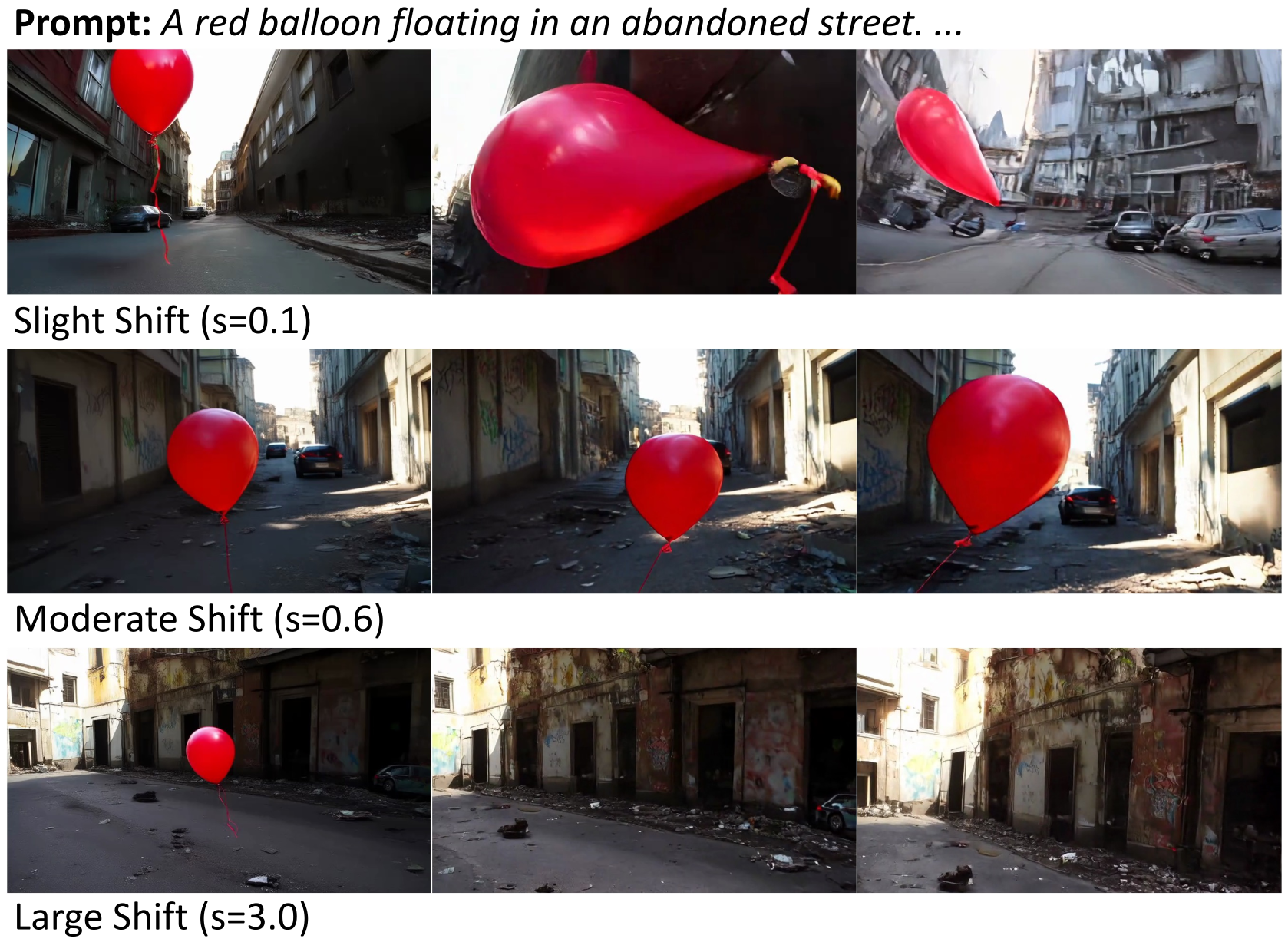
Figure 6 解读: 不同 shift 因子 对生成质量的影响。 (轻微退化): 模型仍然积累误差,质量退化。 (适中): 平衡误差鲁棒性和内容保真度。 (强退化): 模型过度偏离历史内容,出现内容漂移 (如气球形态变化)。因此需要适中的 值。
稀疏历史策略
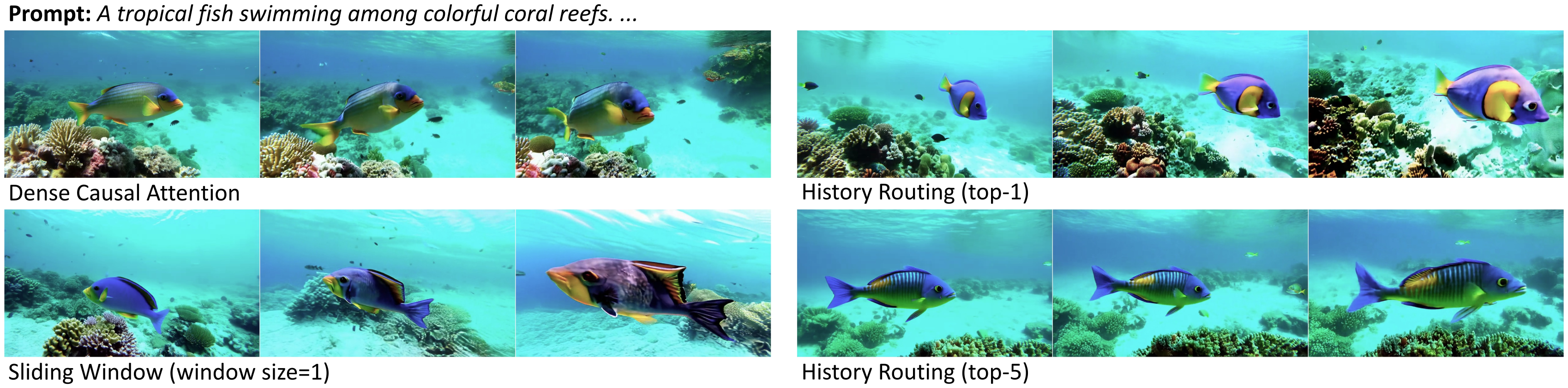
Figure 7 解读: 四种历史注意力策略对比。Dense Causal Attention 效果最好但计算量线性增长。History Routing top-5 (75% 稀疏) 质量接近 dense,显著优于 Sliding Window (size=1) 和 top-1 routing。即使 top-1 (95% 稀疏) 也优于等价稀疏度的 sliding window,说明动态路由比固定窗口能选择更有信息量的上下文。
History Routing 频率分析
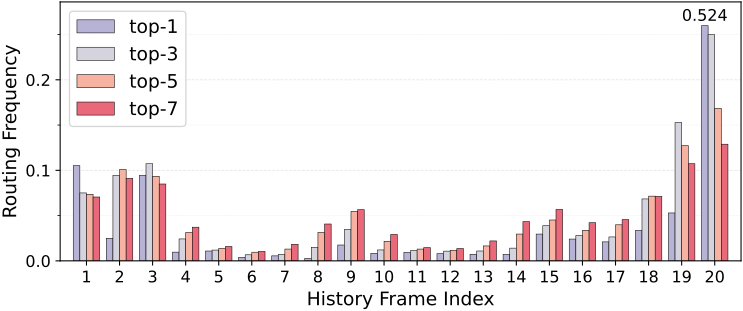
Figure 8 解读: 生成第 21 帧时,前 20 帧被路由选中的频率分布。呈现 “sliding window + attention sink” 的混合模式 — 模型优先关注最近的帧和初始帧 (anchor frames)。 时这种模式最极端, 增大后选择更均匀,覆盖中间帧。这验证了近期 “frame sinks + sliding window” 注意力设计是 dynamic routing 的一个特例。
5.4 代码-论文对应关系
由于 Resampling Forcing 尚未开源,以下基于相关工作 Self Forcing (github.com/guandeh17/Self-Forcing) 的代码结构进行推测性映射:
| 论文组件 | 推测代码位置 | 说明 |
|---|---|---|
| AR Video Diffusion Model | model/ | 基于 WAN2.1 的 DiT 架构,需添加 per-frame timestep conditioning |
| Causal Mask | model/ 或 wan/ | 论文使用 torch.flex_attention() 实现 sparse causal mask |
| Self-Resampling | trainer/ | 训练循环中 no-grad 阶段,自回归调用模型生成退化帧 |
| KV Cache | model/ + pipeline/ | 重采样和推理共用的 KV cache 机制 |
| History Routing | model/ attention layers | Top-K 路由 + flash_attn_varlen_func() 双分支注意力 |
| Training Loop | trainer/ + train.py | 两阶段: resampling (no grad) → parallel training (grad) |
| Euler Solver | pipeline/ | 推理 32 steps Euler;重采样 1-step Euler |
| Timestep Shifting | trainer/ 或 utils/ | LogitNormal 采样 + shift 公式 |
总结
Resampling Forcing 提出了一种优雅的 teacher-free 端到端训练框架:
- Self-Resampling 用在线模型自身的误差替代外部 teacher 信号,是对 Scheduled Sampling (NLP) 思想在 diffusion 领域的精妙适配
- Autoregressive Error Simulation 准确模拟推理时的误差累积模式,优于简单噪声增强或并行重采样
- History Routing 以无参数 top-K 路由实现近恒定注意力复杂度,且路由自动学到了 “attention sink + sliding window” 模式
- 整体方法简洁、不引入额外参数或模型,在 1.3B 模型上即达到需要 14B teacher 的蒸馏方法的可比质量,且在长视频因果一致性上更优