1. Motivation (研究动机)
长视频生成的核心挑战是质量、效率和交互性三者兼得:
- Diffusion/Diffusion-Forcing 模型:质量好,但双向注意力无法使用 KV cache,推理效率极低。例如 SkyReels-V2 在 H100 上生成 60 秒视频需约 50 分钟
- Causal AR 模型:可以用 KV cache 加速,但普遍采用 train-short-test-long 策略——训练在 5 秒短片上,推理时误差累积导致长视频质量逐渐退化(content drift)
- 交互式生成:用户需要在生成过程中切换 prompt,但现有模型在 prompt 切换时要么视觉不连续(清空 KV cache),要么忽略新 prompt(保留旧 KV cache)
- MAGI-1 虽然支持交互,但 prompt 切换需要手动调整不同步骤的 KV-cache 窗口,不实用
核心矛盾:train-short 导致 test-long 质量退化,KV cache 中的旧 prompt 语义导致交互切换失败。
2. Idea (核心思想)
LongLive 的核心 insight:通过 KV-recache 刷新缓存语义 + streaming long tuning 对齐训练推理 + frame sink 保持长程一致性,可以用 1.3B 小模型实现实时交互式长视频生成。
三个关键设计:
- KV-recache:prompt 切换时,用已生成视频 + 新 prompt 重新计算 KV cache,擦除旧 prompt 残留语义,同时保持视觉连续性
- Streaming Long Tuning:train-long-test-long 策略,训练时就让模型在自身不完美输出上滚动生成长序列,消除 train-test mismatch
- Short Window Attention + Frame Sink:限制注意力窗口到近邻帧(效率),同时保留第一帧 chunk 的 KV 作为全局锚点(一致性)
最终:1.3B 模型,单卡 H100 上 20.7 FPS,支持 240 秒视频,32 GPU-days 完成微调。
3. Method (方法)
3.1 整体架构
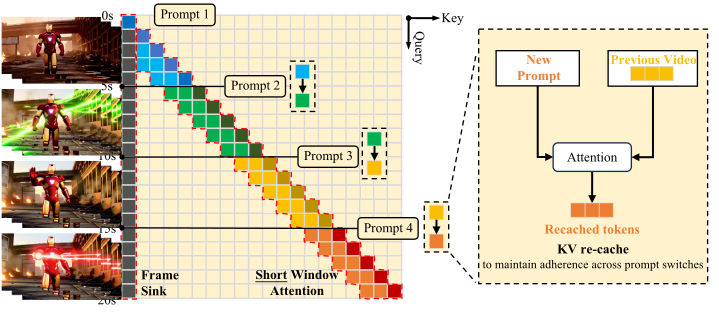
Figure 2 解读:左侧展示了 LongLive 的 Short Window Attention + Frame Sink 机制——attention mask 呈阶梯状,每个 query 只关注最近 帧(蓝色区域)和最底部的 frame sink(绿色区域)。右侧展示了 KV-recache 机制——prompt 切换时,用已生成视频 + 新 prompt 重新计算 KV cache 中的 token(橙色 → 绿色)。
LongLive 是基于 Wan2.1-T2V-1.3B 的 frame-level causal AR video diffusion model。核心架构改动:
- 将双向注意力改为 causal attention,继承 KV cache 机制
- 通过 Self-Forcing + DMD 蒸馏初始化为 few-step 生成器
- 引入 KV-recache、Streaming Long Tuning、Short Window Attention + Frame Sink
训练流程分两阶段:
- Stage 1 (Init):Self-Forcing + DMD 蒸馏,将双向模型转为 causal AR few-step 模型,同时启用 short window attention 和 frame sink
- Stage 2 (Long Tuning):Streaming Long Tuning,在 60 秒长序列上用 KV-recache 训练交互能力
3.2 KV-Recache
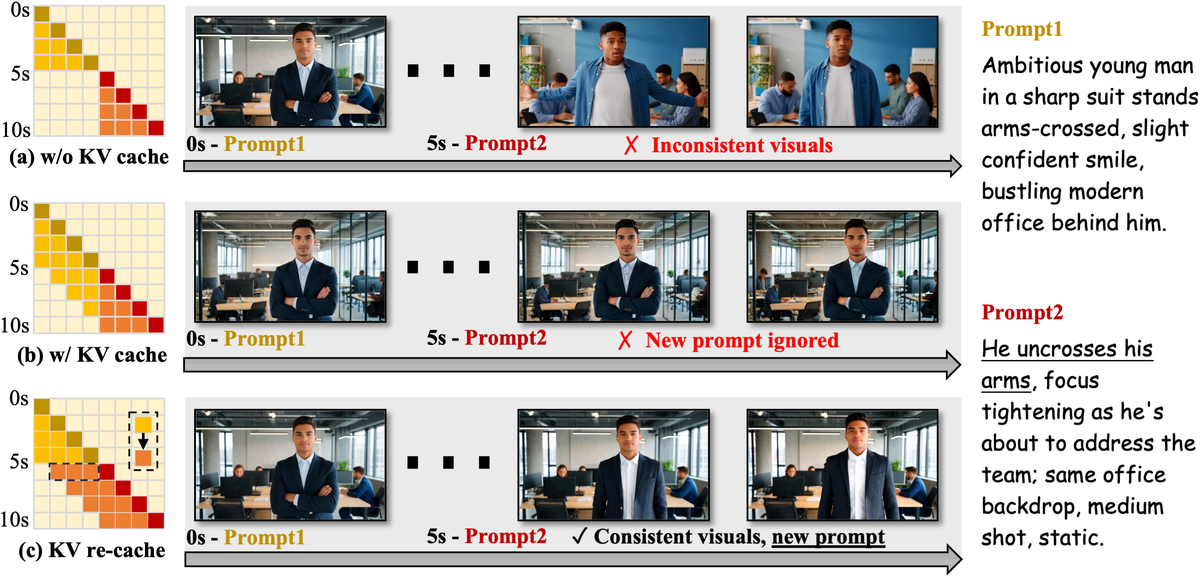
Figure 3 解读:对比三种 prompt 切换策略。(a) 清空 KV cache:Prompt 2 立即生效(人物开始新动作),但画面出现突变,背景和人物外观不连续。(b) 保留 KV cache:画面连续流畅,但 Prompt 2 被忽略——人物仍然按 Prompt 1 的指令行动。(c) KV-recache(本文方法):画面连续 + Prompt 2 立即生效,人物在保持外观一致的同时执行了新动作。
问题诊断:在 DiT 架构中,cross-attention 层不断将 prompt 语义注入 KV cache,self-attention 层将其传播。prompt 切换后,旧 prompt 的残留语义仍留在 cache 中,导致模型无法跟随新 prompt。
- 清空 KV cache(图 3a):新 prompt 立即生效,但视觉不连续
- 保留 KV cache(图 3b):视觉连续,但新 prompt 被忽略或延迟响应
- KV-recache(图 3c):视觉连续 + 新 prompt 立即生效
机制:在 prompt 切换边界,用已生成的视频帧 + 新 prompt 重新前向传播一次,重建 KV cache。旧 prompt 语义被擦除,视觉上下文被保留。
def kv_recache(model, kv_cache, generated_frames, new_prompt, window_size):
    """Refresh KV cache at prompt switch boundary."""
    # Take the most recent W generated frames as visual context
    visual_context = generated_frames[-window_size:]

    # Encode new prompt
    new_prompt_emb = text_encoder(new_prompt)

    # Recompute KV cache: visual context + new prompt semantics
    # This erases old prompt residual while keeping visual continuity
    kv_cache_new = model.recompute_kv(
        video_frames=visual_context,
        prompt_embedding=new_prompt_emb,
        kv_cache=kv_cache,  # rewrite in-place
    )
    # Subsequent frames generated normally with refreshed cache
    return kv_cache_new
源码参考:
wan/modules/causal_model.py→_apply_cache_updates()实现roll_and_insert(滚动插入)和direct_insert(直接插入),在 prompt 切换时触发 recompute。Recache 仅在切换边界调用一次,额外开销约 6%。
训练对齐:训练时也集成 recache 操作——每个训练样本包含一次 prompt 切换,切换时执行 recache + 用新 prompt 给 teacher 提供监督,确保 train-inference 一致。
3.3 Streaming Long Tuning
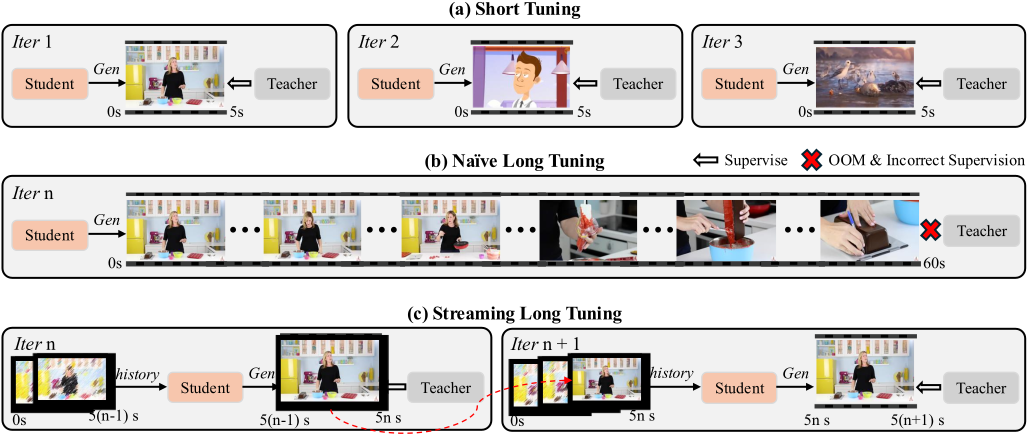
Figure 4 解读:对比三种训练策略。(a) Short Tuning:每次只训练独立的 5s clip,Teacher 能可靠监督,但模型从未见过长序列。(b) Naive Long Tuning:直接在 60s 长序列上训练,但 Teacher 对长序列不可靠(它也只见过 5s),且反向传播整个序列会 OOM。(c) Streaming Long Tuning(本文方法):每次迭代从 KV cache 中取出历史上下文(detach,不回传梯度),生成下一个 5s clip,Teacher 只监督当前 clip(可靠)。这样训练 schedule 完全镜像推理流程。
问题:现有 AR 模型在 5 秒短片上训练(short tuning),推理时 rolling context window 中误差累积,长视频质量逐渐退化。直接在长序列上训练(naive long tuning)会 OOM 且 teacher 对长序列不可靠。
解决方案:Streaming Long Tuning——迭代式生成+监督:
def streaming_long_tuning(generator, teacher, prompt_pair, l_video=60, l_clip=5):
    """Train on long sequences with streaming KV cache and per-clip DMD supervision."""
    kv_cache = initialize_empty()
    current_length = 0

    while current_length < l_video:
        # Select active prompt (switch at random point)
        if current_length < switch_time:
            p_active = prompt_pair[0]
        else:
            p_active = prompt_pair[1]

        # At switch boundary: perform KV recache
        if current_length == switch_time:
            kv_cache = recache(generator, kv_cache, generated_frames, p_active)

        # Generate next 5s clip, conditioned on KV cache (detached, no grad)
        with torch.no_grad():
            clip = generator.rollout(kv_cache, p_active, num_frames=l_clip)

        # DMD supervision: teacher supervises only current 5s clip (reliable)
        loss = dmd_loss(generator, teacher, clip, p_active, kv_cache)
        loss.backward()  # gradients only for current clip
        optimizer.step()

        # Extend KV cache with generated clip (detached as constant context)
        kv_cache = extend_cache(kv_cache, clip.detach())
        current_length += l_clip

        # Reset when reaching max length
        if current_length >= l_video:
            kv_cache = initialize_empty()
            current_length = 0
关键设计:
- 每次迭代只生成一个 5 秒 clip,teacher 对 5 秒片段是可靠的
- 之前生成的 clip detach 后作为常量上下文,梯度只流过当前 clip → 避免 OOM
- 训练 schedule 完全镜像推理流程,消除 train-test mismatch
源码参考:
pipeline/streaming_training.py→StreamingTrainingPipeline,KV cache 通过_initialize_kv_cache()预分配,通过clear_kv_cache()重置。pipeline/self_forcing_training.py用于 Stage 1 初始化。
3.4 Short Window Attention + Frame Sink
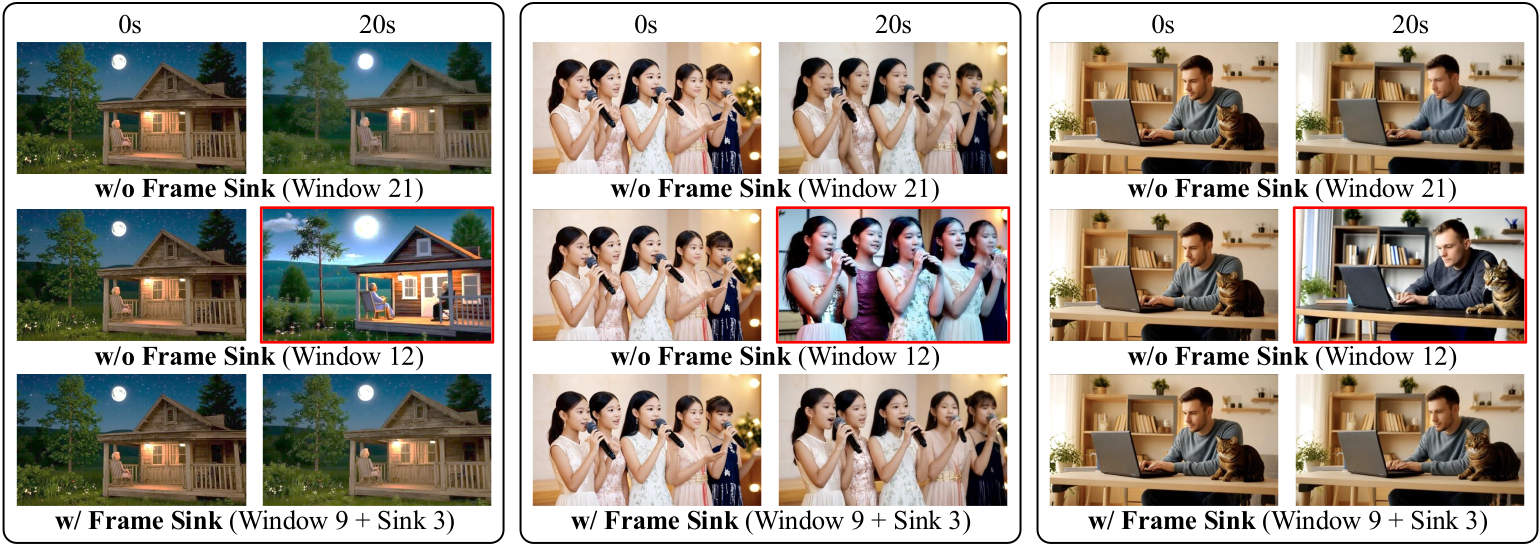
Figure 5 解读:每列展示同一个 prompt 在 20 秒内的生成效果。第一行(Window 21,全窗口):质量好但计算量大。第二行(Window 12,缩小窗口):效率提升但人物外观开始漂移(发型、衣服颜色变化)。第三行(Window 9 + Sink 3,本文方法):窗口更小但加入 frame sink 后,人物一致性恢复到接近全窗口水平。
Short Window Attention:将 causal attention 限制到最近 帧(而非全序列),注意力复杂度从 降到 ,KV cache 大小与窗口成正比而非与总长度成正比。
问题:缩小窗口提升效率但损失长程一致性(远处的关键视觉线索被丢弃)。
Frame Sink:保留第一帧 chunk( 个 latent frame)的 KV token,永远不被驱逐出 cache。这些 sink token 拼接到每层的 KV cache 中,即使在短窗口下也全局可见。
def short_window_attention_with_frame_sink(q, k, v, kv_cache,
                                           local_window=9, sink_size=3,
                                           frame_seqlen=1560):
    """Attention with local window + persistent frame sink tokens."""
    sink_tokens = sink_size * frame_seqlen  # first 3 frames always visible

    # Attention mask: allow current frame to attend to:
    # 1. Sink tokens (always visible, frames 0..S-1)
    # 2. Local window (most recent W frames)
    def mask_fn(q_idx, kv_idx):
        is_sink = kv_idx < sink_tokens
        is_local = (kv_idx >= ends[q_idx] - local_window * frame_seqlen) & (kv_idx < ends[q_idx])
        return is_sink | is_local

    # KV cache eviction: roll out old tokens but protect sink region
    if cache_full:
        num_evicted = num_new_tokens + local_end - cache_size
        num_rolled = local_end - num_evicted - sink_tokens
        # Roll only the non-sink, non-recent portion
        cache["k"][sink_tokens:sink_tokens+num_rolled] = cache["k"][num_evicted+sink_tokens:local_end]

    output = flex_attention(q, k, v, block_mask=mask_fn)
    return output
实际配置:Window 9 + Sink 3 = 有效窗口 12 帧,效果接近 Window 21(全注意力),但计算减少 28%,显存减少 17%。
源码参考:
wan/modules/causal_model.py→attention_mask()定义 flex_attention mask,_apply_cache_updates()中roll_and_insert保护 sink region。
3.5 代码-论文映射
| 论文概念 | 源码文件 | 关键类/函数 |
|---|---|---|
| KV-recache 机制 | wan/modules/causal_model.py | _apply_cache_updates(), roll_and_insert, direct_insert |
| Frame Sink | wan/modules/causal_model.py | sink_size, sink token 保护逻辑 |
| Short Window Attention | wan/modules/causal_model.py | attention_mask() + flex_attention |
| Causal AR forward | wan/modules/causal_model.py | _forward_inference(), patch_embedding |
| Streaming Long Tuning | pipeline/streaming_training.py | StreamingTrainingPipeline, _initialize_kv_cache() |
| Self-Forcing + DMD init | pipeline/self_forcing_training.py | Self-Forcing 训练 pipeline |
| DMD distillation | model/dmd.py | DMD 蒸馏逻辑 |
| Interactive inference | pipeline/interactive_causal_inference.py | 多 prompt 交互推理 |
| Training entry | train.py | 训练入口 |
| Inference entry | inference.py, interactive_inference.py | 推理入口 |
4. Experimental Setup (实验设置)
- 基础模型: Wan2.1-T2V-1.3B(16 FPS,832×480,5s clips)
- 训练硬件: 64 H100 GPUs
- 训练时间: ~12 小时(32 GPU-days)
- 训练数据: 不需要额外视频数据,采用 self-supervised 方法。用 Qwen2-72B-Instruct 从 VidProM 数据集生成 follow-up prompt pairs
- 训练配置:
- Stage 1 (Init): Self-Forcing + DMD 蒸馏,启用 short window attention (window=9) + frame sink (sink=3)
- Stage 2 (Long Tuning): 60s 序列,每 batch 包含一次 prompt 切换(切换时间 5s~55s 均匀采样),3000 iterations
- Optimizer: AdamW,lr_actor = ,lr_critic =
- LoRA rank 256(约 350M 可训练参数,占 27%)
- EMA decay 0.99,batch size 64(1 sample/GPU × 64 GPUs)
- Benchmark:
- 短视频: VBench(5s clips)
- 长视频: VBench-Long(30s single-prompt)
- 交互式: 自建 160 个 60s 交互视频数据集(6 个 10s segments,含 prompt 切换)
- 评估维度: Total Score, Quality Score, Semantic Score(VBench); CLIP Score(交互式语义一致性); Background/Subject Consistency(VBench-Long)
- Baselines: LTX-Video (1.9B), Wan2.1 (1.3B), SkyReels-V2 (1.3B), MAGI-1 (4.5B), CausVid (1.3B), NOVA (0.6B), Pyramid Flow (2B), Self-Forcing chunk/frame-wise (1.3B), FramePack
5. Experimental Results (实验结果)
短视频(5s, VBench)
| Model | Params | Resolution | FPS↑ | Total↑ | Quality↑ | Semantic↑ |
|---|---|---|---|---|---|---|
| LTX-Video | 1.9B | 768×512 | 8.98 | 80.00 | 82.30 | 70.79 |
| Wan2.1 | 1.3B | 832×480 | 0.78 | 84.26 | 85.30 | 80.09 |
| SkyReels-V2 | 1.3B | 960×540 | 0.49 | 82.67 | 84.70 | 74.53 |
| MAGI-1 | 4.5B | 832×480 | 0.19 | 79.18 | 82.04 | 67.74 |
| CausVid | 1.3B | 832×480 | 17.0 | 81.20 | 84.05 | 69.80 |
| Self-Forcing (chunk) | 1.3B | 832×480 | 17.0 | 84.31 | 85.07 | 81.28 |
| Self-Forcing (frame) | 1.3B | 832×480 | 8.9 | 84.26 | 85.25 | 80.30 |
| LongLive | 1.3B | 832×480 | 20.7 | 84.87 | 86.97 | 76.47 |
- LongLive 以 20.7 FPS 达到最快速度,同时 Total Score 84.87 匹配最强 baselines
- Quality Score 86.97 是所有模型中最高的
长视频(30s, VBench-Long)
| Model | Total↑ | Quality↑ | Semantic↑ | FPS↑ |
|---|---|---|---|---|
| SkyReels-V2 | 75.29 | 80.77 | 53.37 | 0.49 |
| FramePack | 81.95 | 83.61 | 75.32 | 0.92 |
| Self-Forcing (chunk) | 81.59 | 83.82 | 72.70 | 17.0 |
| LongLive | 83.52 | 85.44 | 75.82 | 20.7 |
- LongLive 在所有指标上都是 SOTA,且速度最快
交互式长视频(60s, 多 prompt 切换)
| Method | Quality Score↑ | CLIP 0-10s↑ | CLIP 10-20s↑ | CLIP 20-30s↑ | CLIP 30-40s↑ | CLIP 40-50s↑ | CLIP 50-60s↑ |
|---|---|---|---|---|---|---|---|
| SkyReels-V2 | 80.49 | 20.96 | 22.51 | 25.78 | 18.45 | 19.57 | 19.61 |
| Self-Forcing | 82.46 | 28.46 | 24.89 | 23.53 | 22.96 | 23.07 | 23.19 |
| LongLive | 84.38 | 28.85 | 25.68 | 24.64 | 24.23 | 24.32 | 24.32 |
- LongLive 在长时段(30-60s)的 CLIP score 显著优于 baselines,说明 KV-recache 有效保持了 prompt 遵循
- 用户研究(26 人,1248 judgments):LongLive 在 Overall (69.2%)、Motion Quality (67.8%)、Instruction Following (69.8%)、Visual Quality (63.2%) 上全面领先
消融实验
KV-recache 消融(Table 4):
| Method | Background Consistency↑ | Subject Consistency↑ | CLIP Score↑ |
|---|---|---|---|
| No KV cache | 92.75 | 89.59 | 28.95 |
| KV cache (保留) | 94.77 | 93.69 | 25.92 |
| KV recache | 94.81 | 94.04 | 27.87 |
- KV recache 同时实现最好的一致性和较高的语义对齐
Streaming Long Tuning 消融(隐含在 Table 1 中):
- Self-Forcing (chunk/frame) 代表 short tuning baseline(仅训练 5s clip)
- LongLive 在 Total Score 上从 84.31(Self-Forcing chunk, short tuning)提升到 84.87(streaming long tuning),同时 FPS 从 17.0 提升到 20.7
- 论文 Section 3.2 指出:streaming long tuning 不仅提升长视频质量,也是启用高效推理策略(window attention + frame sink)的前提条件
Window Size + Frame Sink 消融(Figure 7):
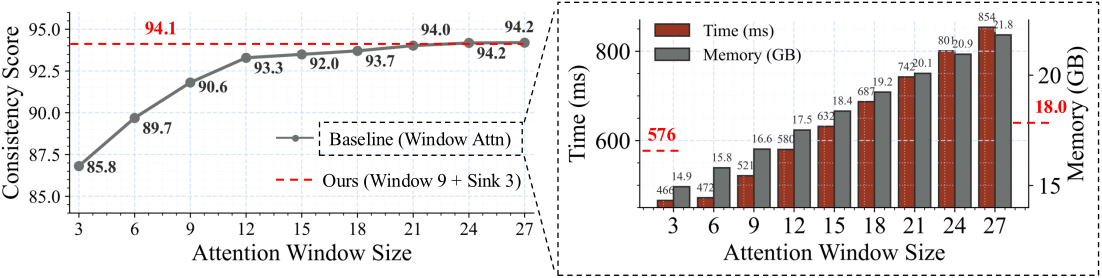
Figure 7 解读:左图展示 Consistency Score 随窗口大小的变化——蓝色虚线(无 frame sink)在小窗口时急剧下降,红色实线(有 frame sink, Window 9 + Sink 3)在 Window=9 时就达到 94.1,接近 Window=24 的饱和值 94.2。右图展示计算时间和显存随窗口大小线性增长,Window 9 + Sink 3 在效率和质量之间取得最佳平衡。
- Consistency 在 Window=24 时饱和(~94.2)
- Window 9 + Sink 3 达到 94.2,接近 Window 21(94.0),但计算时间减少 28%,显存减少 17%
- 无 Frame Sink 时,Window 9 的 Consistency 仅 90.6
局限性(Appendix M)
- 性能上限受基础模型(Wan2.1-1.3B)约束,短片段质量不会超过 base model
- 采用 self-supervised 微调,不使用额外真实视频数据,无法纠正 base model 的系统性错误
- 增益主要在长程适应和稳定化,而非绝对质量天花板