Unified Video Action Model (UVA)
Authors: Shuang Li, Yihuai Gao, Dorsa Sadigh, Shuran Song Affiliations: Stanford University arXiv: 2503.00200 Project Page: unified-video-action-model.github.io GitHub: ShuangLI59/unified_video_action Venue: RSS 2025
1. Motivation (研究动机)
- 视频生成与动作预测的矛盾需求: Action modeling 需要 高时间频率 来捕捉密集、细粒度的运动,而 Video generation 需要 高空间分辨率 来生成高保真视觉输出,后者往往导致处理速度变慢。现有方法难以同时满足这两个需求。
- Action-only 方法的局限: Diffusion Policy 等纯动作方法完全跳过视频生成,虽然减少了计算复杂度,但丧失了视频生成带来的好处——视频监督帮助模型学习场景动态,减少对动作历史的过拟合,并增强对视觉扰动的鲁棒性。
- Video generation 方法的局限: UniPi 等先生成视频再预测动作的分层方法,存在 推理速度慢 和 误差传播 两大问题。生成的视频中的误差会累积传递到动作预测中。
- 核心问题: 如何在一个统一框架中同时进行视频和动作建模,既保留视频生成对动作学习的增益,又实现高速动作推理?
2. Idea (核心思想)
UVA 的核心洞察是:联合训练视频和动作的统一 latent 表示,但在解码阶段解耦它们。
具体来说,UVA 通过三个关键设计实现这一目标:
- 统一 Latent Video-Action 表示: 通过一个 Transformer 学习融合视觉和动作信息的联合 latent space,让视频和动作域之间的交互信息在 latent 层面充分建模。
- 解耦 Video-Action Diffusion: 使用两个独立的轻量级 Diffusion Head 分别解码视频和动作。推理时可以跳过视频生成,直接从联合 latent 解码动作,达到接近 action-only 方法的推理速度。
- Masked Training 实现多功能性: 通过随机 mask 输入输出组合,一个模型可同时充当 policy、video model、forward/inverse dynamics model 和 combined policy+planner。
与现有方法的本质区别在于:UVA 不是分层地先生成视频再预测动作(如 UniPi),也不是完全抛弃视频信息(如 Diffusion Policy),而是在 latent space 中实现了 video 和 action 的 真正融合与灵活解耦。
关于 Reinforcement Learning: 本文 不使用 RL。UVA 是一个基于 imitation learning 的框架,通过 Diffusion loss 进行监督学习训练,不涉及 Reward Model、VLM 判断或任何 reward signal。
3. Method (方法)
3.1 Overall Framework
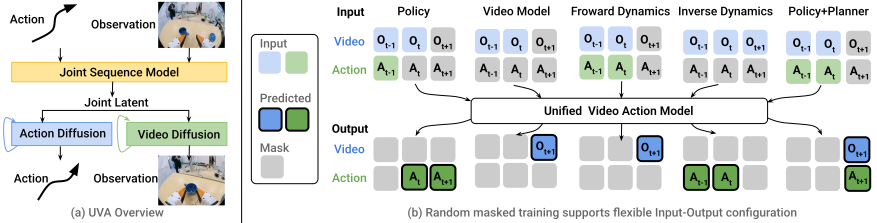
Figure 1 解读: 左侧 (a) 展示 UVA 的整体概览:历史观测和动作输入到一个 Joint Sequence Model(Transformer),产生 Joint Latent 表示,然后通过两个独立的 Diffusion Head 分别解码生成动作和视频观测。右侧 (b) 展示通过不同的 mask 组合实现多种功能:Policy(输入历史观测+动作,输出未来动作)、Video Model(输入历史观测,输出未来视频)、Forward Dynamics(输入观测+动作,输出未来观测)、Inverse Dynamics(输入观测序列,输出动作)、Policy+Planner(输入历史,同时输出未来视频和动作)。
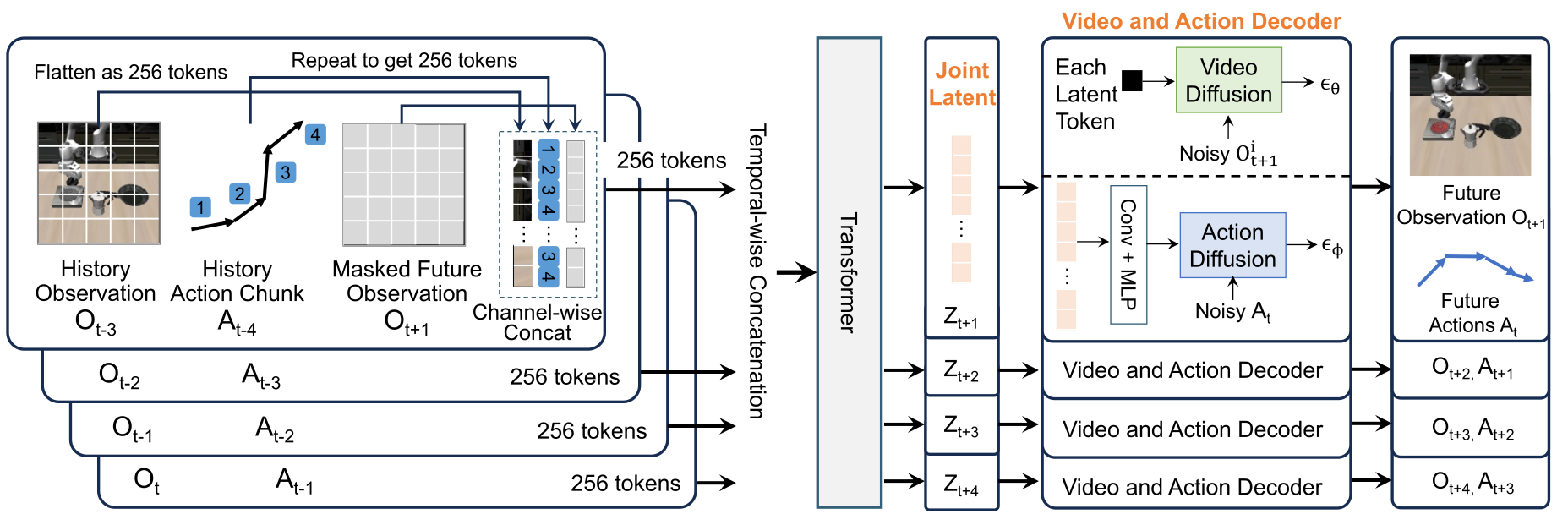
Figure 2 解读: 详细的网络架构图。左侧展示了输入编码过程:历史观测通过 VAE 编码并 flatten 为 个 token,历史动作 chunk 被 repeat 次以匹配视觉 token 数量,未来观测帧的部分 token 被随机 mask。这些 token 经过 channel-wise concatenation 后送入 Temporal-wise Concatenation 模块,再经过 Transformer 得到 Joint Latent 。右侧展示了解码过程:每个 latent token 送入 Video Diffusion 解码为未来观测帧的 patch,所有 latent token 经 aggregation 后送入 Action Diffusion 解码为未来动作序列。
3.2 Encode History (历史编码)
视觉观测编码:
- 历史图像观测 通过预训练的 VAE encoder (kl-f16) 编码为 latent map
- 每张图像被 flatten 后通过 FC 层投影为 个 维 token(,对应 spatial grid)
动作编码:
- 动作采样频率高于视觉观测,每个观测对应 个动作
- 动作 chunk 被 repeat 次以匹配视觉 token 数量
- 通过 FC 层投影为 个 维 action token
位置编码:
- 使用可学习的 temporal position embedding + spatial position embedding(可加性组合)
3.3 Masked Autoencoder for Observation Prediction (视频预测)
UVA 的视频预测方法基于 Masked Autoencoder (MAE) + Diffusion 的组合,受 MaskGIT 和 MAR 方法启发:
- 未来观测帧 同样通过 VAE 编码为 latent token
- 训练时: 随机 mask 部分 visual token(使用 truncated Gaussian 采样 mask ratio,中心在 100%,std=0.25,最小值 0.7),模型学习重建被 mask 的 token
- 推理时: 从全空 mask 开始,逐步自回归地生成所有 token
- 一致性 mask: 为避免信息泄露,所有视频帧在同一空间位置使用相同的 mask pattern
Temporal Concatenation: 来自 个时间步的 latent 表示沿时间维度拼接,形成 的 latent 序列,与历史视觉和动作 token 一起送入 Transformer。
Language Conditioning: 对于需要语言指令的任务(如 Libero10),语言通过 CLIP text encoder 编码为 维 token,repeat 次后 append 到序列中,通过 Transformer 的 cross-attention 融合。
3.4 Decoupled Video and Action Diffusions (解耦 Diffusion 解码)
这是 UVA 最关键的设计之一。与传统方法在整个模型上执行 denoising 不同,UVA 将 denoising 限制在两个轻量级 decoder 中。
Joint Latent : Transformer 输出的联合 video-action latent 表示 ,每个 包含 个 latent token。
Video Diffusion Decoder:
- 对每个 latent token ,使用 Video Diffusion Head 预测对应 patch
- 预测结果 reshape 后送入 VAE decoder 重建完整帧
- 架构: SimpleMLPAdaLN — 一个带 AdaLN modulation 的轻量 MLP,包含 TimestepEmbedder 和多个 ResBlock
Action Diffusion Decoder:
- 对所有 latent token 通过 Conv + FC 网络进行空间聚合(将 spatial grid 降至 再 flatten),生成 action latent
- 通过时间 interpolation(从 4 帧插值到 16 个动作步)和 refinement MLP 得到最终 action condition
- 使用与 Video Diffusion 相同结构的 SimpleMLPAdaLN 作为 Diffusion Head 生成动作 chunk
3.5 Loss Functions (损失函数)
Action Diffusion Loss:
其中 表示加噪后的动作, 是 diffusion timestep, 是添加的噪声, 是以 joint latent 为条件的噪声预测。
Video Diffusion Loss:
其中 是第 个 visual token 在 diffusion timestep 的加噪版本, 是对应的 latent token。
总损失: 每个时间步的损失为两个 diffusion loss 之和:
总损失为所有时间步 上的求和。
3.6 Masked Training with Flexible Objectives (多任务 Mask 训练)
通过在训练中随机选择不同的 task mode,实现一个模型支持多种功能:
| Task Mode | 输入 mask | 输出 | Loss |
|---|---|---|---|
policy_model | 历史观测+动作 → mask 未来视频 | 未来动作 | |
video_model | 历史观测 → mask 部分未来视频 | 未来视频 | |
dynamic_model | 历史观测+动作(含未来动作) | 未来视频 | |
inverse_model | 历史+未来观测 → mask 动作 | 动作 | |
full_dynamic_model | 完整输入 | 视频+动作 |
训练时每个 batch 随机采样一种 task mode,未使用的组件用 learned mask token 替代。
3.7 Pseudocode
Algorithm 1: UVA Forward Pass (Training)
Algorithm: UVA Training Forward Pass
Input: imgs (B, T, C, H, W), cond (B, T, C, H, W), history_nactions, nactions, text_latents, task_mode
Output: loss, video_loss, action_loss

1:  # Patchify images and conditions via VAE
2:  x = patchify(imgs)           # (B, T, seq_len, token_dim)
3:  cond = patchify(cond)        # (B, T, seq_len, token_dim)
4:  gt_latents = x.clone()
5:
6:  # Generate random mask (consistent across temporal frames)
7:  orders = sample_random_orders(B, seq_len)
8:  mask_rate ~ TruncatedGaussian(loc=1.0, std=0.25, min=0.7)
9:  mask = create_spatial_mask(orders, mask_rate)  # same mask for all T frames
10:
11: # === MAE Encoder ===
12: if task_mode == "policy_model":
13:     cond_tokens = z_proj_cond(cond)
14:     x_tokens = fake_latent_x.expand(B, T*S, d)   # all masked
15: elif task_mode == "inverse_model":
16:     x_tokens = z_proj(x)                           # future obs visible
17:     cond_tokens = fake_latent_x.expand(...)         # history masked
18: else:
19:     cond_tokens = z_proj_cond(cond)
20:     x_tokens = z_proj(x)
21:     x_tokens[mask == 1] = fake_latent_x            # partial mask
22:
23: # Concatenate all modality tokens
24: action_tokens = action_proj_cond(nactions) if dynamic_model else fake_action_latent
25: combined = cat([x_tokens, cond_tokens, action_tokens], dim=-1)
26: combined = proj_cond_x_layer(combined)
27: combined = combined + temporal_pos_embed + spatial_pos_embed
28:
29: # Optional: append language tokens
30: if text_latents is not None:
31:     combined = cat([text_proj(text_latents), combined], dim=1)
32:
33: # Transformer Encoder
34: for block in encoder_blocks:
35:     combined = block(combined)
36: encoder_out = encoder_norm(combined)
37:
38: # === MAE Decoder ===
39: z = decoder_embed(encoder_out)
40: z = z + decoder_pos_embed
41: for block in decoder_blocks:
42:     z = block(z)
43: z = decoder_norm(z) + diffusion_pos_embed
44:
45: # === Compute Losses ===
46: video_loss = diffloss(z, gt_latents, mask)
47: action_loss = diffactloss(z, nactions)
48: loss = video_loss + action_loss  # depends on task_mode
49: return loss, video_loss, action_loss
Algorithm 2: Action Diffusion Head (DiffActLoss)
Algorithm: Action Diffusion Decoder
Input: z (B, T*S, d) - joint latent, target (B, num_actions, act_dim) - ground truth actions
Output: action_loss

1:  # Spatial aggregation: reshape latent to spatial grid
2:  z = rearrange(z, "B (T S) d -> (B*T) S d", T=4)
3:  z = rearrange(z, "(B*T) (W H) d -> (B*T) d W H", W=16)
4:
5:  # Conv + Pool to reduce spatial dimensions
6:  z = Conv2d(z)                    # (B*T, d, 16, 16) -> (B*T, d, 4, 4)
7:  z = AdaptiveAvgPool2d(z, (4,4))
8:  z = flatten(z)                   # (B*T, d*4*4)
9:  z = FC(z)                        # (B*T, d)
10:
11: # Temporal interpolation: 4 frames -> 16 action steps
12: z = rearrange(z, "(B T) d -> B T d", T=4)
13: z = Linear_interp(z, 4 -> 16)    # (B, 16, d)
14: z = refine_MLP(z)                 # (B, 16, d)
15:
16: # Diffusion training loss
17: z = rearrange(z, "B T d -> (B*T) d")
18: target = rearrange(target, "B T act_dim -> (B*T) act_dim")
19: t = randint(0, num_diffusion_steps, (B*T,))
20: loss = diffusion_training_loss(SimpleMLPAdaLN, target, t, condition=z)
21: return mean(loss)
Algorithm 3: Video Diffusion Head (DiffLoss)
Algorithm: Video Diffusion Decoder
Input: z (B, T*S, d) - joint latent per token, target (B, T*S, token_dim) - GT visual tokens, mask (B, T*S)
Output: video_loss

1:  # Reshape for per-token diffusion
2:  target = rearrange(target, "B S d -> (B*S) d")
3:  z = rearrange(z, "B S d -> (B*S) d")
4:  mask = rearrange(mask, "B S -> (B*S)")
5:
6:  # Sample diffusion timestep per token
7:  t = randint(0, num_diffusion_steps, (B*S,))
8:
9:  # Compute diffusion loss (noise prediction MSE)
10: loss = diffusion_training_loss(SimpleMLPAdaLN, target, t, condition=z)
11:
12: # Only compute loss on masked positions
13: loss = (loss * mask).sum() / mask.sum()
14: return loss
Algorithm 4: Masked Training Strategy
Algorithm: Masked Training Mode Selection
Input: batch data, task_modes list
Output: total loss

1:  # Randomly select a task mode for this batch
2:  selected_mode = random.choice(task_modes)
3:  # task_modes = ["video_model", "dynamic_model", "policy_model",
4:  #               "inverse_model", "full_dynamic_model"]
5:
6:  # Process data: VAE encode, normalize, extract trajectories
7:  x, z, cond = get_vae_latent(batch_images, vae_model)
8:  history_traj, future_traj = get_trajectory(actions)
9:
10: # Forward pass with selected mode
11: loss, video_loss, act_loss = model(z, cond, history_traj, future_traj,
12:                                     text_latents, task_mode=selected_mode)
13:
14: # In forward_loss:
15: if selected_mode in ["video_model", "dynamic_model"]:
16:     total_loss = video_diffusion_loss          # only video
17: elif selected_mode in ["policy_model", "inverse_model"]:
18:     total_loss = action_diffusion_loss          # only action
19: elif selected_mode == "full_dynamic_model":
20:     total_loss = video_diffusion_loss + action_diffusion_loss  # both
21:
22: return total_loss
3.8 Code-to-Paper Mapping Table
| Paper Concept | Source File | Key Class/Function |
|---|---|---|
| 整体 Policy 封装 | policy/unified_video_action_policy.py | UnifiedVideoActionPolicy |
| MAR Transformer (Joint Latent) | model/autoregressive/mar_con_unified.py | MAR |
| MAE Encoder | model/autoregressive/mar_con_unified.py | MAR.forward_mae_encoder() |
| MAE Decoder | model/autoregressive/mar_con_unified.py | MAR.forward_mae_decoder() |
| Video Diffusion Head | model/autoregressive/diffusion_loss.py | DiffLoss, SimpleMLPAdaLN |
| Action Diffusion Head | model/autoregressive/diffusion_action_loss.py | DiffActLoss |
| Gaussian Diffusion 实现 | model/autoregressive/diffusion/gaussian_diffusion.py | GaussianDiffusion |
| 损失计算 (task mode routing) | model/autoregressive/mar_con_unified.py | MAR.forward_loss() |
| 训练 Workspace | workspace/train_unified_video_action_workspace.py | TrainUnifiedVideoActionWorkspace.run() |
| Random Masking | model/autoregressive/mar_con_unified.py | MAR.random_masking() |
| Token Sampling (推理) | model/autoregressive/mar_con_unified.py | MAR.sample_tokens() |
| VAE Encoder/Decoder | vae/vaekl.py | AutoencoderKL |
| 数据处理与归一化 | utils/data_utils.py | process_data(), get_vae_latent() |
| 训练配置 | config/model/uva.yaml | YAML config |
4. Experimental Setup (实验设置)
数据集与任务
仿真环境:
- PushT: 推灰色 T 块对齐目标位置(单任务),50 rollouts 取最佳 checkpoint 成功率
- ToolHang: 将钩子插入底座并挂上扳手(单任务),RoboMimic 最难任务之一
- PushT-M (Multi-goal): PushT 扩展,目标 T 位置多样化(多任务)
- Libero10: 10 个长 horizon 任务,语言指令描述目标,50 个不同环境评估
真实世界:
- 使用 UMI 手持设备采集的公开数据集
- 3 个任务: Cup Arrangement, Towel Folding, Mouse Arrangement
- 在 ARX X5 机械臂上测试,评估包含 OOD 场景(不同物体、背景、机械手颜色)
Baseline 方法
| 方法 | 类型 | 说明 |
|---|---|---|
| DP-C (Diffusion Policy CNN) | Action-only | CNN-based Diffusion Policy |
| DP-T (Diffusion Policy Transformer) | Action-only | Transformer-based Diffusion Policy |
| DP-UMI | Action-only | 针对 UMI 数据优化的 Diffusion Policy + CLIP ViT-B/16 |
| OpenVLA | VLA | 7B Llama 2 基础的 Vision-Language-Action model |
| UniPi | Video-based | 先生成视频再提取动作 |
| / -FAST | VLA | 3.0B/3.3B flow matching VLA model |
| UVA-action | Ablation | UVA 去掉视频生成部分 |
训练配置
- 模型大小: MAR-Base backbone (~171.27M 参数,0.5B 总参数量)
- VAE: 预训练 kl-f16 (16x downsampling, 16-dim latent)
- 图像分辨率: 256x256
- Diffusion steps: 训练 1000 步(action),100 步采样(仿真),16 步采样(真实世界)
- Optimizer: AdamW, lr=1e-4, weight_decay=0.02, betas=(0.9, 0.95)
- LR Schedule: Cosine with 1000 warmup steps
- Batch size: 32
- 混合精度: FP16
- EMA: 使用,power=0.75, max_value=0.9999
- 硬件: 8x H100 GPU,视频预训练约 2 天 + 联合训练约 2 天(UMI 数据集)
5. Experimental Results (实验结果)
5.1 Policy Learning — 仿真
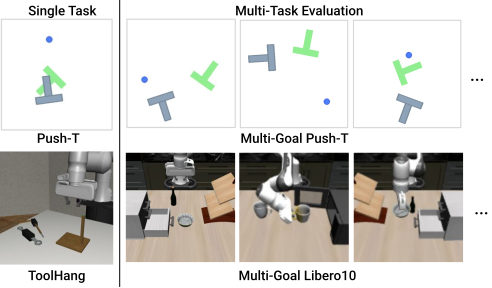
Figure 3 解读: 展示了所有仿真评估环境,包括单任务(PushT, ToolHang)和多任务设置(Multi-Goal PushT-M, Multi-Goal Libero10)。
| 方法 | PushT (单任务) | Tool (单任务) | PushT-M (多任务) | Libero10 (多任务) | Speed |
|---|---|---|---|---|---|
| DP-C | 0.91 | 0.95 | 0.68 | 0.53 | 0.50s |
| DP-T | 0.78 | 0.76 | 0.63 | 0.58 | 0.36s |
| OpenVLA | 0.35 | 0.18 | 0.22 | 0.54 | 1.52s |
| UniPi | 0.42 | 0.00 | 0.19 | 0.00 | 24.07s |
| - | - | - | 0.85 | 0.09s | |
| -FAST | - | - | - | 0.60 | 0.09s |
| UVA-action | 0.45 | 0.62 | 0.46 | 0.86 | 0.22s |
| UVA | 0.98 | 0.88 | 0.88 | 0.90 | 0.23s |
关键发现:
- UVA 在多任务场景中表现尤其突出: PushT-M 比最佳 baseline 高 20%,Libero10 高 5%
- 单任务中 UVA 也能匹配 SOTA(PushT 0.98 vs DP-C 0.91)
- 推理速度 (0.23s) 接近 action-only 方法 DP-T (0.36s)
- UVA-action (去掉视频生成) 性能显著下降,证明联合 video-action 训练的有效性
5.2 Policy Learning — 真实世界
| 方法 | Cup (单任务) | Cup (OOD多任务) | Towel (OOD) | Mouse (OOD) | Speed |
|---|---|---|---|---|---|
| DP-UMI | 0.95 | 0.50 | 0.70 | 0.40 | 70ms |
| UVA | 0.85 | 0.65 | 0.70 | 0.80 | 95ms |
Figure 4 解读: 真实世界 OOD 测试场景,包括不同初始配置 (10%)、不同物体/干扰物 (10%)、不同背景 (8.3%)、不同机械手颜色(未见过的绿色)以及完全不同的任务(Mouse 33.3%, Towel 33.3%)。
关键发现:
- 多任务 OOD 设置下 UVA 明显优于 DP-UMI: Cup +15%, Mouse +40%
- 单任务中 DP-UMI 略优(因其数据含大量 failure recovery 数据,适合无历史依赖的模型)
5.3 视觉鲁棒性
| 方法 | Normal | BgColor | BgObject | GoalColor |
|---|---|---|---|---|
| DP-C | 0.91 | 0.12 | 0.21 | 0.17 |
| DP-T | 0.78 | 0.22 | 0.17 | 0.28 |
| OpenVLA | 0.35 | 0.17 | 0.13 | 0.32 |
| UniPi | 0.42 | 0.31 | 0.36 | 0.40 |
| UVA | 0.98 | 0.35 | 0.31 | 0.64 |
视频生成方法(UVA, UniPi)在视觉扰动下表现更好,UVA 在 GoalColor 变化时达到 64%,远超 OpenVLA 的 32%。
5.4 历史长度鲁棒性
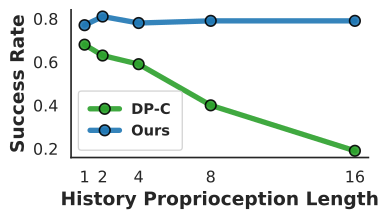
Figure 6 解读: 在 PushT-M 上,DP-C 随着历史长度增加性能下降(过拟合),而 UVA 保持稳定甚至提升。这表明联合 video-action 建模帮助模型更好地利用长时间上下文。
5.5 Video Generation
| 方法 | Libero10 (FVD) | CupArrange (FVD) |
|---|---|---|
| UniPi | 56.55 | 71.37 |
| UVA (1 step) | 89.36 | 51.34 |
| UVA (8 steps) | 51.10 | 29.72 |
UVA 在两个数据集上均优于 UniPi,8 步自回归生成显著提升质量。
5.6 Forward Dynamics Model
| 方法 | R-R | R-G | G-R | G-G | Avg |
|---|---|---|---|---|---|
| DP-C | 0.20 | 0.50 | 0.60 | 0.20 | 0.38 |
| UVA | 0.80 | 0.70 | 0.50 | 0.40 | 0.60 |
| GT-Dynamics | 0.80 | 0.80 | 0.70 | 0.70 | 0.75 |
UVA 作为 forward dynamics model 引导 DP-C policy,将成功率从 38% 提升到 60%。
5.7 Inverse Dynamics Model
| 方法 | Position (L2) | Rotation (L2) |
|---|---|---|
| UniPi Inverse | 1.92 cm | 2.21° |
| UVA | 0.75 cm | 1.11° |
| Visual Inertial SLAM | 0.41 cm | 0.30° |
UVA 大幅优于 UniPi 的逆动力学模型,虽略逊于 SLAM 但实现更简单。
5.8 Inference Speed 分解
| 模块 | 时间 (ms) |
|---|---|
| VAE Image Encoder | 40 |
| Transformer (Attention) | 40 |
| Transformer (Flash Attention) | 30 |
| Action Diffusion (16 steps) | 15 |
| Action Diffusion (100 steps) | 93 |
| Video Diffusion (16 steps) | 100 |
| UVA 总计 (16 steps) | 95 |
| UVA 总计 (100 steps) | 173 |
5.9 Limitations
- 目前未利用大规模无动作标签视频数据进行预训练,限制了在真实世界任务上的泛化能力
- 单任务真实世界场景中仅与 DP-UMI comparable(因 failure recovery 数据对 DP-UMI 更有利)
- Transformer 的 attention 计算占推理时间约一半,可通过 Flash Attention 优化