RynnVLA-002: A Unified Vision-Language-Action and World Model
Authors: Jun Cen, Siteng Huang, Yuqian Yuan, Kehan Li, Hangjie Yuan, Chaohui Yu, Yuming Jiang, Jiayan Guo, Xin Li, Hao Luo, Fan Wang, Deli Zhao, Hao Chen Affiliations: DAMO Academy (Alibaba Group), Hupan Lab, Zhejiang University arXiv: 2511.17502 GitHub: alibaba-damo-academy/RynnVLA-002
1. Motivation (研究动机)
-
VLA 模型的三大根本缺陷: 标准 VLA 架构面临三个核心问题:(1) 无法完全理解 action,因为 action 仅出现在输出端,模型无法形成对 action dynamics 的显式内部表征;(2) 缺乏想象力,无法预测给定 action 后世界状态的变化,阻碍了前瞻性推理和反事实推理;(3) 没有对物理规律的显式理解,无法内化物体交互、接触和稳定性等物理动力学。
-
World Model 的功能缺失: 虽然 World Model 通过学习预测未来观测来弥补上述不足,能提供 action-aware 的内部状态、想象力和物理动力学表征,但 World Model 自身无法直接生成 action 输出,限制了其在需要显式 action planning 场景中的应用。
-
离散 Action Chunk 的误差累积问题: 在自回归模型中,将 action 离散化并与 image/text token 统一到同一 vocabulary 中生成 action chunk 时,由于预训练 MLLM 主要接触的是 image 和 text 而非 action,其在 action domain 的泛化能力有限。后续 action 依赖于前序 action 的生成,导致错误不断传播累积。
-
离散模型在真实机器人上的泛化困难: 离散自回归架构在仿真中表现良好,但在真实机器人实验中泛化能力差、推理速度慢。大型自回归架构在有限真实数据上容易过拟合,且离散 action 生成的顺序性导致动作不连续、推理延迟大。
2. Idea (核心思想)
RynnVLA-002 的核心思想是将 VLA 模型和 World Model 统一在一个自回归 Action World Model 框架中,实现 action 和 image 的理解与生成的联合学习。通过共享的 LLM backbone 参数,VLA 分支学习从视觉观测生成 action,World Model 分支学习从 action 和当前图像预测未来图像状态,两者相互增强:World Model 的图像生成训练目标迫使模型关注被操作物体的运动,从而增强 VLA 对物体交互动力学的注意力;VLA 的视觉理解能力则反过来提升 World Model 的图像生成精度。
与现有方法的根本区别在于:(1) 通过在 Chameleon 架构上构建统一 vocabulary(65536 tokens),实现了 text、image、action、state 四种模态的原生统一;(2) 提出了专门的 action attention mask 策略来解决离散 action chunk 的误差累积问题;(3) 引入了连续 Action Transformer head 来弥补离散模型在真实世界中的泛化和平滑性不足。
3. Method (方法)
3.1 整体框架
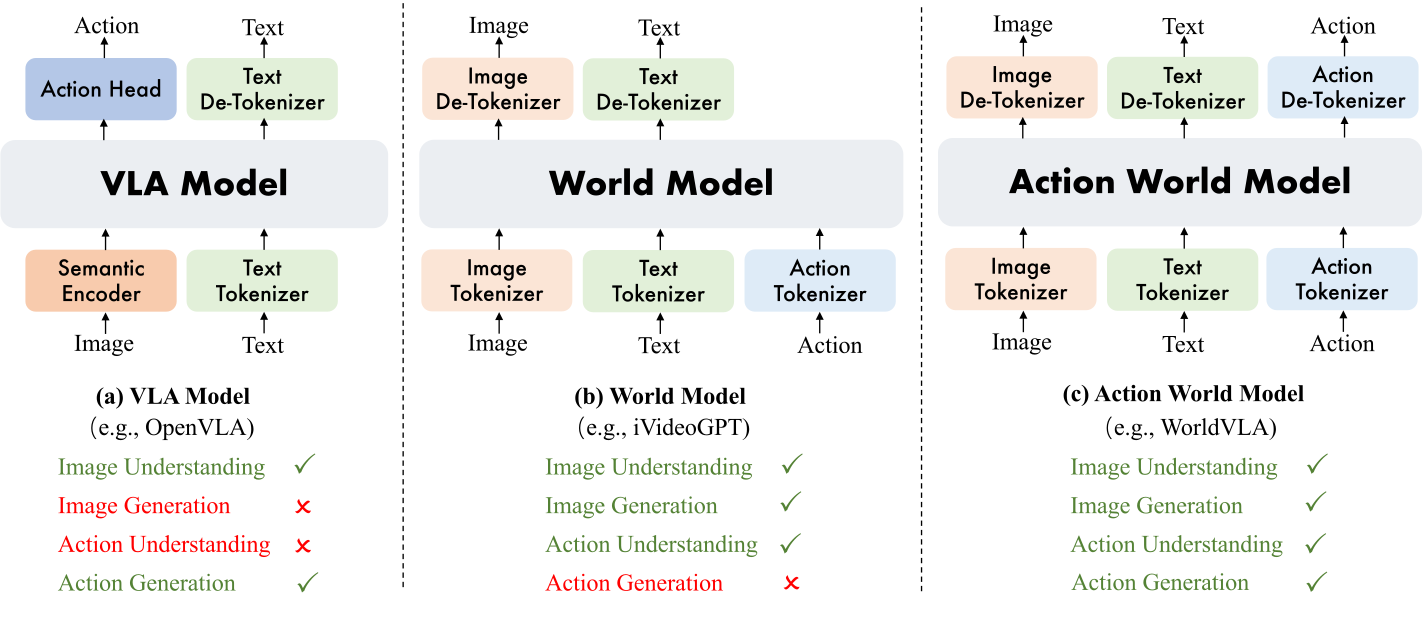
Figure 1 解读: 这张图对比了三种模型范式。(a) VLA Model(如 OpenVLA)仅支持 image understanding 和 action generation,不支持 image generation 和 action understanding;(b) World Model(如 iVideoGPT)支持 image understanding/generation 和 action understanding,但不支持 action generation;(c) Action World Model(如 WorldVLA/RynnVLA-002)同时支持四项能力——image understanding、image generation、action understanding 和 action generation。每种模型底部有对应的 tokenizer(Image/Text/Action Tokenizer),顶部有对应的 de-tokenizer。
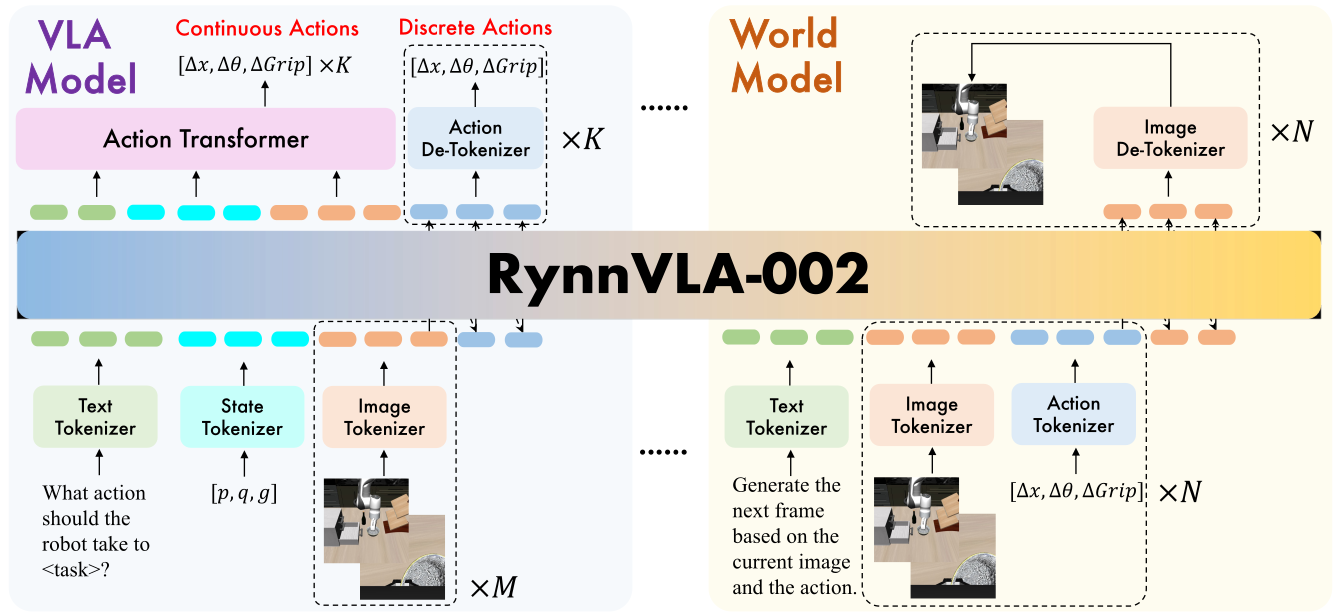
Figure 2 解读: RynnVLA-002 的整体架构图。模型由一个共享的 LLM backbone(中间彩色 token 序列)同时服务两个分支:左侧为 VLA Model 分支,输入包括 Text Tokenizer(语言指令)、State Tokenizer(本体感知状态 )和 Image Tokenizer( 帧历史前置+腕部相机图像),输出通过 Action De-Tokenizer 生成 步离散 action,以及通过 Action Transformer 并行生成 步连续 action ;右侧为 World Model 分支,输入为 Text Tokenizer(生成指令)、Image Tokenizer(当前帧)和 Action Tokenizer( 步 action),输出通过 Image De-Tokenizer 生成 帧预测的未来图像。训练时两个分支混合数据联合优化。
3.2 Data Tokenization
四种 Tokenizer 统一到 65536 大小的共享 vocabulary:
-
Image Tokenizer: 基于 VQ-GAN 模型(Esser et al., 2021),带有额外的 perceptual loss 用于关注 specific image regions(如人脸和显著物体)。压缩比为 16,codebook 大小为 8192。256×256 图像生成 256 tokens,512×512 图像生成 1024 tokens。
-
Text Tokenizer: 继承自 Chameleon 的 BPE tokenizer。
-
State & Action Tokenizer: 将连续的 robot proprioceptive state 和 action 的每个维度离散化为 256 bins,bin 宽度由训练数据范围决定。归一化公式为:
然后通过 np.digitize 映射到对应 bin ID,加上 action start token 的偏移量。
- Continuous Action: Action Transformer 生成的连续 action 为原始 raw action,不经过 tokenization。
3.3 VLA Model 数据格式
VLA 模型的 token 序列结构:
- 文本输入为 “What action should the robot take to + <task> + ?”
- 为历史帧数, 为 action chunk 大小
- 离散 action 的训练损失 为 discrete action token 的 cross-entropy loss
VLA 模型的策略形式化为:
3.4 World Model 数据格式
World Model 的 token 序列结构:
- 文本前缀为 “Generate the next frame based on the current image and the action.”
- 为预测轮数
- 为 discrete image token 的 cross-entropy loss
World Model 形式化为:
3.5 训练目标
混合 VLA 和 World Model 数据联合训练,离散部分的总损失:
加上连续 Action Transformer 的 L1 regression loss 后,最终总损失:
其中 为连续 action loss 的权重系数。
3.6 Attention Mask for Discrete Action Chunk
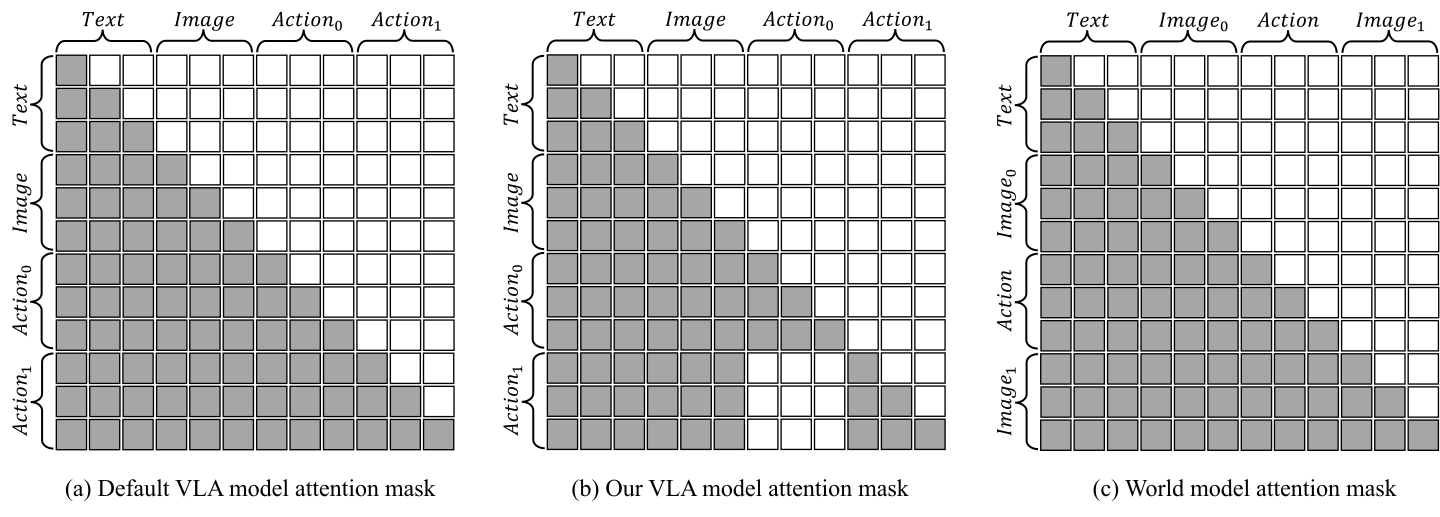
Figure 3 解读: 三种 attention mask 的对比。(a) 默认 VLA 模型使用标准 causal mask,所有 token 都能看到之前的所有 token(包括之前的 action token),这导致生成 action chunk 时后续 action 依赖于前序 action 的预测结果,误差不断累积;(b) RynnVLA-002 提出的 VLA attention mask,action token 之间互相不可见(每个 action 只能看到 text 和 image token),但都能看到所有前序的 text 和 image token,使得每个 action 独立地基于视觉和语言输入生成,有效阻断了误差传播链;(c) World Model 部分保持传统 causal mask,因为图像生成需要 token 之间的顺序依赖。
代码实现(generate_att_mask_3 方法):
- 构建标准下三角 causal mask
- 识别 image block(token 8197/8196 标记)和 action block(token 10004/15004 标记)
- 将最后一个 image block 之后的 action block 之间的 attention 设为不可见
3.7 Action Transformer for Continuous Action Chunk
离散 action chunk 虽然在仿真中表现出色,但在真实机器人中有两个关键问题:(1) 大型自回归架构在有限真实数据上严重过拟合;(2) action mask 使每个 action 独立生成,无法保证 chunk 内动作的时序连续性,导致严重抖动。
Action Transformer 设计:
- 接收 LLM backbone 的 hidden states 作为 context
- 使用可学习的 action token embeddings(
action_token_embeddings) - 通过
hidden_projection降维(默认压缩至 0.25 倍) - 经过多层 Transformer encoder(4 个 attention heads)处理
- 最终由
L1RegressionActionHead(MLP with residual blocks)输出连续 action
关键优势:
- Action Transformer 比 base LLM 小得多,不易过拟合
- 双向 attention 和并行解码,一次 forward pass 输出整个 action chunk
- 生成的动作更平滑连续
3.8 Pseudocode
Algorithm 1: 数据 Tokenization 与序列构建
Algorithm: VLA Data Sequence Construction
Input: language_instruction l, state s, M historical image pairs (front, wrist), K action steps
Output: token_sequence, labels

1: text_tokens = BPE_tokenize("What action should the robot take to + l + ?")
2: state_tokens = []
3: for dim in s:   # 7-dim proprioceptive state
4:     s_norm = 2 * (dim - s_min) / (s_max - s_min + eps) - 1
5:     s_bin = digitize(clip(s_norm, -1, 1), linspace(-1, 1, 256))
6:     state_tokens.append(s_bin + ACTION_START_TOKEN_ID + 1)
7: image_tokens = []
8: for i in 1..M:
9:     front_img = center_crop(front_images[i], 256)
10:    wrist_img = center_crop(wrist_images[i], 256)
11:    front_toks = VQGAN_encode(front_img)  # 256 tokens
12:    wrist_toks = VQGAN_encode(wrist_img)  # 256 tokens
13:    image_tokens.extend([front_toks, wrist_toks])
14: action_tokens = []
15: for k in 1..K:
16:    for dim in action[k]:  # 7-dim action
17:        a_norm = 2 * (dim - a_min) / (a_max - a_min + eps) - 1
18:        a_bin = digitize(clip(a_norm, -1, 1), linspace(-1, 1, 256))
19:        action_tokens.append(a_bin + ACTION_START_TOKEN_ID + 1)
20: token_sequence = text_tokens + state_tokens + image_tokens + action_tokens
21: labels = [-100]*len(text_tokens + state_tokens + image_tokens) + action_tokens
22: return token_sequence, labels
Algorithm 2: Action Attention Mask 构建
Algorithm: Action Attention Mask Generation (generate_att_mask_3)
Input: input_ids (batch of token sequences)
Output: attention_mask [batch_size, seq_len, seq_len]

1: mask = lower_triangular(seq_len)  # standard causal mask
2: for each sequence in batch:
3:     img_blocks = find_blocks(input_ids, start=8197, end=8196)
4:     act_blocks = find_blocks(input_ids, start=10004, end=15004)
5:     last_img_block = img_blocks[-1]
6:     # find action blocks AFTER the last image block
7:     post_img_actions = [b for b in act_blocks if b.start > last_img_block.end]
8:     # make these action blocks invisible to each other
9:     for i, block_i in enumerate(post_img_actions):
10:        for j, block_j in enumerate(post_img_actions):
11:            if i != j:
12:                mask[block_i.start:block_i.end, block_j.start:block_j.end] = 0
13: return mask
Algorithm 3: Action Transformer Forward Pass
Algorithm: Action Transformer Inference
Input: hidden_states H from LLM backbone, input_ids, action_dim=7, time_horizon=K
Output: continuous_actions [batch, K, action_dim]

1: # Extract context hidden states (everything before action tokens)
2: context_positions = find_positions_before(input_ids, target_token_id=10004)
3: context_hs = H[context_positions]  # [batch, ctx_len, hidden_dim]
4: # Project to lower dimension
5: context_proj = hidden_projection(context_hs)  # compress by 0.25x
6: # Create learnable action queries
7: action_queries = action_token_embeddings.expand(batch, K, -1)
8: # Concatenate context with action queries
9: combined = concat(context_proj, action_queries, dim=1)
10: # Process through Transformer encoder (bidirectional attention)
11: encoded = transformer_encoder(combined)
12: # Extract action outputs
13: action_hs = encoded[:, -K:, :]  # last K positions
14: # Regress continuous actions via MLPResNet
15: continuous_actions = L1_regression_head(action_hs)  # [batch, K, 7]
16: return continuous_actions
Algorithm 4: 联合训练
Algorithm: RynnVLA-002 Joint Training
Input: VLA dataset D_vla, World Model dataset D_wm
Output: trained model M_psi

1: Initialize M_psi from Chameleon pretrained weights
2: for epoch in 1..num_epochs:
3:     for batch in shuffle(mix(D_vla, D_wm)):
4:         if batch is VLA data:
5:             tokens, labels = construct_vla_sequence(batch)
6:             att_mask = generate_att_mask_3(tokens)  # action-masked
7:         else:  # World Model data
8:             tokens, labels = construct_wm_sequence(batch)
9:             att_mask = causal_mask(tokens)  # standard causal
10:        # Forward through shared LLM backbone
11:        logits, hidden_states = M_psi(tokens, attention_mask=att_mask)
12:        # Discrete losses
13:        L_dis_action = cross_entropy(logits[action_positions], labels[action_positions])
14:        L_img = cross_entropy(logits[image_positions], labels[image_positions])
15:        # Continuous action loss (only for VLA data)
16:        if batch is VLA data:
17:            cont_actions = ActionTransformer(hidden_states, tokens)
18:            L_conti = L1_loss(cont_actions, ground_truth_actions)
19:        else:
20:            L_conti = 0
21:        # Total loss
22:        L = L_dis_action + L_img + alpha * L_conti  # alpha = 10
23:        L.backward()
24:        optimizer.step()
3.9 Code-to-Paper Mapping
| Paper Concept | Source File | Key Class/Function |
|---|---|---|
| 整体模型架构 | rynnvla-002/model/modeling_xllmx_chameleon_ck_action_head.py | ChameleonXLLMXForConditionalGeneration_ck_action_head |
| Action Transformer Head | rynnvla-002/model/modeling_xllmx_chameleon_ck_action_head.py | ActionHead, L1RegressionActionHead, MLPResNet |
| Action Attention Mask | rynnvla-002/model/modeling_xllmx_chameleon_ck_action_head.py | generate_att_mask_3() |
| 模型配置 | rynnvla-002/model/configuration_xllmx_chameleon.py | ChameleonXLLMXConfig |
| VLA 数据序列构建 | rynnvla-002/data/item_processor.py | FlexARItemProcessor_Action_State |
| Action/State 离散化 | rynnvla-002/data/item_processor.py | norm_action(), np.digitize |
| World Model 数据构建 | rynnvla-002/data/world_model_bi_views_conv_generation.py | - |
| 联合训练 Solver | xllmx/solvers/pretrain/pretrain_ck_action_head.py | PretrainSolverBase_ck_action_head |
| VLA 推理 | rynnvla-002/eval_solver_libero_continous_w_state.py | get_action_Chameleon_dis_awm_ck_continous_action() |
| LIBERO 评估 | rynnvla-002/libero_util/run_libero_eval.py | - |
| Image Tokenizer (VQGAN) | rynnvla-002/model/chameleon_vae_ori/vqgan.py | - |
| Chameleon Base Model | rynnvla-002/model/chameleon/modeling_chameleon.py | ChameleonForConditionalGeneration |
4. Experimental Setup (实验设置)
数据集
仿真 (LIBERO Benchmark):
- LIBERO-Spatial: 空间关系任务,将碗放置在不同位置
- LIBERO-Object: 物体识别与操作,唯一物体
- LIBERO-Goal: 固定物体集合下的程序学习,变化任务目标
- LIBERO-Long: 10 个复杂长时序操作任务
- 数据预处理:移除失败轨迹,过滤 no-operation actions
- World Model 评估:90%/10% 训练/验证集划分
真实机器人 (LeRobot SO100):
- Task 1: Place the block inside the circle(248 demonstrations)
- Task 2: Place strawberries into the cup(249 demonstrations)
- 所有轨迹由专家通过 teleoperation 收集
Baseline 方法
离散 Action 方法: LAPA, TraceVLA, OpenVLA, SpatialVLA, NORA, CoT-VLA, -FAST, MolmoAct, FlowVLA, UniVLA
连续 Action 方法: Diffusion Policy, Octo, MDT, DiT Policy, MaIL, ThinkAct, , SmolVLA, OpenVLA-OFT, Seer, UVA
真实机器人 Baseline: GR00T N1.5,
评估指标
- VLA: 50 次 deployment rollout 的 success rate(每次不同初始状态)
- World Model: FVD (Frechet Video Distance), PSNR, SSIM, LPIPS
训练配置
- 基础模型: Chameleon 7B
- 历史帧数
- Action chunk size: (LIBERO-Long, LIBERO-Spatial), (LIBERO-Object, LIBERO-Goal)
- World Model 预测轮数:
- 连续 action loss 权重:
- Image token loss 权重: 0.04
- VLA 图像分辨率: 256×256
- World Model 图像分辨率: 512×512
- Action 维度: 7()
5. Experimental Results (实验结果)
LIBERO Benchmark 主要结果
| Method | Pretraining | Action Type | Spatial | Object | Goal | Long | Average |
|---|---|---|---|---|---|---|---|
| OpenVLA | Yes | Discrete | 84.7 | 88.4 | 79.2 | 53.7 | 76.5 |
| -FAST | Yes | Discrete | 96.4 | 96.8 | 88.6 | 60.2 | 85.5 |
| UniVLA | Yes | Discrete | 96.5 | 96.8 | 95.6 | 92.0 | 95.2 |
| Yes | Continuous | 90.0 | 86.0 | 95.0 | 73.0 | 86.0 | |
| OpenVLA-OFT | Yes | Continuous | 97.6 | 98.4 | 97.9 | 94.5 | 97.1 |
| RynnVLA-002-Discrete | No | Discrete | 94.2 | 96.8 | 94.6 | 87.6 | 93.3 |
| RynnVLA-002-Continuous | No | Continuous | 99.0 | 99.8 | 96.4 | 94.4 | 97.4 |
关键发现: RynnVLA-002 在不使用任何预训练的情况下,连续 action 版本达到 97.4% 平均成功率,与使用大规模预训练的 OpenVLA-OFT (97.1%) 持平甚至超越。
真实机器人结果 (SO100)
| Task / Setting | GR00T N1.5 | RynnVLA-002 | |
|---|---|---|---|
| Block → Circle / Single | 90.0 | 100.0 | 90.0 |
| Block → Circle / Multi | 60.0 | 70.0 | 90.0 |
| Block → Circle / w/ Distractors | 50.0 | 50.0 | 80.0 |
| Strawberry → Cup / Single | 50.0 | 80.0 | 80.0 |
| Strawberry → Cup / Multi | 50.0 | 70.0 | 80.0 |
| Strawberry → Cup / w/ Distractors | 70.0 | 40.0 | 50.0 |
关键发现: 无预训练的 RynnVLA-002 在 multi-target 和 distractor 场景中显著优于使用预训练的 baseline(超出 10%~30%),表明 World Model 联合训练增强了对复杂场景的鲁棒性。
Ablation Study 关键发现
World Model 增强 VLA:
- 离散 action: 加入 World Model 从 62.8% 提升到 67.2%(Table 3, Line 1→2)
- 连续 action: 从 91.6% 提升到 94.6%(Table 4, Line 2→3)
- 真实机器人:无 World Model 训练的模型成功率低于 30%,加入后提升至 80%+(Table 5)
VLA 增强 World Model (Table 6):
- Action World Model 在所有 LIBERO 子集上的 FVD、PSNR、SSIM、LPIPS 均优于纯 World Model
- 例如 Object 子集 FVD: 1141.6 → 877.2
Attention Mask 的效果:
- 加入 action attention mask 后离散 action 从 54.0% 提升到 76.6%(Table 3, Line 3→4)
- 在 chunk size 增大时优势更加明显(Figure 6)
Wrist Camera 与 Proprioceptive State: 真实机器人实验中,去除任何一个都会导致成功率降至 0%(Table 5, Line 2-3)
离散 Action 加速连续 Action 训练收敛: 保留离散 action token 训练不仅加速收敛,还提升最终成功率(Figure 8)
World Model 预训练: 用 World Model 目标预训练可以进一步提升 VLA(Table 8, Long: 23.0% → 30.2%)
推理效率 (Table 7): 连续 action 推理显著快于离散 action(如 chunk=5 时 24.94 Hz vs 3.69 Hz),且频率几乎不随 chunk size 增加。
局限性
- 论文未讨论在更大规模跨 embodiment 数据上的预训练效果
- World Model 仅使用单步预测 (),多步预测的效果未充分探索
- 真实机器人实验限于 SO100 单一平台,两个 pick-and-place 任务
关于 Reinforcement Learning 的说明
本文不使用 Reinforcement Learning (RL)。RynnVLA-002 完全基于 supervised learning(模仿学习),训练目标包括:
- 离散 action/image token 的 cross-entropy loss(监督信号来自专家 demonstration)
- 连续 action 的 L1 regression loss(监督信号来自专家 demonstration 的 ground-truth action)
不涉及任何 Reward Model、VLM zero-shot 判断、或 reward signal 设计。