Latent Video Prediction Learns Better World Models
Paper: arXiv:2605.15618v1
1. Motivation (研究动机)
当前很多 self-supervised video models 已经被称作 world models,但论文指出它们的评估仍主要停留在 clean benchmark 的单一 Top-1 accuracy:这种分数无法说明模型是否真正具备部署型 world model 需要的性质,例如传感器噪声下的稳定性、遮挡或缺帧时的鲁棒性、对细粒度物理接触差异的判别能力,以及是否编码事件发生的时间方向。本文要解决的具体问题不是提出一个新 video encoder,而是系统比较不同 video self-supervised pretraining objective 是否会在 representation 层留下可测量的结构性差异。
作者选择四个 matched ViT-L capacity(约 参数)的公开视频基础模型:V-JEPA 2.1、V-JEPA 2、VideoPrism、VideoMAEv2,统一冻结 backbone,用 lightweight attentive probe 读出,在 Something-Something v2 (SSv2) 上做五条 robustness / world-modeling 轴的评估。
这个问题值得研究的原因在于:如果 latent prediction 确实比 pixel reconstruction 或 contrastive+masked prediction 更能保留物理世界结构,那么它应该不仅在 clean classification 上有效,还应在 appearance corruption、occlusion、pretend-vs-real physical contact、time reversal 等条件下表现出一致优势。这样的证据能把“world model”从宣传性的 clean score 推向可操作的评估标准。
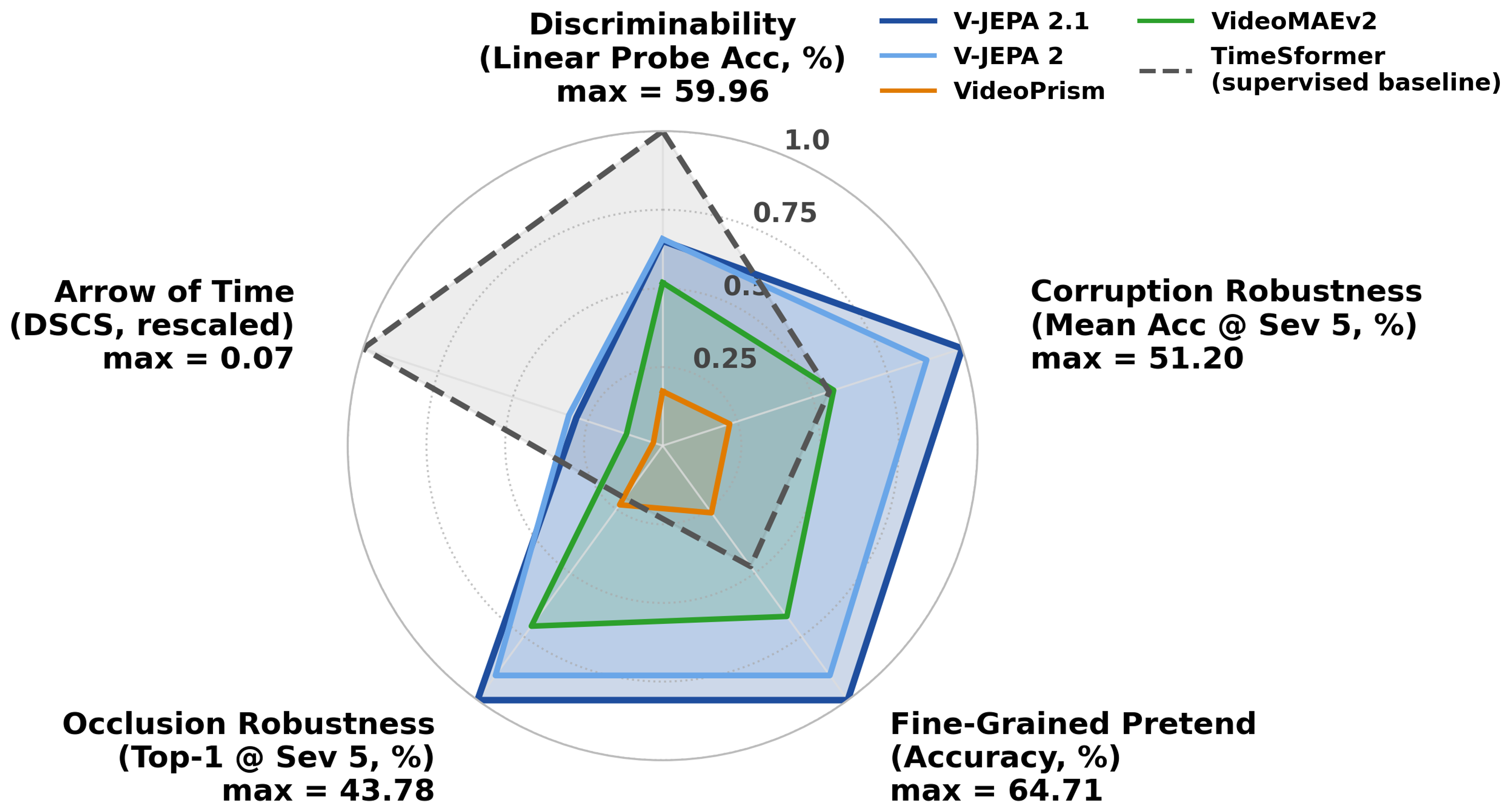
Figure 1 解读:雷达图总结了四类模型在多条 robustness 轴上的相对轮廓。核心信号不是某个单点分数,而是 V-JEPA 系列在 corruption、occlusion、fine-grained contact、temporal direction 上形成一致 profile;VideoPrism 常表现为 embedding 很稳定但 downstream decision 不稳定,VideoMAEv2 则更受 pixel-level perturbation 影响。
2. Idea (核心思想)
核心 insight:一个可用的视频 world model representation 不能只被 clean Top-1 accuracy 定义,而应看它在“世界状态被破坏或时间结构被改变”时如何退化;latent prediction 的优势应表现为有选择地保留语义和物理动态,而不是机械保持 embedding cosine similarity。
本文的关键创新是把 video SSL objective 的比较改写为五轴 evaluation framework:feature discriminability、corruption robustness、fine-grained pretend action discrimination、occlusion robustness、temporal direction sensitivity,并在统一模型容量、读出协议和 SSv2 数据分布下比较三类 pretraining paradigm。
与已有方法的根本差异:VideoMAEv2 的 masked pixel reconstruction 直接优化像素恢复,容易把容量用于 texture、lighting、background;VideoPrism 的 contrastive / video-text alignment 容易形成空间或语义稳定但不一定可判别的 embedding;V-JEPA 的 joint-embedding latent prediction 不预测像素,而预测 learned latent target,因此更可能保留对未来状态、接触关系、动作方向有用的抽象变量。
3. Method (方法)
3.1 Overall evaluation framework
作者固定 SSv2 作为主数据分布,因为它包含超过 个视频、174 个 fine-grained human-object interaction 类,天然包含方向相反、动作相似、pretend-vs-real 等 world-modeling probes。所有主实验比较的 frozen encoders 都使用 unified attentive probe;完整评估约消耗 A100 GPU-hours。
| 评估轴 | 数据规模与目的 |
|---|---|
| Feature Discriminability | 30 类,每类 20 个视频,共 600 videos;按 different-verb、same-verb、pretend-vs-real 分层,测 representation separability。 |
| Corruption Robustness | 500 class-balanced videos;6 种 ImageNet-C corruption:motion blur、snow、pixelation、impulse noise、brightness、elastic transform;3 个 severity levels。 |
| Fine-Grained Action Discrimination | 1,992 test videos,22 个 pretending classes;测模型是否能辨别 simulated / failed physical interaction。 |
| Occlusion Robustness | 1,740 videos,覆盖 174 classes;Moving Block、Temporal Dropout、Spatiotemporal Patch Dropout,3 个 severity levels。 |
| Temporal Robustness | 1,740 videos,覆盖 174 classes;frame shuffling、reversal、static replacement、noise injection,测 temporal order 和 arrow-of-time。 |
模型设置表(论文 Table 1 / Table 2):
| Model | Training objective / regime |
|---|---|
| V-JEPA 2.1 | Latent prediction;frozen encoder + unified attentive probe |
| V-JEPA 2 | Latent prediction;frozen encoder + unified attentive probe |
| VideoPrism | Contrastive + mask prediction;frozen encoder + unified attentive probe |
| VideoMAEv2 | Mask / pixel reconstruction;frozen encoder + unified attentive probe |
| V-JEPA 2 | 在 task-adapted baseline 对比中只训练 attentive probe |
| VideoMAE v1 | 在 SSv2 上 end-to-end fine-tuned |
| TimeSformer | 在 SSv2 上 fully supervised |
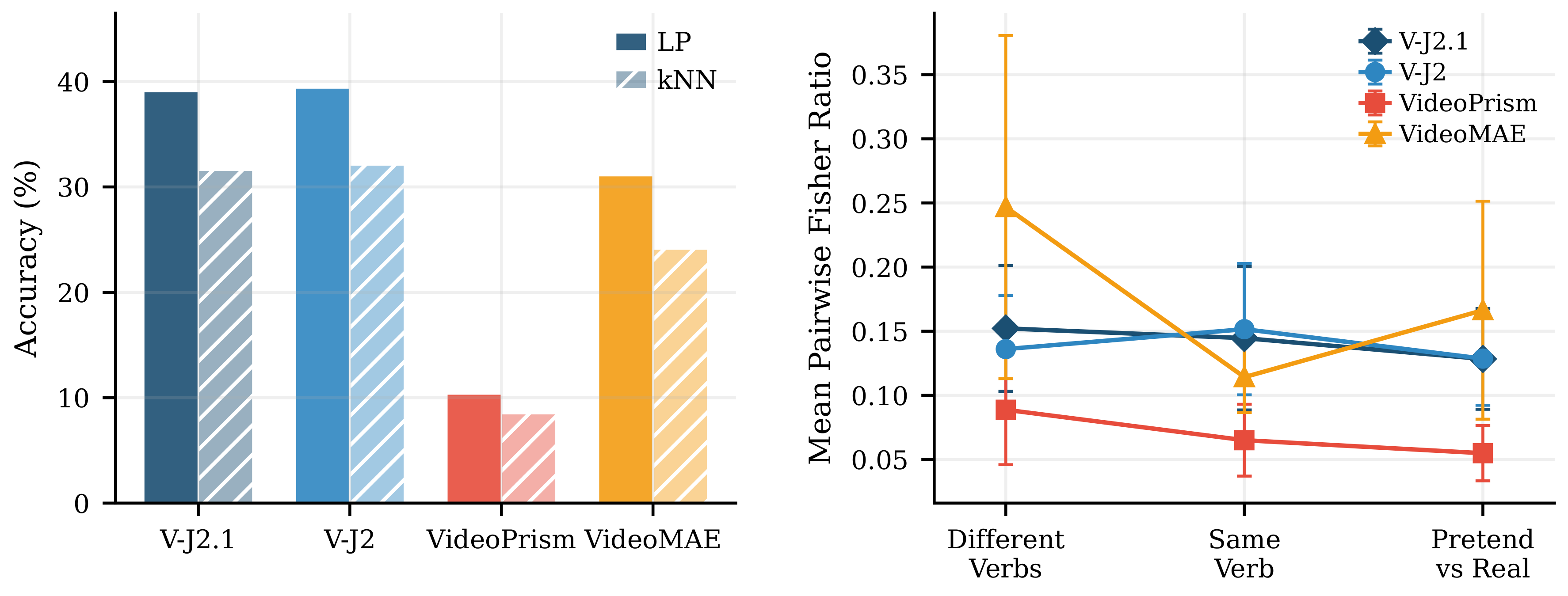
Figure 2 解读:左图比较 linear probe 与 kNN accuracy,右图比较三种语义难度类别的 mean pairwise Fisher ratio。V-JEPA 2.1 / V-JEPA 2 在 linear probe 上高于 VideoMAEv2 和 VideoPrism,说明 latent-prediction representation 对可学习线性读出更友好;VideoMAEv2 虽然有较高 Fisher ratio,但没有转化为更高分类 accuracy,说明 inter-class variance 不等于可用的 decision structure。
3.2 Corruption robustness:meaning over appearance
在 corruption 测试中,作者强调“稳定的 embedding 不等于有用的 embedding”。V-JEPA 2.1 在所有 severity level 上保持最高 Top-1 accuracy,并且在 6 种 corruption 中有 5 种的 severity-5 accuracy retention 最高。VideoPrism 的 cosine similarity 接近完美稳定,但分类 accuracy retention 最低,说明它保留了几何稳定性却丢失了 class-separating structure。
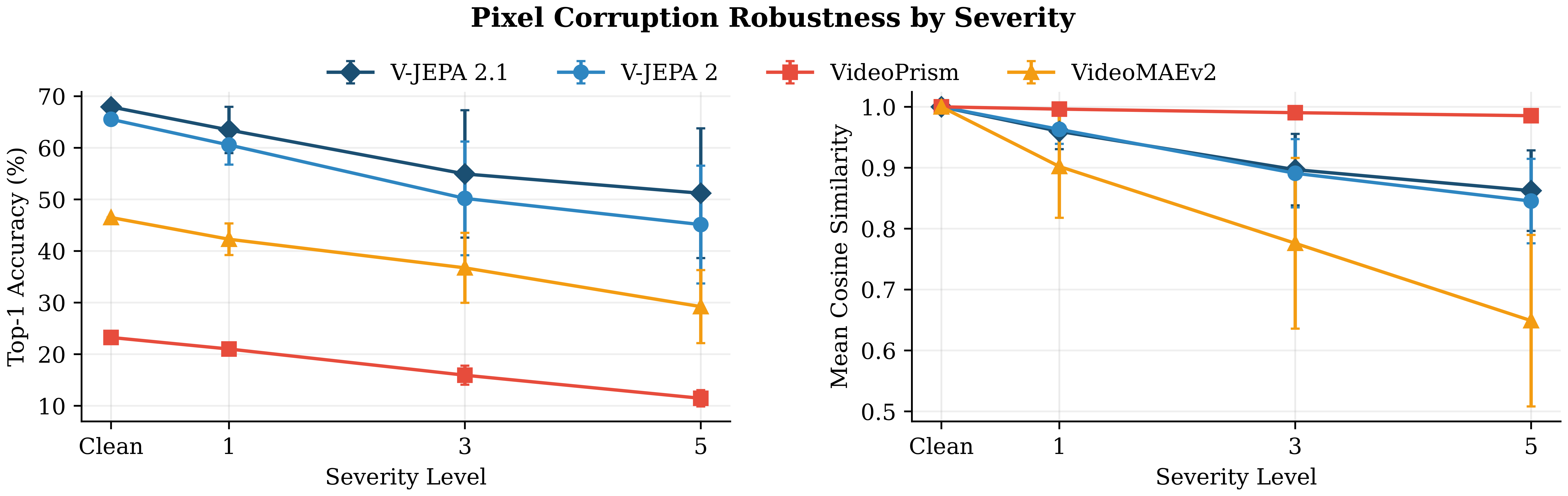
Figure 3 解读:左图是 corruption severity 从 clean 到 1/3/5 时的 Top-1 accuracy,右图是 clean-vs-corrupted feature cosine similarity。V-JEPA 的 accuracy 曲线退化最平滑;VideoPrism 的 cosine similarity 高但 accuracy 差,支持论文的主要判据:world model representation 应稳定保留 task-relevant semantics,而不是只追求 embedding 不动。
severity-5 per-corruption retention(论文 Figure 10 / Figure 11):
| Model | Brightness Acc/Cos | Elastic Acc/Cos | Impulse Acc/Cos | Motion Blur Acc/Cos | Pixelate Acc/Cos | Snow Acc/Cos |
|---|---|---|---|---|---|---|
| V-JEPA 2.1 | 95.9 / 98.2 | 0.6 / 64.8 | 84.4 / 81.1 | 97.3 / 98.1 | 87.9 / 94.7 | 86.1 / 80.4 |
| V-JEPA 2 | 95.4 / 98.5 | 0.9 / 61.3 | 76.5 / 79.6 | 94.2 / 97.8 | 75.5 / 88.7 | 70.6 / 81.3 |
| VideoPrism | 33.6 / 98.7 | 45.7 / 99.2 | 41.4 / 97.6 | 71.5 / 99.5 | 58.6 / 99.4 | 44.8 / 97.0 |
| VideoMAEv2 | 87.5 / 93.2 | 7.8 / 14.5 | 72.4 / 69.3 | 92.2 / 89.0 | 59.9 / 61.3 | 57.3 / 62.1 |
3.3 Pretend-vs-real:细粒度物理接触线索
Pretending subset 包含 1,992 个 test videos、22 个 fine-grained action classes。它的难点在于视觉外观、手势轨迹和 camera viewpoint 与真实动作近似相同,真正的判别信号往往是“没有发生接触”“物体没有形变”“液体没有流动”等细粒度 absence-of-contact cues。作者按 object size(small / medium / large)和 detail sensitivity(high / low)重分组,测试模型是否真正捕捉物理交互。
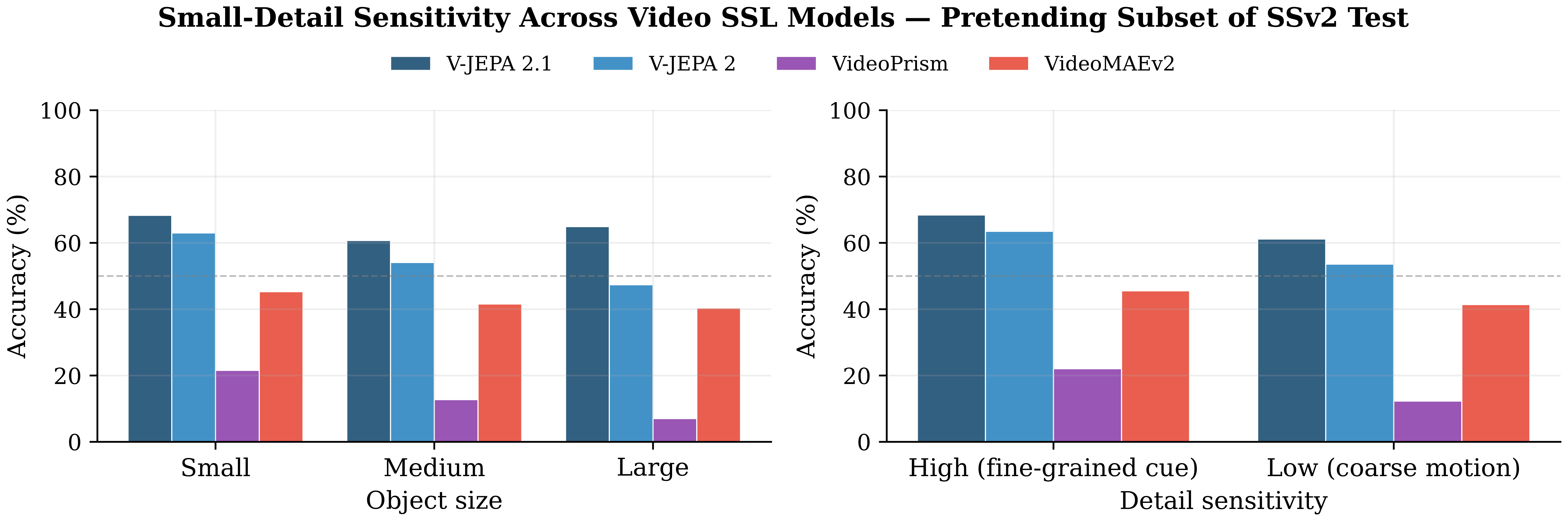
Figure 4 解读:V-JEPA variants 在 small/medium/large object size 和 high/low detail sensitivity 两种分组中都优于 VideoMAEv2。最反直觉的是 high-sensitivity classes 上 latent prediction 反而更强:这说明不重建像素并不等于丢失细节;V-JEPA 可能把接触是否真实发生压缩成对动作状态有用的 latent variable。
3.4 Occlusion robustness:缺失输入下的 useful stability
遮挡实验包含三种 paradigm:Moving Block 用灰色方块跨空间移动,隔离 spatial robustness;Temporal Dropout 用重复上一帧替换连续帧块,隔离 temporal robustness;Spatiotemporal Patch Dropout 将视频体素划分为 的 3D cuboids 并按比例置零,最接近 V-JEPA pretraining 的 masked patches。
关键 metrics 来自论文 Appendix E.2。给定 clean 和 occluded embeddings ,共 个 clips: 这里 kNN classifier 在 clean features 上拟合并在 occluded features 上复用,因此 CCR 衡量同一个 clip 是否仍被路由到同一邻域;RSI 只衡量 embedding cosine stability。
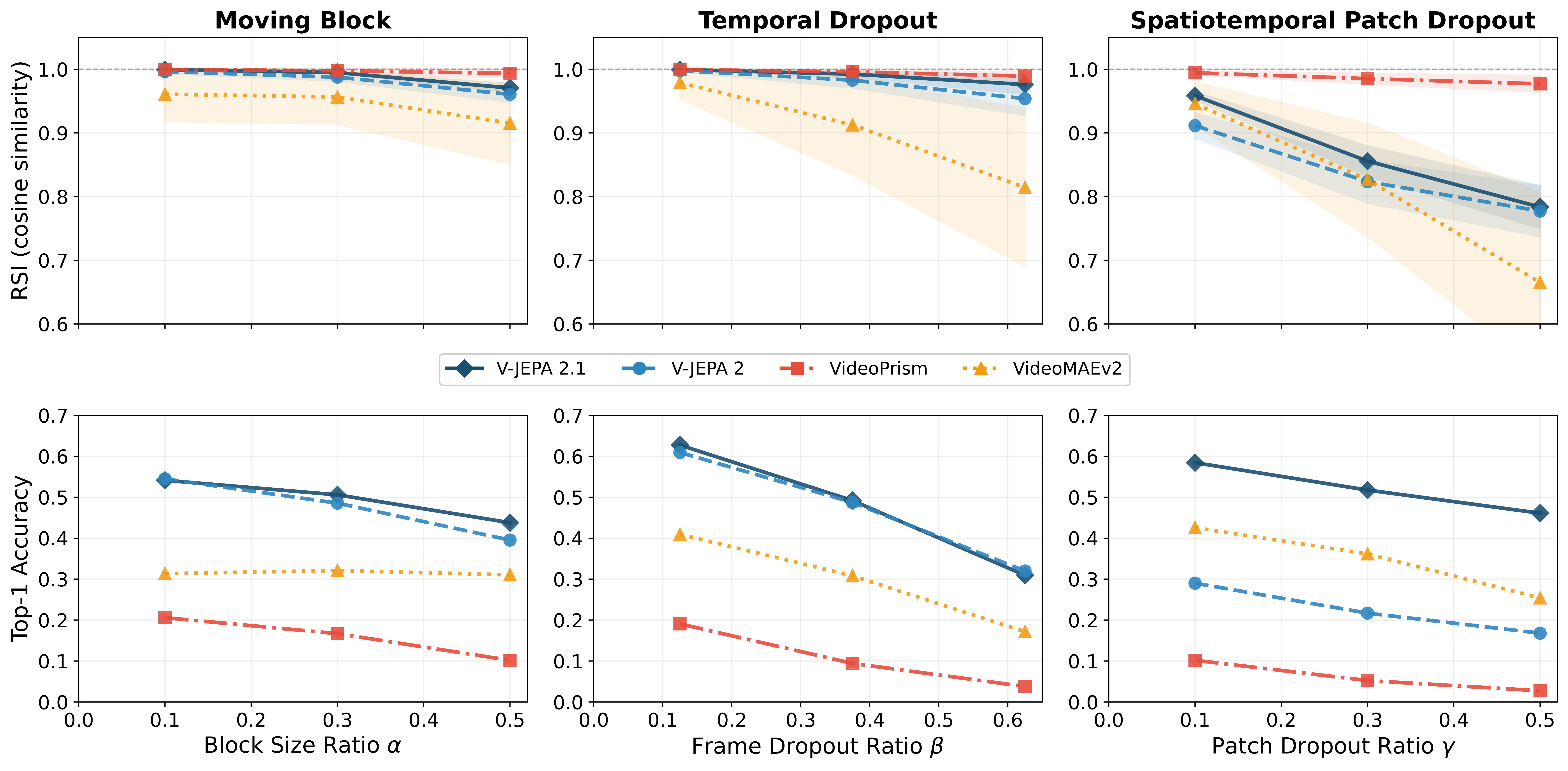
Figure 5 解读:上排是 RSI,下排是 Top-1 accuracy。V-JEPA 2.1 在三个遮挡 paradigm 中都保持最高或最有用的 downstream accuracy;VideoPrism 典型地保持高 RSI 却 accuracy 接近崩溃;VideoMAEv2 在 temporal dropout 和 patch dropout 下退化最快。这支持论文的区分:缺失输入鲁棒性主要来自 prediction target 在 latent space,而不是仅仅使用 masking。
遮挡设置与结果表:
| Component | Setting |
|---|---|
| Dataset | SSv2 test split;1,740 clips;174 classes;16 frames per clip;random seed 42 |
| Moving Block ratio | of |
| Temporal Dropout ratio | of |
| Patch Dropout ratio | of 3D cuboids |
| Attentive probe | depth 2;heads 8;MLP ratio 2.0 |
| kNN probe | ,cosine metric,standardised features |
| Model | Moving Block RSI slope | Temporal Dropout RSI slope | Patch Dropout RSI slope | Patch severity-5 CCR / Top-1 |
|---|---|---|---|---|
| V-JEPA 2.1 | -0.072 | -0.047 | -0.437 | 22.2 / 46.1 |
| V-JEPA 2 | -0.089 | -0.088 | -0.335 | 40.9 / 16.8 |
| VideoPrism | -0.015 | -0.020 | -0.043 | 7.2 / 2.7 |
| VideoMAEv2 | -0.114 | -0.329 | -0.701 | 31.2 / 25.4 |
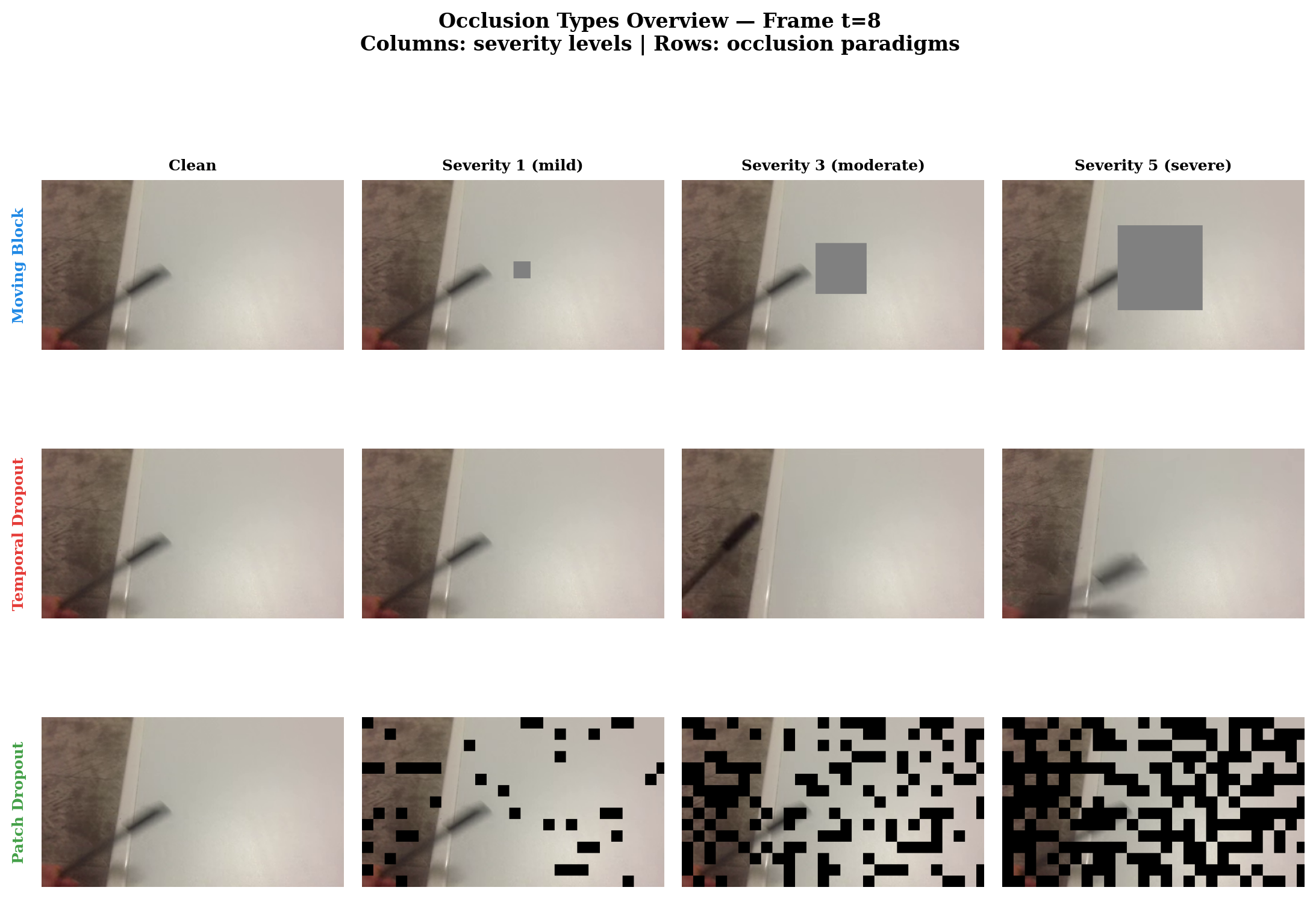
Figure 18 解读:该图展示三种遮挡随 severity 增强的可视化形式,帮助理解 三个参数分别改变空间块大小、连续缺帧比例和 3D patch dropout 比例。它说明本文不是只做随机噪声,而是在模拟空间遮挡、时间缺失和 spatiotemporal missing volume。
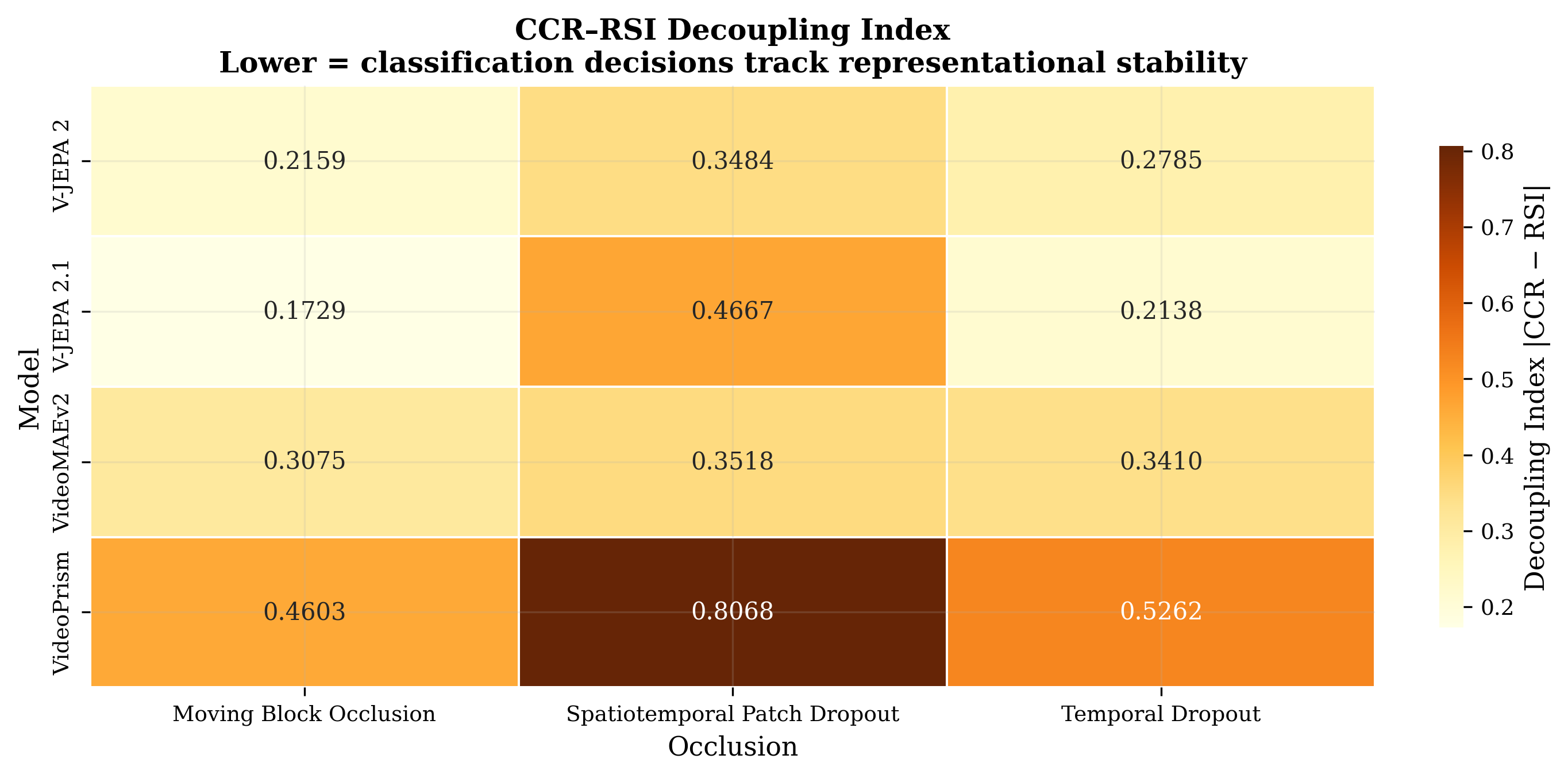
Figure 22 解读:Decoupling index 量化 的差异。VideoPrism 在 Patch Dropout 下 DI 最大,因为 RSI 接近 ,但 CCR 低于 ;这正是“embedding 稳定但决策不可用”的量化版本。
3.5 Temporal direction:arrow of time 是否在 latent space 中可见
视频反转保留每一帧和每个空间特征,只改变时间顺序,因此是测试模型是否编码 directionality 的干净 probe。论文定义 Directional Semantic Coherence Score: 其中 是 reversal 后 prediction changes 落到 semantically antonymous class 的比例,例如 pushing pulling; 是 reversal 诱导的 representation distance。高 DSCS 同时要求 representation 真的移动,且移动方向有语义结构。
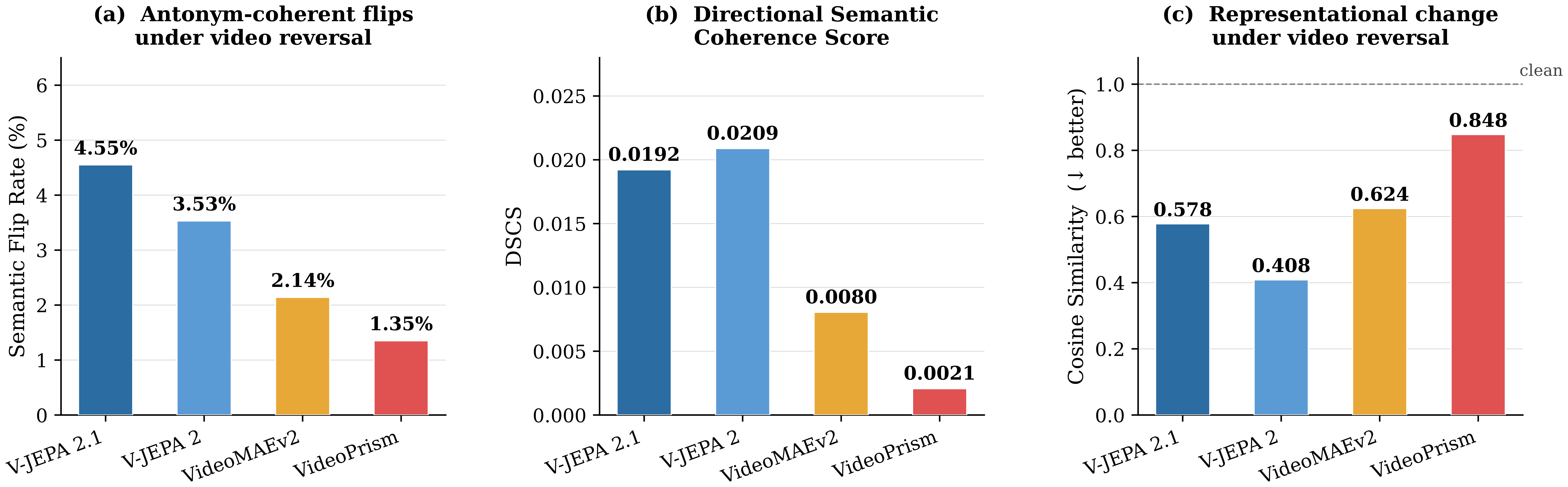
Figure 6 解读:V-JEPA 2.1 / V-JEPA 2 的 semantic flip rate 分别为 4.55% / 3.53%,DSCS 为 0.0192 / 0.0209;VideoMAEv2 为 2.14%、0.0080,VideoPrism 为 1.35%、0.0021。VideoPrism 的 reversed cosine similarity 高达 0.848,却几乎没有方向语义;V-JEPA 的 temporal order 变化会导致更语义一致的 antonym flips。
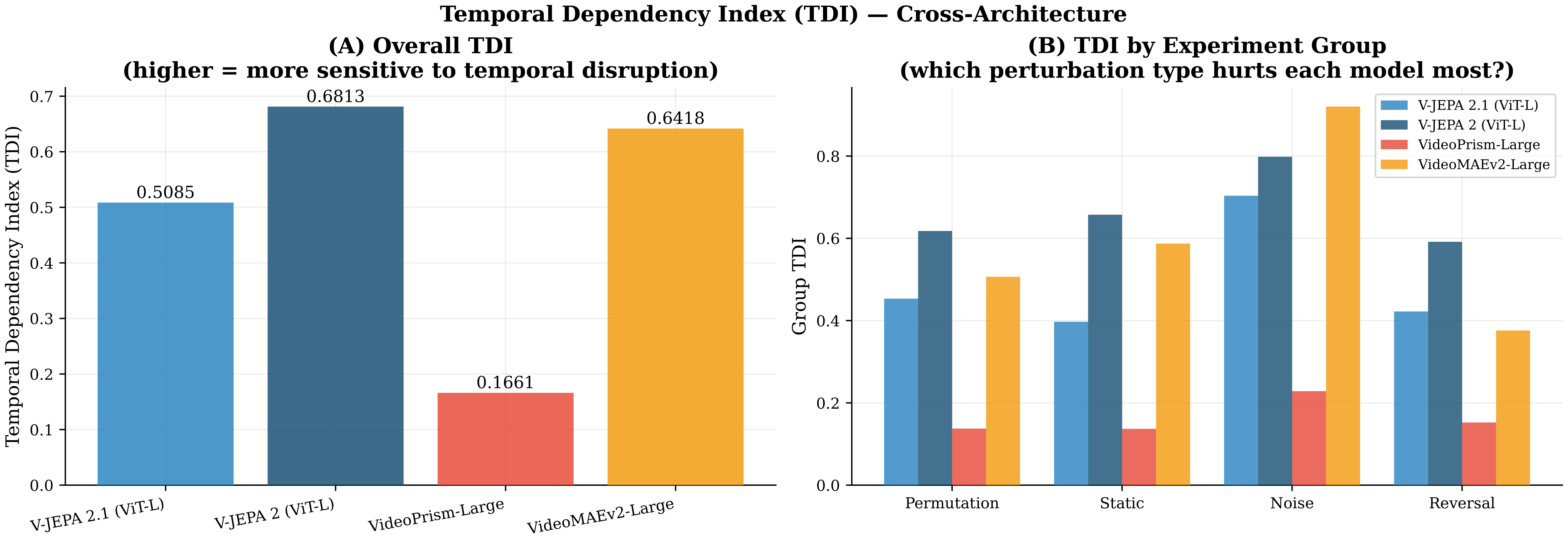
Figure 30 解读:Temporal Dependency Index (TDI) 排序为 VideoPrism 0.17 < V-JEPA 2.1 0.51 < VideoMAEv2 0.64 < V-JEPA 2 0.68。作者的解释不是“TDI 越高越好”:VideoMAEv2 的高 TDI 部分来自 noise 下脆弱性,VideoPrism 的低 TDI 来自时间不敏感;V-JEPA 2.1 的位置更理想,因为它同时保持较高 accuracy 和中等 temporal grounding。
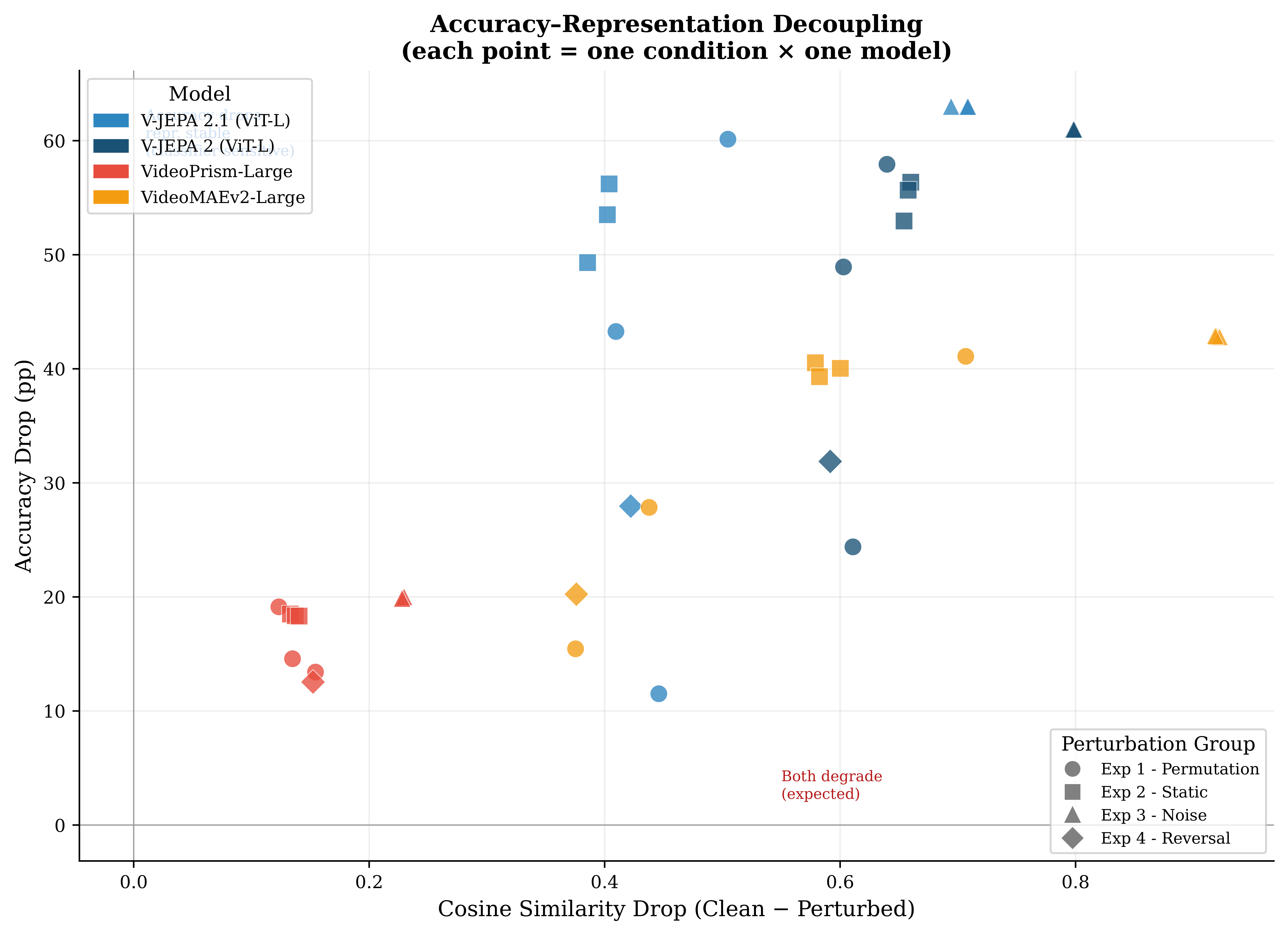
Figure 32 解读:该散点图把 accuracy drop 与 cosine similarity drop 放在一起,揭示 VideoPrism 聚集在“cosine drop 小但 accuracy drop 大”的区域,再次说明几何稳定性不是 world model 的充分条件。V-JEPA 的优势是让 latent space 在该变时改变、在不该变时保留决策相关结构。
3.6 Pseudocode and code status
代码搜索未找到开源实现。已检查 arXiv abstract/source 中无 GitHub/project URL,并用 web/GitHub 搜索 Latent Video Prediction Learns Better World Models github、作者名与标题组合、GitHub repo/code search,未发现公开实现;因此没有 github_ref,也不能建立 released code mapping table。下面 pseudocode 仅复现论文 evaluation protocol,不声称来自作者代码。
import torch
import torch.nn.functional as F

@torch.no_grad()
def encode_clip(encoder, video):
    # video: [B, T, C, H, W], frozen backbone
    features = encoder(video)
    return features.mean(dim=1) if features.ndim == 3 else features


def attentive_probe_train_step(encoder, probe, batch, optimizer):
    video, label = batch
    with torch.no_grad():
        z = encoder(video)
    logits = probe(z)
    loss = F.cross_entropy(logits, label)
    optimizer.zero_grad()
    loss.backward()
    optimizer.step()
    return loss.item()


@torch.no_grad()
def corruption_robustness(encoder, probe, clean_video, corrupt_fn, severities):
    clean_z = encode_clip(encoder, clean_video)
    out = {}
    for s in severities:
        x_s = corrupt_fn(clean_video, severity=s)
        z_s = encode_clip(encoder, x_s)
        logits = probe(z_s)
        acc = (logits.argmax(-1) == clean_video.labels).float().mean()
        cos = F.cosine_similarity(clean_z, z_s, dim=-1).mean()
        out[s] = {"top1": acc.item(), "cosine": cos.item()}
    return out


@torch.no_grad()
def occlusion_metrics(encoder, knn_predict, clean_video, occlude_fn, severity):
    z_clean = encode_clip(encoder, clean_video)
    z_occ = encode_clip(encoder, occlude_fn(clean_video, severity))
    rsi = F.cosine_similarity(z_clean, z_occ, dim=-1).mean()
    ccr = (knn_predict(z_clean) == knn_predict(z_occ)).float().mean()
    return {"RSI": rsi.item(), "CCR": ccr.item()}


@torch.no_grad()
def directional_semantic_coherence(encoder, probe, video, antonym_map):
    z = encode_clip(encoder, video)
    z_rev = encode_clip(encoder, torch.flip(video, dims=[1]))
    y = probe(z).argmax(-1)
    y_rev = probe(z_rev).argmax(-1)
    changed = y != y_rev
    semantic = torch.tensor([antonym_map.get(int(a)) == int(b) for a, b in zip(y, y_rev)])
    r_sem = (semantic & changed.cpu()).float().mean()
    cos_rev = F.cosine_similarity(z, z_rev, dim=-1).mean().cpu()
    return r_sem * (1.0 - cos_rev)
直觉上,上述 protocol 的关键不是重新训练 encoder,而是冻结不同 objective 训练出的 representation 后施加 controlled perturbation。这样可以把性能差异更多归因于 pretraining objective 本身:latent prediction 是否把未来状态、物理接触和方向性变成可读出的 latent variables,而不是被后续 fine-tuning 或 clean-task supervision 覆盖。
4. Experimental Setup (实验设置)
Datasets. 主数据集为 Something-Something v2:超过 videos,174 个 fine-grained human-object interaction categories。具体评估子集为:feature discriminability 使用 600 videos(30 classes × 20 videos);corruption robustness 使用 500 class-balanced videos;pretending subset 使用 1,992 test videos、22 classes;
occlusion 与 temporal robustness 各使用 1,740 videos、174 classes,均为 16 frames per clip。Models and baselines. Frozen encoder 主比较:V-JEPA 2.1、V-JEPA 2、VideoPrism、VideoMAEv2,均为 ViT-Large 级别约 参数。模型详细属性(论文 Appendix Table 3):V-JEPA 2.1 / V-JEPA 2 使用 hours internet video 预训练、objective 为 latent prediction、来源 Meta;
VideoPrism 使用 36M video + video-text pairs、objective 为 contrastive + masked prediction、来源 Google;VideoMAEv2 使用 UnlabeledHybrid public-set mix、objective 为 pixel reconstruction、来源 open-source。Task-adapted 对比:frozen V-JEPA 2 + attentive probe、SSv2 end-to-end fine-tuned VideoMAE v1、fully supervised TimeSformer。
Metrics. Feature discriminability 使用 linear probe accuracy、kNN accuracy、mean pairwise Fisher ratio;corruption 使用 Top-1 accuracy 与 clean-corrupted cosine similarity;pretend actions 使用按 object size / detail sensitivity 分组的 accuracy;occlusion 使用 RSI、CCR、AUC(RSI)、probe Top-1;
temporal 使用 semantic flip rate、DSCS、cosine similarity、TDI、static-frame / noise perturbation 下的 accuracy、confidence、entropy。Training / evaluation config. Encoders frozen,readout 使用 lightweight attentive probe;occlusion benchmark 的 probe depth=2、heads=8、MLP ratio=2.0;kNN probe 使用 、cosine metric、standardised features。
每个 clip 统一 sample 16 frames,occlusion benchmark random seed=42。作者说明完整 SSv2 评估使用 high-end NVIDIA A100,总计超过 GPU-hours;attentive probe training 每个 encoder 约 A100 GPU-hours。论文未详细说明 optimizer、learning rate、batch size 等训练超参数。
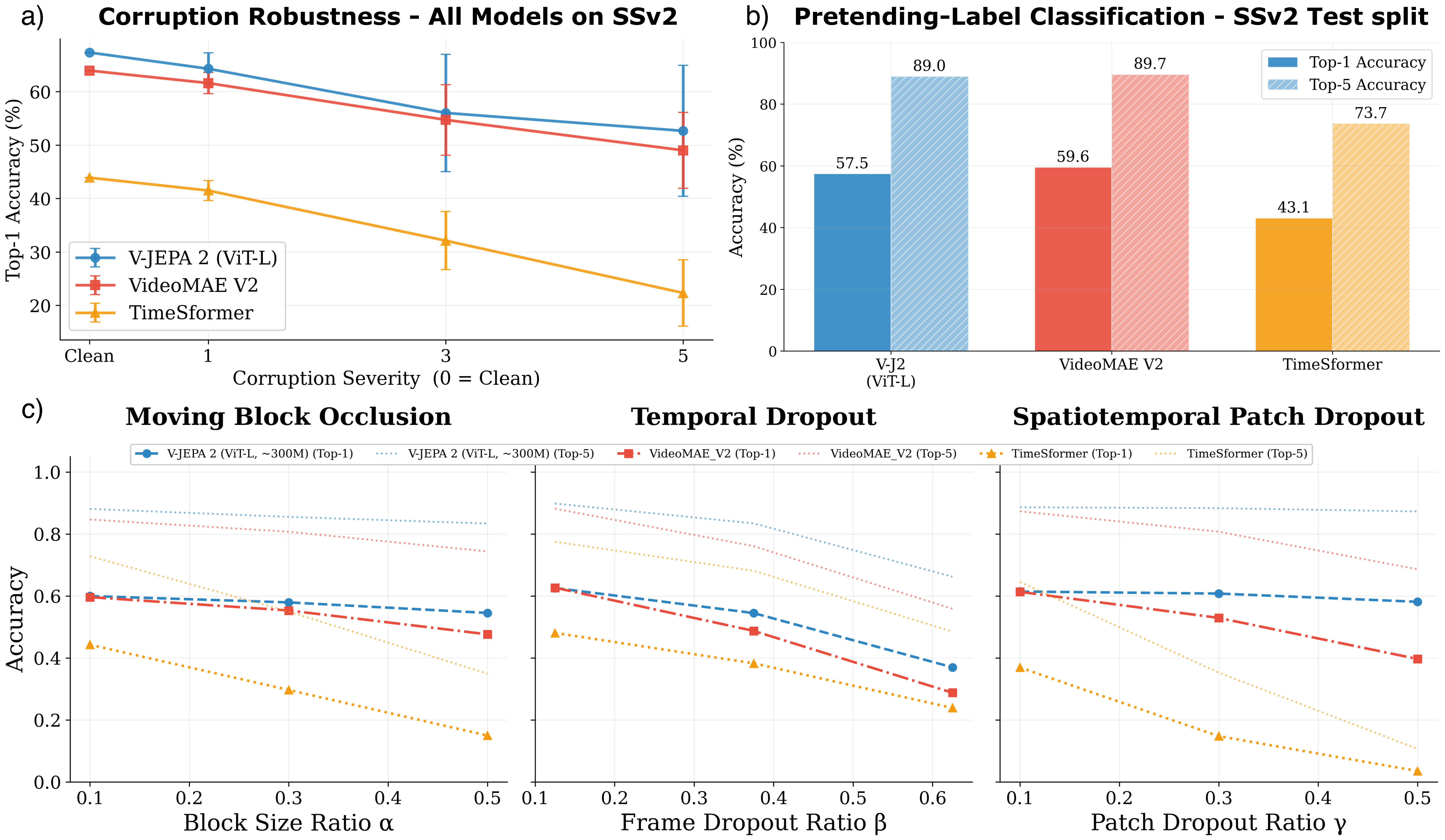
Figure 7 解读:该图把 frozen V-JEPA 2 与 task-adapted baselines 放在同一 corruption / pretend / occlusion setting 下比较。结论是 V-JEPA 2 即使不 fine-tune backbone,也在 corruption 和 occlusion robustness 上领先;在 pretend subset 上接近 fine-tuned VideoMAE、明显优于 supervised TimeSformer,说明 latent-prediction pretraining 的结构性优势能 survive task adaptation comparison。
5. Experimental Results (实验结果)
Main results. 五条评估轴给出一致结论:latent-prediction models 形成稳定的 distinct profile。V-JEPA 2.1 在 corruption severity 全程保持最高 accuracy,并在 severity-5 的 6 个 corruption 中 5 个 accuracy retention 最高;在 occlusion 下 V-JEPA 2.1 的 downstream decision 最稳,Patch Dropout severity-5 时仍有 46.1% Top-1,而 VideoPrism 虽有很高 RSI,却只有 2.7% Top-1;
在 video reversal 中 V-JEPA 2.1 / V-JEPA 2 的 DSCS 为 0.0192 / 0.0209,显著高于 VideoMAEv2 0.0080 与 VideoPrism 0.0021。Ablations / diagnostic findings. 最重要的 ablation-like evidence 是 accuracy-vs-cosine decoupling:VideoPrism 的 representation 在 corruption 和 occlusion 下几何上稳定,但分类结构崩溃;VideoMAEv2 在 pixel-level corruption、temporal dropout 和 noise 下更脆弱;
V-JEPA 的 representation 会在输入变得语义相关时移动,但能保留 decision-relevant class structure。另一个关键诊断是 fine-grained pretend actions:latent prediction 在 high-sensitivity absence-of-contact classes 上优于 pixel reconstruction,反驳了“重建像素才保留细节”的直觉。
Task-adapted baseline comparison. 与 fully fine-tuned VideoMAE 和 fully supervised TimeSformer 相比,frozen V-JEPA 2 + attentive probe 在 corruption robustness 和 occlusion robustness 上仍领先;在 pretending action subset 上接近 fine-tuned VideoMAE,并明显超过 TimeSformer。
作者据此认为,优势主要来自 pretraining objective 塑造的 base representation,而不只是 probe 或 clean-task supervision。Limitations. 作者承认模型比较没有完全控制 pretraining data composition、data scale 和 training schedule;要彻底归因需要从零在相同 data/compute 下重训所有模型。论文的显式 Limitations section 没有展开更多内容;
可从实验设计看,结论主要适用于 SSv2-style human-object interaction 和所选公开 checkpoints,尚未覆盖 adversarial attacks、更多真实传感器失效、具身控制闭环或长时 horizon planning。Overall conclusion. 本文给出的经验结论是:latent video prediction 更像一个可用 world model backbone,因为它不是简单保持 embedding 不变,而是在 corruption、occlusion、细粒度物理接触和 temporal direction 改变时保留对下游决策有用的结构。
V-JEPA 系列的一致优势支持“在 learned latent space 中预测未来状态,比重建 pixels 更适合学习 robust world representations”。