Beyond Pairwise Preferences: Listwise Reward-Aware Alignment for Diffusion Models
Paper: arXiv:2605.26491
1. Motivation(研究动机)
当前 diffusion preference optimization 的主要瓶颈
这篇论文关注的是 text-to-image diffusion model 的 post-training alignment。Stable Diffusion 1.5、SDXL、Imagen 这类模型已经能生成高质量图像,但预训练本身并不保证模型符合人类偏好:美学质量、prompt following、细粒度属性绑定、整体可用性都需要额外对齐。已有 diffusion alignment 大致有两条路线:
- Online RLHF / reward fine-tuning:在训练过程中反复采样图像、打 reward、更新模型。优点是直接优化 reward;缺点是 trajectory generation、reward evaluation、policy update 串行耦合,训练昂贵、难并行,并且容易受 on-policy distribution shift 影响。
- Offline preference optimization:从预收集的人类偏好数据学习,例如把 DPO 类目标迁移到 diffusion denoising loss 上。它更稳定、更便宜,也更容易复用已有 preference dataset。
论文指出,offline preference optimization 仍然继承了 DPO 的一个强假设:每次更新只看一对 winner / loser 图像。这与实际 diffusion preference 数据并不匹配。以 Pick-a-Pic v2 为例,数据表面上是 pairwise preference,但同一个 prompt 往往对应多组比较、多个候选图像;同时,现代 reward model(PickScore、HPS、ImageReward 等)可以给每张图像连续分数。若把这些信息压缩成二元偏好对,会丢掉两类监督:一是同一 prompt 下多个候选之间的 listwise ranking 结构,二是 reward magnitude 中包含的“赢多少 / 输多少”的强弱信息。
本文要解决的问题
本文目标不是提出新的 reward model,也不是在线 RL;它要解决的是:如何让 diffusion model 的 offline preference optimization 直接利用同一 prompt 下多个候选图像及其连续 reward score,而不是把数据拆成若干独立 pairwise comparison。
具体来说,论文提出 Diffusion LAIR(Listwise Advantage-weighted Implicit Reward):对每个 prompt,把候选图像的 reward score 转成以组内均匀分布为基线的 centered advantage weight,再用这些 signed weights 加权 diffusion implicit reward,同时加入二次正则,让更新保持 conservative。
为什么值得研究
这个问题值得研究有三个原因:
- 数据利用效率:已有 preference dataset 中同一 prompt 的多候选结构原本就存在;listwise 方法能从全部候选获得梯度,而不是只从挑出来的一对样本获得信号。
- 监督信号更细:连续 reward score 可以表达“明显更好”“略好”“明显更差”,比二元 winner / loser label 更丰富。
- 训练更可控:pairwise logistic objective 的理想 margin 可以无界增大;LAIR 的二次正则给 implicit reward 一个有限最优解,使偏好更新的幅度由 控制。

Figure 1 解读:这组样例展示了用 Diffusion LAIR 对 SDXL 做 post-training 后的生成效果。它不是方法结构图,而是论文在引言中给出的“目标质量”直观展示:模型希望在保持 SDXL 生成能力的同时,提高图像美感、文本对应性和整体偏好分数。
2. Idea(核心思想)
核心 insight
本文最核心的 insight 是:diffusion preference alignment 不一定要把同一 prompt 下的候选样本压缩成 winner-loser pair;可以把整组候选的 reward score 转成 centered listwise advantage,然后直接监督每个样本相对 reference model 的 denoising-loss improvement。
换句话说,LAIR 把“偏好谁胜过谁”改写成“每个候选相对组平均应该被提升还是压低,以及提升/压低多少”。高 reward 样本得到正权重,低 reward 样本得到负权重;权重和为零,因此更新关注的是同一 prompt 内部的相对质量,而不是 reward 的绝对标定。
关键创新
Diffusion LAIR 有三个关键设计:
- Listwise supervision:训练样本是 ,即一个 prompt 对应 个 candidate image 及其 reward,而不是单个 preferred / dispreferred pair。
- Reward-aware centered advantage:先用 softmax 把 reward 转成组内概率 ,再减去均匀基线 得到 。这样 的样本被提升, 的样本被压低。
- Implicit reward regression with quadratic regularization:LAIR 不直接最大化 reward,而是优化 diffusion implicit reward ;二次项 限制偏好更新幅度。
与已有方法的根本差异
与 Diffusion-DPO / DSPO 相比,LAIR 的差异不只是“把 batch 变大”。Diffusion-DPO 仍然是 pairwise logistic loss:它关心 的 margin,优化上会倾向把 preferred 和 dispreferred 的差距推得越来越大。LAIR 则对每个 prompt 的全部候选构造 signed advantage,并有闭式最优解 ,因此每个样本的目标 implicit reward 是有限的、组内相对的、由 控制的。
3. Method(方法)
3.1 Overall framework:从 pairwise 到 listwise reward-aware alignment
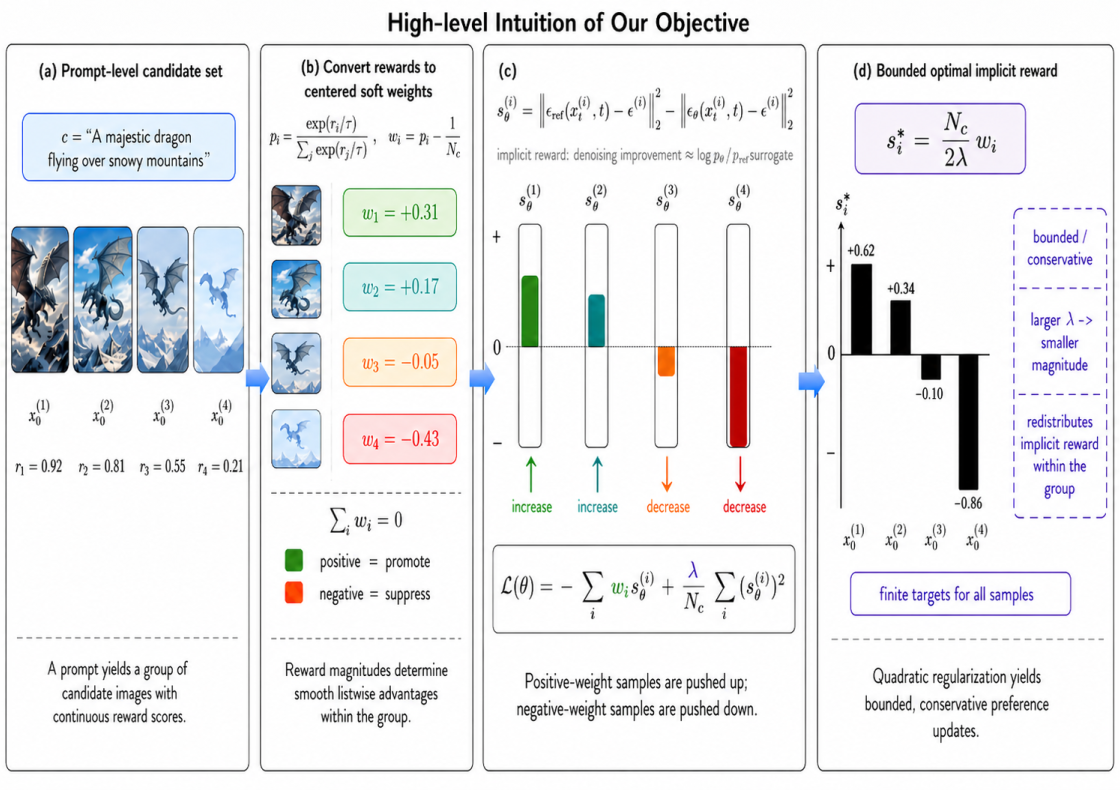
Figure 2 解读:图中左侧表示同一个 prompt 下的多张候选图像;中间用 reward model 给每张图像打分,并把分数转换成 listwise advantage;右侧则把这些 advantage 用来监督 diffusion implicit reward。与 pairwise DPO 只比较一张 preferred 和一张 rejected 图不同,LAIR 对整组样本同时分配正负权重:高 reward 图像推动当前模型比 reference denoise 得更好,低 reward 图像则被相对压低。二次正则项用于防止模型过度偏离 reference。
整体训练流程可以概括为:
- 对每个 prompt ,从 Pick-a-Pic v2 中聚合所有相关候选图像,形成 。
- 用 PickScore 对每个候选图像离线打分,得到 。
- 把 转换成组内 centered advantage 。
- 对每个候选图像采样 timestep 和 noise ,计算当前模型与 reference model 的 denoising loss 差值,即 implicit reward 。
- 用 提升高 reward 样本、压低低 reward 样本,并用 做 conservative regularization。
直觉上,LAIR 把 reward model 的“组内排序”变成了 diffusion denoising 空间里的“相对改善目标”。它不要求 reward score 的绝对值在不同 prompt 之间可比;只要同一 prompt 内部 reward 能区分哪些候选更好,就能产生有效的正负权重。
3.2 Diffusion implicit reward:用 denoising-loss improvement 近似模型偏好
Diffusion model 的生成概率 不像 autoregressive LLM 那样容易直接计算,因此 diffusion DPO 系列方法通常使用 denoising loss 的差值作为 log-ratio surrogate。给定 noisy latent 当前模型和 reference model 的 denoising squared error 是 论文使用的 implicit reward 是 其中 是 ELBO 中由 timestep signal-to-noise ratio 诱导的权重,实践中通常设成常数。若当前模型在某个样本上 denoise 得比 reference 更好,则 ,所以 更大;反之则更小。这使得 preference alignment 可以在 denoising loss 空间中完成。
3.3 Reward-aware centered advantage
对 prompt 的候选集合 及 reward score ,LAIR 先定义组内 softmax 概率: 这里 是 reward temperature。 表示样本 在同一 prompt 候选组中的相对质量, 则是相对均匀分布的 centered advantage。这个设计有几个作用:
- ,所以训练信号是组内相对的,不会因为某个 prompt 的 reward 全体偏高而整体推高所有候选。
- 高 reward 样本满足 ,低 reward 样本满足 。
- 控制 reward 差异被放大的程度; 小时更接近“突出最优候选”, 大时分布更平滑。
如果去掉这个 centered advantage,只用 pairwise label,就会回到 DPO 类方法:训练只知道哪个图像赢了某个比较,却不知道其余候选的相对位置,也不知道赢的幅度。
3.4 Diffusion LAIR objective
LAIR 的核心目标为 $ \mathcal{L}_{\mathrm{Diffusion\text{-}LAIR}}(\theta)
\mathbb{E}{c,t,{\epsilon_i}{i=1}^{N_c}} \left[ -\sum_{i=1}^{N_c} w_i s_\theta^{(i)} + \frac{\lambda}{N_c}\sum_{i=1}^{N_c}\left(s_\theta^{(i)}\right)^2 \right], s_\theta^{(i)}:=s_\theta(\boldsymbol{x}_0^{(i)},\boldsymbol{x}_t^{(i)},t,c,\epsilon_i), \lambda>0$ 控制正则强度。第一项是 advantage-weighted implicit reward regression:
- 若 ,最小化 loss 会鼓励 变大,即当前模型相对 reference 在该高质量图像上 denoise 更好;
- 若 ,最小化 loss 会鼓励 变小,即低质量图像不会被模型过度拟合;
- 若 ,该样本接近组内平均质量,对更新影响较小。
第二项是 quadratic penalty。它的意义不是普通 weight decay,而是直接限制 implicit reward magnitude:模型不能无限增大 来追逐 reward,从而避免过度偏离 reference model。
3.5 理论性质:有限的 optimal implicit reward 与 KL surrogate bound
对于固定候选组和固定 ,论文证明 LAIR 目标对 是 strictly convex,并有唯一逐点最优解: 这个闭式解非常关键:每个样本的目标 implicit reward 与其 centered advantage 成正比,并被 控制。因为 ,也有 ,说明 LAIR 不会把同一 prompt 下所有样本一起推高,而是在组内重新分配 preference signal。
论文还给出一个 surrogate KL bound。设有效最优 implicit reward 的 full-support extension 范围为 ,并在 log-ratio approximation 与 bounded extension 假设下定义 surrogate tilted distribution ,则 若 extension 保持 finite-list optimum 的范围,则 ,得到 作者明确说明这不是精确理论保证,而是基于 diffusion ELBO log-ratio approximation 和 full-support extension 假设的 surrogate bound。它提供的主要直觉是: 越大,允许的 preference tilt 越小;候选组越大,方法可利用的 listwise 信息越充分,也对应更大的可解释偏移范围。
3.6 论文级伪代码(无 released code)
代码搜索未找到开源实现(checked: arXiv/PDF links, title+github, acronym/method+github, arXiv ID, first-author/org candidate repos, GitHub repo search, GitHub code search, and direct plausible owner/name probes; only unrelated repositories or paper-index metadata were found)。因此下面伪代码是按论文公式与 appendix 训练细节整理的 paper-level pseudocode,不是 released code 的逐行映射;本笔记也不设置 github / github_ref 属性。
import torch
import torch.nn.functional as F


def build_prompt_groups(pickapic_rows, reward_model, max_list_size):
    """Aggregate pairwise Pick-a-Pic rows into prompt-level candidate lists."""
    groups = {}
    for row in pickapic_rows:
        prompt = row["prompt"]
        groups.setdefault(prompt, [])
        groups[prompt].append(row["image_a"])
        groups[prompt].append(row["image_b"])

    examples = []
    for prompt, images in groups.items():
        images = deduplicate_images(images)
        if len(images) < 2:
            continue
        images = subsample_or_truncate(images, max_list_size)
        rewards = reward_model.score(prompt, images)  # offline PickScore in the paper
        examples.append({"prompt": prompt, "images": images, "rewards": rewards})
    return examples
def centered_listwise_advantage(rewards: torch.Tensor, tau: float) -> torch.Tensor:
"""Convert reward scores inside one prompt group into signed centered weights."""
probs = torch.softmax(rewards / tau, dim=0)
uniform = torch.full_like(probs, 1.0 / rewards.numel())
weights = probs - uniform
return weights # sum(weights) == 0def diffusion_implicit_reward(model, ref_model, scheduler, x0, prompt, timestep, noise):
"""Denoising-loss improvement of model over fixed reference model."""
xt = scheduler.add_noise(x0, noise, timestep)
eps_theta = model(xt, timestep, prompt)
eps_ref = ref_model(xt, timestep, prompt)
loss_theta = F.mse_loss(eps_theta, noise, reduction="none").flatten(1).mean(dim=1)
loss_ref = F.mse_loss(eps_ref, noise, reduction="none").flatten(1).mean(dim=1)
return loss_ref - loss_thetadef diffusion_lair_loss(model, ref_model, scheduler, batch, tau: float, lambda_reg: float):
"""Paper-level Diffusion LAIR objective for one batch of prompt-level lists."""
losses = []
for example in batch:
images = example["images"] # shape: [Nc, C, H, W]
prompt = example["prompt"]
rewards = example["rewards"] # shape: [Nc]
weights = centered_listwise_advantage(rewards, tau)
t = scheduler.sample_timesteps(images.shape[0], device=images.device)
eps = torch.randn_like(images)
s = diffusion_implicit_reward(model, ref_model, scheduler, images, prompt, t, eps)
linear_term = -(weights * s).sum()
quadratic_term = lambda_reg / images.shape[0] * (s ** 2).sum()
losses.append(linear_term + quadratic_term)
return torch.stack(losses).mean()3.7 论文公式与 released code 实现差异
未发现 public released code,因此无法检查 paper-vs-code implementation gap。当前笔记中的训练配置来自论文 Appendix 的 dataset/training details 与 Table 3,而不是代码配置文件。
4. Experimental Setup(实验设置)
4.1 数据集与模型
训练使用 Pick-a-Pic v2。论文说明该数据集约有 1 million pairwise preference entries,但只有约 59k unique prompts;作者据此把 pairwise rows 聚合成 prompt-level candidate set。每个训练样本为同一 prompt 下的候选列表 ,列表大小在 到最大列表大小 之间。
训练模型包括:
- SD1.5:用 Diffusion LAIR fine-tune Stable Diffusion 1.5。
- SDXL:用 Diffusion LAIR fine-tune Stable Diffusion XL。
评测数据包括:
- Parti-prompts:1632 prompts,用于 general human preference evaluation。
- HPD:3200 prompts,用于 general human preference evaluation。
- GenEval:compositional generation benchmark;每个 prompt 生成 4 张图,使用官方 evaluation script。
- InstructPix2Pix:随机采样 1000 个 image-prompt pairs,用 SDEdit 进行 image editing;每个 prompt 生成 5 张图。
4.2 Baselines
文本到图像与偏好对齐 baselines 包括:Diffusion DPO、DSPO、Diffusion KTO、MaPO、InPO。作者使用 Diffusion DPO、Diffusion KTO、MaPO、InPO 的官方 checkpoints;SD1.5 的 DSPO 由作者用官方代码 fine-tune。由于 DSPO 在 SDXL scale 上计算成本高,SDXL 对比中省略 DSPO。GenEval 还报告 SmPO、SPO、CRAFT 等已有结果。
4.3 Metrics
论文主要使用 reward-model based automatic evaluation:
- PickScore:偏好 reward model 分数,越高越好。
- HPS v2:Human Preference Score v2,越高越好。
- LAION Aesthetics Score(Aes.):图像美学分数,越高越好。
- CLIP score:图文匹配分数,越高越好。
- ImageReward(IR):image reward model 分数,越高越好。
- GenEval metrics:Overall、Color、Count、Position、Single、Attribute、Two-object 等 compositional accuracy 子指标。
- InstructPix2Pix win rate:某模型在 image-prompt pair 上平均 reward 超过 SDXL baseline 的比例。
4.4 Training config 与计算成本
无 public training script 可核对;以下数值来自论文 Appendix 的 Dataset and Training Details / Training Hyperparameters:
| Hyperparameter | SD1.5 | SDXL |
|---|---|---|
| Learning rate | ||
| Maximum list size | 30 | 10 |
| Reward temperature | 0.05 | 0.5 |
| Per-GPU batch size | 1 | 1 |
| Gradient accumulation steps | 16 | 16 |
| Regularization strength | 0.00025 | 0.00025 |
| CFG prompt dropout proportion | 0.1 | 0.1 |
| Training steps | 2300 | 1500 |
| Hardware | 2×A100 | 3×A100 |
论文报告总训练成本约为 24 A100 GPU-hours for SD1.5、140 A100 GPU-hours for SDXL,并强调相对 Diffusion DPO / DSPO 等 baseline 更高效;作者称部分 baseline 在 SDXL training 上可高到接近 5× H100 GPU-hours。
5. Experimental Results(实验结果)
5.1 General preference alignment:reward score 主结果
| Base / Dataset | Method | Pick | HPS | Aes. | CLIP | IR |
|---|---|---|---|---|---|---|
| SD1.5 / Parti | SD1.5 | 21.243 | 0.2738 | 5.360 | 0.3322 | 0.1653 |
| SD1.5 / Parti | DSPO | 21.521 | 0.2813 | 5.658 | 0.3376 | 0.5763 |
| SD1.5 / Parti | InPO | 21.735 | 0.2842 | 5.613 | 0.3457 | 0.7203 |
| SD1.5 / Parti | Diff.-DPO | 21.497 | 0.2773 | 5.445 | 0.3373 | 0.3539 |
| SD1.5 / Parti | Diff.-KTO | 21.550 | 0.2825 | 5.568 | 0.3390 | 0.5941 |
| SD1.5 / Parti | Diff.-LAIR | 21.992 | 0.2860 | 5.671 | 0.3485 | 0.8107 |
| SD1.5 / HPD | SD1.5 | 20.792 | 0.2723 | 5.567 | 0.3498 | 0.0988 |
| SD1.5 / HPD | DSPO | 21.426 | 0.2833 | 5.873 | 0.3566 | 0.6612 |
| SD1.5 / HPD | InPO | 21.792 | 0.2862 | 5.873 | 0.3659 | 0.8114 |
| SD1.5 / HPD | Diff.-DPO | 21.226 | 0.2767 | 5.688 | 0.3553 | 0.3087 |
| SD1.5 / HPD | Diff.-KTO | 21.430 | 0.2849 | 5.792 | 0.3572 | 0.6835 |
| SD1.5 / HPD | Diff.-LAIR | 22.068 | 0.2871 | 5.904 | 0.3670 | 0.8382 |
SD1.5 结果显示 LAIR 在 Parti 和 HPD 上五个 reward 指标全部最优,尤其 ImageReward 从 InPO 的 0.7203 / 0.8114 提升到 0.8107 / 0.8382,说明 listwise reward-aware 监督不仅提升美学分数,也提升综合偏好 reward。
| Base / Dataset | Method | Pick | HPS | Aes. | CLIP | IR |
|---|---|---|---|---|---|---|
| SDXL / Parti | SDXL | 22.425 | 0.2843 | 5.809 | 0.356 | 0.776 |
| SDXL / Parti | InPO | 22.723 | 0.2908 | 5.872 | 0.359 | 1.045 |
| SDXL / Parti | Diff.-DPO | 22.693 | 0.2894 | 5.824 | 0.365 | 1.066 |
| SDXL / Parti | MaPO | 22.399 | 0.2861 | 5.957 | 0.354 | 0.873 |
| SDXL / Parti | Diff.-LAIR | 22.765 | 0.2920 | 5.845 | 0.366 | 1.104 |
| SDXL / HPD | SDXL | 22.589 | 0.2860 | 6.134 | 0.382 | 0.865 |
| SDXL / HPD | InPO | 23.001 | 0.2939 | 6.186 | 0.384 | 1.074 |
| SDXL / HPD | Diff.-DPO | 22.949 | 0.2921 | 6.141 | 0.388 | 1.082 |
| SDXL / HPD | MaPO | 22.638 | 0.2902 | 6.245 | 0.382 | 0.968 |
| SDXL / HPD | Diff.-LAIR | 23.033 | 0.2950 | 6.152 | 0.391 | 1.130 |
SDXL 上 LAIR 在 Pick、HPS、CLIP、ImageReward 上最强,Aesthetics 则低于 MaPO。这说明 LAIR 的收益主要体现为综合偏好与 prompt alignment,而不是单纯追求 aesthetic score。
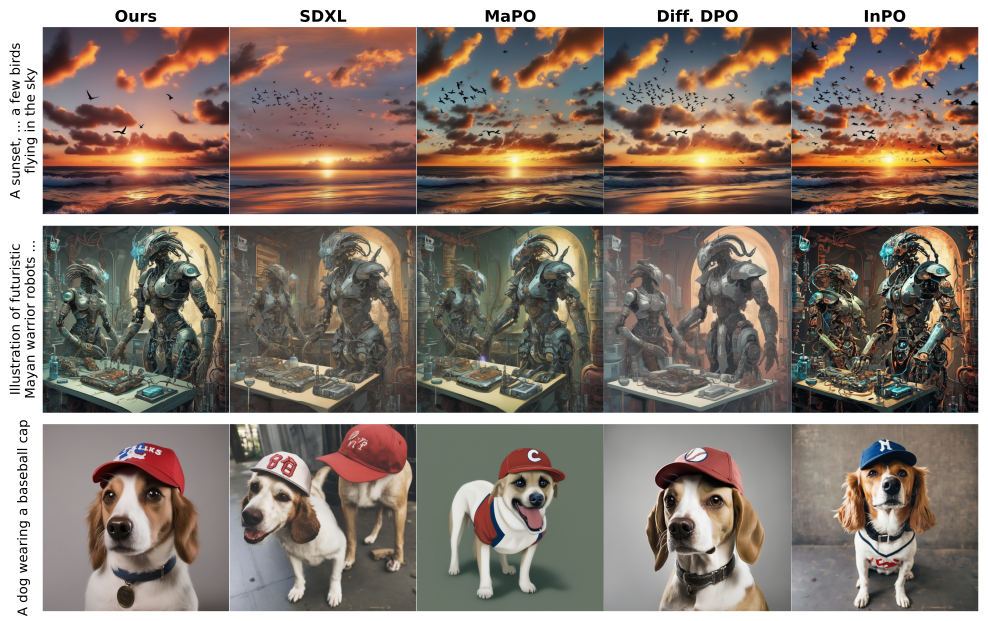
Figure 3 解读:这张图比较 Ours、原始 SDXL、MaPO、Diffusion DPO、InPO 的生成样例。它的作用是补充 reward 表格:LAIR 不只是 reward score 高,视觉上也更倾向于生成与 prompt 更一致、主体更清晰、细节更完整的图像。尤其当 prompt 需要多个属性同时满足时,pairwise baseline 更容易出现局部属性缺失。
5.2 GenEval:compositional generation
| Method | Overall | Color | Count | Pos. | Single | Attr. | Two |
|---|---|---|---|---|---|---|---|
| SD1.5 | 42.42 | 74.47 | 36.56 | 3.50 | 95.62 | 5.25 | 39.14 |
| SmPO | 42.86 | 75.53 | 32.19 | 4.00 | 96.25 | 7.25 | 41.92 |
| Diff.-DPO | 43.28 | 77.39 | 35.00 | 4.75 | 98.12 | 6.00 | 38.38 |
| CRAFT | 45.82 | 77.66 | 38.12 | 6.75 | 96.88 | 8.25 | 47.22 |
| SPO | 44.04 | 72.61 | 33.44 | 6.25 | 95.94 | 6.25 | 49.75 |
| Diff.-LAIR | 51.44 | 84.31 | 45.62 | 6.25 | 99.38 | 13.25 | 59.85 |
SD1.5-based GenEval 中,LAIR 的 Overall 为 51.44,显著高于 Diff.-DPO 的 43.28 和 CRAFT 的 45.82。最大提升来自 Color、Count、Attr. 和 Two-object 指标,说明 listwise reward-aware alignment 对 compositional attribute binding 有帮助。
| Method | Overall | Color | Count | Pos. | Single | Attr. | Two |
|---|---|---|---|---|---|---|---|
| SDXL | 55.05 | 88.30 | 42.81 | 11.00 | 97.50 | 21.00 | 70.96 |
| Diff.-DPO | 57.23 | 86.70 | 45.62 | 11.00 | 98.75 | 20.75 | 80.56 |
| SmPO | 57.86 | 86.70 | 44.69 | 10.50 | 98.75 | 27.00 | 79.55 |
| SPO | 55.43 | 84.04 | 38.44 | 11.75 | 97.81 | 20.50 | 80.05 |
| CRAFT | 57.97 | 87.23 | 36.88 | 14.50 | 99.06 | 23.75 | 86.36 |
| Diff.-LAIR | 59.16 | 90.96 | 39.69 | 13.50 | 100.00 | 28.25 | 82.58 |
SDXL-based GenEval 中,LAIR 的 Overall 为 59.16,在 Color、Single、Attr. 上最优;Two-object 低于 CRAFT,Count 低于 Diff.-DPO / SmPO。这表明 LAIR 的优势并非所有 compositional 子项全面领先,但整体指标仍最高。
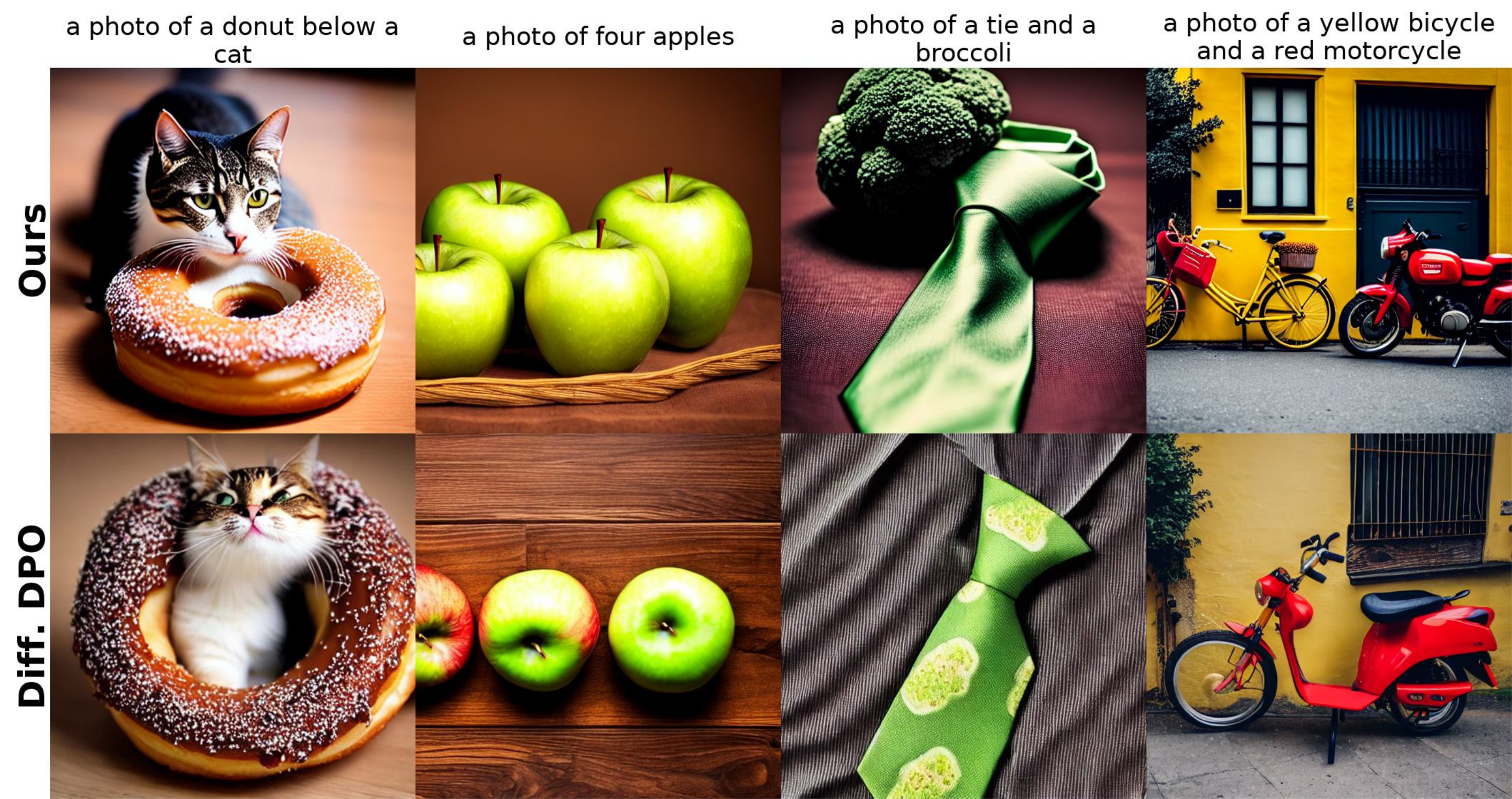
Figure 4 解读:图中对比 LAIR 与 Diffusion DPO 在 GenEval prompt 上的生成效果。论文用它说明 pairwise objective 容易只满足 prompt 的一部分属性,而 LAIR 由于利用整组候选 reward 排序,更能保留颜色、数量、对象关系等组合约束。

Figure 6 解读:这张 appendix 图展示 SD1.5-tuned LAIR 在 GenEval 上的更多样例。它不是 baseline 对比图,而是展示 LAIR 在多个 compositional prompts 下的 qualitative behavior:整体上能较稳定地产生目标对象和属性,但仍可从表格看到 position / counting 等子项不是完全解决。
5.3 Image editing:InstructPix2Pix / SDEdit win rate
| Method | Pick | HPS | Aes. | CLIP | IR |
|---|---|---|---|---|---|
| Diff.-DPO | 81.2% | 76.5% | 65.7% | 71.6% | 73.3% |
| InPO | 78.4% | 82.6% | 73.4% | 62.4% | 74.8% |
| MaPO | 48.8% | 40.6% | 88.4% | 34.8% | 46.9% |
| Diff.-LAIR | 86.4% | 86.1% | 81.6% | 77.5% | 81.0% |
在 image editing setting 中,LAIR 在 Pick、HPS、CLIP、ImageReward win rate 上最高,Aesthetics 低于 MaPO。这与 SDXL text-to-image 表格一致:LAIR 更偏向综合偏好和条件一致性,而非单独最大化 aesthetic score。
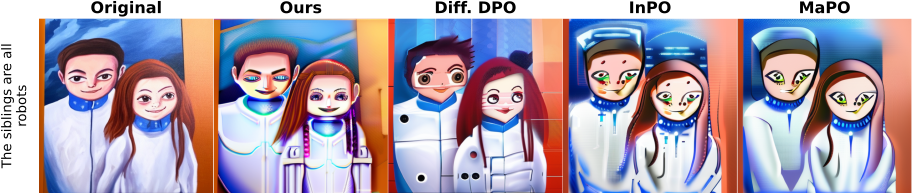
Figure 7 解读:这张图展示 SDXL variants 在 SDEdit / InstructPix2Pix 风格任务上的编辑结果。LAIR 的意义在于:即使训练目标来自 text-to-image preference data,reward-aware listwise alignment 也能迁移到 image editing 的偏好评测上;不过该图仍是 qualitative evidence,最终结论主要由 win-rate 表格支撑。
5.4 SD1.5 qualitative comparison
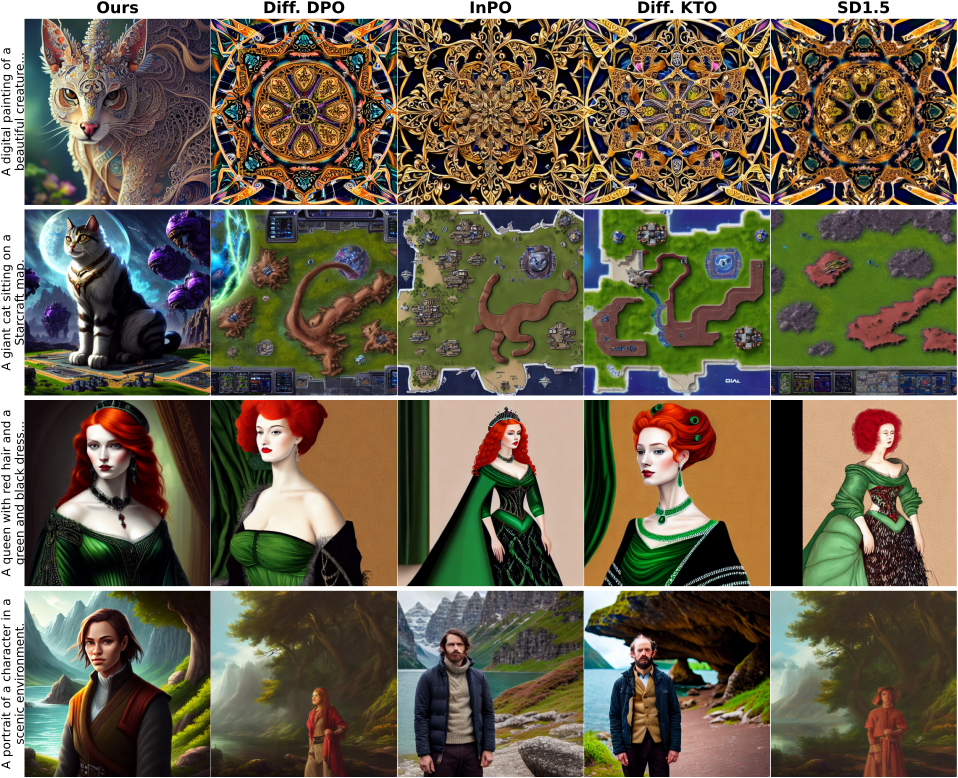
Figure 5 解读:appendix 中这张图比较 SD1.5-tuned LAIR、Diffusion DPO、Diffusion KTO、InPO 和原始 SD1.5。它对应主表中 SD1.5 的 reward 改善:LAIR 生成结果通常更贴近 prompt、更有视觉吸引力。由于图像是 qualitative sample,不能单独证明稳定收益,但与 Parti / HPD / GenEval 数字一致。
5.5 Ablation:最大列表大小 与 reward temperature
| Setting | PickScore | HPS | Aesthetics | CLIP | ImageReward |
|---|---|---|---|---|---|
| 21.950 | 0.2847 | 5.645 | 0.351 | 0.748 | |
| 21.960 | 0.2849 | 5.601 | 0.348 | 0.785 | |
| 21.909 | 0.2845 | 5.613 | 0.346 | 0.740 | |
| 21.886 | 0.2840 | 5.580 | 0.348 | 0.718 |
组大小 ablation 使用 SD1.5,在 100 个随机 Parti-Prompt prompts 上评测、每个 prompt 5 个 samples。总体趋势是较大的 list size 至少不差,并在 PickScore / Aesthetics 等指标上有小幅收益; 的 HPS 和 ImageReward 略高,说明 不是越大所有指标都严格提升,但 listwise supervision 明显优于退化到 的近 pairwise 形态。
| Setting | PickScore | HPS | Aesthetics | CLIP | ImageReward |
|---|---|---|---|---|---|
| 21.930 | 0.2850 | 5.594 | 0.351 | 0.765 | |
| 21.937 | 0.2845 | 5.631 | 0.350 | 0.779 | |
| 21.950 | 0.2847 | 5.645 | 0.351 | 0.748 |
Reward temperature 的影响较小: 在 PickScore / Aesthetics 上略高, 在 HPS 上略高, 在 ImageReward 上略高。作者因此认为 可作为 reward 类型相关的 tuning knob,但方法整体不高度敏感。
5.6 Limitations 与总体结论
作者提到两个主要限制:
- 依赖 reward model 质量:LAIR 训练时直接使用 reward model score;如果 reward model 噪声大或本身与人类偏好不一致,fine-tuned model 也可能被错误引导。
- 理论分析依赖假设:surrogate KL bound 依赖 diffusion ELBO 的 log-ratio approximation,以及把 finite-list implicit reward 扩展到 full-support distribution 的假设;作者强调这提供直觉,不是严格精确保证。
总体上,实验显示 Diffusion LAIR 在 SD1.5 和 SDXL 上都能提升偏好 reward,尤其在 PickScore、HPS、CLIP、ImageReward 和 GenEval Overall 上表现强。核心证据支持论文主张:利用同一 prompt 下多候选 reward score 的 listwise 结构,比把数据压缩成 pairwise winner-loser 更有效;二次正则则让这种偏好更新保持可控。