On-Policy Adversarial Flow Distillation for Autoregressive Video Generation
Paper: arXiv:2605.26105
1. Motivation(研究动机)
这篇论文要解决的是一个很具体的部署问题:强大的 video generation teacher 往往只能作为 sampling-only black-box API 使用,返回完整视频 ,但不暴露 score、logit、latent、sampler state、denoising trajectory 或每个 timestep 的概率;而真正要部署的 student 是 causal autoregressive video generator,需要在自己的 rollout distribution 和自己的 noised states 上学习。两者的监督接口天然不对齐。
当前方法的关键缺口有三层:
- SFT 是 off-policy 的:直接用 teacher-generated videos fine-tune student 时,训练阶段 student 看到的是 teacher-induced prefixes;推理阶段 student 却必须条件化在自己前面生成的 frames 上。局部错误会改变后续 AR conditioning distribution,沿视频时间轴累积。论文 Figure 1 的 preliminary SFT sweep 直接显示:随着 SFT steps 增加,VBench 与 VideoPhy-2 分数不是单调上升,反而会下降。
- DMD / score-based distillation 需要 teacher-side 信息:这类方法通常假设可以访问 teacher score、density ratio 或兼容的 noised states。但 black-box video teacher 只给 clean completed clips,不能给 ,也不能把 teacher step 对齐到 student AR denoising state 。
- 普通 adversarial / reward alignment 信号太稀疏:一个完整视频上的 scalar reward 或 discriminator score 可以告诉 student 这个 rollout 更像 teacher 还是不像 teacher,但不能直接说明哪个 frame、motion pattern 或 denoising timestep 应该被改。训练对象不是一个视频分类器,而是 time-dependent vector field 。
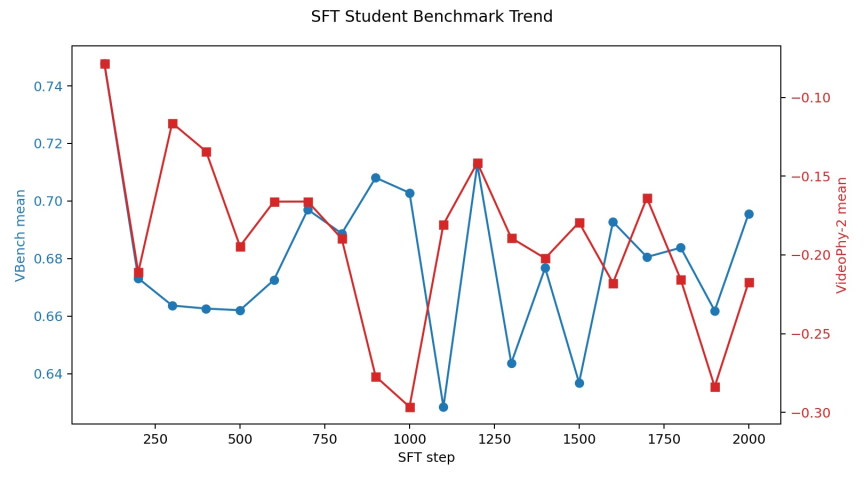
Figure 1 解读:这张图说明 off-policy SFT 的核心症状:继续在 teacher-generated videos 上训练,并不保证 AR student 的 VBench / VideoPhy-2 指标提升。直觉上,teacher videos 只覆盖 teacher 自己的 prefix distribution;student 一旦在推理中犯错,后续 frames 会落到训练时没有见过的 noised AR states,因此 SFT steps 越多不一定越接近 teacher,甚至可能牺牲 motion / physics。
因此,论文关注的问题不是“如何给视频打分”这么简单,而是:如何把 black-box teacher 只能在 completed video 层面提供的 evidence,转换成 student 自己 forward noising process 上的 dense flow-matching supervision。如果这个问题被解决,就能把 proprietary / heterogeneous video teachers 的能力迁移到更适合 streaming、long-horizon 和 interactive deployment 的 AR students 上,同时不要求 teacher 开放内部采样轨迹。
2. Idea(核心思想)
核心洞察是:black-box teacher 的可观测信息只存在于 clean completed samples,但 AR flow student 的可训练对象存在于 forward-noised states;AFD 把这两个空间明确拆开处理。第一步用 prompt-paired Bradley—Terry discriminator 在 clean-video 层估计 teacher—student discrepancy;第二步把这个 on-policy advantage 通过 student 自己的 forward noising kernel 传播到 ,变成 dense velocity-field update。
这和直接 SFT / GAN / diffusion RL 的根本差别在于:AFD 不试图重建 teacher 的隐藏 denoising trajectory,也不把 student reverse chain 人为建成 RL trajectory 来做 credit assignment;它只在 teacher 信息确实可观测的 层估计“哪个 student rollout 更接近 teacher”,然后利用 Flow Matching / DiffusionNFT 的 forward process,把 sample-level signal lift 到 denoising-time vector field。
更具体地说,AFD 把“黑盒蒸馏”拆成了两个互相兼容的估计问题。Discriminator 只回答一个 prompt-paired 问题:在同一 prompt 下,teacher video 和 current student rollout 哪个更像 teacher distribution;它不需要知道 teacher 如何生成,也不需要 teacher score。Flow update 只使用 student-side 信息:把 student 自己生成的 按自己的 forward noising 到 ,因此训练点来自 student 真正会访问的状态分布,而不是 teacher prefix 或 teacher latent。
这种设计也解释了为什么 AFD 比普通 video-level adversarial training 更适合 motion / physics。GAN-style binary loss 可以区分 teacher 与 student 的整体视频分布,但容易被静态外观、prompt 难度或 easy distribution cues 主导;AFD 的 BT loss 在同一 prompt 内做相对比较,得到的 advantage 再进入 positive / negative flow regression,直接调节 velocity field 的方向,因此更接近“把 teacher 的运动规律转成 student 的 denoising 更新”。
一句话概括创新:AFD = adaptive teacher-student discriminator + forward-process credit assignment。前者解决 black-box teacher 只能输出样本的问题,后者解决视频级 feedback 太稀疏、无法直接训练 flow velocity 的问题。
3. Method(方法)
3.1 Overall framework:AFD 如何把 clean-video evidence 变成 flow update
AFD 的训练循环交替进行三件事:
- 对同一批 prompts ,查询 teacher 得到 ,同时用当前 student rollout 得到 。
- 用 prompt-conditioned discriminator 对 teacher sample 与 current student rollout 做 pairwise preference learning,得到 on-policy discrepancy / advantage。
- 将 student rollout 按 student 自己的 forward process 加噪得到 ,用 advantage 权重构造 positive / negative policy optimization,更新 student velocity field,并用 frozen reference student 的 prior loss 防止遗忘。
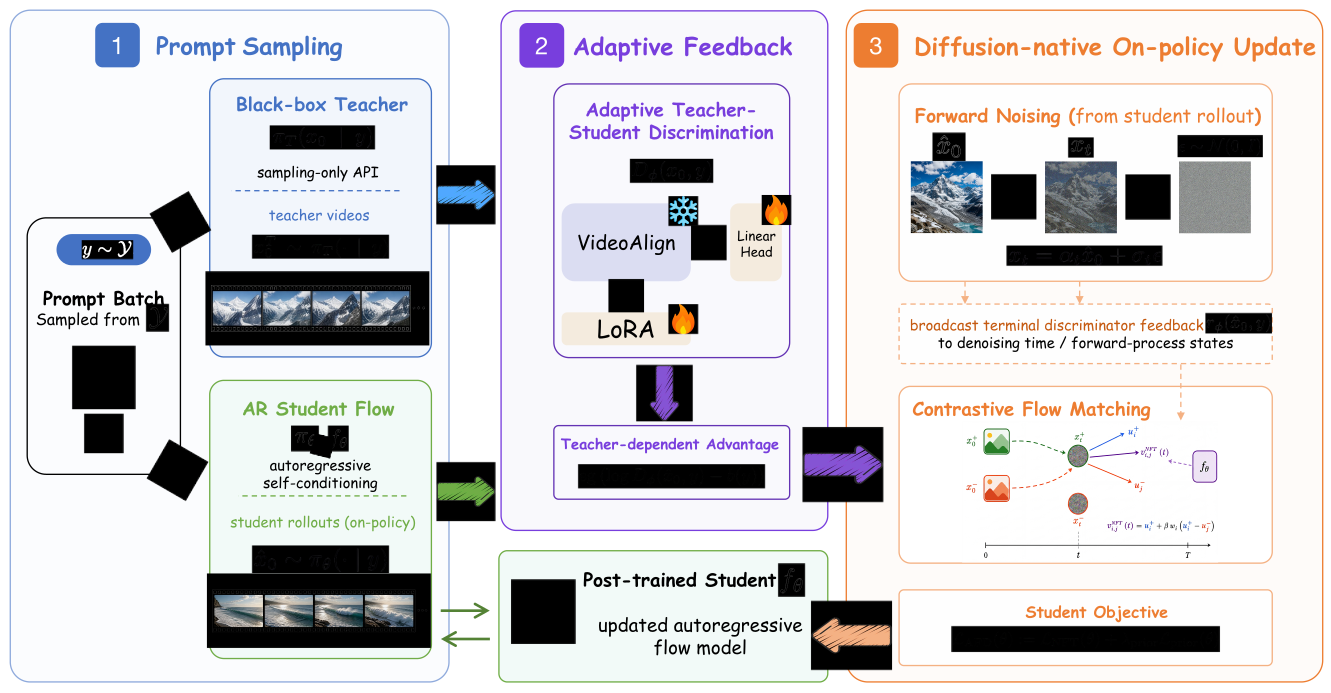
Figure 2 解读:左侧是 clean-video 层面的 adaptive teacher-student discrimination:teacher API 和当前 AR student 在同一 prompt batch 上各自产生完整视频,VideoAlign-style discriminator head 用 Bradley—Terry margin 区分 teacher / student pair。右侧是 DiffusionNFT / forward-process update:discriminator 的 terminal feedback 不直接做 reverse-chain RL,而是 broadcast 到 student 自己 forward-noised states 上,让 flow model 在这些 states 上回归更偏向 positive rollout 的 velocity。图中“sampling-only teacher”和“post-training AR student”之间没有 latent / timestep / trajectory 对齐箭头,这是 AFD 的关键假设边界。
直觉上,AFD 之所以可行,是因为 Flow Matching 的训练目标本来就是在 forward-noised samples 上学习速度场。只要我们能在 clean sample 层面知道哪些 rollout 更像 teacher,就可以把这些 rollout 重新加噪到各种 ,让 student 在自己会遇到的 上朝高分 rollout 的 forward velocity 靠近、远离低分 rollout 的 velocity。这样,视频级别的黑盒判断不会停留在“奖励一个整段视频”,而是通过 forward noising 被转写为密集的 denoising-time 监督。
3.2 Adaptive Teacher—Student Discrimination
AFD 用一个 prompt-conditioned spatiotemporal discriminator 来判断视频 在 prompt 下更像 teacher sample 还是 current student rollout。对每个 prompt,teacher sample 被视为 preferred,student rollout 被视为 rejected,训练 Bradley—Terry loss: 这个 pairwise objective 的作用不是得到一个绝对 calibrated reward,而是在同一 prompt 内学习 teacher 与 student 的相对 margin。论文实现上建议 可从 VideoAlign 这样的 video preference / text-video alignment model 初始化,再用 LoRA online adaptation。这样做的好处是:prompt 难度、静态 appearance bias、内容类别差异会在 paired comparison 中部分抵消;discriminator 关注的是 current student distribution 与 teacher distribution 在同 prompt 下的差距。
Discriminator 诱导的 adaptive reward / advantage 写成: 其中 是 batch-level 或 prompt-level baseline, 表示 stop-gradient。它与固定 reward model 不同: 会跟随 student 的 rollout distribution 一起更新,所以 reward 的含义始终是“当前 student 还在哪些样本上不像 teacher”。
3.3 Diffusion-Native On-Policy Update
直接把 放进 reverse-trajectory RL 会很贵,因为视频 diffusion / flow sampler 的 reverse chain 长,且 teacher 没有提供 reverse actions。AFD 使用 DiffusionNFT-style forward-process update:对 student rollout 、timestep 、noise ,构造: 对一个 minibatch ,先计算 ,再在 batch 内 normalize 成 。论文定义 positive / negative velocity operators: 对应的 negative-aware fine-tuning loss 是: $ \mathcal{L}_\text{NFT}(\theta)
\mathbb{E}{t,x{t,i} \left[ \sum_{i=1}^B w_i|v_{\theta}^{+}(x_{t,i},t,y_i)-v|^2 +(1-w_i)|v_{\theta}^{-}(x_{t,i},t,y_i)-v|^2 \right]. w_iw_i \mathcal{L}{\mathrm{prior} =\mathbb{E}{t,x_{t,i}\sum_{i=1}^B w_i |v_\theta(x_{t,i},t,y_i)-v^{\mathrm{ref}(x_{t,i},t,y_i)|^2. \mathcal{L}{\mathrm{AFD}(\theta) :=\mathcal{L}{\mathrm{NFT}(\theta)+\lambda_{\mathrm{prior}\mathcal{L}_{\mathrm{prior}(\theta). $
3.4 Black-box teacher interface:为什么不能做 step alignment
Teacher 的接口形式只有: 没有 、teacher latents、teacher reverse states 或 teacher transition kernel。AR student 对 个 video blocks 的生成分布是: 这意味着前面 blocks 的误差会改变后面 blocks 的 conditioning distribution。即便 teacher 也是强 video model,它的隐藏 sampler 可能有 个 denoising evaluations,而 student 可能只有 。由于没有共享 latent space 或 trajectory,无法观测对齐算子: AFD 的设计因此遵循“只在可观测处使用 teacher 信息”的原则:teacher-dependent information 只在 completed-video 层被测量;denoising-time structure 完全由 student-side forward process 生成。
3.5 Forward-Process Credit Assignment:从 density ratio 到 vector field
在最优 discriminator 下,BT discriminator 的 logit ratio 可看作 clean-sample density ratio: $ \rho_\phi^(\hat{x}0,y) := \log \frac{D\phi^(\hat{x}0,y)}{1-D\phi^*(\hat{x}_0,y)}
\log \frac{\pi_T(\hat{x}0\mid y)}{\pi\theta(\hat{x}_0\mid y)}. r(\hat{x}_0,y) \pi^+(\hat{x}_0\mid y)\propto r(\hat{x}0,y)\pi\theta(\hat{x}_0\mid y). p(x_t\mid\hat{x}0) \pi_t^+(x_t\mid y)\propto \mathbb{E}{\hat{x}0\sim\pi\theta(\cdot\mid y)} \left[r(\hat{x}0,y)p(x_t\mid\hat{x}0)\right]. v^+(x_t,t,y)= \mathbb{E}{\hat{x}0\sim\pi^+(\cdot\mid y),p(x_t\mid\hat{x}0)} \left[v\mid x_t,y\right]. r\phi(x_0,y)=\exp(\rho\phi(x_0,y))\pi^{\mathrm{old}=\pi\theta\pi^+\pi_T$ 做 on-policy reverse-KL distillation。
3.6 Training procedure pseudocode(基于论文 Algorithm 1;未找到 released code)
论文没有公开实现仓库;下面 pseudocode 是按论文 Algorithm 1、§3 公式和 Table 3 hyperparameters 写出的阅读级伪代码,不是 released code transcription。
def collect_on_policy_batch(teacher_api, student, prompt_sampler, batch_size):
    prompts = prompt_sampler.sample(batch_size)
    teacher_videos = teacher_api.sample(prompts)          # x_0^T ~ pi_T(. | y)
    student_videos = student.rollout(prompts)             # x_hat_0 ~ pi_theta(. | y)
    return prompts, teacher_videos, student_videos
def update_discriminator(discriminator, optimizer_d, teacher_videos, student_videos, prompts):
teacher_scores = discriminator(teacher_videos, prompts)
student_scores = discriminator(student_videos.detach(), prompts)
bt_logits = teacher_scores - student_scores
loss_d = -torch.log(torch.sigmoid(bt_logits)).mean()
optimizer_d.zero_grad(set_to_none=True)
loss_d.backward()
optimizer_d.step()
return loss_ddef compute_afd_weights(discriminator, student_videos, prompts, clip_max=5.0):
with torch.no_grad():
raw_scores = discriminator(student_videos, prompts)
baseline = raw_scores.mean(dim=0, keepdim=True)
advantage = (raw_scores - baseline).clamp(max=clip_max)
weights = (advantage - advantage.min()) / (advantage.max() - advantage.min() + 1e-8)
return weightsdef afd_student_loss(
student, ref_student, student_videos, prompts, weights,
alpha_t, sigma_t, beta=0.1, lambda_prior=1e-4,
):
eps = torch.randn_like(student_videos)
t = torch.rand(student_videos.shape[0], device=student_videos.device)
x_t = alpha_t(t) * student_videos + sigma_t(t) * eps
target_v = alpha_t.derivative(t) * student_videos + sigma_t.derivative(t) * eps
v_theta = student.velocity(x_t, t, prompts)
v_pos = (1.0 - beta) * v_theta.detach() + beta * v_theta
v_neg = (1.0 + beta) * v_theta.detach() - beta * v_theta
loss_pos = ((v_pos - target_v) ** 2).flatten(1).mean(dim=1)
loss_neg = ((v_neg - target_v) ** 2).flatten(1).mean(dim=1)
loss_nft = (weights * loss_pos + (1.0 - weights) * loss_neg).mean()
with torch.no_grad():
v_ref = ref_student.velocity(x_t, t, prompts)
loss_prior = (weights * ((v_theta - v_ref) ** 2).flatten(1).mean(dim=1)).mean()
return loss_nft + lambda_prior * loss_priordef train_afd_step(
teacher_api, student, ref_student, discriminator,
optimizer_s, optimizer_d, prompt_sampler, ema_student,
):
prompts, teacher_videos, student_videos = collect_on_policy_batch(
teacher_api, student, prompt_sampler, batch_size=prompts_per_step,
)
loss_d = update_discriminator(discriminator, optimizer_d, teacher_videos, student_videos, prompts)
weights = compute_afd_weights(discriminator, student_videos, prompts)
loss_s = afd_student_loss(
student, ref_student, student_videos, prompts, weights,
alpha_t=schedule.alpha, sigma_t=schedule.sigma,
)
optimizer_s.zero_grad(set_to_none=True)
loss_s.backward()
torch.nn.utils.clip_grad_norm_(student.parameters(), max_norm=1.0)
optimizer_s.step()
ema_student.update(student, decay=0.99)
return {"loss_d": loss_d.item(), "loss_s": loss_s.item()}3.7 Code search and code-to-paper mapping
代码搜索未找到开源实现。已检查 arXiv abstract/source/PDF 中的链接,使用 web search 查询 On-Policy Adversarial Flow Distillation GitHub、Adversarial Flow Distillation GitHub、AFD Seedance 2.0 VideoAlign GitHub,并用 GitHub CLI 搜索题名、方法名和 arXiv ID;未发现与本文对应的 public repository。因此本笔记不设置 github_ref,也不声称 pseudocode 来自 released code。
Code reference: 代码搜索未找到开源实现(2026-05-26);pseudocode and mapping are based on arXiv v1 paper text only.
| Paper Concept | Source File | Key Class/Function |
|---|---|---|
| Prompt-paired Bradley—Terry discriminator | 代码搜索未找到开源实现 | 论文 §3.1 的 |
| Forward-process noising bridge | 代码搜索未找到开源实现 | 论文 Eq. forward_path 与 §3.4 |
| DiffusionNFT / negative-aware fine-tuning | 代码搜索未找到开源实现 | 论文 §3.2 的 、、 |
| Prior regularization against frozen reference student | 代码搜索未找到开源实现 | 论文 §3.2 / Algorithm 1 的 |
| AFD alternating training loop | 代码搜索未找到开源实现 | 论文 Algorithm 1 |
4. Experimental Setup(实验设置)
4.1 Models and teacher interface
- Student families:Self-Forcing 与 Causal-Forcing 两个 causal autoregressive video student families。
- Teacher:Seedance 2.0,只作为 prompt-conditioned video sampling API 使用;论文明确把它当作 sampling-only black-box teacher。
- Discriminator:默认从 VideoAlign 初始化,用 LoRA online adaptation,在当前 student rollouts 与 teacher samples 上更新。
- Main adaptation data:从 VideoPhy-2 physics benchmark 采样 个 examples,并用同一批 prompts 查询 teacher 得到 black-box adaptation videos。
- Stylized domain ablation:额外使用 个 Disney-style animation prompts,测试 continual learning 到视觉风格偏移域。
这个 setup 的重点是“limited target-domain continual adaptation”,不是从零训练 video model。Student 已经是可生成视频的 pretrained AR model;AFD 只在目标 prompt distribution 上做 post-training,让 student 在自己的 rollout distribution 上逐步靠近 Seedance 2.0 的 sample distribution。由于 teacher 只通过 API 返回完整视频,所有实验都避免使用 teacher logits、teacher hidden states、teacher denoising schedule 或 teacher step alignment。
两个 student family 的作用也不同:Self-Forcing 代表已有 on-policy / autoregressive distillation 思路下的 student,Causal-Forcing 代表另一个 causal AR backbone。AFD 在两者上都做同样的 black-box adaptation,说明方法不是绑定到单一 architecture。VideoPhy-2 physics prompts 则强调 motion、dynamic degree、spatial relation 和 physical consistency,这些正是 off-policy SFT 最容易因为 exposure bias 而退化的维度。
4.2 Baselines
论文比较四类 baselines:
- Base:pretrained AR student,不做 teacher adaptation。
- SFT:直接在 teacher-generated videos 上 supervised fine-tuning,不使用 student on-policy rollouts。
- GAN:用 binary teacher-vs-student discriminator 做 adversarial fine-tuning。
- DMD:score / distribution-matching style distillation baseline,用于对比 teacher-score / density-ratio 假设下的方法。
4.3 Evaluation metrics
- VBench Physics Total:由 temporal flickering、motion smoothness、dynamic degree、human action、spatial relationship 等 physics-sensitive dimensions 组成。
- VBench General Total:除 physics group 外其他 VBench dimensions 的平均,用于检查 general video quality 是否被牺牲。
- VideoAlign-MQ / Motion Quality:用 VideoAlign Motion Quality 评估 motion quality。
- VideoPhy-2-PC / Physical Consistency:用 VideoPhy-2 Physical Consistency 评估物理一致性。
4.4 Training configuration
论文 Table 3 给出的 AFD training hyperparameters 如下;论文未在公开仓库中提供 launch script,因此这些数值来自 arXiv paper 的 hyperparameter appendix,而不是 released config file。
Model & video specs
- Base architecture:Self-Forcing / Causal-Forcing。
- Video resolution:。
LoRA fine-tuning
- Rank :256。
- Scaling factor :256。
- Dropout:0.0。
- Gradient checkpointing:Enabled。
Optimization
- Precision:bfloat16。
- Optimizer:AdamW,、、。
- Learning rate :。
- Weight decay:。
- Max gradient norm:1.0。
Selective regularization / rollout
- Interpolation strength :0.1。
- Prior loss weight :。
- Advantage clip max:5.0。
- Reward normalization:Global Std with Per-Prompt Tracking。
- EMA decay :0.99。
5. Experimental Results(实验结果)
5.1 Main VBench / physics results
Table 1 显示 AFD 在两个 AR student families 上都提升 physics-sensitive generation,同时基本保留 general quality。
| Model | Method | Physics Total | Temporal Flick. | Motion Smooth. | Dynamic Degree | Human Action | Spatial Rel. | General Total |
|---|---|---|---|---|---|---|---|---|
| Self-Forcing | Base | 68.49 | 98.27 | 97.19 | 91.67 | 46.00 | 9.32 | 36.51 |
| Self-Forcing | SFT | 58.69 | 96.64 | 97.40 | 44.44 | 34.00 | 20.97 | 37.62 |
| Self-Forcing | GAN | 83.83 | 99.28 | 98.58 | 61.11 | 79.00 | 81.18 | 60.95 |
| Self-Forcing | DMD | 81.88 | 99.01 | 98.95 | 52.78 | 81.00 | 77.66 | 59.98 |
| Self-Forcing | AFD | 87.55 | 98.78 | 98.30 | 79.17 | 80.00 | 81.50 | 60.83 |
| Causal-Forcing | Base | 86.76 | 98.20 | 97.90 | 87.50 | 76.00 | 74.20 | 59.03 |
| Causal-Forcing | SFT | 76.24 | 99.31 | 99.05 | 29.17 | 78.00 | 75.69 | 59.40 |
| Causal-Forcing | GAN | 83.07 | 98.58 | 98.08 | 66.67 | 76.00 | 76.00 | 59.44 |
| Causal-Forcing | DMD | 82.52 | 99.16 | 98.75 | 58.33 | 77.00 | 79.35 | 60.32 |
| Causal-Forcing | AFD | 88.52 | 98.41 | 97.89 | 88.89 | 80.00 | 77.39 | 59.83 |
关键读法:Self-Forcing 上,AFD 的 Physics Total 是 87.55,高于 GAN 的 83.83 和 DMD 的 81.88;General Total 为 60.83,仅略低于 GAN 的 60.95。Causal-Forcing 上,AFD 的 Physics Total 是 88.52,高于 Base 86.76、GAN 83.07 和 DMD 82.52;General Total 59.83,接近 DMD 的 60.32。最显著的是 Dynamic Degree:Causal-Forcing 中 AFD 达到 88.89,而 SFT 只有 29.17、DMD 58.33、GAN 66.67。
Table 2 的 physics-domain metrics 进一步支持这个结论:
| Model | Method | Motion Quality | Physical Consistency |
|---|---|---|---|
| Self-Forcing | Base | 0.341 | 4.04 |
| Self-Forcing | SFT | 0.296 | 3.72 |
| Self-Forcing | GAN | 0.541 | 4.10 |
| Self-Forcing | DMD | 0.420 | 3.72 |
| Self-Forcing | AFD | 0.605 | 4.20 |
| Causal-Forcing | Base | 0.520 | 4.16 |
| Causal-Forcing | SFT | 0.499 | 4.17 |
| Causal-Forcing | GAN | 0.582 | 4.16 |
| Causal-Forcing | DMD | 0.661 | 4.14 |
| Causal-Forcing | AFD | 0.661 | 4.24 |
Self-Forcing 上 AFD 的 Motion Quality 0.605、Physical Consistency 4.20 均为最高;Causal-Forcing 上 AFD 的 Motion Quality 0.661 与 DMD 持平,Physical Consistency 4.24 最高。
5.2 Qualitative visualizations
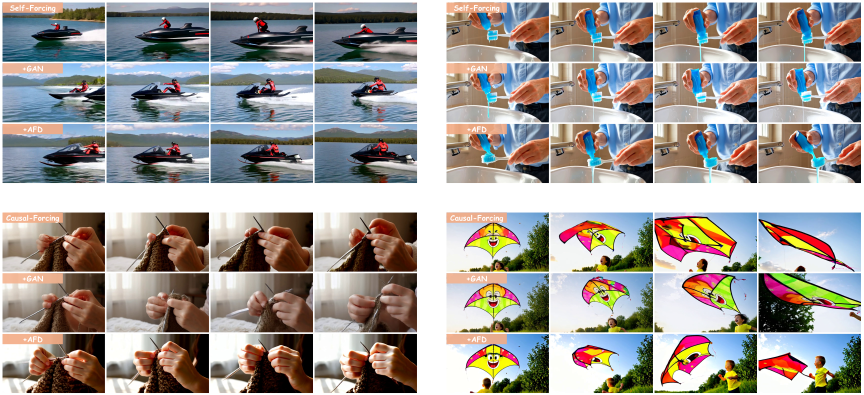
Figure 3 解读:这组图对应 main experiment 的 qualitative comparisons,上排是 Self-Forcing examples,下排是 Causal-Forcing examples。每个 panel 都展示同一 prompt 下 teacher / student 或 adaptation 前后代表 frames 的差异。它支持 Table 1 / Table 2 的趋势:AFD 保留 prompt content 与 visual fidelity,同时更强调 motion evolution、物理行为和时序一致性;这正是 forward-process update 应该改善的部分,而不是只靠一个 video-level GAN loss 改外观。

Figure 4 解读:这组 Disney-style animation examples 用于验证 AFD 不只适用于 physics prompts。两个 examples 都是强风格偏移的 cartoon / storybook prompt;AFD 通过当前 target domain 上的 teacher-student discriminator 产生 feedback,再把 feedback 转成 denoising-time update,使 student 能跟随新风格,同时维持 prompt alignment 与 coherent motion。
5.3 Ablations
Discriminator learning rate
论文 sweep 。结论是 discriminator 更新太慢或太快都会破坏 reward signal:
- 时,discriminator 跟不上 evolving student distribution, 很快接近 1,表现为 stale scoring function 的 saturation,而不是 teacher-student gap 真的消失。
- 时,discriminator 太强,早期就让 接近 0,positive / negative rollout weights 缺少有效 contrast。
- 与 更合适,能产生逐步上升且有信息量的 。
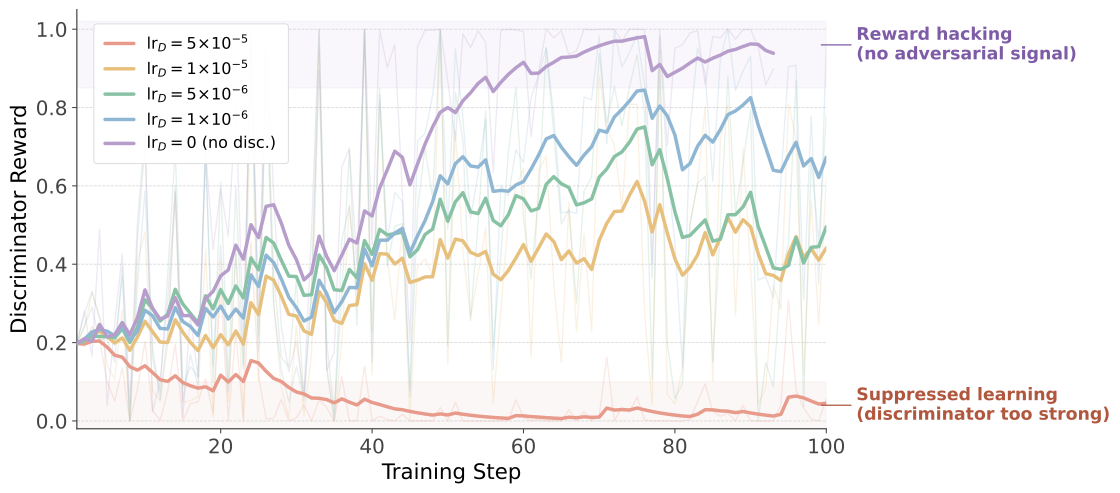
Figure 5 解读:横轴是训练进程,纵轴是 student rollout reward 。中间学习率曲线提供平滑、非饱和的反馈;过小学习率像“旧评委”,过大学习率像“过强评委”,都会让 AFD 的 positive / negative weighting 失去训练价值。这说明 AFD 的 discriminator 不是一次性 reward model,而是需要与 student co-evolve 的 discrepancy estimator。
Bradley—Terry vs. GAN-style discriminator loss
论文还把 prompt-paired BT objective 换成 GAN-style binary classification loss,保持 on-policy data、discriminator architecture 和 forward-process student update 不变。结果显示 BT 主要提升 Dynamic Degree:88.89 vs. GAN 的 79.17,差 9.72 points;Motion Smoothness 也略高:98.89 vs. 98.53;Temporal Flickering、Human Action、Spatial Relationship 基本接近。
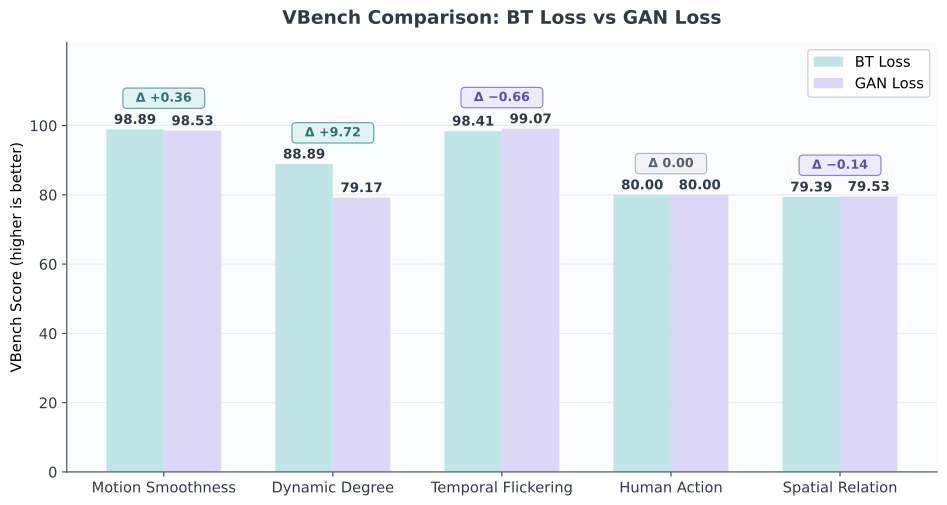
Figure 6 解读:这张图说明 BT loss 更适合 AFD 所需的 on-policy ranking signal。GAN-style loss 学绝对 real/fake 分类,容易被简单分布差异或 prompt 难度主导;BT 在同一 prompt 内比较 ,更能抵消 prompt-level bias,把 signal 聚焦到当前 student 与 teacher 的相对差距,因此对 motion-sensitive dynamic degree 更有效。
5.4 Additional qualitative examples
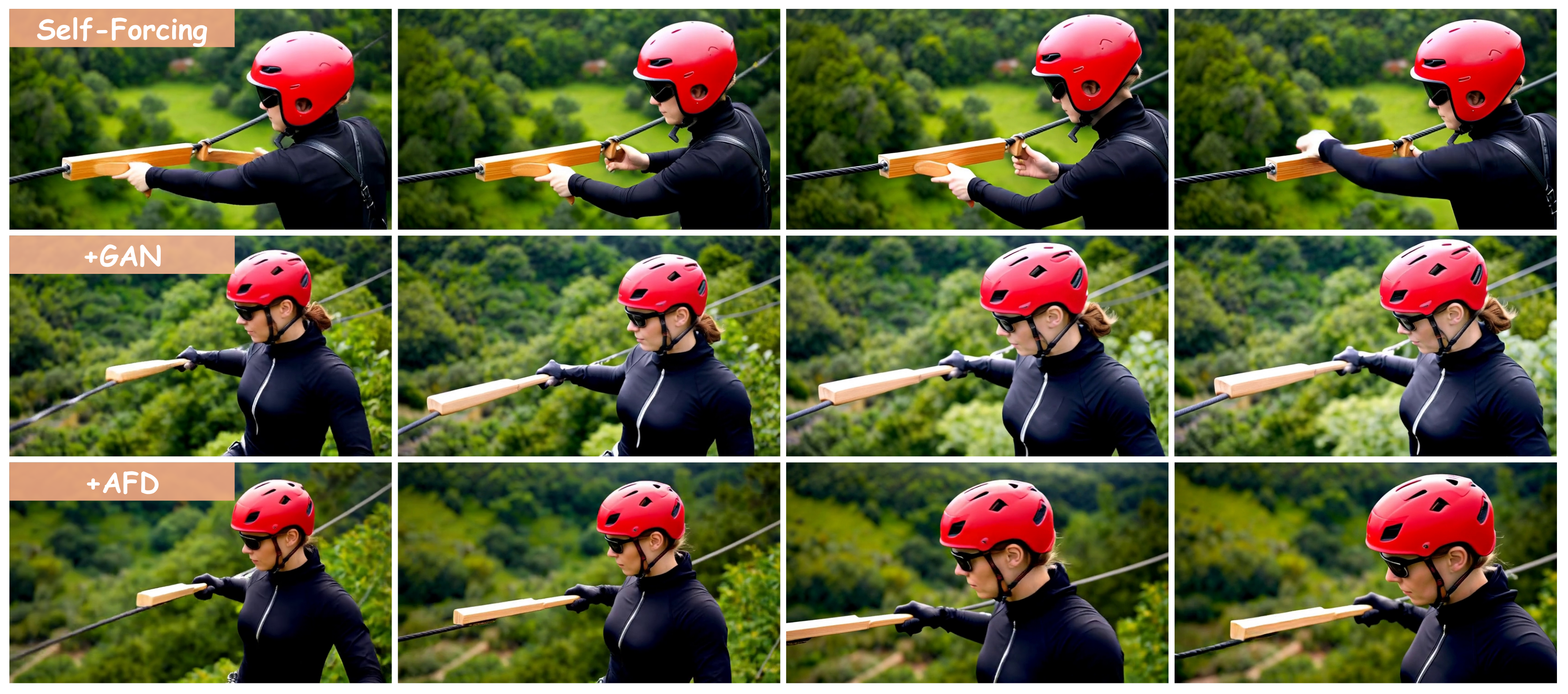
Figure 7 解读:tightrope walker prompt 强调微小平衡动作、物体沿绳索移动和稳定 camera framing。AFD 的意义在于把这些 completed-video 层面的物理 / motion plausibility 差异转成 forward-noised states 上的 velocity correction,而不要求 teacher 给出每个 frame 或 denoising step 的局部 supervision。
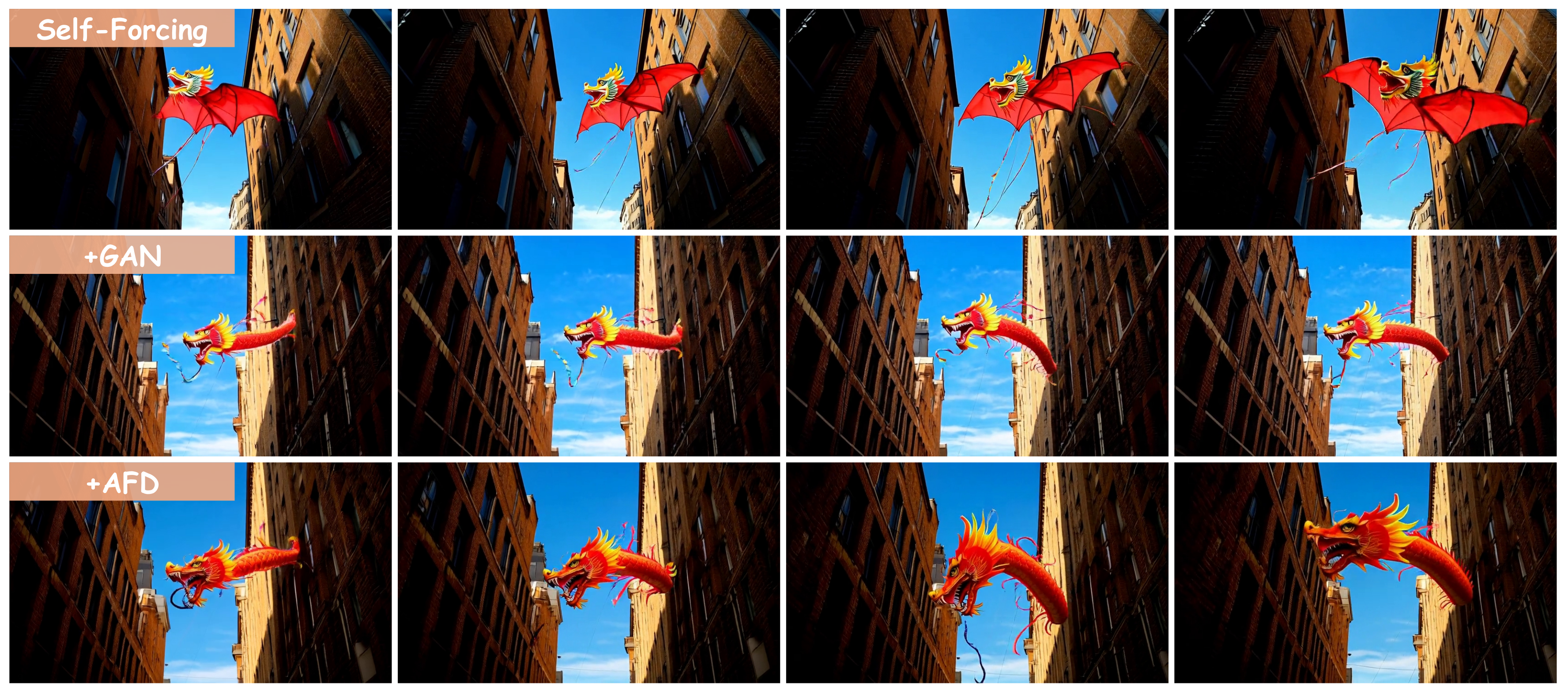
Figure 8 解读:dragon kite prompt 需要同时保持城市峡谷场景、kite shape、ribbons motion 与光照变化。这个例子展示 AFD 并非只优化单一数值指标;如果 discriminator 能在当前 prompt distribution 上区分 teacher / student 的 completed videos,forward-process update 可以改善运动轨迹同时保留静态语义与视觉风格。
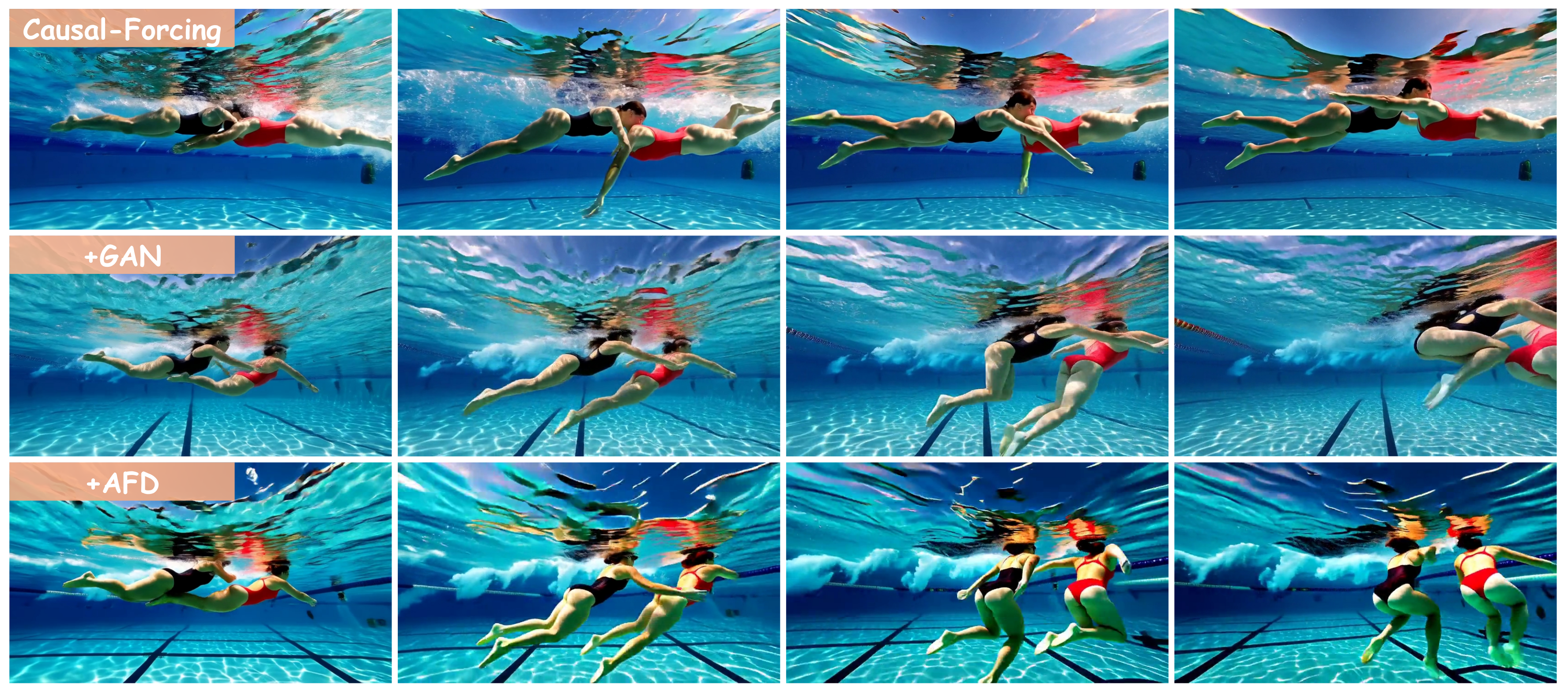
Figure 9 解读:underwater synchronized swimmers prompt 对周期性肢体动作、水下反射和多主体相对运动有要求。它补充说明 AFD 的主要收益集中在 motion evolution 与 physical plausibility:这些因素很难由 off-policy SFT 在 teacher prefixes 上稳定学到,也很难由普通 video-level adversarial loss 精确分配到 denoising-time states。
5.5 Limitations and conclusion
论文承认当前实验范围仍有限:只覆盖两个 causal AR student backbones,以及少量 target domains,主要是 physics-oriented prompts 和 stylized animation prompts。未来还需要在更多 teachers、更长 videos、更广 prompt distributions 上验证泛化性。AFD 还依赖 online discriminator,因此性能会受 discriminator update rate 和 reward calibration 影响;论文的 ablation 给出初步经验,但没有系统解决调参问题。作者也提到,更广泛的 reasoning-oriented benchmarks(如 V-ReasonBench)仍留给 future work。
总体结论是:AFD 把 black-box video distillation 重新表述为“可观测 interface”问题。对 causal AR students 来说,缺的不是 teacher trajectory 本身,而是把 completed-video sample discrepancy 连接到 student 自己 denoising-time states 的机制。Adaptive discrimination 负责估计当前 teacher-student gap,forward-process credit assignment 负责把 gap 变成 dense velocity-field supervision;实验显示这能提升 motion / physics 指标,同时不明显牺牲 general video quality。