Latent-GRPO: Group Relative Policy Optimization for Latent Reasoning
Paper: arXiv:2604.27998 Code: DJC-GO-SOLO/Latent-GRPO Code reference:
main@c0994fb7(2026-05-12)
1. Motivation
Latent reasoning 把中间推理压缩进连续表示,理论上能显著缩短 reasoning chain,但现有工作主要停留在 SFT;一旦直接把 GRPO/Soft-GRPO 迁到 latent space,训练就会不稳定,甚至 collapse。 论文把问题拆成三个具体瓶颈:缺少内在 latent manifold、trajectory-level reward 和 token-level update 的方向不一致、多个正确 latent path 在共享前缀处会发生 harmful averaging。解决这三个点,才能把 latent reasoning 从“能做”推进到“能稳定 RL”。 这个问题值得做,因为一旦稳定,latent reasoning 可以同时保留正确率和更短的推理长度;在难题上还能带来更强的 pass@k 搜索能力。
2. Idea
核心不是“再做一个 latent RL 版本”,而是把 latent RL 重新约束到一个可优化的几何空间里:先用 Latent-SFT 提供有效 manifold,再用三道护栏分别处理无效轨迹、错误的噪声方向、以及共享起点上的 mode averaging。
和 Soft-GRPO 的根本差异是,Soft-GRPO 主要解决“怎么估计 latent token 的 density”,而 Latent-GRPO 进一步改变了 exploration 和 update 的结构,让优势信号、采样扰动、以及多路径竞争都对齐到 latent 机制本身。
3. Method
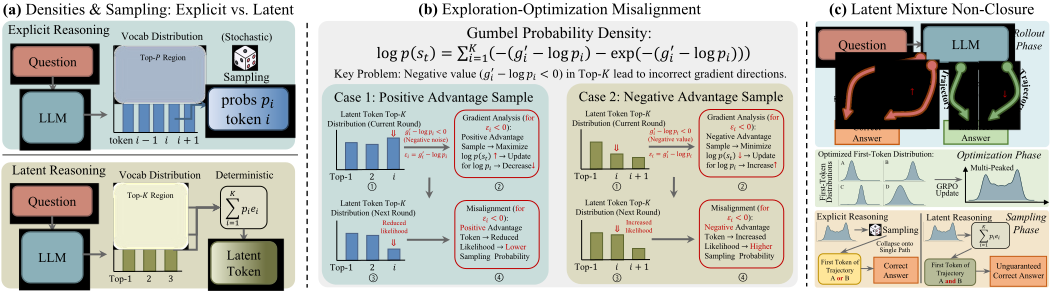
Figure 1 解读:图 (a) 说明 explicit reasoning 和 latent reasoning 在 probability density 与 sampling mechanism 上都不同;图 (b) 展示 naive Gumbel objective 会把正优势轨迹的某些成分往下推、把负优势轨迹的某些成分往上推;图 (c) 说明多个正确 latent path 在共享前缀处会平均成一个不一定合法的连续状态。
3.1 Overall framework
Latent-GRPO 先假设模型已经经过 Latent-SFT 初始化,拥有可用的 latent manifold。训练时,每个 prompt 采样一组 group trajectories;每条轨迹先在 top- vocabulary 上形成 latent token,再根据轨迹级 reward 做 GRPO-style 更新。
方法上有三层改动:
- Invalid Sample Advantage Masking:把超长/不终止的轨迹从 group baseline 里剔除。
- One-sided Noise Sampling:把 Gumbel 扰动改成单边正扰动,并在优化阶段保持方向一致。
- Optimal Correct Path First Token Selection:在多个正确轨迹里只保留一个最优轨迹的第一个 latent token,避免共享前缀上的 harmful averaging。
3.2 Invalid Sample Advantage Masking
设一组采样轨迹为 ,第 条轨迹长度为 ,最大响应长度为 。论文把在预算内正常终止的轨迹定义为 然后只在 valid subset 上计算 group baseline: 优势定义为: \\hat{A}_j^{\\mathrm{valid}}= \\begin{cases} \\dfrac{R_j-\\mu_R}{\\sigma_R}, & j\\in\\mathcal{G}_{\\mathrm{valid}}, \\\\ 0, & j\\notin\\mathcal{G}_{\\mathrm{valid}}. \\end{cases} 直觉是:无效轨迹不是“坏样本的正常一员”,而是已经偏离 latent manifold 的污染源。如果把它们留在 group 统计里,会扭曲 valid samples 的归一化优势。
def mask_invalid_advantage(rewards, lengths, max_len):
    valid = lengths < max_len
    adv = torch.zeros_like(rewards)
    if valid.any():
        mu = rewards[valid].mean()
        sigma = rewards[valid].std(unbiased=False).clamp_min(1e-6)
        adv[valid] = (rewards[valid] - mu) / sigma
    return adv
论文公式与 released code 实现差异:训练脚本里 algorithm.exclude_overlong_samples_from_advantage 不是全局单一配置,GSM8K 脚本为 False,Math500 脚本为 True;代码里也分成了 compute_latent_grpo_outcome_advantage_firstmask_best_exclude_advantage 和 ...include_advantage 两条路径。也就是说,paper 的概念是一致的,但 released code 采用了 task-specific 的开关。
3.3 One-sided Noise Sampling
Soft-GRPO 的问题在于,标准 Gumbel perturbation 是双边的:,其中 可以正也可以负。这样一来,正优势轨迹里的某些 component 反而可能被往下调,负优势轨迹里的某些 component 反而可能被往上推。
Latent-GRPO 把扰动改成单边形式: 并定义 这样在优化初期,target margin 是正的;如果多轮 PPO 更新后 margin 被跨过去,论文再用 conditional STE 把 backward direction 翻回去,维持单边约束。
def one_sided_target(logp_old, gumbel_noise, a=1.5, b=3.0, delta=1e-6):
    xi_pos = gumbel_noise.clamp(-a, b) + a + delta
    return logp_old + xi_pos
释放代码里,这个设计主要落在 sglang_latent_reasoning_pkg/python/sglang/srt/layers/sampler.py 和 rollout 管线里:采样阶段保存 top-k gumbels、原始概率和 token ids,再交给 trainer 计算 surrogate density。训练脚本默认 actor_rollout_ref.rollout.add_noise_gumbel_softmax=True,而评测脚本默认会关掉噪声做 deterministic decoding;pass@k 是单独打开 Gumbel sampling 后测的。
3.4 Optimal Correct Path First Token Selection
这里解决的是 latent mixture non-closure。多个正确路径一起优化时,explicit CoT 还能靠离散采样选中一条具体路径,但 latent token 是连续向量,会把这些正确路径平均成一个可能不合法的中间态,尤其在第一个 reasoning step 最明显。
做法是:先找出验证正确的轨迹集合 ,再用轨迹级平均 surrogate log-probability 选出最优路径 然后取 只屏蔽其他正确路径在 的更新,后续 token 仍然保留。这一点很关键:它不是把训练收缩成单一路径,而是只修掉共享起点上的 harmful averaging。
def select_first_token_mask(correct_scores, correct_flags):
    mask = torch.ones_like(correct_flags, dtype=torch.float32)
    if correct_flags.sum() > 1:
        best = torch.argmax(correct_scores[correct_flags])
        correct_idx = torch.nonzero(correct_flags, as_tuple=False).flatten()
        for i, idx in enumerate(correct_idx):
            if i != best:
                mask[idx, 0] = 0.0
    return mask
3.5 Final objective
最终目标就是把上面三层 mask/target 合到 PPO surrogate 里: 其中 同时包含 invalid-sample masking 和 first-token selection。
def latent_grpo_loss(ratio, ratio_old, advantage, kl, eps_clip, beta):
    clipped = ratio.clamp(1 - eps_clip, 1 + eps_clip)
    ppo_term = torch.min(ratio * advantage, clipped * advantage)
    return -(ppo_term - beta * kl).mean()
3.6 Code-to-paper mapping
Code reference:
main@c0994fb7(2026-05-12) — pseudocode and mapping based on this commit
| Paper concept | Source file | Key class/function | Role |
|---|---|---|---|
| Latent rollout / top-k latent token construction | sglang_latent_reasoning_pkg/python/sglang/srt/layers/sampler.py | top-k sampling helpers | 构造 latent token 的 top-k mixture,并保存采样所需的 scores / probs / gumbels |
| Rollout 输出回传训练端 | verl-0.4.x/verl/workers/rollout/sglang_rollout/sglang_rollout.py | SGLangRollout, _post_process_outputs | 把 token ids、logprobs、top-k gumbels、original probs 整理回 trainer |
| Invalid sample masking + first-token selection | verl-0.4.x/verl/trainer/ppo/core_algos.py | compute_latent_grpo_outcome_advantage_firstmask_best_exclude_advantage, compute_latent_grpo_outcome_advantage_firstmask_best_include_advantage | 实现 group advantage、无效轨迹过滤、最佳正确路径首 token mask |
| GRPO / PPO loss | verl-0.4.x/verl/trainer/ppo/core_algos.py | compute_policy_loss, compute_rewards, kl_penalty | 构造最终 policy objective 和 KL 正则 |
3.7 机制补充:三道护栏如何共同稳定 latent RL
Latent-GRPO 的三项改动分别对应三种失败模式。Invalid Sample Advantage Masking 处理的是 group 统计被污染的问题:过长或没有正常终止的样本往往不是“低 reward 的普通负例”,而是采样过程已经偏离 latent manifold 的异常轨迹。若把它们放进均值和方差,valid 样本的优势会被错误归一化,模型可能为了远离异常样本而破坏原本正确的推理方向。把无效样本优势置零并从 baseline 中剔除,本质上是在告诉优化器:先不要从不可信轨迹里学习方向,只用正常完成的轨迹比较好坏。One-sided Noise Sampling 处理的是 latent token 采样和更新方向不一致的问题。
Soft-GRPO 使用 Gumbel 扰动估计 latent density,但双边噪声会让某些正优势轨迹的 logit 分量被目标压低,也会让负优势轨迹的分量被意外抬高。Latent-GRPO 把扰动改成单边正 margin,再用 conditional STE 在 margin 被跨过后修正反向传播方向,使“采样时选中的 latent token”和“训练时增加其相对概率”保持同向。这个设计尤其适合连续 latent,因为 latent token 不是一个可以独立解释的离散词;一旦某些维度被反向推动,得到的向量可能落到语言模型未见过的中间区域。
Optimal Correct Path First Token Selection 处理的是多条正确路径之间的 non-closure。显式 CoT 中,多条正确推理链共享前缀通常不是大问题,因为模型最终仍然输出某个离散 token;但 latent reasoning 的第一个 latent state 是连续向量,多个正确路径在同一起点被同时拉近时,平均结果未必对应任何一条合法推理模式。论文只屏蔽其他正确路径的 first latent token,而不是屏蔽整条轨迹,说明作者希望保留后续推理多样性,只修复最容易发生 mode averaging 的分岔入口。
这三道护栏的组合比单独任一项更重要。Latent-SFT 先提供可用的表示流形,advantage masking 保证 reward baseline 来自可信轨迹,one-sided noise 保证 latent density surrogate 的梯度方向不反常,first-token selection 再避免多个正确模式在入口处互相平均。最终目标仍然是 GRPO/PPO 风格的 clipped surrogate 加 KL 约束,但被优化的对象已经不再是普通离散 token 序列,而是由 top- 词分布、Gumbel 扰动、latent embedding 和文本解码共同定义的混合轨迹。
论文没有说明所有数据混合比例和每个 benchmark 的完整超参,因此复现时应优先检查 released config 中 mask 开关、Gumbel sampling 开关和 deterministic evaluation 设置是否与实验一致。从实验设计看,low-difficulty、high-difficulty 和 pass@k 三组结果分别验证不同问题:低难度任务检查 latent RL 是否会破坏已有能力,高难度任务检查优化后是否真的提升复杂推理,pass@k 检查 latent sampling 是否带来可搜索的多样性。
Ablation 的意义也应按三种失败模式理解:去掉 advantage masking 会让异常轨迹进入统计,去掉 one-sided noise 会重新出现方向错配,去掉 first-token selection 则会在多正确路径问题上更容易平均。也就是说,Latent-GRPO 的贡献不是某个单独 trick,而是把 latent reasoning 的采样、奖励归一化和轨迹选择重新对齐到同一个几何假设上。
3.8 补充:实现层面的训练闭环
把 Latent-GRPO 落到实现时,需要同时维护三类状态:rollout 端保存每个 latent step 的 top- token、Gumbel 扰动和旧策略概率;trainer 端根据最终答案 reward 计算 group advantage;loss 端再把 advantage、one-sided surrogate ratio、KL 和 first-token mask 合成逐 token 更新。这个闭环说明 latent RL 的困难不只在公式,而在采样记录必须足够完整。如果 rollout 只返回最终文本,trainer 无法重建 latent token 的 surrogate density;
如果只记录 token id 而不记录扰动,one-sided target 就无法和当时的采样事件对齐。与普通 GRPO 相比,Latent-GRPO 的 credit assignment 更依赖“哪些 latent state 仍然在有效流形内”。文本 token 即使低概率,通常仍然是词表中的合法符号;latent token 则可能因为多个 embedding 混合、双边噪声或错误路径平均而落到难以解码的区域。Invalid sample mask 先过滤明显离开流形的轨迹,one-sided noise 让被选中的方向更像一个可重复的正 margin,first-token selection 再减少正确路径入口处的混合。
这样 trainer 更新的不是抽象的“推理能力”,而是保持 latent 表示可解码、可搜索、可被 reward 区分的局部结构。这一点也影响如何解读局限。论文没有把所有 latent manifold 诊断指标、不同 top- 选择或不同噪声截断范围的完整曲线都列出,因此无法断言某个单独超参是通用最优。更稳妥的结论是:在 latent reasoning 已经由 SFT 初始化的前提下,RL post-training 必须同时约束样本有效性、采样扰动方向和多正确路径竞争;否则即使 reward 定义正确,优化也可能把连续 latent 空间推向不可解释的平均态或无效态。
4. Experimental Setup
Datasets
低难度设置:
- 训练:GSM8K-Aug train split;README 里对应默认文件是
GSM8k-Aug-oss-dup-all.parquet。 - 验证/评测:GSM8K-Aug test、GSM-Hard、SVAMP、MultiArith。
- 规模:论文没有逐个给出精确样本数;训练脚本只明确了数据文件名。
高难度设置:
- 训练:
DAPO-Math-17k-en-train.parquet,文件名直接表明是 17k 规模。 - 验证/评测:
Math-500-test.parquet、AIME24、AIME25、GPQA。 - SFT 初始化:Open-R1 的 4K-length reasoning chains 子集。
Baselines
- SFT
- GRPO
- Latent-SFT
- Soft-GRPO
Metrics
- Pass@1:单次采样下的正确率。
- L:平均 reasoning length,越小表示推理更短。
- Pass@k:采样 次后至少一次答对的概率;论文在 Gumbel sampling 下报告这个指标。
Training config
共同点:
MODEL_PATH必须是 Latent-SFT 初始化后的 checkpoint。trainer.n_gpus_per_node=8algorithm.adv_estimator=grpoactor_rollout_ref.actor.optim.lr=1e-6actor_rollout_ref.rollout.enable_latent=Trueactor_rollout_ref.rollout.gumbel_softmax_temperature=1.0actor_rollout_ref.rollout.max_topk=10
低难度脚本 Latent-GRPO-gsm8k-llama3.sh:
data.train_batch_size=64data.val_batch_size=128data.max_prompt_length=192data.max_response_length=128actor_rollout_ref.actor.ppo_mini_batch_size=16actor_rollout_ref.actor.ppo_micro_batch_size_per_gpu=2actor_rollout_ref.actor.use_kl_loss=Falseactor_rollout_ref.actor.ppo_max_token_len_per_gpu=2048actor_rollout_ref.rollout.max_model_len=1024actor_rollout_ref.rollout.max_num_batched_tokens=2048actor_rollout_ref.rollout.temperature=0.6actor_rollout_ref.rollout.latent_end_token_id=524actor_rollout_ref.rollout.add_noise_gumbel_softmax=Trueactor_rollout_ref.rollout.use_one_sided_gumbel_noise=Trueactor_rollout_ref.rollout.noise_scale=1.0actor_rollout_ref.rollout.gpu_memory_utilization=0.6algorithm.exclude_overlong_samples_from_advantage=Falsetrainer.total_epochs=10
高难度脚本 Latent-GRPO-math500-qwen.sh:
data.train_batch_size=32data.val_batch_size=500data.max_prompt_length=1024data.max_response_length=4096actor_rollout_ref.actor.ppo_mini_batch_size=32actor_rollout_ref.actor.ppo_micro_batch_size_per_gpu=1actor_rollout_ref.actor.use_kl_loss=Trueactor_rollout_ref.actor.ppo_max_token_len_per_gpu=20480actor_rollout_ref.model.enable_gradient_checkpointing=Trueactor_rollout_ref.actor.fsdp_config.param_offload=Trueactor_rollout_ref.actor.fsdp_config.optimizer_offload=Trueactor_rollout_ref.rollout.max_model_len=12000actor_rollout_ref.rollout.max_num_batched_tokens=12000actor_rollout_ref.rollout.temperature=0.6actor_rollout_ref.rollout.latent_end_token_id=522actor_rollout_ref.rollout.add_noise_gumbel_softmax=Trueactor_rollout_ref.rollout.use_one_sided_gumbel_noise=Trueactor_rollout_ref.rollout.noise_scale=1.0actor_rollout_ref.rollout.gpu_memory_utilization=0.8algorithm.exclude_overlong_samples_from_advantage=Truetrainer.total_epochs=5
README 还明确提醒:不要直接从非 latent 初始化模型开始做 Latent-GRPO;non-reasoning base model 需要在 chat template 里带 <think>,否则不会进入 reasoning mode。
5. Experimental Results
Low-difficulty suite
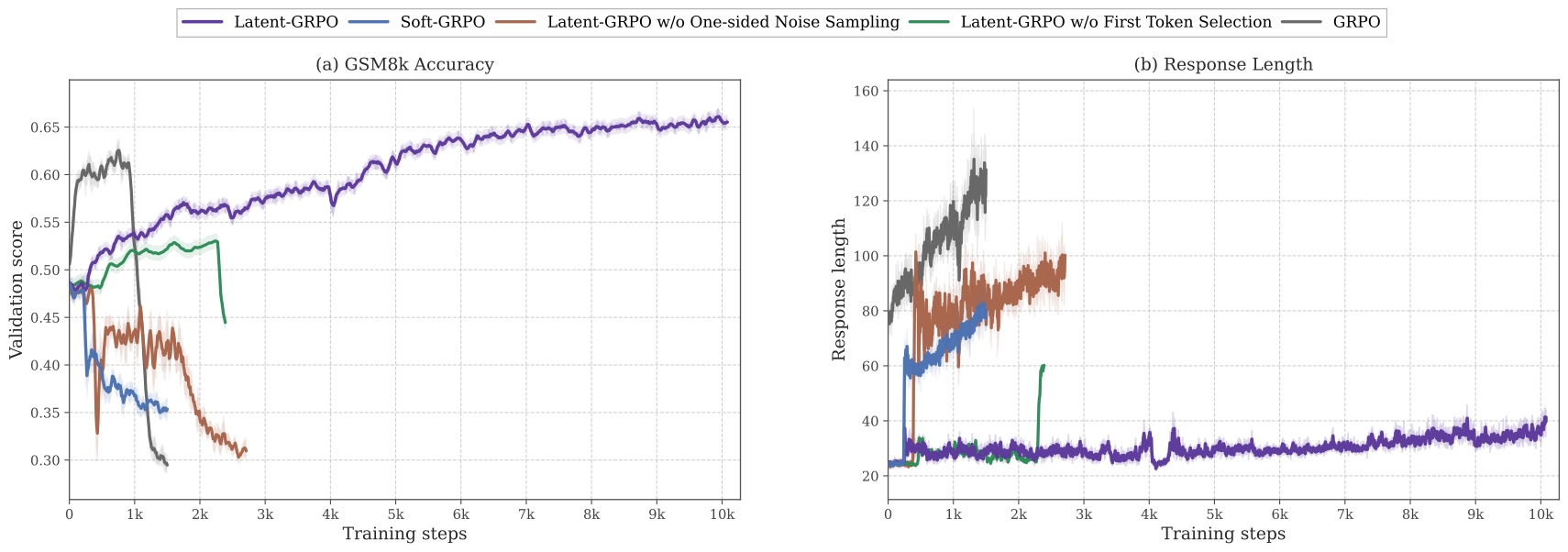
Figure 2 解读:LLaMA-3.2-1B-Instruct 在 GSM8K-Aug 上的训练动态。Latent-GRPO 的验证分数上升更稳,同时长度几乎不增长;GRPO 早期更快,但后期更容易 collapse。
| Method | GSM8K-Aug | GSM-Hard | SVAMP | MultiArith | Avg |
|---|---|---|---|---|---|
| SFT | 49.51 / 77.46 | 11.67 / 85.78 | 57.38 / 44.10 | 92.23 / 45.49 | 52.70 / 63.20 |
| GRPO | 62.26 / 111.1 | 14.70 / 130.8 | 60.78 / 69.40 | 94.16 / 65.50 | 57.98 / 94.20 |
| Latent-SFT | 47.55 / 22.00 | 10.25 / 25.50 | 53.22 / 15.30 | 90.80 / 16.30 | 50.46 / 19.78 |
| Soft-GRPO | 48.34 / 21.60 | 10.30 / 25.60 | 53.19 / 15.30 | 91.07 / 16.40 | 50.73 / 19.73 |
| Latent-GRPO | 66.29 / 23.80 | 15.83 / 28.00 | 56.50 / 15.80 | 94.65 / 17.20 | 58.32 / 21.20 |
关键结论:
- 平均上,Latent-GRPO 比 Latent-SFT 高 7.86 Pass@1,比 GRPO 短 4.44x。
- 它在 GSM-Hard 和 MultiArith 上都优于 GRPO,同时长度远短于 GRPO。
- 论文文字特别指出:one-sided noise 是最关键的稳定性来源,first-token selection 是进一步提升。
High-difficulty suite
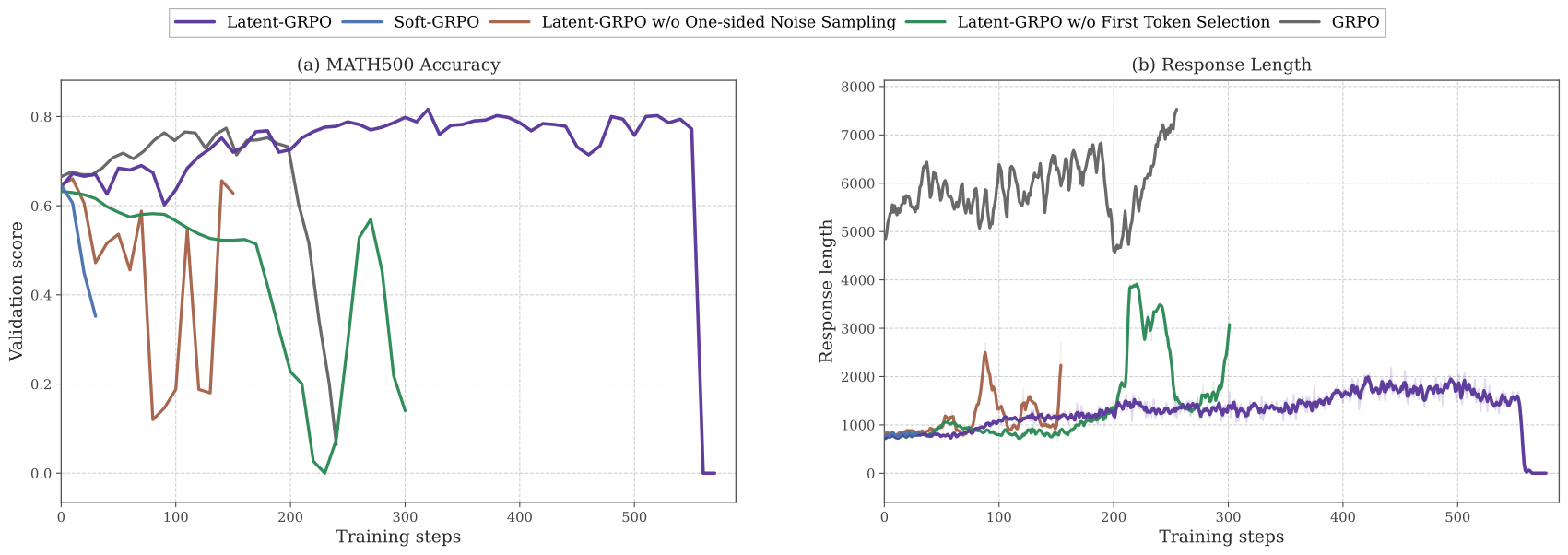
Figure 3 解读:Qwen2.5-Math-7B 在 DAPO-Math-En 上的训练动态。Latent-GRPO 一边提升 Math500 验证分数,一边保持更短的 response length。
| Method | Math500 | AIME24 | AIME25 | GPQA | Avg |
|---|---|---|---|---|---|
| SFT | 67.40 / 2662 | 13.39 / 6423 | 6.77 / 6550 | 32.07 / 3555 | 29.91 / 4798 |
| GRPO | 75.15 / 2982 | 16.61 / 7500 | 19.79 / 6815 | 38.25 / 4568 | 37.45 / 5466 |
| Latent-SFT | 64.85 / 1070 | 6.67 / 1651 | 6.61 / 1299 | 29.67 / 1214 | 26.95 / 1309 |
| Soft-GRPO | 60.60 / 1133 | 6.20 / 1894 | 3.59 / 1511 | 27.12 / 1426 | 24.38 / 1491 |
| Latent-GRPO | 80.40 / 929 | 26.56 / 2548 | 23.23 / 1735 | 36.68 / 1384 | 41.72 / 1649 |
关键结论:
- 平均上,Latent-GRPO 比 Latent-SFT 高 14.77 Pass@1,比 GRPO 高 4.27 Pass@1,同时长短比是 3.31x。
- 在 Math500、AIME24、AIME25 上都是最优 Pass@1。
- Soft-GRPO 在高难度上甚至低于 Latent-SFT,说明只做 density matching 不够。
Pass@k
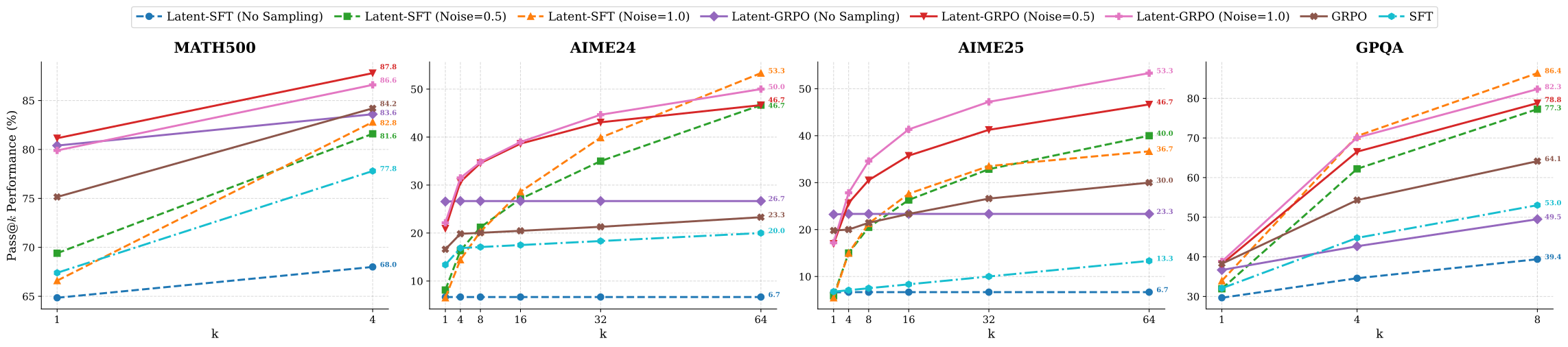
Figure 4 解读:开启 Gumbel sampling 后,Latent-GRPO 的 pass@k 曲线整体优于 explicit GRPO,尤其在更难的 AIME 任务上提升明显。
论文给出的关键数值:
- Math500:Latent-GRPO sampled reach 87.8,GRPO 为 84.2。
- AIME24:GRPO 在 pass@64 为 23.3;Latent-GRPO 在 noise=0.5 / 1.0 时分别到 46.7 / 50.0。
- AIME25:GRPO 在 pass@64 为 30.0;Latent-GRPO 在 noise=0.5 / 1.0 时分别到 46.7 / 53.3。
Ablation and limitations
消融结论是定性的,但方向很明确:
- 去掉 One-sided Noise Sampling,验证性能会明显掉,训练甚至会 collapse。
- 去掉 First Token Selection,也会掉,但幅度比去掉 one-sided noise 小。
限制也很明确:
- No Sampling 的 latent reasoning 是 deterministic 的,不适合直接看 pass@k。
- Gumbel sampling 能提高 pass@k,但会牺牲一部分 pass@1,尤其在最难的 AIME 上。
- one-sided STE 本质上是 surrogate backward rule,不是严格的概率密度。