Graph of Skills: Dependency-Aware Structural Retrieval for Massive Agent Skills
Paper: arXiv:2604.05333 Code: davidliuk/graph-of-skills Code reference:
main@69f2ab2f(2026-05-04)
1. Motivation (研究动机)
这篇论文要解决的是“大规模 agent skill library 怎么检索”的问题,而不是“要不要给 agent 写 skill”。当 skill 从几十个扩展到上千甚至上万个时,直接把所有 SKILL.md 放进上下文会产生三个问题:token 成本线性增长、长上下文里关键约束容易被模型忽略、推理延迟与幻觉风险上升。论文把这个瓶颈称为从 skill authoring 转移到 reusable skill retrieval。
第二个问题是单纯向量检索有“Prerequisite Gap”。很多真实工程任务的 query 只显式提到高层目标,例如“分析某个数据集”或“生成某类报告”,但真正可执行的 skill bundle 还需要 parser、preprocessor、环境初始化、格式转换、上传/下载脚本等前置能力。这些 prerequisite skill 与 query 的语义相似度可能不高,所以 flat vector top-k 容易只找回“主 solver”,缺少把任务跑通的底层工具。
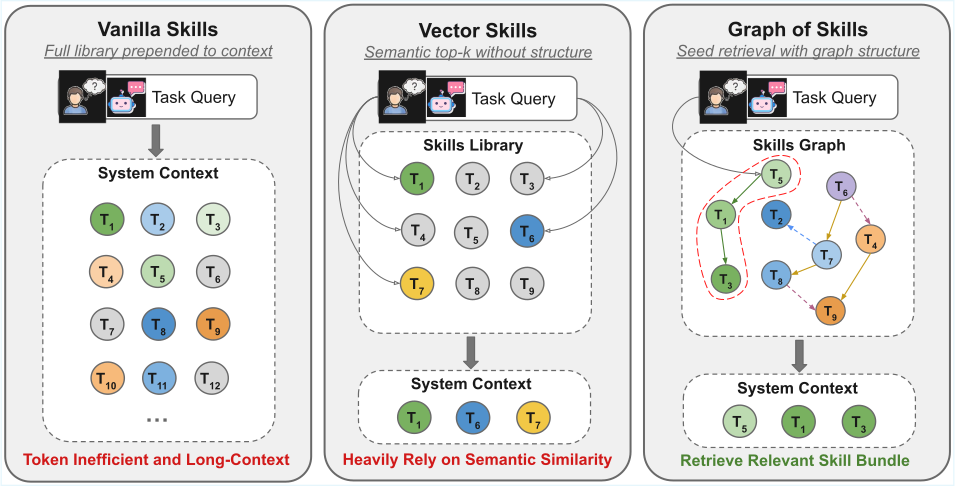
Figure 1 解读:Vanilla Skills 追求最高召回,但把完整 skill library 塞进上下文;Vector Skills 只取语义相近的点,token 更少但可能断掉依赖链;GoS 的核心目标是在两者之间恢复“结构完整性”,即围绕任务取一个小而可执行的依赖子图。
这个问题值得研究,是因为 agent skill 越多,检索失败越不只是“少看了一条说明”,而是会直接导致执行链断裂:模型可能知道要调用某个分析 skill,却没有加载产生输入文件、规范路径、处理格式或验证结果的辅助 skill。GoS 的目标就是让 agent 在有限上下文内看到足够完整的执行 bundle。
2. Idea (核心思想)
核心思想:把 skill library 从一堆独立文档变成一个带类型边的可执行图,然后在推理时做 dependency-aware structural retrieval。GoS 不是简单把向量召回 top-k 做大,而是先用语义+词法检索找到入口点,再用带反向依赖权重的 Personalized PageRank 沿图扩散,把上游 prerequisite skill 一起拉进候选集合,最后在上下文预算内 rerank + hydrate。
与 Vanilla Skills 的本质区别是:GoS 不追求把所有 skill 暴露给模型,而是通过图结构保留“足够执行”的子集。与 Vector Skills 的本质区别是:Vector Skills 只看 query 和 skill 文档的相似度;GoS 额外显式建模 dependency / workflow / semantic / alternative 关系,使检索能从高层目标反推所需的 parser、setup、converter 等低层能力。
这个想法最关键的地方在于“依赖方向要反着走”。如果边 表示 skill 产出 artifact 给 skill 消费,那么 query 往往先命中 这样的高层 solver;为了补齐上下文,检索必须允许分数从 回流到 。论文用 reverse-aware typed diffusion 实现这个回流,而不是依赖模型在过长上下文里自己发现缺失的前置步骤。
3. Method (方法)
3.1 Overall framework:离线建图 + 在线结构检索
GoS 分成两个阶段。离线阶段把每个 skill package 解析成规范化节点,并根据 I/O 兼容性、workflow、语义邻近、替代方案关系构造 typed directed graph。在线阶段把用户 query 转成轻量 retrieval schema,用 semantic/lexical seed 找入口,然后做 reverse-aware Personalized PageRank、field-level reranking 和 budgeted hydration。
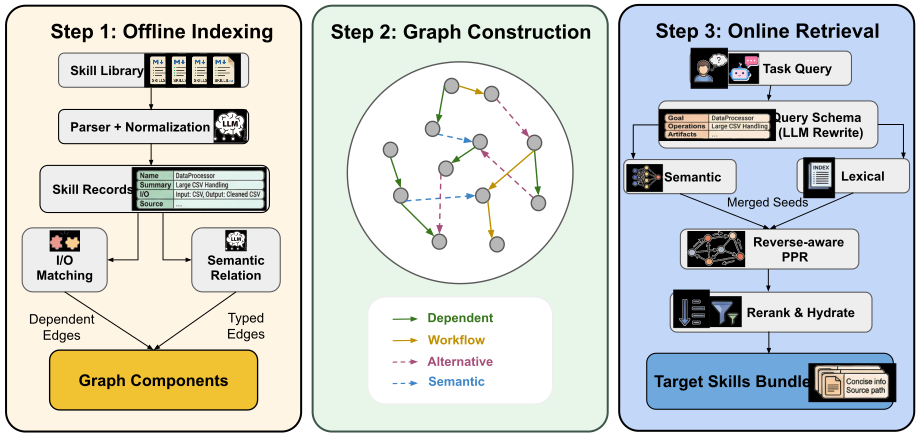
Figure 2 解读:左侧是 offline indexing,把本地 skill package 变成带 name / capability / I/O / domain tags / tooling / entrypoints / compatibility / source_path 的结构化记录;中间是 typed graph,边类型区分依赖、workflow、语义邻近和 alternative;右侧是 online retrieval,把 query 映射为 schema 后进行 hybrid seeding、reverse-aware PPR、rerank 和 hydration,最终输出可直接塞给 agent 的 bounded execution bundle。
3.2 Problem setup:预算约束下的 dependency-complete bundle
论文把本地 skill corpus 表示为 ,并转换为 typed directed graph: 给定任务 query 和上下文预算 ,目标是返回一个 skill bundle ,同时满足相关、尽量执行完整、足够紧凑: 这个目标没有被精确求解;GoS 用三段近似:hybrid seed retrieval 先找入口,reverse-aware graph diffusion 补依赖,budgeted reranking + hydration 控制最终 prompt 成本。
3.3 Offline graph construction:节点标准化与四类边
每个 skill package 被解析成规范化 skill record。代码侧对应 parse_skill_document 和 SkillNode,包含 canonical name、capability summary、inputs/outputs、domain tags、tooling、example tasks、script entrypoints、compatibility、allowed tools、source path 和 rendered snippet。这个设计让检索结果不是抽象标签,而是能直接被 agent 消费的执行材料。
边分四类:
- Dependency:当 的 output type 与 的 input type 兼容时,加入 ;这是最重要的 executable prerequisite 边。
- Workflow:连接常见多步流程中的相邻 skill。
- Semantic:连接近义、主题相近或可互补的 skill。
- Alternative:连接解决同一子问题的可替代策略。
论文避免全量 all-pairs LLM 判断。实际做法是先用 lexical similarity、semantic neighbors 和 I/O expansion 构造小候选池,再只在候选池内做 sparse validation。这一点很重要:图不是“把相似文档连起来”的普通知识图谱,而是尽量围绕可执行关系构造。
3.4 Online structural retrieval:hybrid seeding → reverse-aware PPR → hydration
在线检索先把原始 query 映射为 retrieval schema,包含 task goal、salient operations、referenced artifacts 和 normalized keywords。之后对每个候选 skill 计算 semantic seed score 与 lexical seed score,并线性融合: 扩散阶段对每类关系 构造 forward operator 与 reverse operator ,再合成统一转移矩阵: 然后执行 Personalized PageRank: 最后只靠扩散分数还不够,因为 agent 看到的必须是紧凑且直接可用的 skill payload。GoS 用 field-level query evidence 做 rerank: 其中 汇总 query 与 skill name、capability summary、artifacts、entrypoints 等字段的直接匹配。候选按 排序后,在 per-skill 与 global context budget 下 hydration,生成包含 source path、能力说明和执行 notes 的 bundle。
3.5 Implementation pseudocode (基于 released code)
def build_skill_graph(skill_files, engine):
    nodes = []
    for skill_file in skill_files:
        parsed = parse_skill_document(skill_file.read_text(), source_path=str(skill_file))
        if parsed is not None:
            nodes.append(SkillNode.from_lists(**parsed.to_node_fields()))

    edge_map = {}
    for node in nodes:
        candidates = engine._rank_link_candidates_for_node(node, nodes)
        for candidate in candidates:
            for edge in engine._dependency_edges_for_pair(node, candidate):
                engine._record_edge(edge_map, edge)
        for edge in engine._validate_candidate_relations(node, candidates):
            engine._record_edge(edge_map, edge)
    return nodes, list(edge_map.values())
def retrieve_skill_bundle(query, engine, budget):
nodes = engine._load_all_nodes()
edges = engine._load_all_edges()
schema = engine._fallback_query_schema(query) # released eval disables optional rewrite
lexical = engine._lexical_seed_scores(query, nodes, budget.seed_candidate_top_k_lexical)
semantic = engine._semantic_seed_scores(query, nodes, budget.seed_candidate_top_k_semantic, schema)
seed_weights = merge_and_normalize(semantic, lexical)
transition, name_to_index = build_transition_matrix(
nodes,
edges,
reverse_weights={"dependency": 1.0, "workflow": 0.7, "semantic": 0.3, "alternative": 0.2},
)
personalization = build_personalization(nodes, seed_weights, name_to_index)
graph_scores = personalized_pagerank(transition, personalization, damping=budget.ppr_damping)
ranked = rerank_with_field_evidence(nodes, graph_scores, schema)
return engine._fit_skills_to_context_budget(ranked, budget.max_chars_per_skill, budget.max_context_chars)Code reference:
main@69f2ab2f(2026-05-04) — pseudocode and mapping based on this commit
| Paper Concept | Source File | Key Class/Function |
|---|---|---|
| Skill package parsing / normalization | gos/core/parsing.py | parse_skill_document, ParsedSkillDocument |
| Skill / edge / query schema | gos/core/schema.py | SkillNode, SkillEdge, QuerySchema, RetrievalBudget |
| Graph construction and relation induction | gos/core/engine.py | SkillGraphRAG._dependency_edges_for_pair, _validate_candidate_relations, _link_all_skills |
| Hybrid lexical / semantic seeds | gos/core/engine.py | _lexical_seed_scores, _semantic_seed_scores, _fallback_query_schema |
| Reverse-aware graph diffusion | gos/core/retrieval.py | build_transition_matrix, build_personalization, personalized_pagerank |
| Rerank and context-budgeted hydration | gos/core/engine.py | _rerank_skill_score, _fit_skills_to_context_budget, async_hydrate_skills, async_retrieve |
| CLI / MCP interfaces | gos/interfaces/cli.py, gos/interfaces/mcp.py, gos/interfaces/claude_code.py | retrieve, search_skills, retrieve_skill_bundle, hydrate_skills |
| Benchmarks | evaluation/skillsbench/, evaluation/alfworld_run.py | graphskills_benchmark.py, ALFWorld driver and SkillModule adapter |
论文公式与 released code 实现差异:论文把 online retrieval 描述为可选 LLM query rewrite + semantic/lexical hybrid seeding;实验说明禁用了 optional query-rewrite module,released benchmark 路径强调 raw task instruction / deterministic schema,因此笔记中的实验解释按“无 query rewrite”理解。
4. Experimental Setup (实验设置)
Datasets / benchmarks. 论文使用两个完整 benchmark:SkillsBench 包含 11 个真实技术任务域,覆盖宏观经济去趋势、power-grid feasibility、3D scan analysis、financial modeling、seismic phase picking 等;ALFWorld 使用 full 140-episode split,在 text-only 环境中测试多步 household activity 的顺序决策能力。
Baselines. 三种方法对比:Vanilla Skills 把完整 skill library 直接暴露给 agent,最大化 recall 但没有检索压缩;Vector Skills 使用与 GoS 相同的 openai/text-embedding-3-large(3072 维)做 bounded semantic retrieval,用来隔离“有检索压缩”与“有图结构”的差异;GoS 使用相同 base embedding,但把 nearest-neighbor retrieval 替换为 dependency-aware graph retrieval。
Models. 主实验覆盖 Claude Sonnet 4.5、MiniMax M2.7、GPT-5.2 Codex。每个 model-method setting 跑两次并报告均值。评价指标是平均 reward / success()、平均 input tokens()和 agent-only runtime 秒数()。
Protocol / config. 主实验与 sensitivity 实验使用相同 retry policy:环境构造失败会最多 rebuild/rerun 两次;仍失败的任务作为 unresolved infrastructure failures 排除;agent 已经实质执行后 timeout 计 reward 0,启动前 timeout 则重跑。Sensitivity study 在 full SkillsBench + GPT-5.2 Codex 下把 library size 从 200、500、1,000 扩到 2,000 skills。
5. Experimental Results (实验结果)
5.1 Main results:GoS 在六个 model-benchmark block 中 reward 最高
主结果的整体结论很清楚:GoS 在所有六个 model-benchmark block 中都取得最高 reward;相对 Vanilla Skills,GoS 在全部六个 block 都减少 input tokens,并在五个 block 降低 runtime;相对 Vector Skills,GoS 在同样压缩的 token regime 下提高 reward。摘要报告的总体均值是:GoS 相比 full skill-loading baseline 平均 reward 提升 43.6%,同时 input tokens 降低 37.8%。
SkillsBench 关键数值: Claude Sonnet 4.5 下 Vanilla / Vector / GoS 的 reward 为 25.0 / 19.3 / 31.0;MiniMax M2.7 为 17.2 / 10.4 / 18.7;GPT-5.2 Codex 为 27.4 / 21.5 / 34.4。Vector Skills 在 SkillsBench 上经常低于 Vanilla,说明长程技术任务只取语义近邻会漏掉 prerequisites;GoS 同时保持压缩和结构补全。
ALFWorld 关键数值: Claude Sonnet 4.5 下 GoS 达到 97.9% success,而 Vector 为 93.6%、Vanilla 为 89.3%,同时 token 从 Vanilla 的 1,524,401 降到 27,215。MiniMax M2.7 下 GoS 54.3%,高于 Vanilla 47.1% 和 Vector 50.7%。GPT-5.2 Codex 下 GoS 93.6%,高于 Vanilla 89.3% 和 Vector 92.9%。
5.2 Library-size sensitivity:规模越大,flat exposure 越吃亏
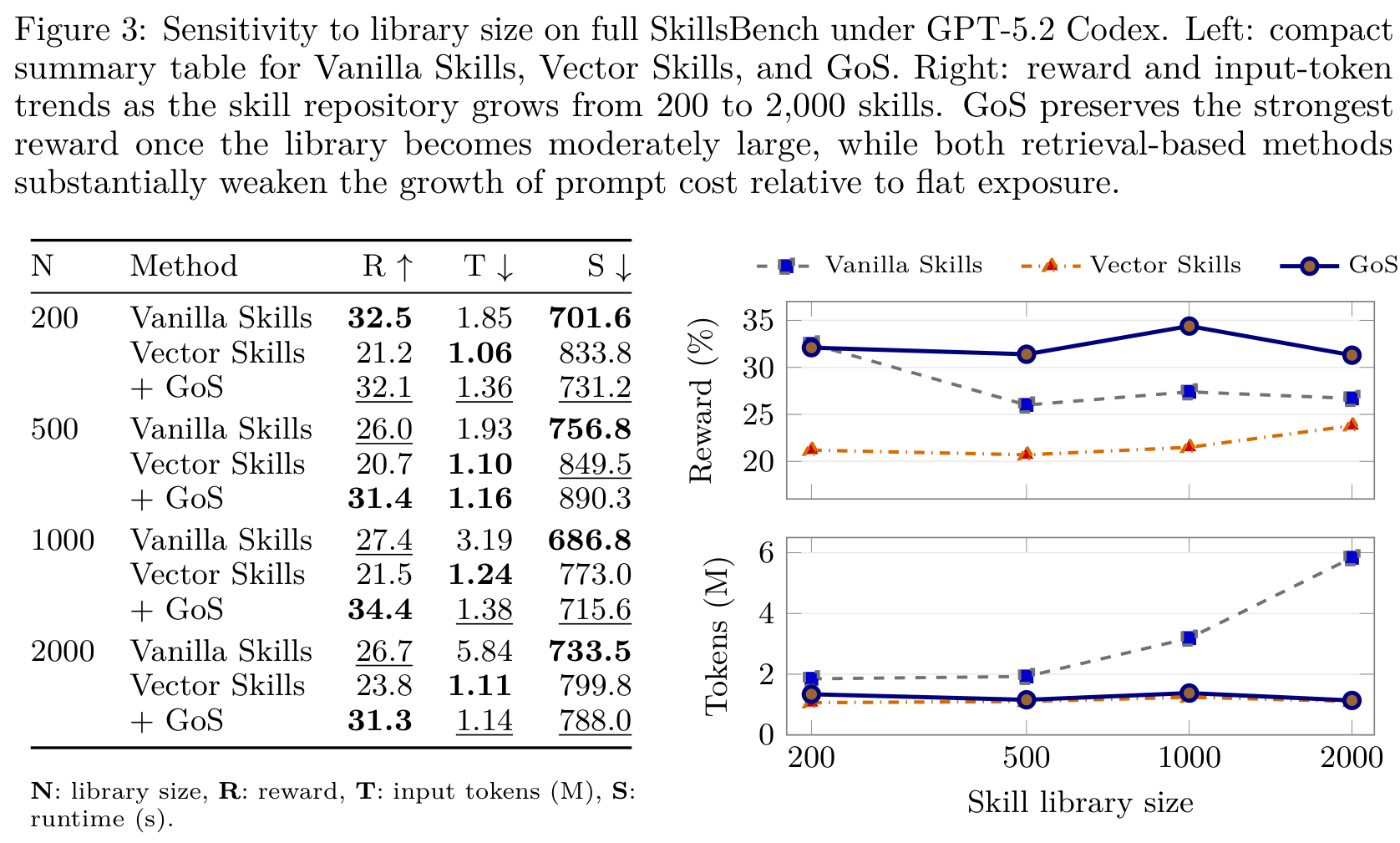
Figure 3 解读:当 SkillsBench library 从 200 增加到 2,000 skills 时,Vanilla Skills 的 input tokens 从 1.85M / 1.93M / 3.19M 增到 5.84M,而 GoS 基本维持在 1.14M–1.38M。reward 上,GoS 在 500、1,000、2,000 skills 时分别为 31.4、34.4、31.3,均高于 Vanilla 的 26.0、27.4、26.7 和 Vector 的 20.7、21.5、23.8。200 skills 时 Vanilla 32.5 略高于 GoS 32.1,说明小库里全量暴露还可以工作;但库变大后,结构检索的优势明显。
5.3 Ablation:seed 质量和图传播都重要
| Method | R ↑ | T ↓ | S ↓ |
|---|---|---|---|
| Full GoS | 34.4 | 1.38M | 715.6 |
| w/o graph propagation | 29.3 | 0.89M | 766.2 |
| w/o lexical + rerank | 26.7 | 1.01M | 747.7 |
去掉 graph propagation 后,reward 从 34.4 降到 29.3,说明仅靠 seed skill 不足以恢复完整执行链;去掉 lexical retrieval + rerank 后,reward 进一步降到 26.7,说明入口点质量比“后面再图扩散”更基础:如果 seed 本身不对,图上能扩出来的 prerequisite neighborhood 也会偏。
5.4 Limitations / caveats
论文没有把 GoS 说成免费提升:它需要离线解析和建图,边质量依赖 skill 文档里的 I/O、entrypoint、compatibility 等字段是否足够清楚;如果 skill package 元数据很弱,仍需要轻量 LLM pass 或 sparse validation 补语义字段。另一个 caveat 是检索 step 本身有 overhead,尤其 GPT-5.2 Codex 的 agent-only runtime 在某些 retrieval setting 下不一定比 Vanilla 更低;不过论文认为主瓶颈仍是大规模 flat library 暴露导致的 prompt cost,而不是 graph traversal 或 vector search 本身。