TRACE: Capability-Targeted Agentic Training
Paper: arXiv:2604.05336 Code: ScalingIntelligence/TRACE Code reference:
main@97c03dd8(2026-04-13) Batch:batch_index=119,category_rank=9,Agent / Reward & Training Methodology
1. Motivation (研究动机)
现有 agentic training 的核心瓶颈不是“没有更多 RL 数据”,而是目标环境的 reward 往往只告诉模型任务成败,却不告诉模型缺少哪一种可迁移能力。论文把 capability 定义为:在某一类任务实例中,成功轨迹必须执行的一组动作或判断;例如客服环境中“检索正确 customer record”是取消航班、改座位、验证预订等任务共享的前置能力。
直接在目标环境上做 RL / SFT 会把 credit assignment 绑定到具体任务轨迹:最终成功、失败、演示 trace 都只监督了一串任务特定动作,模型需要隐式地从稀疏反馈中发现“到底缺 structured data reasoning、precondition verification,还是 tool-calling precision”。这会导致样本效率低,也会让 broad synthetic data / general agent data 方法训练到与当前失败无关的能力。
TRACE 要解决的具体问题是:给定 base agent 在目标环境中的成功与失败轨迹,自动找出“失败中显著缺、成功中不缺”的高影响 capability;为每个 capability 合成可验证、可程序化打分的 targeted environment;再分别训练 LoRA adapter,并在推理时选择最相关的 adapter。这个问题值得研究,因为 agent deployment 的长期改进不应只依赖人工分析 failure cases 或盲目扩大 synthetic environment,而应能把真实失败转化成可复用、可验证、可扩展的训练信号。
2. Idea (核心思想)
核心 insight:agent 的失败不是均匀随机的,少数高覆盖 capability deficits 会解释大量 failed trajectories;如果先用 successful-vs-failed contrastive analysis 把这些 deficits 显式命名,再为每个 deficit 构造 isolated verifiable environment,那么 RL 的 reward 会从“任务级稀疏信号”变成“能力级归因信号”。
TRACE 的关键创新不是提出新的 RL optimizer,而是把训练目标重构为四步闭环:contrastive capability identification → capability-targeted environment generation → per-capability GRPO LoRA training → training-free adapter routing。与 GRPO-on-target 相比,TRACE 不在原环境里让模型同时摸索所有能力;与 AWM / ADP 这类 general-purpose synthetic/data scaling 相比,TRACE 的环境由当前模型的真实失败驱动;与 GEPA prompt optimization 相比,TRACE 不是把 capability 描述塞进 prompt,而是把 capability 训练成独立 adapter。
3. Method (方法)
3.1 Overall framework (整体框架)
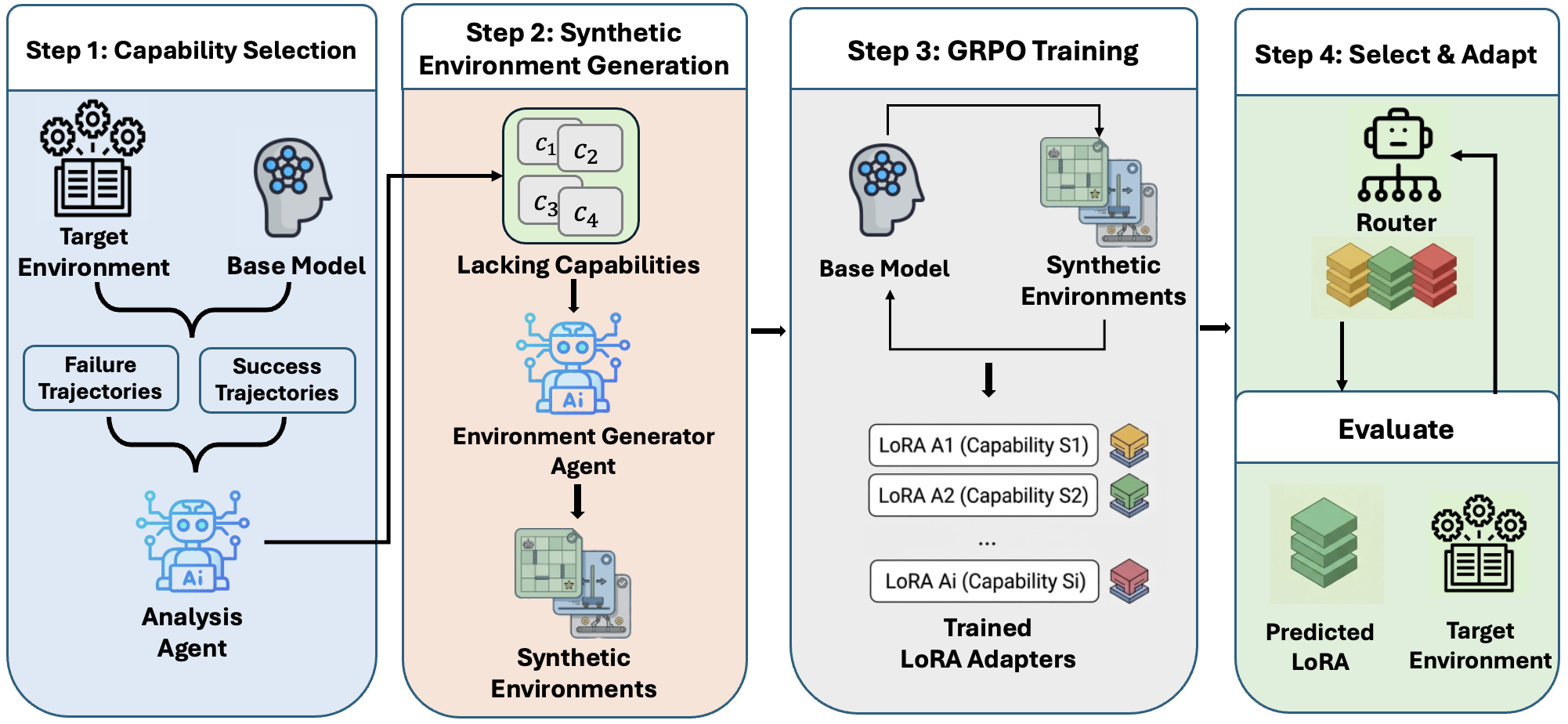
Figure 1 解读:左侧是目标环境中的 base-agent rollouts,TRACE 先收集成功与失败轨迹;中间用 LLM analysis agent 归纳 capability dictionary 并对每条轨迹标注 NA / PRESENT / LACKING;随后 LLM generation agent 为每个 retained capability 生成 synthetic verifiable environment;右侧对每个环境训练一个 LoRA adapter,推理时由 base model 根据 task prompt 和 capability descriptions 选择一个 adapter。
形式化地,目标 agentic environment 写作: 一个 capability 是成功解某个任务子集 所必要的动作/判断集合。若 表示轨迹 对任务 真的 exercise 了 capability ,论文要求成功蕴含必要能力被执行: TRACE 的能力分解直觉是:原环境 reward 同时混合许多能力,失败归因弱;而 capability-targeted synthetic environment 强制每个生成任务 都需要 capability ,同时保留目标环境的 tool schemas、state representation 和 policy constraints,并让 reward/success 可由程序自动计算。
3.2 Contrastive capability identification (对比式能力识别)
给定 base policy 在目标环境收集的数据: TRACE 先按 success label 切分为 与 。为了避免每次 LLM 分析生成不一致的能力名称,流程分两阶段:
- Discovery phase:analysis agent 检查 tool calls、tool results、final responses,归纳候选 capability dictionary ,每个 capability 有固定名称与自然语言描述。
- Labeling phase:用固定 dictionary 重新标注每条 trajectory 与每个 capability 的关系:
NA表示该任务不需要该能力;PRESENT表示需要且轨迹已执行;LACKING表示需要但轨迹未执行。
对每个 capability ,论文估计 successful / failed trajectories 中的 lacking rate:
contrastive gap 定义为:
coverage 定义为:
最终保留:
论文实验设定 、;released code 的 configs/capability_selection.yaml 还设定 n_runs=10、n_candidates=10、k_consistency=8,并由 pipeline/aggregate_capabilities.py 实现“10 次运行中至少 8 次通过阈值”的 consistency filter。
def select_capabilities_from_runs(runs, rho=0.10, delta=0.20, k=8):
    # mirrors pipeline/aggregate_capabilities.py
    summaries = []
    for cap in all_capability_names(runs):
        pass_count, covs, deltas = 0, [], []
        for run in runs:
            labels = run["labels"].get(cap, {})
            total_failed = run["totals"]["total_failed"]
            lf = len(labels.get("lacking_failed", []))
            pf = len(labels.get("present_failed", []))
            lp = len(labels.get("lacking_passed", []))
            pp = len(labels.get("present_passed", []))
            cov = lf / max(total_failed, 1)
            er_minus = lf / max(lf + pf, 1)
            er_plus = lp / max(lp + pp, 1)
            gap = er_minus - er_plus
            covs.append(cov); deltas.append(gap)
            pass_count += int(cov >= rho and gap >= delta)
        if pass_count >= k:
            summaries.append({
                "skill": cap,
                "mean_cov": float(torch.tensor(covs).mean()),
                "mean_delta": float(torch.tensor(deltas).mean()),
                "n_runs_passed": pass_count,
                "status": "PENDING",
            })
    return sorted(summaries, key=lambda x: -x["mean_delta"])
3.3 Capability-targeted environment synthesis (能力定向环境合成)
对每个 retained capability,generation agent 接收 capability description 与对应 failure patterns,生成完整 synthetic environment:seeded task generator 、transition logic、evaluation criteria。每个 seed 确定性生成一个 task instance ,包含 synthetic user profiles、database records、task-specific parameters;这样可以同时避免 memorization,并让 rollout group 能共享同一初始状态。
对 -Bench 的 structured data reasoning,附录中的 synthetic game 会随机生成 Airline / Retail 数据库、用户状态和 goal constraints;agent 多轮调用工具查询/修改数据库,与模拟用户对话;reward 通过 final database hash 与 gold action replay 比对,并检查最终通信内容是否包含应报告信息。对 ToolSandbox 的 error recovery,synthetic game 会构造 PermissionError 触发链,例如 low-battery setting 阻断目标服务;reward 由 action score 与 communication score 加权:。
class CapabilityGame:
    # aligned with game_registry.GameEnv and appendix synthetic games
    def reset(self, seed: int):
        self.scenario = self.generator(seed)
        self.db = copy.deepcopy(self.scenario.initial_db)
        self.done = False
        return self.scenario.initial_user_message

    def step(self, agent_action: str):
        if is_tool_call(agent_action):
            result = execute_tool(agent_action, self.db)
            return tool_result_to_observation(result)
        user_text = self.user_simulator.reply(agent_action)
        if should_stop(user_text):
            self.rewards[0] = self.evaluate(self.db, agent_action)
            self.done = True
        return user_text

    def evaluate(self, final_db, final_response):
        state_ok = hash(final_db) == hash(replay_gold_action(self.scenario))
        comm_ok = all(v in final_response for v in self.scenario.required_outputs)
        return 1.0 if state_ok and comm_ok else 0.3 if state_ok else 0.0
3.4 GRPO LoRA training (每个能力一个 adapter)
TRACE 对每个 训练一个 LoRA adapter ,base policy 冻结。每次 iteration 中,adapted policy 在 中生成 个 rollout groups;每个 group 使用同一 seed 采样 条 trajectories,因此差异主要来自 stochastic decoding。论文中的 group-relative advantage 是:
adapter 用 clipped GRPO surrogate 更新:
其中
released code 的 train/train_grpo.py 采用 vLLM rollout worker + PyTorch distributed training:默认 group_size=16、groups_per_batch=4、lr=1e-5、mini_batch_size=4、clip_eps=0.28、filter_constant_groups=True、dynamic_sampling_max_batches=3;README.md 的 launch recipe 使用 1 张 GPU 跑 vLLM、其余 GPU 跑 torchrun -m train,并启用 runtime LoRA reload。
def grpo_train_iteration(model, old_policy, backend, game, tokenizer, args):
    # based on train/train_grpo.py
    samples, metrics = collect_grpo_rollouts(
        backend=backend,
        tokenizer=tokenizer,
        game_spec=game,
        groups_per_batch=args.groups_per_batch,
        group_size=args.group_size,
        temperature=args.temperature,
        base_seed=args.seed,
    )
    adv = compute_group_advantages(samples)          # code centers rewards per group
    if args.filter_constant_groups:
        samples, adv, _ = filter_constant_reward_groups(samples, adv)

    seqs, prompt_lens, action_lens = build_prompt_action_tensors(samples, tokenizer)
    old_logp = old_policy.logprob_action_tokens(seqs, prompt_lens, action_lens)

    for batch in make_sorted_batches(lengths(seqs), args.mini_batch_size):
        logits = model(input_ids=batch.ids, attention_mask=batch.mask).logits
        new_logp = logprob_action_tokens(logits, batch.ids, batch.prompt_lens, batch.action_lens)
        ratio = torch.exp(new_logp - old_logp[batch.idx])
        surr1 = ratio * adv[batch.idx]
        surr2 = torch.clamp(ratio, 1 - args.clip_eps, 1 + args.clip_eps) * adv[batch.idx]
        loss = -torch.mean(torch.min(surr1, surr2))
        loss.backward()
    return metrics
论文公式与 released code 实现差异:论文 Appendix 的 GRPO advantage 明确除以 group standard deviation ;train/train_grpo.py::compute_group_advantages 在当前 commit 中只做 reward - group_mean,没有除以标准差。论文实验还写“up to 40 iterations per capability”,但 public train_grpo.py 主循环是 range(start_iter, 10_000),没有暴露 40-iteration stop 参数;因此复现实验需要外部 launch/停止策略或 checkpoint 选择。另一个代码内差异是 train/config.py 写 LORA_ALPHA=8,而 train/train_grpo.py CLI 默认 --lora-alpha=16;实际运行应以 launch args / trainer parser 为准。
3.5 Composing acquired capabilities (能力组合与路由)
训练完成后得到 。TRACE 不把所有 capabilities merge 成一个模型,而是使用 training-free routing:给 base model 一个 routing prompt ,其中包含当前 task prompt 、候选 capability descriptions、每个 capability 的一个成功 synthetic trajectory 示例,以及一个 base label token。base model 比较下一 token logits;若 base 最高则使用原模型,否则激活对应 LoRA adapter。
def route_adapter_for_task(base_model, task_prompt, capabilities, adapters):
    # paper routing; public repo describes this in README/paper but does not ship a full router class
    labels = make_single_token_labels(capabilities + ["base"])
    routing_prompt = build_routing_prompt(task_prompt, capabilities, labels)
    next_token_logits = base_model.next_token_logits(routing_prompt)
    choice = max(labels, key=lambda tok: next_token_logits[token_id(tok)])
    if choice == labels["base"]:
        return base_model
    adapter = adapters[capability_for_label(choice)]
    return activate_lora(base_model, adapter)  # W' = W + B @ A for adapted layers
论文公式与 released code 实现差异:paper/README 描述了 Select & Adapt 路由,但当前 public repo 主要提供 pipeline rendering、capability aggregation、environment generation instructions、GRPO training 和 vLLM LoRA reload;没有找到一个完整的 inference-time router implementation。因此本节路由伪代码以论文与 README 为依据,code mapping 只能锚到 README / Appendix routing prompt,而非具体 router source file。
Code reference:
main@97c03dd8(2026-04-13) — pseudocode and mapping based on this commit
| Paper Concept | Source File | Key Class/Function |
|---|---|---|
| capability selection config | configs/capability_selection.yaml | n_runs=10, rho=0.10, delta=0.20, k_consistency=8 |
| contrastive aggregation | pipeline/aggregate_capabilities.py | compute_metrics, main |
| environment generation config | configs/environment_generation.yaml | group_size=16, num_seeds=100, hint_ratio=0.25-0.5 |
| pipeline prompt rendering | render_pipeline.py | render_capability_selection, render_environment_generation |
| synthetic env interface | game_registry.py | GameEnv, GameSpec, register_game |
| rollout collection | train/train_grpo.py | collect_grpo_rollouts, UserLLMClient |
| group advantage / filtering | train/train_grpo.py | compute_group_advantages, filter_constant_reward_groups |
| LoRA GRPO trainer | train/train_grpo.py | parse_grpo_args_optimized, main training loop |
| vLLM LoRA sync | train/inference.py | sync_policy, vLLM backend helpers |
| inference routing | paper / README / Appendix routing prompt | no standalone router class found in released code |
4. Experimental Setup (实验设置)
4.1 Datasets and benchmarks (数据集与规模)
- -Bench:customer-service workflow benchmark;论文使用 50 个
Airlinetasks 与 114 个Retailtasks,总计 164 tasks,评估 policy-sensitive workflows。 - ToolSandbox:129 个 base scenarios,评估 broader stateful tool-use capabilities。
- Evaluation protocol:除非特别说明,所有模型 greedy decoding,temperature ,最大 context length 32,000 tokens,每个 episode 最多 50 interaction steps;user simulator 与 evaluated agent 使用同一 base model。
4.2 Baselines (对比方法)
主要 baselines 包括 Base Model、GRPO on Target、ADP、AWM、GEPA、Single Capability GRPO。能力合并 ablation 还比较 CORE-TSV、On Policy Distillation、SFT Synthetic、Multi Capability GRPO。公平性设置:training baselines 使用与所有 capabilities 分别训练总和相同的 training iterations;GEPA 被限制为每个 capability 使用相同 total rollout budget。
4.3 Metrics (评价指标)
-Bench 报告 Airline、Retail 与 Overall pass rate;Overall 定义为:
ToolSandbox 报告 Perfect 与 Mean Sim.:
4.4 Training config (训练配置)
论文使用 Qwen3-30B-A3B-Instruct-2507 同时作为 base agent 和 simulator,使用 LoRA + GRPO,optimizer 为 AdamW,learning rate ,每个 capability 最多 40 iterations,rollout collection temperature ,gradient checkpointing + distributed data parallelism,硬件为 4—8 张 A100-80GB GPU。
released config/code 可复核的关键值:configs/capability_selection.yaml 设 model=Qwen/Qwen3-30B-A3B-Instruct-2507、n_runs=10、n_candidates=10、rho=0.10、delta=0.20、k_consistency=8;configs/environment_generation.yaml 设 group_size=16、num_seeds=100、hint_ratio=0.25-0.5、temperature=0.7、vLLM max-model-len=32000;train/train_grpo.py CLI 默认 group_size=16、groups_per_batch=4、lora_rank=16、lora_alpha=16、lr=1e-5、mini_batch_size=4、clip_eps=0.28。
5. Experimental Results (实验结果)
5.1 Main results (主结果)
| Approach | Airline (%) | Retail (%) | Overall (%) |
|---|---|---|---|
| Base Model | 24.0 | 36.8 | 32.9 |
| GRPO on Target | 32.0 | 40.4 | 37.8 |
| ADP | 28.0 | 34.2 | 32.3 |
| AWM | 32.0 | 41.2 | 38.4 |
| GEPA | 38.0 | 40.4 | 39.6 |
| Single Capability GRPO (Ours) | 34.0 | 43.0 | 40.3 |
| TRACE (Ours) | 44.0 | 48.2 | 47.0 |
TRACE 在 -Bench 上达到 47.0 overall,比 base model 的 32.9 高 +14.1 points,比最强外部 baseline GEPA 的 39.6 高 +7.4 points。Single Capability GRPO 已达到 40.3,说明 targeted environment 本身强于 general-purpose AWM/ADP;完整 TRACE 进一步通过多 capability routing 获益。
| Model | Perfect | Mean Sim. |
|---|---|---|
| Base (Qwen3-30B-A3B) | 19/129 | 0.411 |
| ADP | 19/129 | 0.422 |
| GRPO on Target | 22/129 | 0.519 |
| AWM | 20/129 | 0.504 |
| GEPA | 22/129 | 0.520 |
| Single Capability GRPO (Ours) | 22/129 | 0.514 |
| TRACE (Ours) | 26/129 | 0.552 |
ToolSandbox 上 TRACE 达到 26/129 perfect 与 0.552 mean similarity,比 base 多 7 个 perfect、mean similarity +0.141;比 GEPA 多 4 个 perfect、mean similarity +0.032。
5.2 Capability analysis (能力识别质量)
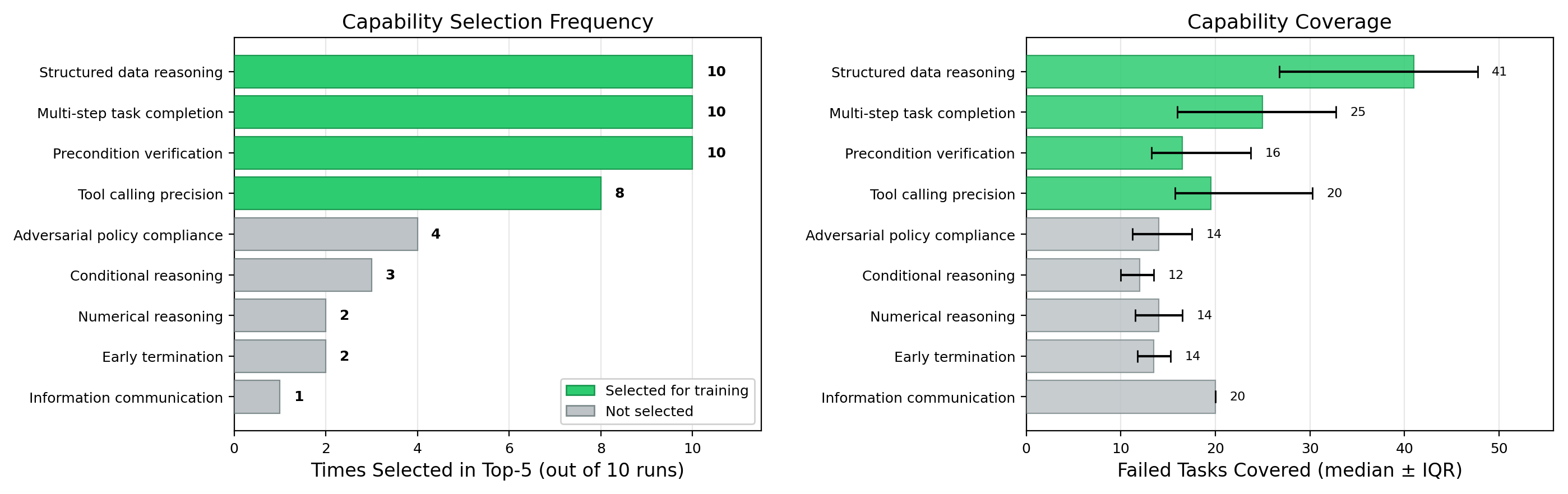
Figure 2 解读:左图展示 10 次独立 contrastive analysis 中,analysis agent 稳定恢复同一组 top capability deficits;右图展示这些 deficits 对 failed tasks 的覆盖高度集中。论文附录说明,-Bench 上四个主要 gaps 是 Structured Data Reasoning、Tool Calling Precision、Multi-Step Task Completion、Precondition Verification;ToolSandbox 上两个 gaps 是 Permission Error Recovery 与 Datetime Reasoning。coverage 不互斥,因为同一失败轨迹可能同时缺多个 capability。
5.3 Routing vs. capability consolidation (路由优于合并)
| Approach | Airline (%) | Retail (%) | Overall (%) |
|---|---|---|---|
| Base Model | 24.0 | 36.8 | 32.9 |
| Single Capability GRPO | 34.0 | 43.0 | 40.3 |
| CORE-TSV | 36.0 | 41.2 | 39.6 |
| On Policy Distillation | 28.0 | 42.1 | 37.8 |
| SFT Synthetic | 36.0 | 38.6 | 37.8 |
| Multi Capability GRPO | 38.0 | 42.1 | 40.9 |
| TRACE | 44.0 | 48.2 | 47.0 |
合并类方法没有达到 routing 的效果:Multi Capability GRPO 为 40.9,CORE-TSV 为 39.6,均低于 TRACE 47.0。这支持论文的设计选择:不要把多个 capability 压进单一 adapter,而是在任务级动态选择单个 relevant adapter,避免能力干扰。
5.4 Scaling behavior (扩展性)
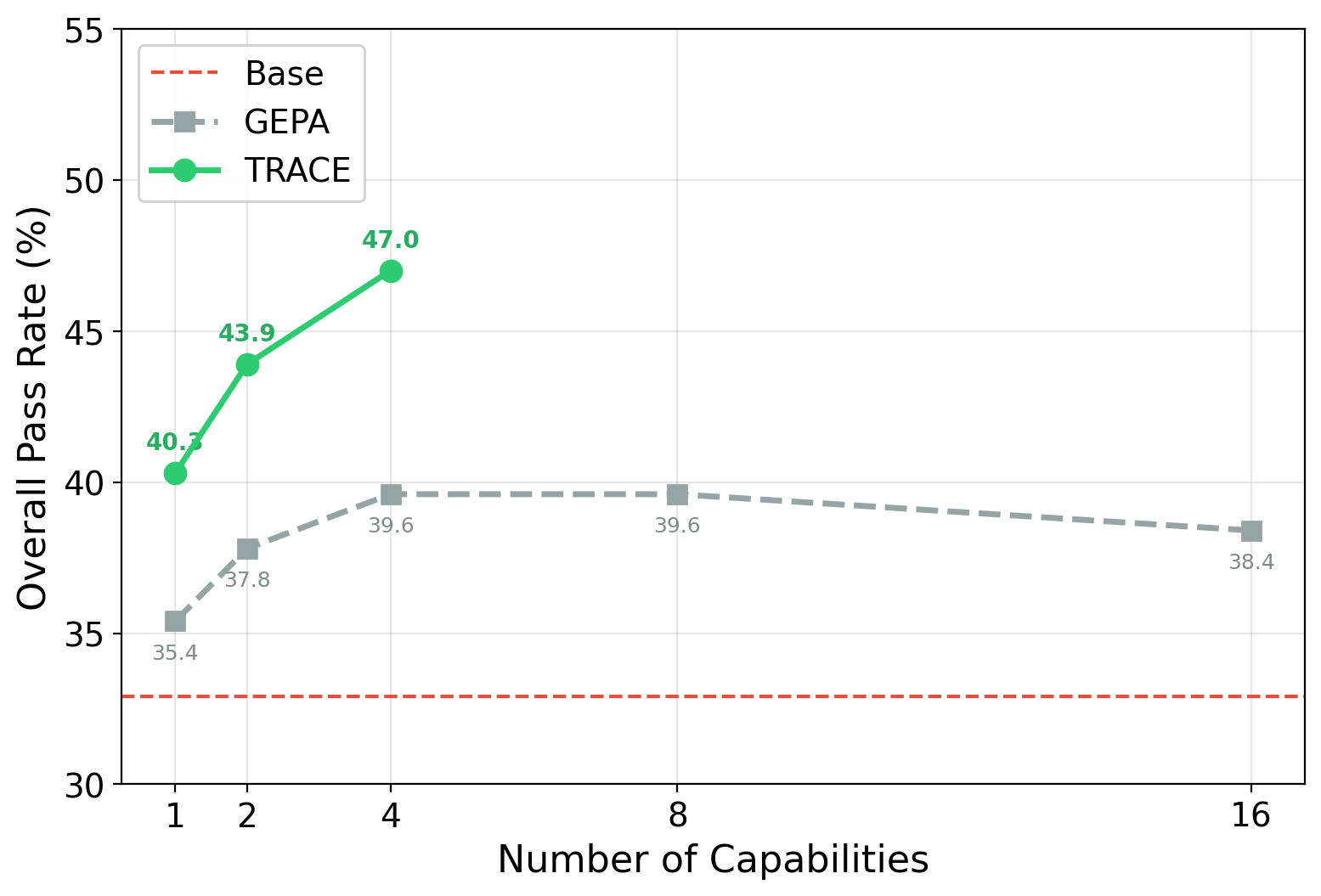
Figure 3 解读:capability 数量增加时,TRACE 的性能持续优于 GEPA-style prompt capability injection。论文正文特别强调,在 2—4 个 LoRA adapters 时,TRACE 可带来约 9.2 points 的 -Bench 提升;这说明“能力变成 adapter”比“能力描述变成 prompt”更稳定。
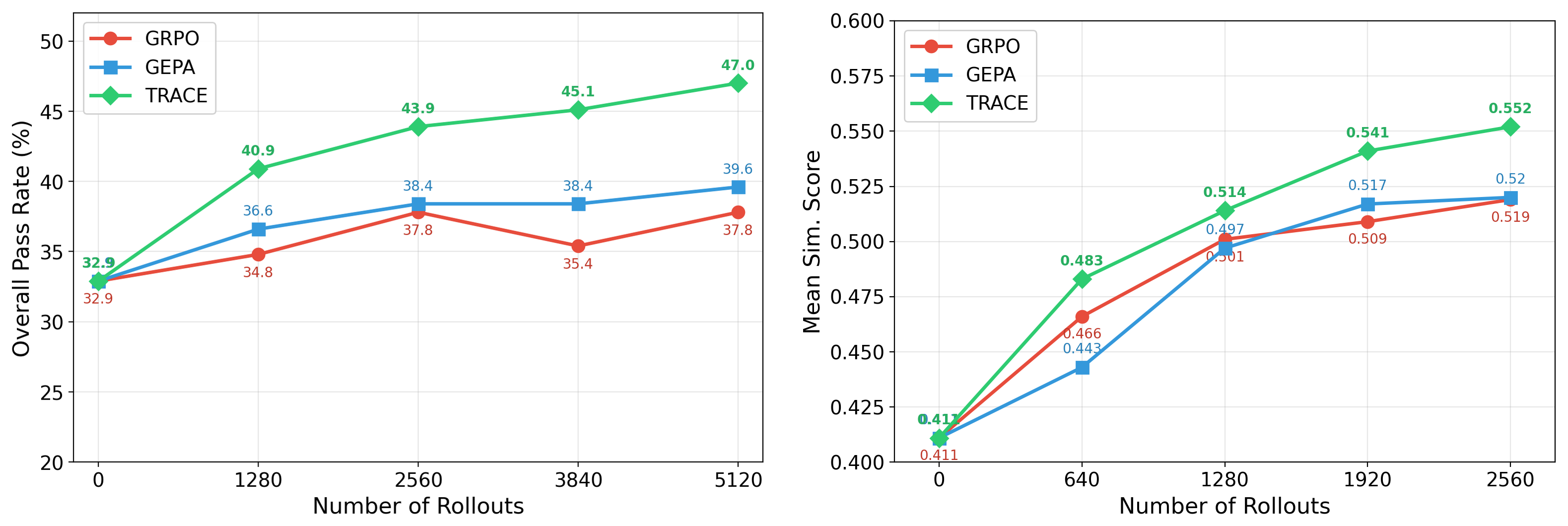
Figure 4 解读:两张子图分别对应 -Bench 与 ToolSandbox 的 rollout-budget scaling。结论是,在相同 rollout budget 下,TRACE 比 GRPO-on-target 和 GEPA 更高效;摘要给出的 -Bench 数字是:相同 rollouts 下 TRACE 分别超过 GRPO 与 GEPA +9.2 和 +7.4 points。
5.5 Caveats and limitations (限制与注意点)
论文没有单列 Limitations section;从方法与 released code 可以确认的 caveats 是:第一,TRACE 依赖目标环境可收集 success/failure trajectories,且最好能把成功标准转化为 verifiable reward;第二,capability discovery 和 environment generation 依赖强 LLM analysis/generation agent,能力标签错误会直接影响后续训练;第三,当前实验集中在 -Bench 与 ToolSandbox,并以 Qwen3-30B-A3B-Instruct-2507 为主,跨更多 agent domains / model families 的泛化还需要验证;第四,public repo 对训练与 pipeline 支持较完整,但 inference-time routing 没有独立实现文件,复现完整 Select & Adapt 需要按论文 prompt 自行实现或等待代码补全。