RAGEN-2: Reasoning Collapse in Agentic RL
Paper: arXiv:2604.06268 Code: mll-lab-nu/RAGEN Code reference:
main@20daedc4(2026-04-14)
1. Motivation (研究动机)
现有 Agentic RL 训练常用 entropy、reward curve、KL 等指标判断训练是否稳定,但 RAGEN-2 指出这些指标漏掉了一个更隐蔽的失败模式:模型的输出仍然“看起来很多样”,却逐渐不再依赖具体输入,而是套用跨 prompt 的固定 reasoning template。论文把这个现象称为 template collapse。它不同于低熵 collapse:低熵 collapse 是每个输入下只输出少数固定答案,而 template collapse 可以维持较高 ,只是 与输入 的互信息 下降。
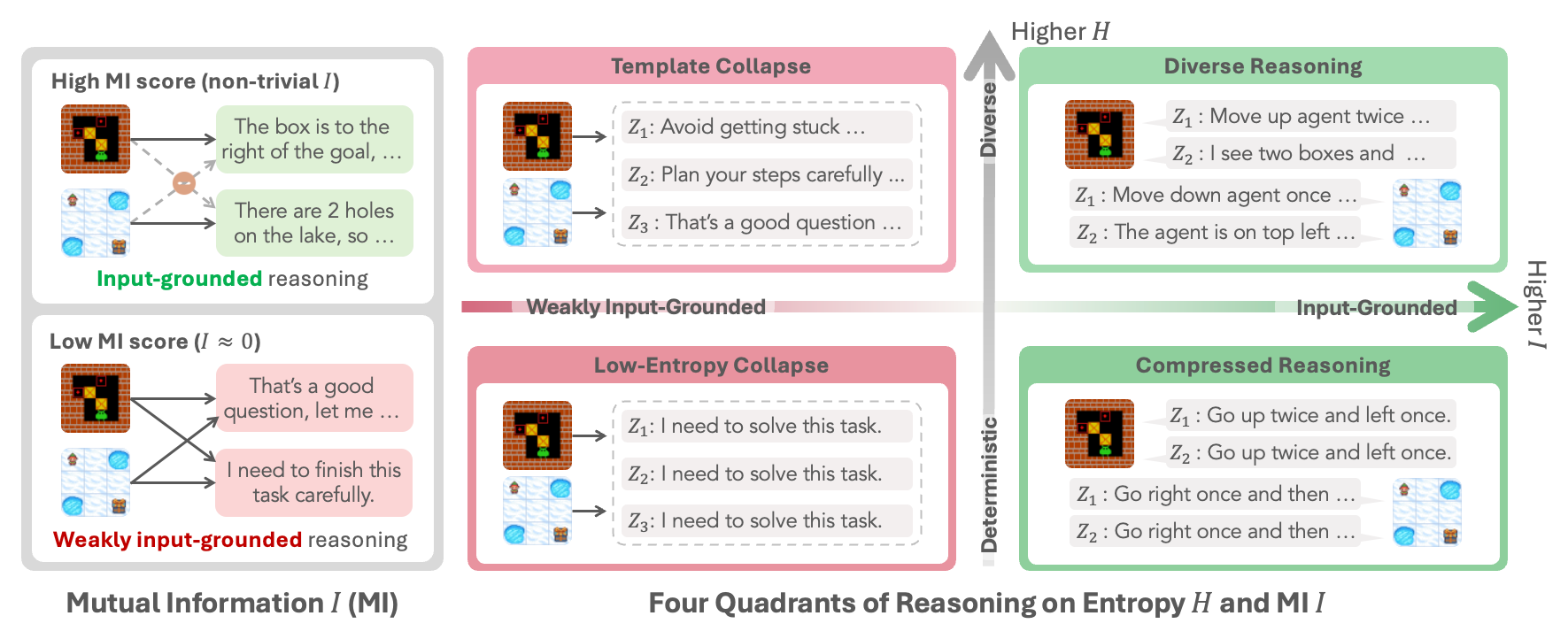
Figure 1 解读:图把 reasoning quality 分成两个轴:横轴是 Mutual Information ,表示 reasoning 是否 input-grounded;纵轴是 entropy ,表示同一输入下的多样性。右上角是理想状态;左上角就是本文关心的 template collapse:reasoning 字面上多样,但与具体 Sokoban/FrozenLake 状态无关;左下角则是传统低熵 collapse。这个图解释了为什么只看 entropy 会误判训练健康。
本文要解决的具体问题不是“如何让 RL 更稳定”这个泛化目标,而是:如何诊断并缓解多轮 LLM agent 在 RL 闭环采样中逐渐失去 input-dependent reasoning 的过程。这个问题值得研究,因为 agent 任务的 reward 常常由长 horizon、环境随机性、format validity 和 sparse success 共同决定;如果更新信号主要来自 input-agnostic pressure,模型会保留格式化思考模板,却不再根据当前 observation/action history 生成真正相关的 reasoning。
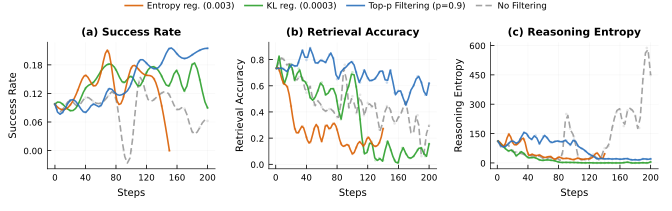
Figure 2 解读:三条曲线分别展示 task success、retrieval-accuracy MI proxy 和 reasoning entropy。No-filter 设置下,MI proxy 很早下降,之后 performance 才恶化;entropy 反而可以升高到很大。因此 failure 的早期信号不是“变得不多样”,而是“多样性失去输入条件”。Top-p SNR-Aware Filtering 保持更高 retrieval accuracy,也带来更高 success。
2. Idea (核心思想)
核心 insight 是:reasoning collapse 的关键不是同一 prompt 下是否多样,而是不同 prompt 是否仍能诱导出可区分的 reasoning 分布。因此,RAGEN-2 用 重新解释 reasoning quality: 只衡量 within-input diversity, 才衡量 cross-input distinguishability。
关键创新有两层。第一,作者构造无需外部 reward model 的 online MI proxy:把每条 reasoning trace 对 batch 内所有 prompt 做 teacher-forced cross-scoring,用检索准确率、MI estimate、MI-ZScore 等指标近似 。第二,作者用 signal-to-noise ratio 解释 collapse:低 reward variance prompt 的 task gradient 弱,而 KL/entropy 等 regularizer 仍然产生 input-agnostic 更新,于是训练被 template drift 主导;对应地,SNR-Aware Filtering 用 within-prompt reward variance 选择高信号 prompt 更新。
与 DAPO、GRPO、Dr.GRPO 或单纯 entropy/KL tuning 的根本差异在于:这些方法主要调稳定性、优势归一化或接受规则,而 RAGEN-2 显式把“哪个 prompt 的 rollout 产生有效 task signal”作为训练时的选择变量。DAPO 的 acceptance/filtering 可以看成固定选择规则;RAGEN-2 的 Top-p RV filter 则提供可调的 keep-rate ,并可在低信号 batch 中自动收紧甚至拒绝更新。
3. Method (方法)
3.1 Overall framework: 从信息诊断到 SNR 过滤

Figure 3 解读:左侧先为每个 prompt 采样多条 rollout 并计算 reward;中间按 within-prompt reward variance 分组,低 RV group 被丢弃,中高 RV group 保留;右侧用 Top-p 累计 RV 质量选择 prompt group。注意它不是在单条 trajectory 级别挑 best-of-,而是在 prompt group 级别判断“这个 prompt 是否能产生可区分的训练信号”。
整体训练循环可以抽象为:每个 prompt 采样 条 trajectory ;计算每条轨迹 reward ;对每个 prompt 计算 reward variance;按 RV 过滤 prompt group;只把保留 group 的样本送入 PPO/GRPO/DAPO/Dr.GRPO 更新。并行地,CollapseDetector 用 cross-scoring 追踪 、retrieval accuracy、conditional entropy 等指标。
直觉上,这个方法把“训练样本是否有用”从 trajectory reward 高低改成了“同一 prompt 下 reward 是否能区分 reasoning choice”。如果一个 prompt 的所有 rollout reward 都几乎一样,无论是都成功、都失败,还是被环境噪声主导,policy gradient 都很难知道哪种 reasoning 更值得强化;此时继续更新只会把 KL、entropy、format pressure 这类与输入内容弱相关的梯度放大。过滤掉这些 prompt 等价于把有限的 rollout/update budget 集中到仍有可学习差异的状态上。
3.2 信息论诊断:Entropy 与 Mutual Information 的分工
论文把 定义为当前 turn 之前的完整上下文,包括 system prompt、历史 observation 、action 和之前 reasoning token ; 是当前 turn 生成的 reasoning token 序列,不含 action token 与边界 marker。标准 objective 中 KL 和 entropy regularizer 对所有输入近似均匀作用: reasoning entropy 的分解是: 其中 表示同一输入下的输出多样性; 表示输入和 reasoning 的依赖强度。template collapse 的特征是 仍高,但 下降。论文用 in-batch teacher-forced scorer 计算每条 trace 对每个 prompt 的 log-likelihood: 给定 cross-score 矩阵 ,主要 proxy 包括: 其中 matched 是真实 prompt 下的 per-token log-prob,marginal 是 uniform prompt mixture 下的 per-token log-prob。template collapse 时 retrieval accuracy 会接近 chance level 。
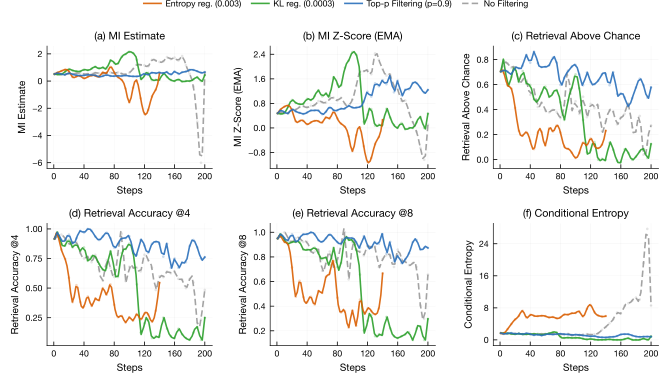
Figure 4 解读:附录展示多种 MI-family proxy 的训练动态。虽然具体尺度不同,trajectory-level 与 first-turn 的 MI proxy 都能反映 input dependence 的下降;这支持作者把 MI proxy 当作 collapse 诊断,而不是仅依赖某一个 retrieval accuracy 指标。
3.3 SNR 机制:为什么低 RV 会导致 template collapse
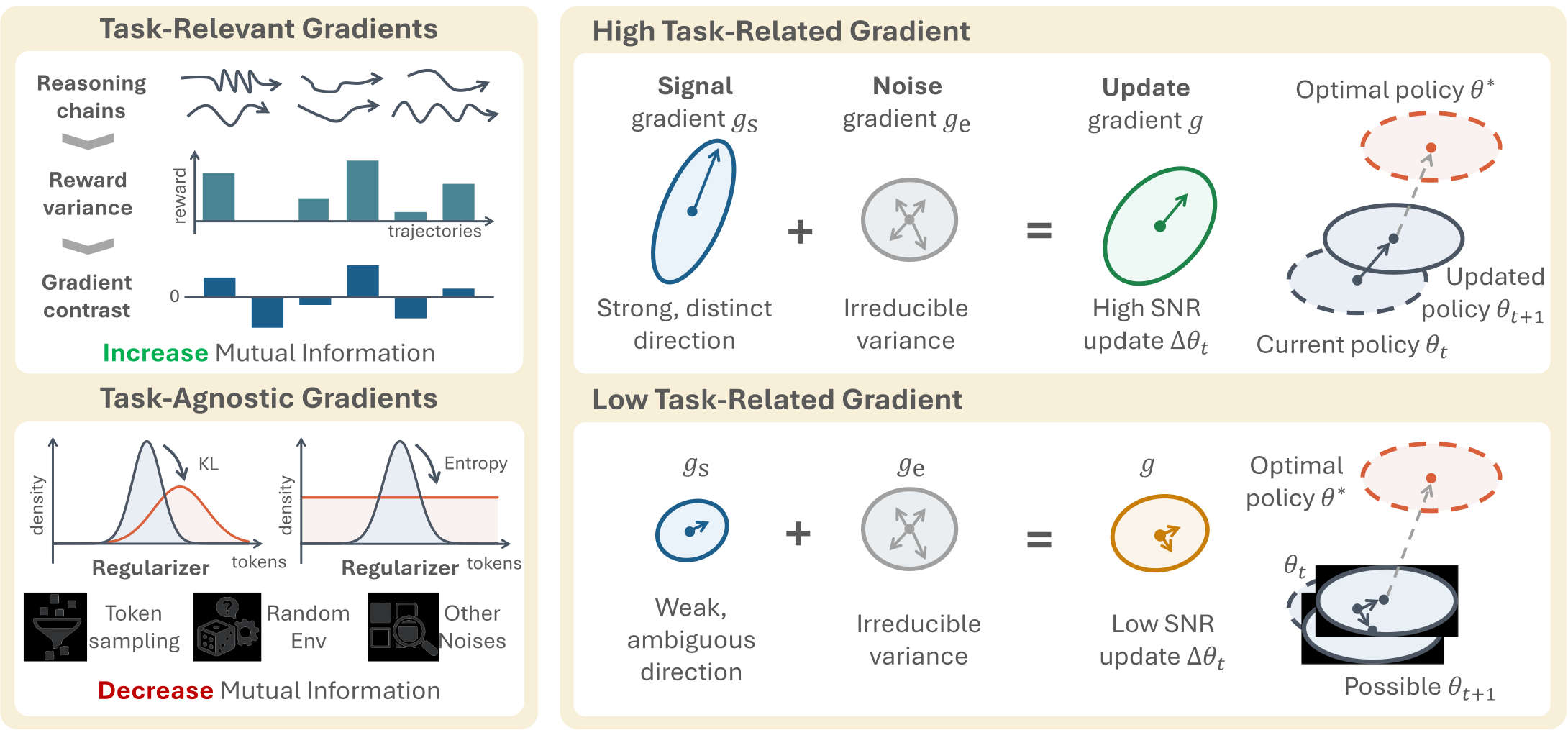
Figure 5 解读:左侧说明 task-relevant gradient 依赖 reward variance:同一 prompt 下不同 reasoning chain 的 reward 有差异,才会产生有方向的 gradient contrast。下方的 KL/entropy/token sampling/environment noise 是 task-agnostic 或不可约 noise,会降低 input dependence。右侧用 SNR 图解释:高 task-related gradient 下,update 指向较明确;低 task-related gradient 下,update 被不可约噪声和 regularizer 主导,policy 可能漂向与 prompt 无关的模板。
定义 within-prompt reward variance: 令优势 ,score function ,task gradient 为: 论文证明 task-gradient norm 被 RV 控制: 因此低 RV prompt 的 task gradient 上限很低。另一方面,regularizer gradient 不需要用 within-prompt reward differences 加权,因而在不同 RV bucket 上更平坦。论文把总更新写成 ,并用 dominance ratio 说明低 RV 时 regularizer 占比上升。对 GRPO-style normalization,附录进一步指出如果用 ,梯度估计方差下界会含有 ,低 RV prompt 在归一化后尤其容易产生高噪声估计。
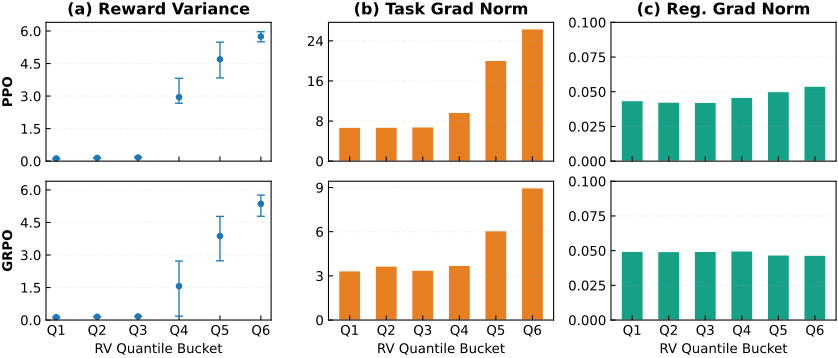
Figure 6 解读:作者把 prompt 按 RV 分成 Q1—Q6。PPO 与 GRPO 中,task gradient norm 随 RV bucket 单调上升;regularizer gradient norm 基本平坦。最低 RV bucket 的 task signal 弱,但 regularizer 仍在,这直接支持“低 SNR 更新会冲淡 input-dependent reasoning”的机制解释。
3.4 SNR-Aware Filtering 的正式定义与实现细节
Top-p SNR-Aware Filtering 的主版本按 reward variance 递减排序。设 是排序 permutation,keep rate 为 ,则: 保留 。Top-k baseline 则固定保留 个最高 RV prompt;Min-p baseline 使用阈值规则;keep-smallest ablation 则反向保留低 RV prompt。
Released code 中 scripts/runs/run_filtering_final.sh 的最终过滤实验显式设定 trainer.total_training_steps=400、micro_batch_size_per_gpu=4、ppo_mini_batch_size=32、algorithm.kl_ctrl.kl_coef=0.001、actor_rollout_ref.actor.kl_loss_coef=0.001、es_manager.train.env_groups=8、es_manager.train.group_size=16,并枚举 reward_variance / reward_sum / entropy / entropy_variance / length 等 filter metric。config/base.yaml 中 actor LR 为 1e-6,critic LR 为 1e-5,entropy coefficient 为 0.001,validation sampling temperature 为 0.5,collapse detection 每 5 step 计算,first-turn 与 multi-turn MI 都开启。
论文公式与 released code 实现差异:没有发现主公式与代码的实质性矛盾,但代码有两个实现细节需要记录。第一,RolloutFilterConfig.top_p_prob_mode 支持 linear 和 softmax;run_filtering_final.sh 沿用 base 的 linear,而 scripts/runs/run_main_table_diff_size.sh 明确覆盖为 softmax。第二,linear top-p 的代码阈值是 value * scores.sum() - selection_eps,并且遇到非正 score 会停止;这比论文正文的理想化累计 RV 公式多了 selection_eps=0.01 与 zero-score handling。
import torch


def snr_top_p_filter(rewards: torch.Tensor, rho: float = 0.9, include_zero: bool = False, eps: float = 0.01):
    """Code-faithful sketch of ragen/trainer/rollout_filter.py.
    rewards: [P, G] reward matrix for P prompt groups and G rollouts.
    """
    rv = rewards.var(dim=1, unbiased=False)               # rollout_filter_metric=reward_variance
    group_ids = torch.arange(rv.numel(), device=rv.device)
    if not include_zero:
        keep_nonzero = rv.abs() > 1e-10
        rv, group_ids = rv[keep_nonzero], group_ids[keep_nonzero]
    if rv.numel() == 0:
        return torch.empty(0, dtype=torch.long, device=rewards.device)

    values, order = torch.sort(rv, descending=True)
    threshold = rho * values.sum() - eps                  # linear top_p mode
    chosen, total = [], 0.0
    for local_idx, score in zip(order, values):
        if total >= threshold or score.item() <= 0:
            break
        chosen.append(local_idx)
        total += float(score)
    if total < threshold:
        return torch.empty(0, dtype=torch.long, device=rewards.device)
    return group_ids[torch.stack(chosen)]
3.5 MI proxy 与 collapse metrics 的实现
ragen/trainer/collapse_metrics.py 的实现与论文表述一致:先把 reasoning trace 对 batch 内所有 prompt 做 cross log-prob,取真实 prompt 列作为 matched,取 logsumexp prompt mixture 作为 marginal,然后计算 MI estimate、retrieval accuracy、conditional entropy 和 reasoning entropy。ragen/llm_agent/ctx_manager.py 负责收集 first-turn prompt/reasoning IDs 与 multi-turn trajectory prompt/reasoning IDs;ragen/llm_agent/agent_proxy.py 把这些非 tensor metadata 放入 rollout batch。
import math
import torch


def compute_mi_family(cross_log_probs: torch.Tensor, true_prompt_ids: torch.Tensor):
    """Sketch based on CollapseDetector._compute_matched_marginal and retrieval metrics.
    cross_log_probs[n, j] = log q(z_n | x_j).
    """
    n_samples, n_prompts = cross_log_probs.shape
    row = torch.arange(n_samples, device=cross_log_probs.device)
    matched = cross_log_probs[row, true_prompt_ids]
    marginal = torch.logsumexp(cross_log_probs, dim=1) - math.log(n_prompts)

    mi_estimate = (matched - marginal).mean()
    conditional_entropy = -matched.mean()
    reasoning_entropy = -marginal.mean()

    pred_prompt = cross_log_probs.argmax(dim=1)
    retrieval_acc = (pred_prompt == true_prompt_ids).float().mean()
    chance = 1.0 / n_prompts
    return {
        "mi_estimate": mi_estimate,
        "conditional_entropy": conditional_entropy,
        "reasoning_entropy": reasoning_entropy,
        "retrieval_accuracy": retrieval_acc,
        "retrieval_above_chance": retrieval_acc - chance,
    }
3.6 Training-step integration
ragen/trainer/agent_trainer.py 在 rollout 后调用 self.rollout_filter.filter(batch),记录 rollout/filter_kept_count、rollout/filter_kept_ratio、rollout/filter_zero_count 等 metrics,再按保留样本计算 advantage 和 policy loss。代码还处理过滤后 batch size 与 num_groups、ppo_mini_batch_size、GPU 数的整除关系,并支持当连续若干 step 无样本保留时触发 early stop。
def train_iteration(batch, rollout_filter, actor, critic, optimizer):
    """High-level sketch of agent_trainer.py around rollout filtering and update."""
    batch, filter_metrics = rollout_filter.filter(batch)
    if batch_is_empty(batch):
        maybe_early_stop(reason="reward_variance_collapse")
        return filter_metrics

    batch = make_batch_divisible(batch, divisors=[num_groups(batch), ppo_mini_batch_size, n_gpus])
    rewards = compute_rewards(batch)
    advantages = compute_advantages(rewards, estimator=config.algorithm.adv_estimator)
    loss = actor.policy_loss(batch, advantages)
    if config.actor_rollout_ref.actor.filter_loss_scaling in {"linear", "sqrt"}:
        loss = scale_loss_by_filter_ratio(loss, filter_metrics["rollout/filter_kept_ratio"])
    loss.backward()
    optimizer.step()
    return filter_metrics
Code reference:
main@20daedc4(2026-04-14) — pseudocode and mapping based on this commit
| Paper Concept | Source File | Key Class/Function |
|---|---|---|
| SNR-Aware prompt-group filtering | ragen/trainer/rollout_filter.py | RolloutFilterConfig, RewardRolloutFilter._select_top_groups, RewardRolloutFilter.filter |
| Rollout filtering inserted into RL update | ragen/trainer/agent_trainer.py | AgentTrainer.fit, self.rollout_filter.filter(batch), filter metrics, batch divisibility logic |
| MI / entropy collapse detection | ragen/trainer/collapse_metrics.py | CollapseDetector.compute_collapse_metrics, _compute_matched_marginal, _compute_mi_estimate, _compute_reasoning_entropy |
| First-turn / multi-turn reasoning metadata | ragen/llm_agent/ctx_manager.py, ragen/llm_agent/agent_proxy.py | _build_first_turn_prompt_and_reasoning_ids, to_llm_inputs, include_collapse_data |
| Main filtering ablations | scripts/runs/run_filtering_final.sh | experiment list over metric/strategy/value/type; ENV="_2_sokoban"; 400 steps; |
| Main table/model-scale experiments | scripts/runs/run_main_table_diff_algo.sh, run_main_table_diff_model.sh, run_main_table_diff_size.sh | algorithm/model-size overrides, rollout_filter_metric=reward_variance, rollout_filter_value |
| Default selected config | config/_2_sokoban.yaml, config/base.yaml | _2_sokoban inherits base; LR, entropy coefficient, rollout params, collapse detection, env groups |
4. Experimental Setup (实验设置)
4.1 Tasks / datasets / environments
论文采用 RAGEN testbed,覆盖七类环境:Sokoban、FrozenLake、MetaMathQA、Countdown、SearchQA、WebShop、DeepCoder。正文主表主要报告四个代表性任务:Sokoban、FrozenLake、MetaMathQA、Countdown;附录进一步描述 SearchQA/WebShop/DeepCoder。论文没有把所有数据源都写成固定 sample count;对 RL 训练,它更强调每次 rollout-update 的 online sampling 规模:主实验每个环境每 iteration 收集 条 trajectory,通常组织为 个 prompt group、每组 条并行样本。验证配置在代码中使用 es_manager.val.env_groups=512, group_size=1。
| Task | Stochastic | Multi-turn | State | Reward |
|---|---|---|---|---|
| Sokoban | ✗ | ✓ | Grid | Dense |
| FrozenLake | ✓ | ✓ | Grid | Binary |
| MetaMathQA | ✗ | ✓ | Text | Dense |
| Countdown | ✗ | ✗ | Text | Binary |
| SearchQA | ✗ | ✓ | Text | Dense |
| WebShop | ✗ | ✓ | Text | Dense |
| DeepCoder | ✗ | ✗ | Text | Dense |
4.2 Baselines and variants
比较对象包括 PPO、DAPO、GRPO、Dr.GRPO,不同模型尺度和类型包括 Qwen2.5-0.5B/1.5B/3B/7B、Qwen2.5-3B-Instruct、Llama3.2-3B,以及 Qwen2.5-VL-3B 的 text/image-conditioned 输入。过滤策略比较包括 no filtering、Top-p SNR-Aware Filtering、Top-k fixed-count filtering、Min-p、keep-largest/keep-smallest、trajectory-level filtering、不同 filter metric(reward variance、reward sum、entropy、entropy variance、length)。
4.3 Evaluation metrics
主指标是 validation task success rate。诊断指标包括 Retrieval-Acc 形式的 MI proxy、MI-Est、MI-Seq-Est、MI-ZScore、conditional entropy 、reasoning entropy 、valid thinking rate、reward variance distribution、filter kept ratio、zero-variance prompt count。Table 9 的 collapse indicator 定义为训练中 validation success rate 是否曾低于 。
4.4 Training config and hardware
论文附录写明主实验使用 Qwen2.5-3B,基于 veRL/HybridFlow,在 NVIDIA GPUs 上训练 PPO/DAPO/GRPO/Dr.GRPO,最多 400 rollout-update iterations,并开启 early stopping。主设置每 iteration 采样 trajectories, prompt groups, samples per prompt。交互环境 Sokoban/FrozenLake 最多 5 turns、每 turn 2 actions,即每条 trajectory 最多 10 actions;Countdown/MetaMathQA 是 1 turn、1 action。
优化配置:update batch size 为 32,per-GPU minibatch size 为 4;GAE 使用 ;Adam betas 为 ;actor LR 为 ,critic LR 为 ;entropy coefficient 为 ;PPO asymmetric clipping 使用 ;invalid structured response 施加 format penalty。对应 released code 中,scripts/runs/run_filtering_final.sh 覆盖 trainer.total_training_steps=400 micro_batch_size_per_gpu=4 ppo_mini_batch_size=32,并设 algorithm.kl_ctrl.kl_coef=0.001 actor_rollout_ref.actor.kl_loss_coef=0.001 es_manager.train.env_groups=8 es_manager.train.group_size=16;config/base.yaml 提供 model_path=Qwen/Qwen2.5-3B-Instruct、actor/critic LR、entropy coefficient、rollout filter defaults 和 validation temperature 0.5。
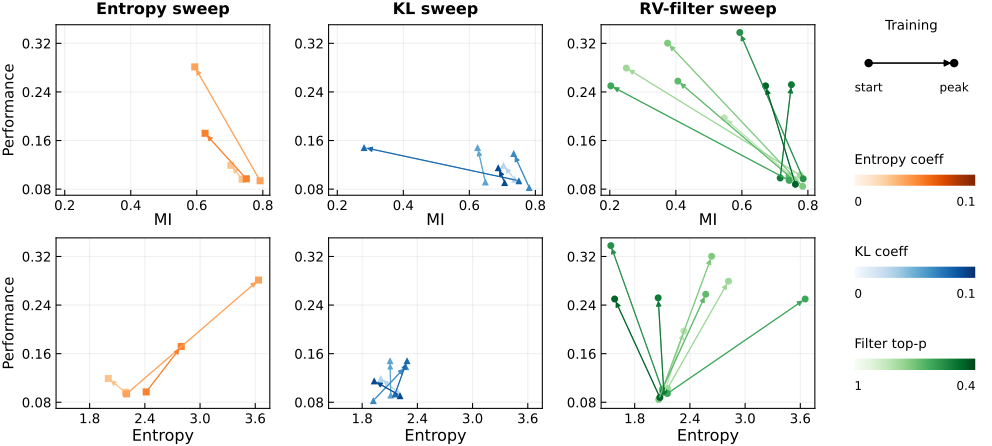
Figure 7 解读:训练轨迹图把不同 intervention 的 success / MI / entropy 联合展示,说明作者不是只在最终成功率上做比较,而是把 collapse 过程当成动态现象追踪。MI 先于 success 恶化,是训练监控中更早的 warning signal。
5. Experimental Results (实验结果)
5.1 Main result: SNR-Aware Filtering across algorithms / scales / modalities
Table 4 报告每个 cell 的 baseline peak 和 filter delta。过滤后平均分在所有 variant 上均提升,尤其在小模型、VL 输入和 Sokoban/FrozenLake 上幅度更大。
| Variant | Sokoban | FrozenLake | MetaMathQA | Countdown | Average |
|---|---|---|---|---|---|
| PPO, Qwen2.5-3B | 12.9 (+16.0) | 67.0 (+10.9) | 92.6 (+0.6) | 97.9 (+0.0) | 67.6 (+6.9) |
| DAPO | 16.2 (+5.1) | 66.8 (+2.1) | 90.8 (+2.8) | 95.7 (+1.6) | 67.4 (+2.9) |
| GRPO | 12.1 (+9.0) | 70.9 (-3.0) | 91.2 (+1.2) | 95.7 (+2.2) | 67.5 (+3.7) |
| Dr.GRPO | 12.1 (-0.4) | 23.2 (+0.6) | 91.2 (+1.4) | 96.5 (+1.4) | 55.8 (+0.8) |
| Qwen2.5-0.5B | 3.3 (+22.9) | 19.5 (+0.0) | 10.0 (-0.2) | 23.0 (-0.7) | 14.0 (+5.5) |
| Qwen2.5-1.5B | 17.0 (+6.2) | 36.5 (+1.6) | 80.3 (+7.0) | 56.6 (+1.6) | 47.6 (+4.1) |
| Qwen2.5-7B | 42.4 (+4.9) | 85.0 (-0.6) | 84.0 (+11.7) | 97.7 (+0.3) | 77.3 (+4.1) |
| Qwen2.5-3B-Instruct | 22.5 (+14.2) | 83.6 (+2.3) | 91.2 (+0.4) | 96.3 (-0.6) | 73.4 (+4.1) |
| Llama3.2-3B | 24.4 (+18.8) | 84.6 (-0.2) | 86.1 (+3.7) | 99.2 (-1.2) | 73.6 (+5.3) |
| Qwen2.5-VL-3B (T) | 53.0 (+6.0) | 16.0 (+53.5) | - | - | 34.5 (+29.8) |
| Qwen2.5-VL-3B (V) | 65.0 (+12.0) | 19.5 (+59.5) | - | - | 42.3 (+35.8) |
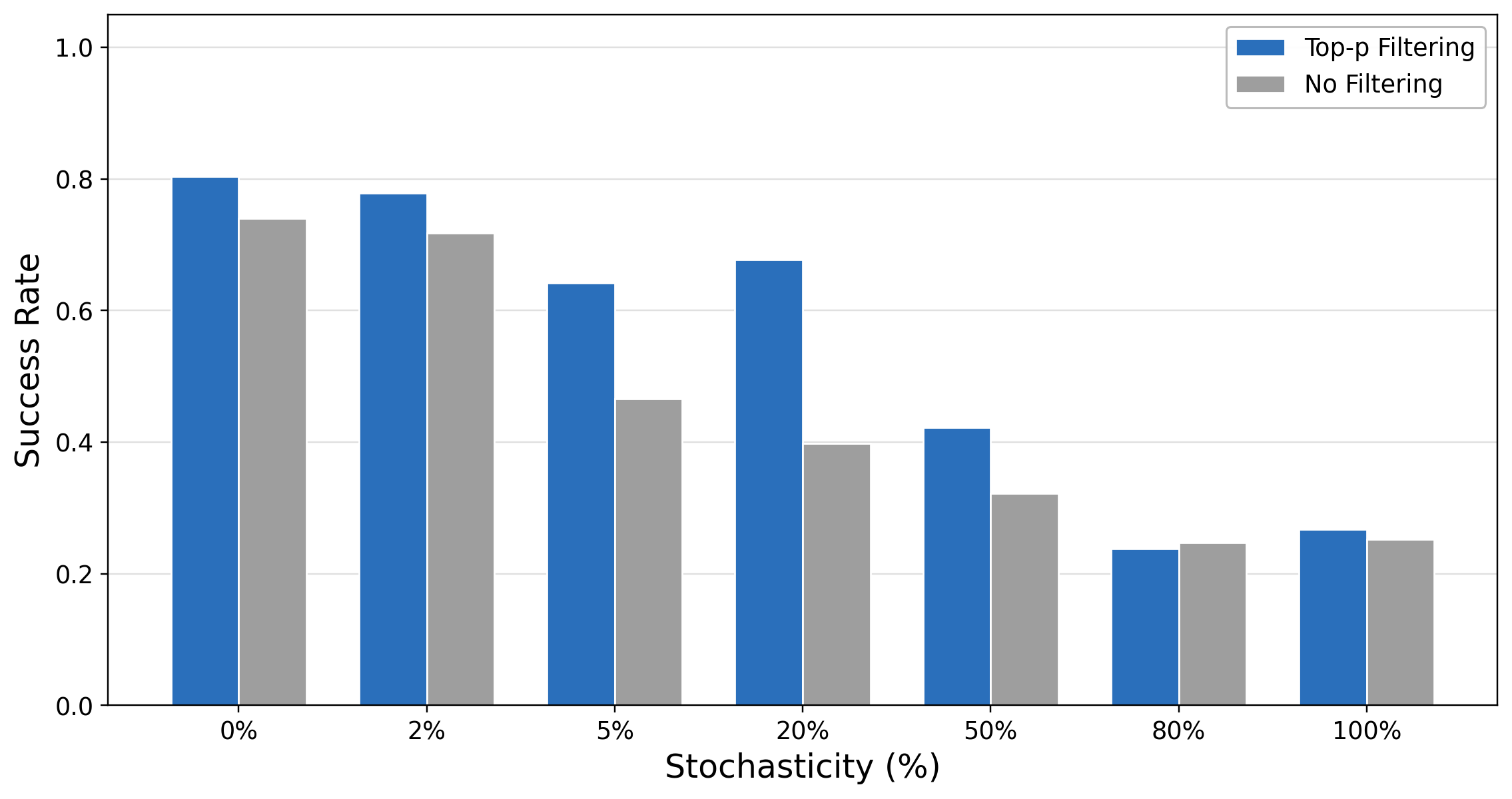
Figure 8 解读:FrozenLake stochasticity sweep 展示 Top-p Filtering 在 0%—50% stochasticity 区间保持高于 no filtering 的 median success;到 80%—100% 时差距缩小。这是一个重要边界条件:当环境噪声过强,RV 不再可靠地区分 task signal 与 noise。
5.2 Compute cost and group sampling
Table 5 固定总 rollout budget 为 128,比较不同 组织方式。 和 过滤后 task performance 分别达到 27.3% 和 27.4%,高于 baseline 的 23.6%;同时 step time 从约 90 秒降到 64.9/52.6 秒。论文强调 RV 计算自身增加不到 0.1% iteration time,主要节省来自过滤后更少 group 进入 gradient computation。
| NF Perf | F Perf | Δ | NF Time | F Time | Δ% | NF VRAM | F VRAM | Δ | |
|---|---|---|---|---|---|---|---|---|---|
| 128×1 | 23.6 | - | - | 89.8 | - | - | 201.80 | - | - |
| 64×2 | 18.8 | 27.3 | +8.6 | 91.8 | 64.9 | -29% | 201.39 | 201.83 | +0.44 |
| 32×4 | 24.2 | 27.4 | +3.2 | 89.8 | 52.6 | -41% | 202.11 | 201.67 | -0.44 |
| 8×16 | 15.6 | 23.6 | +8.0 | 89.2 | 65.9 | -26% | 201.54 | 201.90 | +0.36 |
5.3 MI beats entropy as a collapse diagnostic
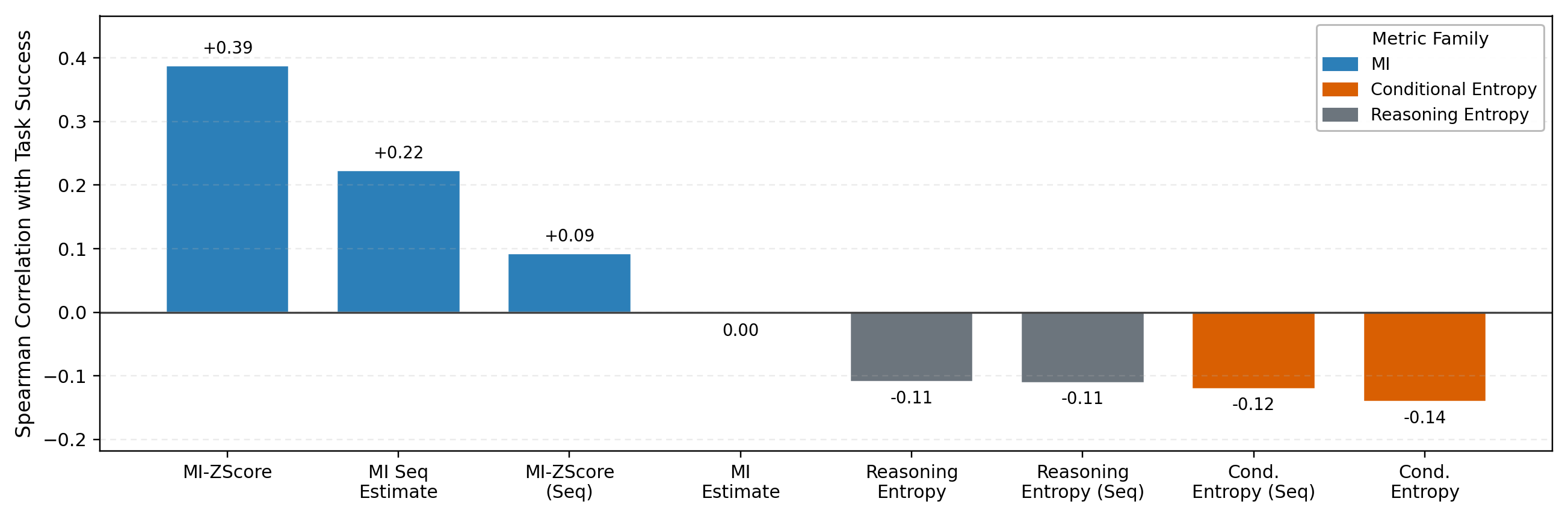
Figure 9 解读:Spearman correlation 显示 MI-family metrics 与 task success 的相关性为正:MI-ZScore 达到 +0.39,MI Seq Estimate 为 +0.22,MI-ZScore (Seq) 为 +0.09,MI Estimate 约为 0。相反,Reasoning Entropy、Reasoning Entropy (Seq)、Conditional Entropy (Seq)、Conditional Entropy 分别约为 -0.11、-0.11、-0.12、-0.14。这说明 entropy 变化不能稳定解释 performance,而 MI 才更接近 task-grounded reasoning。
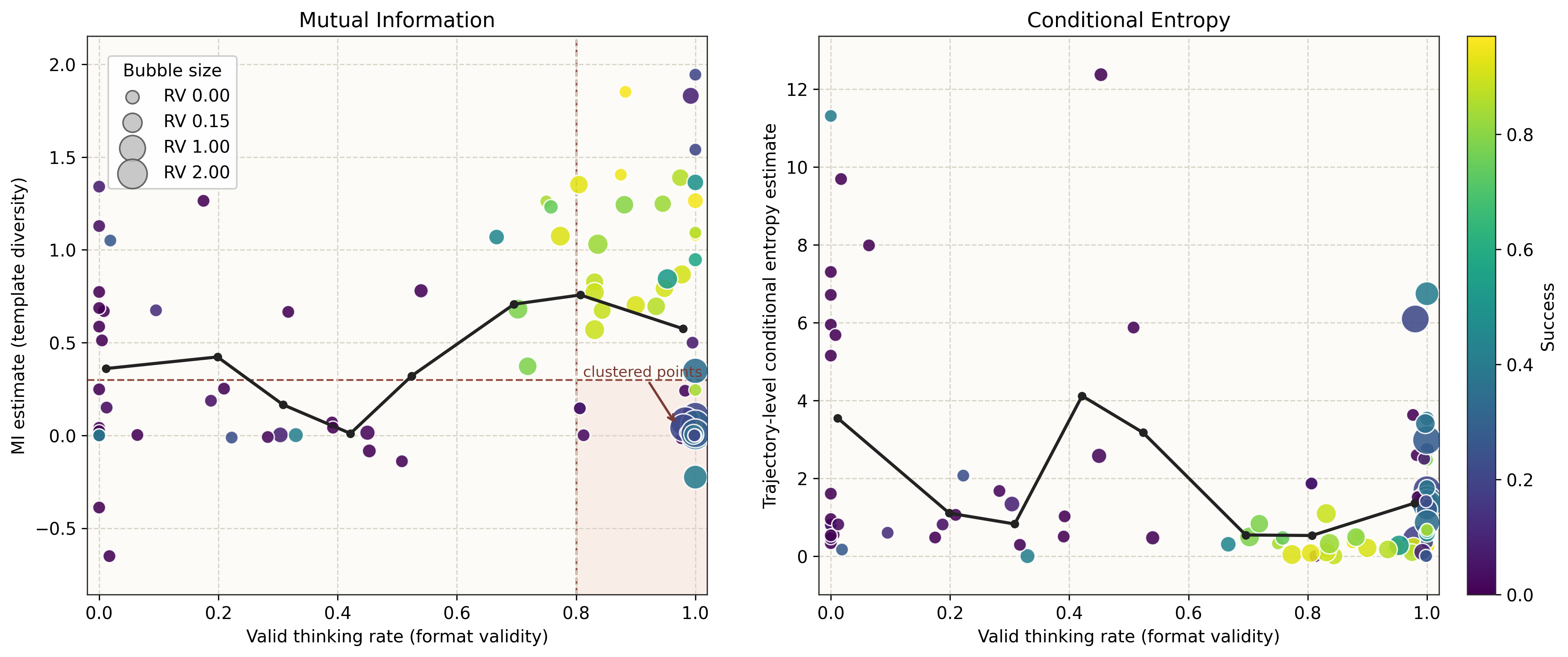
Figure 10 解读:左图用 valid thinking rate 和 MI 展示 runs 的分布,低 MI 区域出现大量 cluster;右图则显示 conditional entropy 与 performance 的关系更混乱。黑线代表 success trend,说明高 entropy 不必然带来更好 agent 行为。
5.4 RV causal evidence and ablations
Quartile ablation 直接验证 RV 与 signal quality 的因果关系。Sokoban Qwen2.5-3B 中,保留最高 RV 的 Q1 达到 21.1% task performance、MI proxy 0.95;Q2 为 19.5% / 0.93;Q3 降到 10.7% / 0.81;最低 RV 的 Q4 为 11.0% / 0.73。entropy 并不单调解释表现,Q4 entropy 反而为 1.87,高于 Q3 的 1.41。
| Quartile | RV Range | Task Perf (%) | MI Proxy | Entropy |
|---|---|---|---|---|
| Q1 (highest RV) | [4.4, 5.6] | 21.1 | 0.95 | 2.02 |
| Q2 | [1.5, 4.2] | 19.5 | 0.93 | 1.53 |
| Q3 | [0.0, 0.2] | 10.7 | 0.81 | 1.41 |
| Q4 (lowest RV) | [0.0, 0.1] | 11.0 | 0.73 | 1.87 |
Trajectory-level vs prompt-level filtering 进一步排除“只是扔掉坏轨迹”的解释。No filter 使用 8/8 prompts、128 trajectories/update,task perf 12.9%、MI 0.83;prompt-level RV 只用平均 3.2/8 prompts、50.6 trajectories/update,却达到 23.6%、MI 1.80;trajectory-level 保留所有 prompts 但每 prompt 选 top-8/bottom-8 trajectories,64 trajectories/update,task perf 16.8%、MI 0.20。结论是 prompt-level signal selection 比单条轨迹筛选更关键。
| Method | Prompts Used | Traj/Update | Task Perf (%) | MI Proxy |
|---|---|---|---|---|
| No filter | 8/8 | 128 | 12.9 | 0.83 |
| Prompt-level RV () | 3.2/8 | 50.6 | 23.6 | 1.80 |
| Trajectory-level | 8/8 | 64 | 16.8 | 0.20 |
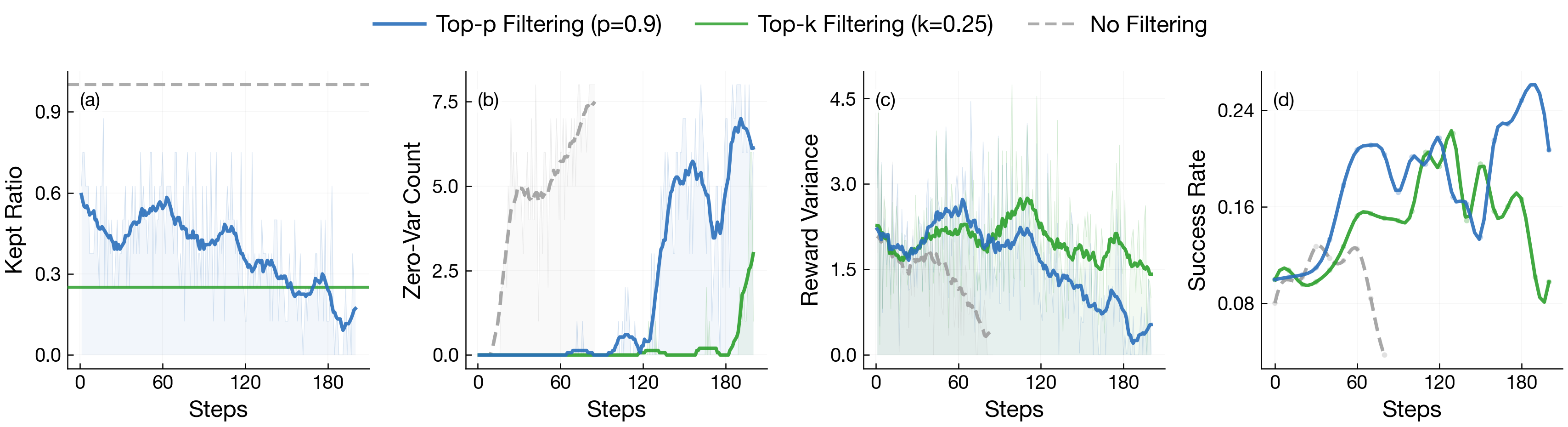
Figure 11 解读:Top-p Filtering 的 kept ratio 会随训练下降,zero-var count 上升,reward variance 下降但 success rate 上升;Top-k 固定保留比例,无法适配逐渐变多的无信号 prompt;No Filtering 的 success 最弱。这支持“自适应而不是固定比例”是 SNR-aware 的核心。
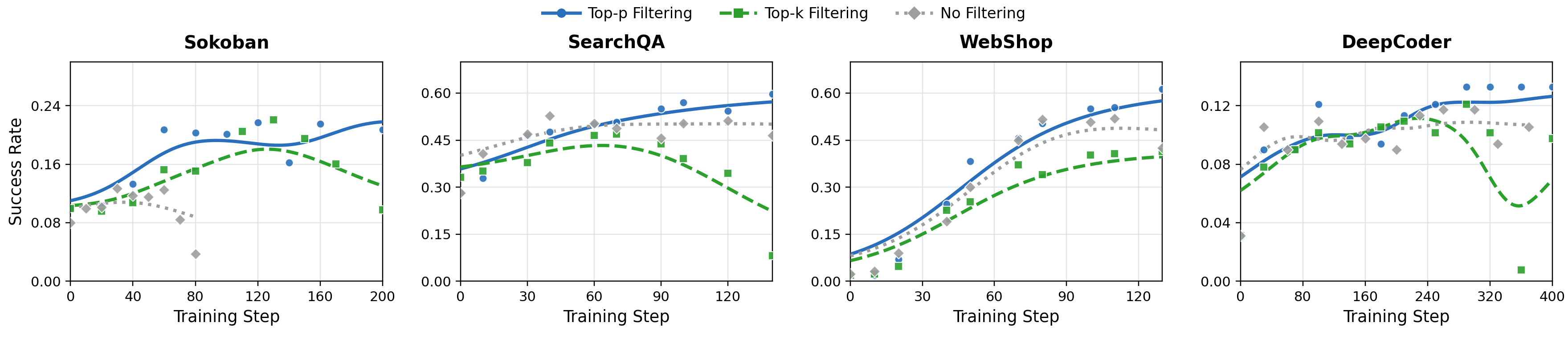
Figure 12 解读:四环境曲线显示 Top-p / Top-k / No-filter 的差异并非只存在于单一任务。Top-p 的优势来自随着 RV 分布自动调整 kept groups;Top-k 虽然也偏向高 RV,但保留固定数量,仍可能把低 signal prompt 带入更新。
5.5 Filtering metric and keep-strategy ablation
Table 9 在 Sokoban Qwen2.5-3B 上比较采样阈值、filter metric 和 keep strategy。Sampling 方面,Top-p=1.0 baseline 为 task perf 0.17、MI 0.54、entropy 2.76 且 collapse;Top-p=0.9 提升到 0.38 / 0.84 / 1.64 且稳定;Min-p=0.2 task perf 最高 0.45,但 MI 降到 0.36、entropy 升到 3.01,说明 success 与 input dependence 不总一致;Top-k=0.5 达到 0.44 / 0.89 / 1.47。
Filter metric 方面,reward variance 为 0.38 / 0.84 / 1.64 且稳定;reward sum 为 0.24 / 0.80 / 4.18 且 collapse;entropy 为 0.20 / 0.41 / 2.20 且 collapse;entropy variance 为 0.23 / 0.70 / 2.94 且 collapse;length 为 0.16 / 0.91 / 1.65 且 collapse。Keep strategy 方面,keep-largest baseline 为 0.44 / 0.89 / 1.47 且稳定;keep-smallest 降为 0.29 / 0.47 / 5.31。这个对照最直接地说明:高 RV group 承载的是更有用的训练信号,低 RV group 更像噪声或无信息更新。
5.6 Reward/RV evolution, reasoning compression, and limitations
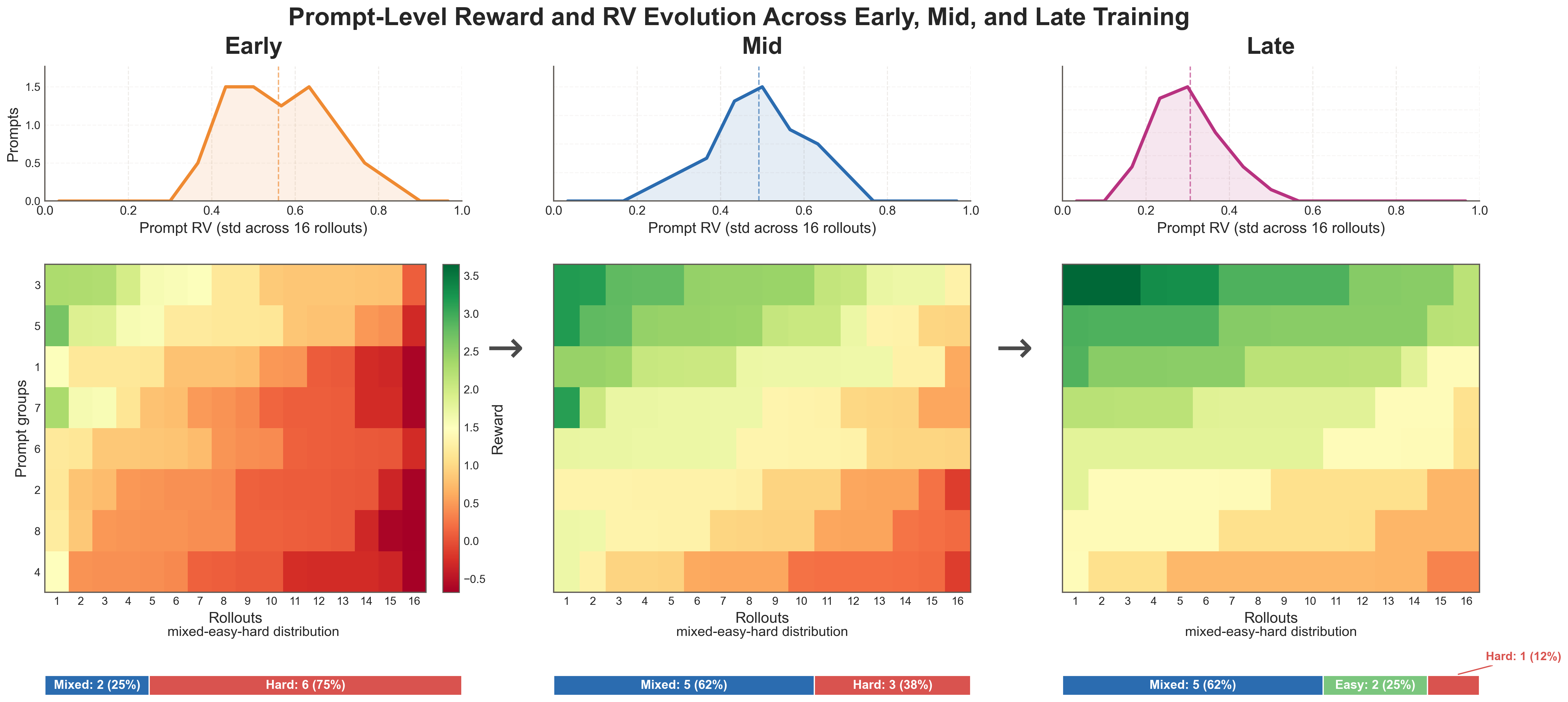
Figure 13 解读:训练早/中/晚期的 prompt RV 与 reward heatmap 显示,随着 policy 变强,prompt 难度分布移动:hard prompt 比例下降,mixed/easy prompt 上升,很多 prompt 的 reward 更趋同。过滤器因此需要动态收紧,否则会继续在低差异 prompt 上浪费更新预算。
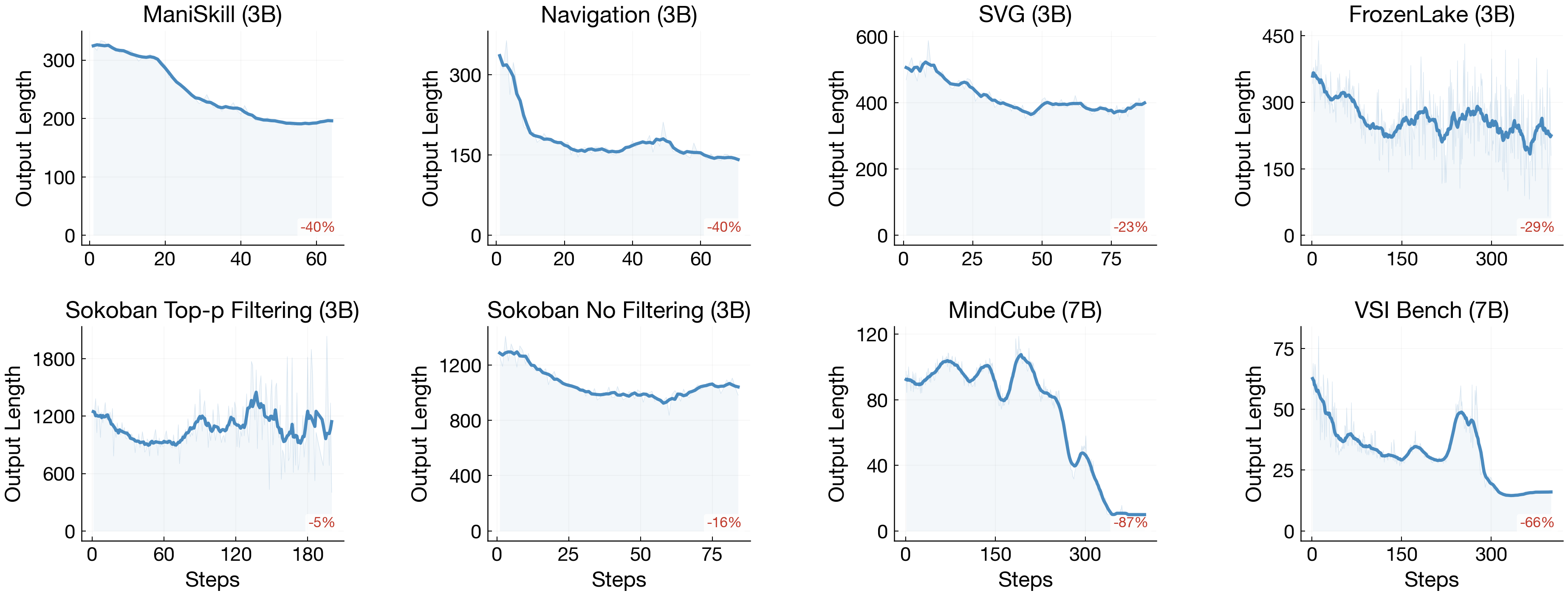
Figure 14 解读:多个任务中 output length 都出现压缩趋势:ManiSkill 与 Navigation 约 -40%,SVG 约 -23%,FrozenLake 约 -29%,MindCube 约 -87%,VSI Bench 约 -66%;Sokoban Top-p Filtering 只约 -5%,而 Sokoban No Filtering 约 -16%。这说明 reasoning compression 是 collapse 的行为表征之一,但 length 本身不是可靠的过滤 metric。
Per-setting RV 统计给出何时 filtering 有效的经验判断:Sokoban 14B 的 Filter Δ 为 +4.6%,Std/Mean=1.29;Sokoban 3B 为 +3.2%,Std/Mean=1.16;FrozenLake 3B (GRPO) 为 -5.0%,Std/Mean=0.33。Std(RV)/Mean(RV) 高时,RV 分布更 bimodal,过滤能分离 signal-rich 与 noise-only prompts;接近 0 时,过滤近似随机丢数据。
主要局限也来自这个机制本身:SNR-Aware Filtering 需要 trajectories per prompt 来估计 RV;当环境随机性极高(论文报告 80%—100% stochasticity)时,RV 可能由 noise 而不是 task signal 主导,过滤优势会消失;当所有 prompt 的 RV 都接近一致时,filter 也难以区分有用 prompt。作者没有声称 RV 是万能质量指标,而是把它定位为便宜、可在线计算、在跨 prompt RV 异质性足够大时有效的 SNR proxy。