From Reasoning to Agentic: Credit Assignment in Reinforcement Learning for Large Language Models
Paper: arXiv:2604.09459 Code: xxzcc/Awesome-Credit-Assignment-in-LLM-RL Code reference:
main@e6a34ab4(2026-05-16)
1. Motivation (研究动机)
这篇论文的核心问题是:LLM RL 里常见的 outcome-level sparse reward 只告诉我们“整条轨迹成功/失败”,却不能告诉优化器“哪一个 token、step、turn、tool call 或 agent 真正改变了结果”。在 reasoning RL 中,这个问题已经很明显:一个 500—30K+ token 的 CoT 可能只有少数关键推理步骤决定最终答案,但 GRPO/PPO 通常把同一个 episode advantage 发给整条响应。到了 agentic RL,问题变成质变:trajectory 变成 10—100+ turns、100K—1M tokens,环境是 stochastic、partially observable,而且每个 turn 的动作类型从“生成下一个 token”扩展为搜索、读文件、调用 API、写代码、与其他 agent 通讯等异质动作。
论文要解决的不是提出一个新的单一 RL 算法,而是系统回答:从 reasoning 到 agentic 后,credit assignment 的问题结构发生了什么变化,现有方法分别把 credit 分配到哪个粒度,并且在什么条件下会失效或适用。作者把 2024—early 2026 的 47 篇方法分成 41 个 core CA methods 和 6 个 CA-adjacent enablers,并用两个轴组织:granularity(token / segment / step-turn / multi-agent)与 methodology(MC、TD/value、LLM-as-Critic、game-theoretic、information-theoretic 等)。
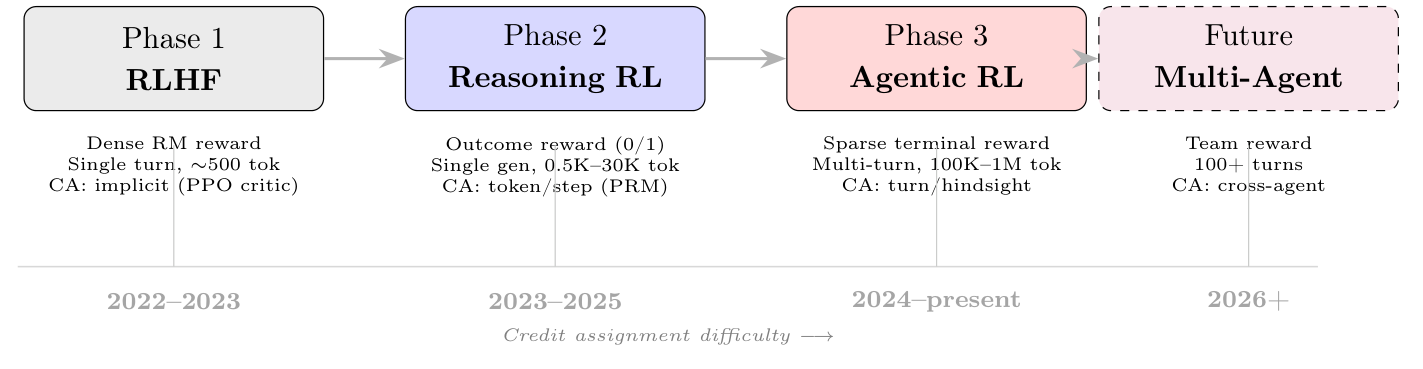
Figure 1 解读:图中把 LLM RL 分成 RLHF、Reasoning RL、Agentic RL、Multi-Agent 四个阶段。关键趋势不是“任务更难”这么简单,而是 credit 的可定位对象在变粗、轨迹在变长:RLHF 主要靠 dense RM / PPO critic;Reasoning RL 关注单轮 CoT 内 token/step credit;Agentic RL 需要 turn-level / hindsight credit;Multi-Agent 还要跨 agent 分摊 team reward。
这个问题值得研究,是因为它直接决定 agentic training 是否可扩展。若无法定位关键决策,训练会把成功/失败信号均匀扩散到 routine actions 上,导致 sample inefficiency、reward hacking、echo trap、tool-use collapse 或多 agent 梯度不稳定。相反,如果能把 credit 对齐到“真正有 causal impact 的动作”,就能减少 rollout 需求、提高长程任务稳定性,并把 RL 从数学/代码答案验证推进到软件工程、Web navigation、OS control、多 agent 协作等真实环境。
2. Idea (核心思想)
核心洞察是:agentic RL 不是 reasoning RL 的长版本,而是一个 credit assignment problem 的 regime shift。Reasoning CA 通常假设 deterministic generation、full observability、step-level verifiability 和相对短的 single-generation trajectory;Agentic CA 则面对 stochastic transitions、POMDP observation、非可验证中间状态、100+ turn horizon 与 rare-but-decisive bifurcation points。
论文的创新在于提供三类 reusable resources:第一,47 篇方法的 structured taxonomy 和 inventory;第二,面向未来 CA paper 的 reporting checklist;第三,包含 benchmark metadata、controlled bifurcation tasks 与 method selection decision tree 的 benchmark/protocol specification。它把“PRM、counterfactual、critic-free、hierarchical、information gain、multi-agent Shapley”等看似分散的工作放到同一个坐标系里。
与单一方法论文不同,本文的 fundamental difference 是把 credit assignment 从“某个 reward shaping trick”提升为 agentic RL training pipeline 的核心接口。相比 GRPO 这种 episode-level baseline,它强调 credit 需要按任务结构选择 granularity;相比 classical RL credit assignment,它指出 LLM-as-Critic、natural-language retrospective critique、turn-level MDP、cross-agent semantic contribution 这些机制是 LLM 时代特有的设计轴。
3. Method (方法)
3.1 总体框架:多粒度 credit hierarchy + 二维 taxonomy
论文先把一个 agentic trajectory 写成多层结构: 这说明 credit 可以被分配到不同层级:episode、turn、segment、token,甚至在 multi-agent setting 中继续分到 agent-level。GRPO 的 episode-level estimator 是: 问题在于, 中所有 token / action 都拿到同一个 。对 1-turn reasoning,— tokens 时还能勉强工作;对 agentic RL,— tokens、10—100+ turns 时,关键 API 选择和无关格式化动作被等价更新,signal-to-noise ratio 会塌陷。
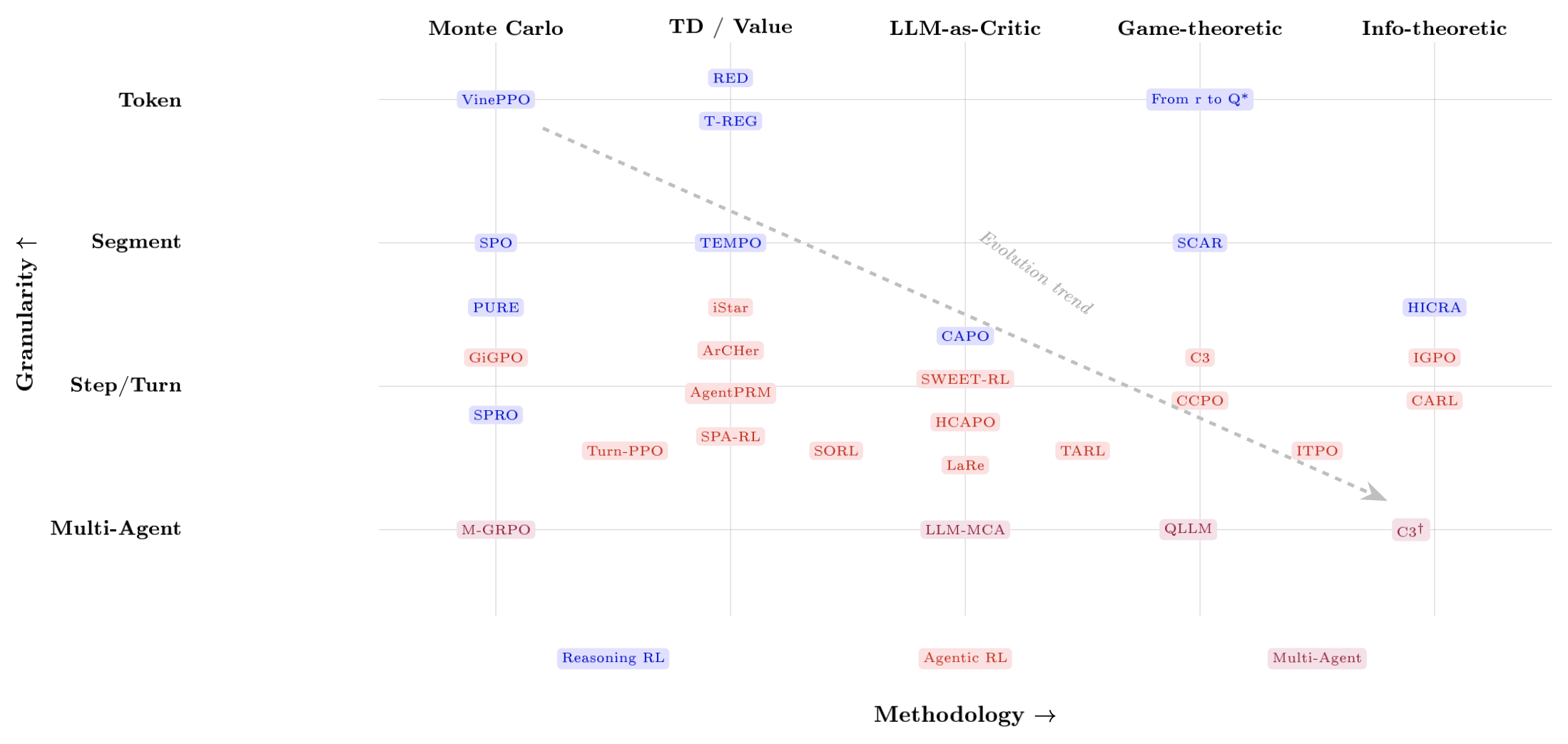
Figure 2 解读:横轴是 credit 计算方式,纵轴是 credit 分配粒度。蓝色 reasoning methods 集中在 token/segment/step;红色 agentic methods 向 step/turn 和 LLM-as-Critic、game-theoretic、information-theoretic 移动;紫色 multi-agent methods 进一步要求跨 agent credit。虚线箭头表达了作者的主张:领域正在从 fine-grained reasoning credit 迁移到更粗但环境感知更强的 agentic credit。
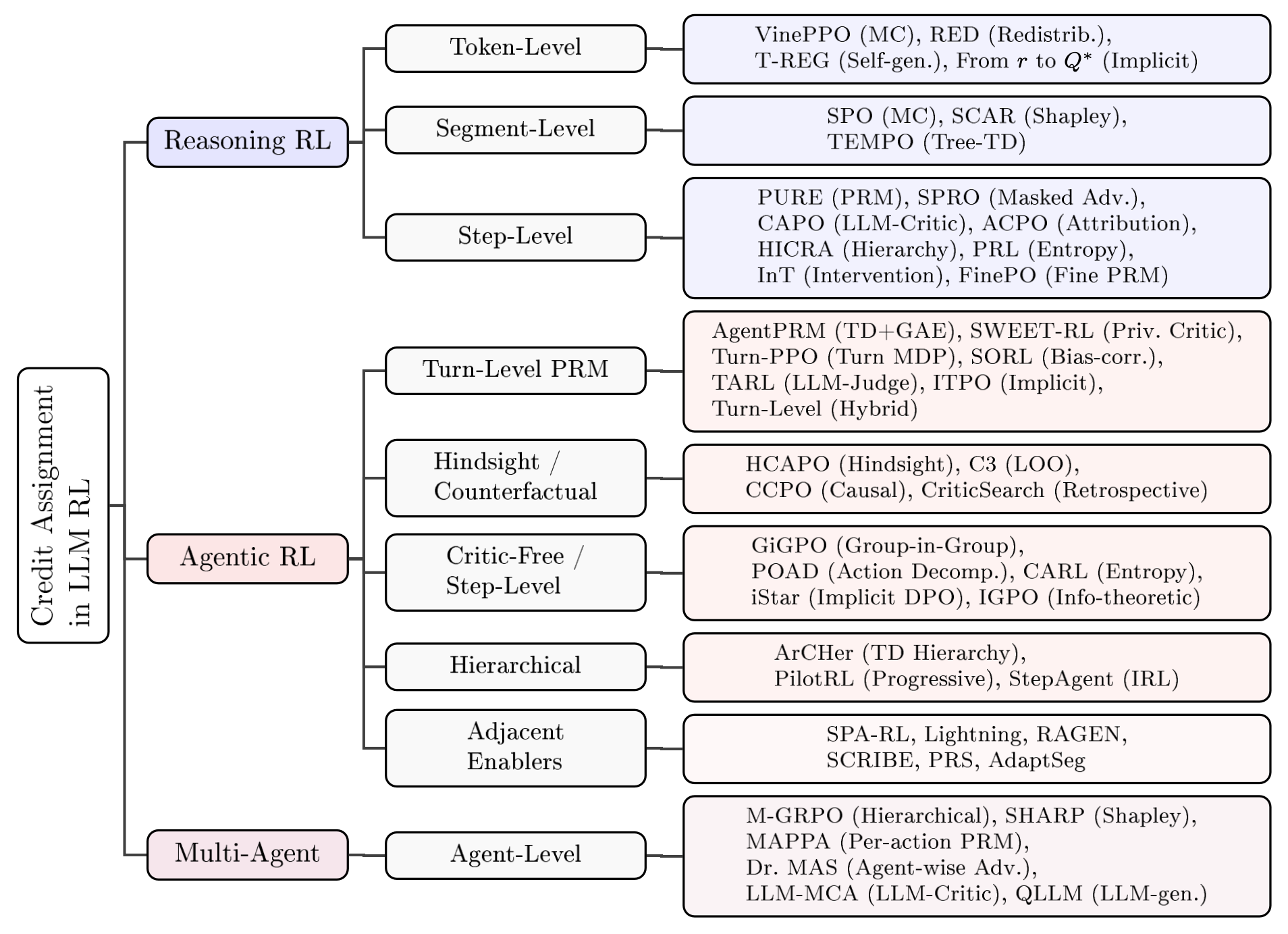
Figure 3 解读:树状图把 47 个方法按 setting 再按方法族分层。Reasoning RL 包含 token-level、segment-level、step-level;Agentic RL 包含 turn-level PRM、hindsight/counterfactual、critic-free step-level、hierarchical、adjacent enablers;Multi-Agent 则集中在 agent-level credit。这个图的价值是让读者看到“method name”背后的问题分解,而不是把所有 paper 都混成一类 RLHF 改进。
3.2 为什么 agentic RL 让 credit assignment 变难
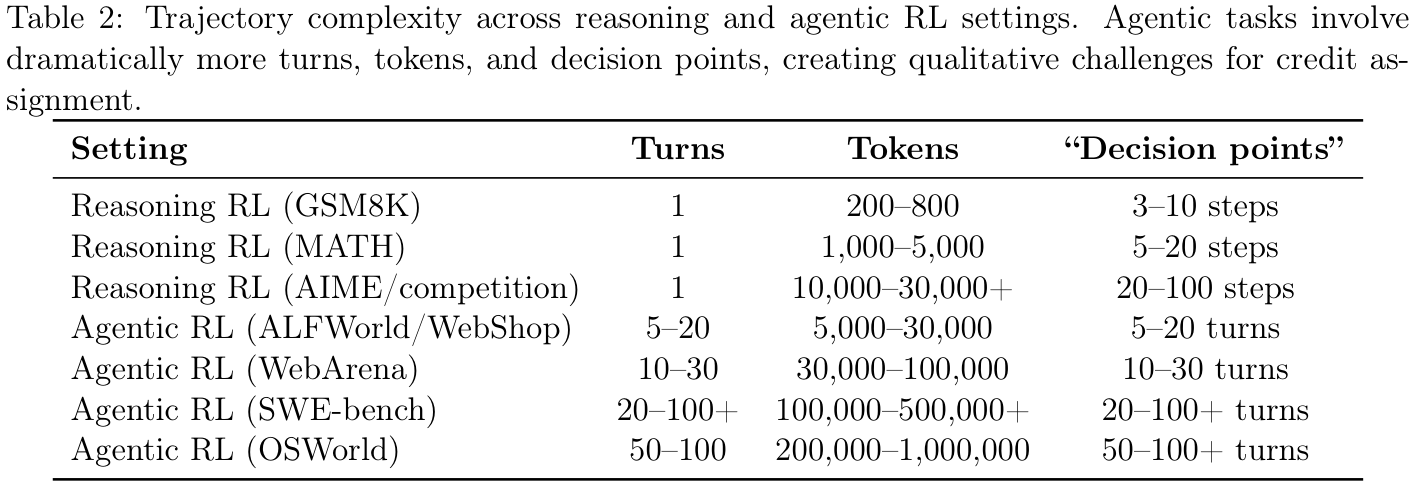
Table 2 解读:reasoning tasks 通常 1 turn:GSM8K 是 200—800 tokens / 3—10 steps,MATH 是 1,000—5,000 tokens / 5—20 steps,AIME/competition 可到 10,000—30,000+ tokens / 20—100 steps。Agentic tasks 的量级直接上升:ALFWorld/WebShop 是 5—20 turns / 5,000—30,000 tokens;WebArena 是 10—30 turns / 30,000—100,000 tokens;SWE-bench 是 20—100+ turns / 100,000—500,000+ tokens;OSWorld 是 50—100 turns / 200,000—1,000,000 tokens。
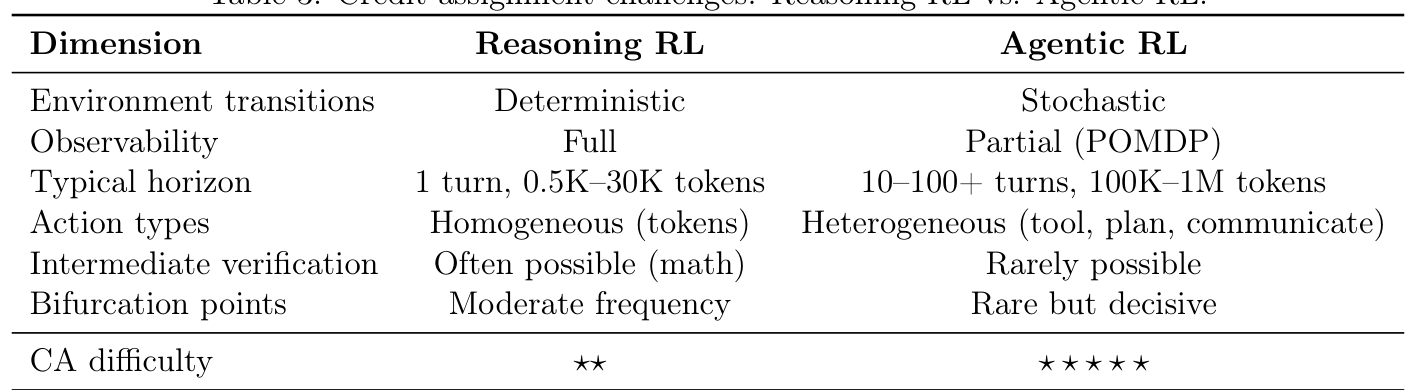
Table 3 解读:作者把困难归纳为六类。Reasoning RL 的 transition 是 deterministic、state full observable、intermediate verification often possible;Agentic RL 则是 stochastic、partial observable、heterogeneous action types、non-verifiable intermediate states,并且 bifurcation points rare but decisive。这意味着用同一套 PRM 或 GRPO 逻辑去训练 agent 很容易把“信息缺口”和“决策错误”混淆。
长 horizon 还带来方差问题。论文指出,在带常数 baseline 的 REINFORCE estimator 中,梯度方差约随 缩放;从 的 reasoning 任务到 的 complex agentic 任务,达到同等 gradient quality 需要的 rollout 数可能增加约 10 倍。实践中这对应训练不稳定、reward hacking 和 RAGEN/StarPO 所说的 echo trap。
3.3 Reasoning RL 中的 credit assignment 方法族
Reasoning RL 的方法相对成熟,因为轨迹是单轮、可回放、很多任务可验证。论文按粒度组织:
- Token-level:VinePPO 从任意 token prefix fork 个 continuations,用 MC 估计 ,再用 给 token 分 credit;RED 读取 reward model hidden states,用轻量 probe 做 token reward redistribution;T-REG 用正确/错误解的 contrastive self-prompting 找 discriminative tokens;From to 说明 DPO 的 log-probability ratio 可被理解为 implicit token-level Q-function。
- Segment-level:SPO 把 CoT 切成 semantic segments,在 segment cutpoint 上做 MC credit;TEMPO 把 reasoning path 建成 tree,在叶子用 MC、内部用 TD-style bootstrap;SCAR 把 segment 当作 cooperative game player,用 Shapley value 衡量 marginal contribution。
- Step-level / PRM:Math-Shepherd 和 OmegaPRM 为 step-level PRM 提供 MC labeling 基础;PURE 提出 min-form PRM,避免 sum-form credit 被 reward hacking;SPRO 用 masked-step advantage 做 leave-one-out;FinePO 把 PRM 推到 sub-step;PRL 从 entropy-regularized RL 推导 process reward;InT 让模型自提 counterfactual interventions;ACPO 把 attribution credit 与 curriculum learning 结合;CAPO 用 LLM 自己生成 natural-language critiques;HICRA 区分 planning tokens 与 procedural tokens。
经典 TD/GAE 公式在论文中作为方法基础出现: 这组 reasoning methods 的共同假设是:可以从 prefix cheap fork,或者可以拿到 step-level correctness signal。作者明确指出,当这些假设被 agentic RL 打破,VinePPO 的 environment re-execution、PRM 的 step verification 都会变贵或失效。
3.4 Agentic RL 方法族:turn-level、hindsight、critic-free、hierarchical
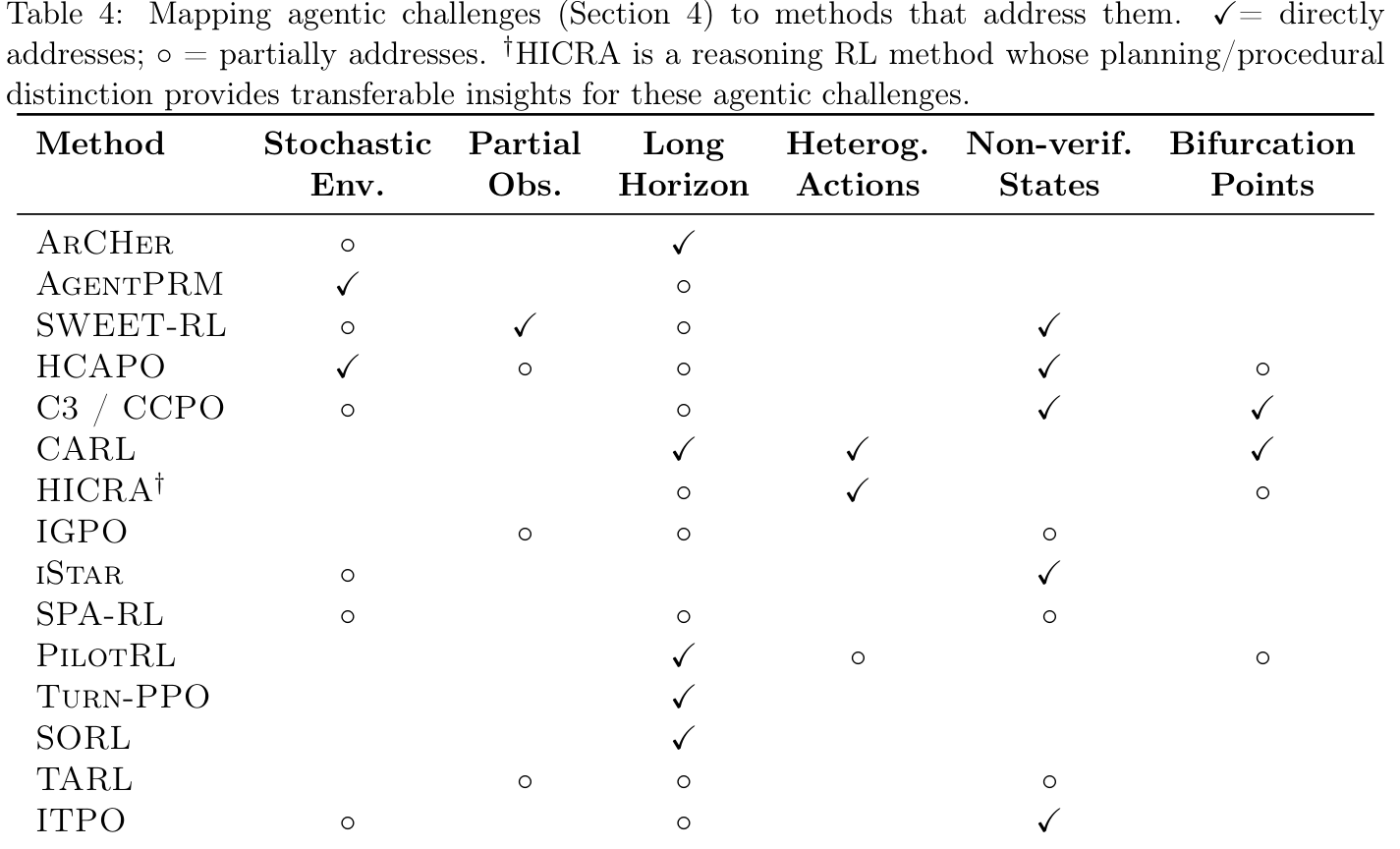
Table 4 解读:这张表把 6 个 agentic challenge 映射到方法。比如 SWEET-RL 主要利用 partial observability 下训练期可见的 privileged information;HCAPO/C3/CCPO 面向 non-verifiable states 和 bifurcation points;CARL 直接处理 heterogeneous actions 与 bifurcation points;ArCHer、Turn-PPO、SORL 关注 long horizon / turn-level MDP;AgentPRM 用 TD+GAE 处理 stochastic environment 下 MC continuation 太贵的问题。
Turn-level PRM / value methods
AgentPRM 把 reasoning PRM 的 MC step labeling 换成 TD+GAE value estimation,因为 agentic setting 中从中间状态重跑环境意味着重启 sandbox、发 API、执行网页/代码,成本远高于继续生成 token。SWEET-RL 使用 privileged asymmetric critic:训练时 critic 能看见 gold answer、future trajectory 或额外环境状态,actor 推理时仍只看普通 observation。Turn-PPO 把一个 complete LLM response + environment feedback 视作 turn-level macro-action,用 turn-level importance ratio 替代 token-level ratio,降低跨 turn credit 的方差。SORL 进一步处理 off-policy multi-turn 训练中的 granularity mismatch 和 high-variance updates。
Hindsight / counterfactual methods
HCAPO 在 trajectory 完成后让 LLM critic 做 retrospective verification,评估每个 turn 对 outcome 的贡献;C3 用 leave-one-out counterfactual credit: 其中 表示把第 个 turn 的 action 替换为 default 后的 counterfactual trajectory。CCPO 进一步把 turn action 视作 treatment、outcome 视作 effect,用 SCM / ATE 给 counterfactual credit 提供因果解释。CriticSearch 把类似思想用于 search agents,让 frozen asymmetric critique LLM 根据完整轨迹和 gold answers 生成 dense turn-level rewards。
Critic-free / step-level methods
GiGPO 把 GRPO 的 group comparison 从 episode-level 扩展到 step-level:外层还是 trajectory group comparison,内层用 anchor state groups 比较同一轨迹中的 steps,从而不需要 learned value function。POAD 同时做 inter-action 和 intra-action credit,因为 agentic action 本身是 variable-length token sequence。CARL 不试图给所有 action 精确打分,而是用 policy action entropy 找 critical actions,只在 bifurcation points 上更新。IGPO 从 information gain 定义 turn credit:
Hierarchical / infrastructure methods
ArCHer 用 high-level off-policy critic 学 turn-level ,低层 actor 仍在 turn 内做 token-level policy optimization;PilotRL 则从 plan-level 到 step-level 再到 token-level progressive cascade;StepAgent 用 inverse RL 从 expert demonstrations 中推断 step-level reward。Agent Lightning、RAGEN/StarPO、SPA-RL、SCRIBE、PRS、AdaptSeg 不是都提出纯 CA 算法,但分别从 decoupled training architecture、uncertainty filtering、MLP progress estimation、skill prototypes、progressive reward shaping、adaptive segmentation 等角度让 agentic credit assignment 更可落地。
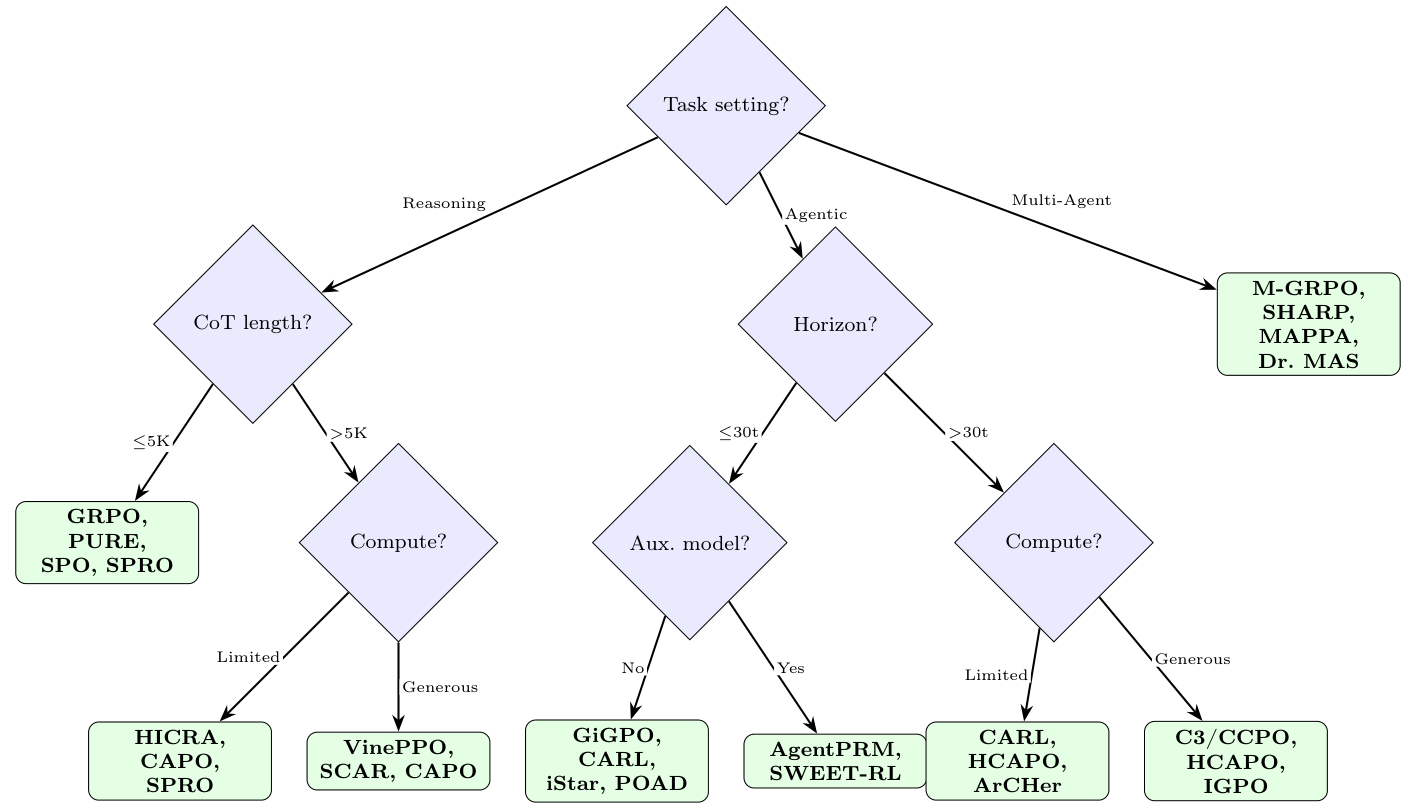
Figure 4 解读:决策树把任务 setting 作为第一层分支:Reasoning、Agentic、Multi-Agent。Reasoning 下再看 CoT length 和 compute;Agentic 下先看 horizon,再看是否可用 auxiliary model 或 compute;Multi-Agent 直接指向 M-GRPO、SHARP、MAPPA、Dr. MAS 等跨 agent 方法。作者用 6 个已知 task-method pair 做 retrospective validation,报告 6/6 被这棵树恢复。
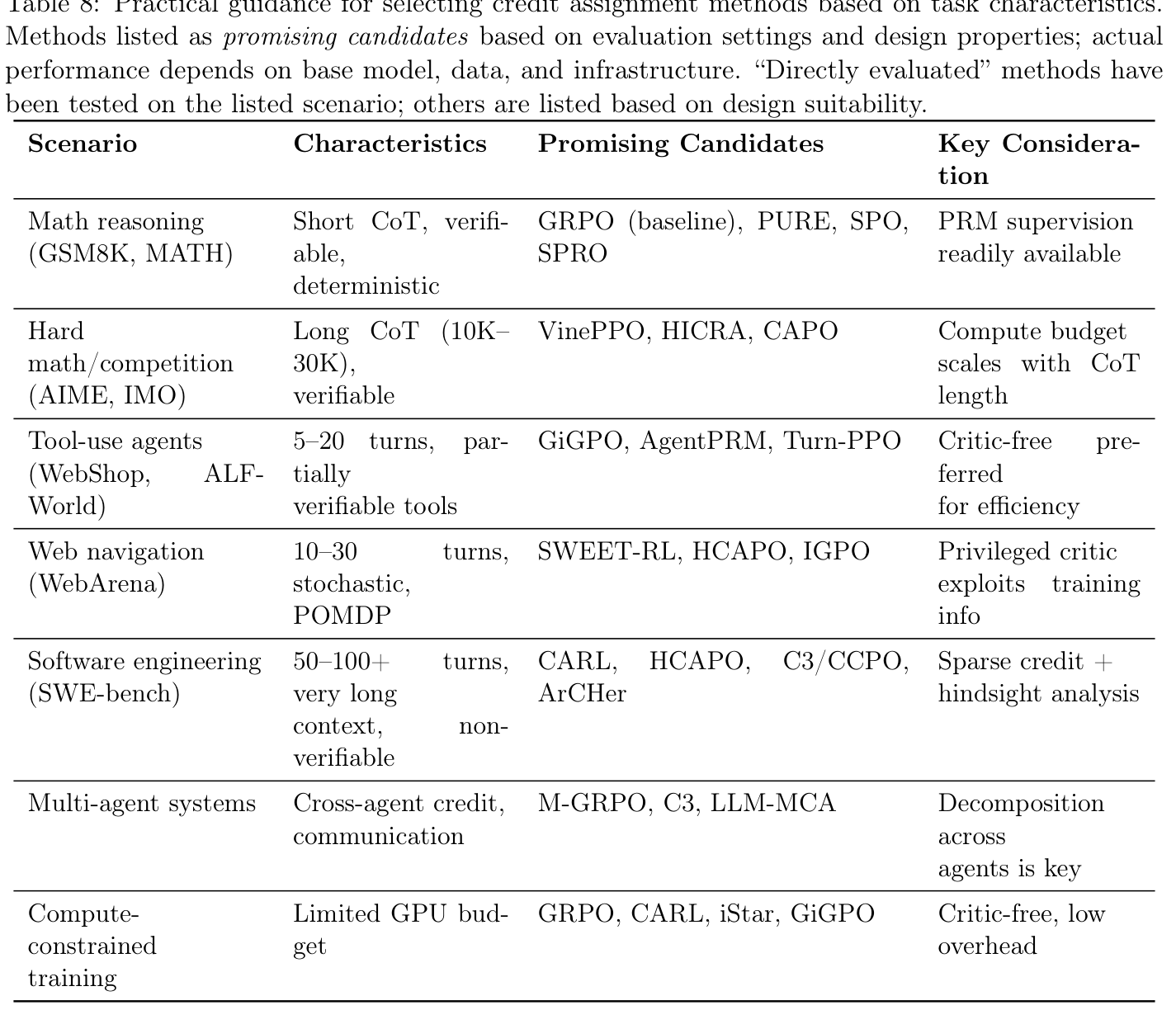
Table 8 解读:这张表给出更实用的选择建议:GSM8K/MATH 这类 short deterministic math 可用 GRPO/PURE/SPO/SPRO;AIME/IMO 这类 long CoT 可考虑 VinePPO/HICRA/CAPO;WebShop/ALFWorld 这类 5—20 turn tool-use tasks 偏向 GiGPO/AgentPRM/Turn-PPO;WebArena 这类 POMDP web navigation 偏向 SWEET-RL/HCAPO/IGPO;SWE-bench 这种 50—100+ turn software engineering 需要 CARL/HCAPO/C3/CCPO/ArCHer;compute-constrained training 则偏向 critic-free low-overhead methods。
3.5 Multi-Agent credit assignment
Multi-agent setting 需要同时处理 temporal credit 和 cross-agent credit。M-GRPO 把 credit 分为 inter-agent credit 和 intra-agent credit:前者比较不同 team compositions 的 outcome,后者在每个 agent 内做 GRPO-style advantage。LLM-MCA 用 centralized LLM critic 读完整 interaction history,给每个 agent 的 contribution 生成自然语言评估再转 scalar rewards。QLLM 让 LLM 根据任务描述和样例轨迹生成 Python credit function。SHARP 用跨 agent Shapley value 分解 global reward。MAPPA 给每个 agent action 提供 AI-feedback process rewards。Dr. MAS 则指出 global normalization baseline 会因 agent 分布异质导致梯度不稳定,因此用 agent-wise advantage normalization。
对 multi-agent C3,论文给出的 leave-one-out 形式是: 其中 是去掉 agent 后的 counterfactual trajectory。这种形式公平、直观,但当 agent 数 增大时需要 次 counterfactual evaluation,扩展性仍是 open problem。
3.6 Pipeline 视角:CA 不是后处理,而是训练系统接口
论文把 agentic RL training pipeline 划成五步:environment construction、rollout generation、reward computation、credit assignment、policy update。Credit assignment 会反向影响 rollout efficiency、reward design 和 exploration:CARL 通过只更新 critical actions 可减少 72% gradient updates;PRS 和 IGPO 实际上重写了 reward signal 的密度/形状;而 credit uncertainty 理论上应该引导 exploration,但当前方法还很少把二者结合。
3.7 Companion repo 与 released code 对齐情况
官方仓库 xxzcc/Awesome-Credit-Assignment-in-LLM-RL 在 main@e6a34ab4 是 companion awesome list,不是训练实现。仓库包含 README.md、assets/taxonomy.png、assets/taxonomy_tree.png 和 gen_figures.py;gen_figures.py 使用 Matplotlib 生成 taxonomy grid 和 taxonomy tree,当前没有 RL training loop、benchmark runner、JSON/CSV inventory schema 或 checkpoint/config。
论文公式与 released code 实现差异:论文在 Supplementary Material Release 中承诺 release structured inventory(CSV/JSON)、screening log、taxonomy labels、reporting checklist template、benchmark protocol schema;但截至 main@e6a34ab4,公开仓库主要是 living README + taxonomy figure generator,尚未包含这些结构化 artifact。因此下面的伪代码与 mapping 只锚定 companion repo 的 taxonomy asset generation / method inventory,不把它误写成训练算法实现。
from dataclasses import dataclass
from typing import Literal

Setting = Literal["reasoning", "agentic", "multi_agent"]
Granularity = Literal["token", "segment", "step_turn", "multi_agent"]
Methodology = Literal["mc", "td_value", "llm_as_critic", "game_theoretic", "info_theoretic"]

@dataclass
class CreditAssignmentMethod:
    name: str
    setting: Setting
    granularity: Granularity
    methodology: Methodology
    requires_aux_model: bool
    compute_level: Literal["low", "medium", "high"]
    benchmarks: list[str]


def place_on_taxonomy_grid(method: CreditAssignmentMethod) -> tuple[int, int, str]:
    """Reflects the grid encoded by gen_figures.py: column=methodology, row=granularity."""
    col = {
        "mc": 1,
        "td_value": 2,
        "llm_as_critic": 3,
        "game_theoretic": 4,
        "info_theoretic": 5,
    }[method.methodology]
    row = {"token": 4, "segment": 3, "step_turn": 2, "multi_agent": 1}[method.granularity]
    color = {"reasoning": "blue", "agentic": "red", "multi_agent": "purple"}[method.setting]
    return col, row, color
def choose_ca_family(task_setting: str, horizon_turns: int, cot_tokens: int,
has_aux_model: bool, compute_budget: str) -> list[str]:
"""Paper Figure 4/Table 8 distilled into executable decision logic."""
if task_setting == "multi_agent":
return ["M-GRPO", "SHARP", "MAPPA", "Dr. MAS", "LLM-MCA"]
if task_setting == "reasoning":
if cot_tokens <= 5_000:
return ["GRPO", "PURE", "SPO", "SPRO"]
if compute_budget == "generous":
return ["VinePPO", "SCAR", "CAPO"]
return ["HICRA", "CAPO", "SPRO"]
if task_setting == "agentic":
if horizon_turns <= 30:
if has_aux_model:
return ["AgentPRM", "SWEET-RL"]
return ["GiGPO", "CARL", "iStar", "POAD"]
if compute_budget == "generous":
return ["C3", "CCPO", "HCAPO", "IGPO"]
return ["CARL", "HCAPO", "ArCHer"]
raise ValueError(f"unknown setting: {task_setting}")def generate_companion_taxonomy_assets(methods: list[CreditAssignmentMethod]) -> None:
"""High-level pseudocode for gen_figures.py at main@e6a34ab4."""
canvas = new_matplotlib_canvas(width=18, height=11)
draw_grid(columns=["MC", "TD/Value", "LLM-as-Critic", "Game-theoretic", "Info-theoretic"],
rows=["Token", "Segment", "Step/Turn", "Multi-Agent"])
for method in methods:
col, row, color = place_on_taxonomy_grid(method)
draw_rounded_label(canvas, x=col, y=row, text=method.name, color=color)
draw_evolution_arrow(start=(1.2, 3.8), end=(4.8, 1.2))
save(canvas, "assets/taxonomy.png")
tree = new_matplotlib_canvas(width=24, height=16)
draw_root(tree, "Credit Assignment in LLM RL")
draw_branch(tree, "Reasoning RL", ["Token-Level", "Segment-Level", "Step-Level"])
draw_branch(tree, "Agentic RL", ["Turn-Level PRM", "Hindsight/Counterfactual",
"Critic-Free/Step-Level", "Hierarchical", "Adjacent Enablers"])
draw_branch(tree, "Multi-Agent", ["Agent-Level"])
save(tree, "assets/taxonomy_tree.png")Code reference:
main@e6a34ab4(2026-05-16) — pseudocode and mapping based on this commit
| Paper Concept | Source File | Key Class/Function |
|---|---|---|
| Figure 2 二维 taxonomy grid | gen_figures.py; assets/taxonomy.png | make_taxonomy_grid(), draw_label() |
| Figure 3 hierarchical taxonomy tree | gen_figures.py; assets/taxonomy_tree.png | make_taxonomy_tree() |
| Living method inventory / paper list | README.md | sections: Credit Assignment in Reasoning RL, Credit Assignment in Agentic RL, Multi-Agent Credit Assignment |
| Survey companion metadata | README.md | arXiv badge, survey citation block, update log |
| Missing structured release artifacts | not present in this commit | no CSV/JSON inventory, no benchmark schema, no screening log files |
4. Experimental Setup (实验设置)
这篇论文是 survey + taxonomy,不是新模型训练论文,因此没有自己的 GPU training run、learning rate、batch size 或 launch config。可复现对象是文献筛选、taxonomy coding、benchmark/result extraction、checklist validation 与 companion repo figures;训练配置只能来自被综述的原论文,本文不声称统一复现实验。
- Literature corpus / 数据规模:覆盖 January 2024 到 April 2026 的 LLM RL credit assignment 方法;通过 arXiv、Semantic Scholar、Google Scholar keyword search,结合 VinePPO、ArCHer、GRPO、DeepSeek-R1 等 foundational works 的 forward/backward citation chasing,以及 NeurIPS、ICML、ICLR、ACL 2025 和 HuggingFace Daily Papers 监控。最终纳入 47 篇:41 core CA methods + 6 CA-adjacent enablers。
- 分类标签:Type 包含 C(core CA)与 E(CA-adjacent enabler);Setting 包含 R(Reasoning RL)、A(Agentic RL)、M(Multi-Agent);Granularity 包含 token、segment、step、turn、multi-agent;Baseline family 包含 GRPO、PPO、DPO、ORM、TD;Evidence level 包含 strong empirical、limited but suggestive、primarily analytical。
- Benchmarks:Reasoning side 包括 GSM8K(8.5K test problems)、MATH(5K problems, 5 difficulty levels)、AIME、CodeContests;Agentic side 包括 WebArena、Mind2Web、WebShop、ToolBench、API-Bank、Gorilla、SWE-bench、HumanEval+、MBPP+、ALFWorld、ScienceWorld、Minecraft、ChatDev、MetaGPT evaluation suites。
- Baselines / metrics:论文不统一重跑 baseline,而是从原论文抽取相对各自 episode-level baseline 的 gains;常见 baseline 是 GRPO/PPO/DPO/ORM,metrics 包括 accuracy/success rate/F1/reward/pass rate 等。作者强调不同 base model、training data、hyperparameters 不可直接横比,最有意义的是同一 paper 内相对 baseline 的 。
- Reporting checklist validation:作者用 HICRA(reasoning)、GiGPO(agentic)、M-GRPO(multi-agent)三篇代表性论文测试 checklist,检查 base model、training data source/size、credit granularity、methodology family、episode baseline、compute-controlled baseline、CA ablation、benchmark split、variance/CI、GPU-hours、CA overhead、trajectory length 等项目是否报告。
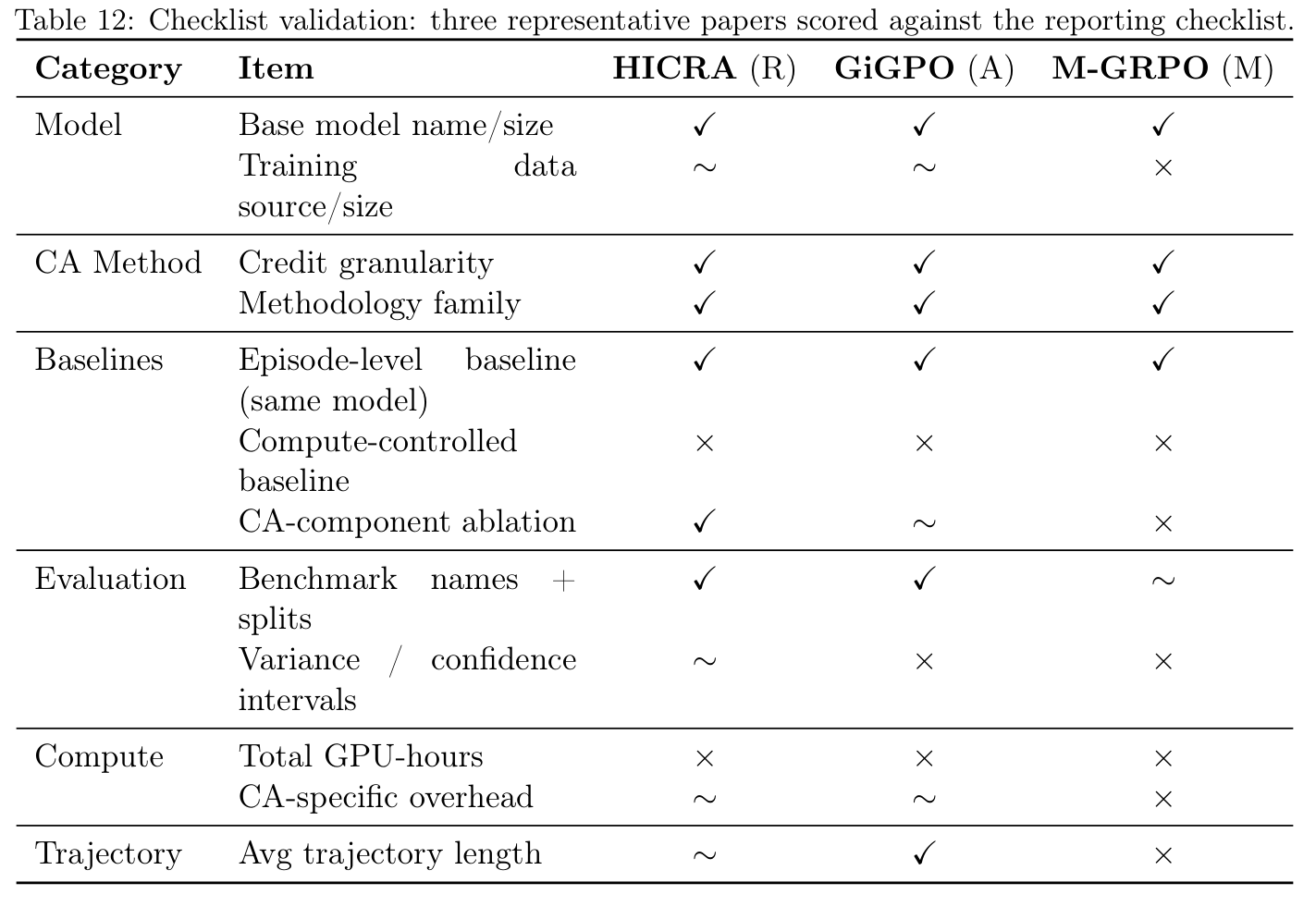
Table 12 解读:三篇代表论文普遍报告 base model、credit granularity、methodology family 和 episode-level baseline;但 compute-controlled baseline、variance / confidence intervals、total GPU-hours、CA-specific overhead 经常缺失。这个表支撑作者的一个重要批评:当前 CA 论文的结果表面上很多,但可比较性和可复现性不足。
5. Experimental Results (实验结果)
5.1 Quantitative results: reasoning RL
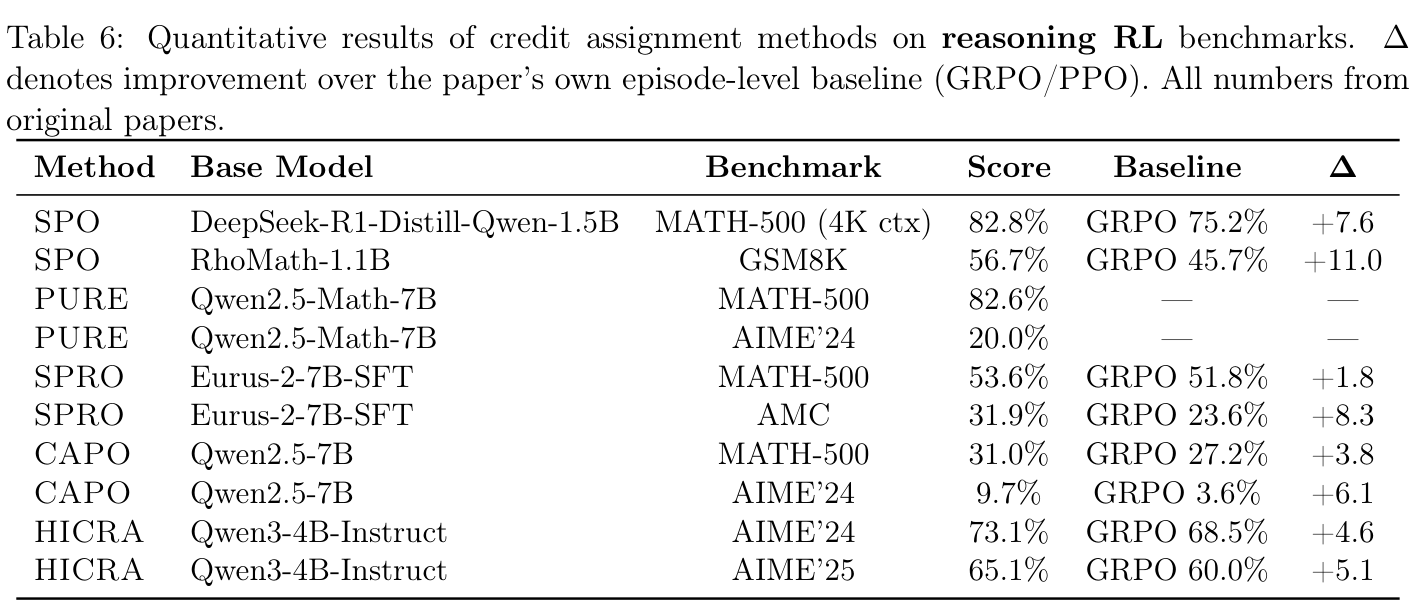
Table 6 解读:reasoning methods 在各自 baseline 上有稳定但不完全可比的提升。SPO 在 MATH-500 上从 GRPO 75.2% 到 82.8%(+7.6),在 GSM8K 上从 45.7% 到 56.7%(+11.0);SPRO 在 MATH-500 上 +1.8,在 AMC 上 +8.3;CAPO 在 MATH-500 上 +3.8,在 AIME’24 上 +6.1;HICRA 在 AIME’24 上从 68.5% 到 73.1%(+4.6),在 AIME’25 上从 60.0% 到 65.1%(+5.1)。PURE 报告 Qwen2.5-Math-7B 在 MATH-500 82.6%、AIME’24 20.0%,但表中没有同表 baseline。
5.2 Quantitative results: agentic RL
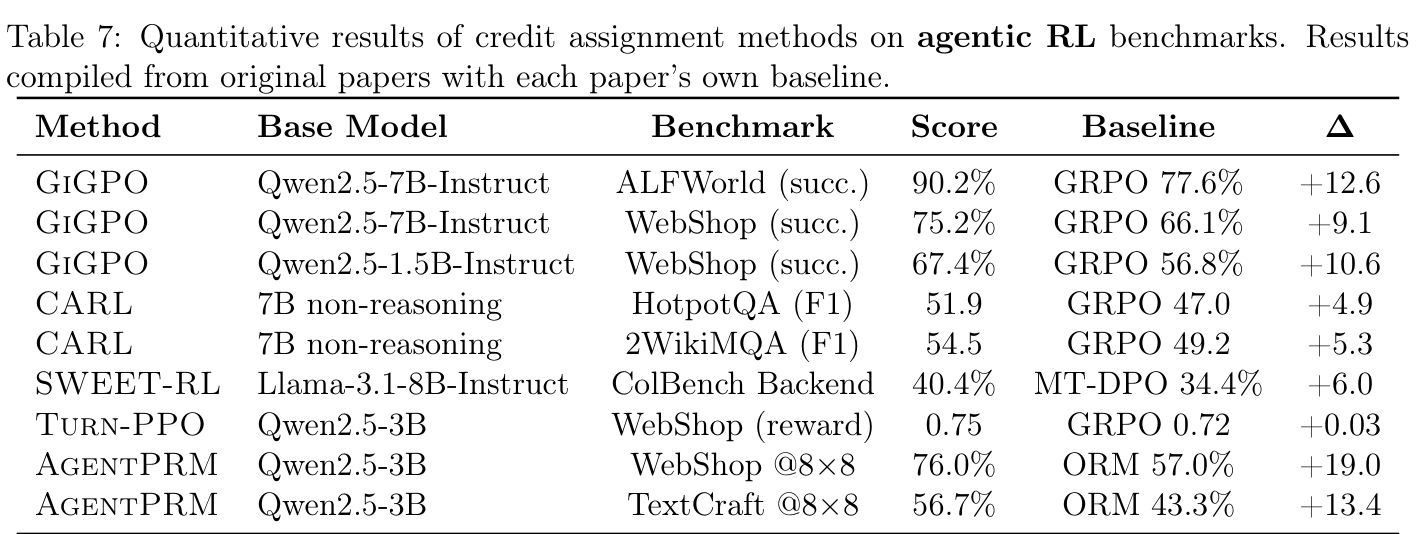
Table 7 解读:agentic subset 的相对提升更大但 confound 更多。GiGPO 在 ALFWorld success 上从 GRPO 77.6% 到 90.2%(+12.6),在 WebShop success 上分别 +9.1 和 +10.6;CARL 在 HotpotQA F1 上 +4.9,在 2WikiMQA F1 上 +5.3;SWEET-RL 在 ColBench Backend 上从 MT-DPO 34.4% 到 40.4%(+6.0);Turn-PPO 的 WebShop reward 从 0.72 到 0.75(+0.03);AgentPRM 在 WebShop @8×8 上从 ORM 57.0% 到 76.0%(+19.0),在 TextCraft @8×8 上从 43.3% 到 56.7%(+13.4)。作者把这些结果解读为“limited but suggestive”:在 GRPO-baseline methods 中,agentic subset mean 是 +8.5(),reasoning subset 是 +6.0();去掉 single outlier 后为 +7.5 vs. +4.5。
5.3 Ablation / synthesis findings
论文没有统一的 controlled ablation suite,而是跨论文抽取四个 trade-offs:
- Granularity vs. computational cost:token-level credit 更精确但更贵;VinePPO 需要 additional forward passes,SCAR/Shapley 需要组合评估。Turn-level methods 是 agentic RL 的 practical sweet spot。
- Forward estimation vs. hindsight analysis:PRM/VinePPO/AgentPRM 从当前状态估计 value;HCAPO/C3/CCPO 在 trajectory 后回看,信息更充分但有 latency 和 hindsight bias。
- Auxiliary model requirements:CARL/iStar/GiGPO 不需要辅助模型;SPA-RL 只需轻量 MLP;ArCHer/AgentPRM/PURE 需要 critic/PRM;CAPO/HCAPO/LLM-MCA 需要 LLM-scale evaluation。
- Reasoning-specific vs. agent-general:VinePPO/PURE/HICRA 利用了 deterministic transitions 和 verifiable steps;HCAPO/SWEET-RL/CARL/GiGPO 更少依赖这些 reasoning-only 假设。
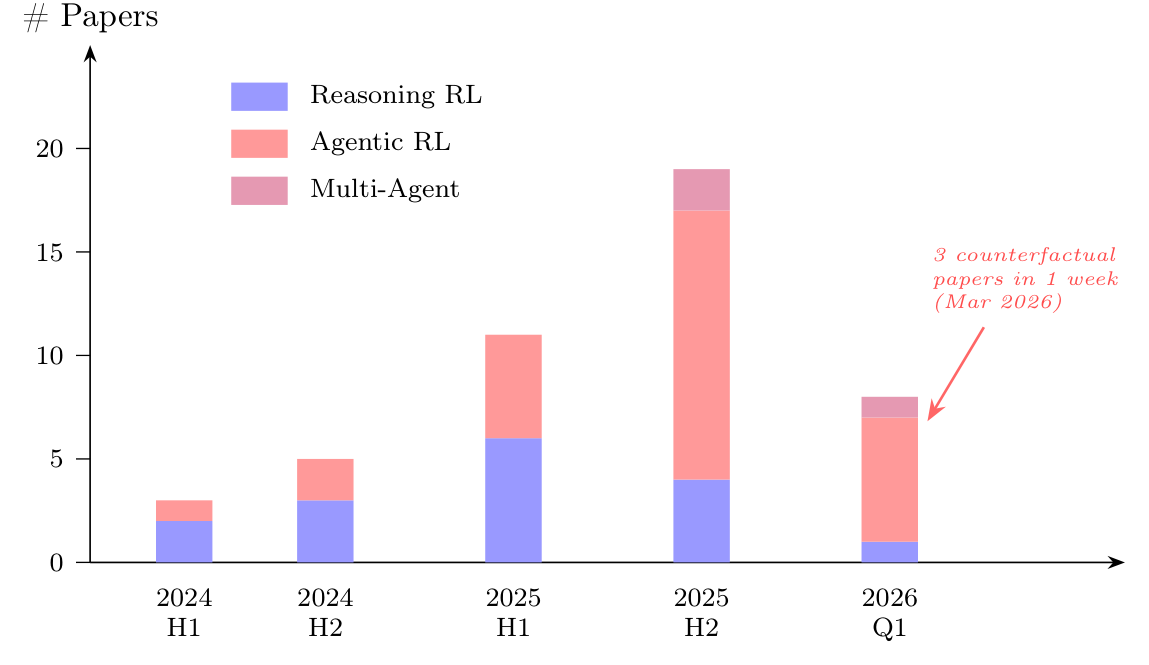
Figure 5 解读:2024 H1 以 reasoning papers 为主,2025 H2 agentic papers 明显上升,2026 Q1 已出现 multi-agent 与 counterfactual credit 热点。作者特别标注 March 2026 一周内出现 3 篇 counterfactual CA papers(HCAPO、C3、CCPO),把它视为 agentic credit assignment 正在形成 community convergence 的信号。
5.4 Limitations and Threats to Validity
作者明确列出五类 limitations / threats:多数论文仍是 arXiv preprints,方法和结果可能变化;搜索可能漏掉非索引 venue、industry reports 或 cutoff 后 concurrent preprints;表格中的 quantitative results 跨 base model、benchmark 和训练 recipe,不能当作 controlled comparison;taxonomy 边界有 judgment calls;所有 screening、classification、evidence-level coding 由单作者完成,有 single-coder limitation。
更实质的 open problems 包括:ultra-long horizon agents 已经达到 50—100+ turns / 100K—500K tokens,当前 5—30 turn method 可能不够;open-world agents 缺少 binary terminal reward;multi-agent 系统扩展到几十个 specialist 后,leave-one-out counterfactual 的 次评估不可扩展;credit assignment 与 exploration 仍缺少统一理论;给定固定 compute budget 时,到底应该多 rollout + 粗 credit,还是少 rollout + 精细 credit,尚无类似 scaling law 的答案。
5.5 Overall conclusion
论文的结论可以压缩为一句话:从 reasoning 到 agentic,credit assignment 从“如何让 sparse reward 更有用”变成“能否训练长程 agent 的基础设施问题”。Reasoning CA 已经在 PRM、critic-free group comparison、hierarchy-aware step credit 上趋于成熟;agentic CA 正在形成 hindsight/counterfactual、privileged critic、entropy-based critical action identification、turn-level MDP 等新范式;multi-agent CA 则刚进入活跃期,需要处理 communication credit、heterogeneous agent roles 和 scalable decomposition。