Efficient Agentic Reasoning Through Self-Regulated Simulative Planning
Paper: arXiv:2605.22138 Code: sailing-lab/sr2am Code reference:
main@6f4ac782(2026-05-21)
1. Motivation (研究动机)
这篇论文要解决的问题不是“让 LLM 想得更短”这么简单,而是:一个 Agent 应该如何决定什么时候规划、规划成什么结构、规划多远,然后什么时候停止规划并直接行动。现有 Agentic LLM 往往把 Agent 写成 reactive policy:每一步都生成 unconstrained Chain-of-Thought,再决定是否调用工具或给答案。这样做有三个具体问题:
- 规划没有显式结构:长期目标、当前 belief state、候选 action、future state prediction 都混在普通 CoT 里,外部很难分析哪一段是在模拟未来,哪一段只是局部推理。
- 规划没有调度机制:模型通常只能通过“多想一点 / 少想一点”隐式调节计算量,无法显式决定本 turn 是否需要 plan、是否沿用旧 plan、需要 1 步还是多步 horizon。
- token 成本不可控:论文指出,训练后的 agentic reasoning 很容易显著增加 reasoning token,但更长的 reasoning 并不保证更高准确率;在 web、table、science 等需要工具交互的任务中,这会直接拖慢推理并推高上下文溢出的风险。
作者把这个问题放在 long-horizon planning 的历史目标下理解:如果 planning 只是被期待“自然涌现”在 CoT 中,那么 Agent 没有真正的 internal agency 去管理自己的 planning process。解决它的价值在于:小模型可以通过结构化的 planning 和工具使用接近大模型系统的性能,同时把 reasoning token 增长限制在可控范围内。
更具体地说,论文认为现有方法缺少的是“可干预的中间层”。例如 ReAct / WebSailor 类方法虽然能边想边搜,但每一步为什么要搜、搜之前是否需要模拟多个 future states、已有 plan 是否已经失效,都没有显式变量;effort-adaptive 方法可以控制 thinking budget,却不控制 thinking 的语义类型;workflow distillation 可以蒸馏固定流程,但往往牺牲 free-form reasoning 的灵活性。SR²AM 试图把这些能力重新组合:保留自由推理,加入显式的 state-action-future-state plan,并让模型学会按 task uncertainty 和 progress 来调用 plan。
这个问题值得研究的另一个原因是 evaluation setting 本身很现实:math/science 可以靠内部推理,tabular analysis 需要 Python 或结构化计算,web information seeking 还要处理搜索、网页摘要、证据不完整和环境变化。一个统一 planner 如果能跨这四类任务工作,就说明 simulative planning 不只是某个 domain-specific workflow,而可能是 Agentic LLM 的通用 reasoning control mechanism。
2. Idea (核心思想)
核心 insight 是:把 Agent 的内部决策拆成 System I / II / III,而不是把所有计算都塞进一条 undifferentiated CoT。System I 做 reactive execution 和局部动作,System II 做 simulative reasoning,即通过 world model 预测未来 state,System III 做 self-regulation,即决定当前是否需要规划以及规划多深。
SR²AM 的关键创新是把“是否规划”和“规划 horizon”变成可学习、可观察的中间变量。它不是像 ReAct / WebSailor 那样让模型自由思考并调用工具,也不是像 mode routing 那样只在任务开头选模式;它在每一步都让 configurator 先判断,再让 planner 在需要时生成 state-action-future-state 结构,最后由 actor 执行工具或输出答案。
和已有方法的差异可以概括为:unregulated deliberation 只有 System I 的长 CoT;workflow distillation / mode routing 只有部分 regulation;一些 world-model 方法会强制每步 simulation。SR²AM 的目标是同时具备三点:free-form reasoning、可选择的 simulative planning、以及可学习的 planning 调度。
一个有用的直觉是:SR²AM 不是把 CoT 改写成 rigid planner,而是在 CoT 内部插入“自我管理协议”。当任务简单或已有 plan 足够时,System III 可以让模型直接执行,避免无谓展开;当 observation 表明当前 state 有歧义或下一步 action 会影响后续搜索空间时,它让 System II 先写出可能 action 与 future state。这样,planning 不再是 token 越多越好,而是只有在能减少未来不确定性、发现潜在错误或保持长期目标一致时才值得花费。
v0.1 和 v1.0 的区别也体现了这篇论文的核心路线:v0.1 用外部分工模块“演示”三系统分解可以工作;v1.0 则从强 reasoning LLM 的 traces 中反向重建 planner/configurator 标注,让结构化规划可以被 SFT 和 RL 学进单个模型里。也就是说,最终目标不是部署一个多模块 pipeline,而是训练一个能在单条 reasoning stream 中自我调节的 Agentic LLM。
3. Method (方法)
3.1 Overall framework:System I + II + III
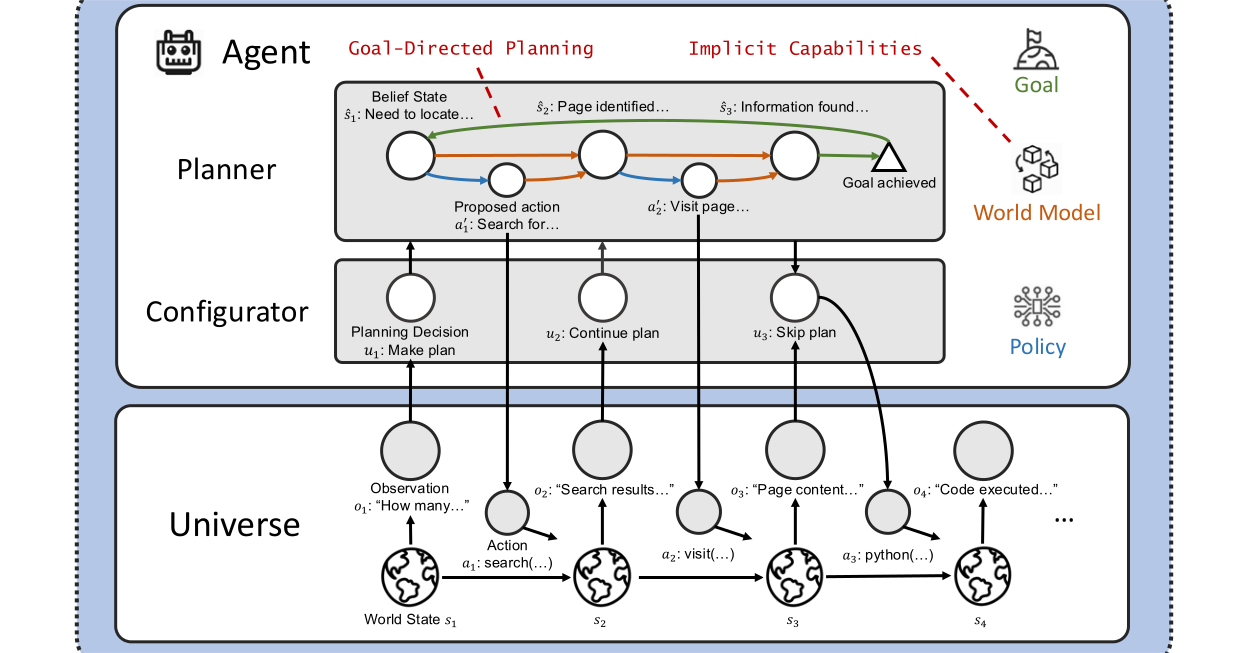
Figure 1 解读:图中把一次 web information-seeking trajectory 拆成三层。Configurator(System III)先读当前 observation / history,决定是跳过 planning、继续旧 plan,还是启动新的 simulative plan;Planner(System II)在需要时写出当前 state、下一步 action、以及预期 future state;Actor(System I)再执行 search / visit / Python / final answer。这个图的重点不是工具本身,而是每个 turn 都有一个可学习的“规划开关”和“规划深度”。
形式化上,智能体无法直接访问真实 state ,只能从 observation 形成 belief state 。如果有 world model ,理想的 simulative planner 可以近似求: 实际中精确优化不可行,因此 planner 输出一个结构化 plan: 传统 reactive CoT 可以写成: 其中 是不受约束的 latent deliberation。SR²AM 则把 action distribution 拆成三段: 这里 是 configurator 的 planning decision, 是 planner 生成的 plan, 是执行具体 tool call / final answer 的 actor。这个分解让“规划是否发生”和“规划内容”都能被监督数据和 RL 单独塑形。
3.2 Environment and tools
每个时间步 ,模型接收 observation ,其中包含之前的 reasoning context、action、tool outputs。它最多执行 个 actions,最后根据 trajectory 和 final answer 计算 reward。论文使用三个工具:
web_search:通过 SerpAPI(默认)或 Serper.dev 做批量 web search。visit_tool:访问网页并用 LLM summarizer 总结页面内容;released code 默认把网页截断到 28K tokens,并使用 OpenAI-compatible summarizer endpoint。python_repl_tool:通过 SandboxFusion 执行 stateless Python,用于计算、表格处理或数据分析。
released code 中这些工具位于 tools/websailor_tools_fast.py。主循环在 agent_base.py::generate_response_agent:它把 user question 放入 messages,循环调用 model,解析 tool calls,执行工具,再把 tool result 追加回 messages,直到模型完成或达到 max_turns。
3.3 Supervised data construction v0.1:Multi-Module Inference
v0.1 是 feasibility 版本。作者用 prompted LLM modules 显式实现 configurator 和 planner ,再加上一些辅助模块,例如 belief formation、user intent interpretation、problem solving。Configurator 可以自由调用这些模块:如果还需要 planning,就调用相应能力;如果 planning 完成,就选择下一步 action。
具体细节:v0.1 主要用 o4-mini 收集 traces;每条 trajectory 最多 actions,最多 retry 3 次直到得到 final answer;之后按 answer correctness 和 minimum reasoning complexity 过滤。Web tasks 还额外用 GPT-4.1 补充 configurator reasoning,使 action selection 前的状态解释更充分。这个版本最后得到 4,845 条 supervised examples,共 20.7M tokens。
3.4 Supervised data construction v1.0:Plan Reconstruction
v1.0 是论文的主版本,避免每次都跑复杂 multi-module prompted system。作者先用 DeepSeek-V3.2 生成 thinking-acting trajectories:
再让 annotator LLM 从整条 trace 中重建每一步的 configurator decision 和 planner content。对每个 step ,annotator 先输出:
表示是否需要 planning。如果 ,则输出结构化 plan:
其中 是 planning-relevant condition, 是 proposed action, 是 predicted future state。一个 planning step 可以覆盖多个 real-time tool steps,也可以只覆盖一个 step 的一部分,所以 horizon 是可层级化的。Web-browsing 问题因为环境不确定性高,训练数据中把 plan 截断到最多 2 steps。
Appendix C 给出的 v1.0 collection 设置是:DeepSeek-V3.2 thinking mode,128K context, steps,最多 retry 5 次直到正确;plan annotation 也用 DeepSeek-V3.2 thinking mode,在整条 trajectory 上 single-pass 完成。v1.0 在 v0.1 数据基础上加入 MegaScience、WebDancer、WebShaper、TaskCraft、ASearcherLRM35k 等数据,最终得到 10,787 条 supervised examples,共 39.5M tokens。
3.5 Reinforcement learning refinement
SFT 之后,作者用 RL 让三套系统围绕 task success 协同。对任务 ,agent 生成 trajectory: Reward 是三个 binary signals 的 piecewise 组合:answer correctness、trajectory structure compliance、final-answer format compliance。 这些 reward values 在所有实验中固定,没有调参。优化目标是 adapted GRPO:对每个 initial observation 采样 条 trajectories,用 group-level z-score reward 得到 token-level advantage: 最终最大化 asymmetric clipping 的 surrogate objective: 作者强调所有 model updates 保持 on-policy;对 30B 及以上模型,会过滤掉因 truncation 终止的 trajectories,避免 malformed negatives 破坏格式学习。
3.6 Data filtering and training hyperparameters
RL 数据使用 difficulty-based filtering:用 pre-RL checkpoint 对问题 rollout 次,仅保留 Pass@ 的题目,使 sampled trajectories 产生非零 advantage。对 web-heavy 任务,则用强 instruct LLM 采样 个答案,用 Pass@ 近似筛掉太容易的问题。
- SR²AM-v0.1-8B:base model 是
Qwen3-8B;SFT 用 Axolotl / FSDP,global batch size 32,max context 32,768,Adam lr ,warmup ratio 0.1,cosine decay 到 ,weight decay 0.01,4 epochs。RL 用 Slime,rollout batch size 128,每 prompt 8 samples,max response 8,192,max context 40,960,temperature 0.8,max 40 action steps,,,Adam constant lr ,weight decay 0.1,400 steps / 51.2K examples。SFT 用 8 Hopper GPUs 约 3 小时,RL 用 32 Hopper GPUs 约 3.3 天。 - SR²AM-v1.0-30B:base model 是
Qwen3-30B-A3B-Thinking-2507;SFT 用 ms-swift / Megatron,global batch size 32,max context 131,072,sample packing,MoE auxiliary loss 0.01,Adam lr ,warmup fraction 0.05,cosine decay 到 ,weight decay 0.01,4 epochs。RL 与 v0.1 同一 GRPO 配置,但 max response 16,384,max context 122,880,temperature 1.0,top-p 0.95,max 100 tool steps;训练 200 steps / 25.6K examples,其中前 160 steps 后用 intermediate checkpoint 重新过滤数据,剩下 40 steps 用更匹配当前能力的难题。SFT 用 32 Hopper GPUs 约 1.5 小时,RL 约 6 天。 - released code 对训练配置的覆盖:
sailing-lab/sr2am当前 commit 主要发布 inference / evaluation / reproduction scripts,没有 SFT、plan reconstruction annotation、GRPO training launch config。因此上面训练超参来自论文 Appendix E.3;released code 可验证的是 inference/evaluation 配置,例如scripts/run_inference_local.sh对 8B 默认max_turns=50, temperature=0.8, context=40960,对 30B 默认max_turns=100, temperature=1.0, context=131072,并统一max_completion_tokens=16384。
3.7 Code-grounded pseudocode
下面伪代码只覆盖 released implementation 中可运行的 inference / evaluation 部分;训练与 annotation pipeline 在当前 public repo 中未发布。
async def sr2am_tool_loop(client, model, question, tools, system_prompt, max_turns):
    instance_id = None
    for tool in tools.values():
        instance_id = await tool.create(instance_id=instance_id)

    messages = [{"role": "system", "content": system_prompt},
                {"role": "user", "content": question}]
    cumulative_reward = 0.0

    for _ in range(max_turns):
        response = await client.chat.completions.create(
            model=model,
            messages=messages,
            tools=[tool.get_openai_tool_schema().model_dump() for tool in tools.values()],
            max_completion_tokens=16384,
        )
        assistant = response.choices[0].message.model_dump()
        messages.append(assistant)

        tool_calls = assistant.get("tool_calls")
        if not tool_calls:
            break

        for call in tool_calls:
            fn_name = call["function"]["name"]
            fn_args = json.loads(call["function"]["arguments"])
            result, reward, metrics = await tools[fn_name].execute(
                instance_id=instance_id,
                parameters=fn_args,
            )
            cumulative_reward += reward
            messages.append({
                "role": "tool",
                "content": result,
                "reward": reward,
                "metrics": metrics,
                "tool_call_id": call["id"],
            })

        if cumulative_reward <= -0.5:
            break

    for tool in tools.values():
        await tool.release(instance_id=instance_id)
    return messages, messages[-1].get("content", "")
async def filtering_eval_question(question, row, run_agent, judge_answer, num_retries):
results, num_corrects, num_wrongs = [], 0, 0
for rep_idx in range(num_retries):
messages, answer = await run_agent(question)
judge = await judge_answer(row, answer)
correct = judge["score"] == 1.0
results.append({
"question": question,
"messages": messages,
"answer": answer,
"correct": correct,
"judge_result": judge,
"rep_idx": rep_idx,
})
num_corrects += int(correct)
num_wrongs += int(not correct)
if num_corrects > 0 and num_wrongs > 0:
break
return resultsdef build_agent_system_prompt(dataset, fix_datetime=False):
if fix_datetime:
current_time = "Sun Aug 31 2025 23:34:17"
else:
current_time = datetime.now().strftime("%a %b %d %Y %H:%M:%S %z")
base = (
f"CURRENT_TIME: {current_time}\n"
"You are K2-Researcher, a reasoning assistant with the ability "
"to perform web searches, browse web pages, and execute Python code."
)
return base + "\n\nYou should follow the answer format described in the question."def count_reasoning_tokens(output_rows, tokenizer, source="think"):
total = 0
for row in output_rows:
for message in row["messages"]:
if message.get("role") != "assistant":
continue
text = extract_assistant_text(message, source=source)
if "</think>" in text:
text = text.split("</think>", 1)[0]
else:
text = ""
total += len(tokenizer.encode(text))
return total论文中的 v1.0 plan reconstruction 与 GRPO update 可以概念化为下面两段,但它们不是当前 released repo 的可运行代码:
def reconstruct_self_regulated_trace(trajectory, annotator_llm, max_web_horizon=2):
    annotated_steps = []
    previous_plans = []
    for step in trajectory.steps:
        need_plan = annotator_llm.predict_planning_decision(
            full_trajectory=trajectory,
            current_step=step,
            previous_plans=previous_plans,
        )
        if need_plan:
            plan = annotator_llm.reconstruct_plan(
                full_trajectory=trajectory,
                current_step=step,
                previous_plans=previous_plans,
            )
            if trajectory.is_web_task:
                plan = plan.truncate(horizon=max_web_horizon)
        else:
            plan = None
        annotated_steps.append((step.free_form_reasoning, need_plan, plan, step.action))
        previous_plans.append(plan)
    return annotated_steps
def grpo_update(policy, prompts, reward_fn, eps_low=0.2, eps_high=0.28, group_size=8):
trajectories = [policy.rollout(prompt) for prompt in prompts for _ in range(group_size)]
rewards = torch.tensor([reward_fn(tau) for tau in trajectories])
grouped = rewards.view(len(prompts), group_size)
advantages = (grouped - grouped.mean(dim=1, keepdim=True)) / grouped.std(dim=1, keepdim=True)
loss = 0.0
for tau, adv in zip(trajectories, advantages.flatten()):
ratio = torch.exp(policy.logprob(tau) - policy.old_logprob(tau))
clipped = torch.clamp(ratio, 1 - eps_low, 1 + eps_high)
loss -= torch.min(ratio * adv, clipped * adv).mean()
loss.backward()
policy.optimizer.step()3.8 Code-to-paper mapping
Code reference:
main@6f4ac782(2026-05-21) — pseudocode and mapping based on this commit
| Paper Concept | Source File | Key Class/Function |
|---|---|---|
| Public implementation repo | README.md | Model download, tool setup, paper reproduction commands, 8219-row evaluation set |
| Website/project repo pointer | sailing-lab/sr2am-self-regulated-planning/README.md | Points from project page repo to implementation repo sailing-lab/sr2am |
| Agent multi-turn loop | agent_base.py | Agent, generate_response_agent, process_questions, process_single_question |
| Thinking-mode model wrapper | run_agent.py | VLLMModelThinkAgent, VLLMModelConfiguratorAgent, VLLMModelInstructAgent |
| Inference CLI and tool wiring | run_agent.py | --agent_type, --max_turns, --max_completion_tokens, TOOL_CFGS, TOOL_CLS |
| Reproduction defaults | scripts/run_inference_local.sh | 8B/30B defaults for TP/DP, context length, max turns, temperature |
| System prompt / fixed time | system_prompts.py | AGENT_SYSTEM_PROMPT, FIXED_DATETIME, get_agent_system_prompt |
| Web search / browser / Python sandbox tools | tools/websailor_tools_fast.py | WebSailorMiroflowMultiWebSearchToolFast, WebSailorMultiVisitToolFast, SandboxFusionCodeTool |
| Full benchmark builder | evaluation/prepare_test_data.py | create_test_dataset_full, dataset loaders, repeat schedule |
| Scoring / pass rate | evaluation/compute_rep_results.py, evaluation/run_judge_results.py | Pass@K aggregation, post-hoc judging |
| Reasoning-token accounting | avg_tokens_before_think_close.py | THINK_CLOSE, configurator/reasoning text extraction, per-dataset breakdown |
论文公式与 released code 实现差异:当前 released code 没有发布 SFT data construction、plan reconstruction annotator、GRPO/Slime training loop 或 Axolotl/ms-swift launch configs;它主要覆盖 inference/evaluation harness。因此,训练超参不能从 released launch config 复核,note 中的训练数值以论文 Appendix E.3 为准;code-grounded 部分只锚定可运行的 inference/evaluation path。
4. Experimental Setup (实验设置)
4.1 Benchmarks and scale
论文评测 11 个 benchmark,分成四类。released reproduction script evaluation/prepare_test_data.py 会构建 8219 rows 的 full test set;为了降低方差,AIME-24/AIME-25 重复 ,GPQA-Diamond/GAIA/XBench-DeepSearch 重复 ,其他 benchmark 重复 。
| Category | Benchmarks | Scale / source stated in paper or code |
|---|---|---|
| Math | AIME-24, AIME-25, MATH-500 | AIME 源文件为 *_repeated_8x_240.parquet,builder 去重后再 ;MATH-500 为 500 题 |
| Science | GPQA-Diamond, SuperGPQA, HLE | GPQA-Diamond 源文件 198 题并 ;SuperGPQA 源文件 1K;HLE 用 500-question subset |
| Tabular | FinQA, MultiHier | FinQA 源文件约 1.1K;MultiHier 源文件 336 |
| Web | BrowseComp, GAIA-103, XBench-DeepSearch | BrowseComp 用 AFM browsecomp.json;GAIA 为 103 题并 ;XBench-DeepSearch 用 decrypted CSV 并 |
4.2 Baselines
Baselines 分三组:
- Reference Systems:pretrained LLMs,不做 agentic training。包括 text-only reasoning LLMs(GPT-5.4-xhigh、DeepSeek-V3.2、K2-Think-V2-high、Qwen3-30B-A3B-Thinking-2507)和同一 tool harness 下的 pretrained LLMs + Tools(GPT-5.4-xhigh、Kimi-K2.5、DeepSeek-V3.2、GLM-4.6、GPT-OSS-120B-high、Qwen3-8B/30B/235B 等)。
- Unregulated Deliberation:训练成自由 CoT + tool interaction 的 agentic LLMs,包括 Tongyi-DeepResearch、MiroThinker-v1.5-30B、WebSailor-7B/32B、ASearcher-Web、SimpleTIR、WebExplorer-8B。
- Partially-Regulated Deliberation:只实现部分 System I+II+III 分解的系统,包括 Mode Routing 的 A²FM,以及 Workflow Distillation 的 AFM-Web-7B-RL / AFM-Code-7B-RL。
4.3 Metrics and inference config
主指标是 overall Pass@1,按 11 个 datasets 的 Pass@1 做 unweighted average;可用时也报告 Pass@3。效率指标是 average reasoning tokens per trajectory,released code 用 avg_tokens_before_think_close.py 统计 </think> 之前的 assistant reasoning tokens,或从 Responses API usage 中读取 reasoning token counts。
论文 reproduction 使用 SerpAPI 作为默认 search provider,并固定 system prompt datetime 为 Sun Aug 31 2025 23:34:17。Released README 中 30B reproduction 使用 SR2AM-v1.0-30B、8 GPUs(TP=4, DP=2)、--fix_datetime、--code_concurrency 128、--visit_concurrency 64、--search_concurrency 128、--shuffle_questions;8B reproduction 使用 8 GPUs(TP=1, DP=8)。run_inference_local.sh 默认 8B 为 temperature=0.8, max_turns=50, context=40960,30B 为 temperature=1.0, max_turns=100, context=131072,两者默认 max_completion_tokens=16384。
5. Experimental Results (实验结果)
5.1 Main performance and reasoning efficiency
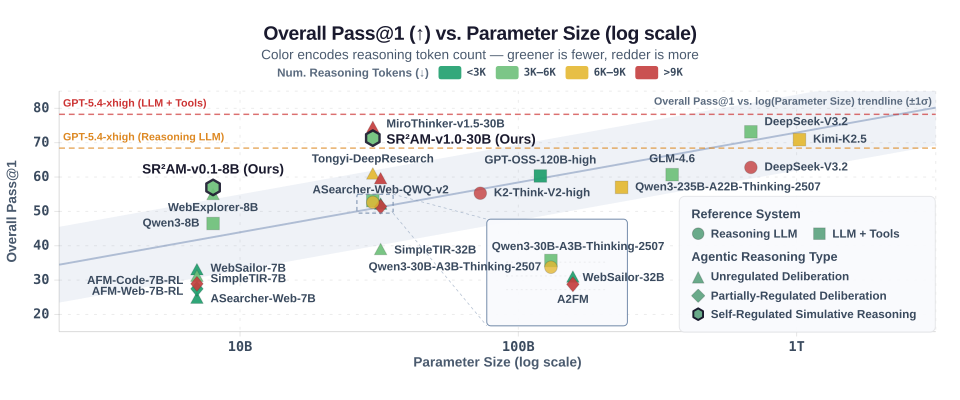
Figure 2 解读:横轴是 parameter size(log scale),纵轴是 overall Pass@1,颜色表示 reasoning token 数。SR²AM-v0.1-8B 在 8B 规模上达到 57.0 overall Pass@1;SR²AM-v1.0-30B 达到 71.3,接近或竞争于更大模型的 tool-use 系统。图的核心证据是:SR²AM 的点在性能-规模趋势上方,同时颜色没有像许多 unregulated agent 那样变红,说明它没有靠无限拉长 reasoning trace 换准确率。
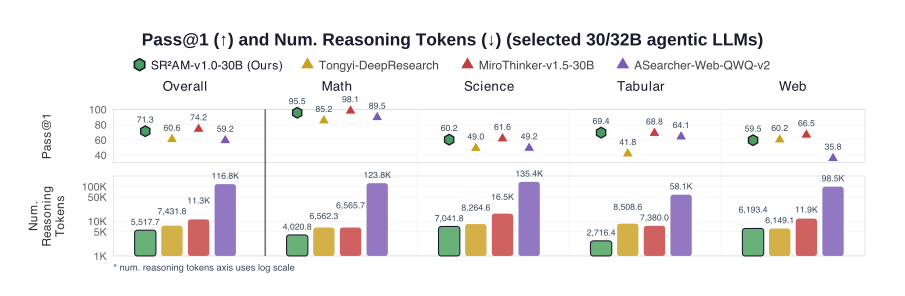
Figure 3 解读:点表示 Pass@1,柱表示 average reasoning tokens(log scale),按 task category 分解 30/32B agentic LLMs。SR²AM-v1.0-30B 在 overall Pass@1 71.3 的同时只用 5,517.7 reasoning tokens;相比 MiroThinker-v1.5-30B 的 11,295.2 tokens,token 少 51.2%,但 Pass@1 仍然接近(71.3 vs. 74.2)。论文总结为:在 overall Pass@1 ≥ 60 的强 30/32B agentic baselines 中,SR²AM-v1.0-30B 少用 25.8–95.3% reasoning tokens。
| Model | Size | Reasoning Tokens | Overall Pass@1 | Comment |
|---|---|---|---|---|
| Qwen3-30B-A3B + Tools | 30B | 5,410.1 | 53.1 | 同 tool harness,无 agentic training |
| A2FM | 32B | 23,424.8 | 51.4 | Mode Routing,partially regulated |
| MiroThinker-v1.5 | 30B | 11,295.2 | 74.2 | 最强 30B unregulated baseline 之一 |
| DeepSeek-V3.2 + Tools | 685B | 3,011.5 | 73.2 | 大模型 reference system |
| Kimi-K2.5 + Tools | 1024B | 6,413.1 | 70.9 | 1T 级 reference system |
| SR²AM-v0.1-8B | 8B | 3,697.6 | 57.0 | 8B feasibility version |
| SR²AM-v1.0-30B | 30B | 5,517.7 | 71.3 | 主方法,性能接近大模型 / 强 30B baseline,token 更少 |
SR²AM-v1.0-30B 的 per-benchmark Pass@1 是:AIME-24 96.2,AIME-25 91.1,MATH-500 99.2,GPQA-Diamond 77.3,SuperGPQA 73.0,HLE 30.4,FinQA 73.4,MultiHier 65.5,BrowseComp 22.5,GAIA 76.0,XBench-DeepSearch 80.0。SR²AM-v0.1-8B 则是:83.8,74.2,96.2,60.9,58.0,14.2,73.6,64.6,4.8,46.1,50.5。
5.2 Component ablation
| Configuration | # Reasoning Tokens | Pass@1 | Pass@3 |
|---|---|---|---|
| SR²AM-v1.0-30B (SFT) | 4,925 | 66.6 | 79.4 |
| − Free-form Reasoning (System I) | 1,188 | 46.8 | 66.1 |
| − Simulative Planning (System II) | 4,602 | 65.2 | 78.5 |
| − Selective Planning (System III) | 5,451 | 65.2 | 78.8 |
| − Plan Horizon Control (System III) | 4,829 | 65.3 | 77.3 |
| Original Teacher CoT (SFT) | 3,844 | 65.3 | 78.5 |
| SR²AM-v1.0-30B (SFT + RL) | 5,414 | 72.8 | 82.4 |
Ablation 的最重要结论是:System I 的 free-form reasoning 不能去掉,去掉后 Pass@1 从 66.6 掉到 46.8;这说明结构化 plan 不是要替代所有 CoT,而是作为可调度的 planning scaffold。System II / III 的 ablation 单项下降看似较小(66.6 → 65.2/65.3),但完整分解比 original teacher CoT SFT 更好(66.6 vs. 65.3),并且提供了更适合 RL 的 substrate,RL 后升到 72.8。
5.3 RL changes planning horizon, not planning frequency
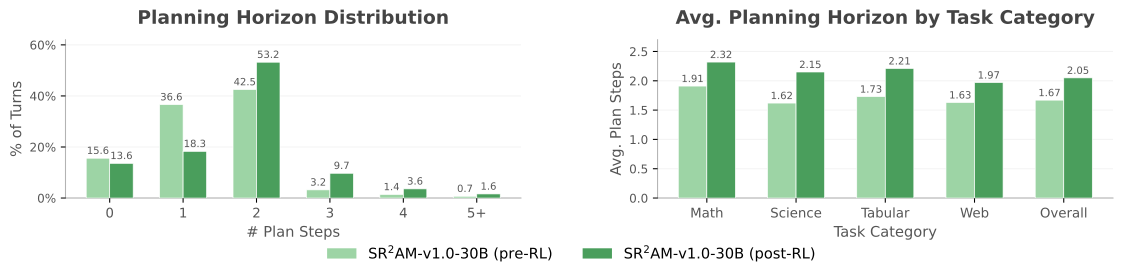
Figure 4 解读:左图比较 RL 前后 planning horizon 分布:2-step 和 3+-step plans 的占比从 5.3% 增到 14.9%,而 unplanned turns 基本稳定(15.6% → 13.6%)。右图按 task category 展示 average plan horizon 的变化:science 增幅最大(32.7%),web 增幅最小(20.9%),符合 web 环境不确定性更高、可安全规划 horizon 更短的直觉。关键不是“更频繁规划”,而是“当决定规划时规划得更远”。
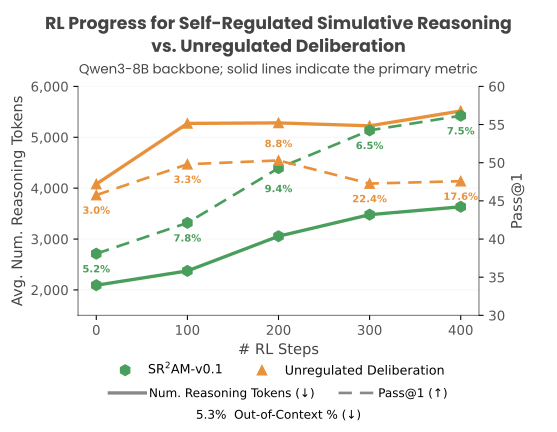
Figure 5 解读:v0.1 上的 400-step RL 对比显示,unregulated deliberation 的 token 从约 4,100 持续增加,但 pass rate 在 step 200 后反而下降,并伴随 22.4% context overflow;SR²AM-v0.1-8B 的 token 从约 2,100 增到 3,600,仍然稳定更低,且 step 400 时 reasoning tokens 少 34.1%,Pass@1 更高(56.2 vs. 47.6)。这支持作者关于“RL 优化 planning quality,而不是只奖励更长 CoT”的解释。
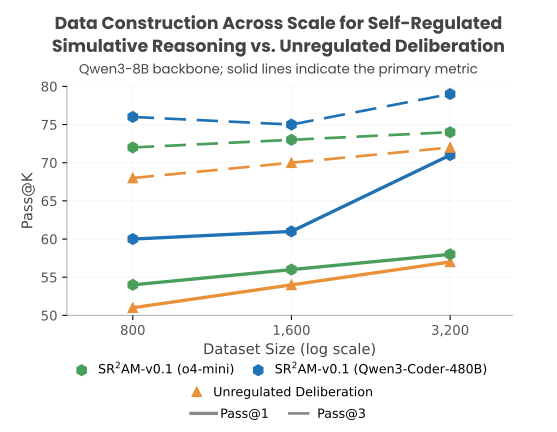
Figure 6 解读:在 Qwen3-8B 上比较不同 SFT 数据构造方式。相同 teacher LLM(o4-mini)下,SR²AM 的 structured System I+II+III data 在 800–3,200 examples 的所有规模上都优于 unregulated reasoning reconstruction:Pass@1 高 1.2–3.5%,Pass@3 高 1.5–3.4%。当 teacher 换成 Qwen3-Coder-480B-A35B-Instruct,数据规模从 1,600 到 3,200 时 Pass@1 从 60.9 升到 72.9,说明结构化分解能随数据质量和 teacher 能力放大。
5.4 Limitations and takeaways
作者明确给出三类限制。第一,实验只覆盖 language-based interactive reasoning,尚未验证 embodied 或 multi-agent 场景;后者有更复杂的 state representations 和 coordination constraints。第二,SR²AM 把 LLM 当作 language-space world model,这在物理世界和社会互动中的 predictive power 可能不足;未来需要 multimodal world model 来预测 perceptual next states。第三,论文主要评估整体 task accuracy 和 reasoning efficiency,还没有单独评估 configurator 的 planning-decision accuracy 或 world-model future-state prediction accuracy。
整体结论是:SR²AM 证明了“Agent 不一定要通过更长 CoT 获得更强能力”。把 reactive execution、simulative planning、self-regulation 拆开后,RL 学到的是更深的 planning horizon 和更好的 planning usage,而不是简单增加 token。当前 released code 已足够复现 inference/evaluation path,但训练与 annotation pipeline 尚未开源,因此工程复现仍依赖论文 Appendix 中的超参描述。