CopT: Contrastive On-Policy Thinking with Continuous Spaces for General and Agentic Reasoning
Paper: arXiv:2605.20075 Code: sdc17/CopT Code reference:
main@343713a8(2026-05-21)
1. Motivation (研究动机)
现有 Chain-of-Thought (CoT) 推理默认遵循“先完整思考、再输出答案”的顺序。这个范式在数学、代码和 agentic reasoning 上有效,但也带来一个很具体的低效:模型经常已经内部确定了一个 plausibly correct answer,却仍然继续生成很长的显式 reasoning trace;论文把这类现象称为 performative reasoning。它的问题不是 CoT 不会推理,而是 CoT 把“思考”当成回答的必要前置步骤,导致两类浪费:一是用户必须等待完整 reasoning trace 结束才能看到答案;二是简单样本也消耗大量 token。
这篇论文要解决的目标是:在不训练模型、不改变权重的前提下,让 LLM 先给出 draft answer,再只在 draft 不可靠时触发后续 on-policy thinking 来反思和修正。这样既保留 explicit reasoning 的可读性,又避免对所有样本一刀切地执行长 CoT。
这个问题值得研究的原因在于推理型模型的成本瓶颈已经从“是否能生成 reasoning”转向“是否能把 reasoning 用在真正需要的样本上”。如果可以可靠判断 draft answer 是否足够可信,就能把 token budget 从容易样本转移到困难样本;如果还可以控制 draft answer 在后续思考中的可见性,就能利用其中的局部信息,同时降低错误 draft 误导后续推理的风险。这对数学、代码、函数调用和多轮工具交互尤其重要,因为这些任务既需要准确性,也需要延迟和 token 成本可控。
2. Idea (核心思想)
CopT 的核心 insight 是:continuous embeddings 不一定要像 latent CoT 那样直接拿来“生成”隐式思考,它们也可以被当作 inference-time verifier。具体做法是对同一串已生成 token,比较模型在 discrete-token prefix 下和 continuous-embedding prefix 下对这些 token 的支持度;两者差异越大,说明连续空间保留的不确定性越会改变模型对当前回答/思考片段的信心。
方法上,CopT 先强制模型跳过 <think> 直接生成 draft answer,然后用 sequence-level reverse KL estimator 判断 draft 是否可靠;若不可靠,再触发 <think>,进行 conditioned on draft 的 on-policy thinking,并在每个 chunk 结束后用另一个 estimator 决定下一段思考是否能看见 draft answer。
与 Soft-Thinking、SwiReasoning 等 training-free continuous reasoning 方法的根本差异是:后者主要把 continuous embeddings 当作 generation medium,牺牲或弱化显式可读 trace;CopT 则保持输出仍是 explicit natural-language/code reasoning,只把 continuous embeddings 用作 contrastive verifier 和 visibility controller。因此 CopT 的目标不是把思考隐藏在连续空间里,而是在显式思考外面加一个“是否需要思考、以及思考时是否应该参考 draft”的控制层。
3. Method (方法)
3.1 Overall framework: answer-first + contrastive verification
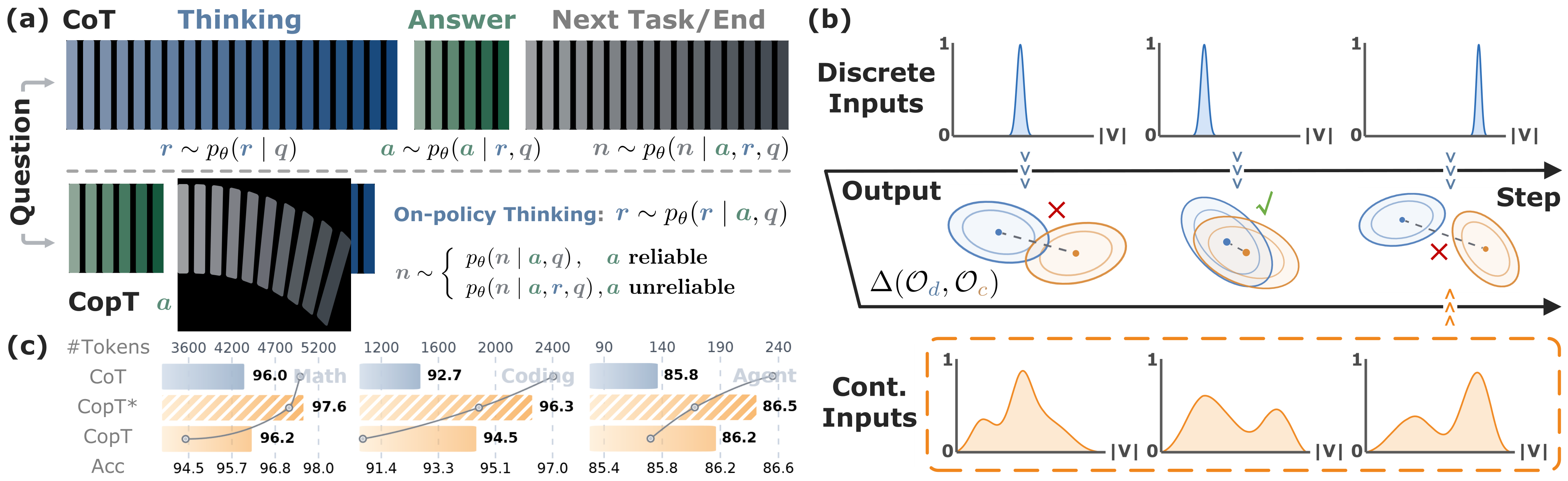
Figure 1 解读:Figure 1a 对比了标准 CoT 和 CopT 的执行顺序:CoT 先 thinking 再 answer,而 CopT 先产出 draft answer,再根据 verifier 决定是否进入 on-policy thinking。Figure 1b 展示了 contrastive verifier 的关键:同一组输出 token 会分别在 discrete inputs 与 continuous inputs 下被打分,分布差异就是 reliability signal。Figure 1c 给出直观 trade-off:CopT 在 matched 或更少 token 下提高 peak accuracy;绿色星号对应 increasing reasoning effort 的设置。
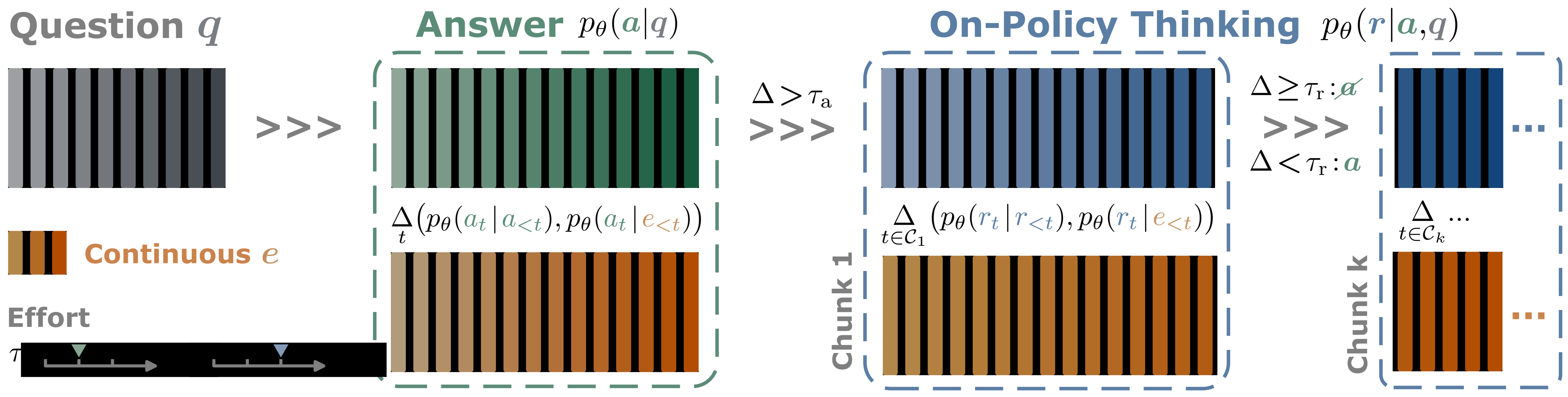
Figure 2 解读:Figure 2 是完整 pipeline。左侧 draft-answer stage 中,模型被强制先输出 </think>,直接进入 answer mode;生成每个 draft token 时同时缓存 chosen-token log-probability 与由 next-token distribution 加权得到的 continuous embedding。中间的 用这些缓存比较 discrete prefix 与 continuous prefix 下的 token support,若 就直接接受 draft;若 ,右侧进入 on-policy thinking。on-policy thinking 被切成多个 chunk,每个 chunk 结束后用 判断当前思考是否稳定,并更新下一 chunk 中 draft answer 的 visibility mask 。
直觉上,CopT 把“是否应该继续思考”转化为一个 token-support stability 问题。如果 draft answer 是模型在不确定状态下偶然采样出来的,那么把历史 token 替换成 continuous embeddings 后,模型对同一 answer token 的支持度会发生明显变化;反过来,如果 continuous prefix 和 discrete prefix 都支持这串 answer token,则 draft 更可能已经足够可靠。后续 thinking 阶段同理:如果当前 chunk 在 continuous contrast 下不稳定,就暂时隐藏 draft,避免错误 answer anchoring;如果 chunk 稳定,则允许 draft 重新可见,利用其中可能正确的部分信息。
3.2 Draft-answer elicitation
设模型为 ,输入 embedding matrix 为 。给定问题 token 序列 ,CopT 不让模型先生成完整 CoT,而是在开头强制输出 </think>,直接进入 answering mode。draft answer 记为:
生成 draft 的每个 token 时,CopT 缓存两类量:
其中 是实际采样 token 的概率, 是按完整 next-token distribution 加权的 continuous embedding。这个 保留了“模型本来还在考虑哪些 token”的不确定性,而不只保留最终采样出来的 token。
3.3 Draft reliability estimator
draft 结束后,CopT 用 continuous prefix 重新 teacher-force 同一组 answer token。对每个位置:
sequence-level reverse KL estimator 定义为:
对固定 draft length ,论文证明它是下面 normalized sequence-level reverse KL 的 unbiased estimator:
若 ,说明 answer token 在 continuous uncertainty 下不再被同样支持,draft 可能不可靠,于是 CopT 强制模型输出 <think>,开始后续 on-policy thinking;若 ,直接接受 draft。
3.4 On-policy thinking and draft visibility control
当 draft 被判为不可靠时,CopT 不是丢弃它,而是启动后续 thinking: thinking trajectory 被分成长度为 的 chunks。第 个 chunk 的开始位置为: 并定义 draft 在该 chunk 是否可见: 在第 个 chunk 内,每个 thinking token 同样缓存: 然后用 modified intra-chunk input embeddings 得到 teacher probability: chunk-level estimator 为: $ \kappa_r^{(k)}(r_{s_k:s_k+C-1}) :=\frac{1}{C}\sum_{t=s_k}^{s_k+C-1}\left[ \log p_\theta(r_t\mid q,a^{(m_k)},r_{T_a+1:t-1})
\log p_\theta(r_t\mid q,a^{(m_k)},r_{T_a+1:s_k-1};e_{s_k:t-1}) \right]. \kappa_r^{(k)}<\tau_r m_{k+1}=\begin{cases} 1,&\kappa_r^{(k)}<\tau_r,\ 0,&\text{otherwise}. \end{cases} $
3.5 Theoretical interpretation: answer-relevant uncertainty
论文给出一个 local mixture-prefix 解释。设 latent reasoning state 集合为 ,答案 token 集合为 。离散 prefix 相当于 commit 到某个 latent state ,其 next-token distribution 为: continuous prefix 可以表示多个 latent states 的 mixture,假设其 next-token distribution 满足 mixture-linear: 对 emitted answer token ,local reverse-KL contribution 是: 定理说明: \mathbb{E}_{S\sim w,A\sim P_S}[\kappa(S,A)] =\sum_{s\in\mathcal{S}}w(s)D_{\mathrm{KL}}(P_s\,\middle\|\,\bar P_w)=I(S;A). 这解释了为什么 测量的不是“latent state 本身是否不确定”,而是“这种不确定性是否会影响 emitted answer token”。如果多个 latent states 虽然不同,但都支持同一答案, 可以很小;如果 unresolved state 会导致不同答案, 会变大。
3.6 Implementation-grounded pseudocode
下面伪代码按 released code generation_utils.py 的实现抽象而来,而不是只按论文公式重写。真实代码有两套路径:generate_copt 用于普通 Transformer cache,generate_copt_hybrid 用于 hybrid cache;generate_copt_general 会根据模型 cache 结构自动分派。
Component A: continuous embedding cache
import torch
import torch.nn.functional as F

@torch.no_grad()
def sample_token_and_cache(model, logits, embedding_matrix, temperature=0.6,
                           top_p=0.95, top_k=20, min_p=0.0, do_sample=True):
    # Released code samples from filtered logits but computes cached log-prob/soft-embed
    # from the raw next_token_logits.
    filtered = apply_sampling_filter(logits / temperature,
                                     top_k=top_k, top_p=top_p, min_p=min_p)
    probs = F.softmax(filtered, dim=-1)
    token = torch.multinomial(probs, 1).squeeze(-1) if do_sample else probs.argmax(dim=-1)

    raw_logprob = F.log_softmax(logits, dim=-1).gather(1, token[:, None]).squeeze(1)
    soft_embed = F.softmax(logits, dim=-1) @ embedding_matrix
    return token, raw_logprob, soft_embed
Component B: cached reverse-KL teacher pass
@torch.no_grad()
def cached_soft_teacher_reverse_kl(model, teacher_inputs_embeds, target_ids,
                                   student_token_log_probs, sample_attention_mask,
                                   prefix_len):
    if teacher_inputs_embeds.size(1) == 0 or target_ids.size(1) == 0:
        return None

    # The released code obtains all teacher probabilities for a span in one
    # forward pass over modified input embeddings.
    teacher_attention_mask = sample_attention_mask[:, :prefix_len + teacher_inputs_embeds.size(1)]
    teacher_outputs = model(inputs_embeds=teacher_inputs_embeds,
                            attention_mask=teacher_attention_mask,
                            use_cache=False)
    teacher_log_probs = F.log_softmax(teacher_outputs.logits, dim=-1)
    teacher_token_log_probs = teacher_log_probs.gather(-1, target_ids[..., None]).squeeze(-1)

    token_reverse_kl = student_token_log_probs - teacher_token_log_probs
    return token_reverse_kl.mean().item()
Component C: draft-answer gate
@torch.no_grad()
def draft_answer_gate(sample_ids, draft_soft_embeds, draft_student_log_probs,
                      draft_answer_start, draft_end, tau_a):
    draft_len = draft_end - draft_answer_start + 1
    if draft_len <= 1:
        return "accept"

    teacher_inputs_embeds = torch.stack(draft_soft_embeds[:draft_len - 1], dim=0)[None]
    target_ids = sample_ids[:, draft_answer_start + 1:draft_end + 1]
    student = torch.tensor(draft_student_log_probs[1:draft_len])[None]

    kappa_a = cached_soft_teacher_reverse_kl(
        model, teacher_inputs_embeds, target_ids, student,
        sample_attention_mask=attention_mask, prefix_len=draft_answer_start,
    )
    return "restart_think" if kappa_a is not None and kappa_a > tau_a else "accept"
Component D: chunk visibility update
@torch.no_grad()
def update_draft_visibility(chunk_positions, restart_all_soft_embeds,
                            restart_chunk_log_probs, sample_ids, tau_r):
    if not chunk_positions:
        return False

    span_start, span_end = chunk_positions[0], chunk_positions[-1]
    chunk_len = span_end - span_start + 1
    teacher_inputs_embeds = torch.stack(restart_all_soft_embeds[-chunk_len:], dim=0)[None]
    target_ids = sample_ids[:, span_start:span_end + 1]
    student = torch.tensor(restart_chunk_log_probs[-chunk_len:])[None]

    kappa_r = cached_soft_teacher_reverse_kl(
        model, teacher_inputs_embeds, target_ids, student,
        sample_attention_mask=attention_mask, prefix_len=span_start,
    )
    # Released code makes the draft visible iff chunk_kl < tau_r.
    return kappa_r is not None and kappa_r < tau_r
Component E: overall inference loop
@torch.no_grad()
def copt_generate(model, tokenizer, prompt_ids, tau_a, tau_r,
                  max_new_tokens=32768, draft_max_new_tokens=1024):
    # 1. Force </think>, then draft an answer.
    generated = append_forced_tokens(prompt_ids, tokenizer.encode("</think>"))
    draft_logprobs, draft_soft_embeds = [], []

    for _ in range(max_new_tokens):
        logits = model(generated).logits[:, -1, :]
        token, logprob, soft_embed = sample_token_and_cache(
            model, logits, model.get_input_embeddings().weight,
        )
        generated = append_token(generated, token)
        draft_logprobs.append(logprob)
        draft_soft_embeds.append(soft_embed)

        if token_is_eos(token) or len(draft_logprobs) >= draft_max_new_tokens:
            if draft_answer_gate(generated, draft_soft_embeds, draft_logprobs,
                                 draft_answer_start=answer_start(generated),
                                 draft_end=answer_end(generated),
                                 tau_a=tau_a) == "accept":
                return generated
            break

    # 2. Restart explicit thinking and periodically hide/show the draft.
    generated = hide_draft_from_attention(generated)
    generated = inject_tokens(generated, tokenizer.encode("<think>"))
    chunk_size = max(1, len(draft_logprobs) // 4)
    chunk_logprobs, chunk_soft_embeds, chunk_positions = [], [], []

    for _ in range(max_new_tokens):
        logits = model(generated).logits[:, -1, :]
        token, logprob, soft_embed = sample_token_and_cache(
            model, logits, model.get_input_embeddings().weight,
        )
        generated = append_token(generated, token)
        chunk_positions.append(current_position(generated))
        chunk_logprobs.append(logprob)
        chunk_soft_embeds.append(soft_embed)

        if len(chunk_positions) >= chunk_size:
            visible = update_draft_visibility(chunk_positions, chunk_soft_embeds,
                                              chunk_logprobs, generated, tau_r)
            generated = set_draft_attention_visibility(generated, visible)
            chunk_positions, chunk_logprobs, chunk_soft_embeds = [], [], []

        if token_is_eos(token):
            return generated
3.7 Code-to-paper mapping
Code reference:
main@343713a8(2026-05-21) — pseudocode and mapping based on this commit
| Paper Concept | Source File | Key Class/Function |
|---|---|---|
| CopT dispatch for standard vs hybrid cache | generation_utils.py | generate_copt_general, _model_has_hybrid_cache_structure |
Draft-first inference and forced </think> | generation_utils.py | generate_copt, generate_copt_hybrid |
| Continuous embedding cache | generation_utils.py | sampling loop computes raw_soft_embeds = softmax(logits) @ embedding_matrix |
| Draft reliability estimator | generation_utils.py | _draft_answer_reverse_kl, _cached_soft_teacher_reverse_kl |
On-policy thinking restart with <think> | generation_utils.py | inject_queues, restart_triggered, attention-mask draft hiding |
| Chunk visibility estimator | generation_utils.py | _restart_chunk_reverse_kl, restart_chunk_positions, restart_chunk_log_probs |
| General benchmark evaluation | run.py | main, generate_cot, generate_copt_general, answer_match |
| Agentic/ZebraArena evaluation | run_agents.py | ZebraArena loop, per-turn zebra_gen_kwargs, draft_max_new_tokens=512 |
| Default reasoning effort thresholds | config/default_effort_*.json | per-dataset tau_a, tau_r |
| Result aggregation | merge.py | merges distributed output files for a method/dataset/model |
论文公式与 released code 实现差异:未发现关键 estimator 方向或 visibility rule 的明显矛盾;但实现中 restart_chunk_sizes = max(1, draft_len // 4),其中触发处的 draft_len 在普通路径里从 forced </think> 起算,边界上可能比论文记号中的纯 draft-answer length 多包含 sentinel token。这个差异通常只影响 chunk size 的 off-by-one 级别,不改变 / 的定义或 chunk_kl < tau_r 才显示 draft 的规则。
4. Experimental Setup (实验设置)
4.1 Benchmarks and scale
论文评测 10 个 reasoning benchmarks:
| Group | Benchmark | Scale / split | What is measured |
|---|---|---|---|
| Math | GSM8K | 1,319 test problems | grade-school arithmetic reasoning accuracy |
| Math | Math500 | 500 curated MATH problems | high-school competition math accuracy |
| Math | AIME 2024 | 30 problems | competition-level numeric-answer reasoning;论文重复 8 次取平均 |
| Math | AIME 2025 | 30 problems | competition-level numeric-answer reasoning;论文重复 8 次取平均 |
| STEM | GPQA Diamond | 198 expert-verified multiple-choice questions | expert-level STEM reasoning |
| Coding | HumanEval | 164 Python tasks | unit-test pass accuracy |
| Coding | LeetCode-Contest | 180 contest problems | generated solution passes all tests |
| Coding | MBPP | 257 sanitized test problems | execution-based Python problem solving |
| Agentic | BFCL v4 | 2,501 non-live + live function-calling problems | function/tool invocation accuracy |
| Agentic | ZebraArena | Small / Medium / Large missing-clue multi-turn splits;论文未详细说明每 split 样本数 | multi-turn tool-augmented constraint-solving accuracy |
4.2 Models, baselines, and metrics
模型覆盖 Qwen3 与 Qwen3.5:general reasoning 使用 pure Transformer Qwen3 models,主表重点报告 Qwen3-8B;agentic reasoning 使用 Qwen3.5-2B 与 Qwen3.5-35B-A3B,因为 Qwen3.5 面向更强 agentic capabilities。论文还在 2B、8B、35B scales 上验证跨模型族、dense/sparse/hybrid 架构的稳定性。
Baselines 包括:standard CoT、CoT (Greedy)、Soft-Thinking、SwiReasoning,以及在 agentic benchmarks 上的 CoT baseline。评价指标主要是 Acc. (%) 和 # Tokens;Fig. 3 还报告 single H200 GPU 上的 average per-sample latency。对 continuous-generation baselines,token counts 按 generation steps 计数,不区分 explicit 或 latent steps。
4.3 Inference and implementation configuration
论文与 released code 一致地使用 Qwen3/Qwen3.5 默认 sampling settings:temperature 0.6、top-p 0.95、top-k 20、min-p 0,并且 do_sample=True。所有实验在 single NVIDIA H200 GPU 上运行。默认 maximum generation length:GSM8K、Math500、GPQA Diamond、HumanEval、LeetCode-Contest、MBPP、BFCL v4 为 32768 tokens;AIME 2024/2025 为 38912 tokens;ZebraArena Small/Medium/Large 分别为 32768、65536、98304 tokens。
released code 的实际 launch/config 锚点如下:
- General reasoning launch:
run.sh调用run.py;Qwen3-8B 上 GSM8K batch size256,Math500128,GPQA Diamond32,AIME24/2530且--max_new_tokens 38912。 - Agentic reasoning launch:
run.sh调用run_agents.py;ZebraArena Small/Medium/Large batch size 分别为16/8/4,max turns 分别为16/32/48。 - Default effort configs:
config/default_effort_gsm8k.json设置tau_a=0.6, tau_r=0.7;default_effort_math500.json设置0.6, 0.4;default_effort_aime_2024.json与default_effort_aime_2025.json设置1.0, 0.3;default_effort_gpqa_diamond.json设置1.0, 0.6;default_effort_zebra_arena.json设置1.5, 0.0。 - Draft/chunk settings: supplement 写明 ;released code 中
generation_utils.py用restart_chunk_sizes = max(1, draft_len//4)。default draft answer length cap 是1024,ZebraArena 在run_agents.py中显式设置draft_max_new_tokens=512。
5. Experimental Results (实验结果)
5.1 Main general-reasoning results on Qwen3-8B
Table 1 的核心结论是:CopT 可以在 matched 或更高 accuracy 下显著减少 token,也可以通过 increasing reasoning effort 获得更高 peak accuracy。
| Benchmark | CoT Acc / Tokens | CopT token-saving Acc / Tokens | CopT higher-effort Acc / Tokens |
|---|---|---|---|
| GSM8K | 95.75 / 2138 | 95.98 (+0.23) / 961 (-55.1%) | 96.36 (+0.61) / 1813 (-15.2%) |
| Math500 | 96.00 / 4985 | 96.20 (+0.20) / 3609 (-27.6%) | 97.60 (+1.60) / 4851 (-2.7%) |
| AIME24 | 75.83 / 12077 | — | 79.17 (+3.34) / 11525 (-4.6%) |
| AIME25 | 67.50 / 12924 | — | 70.42 (+2.92) / 12801 (-1.0%) |
| HumanEval | 92.68 / 2368 | 94.51 (+1.83) / 1023 (-56.8%) | 96.34 (+3.66) / 1842 (-22.2%) |
| LeetCode-Contest | 59.44 / 7306 | 61.11 (+1.67) / 6993 (-4.3%) | 66.11 (+6.67) / 7607 (+4.1%) |
| MBPP | 94.16 / 2033 | — | 94.55 (+1.39) / 1997 (-1.8%) |
| GPQA Diamond | 59.60 / 8123 | — | 61.62 (+2.02) / 6851 (-15.7%) |
需要注意,CopT 并不是所有点都同时降低 token:LeetCode-Contest 的 higher-effort setting 用 7607 tokens,比 CoT 多 4.1%,但 accuracy 提升 6.67。论文因此把 CopT 作为 controllable accuracy-token trade-off,而不是固定 token-reduction trick。
5.2 Comparison with continuous-generation methods
Table 2 对比 training-free continuous methods。Soft-Thinking 与 SwiReasoning 使用 continuous embeddings 作为 generation medium,因此不完全保留 explicit readability;CopT 保留显式输出并取得更好的 accuracy-token trade-off。
| Method | GSM8K Acc / Tokens | AIME25 Acc / Tokens | HumanEval Acc / Tokens | GPQA Diamond Acc / Tokens | Fully explicit readability |
|---|---|---|---|---|---|
| Soft-Thinking | 95.38 / 2073 | 68.33 / 13665 | 92.07 / 2408 | 59.60 / 8153 | No |
| SwiReasoning | 96.06 / 2218 | 70.00 / 13911 | 95.73 / 2894 | 61.11 / 8359 | No |
| CopT | 96.36 / 1813 | 70.42 / 12801 | 96.34 / 1842 | 61.62 / 6851 | Yes |
这组结果支撑了论文的核心定位:continuous space 的价值不必体现在“用连续状态替代 token 生成”,也可以体现在“对 token 生成过程进行 verifier-style contrast”。
5.3 Controllable reasoning effort and latency
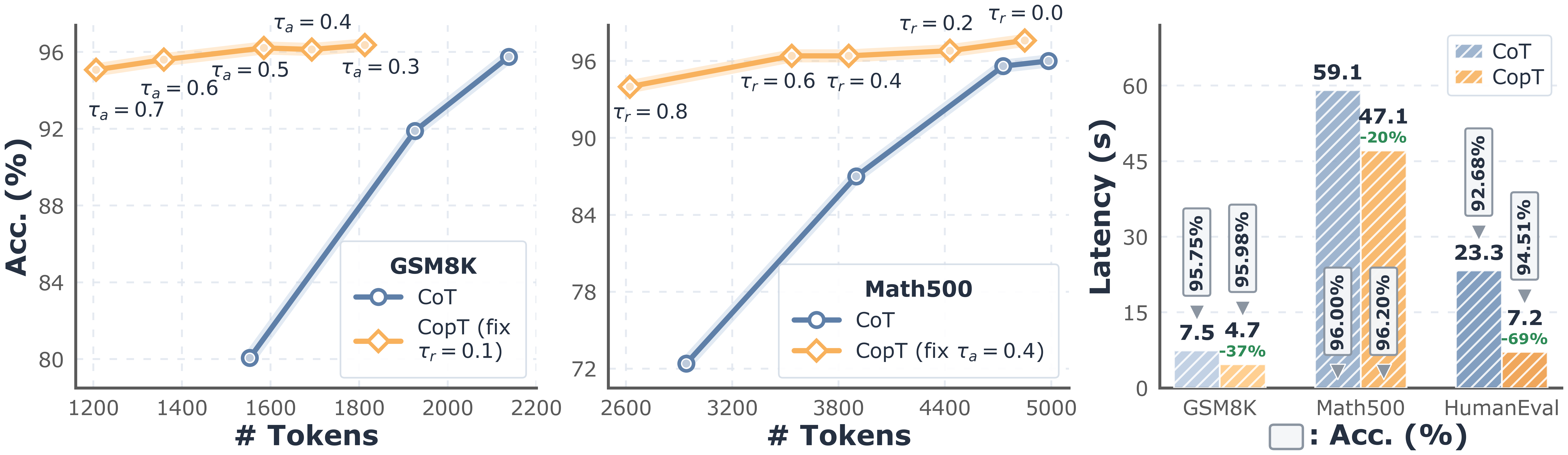
Figure 3 解读:左、中的曲线展示调节 与 后的 accuracy-token trade-off。降低 会让更少 draft 被直接接受,从而提高 reasoning effort;降低 会让后续 thinking 更少依赖 draft answer,也提高 correction effort。右图显示 token saving 会转化为真实 latency reduction:在 comparable 或更高 accuracy 下,CopT 在 GSM8K、Math500、HumanEval 上分别降低 37%、20%、69% 的 average per-sample latency,测量环境为 single H200 GPU。
5.4 Agentic reasoning results
Table 3 显示 CopT 在 BFCL v4 和 ZebraArena 上同样有效。BFCL 是 single-turn function calling;ZebraArena 是 multi-turn missing-clue tool-augmented reasoning。
| Benchmark / Model | CoT Acc / Tokens | CopT token-saving Acc / Tokens | CopT higher-effort Acc / Tokens |
|---|---|---|---|
| BFCL v4, Qwen3.5-2B | 77.53 / 234 | 78.01 (+0.48) / 139 (-40.6%) | 78.37 (+0.84) / 164 (-29.9%) |
| BFCL v4, Qwen3.5-35B-A3B | 85.77 / 235 | 86.17 (+0.40) / 130 (-44.7%) | 86.45 (+0.68) / 168 (-28.5%) |
| ZebraArena Small, Qwen3.5-35B-A3B | 93.71 / 3357 | — | 96.69 (+2.98) / 3486 (+3.8%) |
| ZebraArena Medium, Qwen3.5-35B-A3B | 75.00 / 7217 | — | 88.14 (+13.14) / 5457 (-24.4%) |
| ZebraArena Large, Qwen3.5-35B-A3B | 59.21 / 8070 | — | 82.24 (+23.03) / 6486 (-19.6%) |
最强信号来自 ZebraArena Medium/Large:多轮交互越长,错误 draft 或冗余 thinking 的累计影响越大,CopT 的“选择性纠错 + 动态 draft visibility”越有价值。Large split 上 accuracy 从 59.21 提升到 82.24,同时 tokens 从 8070 降到 6486。
5.5 Ablations
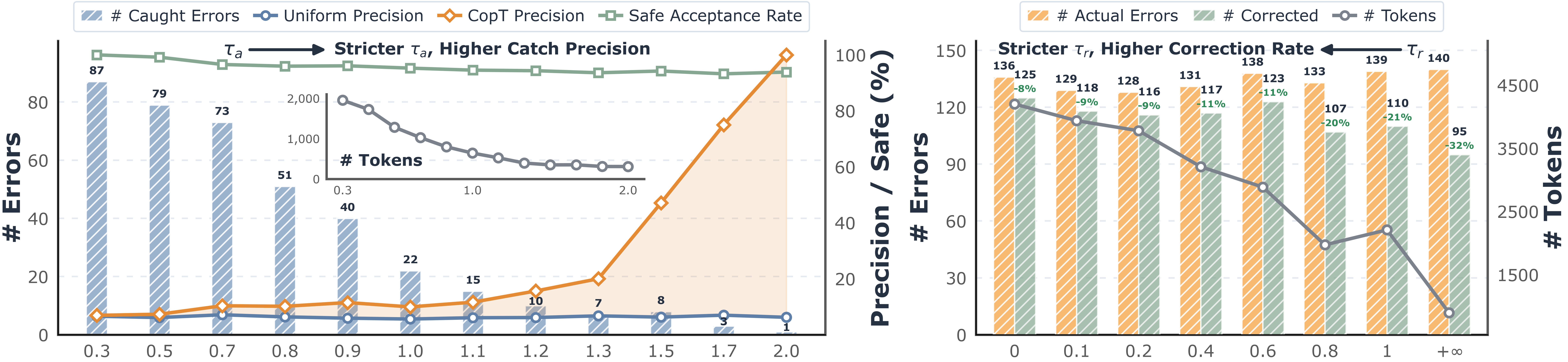
Figure 4 解读:左图研究 是否真的能抓到错误 draft。随着 更严格,CopT 选出的 unreliable drafts 数量减少,但 precision 上升;uniform selection 的 precision 低且近似平坦,说明不是“随机多想一点”就能定位错误。右图研究 对 draft visibility 的影响:更严格的 visibility control 会让模型更少暴露于可能错误的 draft,并纠正更多实际 draft errors,同时 token usage 上升,体现出 correction-vs-efficiency trade-off。
补充实验还报告了两个实现敏感点:
- Answer granularity: 默认 对 whole draft answer 计算,在 GSM8K / Math500 上为 95.98 / 961 和 96.20 / 3609;只对 extracted answer span 计算可提升到 96.36 / 885 与 96.40 / 3214,说明更聚焦 answer content 可能进一步节省 token,但论文主实验采用 whole draft answer 作为简单默认。
- Maximum draft length: 默认
1024在 GSM8K 上达到 95.98 / 961;Math500 上512达到最高 97.00 / 3660,但2048降到 94.40 / 3265。作者结论是 draft cap 主要用于防止少数难题在 answer-first 阶段生成重复/无效文本,不是高度敏感的核心 hyperparameter。
5.6 Limitations and takeaways
作者明确指出三类限制。第一, 与 都基于 inference-time realized trajectory,而不是对多个 continuations 的分布均值做估计;这符合 per-instance control,但方差可能高于 multi-sample estimates,论文通过 token averaging 缓解。第二,CopT 需要访问模型 logits、input embeddings 和 attention mask,因此更适合 open-weight 或可深度控制推理栈的模型;如果只能调用黑盒 API,continuous-prefix teacher pass 和 draft visibility masking 不一定可用。第三,thresholds 、 仍需要按任务调节,虽然 released configs 给出了默认 effort,但不同模型/任务可能需要重新扫 trade-off 曲线。
总体结论是:CopT 把 continuous embeddings 从“隐式生成空间”重新定位为“显式推理的 verifier/control signal”。它不训练模型,却能在数学、代码和 agentic reasoning 中同时改善 accuracy-token trade-off;尤其在多轮 agentic setting 中,动态决定是否继续思考以及是否参考 draft answer,比固定长 CoT 更适合实际部署。