SEAL: Synergistic Co-Evolution of Agents and Learning Environments
Paper: arXiv:2605.24426 Code: yihaohu0118/SEAL Code reference:
main@a0d22dba(2026-05-25)
1. Motivation (研究动机)
当前 LLM agents 的 self-evolution 通常把“agent 变强”理解成单侧优化:要么只更新 policy,要么只扩展 curriculum / task / environment distribution。SEAL 认为这两类路线在交互式 tool-use 场景中共享一个结构性瓶颈:训练时 environment 提供的学习信号没有跟上 agent 能力边界的变化。agent 经过若干轮训练后,失败模式会从“不会调用工具”转向“参数类型错”“调用顺序错”“收到错误后不会恢复”等更细粒度问题;如果环境仍只返回稀疏的 binary verifier reward,policy 只能知道整条 trajectory 成败,却不知道失败应归因到哪个 turn、哪个 tool schema、哪类 recovery 行为。
论文把这个问题命名为 Agent-Environment Misalignment。这里的 environment 不是测试 benchmark 本身,也不是 tool 的真实语义或 verifier,而是 training-time learning substrate:任务暴露方式、observation interface、action constraints、execution error feedback、recovery hints 等让模型学习的接口层。这个定义很关键,因为它允许训练时增强反馈,但不改变 benchmark 的 tool semantics、task labels、transition dynamics、reward 和 evaluation verifier,避免把方法收益混成“测试接口变简单”。
研究这个问题值得做,是因为 realistic tool-use agents 的错误通常发生在 multi-turn、strict-schema、可执行环境中:一次无效 tool call 可能导致后续状态全错;一次参数类型错误可能需要先查询 prerequisite information 再恢复;final answer 错误可能只是早期 tool argument 错误的下游结果。若训练只用终端 reward,credit assignment 非常粗;若 curriculum 不看当前 agent 的 executable failures,又可能生成“更难但不对症”的环境。SEAL 的目标是在 low-resource 场景下,用少量 400 个 BFCL V3 training samples,把失败轨迹转成更有诊断价值的训练信号,从而提升多轮 tool-use 学习效率和 OOD transfer。
2. Idea (核心思想)
核心 insight:agent 和 training-time environment 应该共同进化,而连接两者的共享信号不是 free-form reflection,而是 executable verifier-grounded failure diagnosis。SEAL 先让当前 policy 在可执行 tool environment 中 rollout,再把失败分解成 turn-level diagnostic labels;同一组 labels 一方面更新训练接口,让后续 observation 暴露更清楚的 schema / constraint / recovery cues,另一方面重加权 GRPO advantage,让更可归因、更可修复的轨迹贡献更大 policy-gradient 信号。
与 model-centric RL / self-reflection 的根本差别在于,SEAL 不只把失败当作 reward 或文本反思来更新 policy,而是把失败 profile 反馈给 training interface。与 environment-centric curriculum / data evolution 的差别在于,SEAL 不泛化地增加任务难度或多样性,而是根据当前 agent 已经暴露出的 executable failure types 定向调整接口。因此它形成闭环:policy 暴露能力缺口 → diagnosis 汇总 failure profile → interface 和 policy update 同时改变 → 下一轮 rollout 产生新的 failure profile。
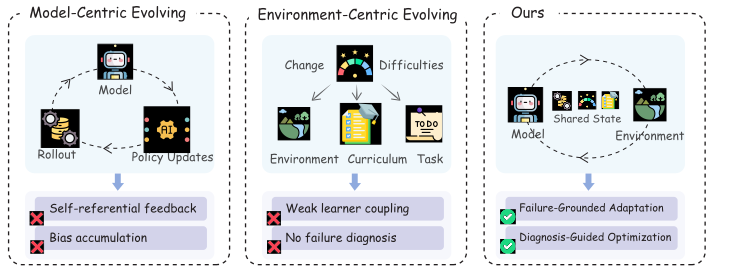
Figure 1 解读:图中对比了三种 self-evolution 形态。只更新 agent 的方法会面对固定环境,容易受稀疏 reward 和自分布 rollout bias 限制;只更新 environment 的方法可能没有对齐当前 agent 的真实失败;SEAL 则用 verifier-grounded diagnosis 把 agent side 与 environment side 连成闭环。注意这里的 environment adaptation 只发生在 training-time interface,而不是修改 benchmark verifier 或 tool semantics。
3. Method (方法)
3.1 Overall framework:闭环 co-evolution 训练循环
SEAL 面向 interactive tool use,把一条任务视作 partially observable decision process: 给定 instruction ,policy 与 executable environment 交互生成 rollout: 其中 是 dialogue context, 是模型 action, 是 environment observation。verifier 只给 terminal binary reward: 标准 RL 最大化 ,但这个目标只回答“成功了吗”,不回答“为什么失败”。SEAL 因此把训练反馈扩展成 :reward 仍由原始 verifier 决定, 是从执行轨迹中抽取的 structured failure diagnoses。
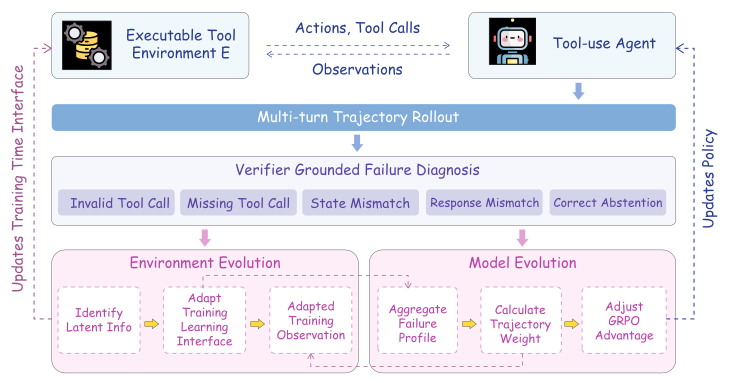
Figure 2 解读:SEAL 的训练循环包含四步:当前 agent 在可执行 tool environment 中生成 multi-turn trajectories;每条 trajectory 被 verifier 打分并被诊断为若干 failure types;failure profile 同时驱动两条路径——训练接口演化与 diagnosis-guided trajectory weighting;policy 再用 weighted advantages 做 GRPO 更新。图的关键不是“多加一个 reward model”,而是同一诊断信号同时改变下一轮环境接口和本轮 policy update 的优化压力。
直觉上,SEAL 把 sparse binary reward 变成“仍然守住原始 verifier 的可执行证据链”。例如模型把 city name 填到 airport code 参数里,终端 reward 只会给失败;SEAL 会把这类失败标成 argument mismatch,并在后续训练接口中更显式地暴露 required arguments / enum constraints,同时在 policy update 中提高这类可归因失败轨迹的学习权重。这样做的价值是:模型没有看到 reference trajectory 或 final answer,但能看到“这类错误该从 schema/constraint/recovery 角度修”。
3.2 Verifier-grounded failure diagnosis
对每条 rollout ,SEAL 生成 turn-level diagnostic labels: 每个 表示第 轮的主导 outcome / failure mode。诊断函数写作: 其中 是模型 action, 是 parser / schema / execution / verifier evidence, 是可获得的前后状态, 是工具集合。 是 deterministic rule-based classifier,优先使用可执行证据,而不是让 LLM 自由评论失败原因。论文强调:诊断不改 reward,仍然满足 诊断优先级来自 appendix:当同一 turn 有多个 failure signals 时,按直接可执行失败优先于 downstream verifier failure 的原则分配 dominant label。
| Priority | Label | 含义 |
|---|---|---|
| 1 | invalid_tool_call | action 无法 parse 或调用了不存在的 tool |
| 2 | argument_mismatch | tool 合法,但 required field、type、enum value 或 argument structure 错 |
| 3 | state_mismatch | action 执行了,但未产生 expected observable state transition |
| 4 | recovery_failure | 模型收到 executable error feedback 后,后续 turn 仍未恢复 |
| 5 | missing_tool_call | 模型跳过必要 tool use 或过早给最终回答 |
| 6 | response_mismatch | tool interaction 大体可接受,但 final answer 未通过 verifier |
这个优先级避免把早期具体 tool/argument 错误简单归到最终 response mismatch。例如,若 final verifier fail 是因为前面一个 tool call 参数错,SEAL 会记录 argument_mismatch,从而让后续 interface 与 advantage weight 都围绕可修复的错误类型调整。
3.3 Learning-interface evolution:只改训练接口,不改测试环境
SEAL 只演化 training-time learning interface。令 为原始 observation,SEAL 构造增强 observation: 其中 是历史诊断上下文, 是最近 rollouts 汇总出的当前 policy failure profile。实现上, 由三类轻量组件拼接:
- :暴露 tool schema implied affordances,例如 required arguments、enum constraints、argument types、valid tool-call formats。appendix 中 active BFCL 配置使用
observation_lite,把参数描述加上[required]或 allowed values,但不泄漏正确 tool choice / hidden parameter / reference trajectory。 - :论文描述为把 parse / execution errors 转成 recovery-oriented feedback;released
bfcl_env.py中存在_enrich_parse_error与_enrich_tool_response_text实现,但当前exp/SEAL.yaml没有启用tool_feedback_evolution,所以主 released recipe 的 active interface evolution 主要是observation_liteschema annotation。 - :论文描述为根据当前 failure profile 选择 capability-specific cues;released code 中闭环 capability state 主要进入 A-Patch dynamic tag weights,而不是显式实现
interface.evolve/aggregate_failure_profile这样的接口演化函数。
这种 interface evolution 的边界非常保守:它不改变 tool API、tool signatures、tool outputs、verifier behavior、task labels,也不在 evaluation 时保留 wrapper。换句话说,训练时给模型更清楚的学习信号,测试时仍回到原始 benchmark interface,用以判断 policy 是否真正 internalized better tool-use behavior。
3.4 Diagnosis-guided advantage reweighting
SEAL 的 policy-side 改动不是替换 GRPO,而是在 GRPO group-relative advantage 上做 diagnostic preconditioning。对 trajectory ,先把 turn-level labels 汇总成 empirical diagnostic profile:
再定义 utility function ,衡量某类诊断是否 actionable / attributable。trajectory-level diagnostic weight 为:
其中论文实验使用 。最后把原 GRPO advantage 改成:
重要性质:,所以它不改变 advantage 的符号,不改变 verifier-induced ranking;verifier reward 仍决定 update direction,diagnosis 只决定“这条轨迹多值得学”。appendix 给出的 utility weights 包括:spurious_tool_call 2.0、correct_abstention 1.8、empty_turn_model_response 1.5、state_mismatch 1.0、response_mismatch 0.9、instance_mismatch 0.6、pass 1.0。直观上,越直接、越可归因的失败权重越高,越模糊、越下游的失败权重越低。
3.5 SEAL training algorithm
每轮 ,SEAL 用当前 interface 实例化训练环境,当前 policy 采样 trajectories:
每条 trajectory 用原始 verifier 得到 ,并用 得到 。诊断集合被聚合为 failure profile:
随后更新 interface 与 policy:
下面伪代码按 released code main@a0d22dba 的实现重写。论文中的 Algorithm 1 是概念流程;代码中最直接对应的是三条链路:multi_turn_progress.py 产生 BFCL per-turn tags,env_manager.py 把这些 tags 写入 rollout extras,apatch.py 按 tag distribution 缩放 batch advantages。
论文公式与 released code 实现差异:论文 Table 5 使用 invalid_tool_call、argument_mismatch、recovery_failure、missing_tool_call 等诊断标签;released code 的 A-Patch 实际消费的是 multi_turn_progress.py 的 BFCL progress tags:spurious_tool_call、correct_abstention、empty_turn_model_response、state_mismatch、instance_mismatch、response_mismatch、checker_error、gt_error、pass。因此,代码不是把 Table 5 labels 逐一映射到 Table 6,而是在 BFCL grader 的 progress vocabulary 上实现 diagnosis-guided weighting。
import torch

TAG_WEIGHTS = {
    "spurious_tool_call": 2.0,
    "correct_abstention": 1.8,
    "empty_turn_model_response": 1.5,
    "state_mismatch": 1.0,
    "response_mismatch": 0.9,
    "instance_mismatch": 0.6,
    "pass": 1.0,
}
EXCLUDE_TAGS = {"checker_error", "gt_error"}


def compute_per_turn_failure_tags(model_turns, ground_truth_turns, state_checker, response_checker):
    """Paper Z(tau), implemented in env_service/environments/bfcl/multi_turn_progress.py."""
    failure_tags = []
    for model_turn, gt_turn in zip(model_turns, ground_truth_turns):
        if gt_turn.is_irrelevant:
            failure_tags.append("spurious_tool_call" if model_turn.called_tools else "correct_abstention")
            continue
        if not model_turn.called_tools:
            failure_tags.append("empty_turn_model_response")
            continue
        if model_turn.instance_set != gt_turn.instance_set:
            failure_tags.append("instance_mismatch")
            continue
        try:
            state_ok = state_checker(model_turn, gt_turn)
        except Exception:
            failure_tags.append("checker_error")
            continue
        if not state_ok:
            failure_tags.append("state_mismatch")
            continue
        try:
            response_ok = response_checker(model_turn, gt_turn)
        except Exception:
            failure_tags.append("checker_error")
            continue
        failure_tags.append("pass" if response_ok else "response_mismatch")
    return failure_tags


def trajectory_scale(failure_tags, tag_weights=TAG_WEIGHTS, min_scale=0.5, max_scale=2.0):
    """Released A-Patch scale in agentevolver/module/tocf/apatch.py."""
    effective = [tag for tag in failure_tags if tag not in EXCLUDE_TAGS]
    if not effective:
        return 1.0
    raw_scale = sum(tag_weights.get(tag, 1.0) for tag in effective) / len(effective)
    return float(min(max_scale, max(min_scale, raw_scale)))


def apply_apatch_advantage_weighting(batch, config, capability_state=None, global_step=None):
    """In-place advantage scaling for samples carrying extras['bfcl_failure_tags']."""
    advantages = batch.batch["advantages"]
    extras = batch.non_tensor_batch.get("extras") or []
    scales = torch.ones(advantages.shape[0], dtype=advantages.dtype, device=advantages.device)
    tag_weights = dict(TAG_WEIGHTS)
    if capability_state is not None and config.tocf.advantage.apatch.dynamic.enable:
        tag_weights = capability_state.update_dynamic_tag_weights(
            tag_weights,
            min_scale=config.tocf.advantage.apatch.min_scale,
            max_scale=config.tocf.advantage.apatch.max_scale,
            ema_beta=0.25,
            prevalence_alpha=1.0,
            confidence_samples=32,
        )
    for idx, extra in enumerate(extras):
        tags = extra.get("bfcl_failure_tags") if isinstance(extra, dict) else None
        if tags:
            scales[idx] = trajectory_scale(tags, tag_weights)
    advantages.mul_(scales.unsqueeze(-1))
    return batch


def seal_train_step(trainer, gen_batch, tasks):
    # ae_ray_trainer.py: rollout through ParallelEnvManager; BFCL env applies
    # active train-only observation_lite from exp/SEAL.yaml during sampling.
    trajectories = trainer.env_manager.rollout(tasks, mode="sample")
    if trainer.tocf_stats is not None:
        trainer.tocf_stats.observe(tasks, trajectories, trainer.epoch, trainer.global_steps)

    # env_manager.py copies bfcl_dense_progress_info["failure_tags"] into
    # extras["bfcl_failure_tags"], so the RL batch carries verifier-grounded tags.
    batch = build_grpo_batch_from_trajectories(gen_batch, trajectories)
    batch = compute_grpo_advantages(batch, adv_estimator="grpo", num_repeat=8)

    if apatch_enabled(trainer.config):
        batch, metrics = apply_apatch_advantage_weighting(
            batch=batch,
            config=trainer.config,
            env_type=trainer.config.env_service.env_type,
            capability_state=trainer.tocf_state,
            global_step=trainer.global_steps,
        )
        trainer.metrics.update(metrics)
    return trainer.actor_update(batch)
3.6 Released code mapping
Code reference:
main@a0d22dba(2026-05-25) — pseudocode and mapping based on this commit
| Paper Concept | Source File | Key Class/Function |
|---|---|---|
| Full SEAL recipe / launch config | exp/SEAL.yaml | GRPO config, BFCL env config, tocf.feedback.dense_reward, tocf.advantage.apatch |
| Training entrypoint | launcher.py, agentevolver/main_ppo.py | python launcher.py --conf exp/SEAL.yaml, PPO/GRPO trainer setup |
| TOCF trainer integration | agentevolver/module/trainer/ae_ray_trainer.py | loads TOCFCapabilityState; observes TOCF stats after rollout; calls apply_apatch_advantage_weighting after GRPO advantages are computed |
| BFCL executable environment + train-only interface | env_service/environments/bfcl/bfcl_env.py | BfclEnv, _apply_observation_lite, _enrich_parse_error, _enrich_tool_response_text |
| Per-turn verifier-grounded progress tags | env_service/environments/bfcl/multi_turn_progress.py | compute_per_turn_progress, safe_compute_progress |
| Dense BFCL grader and progress metadata | agentevolver/module/task_manager/rewards/bfcl_dense_env_grader.py | BfclDenseEnvGrader.calculate_reward |
| Passing failure tags into RL batch extras | agentevolver/module/env_manager/env_manager.py | rollout extras include bfcl_failure_tags from bfcl_dense_progress_info |
| Diagnosis-guided advantage weighting | agentevolver/module/tocf/apatch.py | _trajectory_scale, apply_apatch_advantage_weighting |
| Closed-loop capability / dynamic tag statistics | agentevolver/module/tocf/state.py, agentevolver/module/tocf/stats.py | TOCFCapabilityState, update_dynamic_tag_weights, trajectory stats collectors |
| Released BFCL data split | data/bfcl_train.parquet, data/bfcl_eval_400.parquet, data/bfcl_400_split.json | train/eval split files |
论文公式与 released code 实现差异:除了上面提到的 label vocabulary 差异,训练配置也有一个需要注意的差异。论文 Appendix Table 4 写默认 backbone 为 Qwen2.5-7B-Instruct、GPU memory utilization 为 0.6;released exp/SEAL.yaml 当前写的是 actor_rollout_ref.model.path: Qwen/Qwen3.5-4B 与 gpu_memory_utilization: 0.4。此外,paper-level “interface evolves from failure profile” 在 released main recipe 中没有对应的 interface.evolve 函数;当前 active code path 是 train-only observation_lite schema annotation + TOCF stats/state + dynamic A-Patch weights。bfcl_env.py 虽然包含 parse/tool feedback enrichment code,但 exp/SEAL.yaml 未启用 tool_feedback_evolution。因此本笔记的实验结果仍按论文表格解释,但复现实验时应以 exp/SEAL.yaml 作为代码锚点,并确认作者是否后续更新过配置。
4. Experimental Setup (实验设置)
4.1 Datasets and splits
- In-distribution benchmark:BFCL V3 multi-turn subset,共 800 examples,覆盖 4 类:Base、Missing Functions、Missing Parameters、Long Context。论文采用 low-resource setting:400 training examples(每类 100),remaining 400 用于 held-in evaluation。
- Out-of-distribution benchmarks:BFCL V4 的 Web Search 与 Memory;以及 -bench 的 Retail、Airline、Telecom domains。这些 held-out benchmarks 与 BFCL V3 在 tool domains、schema structure、interaction patterns 上不同,用来检验 transfer。
4.2 Models and baselines
SEAL 在三类 3B—8B backbone 上训练:Qwen2.5-3B-Instruct、Qwen2.5-7B-Instruct、ToolACE-2-Llama-3.1-8B。Qwen models 代表 general instruction-tuned agents;ToolACE-2 是更强的 tool-specialized initialization。
受控 baseline 是 Vanilla RL:同一 initial checkpoint、同一 400-sample split、同一 rollout budget、同一 optimizer family、同一 decoding configuration、同一 verifier reward。论文也报告 Gemini-3-Pro-Preview、Claude-Sonnet-4.5、GPT-4o-2024-11-20、Gemini-2.5-Flash、GLM-4.6 355B、Qwen3-32B、Qwen2.5-14B-Instruct、xLAM-2-3b-fc-r、BitAgent-8B、watt-tool-8B 等作为 reference points,但这些模型的规模和训练 recipe 不同,不是严格 controlled baselines。
4.3 Evaluation metrics
所有表格主要报告 success / accuracy percentage。BFCL V3 分为 Average、Base、Miss Func、Miss Param、Long Context;BFCL V4 分为 Avg.、Web Search、Memory;-bench 分为 Avg.、Retail、Airline、Telecom。Figure 3 的 validation curves 按 training steps 报告 BFCL V3 四个 100-sample validation subsets 的 validation accuracy,shaded region 是 binomial standard error。
4.4 Training config
主 BFCL 配置以 released exp/SEAL.yaml 为代码锚点:train_files=data/bfcl_train.parquet,val_files=data/bfcl_eval_400.parquet,train_batch_size=32,max_prompt_length=8192,max_response_length=4096;algorithm.adv_estimator=grpo,use_kl_in_reward=false;rollout.name=vllm、mode=async、training temperature 1.0、validation temperature 0、rollouts per prompt 8、max_model_len=16384、tensor_model_parallel_size=1、max_env_worker=32;actor LR ,kl_loss_coef=0.001,entropy_coeff=0,PPO micro-batch size / GPU 1,PPO mini-batch size 8,clip_ratio=clip_ratio_low=clip_ratio_high=0.2、clip_ratio_c=10.0;multi-turn enabled,format llama3_json,max steps 20;trainer 使用 4 GPUs、1 node、total_epochs=6、test_freq=10。SEAL-specific switches 包括 observation_lite.enable=true、apply_to_validation=false、required/enum hints enabled,tocf.feedback.dense_reward.enable=true、mode=capped、partial_credit_cap=0.0,以及 tocf.advantage.apatch.enable=true、min_scale=0.5、max_scale=2.0、dynamic weights enabled。注意:代码当前 actor_rollout_ref.model.path=Qwen/Qwen3.5-4B、gpu_memory_utilization=0.4,与论文 Table 4 的 Qwen2.5-7B-Instruct / 0.6 不完全一致。
5. Experimental Results (实验结果)
5.1 BFCL V3 in-distribution:400 samples 下稳定超过 Vanilla RL
| Model / training | Average | Base | Miss Func | Miss Param | Long Context |
|---|---|---|---|---|---|
| Qwen2.5-3B-Instruct | 5.75 | 11.00 | 6.00 | 3.00 | 3.00 |
| + Vanilla RL | 9.25 | 16.00 | 9.00 | 6.00 | 6.00 |
| + SEAL | 14.00 | 19.00 | 15.00 | 12.00 | 10.00 |
| Qwen2.5-7B-Instruct | 14.00 | 22.00 | 14.00 | 10.00 | 10.00 |
| + Vanilla RL | 30.75 | 46.00 | 27.00 | 27.00 | 23.00 |
| + SEAL | 40.25 | 58.00 | 36.00 | 34.00 | 33.00 |
| ToolACE-2-Llama-3.1-8B | 32.00 | 45.00 | 26.00 | 35.00 | 22.00 |
| + Vanilla RL | 38.50 | 52.00 | 30.00 | 40.00 | 32.00 |
| + SEAL | 46.75 | 58.00 | 46.00 | 44.00 | 39.00 |
相对原始 checkpoints,SEAL 在三种 backbone 上分别带来 +8.25、+26.25、+14.75 average-point gains;相对受控 Vanilla RL,分别再提升 +4.75、+9.50、+8.25 points。最能说明机制有效的是 Qwen2.5-7B:Missing Functions 从 14.00% 提到 36.00%,Missing Parameters 从 10.00% 提到 34.00%,正好对应 SEAL 重点诊断和修复的 tool selection / argument constraint 错误。ToolACE-2 已经是 tool-specialized model,SEAL 仍把 average 从 38.50 提到 46.75,说明收益不只来自弱模型“补基础格式”。
参考模型中,Claude-Sonnet-4.5 为 61.38 average,Gemini-3-Pro-Preview 为 60.75,GLM-4.6 355B 为 68.00,xLAM-2-3b-fc-r 为 58.38;这些不是受控 baseline,但提供了当前 BFCL V3 multi-turn 的 broader performance range。
5.2 OOD generalization:BFCL V4 与 -bench 均有 transfer
| Model / training | BFCL V4 Avg. | BFCL V4 Web Search | BFCL V4 Memory | Avg. | Retail | Airline | Telecom |
|---|---|---|---|---|---|---|---|
| Qwen2.5-3B-Instruct | 4.69 | 0.00 | 9.38 | 9.64 | 5.26 | 14.00 | 9.65 |
| + Vanilla RL | 5.98 | 0.50 | 11.26 | 10.60 | 6.14 | 16.00 | 9.65 |
| + SEAL | 8.63 | 2.00 | 15.26 | 11.76 | 8.77 | 16.00 | 10.52 |
| Qwen2.5-7B-Instruct | 9.17 | 6.50 | 11.83 | 16.11 | 16.67 | 20.00 | 11.67 |
| + Vanilla RL | 10.26 | 7.50 | 13.02 | 17.19 | 19.30 | 20.00 | 12.28 |
| + SEAL | 12.71 | 9.50 | 15.92 | 20.79 | 26.32 | 22.00 | 14.04 |
SEAL 只用 BFCL V3 的 400 training samples 训练,却在 held-out BFCL V4 和 -bench 上提升。Qwen2.5-3B 的 BFCL V4 Avg. 从 4.69 到 8.63, Avg. 从 9.64 到 11.76;Qwen2.5-7B 的 BFCL V4 Avg. 从 9.17 到 12.71, Avg. 从 16.11 到 20.79。说明 SEAL 学到的不只是 BFCL V3 的具体 task distribution,而是更通用的 schema-following、missing-tool recovery、argument repair 与 multi-turn state tracking 行为。
5.3 Ablation:三个组件都重要
| Variant on Qwen2.5-7B | Average | Base | Miss Func | Miss Param | Long Context |
|---|---|---|---|---|---|
| Qwen2.5-7B-Instruct | 14.00 | 22.00 | 14.00 | 10.00 | 10.00 |
| + Vanilla RL | 30.75 | 46.00 | 27.00 | 27.00 | 23.00 |
| SEAL w/o Environment-Side Adaptation | 35.75 | 52.00 | 31.00 | 32.00 | 28.00 |
| SEAL w/o Diagnosis-Guided Reweighting | 32.75 | 48.00 | 27.00 | 31.00 | 25.00 |
| SEAL w/o Closed-Loop Update | 33.00 | 46.00 | 32.00 | 28.00 | 26.00 |
| Full SEAL | 40.25 | 58.00 | 36.00 | 34.00 | 33.00 |
去掉 Environment-Side Adaptation 后 average 为 35.75,说明只用 diagnosis reweighting 还不够,训练接口必须暴露更有用的 cues。去掉 Diagnosis-Guided Reweighting 后 average 32.75,说明只改 interface 不足以把优化压力集中到高价值轨迹。去掉 Closed-Loop Update 后 average 33.00,说明 failure profile 需要随 policy 能力变化动态更新;固定一次性诊断无法跟踪能力边界。Full SEAL 40.25 是三个组件协同后的结果。
5.4 Learning dynamics:更快、更稳地拉开差距
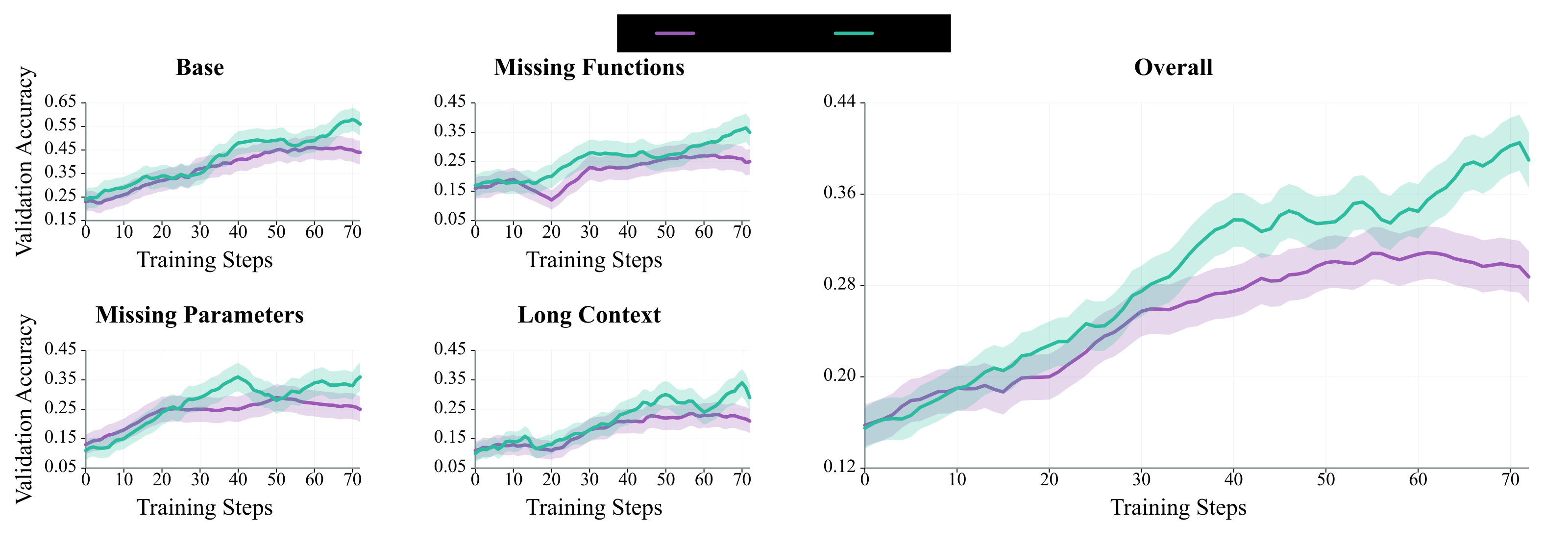
Figure 3 解读:四个 validation subsets 中,SEAL 相对 Vanilla RL 更快上升并达到更高 final accuracy,尤其在 Missing Functions 与 Missing Parameters 上 gap 更明显。Base 任务两者早期都提升,但 SEAL 稳定在更高水平;Long Context 仍是最难 subset,但 SEAL 曲线更持续上行。这支持论文的解释:当 policy 的主要失败类型变化时,SEAL 会更新 interface 来暴露更相关 cues,而 Vanilla RL 仍只依赖稀疏 terminal signal。
5.5 Limitations 与结论
论文明确指出三点限制。第一,SEAL 依赖 executable environments,需要 tool schemas、execution traces 和 verifier feedback;更 open-ended 的任务可能没有足够结构化的诊断证据。第二,environment evolution 刻意保守,只改 training-time interface,不改 tool semantics 或 evaluation rules;这保证公平,但也限制了 adaptation 范围。第三,diagnostic utility weights 当前跨 task / backbone 固定,未来可学习 adaptive weights;同时 cross-domain generalization 仍然 challenging。
总体结论是:tool-use agent 的改进不应只看 policy optimizer,也应看训练环境是否能随 agent 的 failure profile 变化而变化。SEAL 的实验证明,verifier-grounded failure diagnosis 可以同时作为 interface evolution 和 policy optimization 的共享信号,在 400-sample low-resource 设定下显著提高 multi-turn tool-use learning,并在不同 held-out tool domains 上保留正向迁移。