TMAS: Scaling Test-Time Compute via Multi-Agent Synergy
Paper: arXiv:2605.10344 Code: IQuestLab/tmas Code reference:
master@426dbbcd(2026-05-14)
1. Motivation (研究动机)
当前方法的问题
Test-time scaling (TTS) 的基本想法是:推理时给模型更多计算量,让模型生成更长的 chain-of-thought、更多候选解、或更多轮 refine,从而提高数学/推理任务的正确率。早期方法主要在单条轨迹内加深思考;后续方法开始做多轨迹、多轮 refinement、verification feedback,例如 Self-Refine、Verify-Refine、PaCoRe、RSE、DeepSeek-Math-V2、Nemotron-Cascade 2 等。
这篇论文认为现有 structured TTS 的瓶颈不是“有没有更多 rollouts”,而是“多条 rollout 之间有没有有效协作”。典型问题有两类:
- 并行轨迹弱耦合:Verify-Refine 类系统可以并行生成、验证、修正多个候选解,但不同候选解之间通常缺少可复用的信息流;一个分支发现的局部正确结论或错误模式,不一定会被其他分支及时利用。
- 历史信息使用太粗糙:PaCoRe / RSE 一类方法会把历史轨迹或经验喂回模型,但如果不显式区分“应该复用的低层可靠结论”和“已经尝试过、下次应避免重复的高层策略”,历史上下文会同时带来噪声、冗余和 context rot。
本文要解决的问题
TMAS 要解决的是:如何把 test-time compute 从“多采样/多轮修正”扩展成一个有分工、有记忆、有探索-利用平衡的 multi-agent inference system。具体目标不是训练一个新的基础模型,而是在推理阶段组织多个 agent:生成候选解、验证候选解、总结验证反馈、维护低层 experience bank、维护高层 guideline bank,并让这些信息跨 rollout、跨 iteration 传递。
为什么值得研究
如果这个问题解决得好,小模型可以通过更有效的推理时计算接近大模型表现。论文在 full IMO-AnswerBench 上给出的直观结果是:Qwen3-30B-A3B-Thinking-2507 从 64.9% 提升到 77.2% Pass@1;Qwen3-4B-Thinking-2507 配合 TMAS + Hybrid-RL 从 53.5% 提升到 73.5%。这说明 test-time compute 的收益不只来自“采样更多”,还来自“把每次采样产生的局部知识结构化地传给后续采样”。
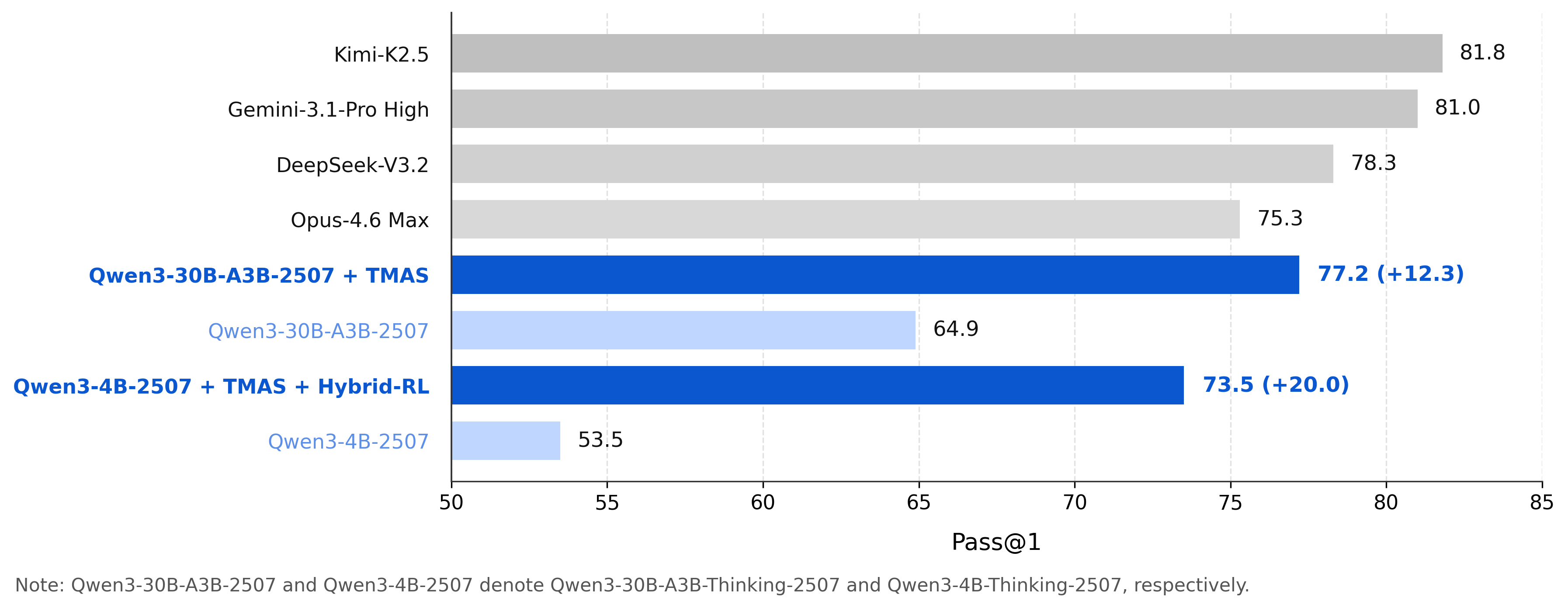
Figure 1 解读:这张图把原始 Qwen3 backbone、TMAS-enhanced backbone 与若干 frontier model 的 IMO-AnswerBench Pass@1 放在一起比较。关键不是说 4B 模型已经超过所有闭源大模型,而是说明 TMAS 把小模型的推理时计算组织成可累积、可复用的协作过程后,能显著缩小与大模型的绝对性能差距。
2. Idea (核心思想)
TMAS 的核心洞察是:多轨迹 TTS 中真正稀缺的不是更多候选答案,而是“哪些局部结论值得复用、哪些高层策略已经尝试过应避免重复”的结构化记忆。它把 reasoning rollout 产生的信息分成两层:experience bank 负责低层、可直接复用的 verified anchors / error-avoidance heuristics;guideline bank 负责高层、已探索过的策略方向,用来推动后续 rollout 做非冗余探索。
关键创新可以概括为三点:第一,推理过程由五个 agent 分工完成,而不是一个模型反复自我修正;第二,experience bank 和 guideline bank 分别服务 exploitation 与 exploration,避免把所有历史轨迹混成一段长上下文;第三,Hybrid-RL 不只奖励最终答案正确,还奖励模型会使用 experience、会产生新的高层策略。
与 PaCoRe / RSE 相比,TMAS 的根本差异在于它不只是把历史轨迹聚合后喂回模型,而是显式维护两种语义不同的 memory bank。与 Verify-Refine 相比,TMAS 不把 verifier feedback 限制在当前候选解的局部修正里,而是通过 summary / experience / guideline agent 把 feedback 转换成后续 iteration 可共享的系统状态。
3. Method (方法)
3.1 Overall framework:五类 agent + 两级 memory bank
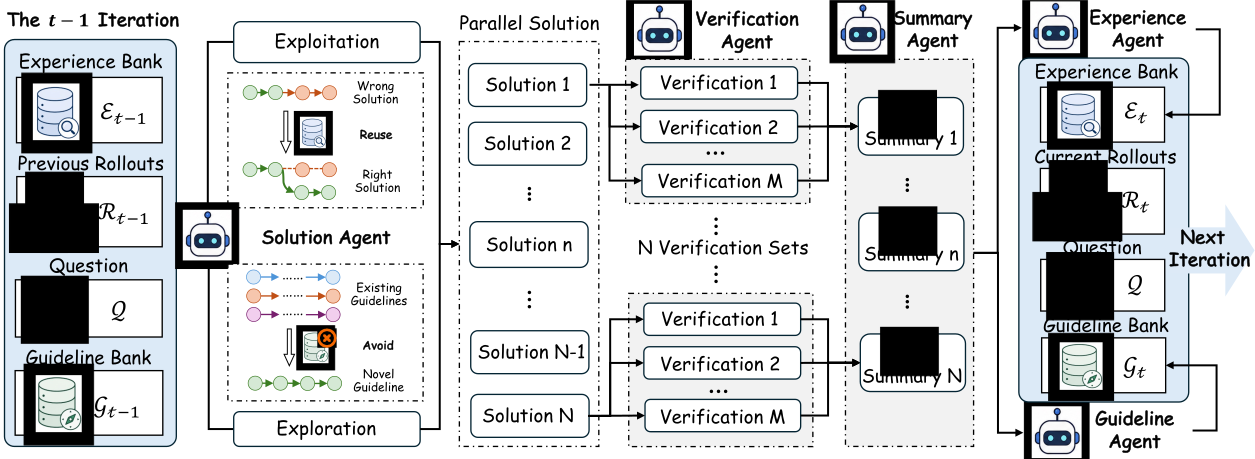
Figure 2 解读:图中每个 iteration 都包含两条互补路径。左侧 exploitation branch 使用 previous rollouts 和 experience bank 来改进已有推理路径;右侧 exploration branch 使用 guideline bank 记录的“已经尝试过的高层策略”,要求 solution agent 避免复读这些策略,从而探索新路线。每条候选 solution 都由多个 verification agent 独立打分和给反馈,再由 summary agent 汇总;experience agent 抽取低层可复用结论,guideline agent 抽取高层策略记忆。这里的 synergy 不是让 agent 互相聊天,而是把每轮 rollout 变成后续 rollout 的结构化状态。
TMAS 的五个 agent 分工如下:
| Agent | 输入 | 输出 | 作用 |
|---|---|---|---|
| Solution Agent | 问题 ,上一轮 rollouts / experience 或 guideline | 候选解 | 生成 exploit 或 explore 分支的 candidate solution |
| Verification Agent | 与候选解 | 个 verification outputs + score | 给出正确、部分正确、致命错误等反馈 |
| Summary Agent | 候选解与 个验证结果 | rollout summary | 把多次验证压缩成可复用摘要 |
| Experience Agent | 当前 rollouts 与旧 experience bank | 新 experience bank | 提取 verified anchors、局部技巧、错误规避规则 |
| Guideline Agent | 当前 rollouts 与旧 guideline bank | 新 guideline bank | 记录已探索过的高层策略,帮助后续非冗余探索 |
直觉上,experience bank 更像“这道题已经验证过的局部事实库”,例如某个中间结论、边界条件、常见错误;guideline bank 更像“解题路线日志”,例如已经尝试过 induction / generating function / case split 等。把两者混在一起会导致 exploitation 与 exploration 互相干扰:低层事实应该被复用,高层路线却常常应该被避开以扩大搜索。
3.2 Multi-agent inference:epsilon-greedy 的探索/利用调度
对问题 ,TMAS 运行 个 iteration。每轮生成 条候选轨迹,并对每条轨迹做 次独立验证。第 轮第 条候选解按 epsilon-greedy 方式采样:
第一支路是 exploitation:看上一轮 rollouts 与 experience bank,修补已有思路;第二支路是 exploration:只给 guideline constraint,要求模型避开已记录的高层路线。每条候选解的 verification set 为:
summary agent 将验证结果压缩为:
并把 rollout 定义为 ,当前轮集合为 。然后两个 memory update agent 并行更新:
Released code 的主流程在 code/inference.py::HighComputeSearch.run_single_problem 中实现。它为每道题创建 PersistentMemory(..., file_suffix="experience") 和 PersistentMemory(..., file_suffix="guideline"),每轮用 random.random() < epsilon 决定每个 solution 是否走 guideline branch,然后 asyncio.gather 并发运行所有 solution、verification、summary、experience update 和 guideline update。
async def tmas_inference(problem, cfg, memory_dir):
    question = problem["question"]
    n_candidates = cfg.get("n_candidates", 8)
    n_verifications = cfg.get("n_verifications", 8)
    max_iterations = cfg.get("max_iterations", 20)
    epsilon = cfg.get("epsilon", 0.2)

    experience_bank = PersistentMemory(problem["problem_id"], memory_dir, "experience", threshold=0.7)
    guideline_bank = PersistentMemory(problem["problem_id"], memory_dir, "guideline", threshold=0.7)
    await experience_bank.load_from_file()
    await guideline_bank.load_from_file()

    prev_rollouts = []
    best_candidate = None
    for iter_idx in range(max_iterations):
        use_guideline = [random.random() < epsilon for _ in range(n_candidates)]
        current_rollouts = await asyncio.gather(*[
            process_one_solution(
                question=question,
                prev_rollouts=prev_rollouts,
                experiences=experience_bank.items,
                guidelines=guideline_bank.items,
                use_guideline=use_guideline[i],
                n_verifications=n_verifications,
            )
            for i in range(n_candidates)
        ])
        current_rollouts = [r for r in current_rollouts if r is not None]
        if not current_rollouts:
            continue

        best_candidate = max(current_rollouts, key=lambda r: r.candidate.average_score).candidate
        new_experiences, new_guidelines = await asyncio.gather(
            experience_extractor.evolve_experience_bank(current_rollouts, question, experience_bank.items),
            guideline_manager.update_guideline_bank(current_rollouts, question, guideline_bank.items),
        )
        experience_bank.items = new_experiences or experience_bank.items
        guideline_bank.items = new_guidelines or guideline_bank.items
        await experience_bank.save_to_file()
        await guideline_bank.save_to_file()
        prev_rollouts = current_rollouts

    return best_candidate
3.3 Solution generation:rollout/experience branch 与 guideline branch 的提示词差异
code/generation.py 把 solution prompt 分成两个模式:
- exploitation mode (
generate_with_rollouts):如果存在 previous rollouts,就使用REFINE_GENERATION_PROMPT,追加 rollout context;如果存在 experience bank,就把Anchor:条目格式化为 verified anchors,把Heuristic:条目格式化为 error-avoidance heuristics。 - exploration mode (
generate_with_guideline):当use_guideline=True时,代码会清空前面组装的 rollout/experience prompt,只保留基础 proof generation prompt 与 guideline constraint。这与论文中 的设定一致:探索分支不直接继承上一轮具体解,而是被要求避开既有策略。
def build_solution_prompt(question, prev_rollouts, experiences, guidelines, use_guideline, max_rollouts=None):
    if max_rollouts is not None and len(prev_rollouts) > max_rollouts:
        prev_rollouts = random.sample(prev_rollouts, max_rollouts)

    if use_guideline:
        prompt = PROOF_GENERATION_PROMPT.format(question=question)
        if guidelines:
            prompt += "\n\n" + GUIDELINE_CONSTRAINT_TEMPLATE.format(
                tried_list="\n".join(f"- {g}" for g in guidelines)
            )
        return prompt

    prompt = REFINE_GENERATION_PROMPT.format(question=question) if prev_rollouts else PROOF_GENERATION_PROMPT.format(question=question)
    if prev_rollouts:
        prompt += "\n\n" + ROLLOUT_CONTEXT_HEADER + format_rollouts(prev_rollouts)
    if experiences:
        prompt += "\n\n" + format_experience_bank(experiences)
    return prompt
3.4 Verification 与 summary:多次独立判断压缩成 rollout summary
code/verification.py::Verifier.verify_batch 为每个 candidate 补齐到 n_verifications 个验证结果。每个 verification prompt 包含原问题和候选 proof,调用 verifier model 后用 utils.extract_score 解析数值分数;随后 summarize_verifications 把所有 evaluations 及 score 拼成 VERIFICATION_SUMMARY_TEMPLATE,生成一个自然语言 summary。
async def verify_and_summarize(candidate, question, n_verifications):
    tasks = []
    for _ in range(n_verifications - len(candidate.verifications)):
        prompt = VERIFY_TEMPLATE.format(question=question, proof=candidate.proof_text)
        tasks.append(call_llm(prompt, mode="verification", temperature=1.0))

    for response in await asyncio.gather(*tasks):
        score = extract_score(response)
        if score is not None:
            candidate.verifications.append(VerificationResult(analysis=response, score=score))

    evaluations = "\n\n".join(
        f"[Evaluation {i+1} - Score: {v.score}]\n{v.analysis}"
        for i, v in enumerate(candidate.verifications)
    )
    summary = await call_llm(
        VERIFICATION_SUMMARY_TEMPLATE.format(
            question=question,
            solution=remove_think_block(candidate.proof_text),
            n_verifications=len(candidate.verifications),
            evaluations=evaluations,
        ),
        mode="verification_summary",
        temperature=0.6,
    )
return Rollout(candidate=candidate, verification_summary=summary)实现上,Candidate.average_score 是所有 verification scores 的均值;Candidate.is_fully_verified(threshold=8) 要求验证数量至少 threshold - 2 且所有已有分数等于 1.0。这意味着在 API 失败导致少数 verification 缺失时,released code 允许 6/6 全 1.0 被视为 solved,而不是严格要求 8/8。
3.5 Experience bank 与 guideline bank:一个提低层事实,一个提高层路线
code/experience.py::ExperienceExtractor.evolve_experience_bank 会把当前轮 rollouts 格式化为 solution + verification summary,要求 LLM 输出 JSON。输出中的 verified_anchors 被写成 Anchor: ...,error_avoidance_heuristics 被写成 Heuristic: ...。如果 n_verifications=0,代码会跳过 experience evolution,以避免无监督生成 hallucinated experience。
code/guideline.py::GuidelineManager.update_guideline_bank 则要求 LLM 管理 high-level strategy list。论文 prompt appendix 明确要求 guideline bank 是 append-only:记录已尝试过的 conceptual approach / proof strategy,不记录低层计算细节;重复策略不新增。这让 guideline bank 可以作为 exploration constraint:后续 exploration branch 不是“沿着这个策略继续”,而是“不要复用这些策略”。
async def update_memory_banks(question, current_rollouts, experience_bank, guideline_bank):
    experience_input = [
        {
            "solution": remove_think_block(r.proof_text),
            "verification_summary": r.verification_summary,
            "avg_score": r.avg_score,
        }
        for r in current_rollouts
    ]
    experience_json = await call_llm(
        EXPERIENCE_EVOLUTION_FROM_ROLLOUTS_TEMPLATE.format(
            question=question,
            existing_experiences=split_anchors_and_heuristics(experience_bank),
            rollouts=experience_input,
        ),
        mode="experience_evolution",
        temperature=0.6,
    )
    new_experience_bank = [f"Anchor: {x}" for x in experience_json["verified_anchors"]]
    new_experience_bank += [f"Heuristic: {x}" for x in experience_json["error_avoidance_heuristics"]]

    guideline_json = await call_llm(
        GUIDELINE_UPDATE_FROM_ROLLOUTS_TEMPLATE.format(
            question=question,
            existing_guidelines=guideline_bank,
            rollouts=experience_input,
        ),
        mode="guideline_update",
        temperature=0.6,
    )
    return new_experience_bank, guideline_json["updated_guidelines"]
论文公式与 released code 实现差异:论文和 prompt appendix 把 guideline bank 描述为 append-only,但 GuidelineManager.update_guideline_bank 在代码层面直接用 LLM 返回的 updated_guidelines 替换旧列表;append-only 约束主要依赖 prompt 执行,而不是由 Python 代码强制检查。另一个实现差异是,论文讨论了 Hybrid-RL 训练,但公开 repo 当前只包含 inference/evaluation pipeline 与 RL-training-data.parquet,没有发布 verl GRPO 训练脚本;因此 Hybrid-RL 的 reward 伪代码只能依据论文公式和 appendix training settings,而不是 released training code。
3.6 Hybrid Reward RL:让模型学会使用 experience 与探索新策略
论文在 GRPO / RLVR 框架上训练 Qwen3-4B-Thinking-2507。GRPO 目标保持不变,只改 rollout-level reward : 其中 ,。三类 reward 是:
- Standard Correctness Reward:答案正确给 ,错误给 ,保留基础数学推理能力。
- Experience Utilization Reward:把 rollouts 分成 Base group 与 Bank group;Base 只看问题和历史轨迹,Bank 额外看 experience bank。若 Bank group 的正确 rollout 解决了 Base group 难以解决的问题,则奖励更高:
- Novel Strategy Exploration Reward:同时看答案正确性 与 guideline-level novelty : 这个 reward 的偏好很明确:正确性仍然最重要;在正确解之间,新策略优于重复策略;在错误解之间,新策略的惩罚也比重复无效策略轻,因为它至少扩展了搜索空间。
def hybrid_reward(batch, beta=0.6):
    rewards = []
    if batch.objective == "standard_correctness":
        for rollout in batch.rollouts:
            rewards.append(1.0 if rollout.final_answer_correct else -1.0)

    elif batch.objective == "experience_utilization":
        base = [r for r in batch.rollouts if r.group == "base"]
        p_base = sum(r.final_answer_correct for r in base) / max(len(base), 1)
        for rollout in batch.rollouts:
            r = 1.0 if rollout.final_answer_correct else -1.0
            if rollout.group == "bank" and rollout.final_answer_correct:
                r = r + beta * (1.0 - p_base)
            rewards.append(r)

    elif batch.objective == "novel_strategy_exploration":
        for rollout in batch.rollouts:
            correct = rollout.final_answer_correct
            novel = guideline_judge(rollout.solution_guideline, batch.existing_guidelines)
            if correct and novel:
                rewards.append(1.0)
            elif correct and not novel:
                rewards.append(0.2)
            elif (not correct) and novel:
                rewards.append(-0.5)
            else:
                rewards.append(-1.0)
    return group_normalize(rewards)
3.7 Code-to-paper mapping
Code reference:
master@426dbbcd(2026-05-14) — pseudocode and mapping based on this commit
| Paper Concept | Source File | Key Class/Function |
|---|---|---|
| End-to-end TMAS inference loop | code/inference.py | HighComputeSearch.run_single_problem |
| Solution generation / epsilon branch | code/generation.py, code/inference.py | SolutionGenerator.generate_from_rollouts, process_one_solution |
| Verification and summary agent | code/verification.py | Verifier.verify_batch, Verifier.summarize_verifications |
| Experience bank evolution | code/experience.py, code/memory.py | ExperienceExtractor.evolve_experience_bank, PersistentMemory |
| Guideline bank evolution | code/guideline.py, code/memory.py | GuidelineManager.update_guideline_bank, PersistentMemory |
| Candidate / rollout scoring | code/structures.py | Candidate.average_score, Candidate.is_fully_verified, Rollout |
| Inference hyperparameters | run.sh, code/main.py | N_CANDIDATES=8, N_VERIFICATIONS=8, MAX_ITERATIONS=20, EPSILON=0.2, MAX_TOKENS=128000 |
| Prompt templates | code/prompts.py, paper appendix supplementary/prompts.tex | proof generation, refine generation, verification, experience evolution, guideline update |
| Hybrid-RL training | paper appendix supplementary/experimental_details.tex; no released training script found | reward design described in paper; repo contains RL-training-data.parquet but no verl training entrypoint |
4. Experimental Setup (实验设置)
Datasets and scale
- IMO-AnswerBench-50:从原始 400 题 IMO-AnswerBench 中筛选。作者用 Qwen3-4B-Thinking-2507 对每题做 8 次独立推理,保留 8 次中正确少于 2 次的难题池,再选 50 题做主实验。
- HLE-Math-100:采用 RSE 发布的 Human’s Last Exam 数学子集,共 100 题。
- Full IMO-AnswerBench:完整 400 题,用于检验 hard subset 上的增益是否能泛化。
- AIME26 / HMMT-25-Nov:补充评估,作者认为这些 benchmark 对所用 base model 相对较容易,因此不作为主结果。
Baselines
论文比较了五类 test-time scaling baseline:MV@64(majority vote)、Self-Refine、Verify-Refine (V-R)、PaCoRe、RSE。Self-Refine 使用 8 条并行 solution 并独立 refine;V-R 先生成 solution,再用 verifier 判断并由 corrector 修正;PaCoRe 和 RSE 使用其官方实现,并把输入格式改到对应数据集。为公平比较,PaCoRe 的 num_responses_per_round=8、N_COMPLETIONS=8,与 TMAS 的 8 条并行 solution budget 对齐。
Metrics
主指标是 Pass@1 accuracy (%)。每个生成解由 DeepSeek-V3.2 做 4 次独立 LLM-as-Judge,与 reference answer 判断等价性,得到 4 个 binary correctness labels。第 次 judge 的 Pass@1 为: 最终报告为:
Inference and training config
Inference config 来自 released run.sh / code/main.py:每题 条 parallel candidate solutions, 个 verification agents,最多 20 iterations,,最大输出长度 128K tokens,temperature=1.0,top_p=0.95,NO_PROOF=true,INCLUDE_PAST_SOLUTIONS=true,默认 MAX_ROLLOUTS 为空即使用上一轮所有 rollouts。run.sh 还把 CONCURRENCY=800、MAX_CONCURRENT_PROBLEMS=100 作为大规模评测参数。
Hybrid-RL training config 来自论文 appendix(released repo 未提供 verl training script):backbone 为 Qwen3-4B-Thinking-2507;每个 prompt 采样 16 rollouts;每个 response 最多 80K output tokens;训练使用 256 张 NVIDIA H20 GPU;batch size 128;learning rate ;训练 190 steps;启用 dynamic batching、optimizer offloading、activation recomputation;rollout generation 使用 SGLang,并在 rollout generation 中使用 FP8 quantization;clipping range 为 ,clipping coefficient 10.0;entropy coefficient 0;reward 不使用 KL regularization;Experience Utilization Reward 的最大 bonus coefficient 为 。
冷启动训练数据由 DAPO 与 Skywork-OR1 等开源 RL 数据出发,用 DeepSeek-V3.2 作为 teacher 模拟 TMAS-style iterative inference。最终数据包含 1.6K 条 Experience Utilization、0.6K 条 Novel Strategy Exploration、2.2K 条 Standard Correctness Reward 训练实例。
5. Experimental Results (实验结果)
5.1 Main results:TMAS 的迭代收益更稳定
在 Qwen3-30B-Thinking-2507 上,TMAS 在 IMO-AnswerBench-50 的 It19 达到 40.50,超过 RSE 的 38.00、V-R 的 31.06、PaCoRe 的 30.31、Self-Refine 的 24.19;在 HLE-Math-100 的 It19 达到 35.38,也超过 RSE 的 31.75、PaCoRe 的 32.78、V-R 的 30.41、Self-Refine 的 27.12。早期 PaCoRe 在 It1/It3 可能更强,但后期 TMAS 持续爬升,说明 hierarchical memories 更适合利用更长 iteration budget。
在 Qwen3-4B-Thinking-2507 上,未训练的 TMAS 在 IMO-AnswerBench-50 It19 为 17.06,HLE-Math-100 It19 为 17.41;加入 Hybrid-RL 后分别提升到 30.88 和 28.16。论文特别强调,It19 时 4B 与 30B TMAS 的差距从 IMO 上的 23.44 点缩小到 9.62 点,在 HLE 上从 17.97 点缩小到 7.22 点,对应相对缩小 59.0% 和 59.8%。
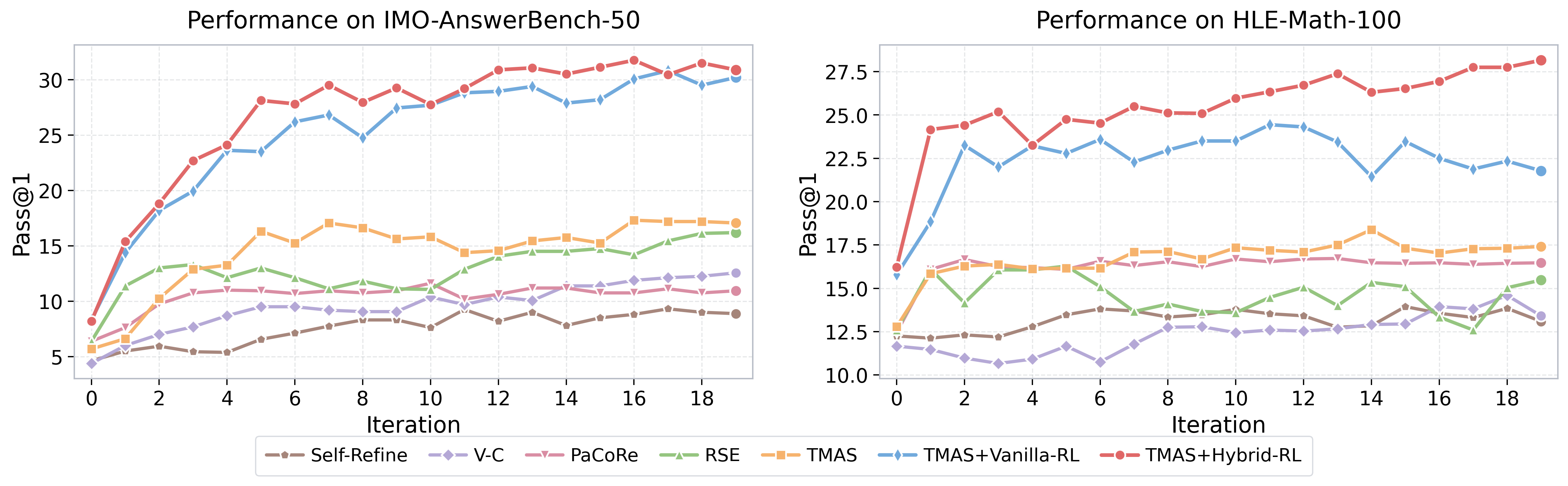
Figure 3 解读:这张图比较 No RL、Vanilla-RL 和 Hybrid-RL 的迭代曲线。Vanilla-RL 只奖励最终正确性,能提高早期能力,但后期容易饱和或回落;Hybrid-RL 额外奖励 experience utilization 与 novel strategy exploration,因此随着 iteration 增加仍能利用 memory bank 继续改进。
5.2 Full IMO-AnswerBench:小 backbone 接近 frontier 系统
完整 IMO-AnswerBench 有 400 题。Qwen3-30B-A3B-Thinking-2507 用 TMAS 从 64.9% 提升到 77.2%,增益 12.3 点;Qwen3-4B-Thinking-2507 用 TMAS + Hybrid-RL 从 53.5% 提升到 73.5%,增益 20.0 点。作者将这些结果与 DeepSeek-V3.2、Kimi-K2.5、Opus-4.6 Max 等报告值放在一起,说明 TMAS 的价值主要体现在用 test-time compute 弥补模型规模差距。
5.3 Ablation:experience 与 guideline 贡献互补
组件消融在 Qwen3-30B-Thinking-2507 + IMO-AnswerBench-50 上进行。完整 TMAS 从 It0 的 10.88 提升到 It11 的 37.81;移除 guideline 后 It11 为 35.75;移除 experience 后 It11 为 33.44;两者都移除后 It11 为 33.16。早期去掉 guideline 的伤害更明显,例如 It1 从 22.06 掉到 10.88,说明 guideline 对快速避开重复策略重要;后期去掉 experience 的伤害更持续,说明低层 verified anchors 对长期 refinement 更关键。
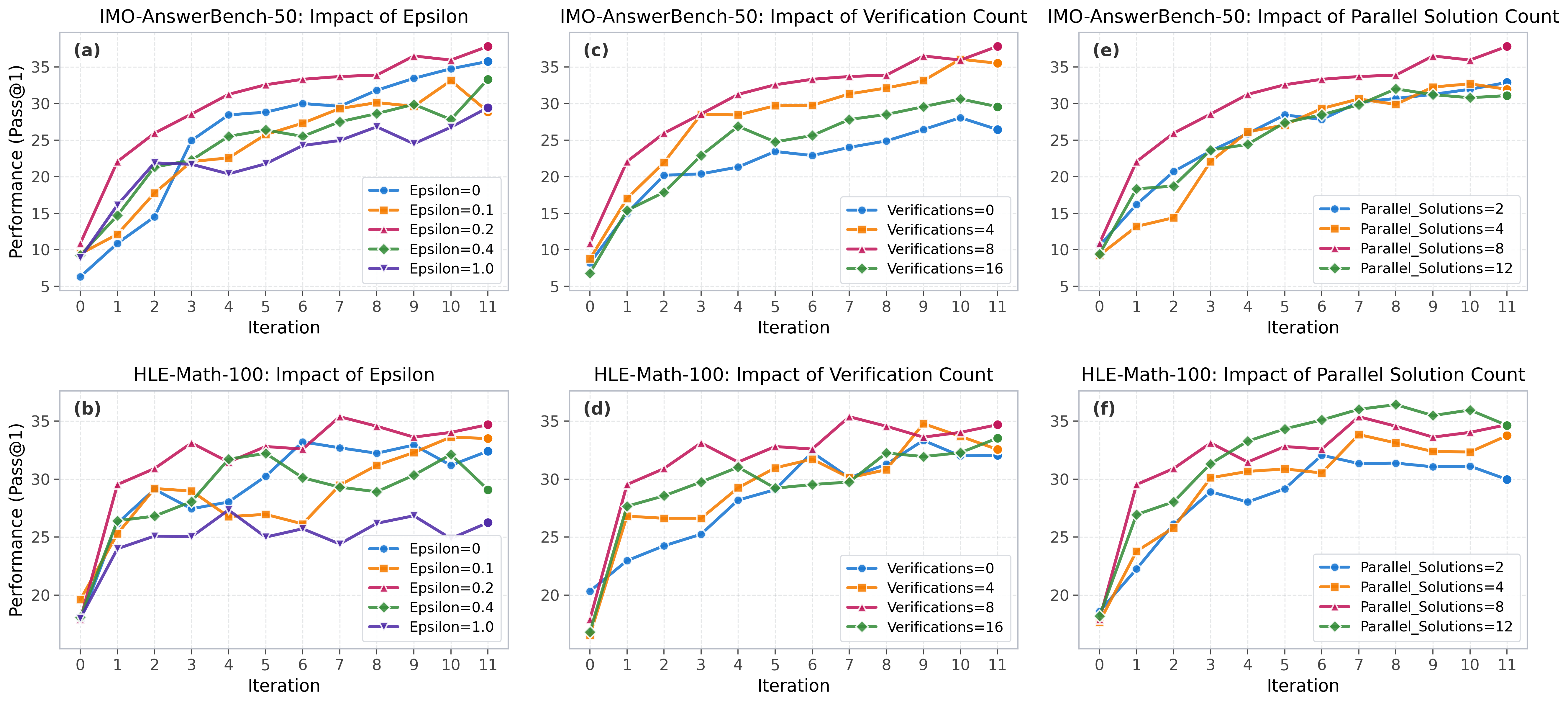
Figure 4 解读:Figure 4a–4f 分别分析 、verification count、parallel solution count 对 IMO-AnswerBench-50 与 HLE-Math-100 的影响。 太保守, 太发散, 最平衡;verification count 从 0 提到 8 明显有益,但 16 会引入冗余或不一致反馈;parallel solutions 太少限制多样性,过多则难以被系统有效整合,8 条是主实验采用的折中点。
5.4 Supplementary benchmarks and exploration analysis
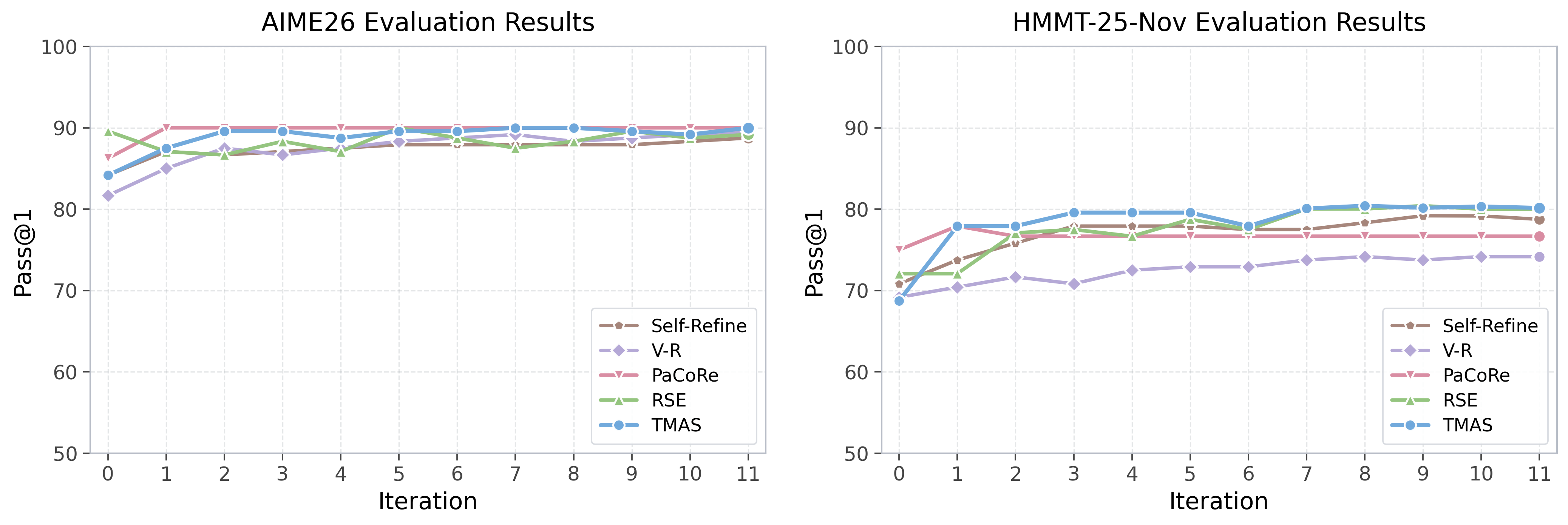
Figure 5 解读:AIME26 与 HMMT-25-Nov 上,不同方法差距较小。作者把它们放在 appendix,是因为这些题对 Qwen3-30B-A3B-Thinking-2507 相对容易,不能充分体现 test-time compute 在高难任务上的边际收益。
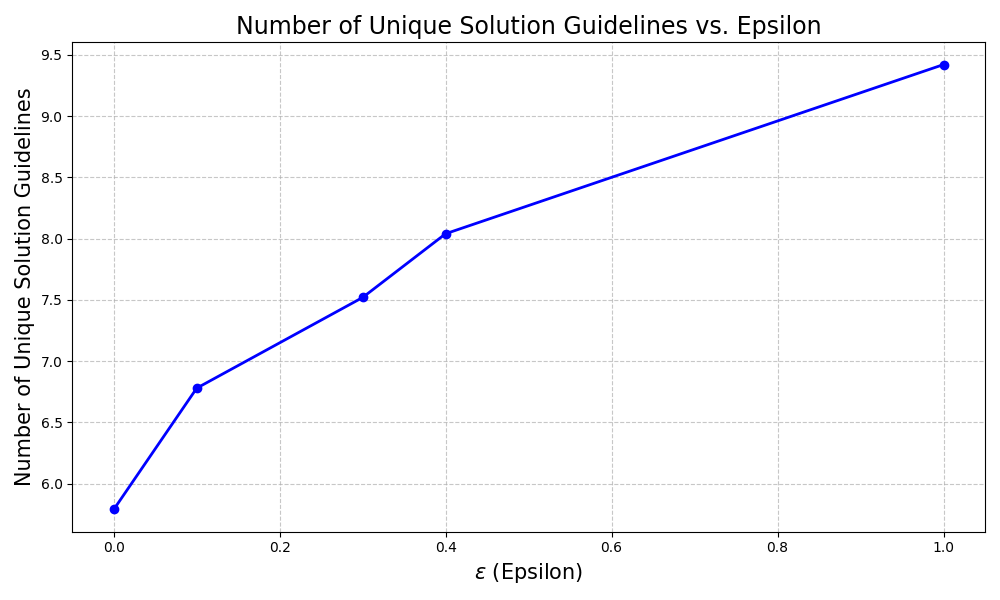
Figure 6 解读:随着 exploration coefficient 变大,unique solution guidelines 数量上升,说明 guideline branch 确实增加了策略多样性。但 Figure 4 已经说明,多样性不是越多越好;太高的 会削弱对已有正确轨迹和 experience 的利用。
5.5 Verification paradox:verifier 与 generator 共享能力边界
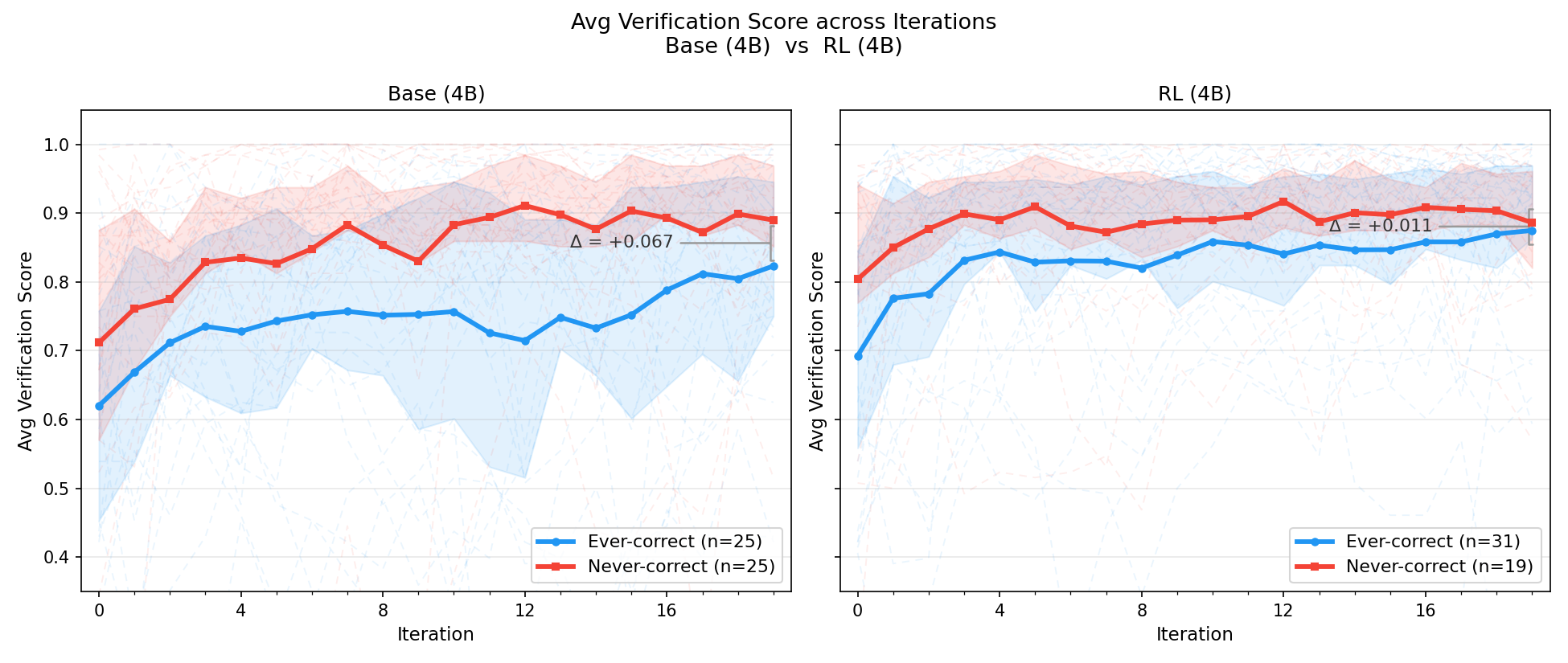
Figure 7 解读:论文把 IMO-AnswerBench-50 题目分成 ever-correct 与 never-correct 两组。基础模型中,never-correct 题反而长期得到更高 verification scores,说明 verifier 在 hardest unsolved problems 上也会误判;Hybrid-RL 后两个组的 verification score 都上移且差距变小,但 verifier 仍不是完美判别器。
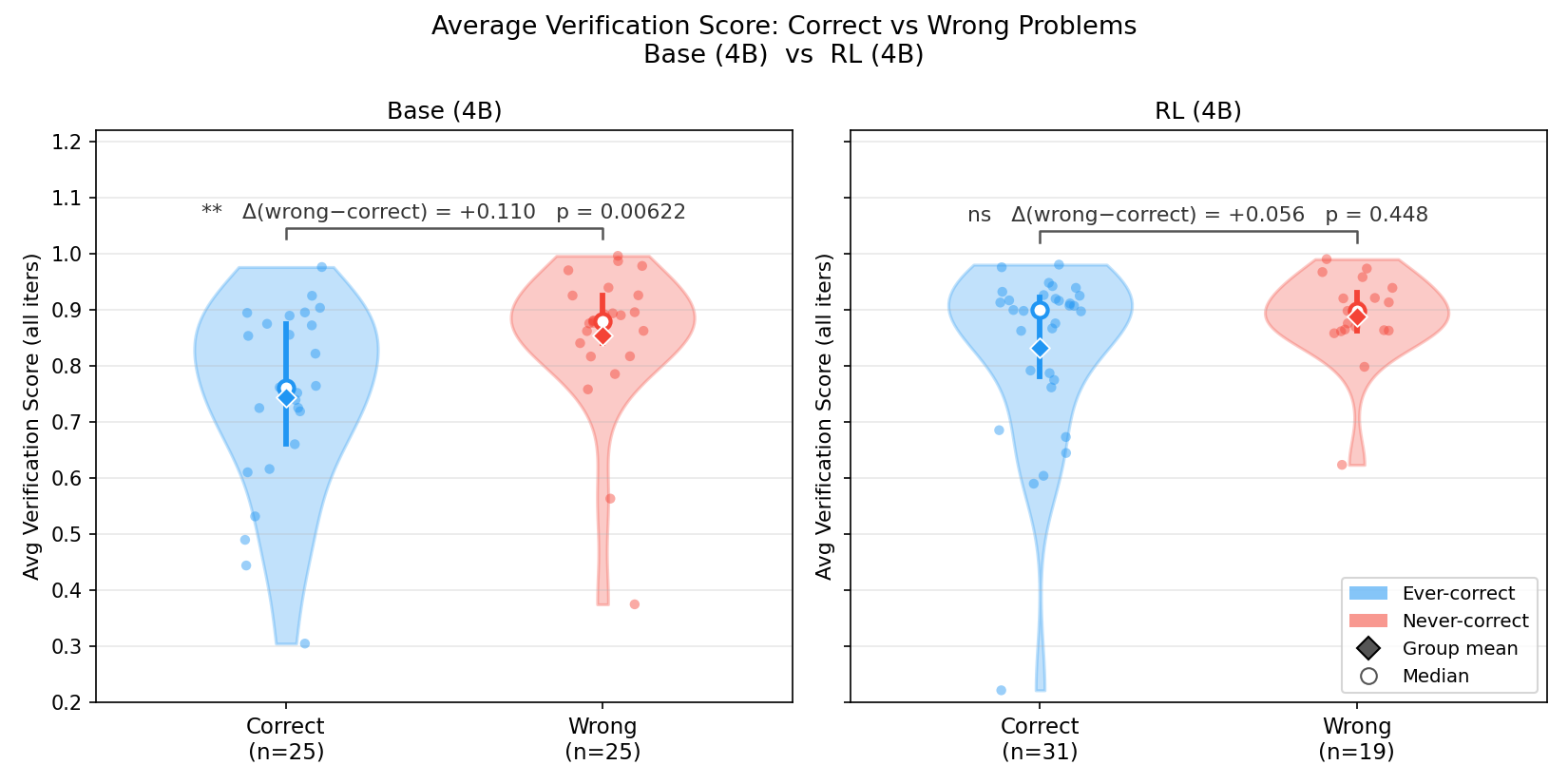
Figure 8 解读:基础模型中 never-correct 题的平均 verification score 比 ever-correct 高 ,且 ,这很反直觉;Hybrid-RL 后差距变成 ,,不再显著。作者据此指出:进一步强化 verifier,或者引入更专门的 verifier model,是 TMAS 后续提升的重要方向。
5.6 Case study:experience bank 如何把一次正确 rollout 变成后续可复用知识
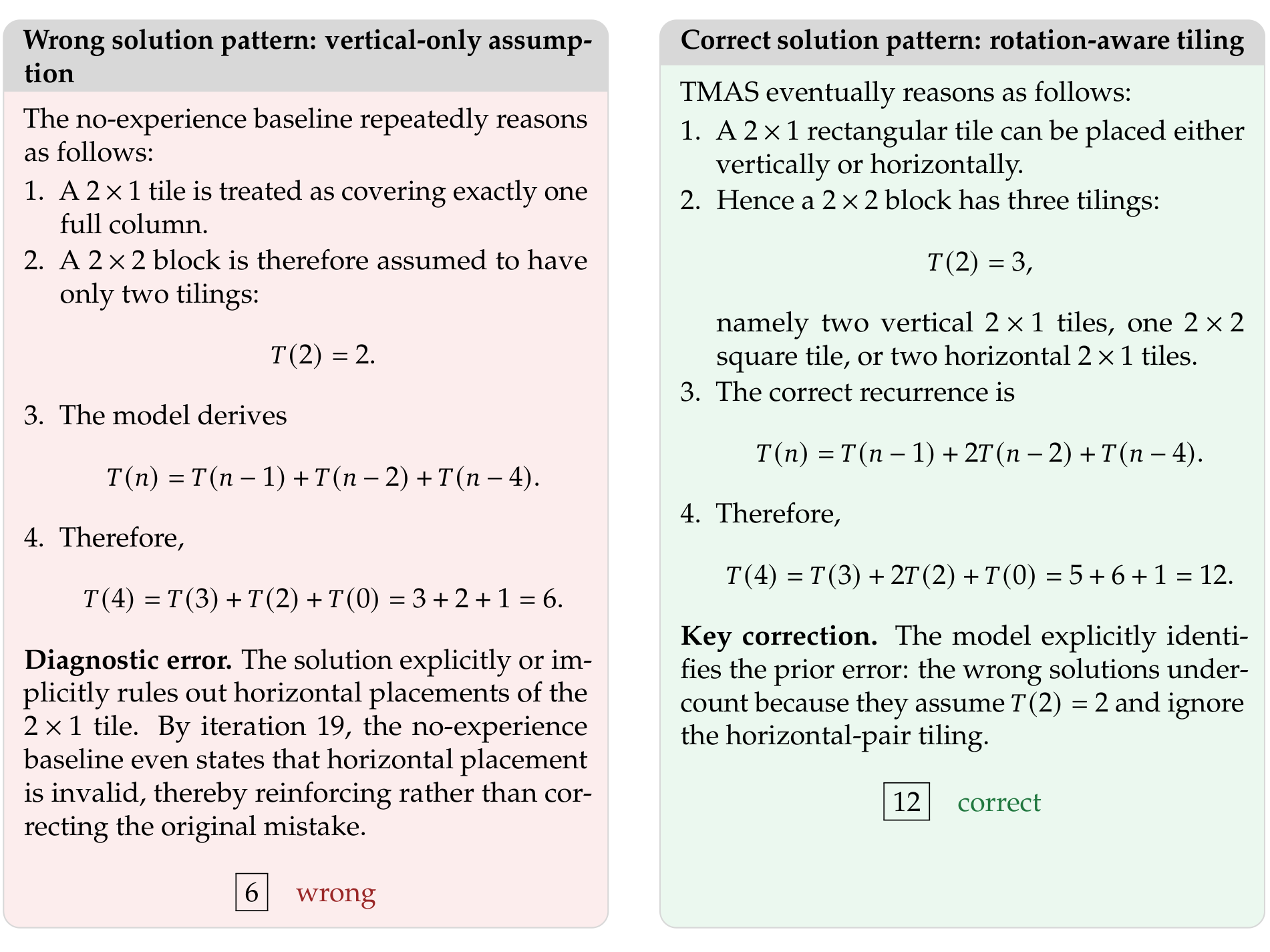
Figure 9 解读:case study 是 HLE-Math-100 的 Problem 720:用 、、 tiles 铺 board。错误路线假设 只能竖放,得到 与 ;正确路线允许 横放,得到 、递推 ,最终 。TMAS 的 experience bank 会保存 、、正确递推式和“不要假设只能竖放”的 avoidance heuristic,使后续 rollouts 从局部正确发现中受益。
Table 11 中的 experience entries 说明 experience bank 存的是低层、可操作的事实:verified anchors 、,structural rule ,以及避免 vertical-only assumption 的 heuristic。Table 12 显示 TMAS 的正确 rollouts 数从 iteration 0/1 的 0/8,到 iteration 5 的 1/8,iteration 10 的 4/8,iteration 11 和 15/19 的 7/8;无 experience baseline 在这些采样点始终是 0/8。这个例子清楚展示了 TMAS 的核心机制:一次正确轨迹不会只作为最终答案候选存在,而会被转写成后续轨迹能直接利用的局部知识。
5.7 Limitations
论文在 conclusion 和 appendix 中强调的主要限制是 verification capability。TMAS 依赖 verifier feedback 来生成 summary、experience 和 guideline;如果 verifier 与 generator 共享同一能力边界,最难题上的错误解可能也得到高分,导致 memory bank 污染或 refinement 方向偏移。作者提出的后续方向包括:让 verifier 针对 ground-truth correctness 更直接地训练、使用更强或更专门的 verifier model、改进 verification signal 与 generation capability 的协同扩展。
整体结论是:TMAS 证明了 test-time scaling 的一个更细粒度方向——不是简单增加 rollouts,而是把 rollouts 产生的信息组织成跨 agent、跨轨迹、跨 iteration 的结构化记忆。Hybrid-RL 则进一步让模型学会何时利用这些记忆、何时跳出已有策略。