Beyond Individual Intelligence: Surveying Collaboration, Failure Attribution, and Self-Evolution in LLM-based Multi-Agent Systems
Paper: arXiv:2605.14892 / HF Papers Code: mira-ai-lab/awesome-mas-life Code reference:
main@7d8e4be9(2026-05-25)
1. Motivation (研究动机)
这篇 survey 关心的不是“单个 LLM Agent 能不能更聪明”,而是一个更靠近真实部署的问题:当多个 LLM-based agents 通过角色、工具、消息和环境状态长期协作时,系统级能力、系统级失败和系统级自我改进会一起出现。作者认为,现有综述把这几条线拆开了:一类综述讲 individual agent 的 reasoning / memory / planning / tool use;一类综述讲 multi-agent collaboration;另一类综述讲 self-evolving agents。但真实 MAS 的关键难点恰恰在它们之间的因果依赖:协作结构决定失败如何传播,失败归因决定改进搜索空间,而自我进化又会重塑协作结构。
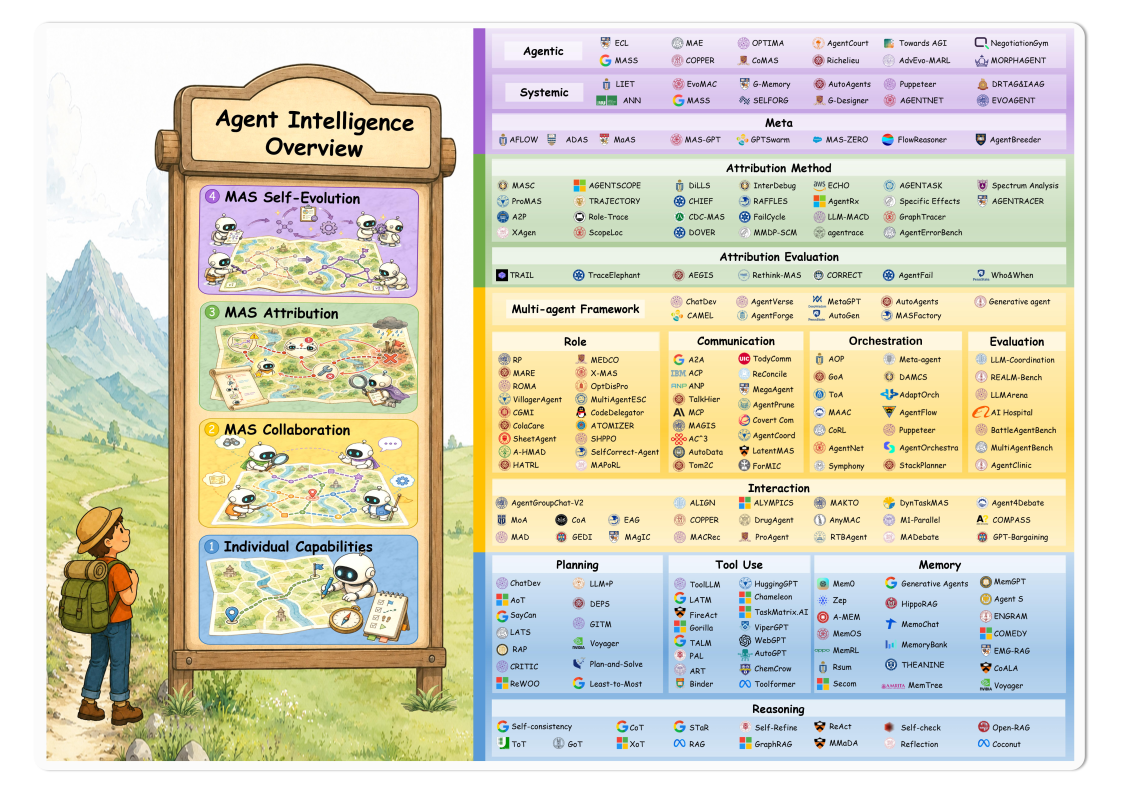
Figure 1 解读:这张图把 LLM-based MAS 的生命周期压缩成一条从 action 到 evolution 的链路。右侧是每个阶段的代表主题与系统,左侧强调阶段之间不是并列 taxonomy,而是有方向的 progression:先有单体能力,才有可组合协作;协作越复杂,失败归因越必要;归因如果不能反哺结构更新,就停留在事后 debugging。
作者指出当前方法的三个具体瓶颈。第一,单体 agent 在长交互、动态任务条件、多工具环境中仍然缺少稳定记忆、规划和闭环行动能力。第二,MAS 虽然能通过角色分工扩大能力边界,但也放大了 inter-agent dependency:一个 hallucinated fact、错误 message routing 或 tool invocation 可能在后续轮次中被其他 agent 继承、改写并放大,导致最终失败点与根因分离。第三,即使能够定位失败,很多系统也只是修补 prompt 或手工调整 workflow,缺少把 failure attribution 转化为 topology、role allocation、communication policy 或 agent behavior 自主改进的机制。
本文要解决的具体问题是:给 LLM-based MAS 建立一个覆盖“能力基础 → 协作组织 → 失败归因 → 自我进化”的统一分析框架。这个框架被命名为 LIFE progression:Lay capability foundation(即 Lay the capability foundation / Lay capability foundation),Integrate agents through collaboration,Find faults through attribution,Evolve through autonomous self-improvement。研究这个问题的价值在于,它把 MAS 从“人工设计协作流程”推进到“可诊断、可重组、可持续自我改进的 collective intelligence”。
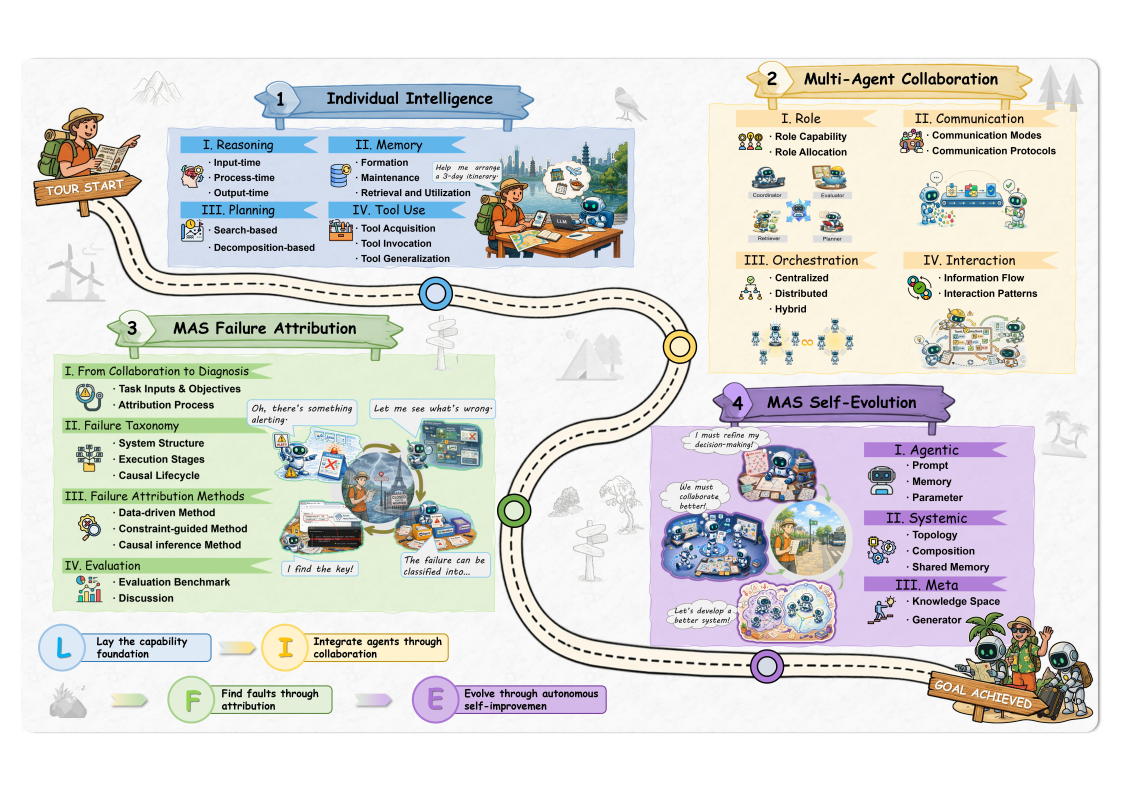
Figure 2 解读:作者用 travel-planning scenario 串起 LIFE 的四步:单体 agent 先具备 observation、memory、planning、tool-use;多个 agent 通过 role / communication / orchestration / interaction 形成协作;系统失败后需要定位是哪一个 agent、哪一步、哪类 failure;最后把诊断结果作为 selection pressure,驱动 agentic、systemic 或 meta-level evolution。
2. Idea (核心思想)
核心 insight 是:LLM-based MAS 不是四个独立研究主题的拼接,而是一个有因果闭环的 operational lifecycle。Individual intelligence 是 collaboration 的能力地基;collaboration 的结构决定 failure attribution 的可观测性和粒度;failure attribution 缩小 self-evolution 的搜索空间;self-evolution 的结果又会改变下一代协作结构。
本文的创新不是提出一个新训练算法,而是把已有研究重新组织成一个可操作的闭环框架:LIFE 既是 taxonomy,也是研究 agenda。它比传统“multi-agent collaboration survey”更进一步,因为后者通常只比较 role、communication、orchestration 和 interaction;本文额外加入 failure attribution,并把它定义为从 collaboration 到 self-evolution 的必要桥梁。
与 MetaGPT / AutoGen / ChatDev 这类具体 MAS framework 相比,本文不关注某一种固定 SOP 或 coordinator 设计是否更好,而关注更上层的问题:如果协作失败了,系统如何知道是 role boundary、message protocol、tool action、verification stage 还是 platform-level orchestration 出错?如果知道了,又如何把诊断结果变成下一代结构或策略?这也是它与只讨论 individual self-improvement 的 agent survey 的根本差异。
3. Method (方法)
3.1 Overall framework: LIFE as a closed-loop survey framework
本文的方法可以理解为一个“survey-level framework construction”:先形式化 individual agent,再形式化 MAS collaboration,然后引入 failure attribution 的输入/输出形式,最后把 MAS 写成按 generation 演化的 time-varying tuple。它没有训练新模型,也没有发布可运行算法;真正的方法贡献是把这些 formal objects 放在同一个 causal chain 中。
LIFE 的四个阶段
- Lay individual capability foundation:单体 agent 必须有 reasoning、memory、planning、tool use,否则多 agent 系统只是多个 stateless LLM call 的堆叠。
- Integrate agents through collaboration:把 agents 组织成 roles、communication protocols、orchestration topology 和 runtime interaction pattern。
- Find faults through attribution:当 MAS 失败时,不只判断 final answer 对错,而要定位 responsible agent、critical step、failure category 和 propagation path。
- Evolve through autonomous self-improvement:把归因结果、peer critique、environment reward 和 self-evaluation 作为 selection pressures,更新 prompt、memory、parameters、topology、protocol 或完整 system design。
这种组织方式的直觉是:MAS 的真正难点不是“更多 agents 是否更强”,而是“系统是否能从自己的协作失败中形成可复用的结构性改进”。如果没有 attribution,evolution 的搜索空间太大;如果没有 evolution,attribution 只能做事后报告;如果没有 collaboration,failure attribution 没有系统级对象;如果没有 individual capabilities,collaboration 没有可靠组件。
3.2 Individual intelligence: agent tuple and four capabilities
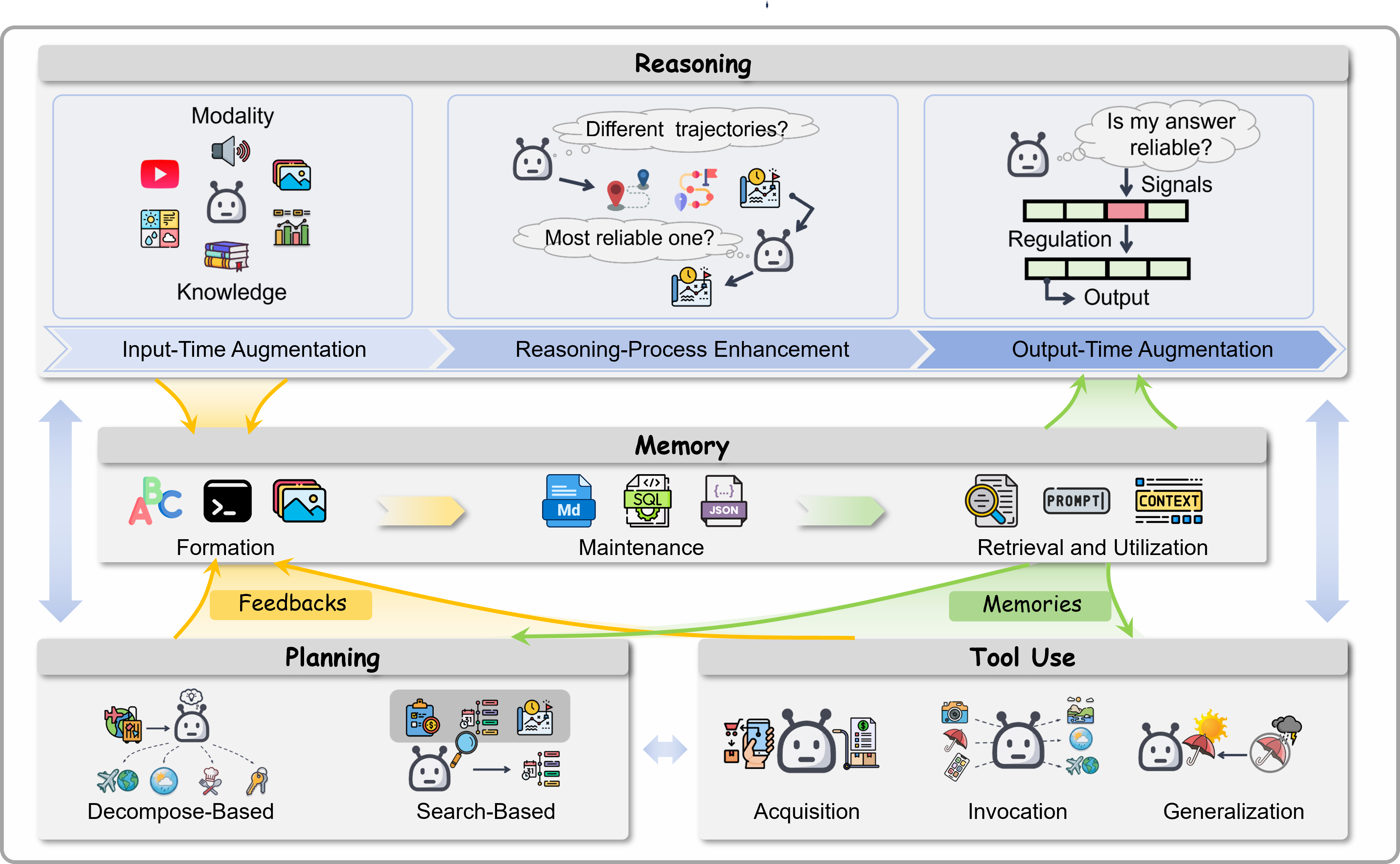
Figure 3 解读:Figure 3 把单体 agent 拆成一条 reasoning pipeline。Memory 不是单独阶段,而是贯穿 observation、reasoning、planning、tool use 和 feedback update 的 cross-cutting module;planning 把高层目标转成多步 action plan;tool use 把 agent 的 action 接到外部环境。这个图说明,单体能力之间有强耦合:只优化 reasoning 而忽略 memory retrieval 或 tool feedback,可能仍然导致部署失败。
作者把 LLM-based agent 定义为: 其中 是 observation space, 是 action space, 是 tool-returned observation space, 是 memory state space,、、 分别对应 reasoning、planning、tool execution。每个时间步 的闭环可以写成: 这里 表示一次交互经验。这个 formalization 的作用是把“agent intelligence”从 monolithic LLM response 改写为 modular decision process:reasoning 产生中间表征,planning 组织行动序列,tool execution 提供 grounding,memory 把一次执行中的 observation/action/tool feedback 保存为后续决策的状态。
作者在 individual intelligence 下比较了 reasoning、memory、planning、tool use 四类能力增强方法。Reasoning enhancement 被拆成 input-stage enhancement、reasoning-process enhancement 和 output-stage regulation;memory enhancement 被拆成 formation、maintenance、retrieval/utilization;planning enhancement 被拆成 decomposition-based planning 与 search-based planning;tool use 被拆成 capability acquisition、tool invocation 和 generalization。Section 2 的讨论强调:现有方法多为 modular optimization,但 capability mismatch 往往发生在模块交界处,当前 benchmark 很难观察这种 inter-module coupling。
3.3 Multi-agent collaboration: from components to topology
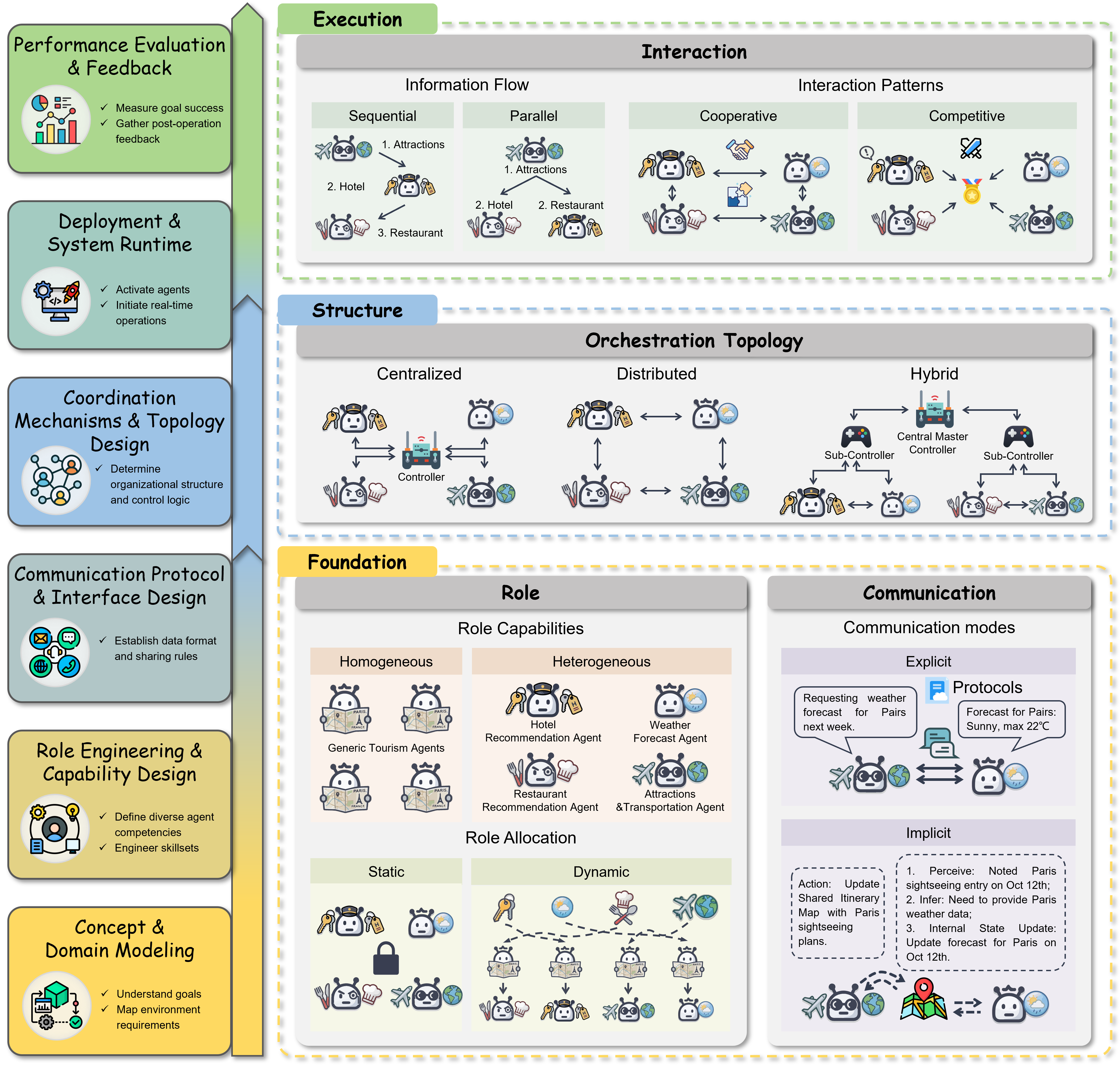
Figure 4 解读:Figure 4 是协作系统的主框架。右侧三层结构把 MAS 拆成 Foundation、Structure、Execution:Foundation 解决任务概念和 domain modeling,Structure 组织 role、communication、orchestration,Execution 关注 interaction、evaluation 和 feedback。左侧生命周期说明 MAS 不是一次性 prompt design,而是从需求建模到执行评估的 bottom-up system design process。
作者把 MAS 定义为: 其中 \mathcal{A}=\{a_1,\ldots,a_N}\} 是 agents, 是 shared environment, 是 communication protocol, 是 orchestration topology, 是 collaboration policies。这个定义对应四个问题:
- Role / Who acts? 角色分配函数 决定每个 agent 的职责和能力边界。
- Communication / How do agents communicate? 消息生成机制 决定消息内容、结构和传播方式。
- Orchestration / How are agents connected? 描述通信边;若 \mathcal{E}_c=\{(a_i,a_j)\mid i\neq j}\},则 agents fully interconnected。
- Interaction / How do agents collaborate during execution? 执行轨迹 包含 actions、messages 和 intermediate reasoning steps,是评价和归因的共同对象。
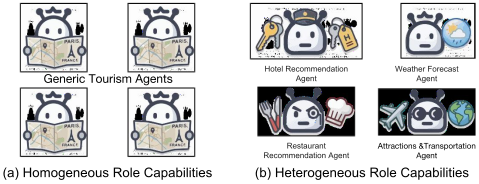
Figure 5 解读:Figure 5 对 role capability 做 taxonomy:homogeneous roles 复用同一底座模型与工具接口,工程简单、适合控制变量;heterogeneous roles 通过不同模型、不同信息访问权限或不同职责实现 specialization,更适合复杂任务,但也更容易出现接口不匹配和责任边界模糊。
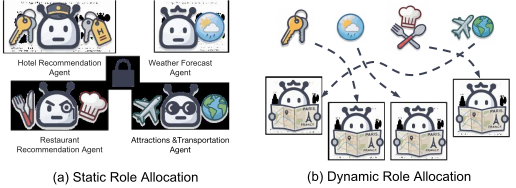
Figure 6 解读:Figure 6 对 role allocation 做 taxonomy:static allocation 便于解释和复现,适合任务结构稳定的流程;dynamic allocation 允许运行时新增、重分配或退休角色,适合 open-ended / non-stationary tasks,但当前很多方法仍依赖 heuristic rule,尚未学会何时需要 specialization、何时 redundancy 有益、何时更多 agents 只是噪声。
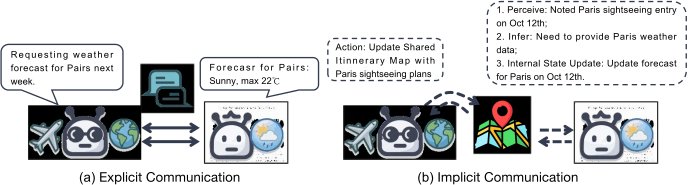
Figure 7 解读:Figure 7 总结 communication modes。显式自然语言消息透明、易审计、适合 debate / critique,但随 agent 数量和交互轮次增长会造成 token overhead、latency 和 context inconsistency;implicit communication 可以通过 shared memory、environment state、latent state 或 policy-conditioned behavior 降低通信成本,但解释性和可控性更难保证。
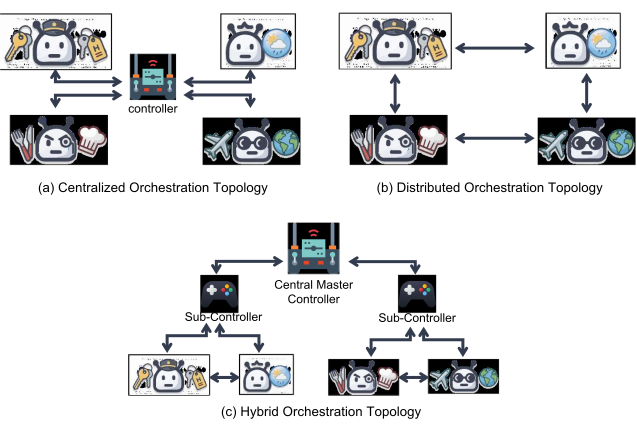
Figure 8 解读:Figure 8 对 orchestration topology 做分类。Centralized topology 有全局控制与清晰责任分配,但存在 coordinator bottleneck 和 single point of failure;distributed topology 增强并行性和鲁棒性,但 consensus、conflict resolution 和 global coherence 更难;hybrid topology 尝试把 top-down structure 与 local autonomy 结合,是当前复杂 MAS 趋势。
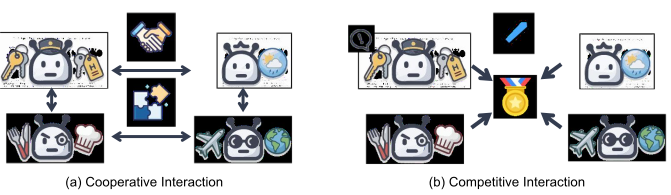
Figure 9 解读:Figure 9 展示 interaction patterns。Sequential interaction 可追踪、适合 refinement / verification / stage ordering,但早期错误容易 cascade;parallel interaction 适合候选生成、多路径搜索和可分解任务,但需要昂贵的 aggregation 与 conflict reconciliation。Cooperative interaction 是主流,competitive interaction 可用于 debate、negotiation、adversarial review,但需要 incentive 和 adjudication 设计,否则容易 reward gaming。
3.4 Failure attribution: make collaboration diagnosable
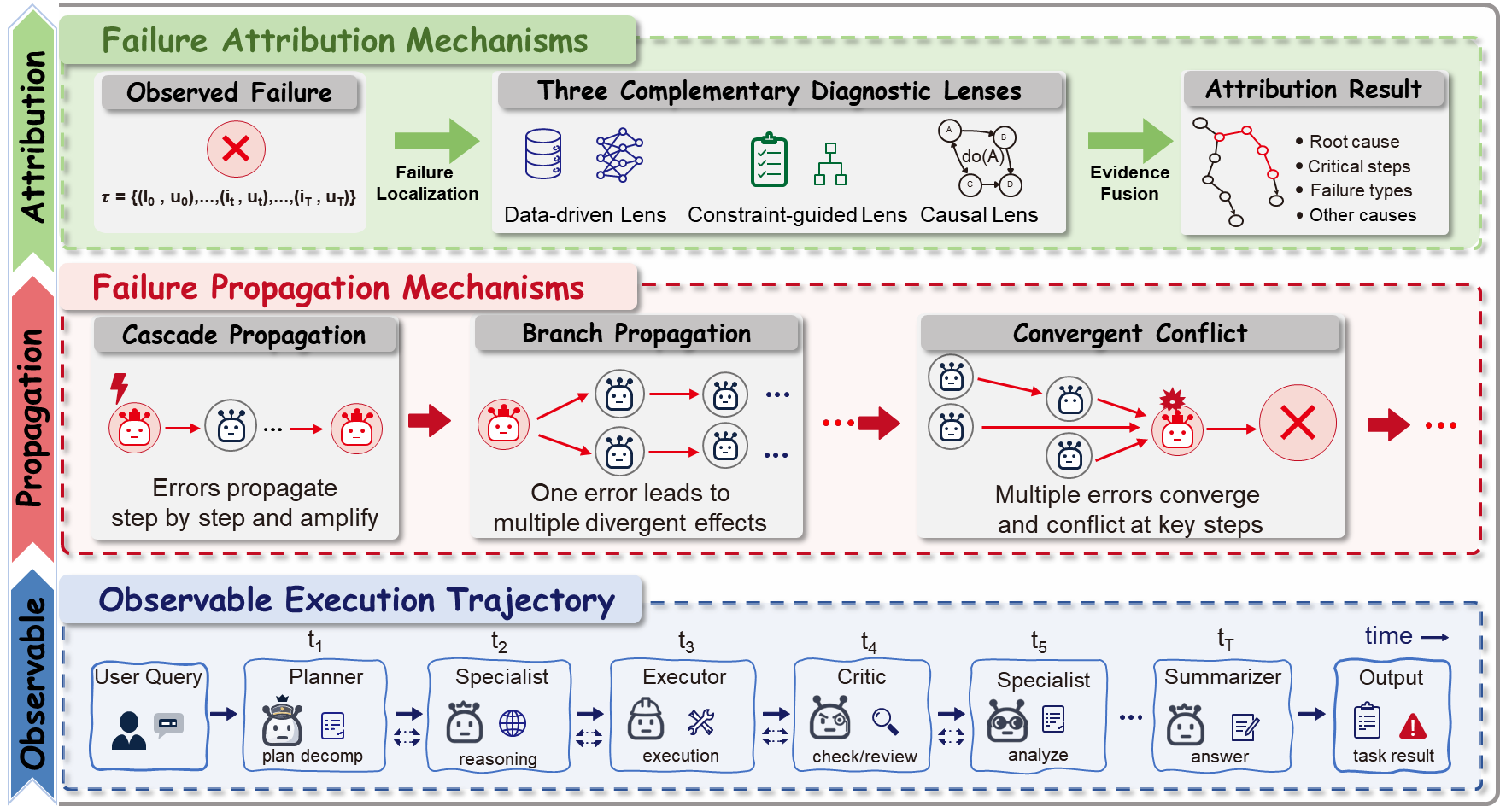
Figure 10 解读:这张图说明 failure attribution 的核心机制:输入不是单步错误,而是完整 multi-agent trajectory;输出也不只是“最后答案错了”,而是 responsible agent、critical time step、failure type、propagation path 和可用于 repair/evolution 的 diagnostic signal。它是从 collaboration 到 evolution 的中间层。
作者定义执行轨迹: 其中 是 horizon, 表示时间步 的 active agent 与其 action。给定 trajectory evaluation function ,当 时表示最终结果异常。Failure attribution model 在系统配置 、用户查询 和轨迹 上返回负责 agent 与关键时间步: 这个 pairwise 形式可扩展到 multi-agent、multi-step 或 causal-chain attribution。作者把 failure taxonomy 分成三类视角:system structure 关注协作链条在哪里断裂,例如 specification/system design failure、inter-agent misalignment、verification/termination failure;execution stages 按 reasoning、tool invocation、planning、memory、reflection、action 等功能模块或时间阶段分类;causal lifecycle 区分 root cause、传播过程和可见失败点,强调 failure origin 往往不等于 manifestation point。
方法族上,本文把 attribution 分为三条路线。Data-driven methods 从 raw logs 转向 labeled failure trajectories、structured representations 和 specialized attribution models,例如 AGENTRACER、AEGIS、GraphTracer、Trajectory Guard。Constraint-guided methods 把 attribution 拆成 scope delimitation、hypothesis generation、minimal correction、outcome prediction、evidence validation 等可审计步骤,例如 SDBL、A2P、DoVer、AgentRx。Causal-inference methods 关注 counterfactual replay、intervention analysis、causal graph / dependency graph,以区分真正 root cause 和 propagated symptom,例如 CDC-MAS、CHIEF、AgentTrace、specific-effect / total-counterfactual-effect 相关工作。
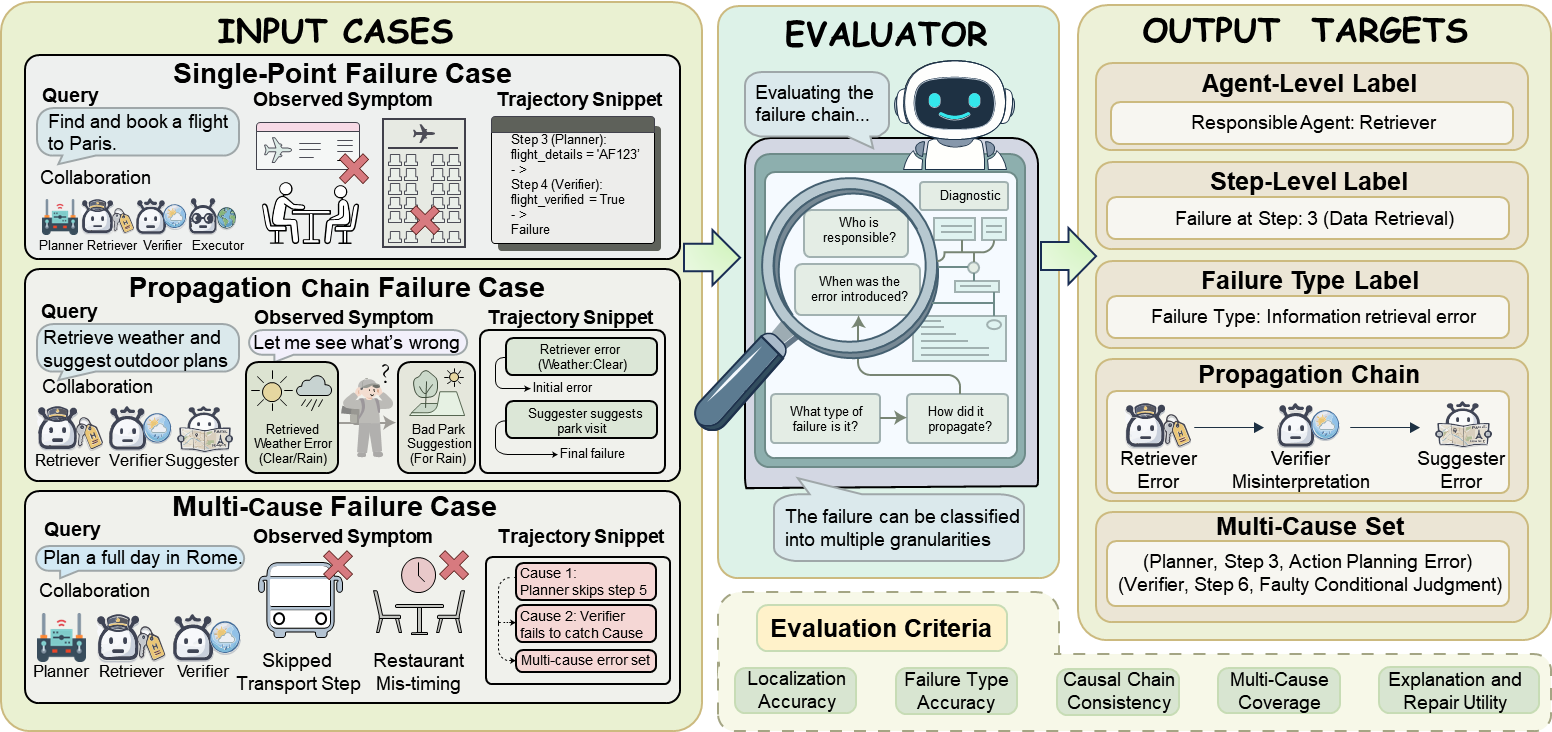
Figure 11 解读:Figure 11 把 attribution evaluation 拆成三类输入 case:single-point failure、propagation-chain failure、multi-cause failure;对应输出也从单一 agent/step 扩展到多粒度 targets。它强调真实 MAS failure 往往不是单因单果,所以 evaluation 需要同时检查 localization accuracy、explanation quality 和 process faithfulness。
3.5 Self-evolution: from diagnosis to next-generation MAS
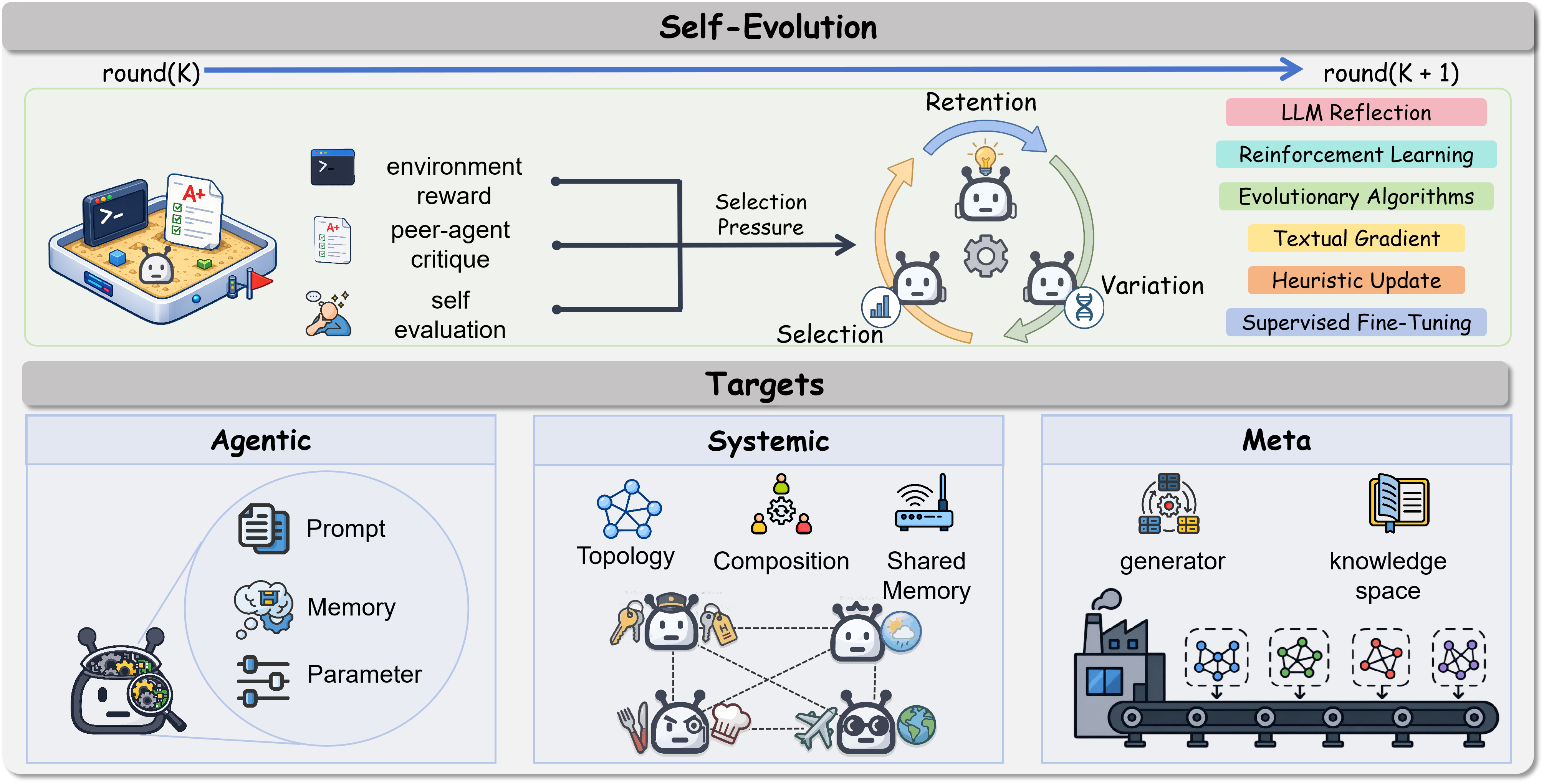
Figure 12 解读:Figure 12 上半部分是 variation–selection–retention 的自进化循环:系统基于环境 reward、peer critique、self-evaluation 和 failure attribution 产生变体,选择更优配置,并把改进保留到下一代。下半部分把 evolution target 分成 Agentic、Systemic、Meta 三层,分别对应 agent 内部组件、单个 MAS 实例的协作结构、以及完整系统设计空间。
作者把 self-evolving MAS 写成 generation-indexed tuple: Self-evolution mechanism 是 transition mapping: 其中 存储历史 trajectories、localized error attributions、peer-agent critiques 等上下文。目标是在任务分布 上提升期望效用: Evolutionary locus 被拆成:
- Agentic evolution:更新 individual agent 的 prompt 、memory 或 parameters 。Prompt evolution 可解释但受 context window 和底座模型能力限制;memory evolution 支持 persistent learning 但带来 retrieval cost 和 historical bias;parameter evolution 用 SFT/RL 把能力内化到权重,推理成本低但训练贵且可能 catastrophic forgetting。
- Systemic evolution:更新 、 或 ,例如 topology rewiring、communication protocol search、dynamic role/team formation。这一层直接回应 failure attribution,因为许多失败不是单 agent 错,而是结构性协作失败。
- Meta evolution:把完整系统配置 当作候选,使用 meta-agent、search algorithm、evolutionary algorithm 或 generator 在 design space 中搜索。ADAS、AgentBreeder、AFlow、MAS-ZERO、FlowReasoner、MaAS、MAS-GPT 等代表不同 search/generator 路线。
作者进一步用 VSR 框架分析 driving mechanisms:LLM Reflection、RL、SFT、EA、Textual Gradient 和 Heuristic Update。Table 13 的关键结论是:31 个 surveyed frameworks 被映射到三种 evolutionary loci 和六类 driving mechanisms;由于有方法跨多个 locus 或混合机制,图中有 36 个 mechanism-locus circles。最密集的是 agentic-level RL,其次是 agentic/systemic-level LLM Reflection;LLM Reflection、RL、EA 是唯一跨三层 locus 都出现的机制,而 Textual Gradient 和 Heuristic Update 目前主要局限在 systemic level。
3.6 Pseudocode: Conceptual workflow, not runnable released implementation
Released repo mira-ai-lab/awesome-mas-life 是 survey companion / awesome list,不是训练或推理代码库;因此下面 pseudocode 反映论文的 formal workflow,而不是 repo 中可执行函数。
def life_closed_loop(system, task_distribution, history):
    """Conceptual LIFE loop from the survey."""
    individual_agents = lay_capability_foundation(system.agents)
    mas = integrate_agents(
        agents=individual_agents,
        roles=assign_roles(individual_agents),
        communication_protocol=system.communication_protocol,
        orchestration_topology=system.topology,
        collaboration_policies=system.policies,
    )

    trajectories = []
    for task in task_distribution.sample_batch():
        tau = execute_collaboration(mas, task)
        trajectories.append(tau)
        if is_anomalous(tau):
            diagnosis = attribute_failure(mas.config, tau, task.query)
            history.add(tau=tau, diagnosis=diagnosis)

    next_system = evolve_mas_generation(mas, history)
    return next_system, trajectories
def attribute_failure(system_config, trajectory, query):
"""Implements the paper's piecewise attribution definition."""
if evaluate_trajectory(trajectory) != 1:
return None
candidates = extract_agent_step_candidates(trajectory)
evidence = build_failure_evidence(
system_config=system_config,
trajectory=trajectory,
query=query,
candidates=candidates,
)
responsible_agent, critical_step = rank_root_causes(evidence)
propagation_path = trace_downstream_effects(
trajectory=trajectory,
root=(responsible_agent, critical_step),
)
return {
"agent": responsible_agent,
"step": critical_step,
"propagation_path": propagation_path,
"repair_signal": summarize_for_evolution(evidence),
}def evolve_mas_generation(mas, history):
"""Conceptual transition S^(k+1)=Gamma(S^(k), H^(k))."""
variation_pool = []
for diagnosis in history.recent_diagnoses():
variation_pool += propose_agentic_updates(mas, diagnosis) # prompt/memory/parameters
variation_pool += propose_systemic_updates(mas, diagnosis) # topology/protocol/policy
variation_pool += propose_meta_designs(mas, history) # whole-system candidates
scored = []
for candidate in variation_pool:
utility = evaluate_expected_utility(candidate, task_distribution=history.tasks)
cost = estimate_execution_cost(candidate)
safety = evaluate_alignment(candidate)
scored.append((utility, cost, safety, candidate))
selected = select_under_constraints(scored)
return retain_evolutionary_gains(previous=mas, selected=selected, history=history)3.7 Code / paper mapping and implementation gap
Code reference:
main@7d8e4be9(2026-05-25) — pseudocode and mapping based on this commit. The repository is a curated survey companion, not an executable MAS implementation.
| Paper Concept | Source File | Key Class/Function |
|---|---|---|
| LIFE paper metadata, contents, and curated reading list | README.md | Markdown headings: Individual Intelligence, Multi-Agent Collaboration, Failure Attribution, Self-Evolution |
| Survey bibliography backing the paper list | reference.bib | BibTeX entries for surveyed systems and benchmarks |
| Companion figures for surveyed works | figs/*.png | Static assets referenced by README paper list |
| Placeholder metadata/config | configs/readme_survey_config.json | Placeholder fields only: PLACEHOLDER_ARXIV_ID, PLACEHOLDER_HF_PAPER_ID, PLACEHOLDER_VENUE, PLACEHOLDER_YEAR |
| Paper formal definitions and figure captions | arXiv source survey_main.tex | LaTeX equations for , , , , and |
论文公式与 released code 实现差异:paper 给出了 agent tuple、MAS tuple、failure attribution function 和 self-evolution transition mapping,但 official GitHub awesome-mas-life 没有实现这些函数,也没有训练 loop、evaluation runner、launch script 或 hyperparameter config。它是公开维护的 literature/taxonomy resource。因此本笔记不把任何 repo 文件解释为算法实现;github_ref 只锚定 README、figures、BibTeX 和 placeholder config 的版本。
4. Experimental Setup (实验设置)
这是一篇 survey,没有提出新的训练方法、模型架构、benchmark protocol 或 controlled experiment;因此不存在“本文方法 vs baseline”的实验设置,也没有 GPU、learning rate、batch size、training steps 等训练超参。官方 repo 的 configs/readme_survey_config.json 只有 placeholder metadata,不是训练配置。
作者实际整理的是 evaluation landscape:
- Single-agent capability benchmarks:Table 5 覆盖 comprehensive、web、desktop/mobile、code/software、tool use、planning、memory、science/ML、enterprise、safety 等域。示例规模包括 ToolBench 12,657、API-Bank 314、T-Eval 553、AppWorld 750、-bench 168、BFCL 2,000+、ToolSandbox 180、ALFWorld 134、ScienceWorld 300、LoCoMo 10 conversations、LongMemEval 500、MemoryAgentBench 1,000+、MLE-bench 75、MLAgentBench 13、CORE-Bench 270、ScienceAgentBench 102、PaperBench 20 papers、WorkArena++ 682、CRMArena 1,186、Cybench 40、AgentHarm 440。
- Multi-agent collaboration benchmarks:Figure 10 / Section 3.5 讨论 LLM-Coordination、LLMArena、BattleAgentBench、MultiAgentBench、AgentClinic、MVME、REALM-Bench 等,用 task components、evaluation samples 和 metrics 比较 collaboration quality、sequential decision-making、cooperative/competitive capability、milestone KPIs、topology effects 等。
- Failure attribution datasets:Table 9 给出 Who&When 184、TRAIL 148、AgentFail 307、AgentErrorBench 200、CORRECT-Error 2000+、AgentErrata 210、MP-Bench 289、TraceElephant 220;annotation 包括 manual 与 synthetic,granularity 包括 Agent+Step、Step+Type、Agent+Category、Category+Feedback、Multi-Step 等。
- Self-evolution evaluation environments:Section 5.5 把 evaluation environments 分为 static benchmarks(MMLU、GSM8K、MATH、HumanEval)、interactive environments(SWE-Bench、rSDE-Bench、AgentCourt、NegotiationGym)、embodied sandboxes(如 TDW-MAT)和 adversarial arenas(如 SaladData 或 adversarial self-play)。
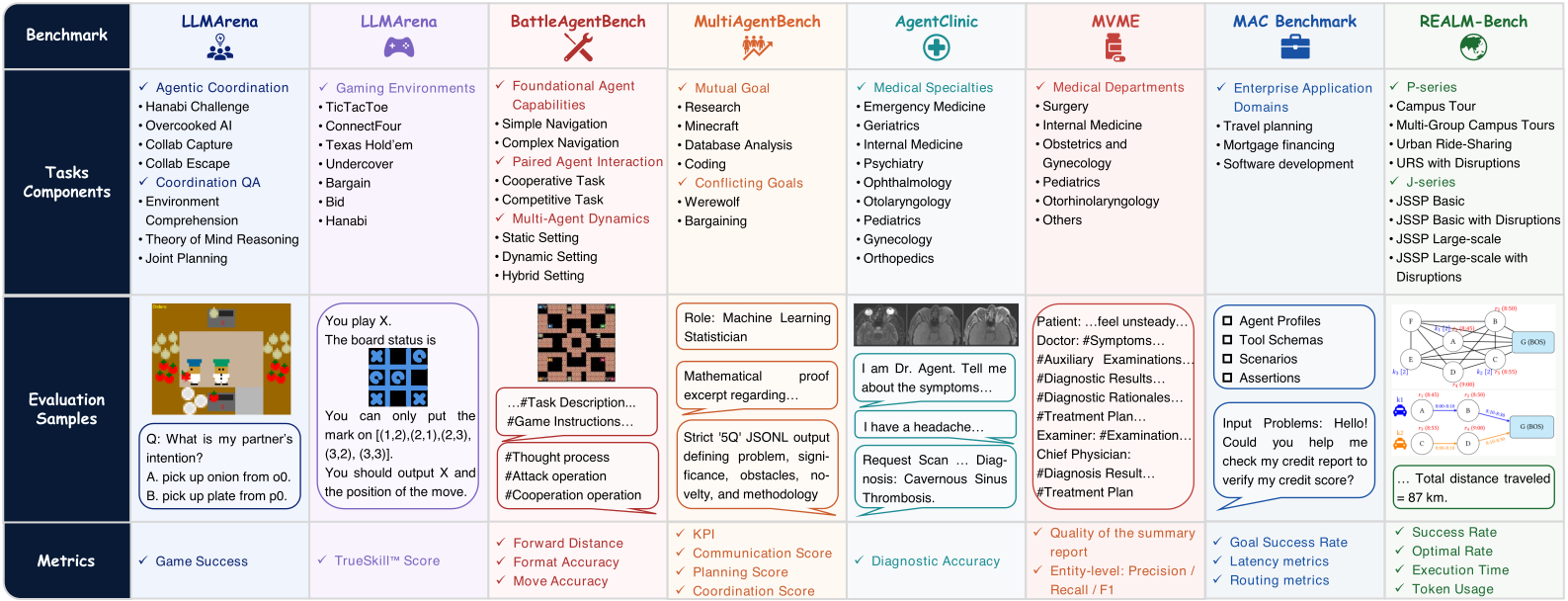
Figure 13 解读:Figure 13 汇总 multi-agent collaboration benchmark 的评价维度。它说明 MAS benchmark 正从 final-answer accuracy 转向 trajectory-level signals:是否需要多 agent 信息共享、是否包含多轮协作、是否评价 communication topology、milestone completion、success rate、LLM-as-judge 或 composite metrics。对本文框架而言,这些 benchmark 是 collaboration 和 attribution 的共同数据基础。
5. Experimental Results (实验结果)
由于本文是 survey,不报告一个新模型在 benchmark 上的主结果表;“结果”主要是对已有文献的结构化发现。
5.1 LIFE-level findings
最重要的结论是,四个阶段之间存在方向性约束:individual agent 的 reasoning / memory / planning / tool use 决定协作组件的可靠性;collaboration topology、communication protocol 和 interaction pattern 决定哪些失败能被观察、记录和归因;failure attribution 把长轨迹中的异常压缩成可行动的 repair signal;self-evolution 则把这些 signals 转化为 prompt、memory、parameter、topology、protocol 或完整 system design 的变化。
5.2 Collaboration findings
Table 7 比较了 12 个代表性 MAS frameworks:Generative Agent、CAMEL、GPT-Bargaining、MetaGPT、AutoGen、AgentVerse、AutoAgents、MAPoRL、OSC、Puppeteer、AgentForge、MASFactory。作者的归纳是:早期 homogeneous/static systems 易设计但容易陷入重复 self-consistency loops;新系统越来越多采用 heterogeneous roles、dynamic role allocation、hybrid/distributed orchestration 和 optimization loop。没有一种 topology 普遍最优:centralized 强在全局控制,distributed 强在自治和单点故障鲁棒性,hybrid 试图折中;sequential execution 强在可解释,parallel execution 强在多样性和鲁棒性,但需要 aggregation。
5.3 Attribution findings
Failure attribution research 的主要趋势是从“让 LLM 读完整 log 并判断谁错了”转向三类更系统的方法。Data-driven methods 通过 labeled failure trajectories、counterfactual replay、error injection、suspiciousness scoring、dependency graphs 等学习或缓存可复用 failure patterns;constraint-guided methods 通过 scope delimitation、taxonomy、intervention、replay 和 evidence validation 缩小搜索空间;causal-inference methods 用 counterfactual effect、causal discovery、hierarchical causal graph、dependency tracing 来区分 root cause 与 propagated symptom。Table 9 的数据集规模显示 attribution benchmark 仍偏小,最大明确规模是 CORRECT-Error 的 2000+,其余多在 148–307 区间,因此 generalization 和 open-ended failure coverage 仍是限制。
5.4 Self-evolution findings
Agentic evolution 当前最密集的是 parameter-level RL / SFT 路线,例如 CoMAS、MAE、AdvEvo-MARL、Optima、ECL 等;prompt 和 memory evolution 更可解释、更轻量,但能力上限受底座模型和 retrieval 机制限制。Systemic evolution 更贴近 MAS 本体,关注 topology、communication protocol、role/team formation 和 workflow;Meta evolution 则把完整 MAS 设计当作搜索对象,知识空间路线(如 ADAS、AgentBreeder、AFlow、MAS-ZERO)探索充分但昂贵,generator 路线(如 FlowReasoner、MaAS、MAS-GPT)更快但可能牺牲可验证性。
Table 13 的精确结论是:作者把 31 个 self-evolution frameworks 映射到 3 个 evolutionary loci 和 6 类 driving mechanisms;由于 hybrid 或跨 locus 方法存在,圈点总数是 36。RL at the agentic level 是最密集 cluster,LLM Reflection 在 agentic 和 systemic level 也很密集;LLM Reflection、RL 和 EA 是唯一覆盖三个 loci 的机制,Textual Gradient 和 Heuristic Update 目前只出现在 systemic level。作者特别指出 hybrid mechanisms 很少,这提示 future work 可以结合 EA 的 population diversity、RL 的 parametric refinement 和 Reflection 的 semantic directedness。
5.5 Limitations and open challenges
作者明确指出若干限制与开放问题。第一,当前 MAS evolution 多为 online-ephemeral 或 offline-persistent,距离真正 lifelong evolution 还有差距;参数进化可能 catastrophic forgetting,memory evolution 又会遇到 retrieval degradation 和 context cost。第二,self-evolution 搜索空间组合爆炸,每个候选 MAS 都可能需要完整多 agent workflow 执行,token、latency 和 API cost 很高。第三,evolving MAS 可能绕开静态安全约束,若 selection pressure 只优化 task success,可能产生 deceptive communication、collusion 或 reward hacking。第四,现有 static benchmarks 无法衡量系统随 generation 的 adaptation speed、robustness 和 behavioral diversity;未来需要 open-ended protocols,从“Generation 的绝对准确率”转向 evolutionary sample efficiency 和跨任务结构迁移能力。
5.6 Overall conclusion
本文的贡献在于把 LLM-based MAS 的研究对象从“如何设计一组 agent 协作完成任务”扩展为“如何构建一个能诊断并重塑自身协作结构的闭环系统”。它的最终判断是:multi-agent systems 的长期潜力不只是让多个独立设计的 agents 更好协作,而是培养一种 collective intelligence,使系统级能力从 agent interaction 中涌现,并超过任何单个组成 agent 的能力。