The Last Human-Written Paper: Agent-Native Research Artifacts
Paper: arXiv:2604.24658 Code: Orchestra-Research/Agent-Native-Research-Artifact(GitHub API canonical full name:
AmberLJC/Agent-Native-Research-Artifact) Code reference:main@dc4cc1f8(2026-05-19)
1. Motivation (研究动机)
这篇论文的出发点不是“把论文排版得更适合 AI 阅读”,而是指出当前 scientific publication 的基本抽象已经错位:研究过程本来是一个 branching knowledge object,包含被尝试又放弃的假设、实验失败、调参轨迹、工程 workaround、环境约束和证据链;最终论文却把它编译成线性 narrative。作者把这个压缩过程拆成两个税:Storytelling Tax 和 Engineering Tax。前者指 dead ends、rejected hypotheses、branching exploration 被叙事格式丢掉;后者指“足够 reviewer 看懂”的 prose 与“足够 agent 复现/扩展”的 executable specification 之间存在缺口。
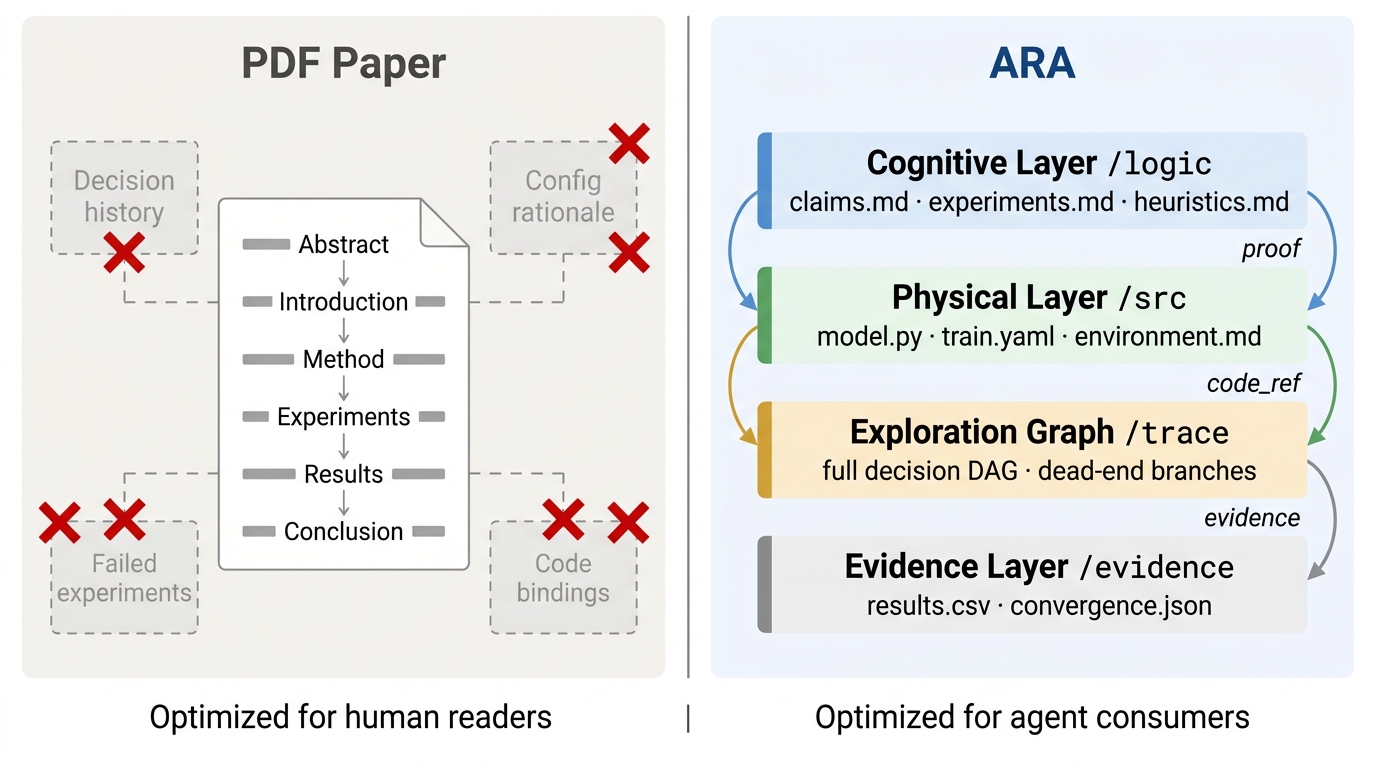
Figure 1 解读:左侧传统 PDF 是从完整研究对象编译出的 lossy narrative;右侧 ARA 把研究对象保存为 machine-executable knowledge package。核心差别不在文件格式,而在信息保真度:PDF 主要服务 human storytelling,ARA 服务 agent 的检索、执行、验证和扩展。
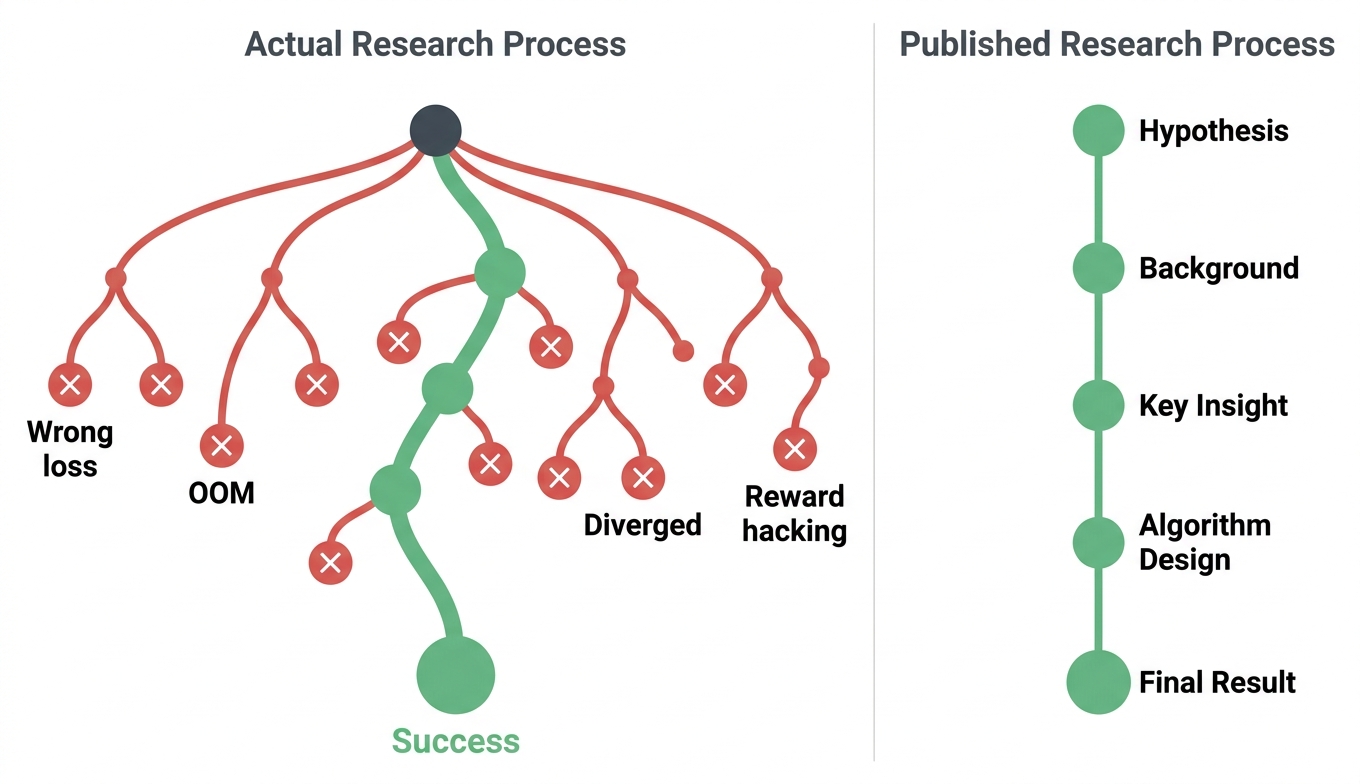
Figure 2 解读:研究真实发生时像一棵树,包含失败分支、pivot 和经验性 heuristics;论文发表时通常只保留一条成功路径。对人类读者这可能是可接受的叙事压缩;对后续 agent 来说,失败路径恰恰是避免重复试错的高价值信息。
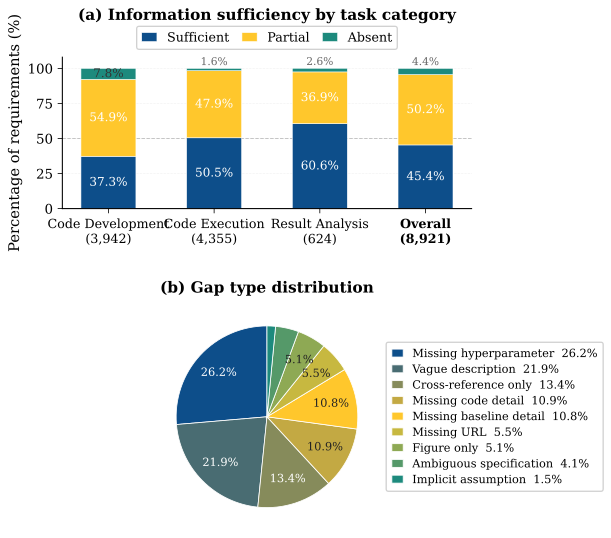
Figure 3 解读:作者用 PaperBench 的 8,921 个 reproduction requirements 量化 Engineering Tax:source PDF 只充分说明 45.4% 的需求,50.2% 只是部分说明,4.4% 完全缺失。最常见 gap 是 missing hyperparameter(2,558,占 26.2%)、vague description(2,141,占 21.9%)和 cross-reference only(1,313,占 13.4%)。
论文要解决的问题是:当 AI agents 开始成为论文的主要消费者之一时,传统 paper + repo 是否仍然足以支持理解、复现、扩展和审稿?作者的答案是否定的。目标不是写一个更长的 appendix,而是把 primary research object 从 linear paper 换成 agent-native research artifact:一个可被 agent 用标准文件工具读取、导航、执行、验证的研究包。
这个问题值得研究,因为 AI agents 的能力瓶颈越来越少是“读不懂论文文字”,而是“无法获得论文没有保存的信息”。如果 artifact 能保留 configuration depth、exploration depth 和 evidence lineage,后续 agent 就不需要重复挖掘同一个 repo、重复踩同一个 failure mode,也可以把审稿中的机械检查转给机器,把 human reviewer 留给 novelty、significance 和 taste。
2. Idea (核心思想)
核心 insight:论文不应再是研究的唯一原件,而应只是从一个结构化研究对象编译出的 human-readable view。Agent-Native Research Artifact (ARA) 把科学逻辑、可执行规格、探索轨迹和证据层拆成可独立读取的文件系统层,并用 forensic bindings 把 claim、code、experiment、raw evidence 连接起来。
关键创新有三层:第一,提出 ARA protocol,即四层目录结构和 schema;第二,提出 Live Research Manager,让研究过程在 agent-human sessions 中自然 crystallize 成 ARA,而不是要求研究者手工填表;第三,提出 ARA Compiler 和 ARA-native review system,用来把 legacy PDF/repo 编译成 ARA,并用 Seal Level 1–3 做结构、论证和执行层面的机器验证。
它与现有 artifact 的根本差别在于:传统 PDF+GitHub、OpenReview appendix、Artifact Evaluation、ReproZip、Jupyter notebook 等主要保存“最终结果或可运行环境”;ARA 试图保存研究的认知结构和失败轨迹。例如 PDF+repo 可以让 agent grep config,但不告诉它为什么某个 design path 被放弃;ARA 的 /trace/exploration_tree.yaml 和 /logic/solution/heuristics.md 会把这个 negative knowledge 变成一等公民。
3. Method (方法)
3.1 Overall framework:ARA as a four-layer filesystem ontology
ARA protocol 把一个研究项目组织成四层:Cognitive Layer (/logic)、Physical Layer (/src)、Exploration Graph (/trace) 和 Evidence Layer (/evidence)。这四层分别回答 agent 的四类问题:为什么成立、如何实现、沿途试过什么、有哪些原始证据。相比把所有信息压在一个 PDF 里,ARA 让 agent 通过 progressive disclosure 只加载当前任务相关的文件,避免上下文污染。
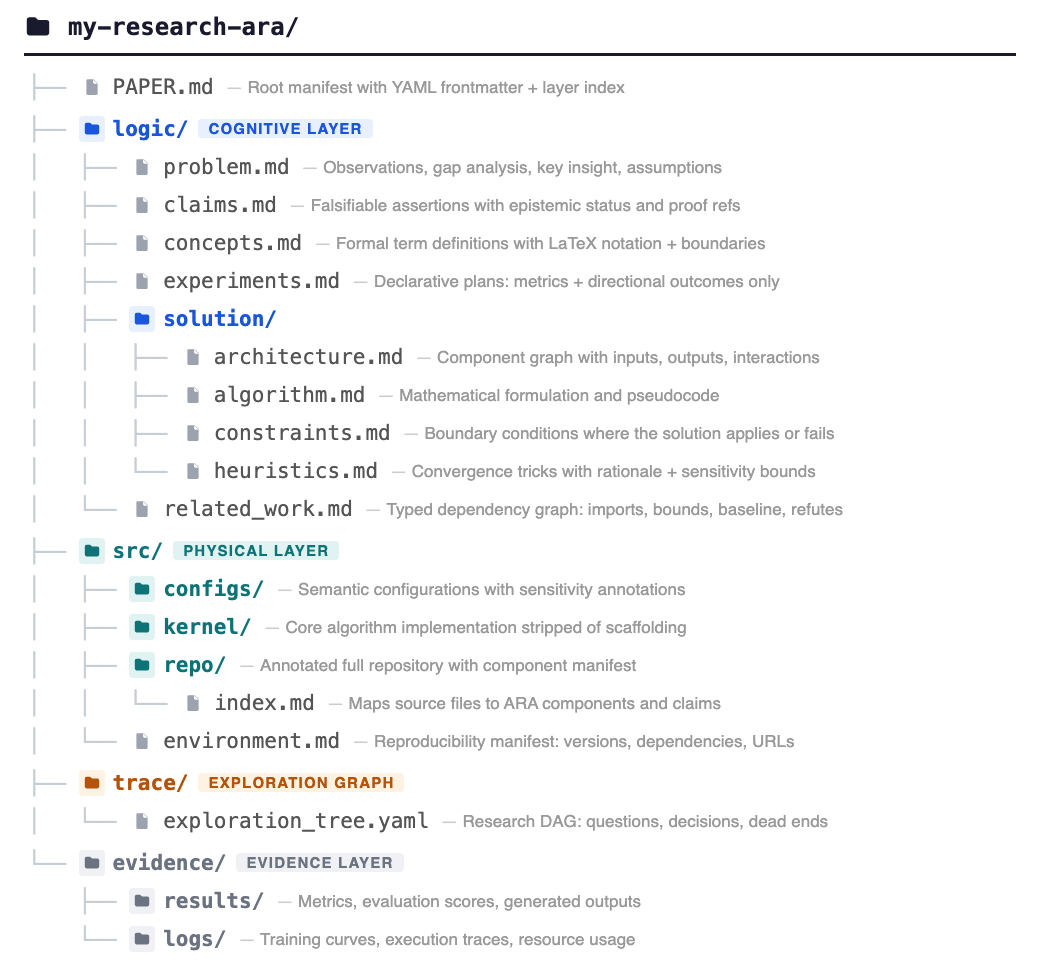
Figure 4 解读:目录结构本身就是协议。PAPER.md 是入口 manifest;logic/ 保存 problem、claims、concepts、experiments 和 solution;src/ 保存 configs、execution stubs、environment;trace/ 保存 exploration tree 和 sessions;evidence/ 保存 table/figure/raw output 索引。图中标注的 forensic bindings 说明每个 claim 应能向下追到 code/evidence,也能向上追到 problem/decision。
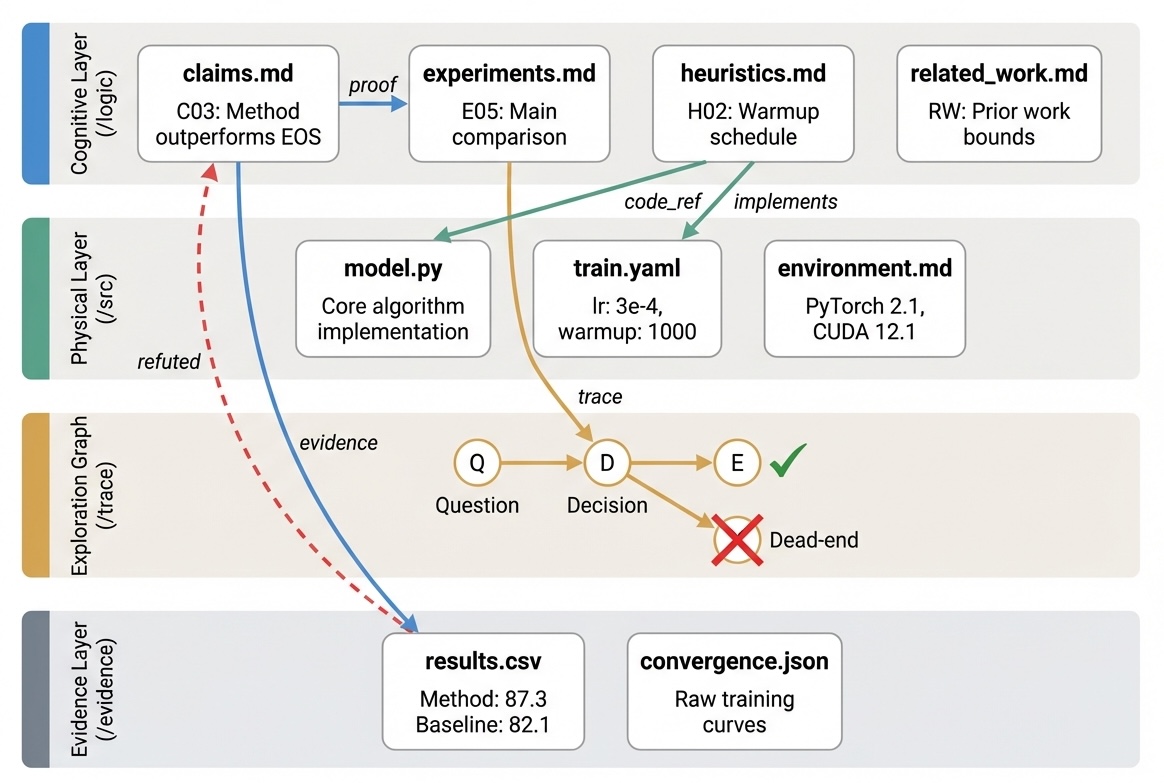
Figure 5 解读:这张图展示真实 ARA 的 cross-layer 结构:/logic/claims.md 中的 claim 不是孤立文本,而是连接到 /src 中的实现、/evidence 中的表格或 figure、以及 /trace 中的 dead-end/decision 节点。这样 reviewer 或 agent 可以问“这个 claim 的证据是什么”“对应代码在哪里”“是否有失败分支反驳它”。
直觉上,ARA 的有效性来自“把检索问题改写成定位问题”。传统论文中,一个 hyperparameter 可能在 appendix table、README、config default 或脚注中散落;在 ARA 中,它应该集中进入 src/configs/training.md 并通过 claim/evidence 链被引用。Agent 不再需要在长 PDF 和 repo 中搜索,而是按 ontology 路由到应有位置。
3.2 ARA Protocol:四层的输入/输出与失效模式
- Cognitive Layer (
/logic):输入是 paper/rubric/session 中的研究问题、claim、概念、实验设计;输出是可引用的 observations、gaps、claims、experiments、algorithm/constraints/heuristics。若缺失这一层,agent 只能读 narrative,无法区分 evidence basis 与作者 interpretation。 - Physical Layer (
/src):输入是 repo、configs、environment、核心实现;输出是可执行或 stub-level 的代码与配置规格。若缺失这一层,复现实验会退化成从 prose 推断工程细节。 - Exploration Graph (
/trace):输入是 session logs、MALT traces、失败实验和 pivot;输出是 DAG,包括 decision、dead_end、experiment、lesson。若缺失这一层,后续 agent 会重复探索已知 dead ends。 - Evidence Layer (
/evidence):输入是 raw tables/figures/logs/checkpoints;输出是结构化 evidence index。若缺失这一层,claim 只能停留在文本断言,无法做 machine-checkable review。
3.3 Live Research Manager:born-agent artifact 的捕获机制
Live Research Manager 解决“谁来填 ARA”的问题。作者认为在 AI-native research 中,研究过程已经天然存在于 researcher-agent conversation:用户指令、工具调用、实验输出、bug 修复、设计选择都已经是 machine-readable text。Live Manager 的任务是在 session boundary 后把这些信息转成 typed events,并让 staged observations 在有 closure signal 时 crystallize 成 claims、heuristics 或 dead_end nodes。
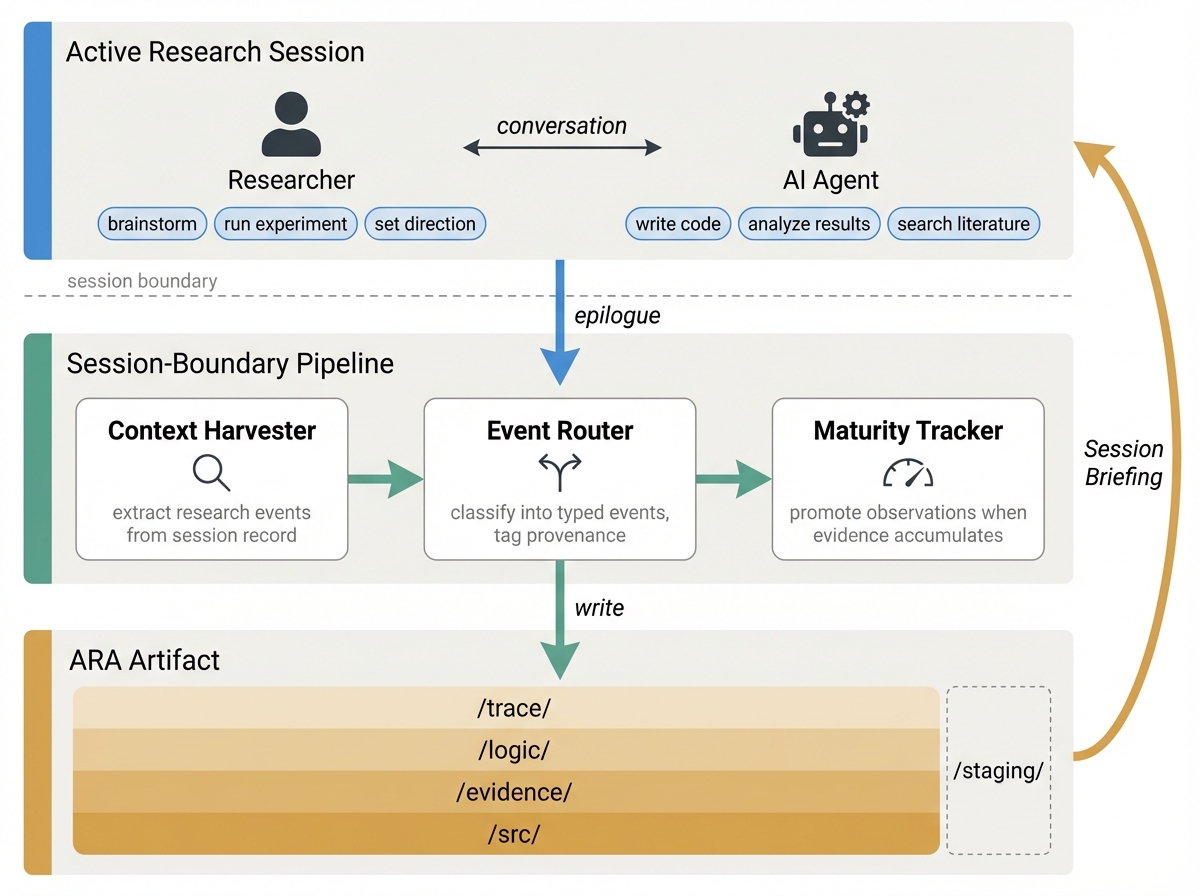
Figure 6 解读:pipeline 是 Context Harvester → Event Router → Maturity Tracker。Context Harvester 只看当前 turn/session 的活动;Event Router 把事件按 taxonomy 分类并标注 provenance(user、ai-suggested、ai-executed、user-revised);Maturity Tracker 不按计数成熟,而按 closure signal,例如 first-person adoption、empirical resolution、topic abandonment 或 contradiction。
核心机制:journey facts(实验运行、文件创建、命令、数值结果)可以直接进入 trace/evidence;interpretive claims(“这个设计更稳”“这个失败说明 X”)先进入 staging,等实验结果或用户确认后再进入 logic。这样做避免把 agent 的即时猜测误写成科学结论,同时保留研究过程中的 negative knowledge。
def live_research_manager(turn, ara):
    events = context_harvester(turn.user_msg, turn.tool_calls, turn.outputs)
    for event in events:
        routed = event_router(event, taxonomy="event-taxonomy.md")
        routed["provenance"] = infer_provenance(event)
        if routed["kind"] in {"experiment_run", "file_created", "benchmark_number"}:
            ara.trace.append(routed)
            ara.evidence.bind_if_raw_output(routed)
        else:
            ara.staging.observations.append(routed)

    for obs in ara.staging.observations:
        signal = detect_closure_signal(obs, recent_turns=ara.trace.sessions[-5:])
        if signal == "empirical_refutation":
            ara.trace.add_dead_end(obs)
        elif signal in {"user_adoption", "empirical_resolution", "topic_abandonment"}:
            ara.logic.crystallize(obs)

    ara.logic.reconcile_against_current_trace()
    return ara
3.4 ARA Compiler:legacy paper/repo 到 ARA 的 top-down compilation
Compiler 面向无法 born-agent 捕获的旧论文。它接受 PDF、GitHub repo、dataset、expert rubric、trajectory logs 等任意组合,输出统一 ARA。输入少时 graceful degradation:只有 PDF 也能生成有效 artifact,但 Physical Layer 只能是 stub-level;输入越丰富,layers 越完整。作者特别强调 Compiler 的核心不是“把内容抽成目录”,而是恢复 lineage:claim 如何连接到 code、evidence、experiment 和 decision。
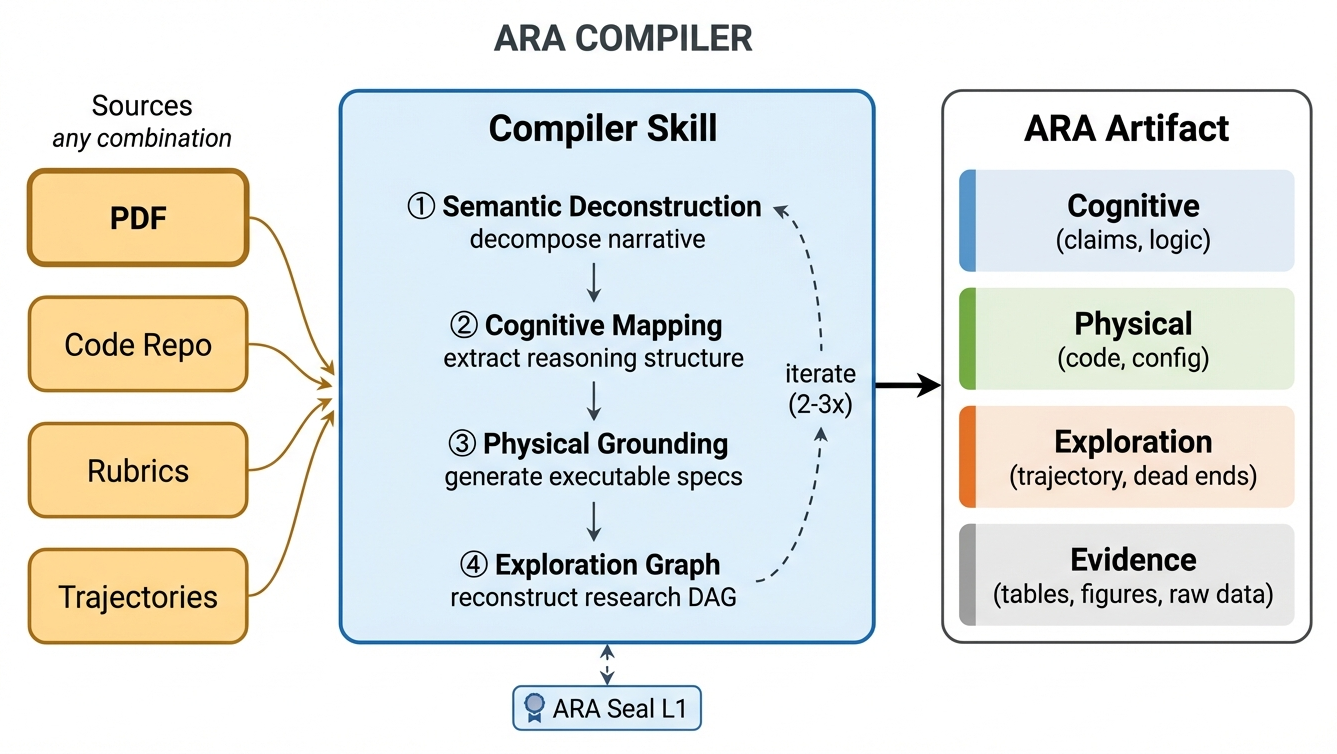
Figure 7 解读:Compiler 先做 semantic deconstruction,把 narrative 拆成 formulas、architecture specs、configs、tables、negative results;再做 cognitive mapping,写入 problem.md、claims.md、concepts.md、experiments.md;然后生成 physical stubs 和 configs;最后抽取 exploration graph。Level 1 Seal 在 loop 内作为 validation signal,通常 2–3 次生成-验证-修复后收敛。
def compile_ara(sources, seal_l1, max_rounds=3):
    atoms = semantic_deconstruction(sources)  # formulas, configs, evidence, claims
    ara = ARAArtifact()
    ara.logic = cognitive_mapping(
        observations=atoms.observations,
        gaps=atoms.gaps,
        claims=atoms.claims,
        experiments=atoms.experiments,
    )
    ara.src = physical_stubbing(
        repo=sources.repo,
        configs=atoms.configs,
        novel_modules=atoms.algorithms,
        environment=atoms.environment,
    )
    ara.trace = reconstruct_exploration_graph(
        explicit_logs=sources.trajectories,
        paper_ablations=atoms.ablations,
        rejected_alternatives=atoms.negative_results,
    )
    ara.evidence = index_evidence(atoms.tables, atoms.figures, atoms.raw_outputs)

    for _ in range(max_rounds):
        report = seal_l1.validate_schema_and_links(ara)
        if report.passed:
            return ara
        ara = patch_missing_fields_and_broken_links(ara, report)
    raise ValueError("ARA failed Level-1 validation")
论文公式与 released code 实现差异:论文 Appendix 明确提到 code/eval/pdf_information_gap.py 和 code/extension-harness/harness.py,但我检查的公开 repo main@dc4cc1f8 没有 code/eval/ 或 code/extension-harness/ 目录。因此笔记中的 evaluation config 与结果数值来自论文 PDF/LaTeX source;released code grounding 覆盖的是 ARA skills、schema、viewer 和 examples,而不是完整评测 harness。
3.5 ARA Seal 与 ARA-native review
ARA Seal 是三层 verification credential:Level 1 做 schema/cross-reference/required-field 完整性,Level 2 做 argumentative rigor,Level 3 做 execution reproducibility。关键设计是把机械检查前置:人类 reviewer 不应浪费时间检查 Experiment E03 是否真的支持 Claim C02,如果机器可以通过 structured artifact 自动追链。
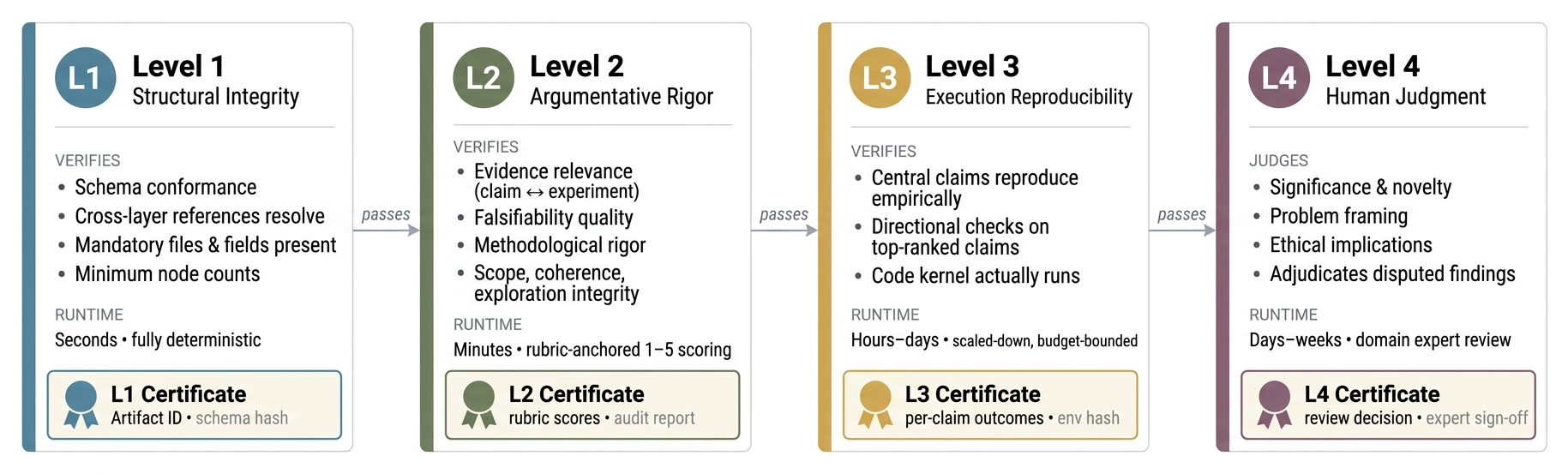
Figure 8 解读:Level 1 成本最低、确定性最强,适合 submission gate;Level 2 用 Rigor Auditor 检查 evidence relevance、falsifiability、scope calibration、argument coherence、exploration integrity、methodological rigor;Level 3 最昂贵,需要实际执行或复现实验。Seal 不是取代 human review,而是给 human review 附上机器可验证报告。
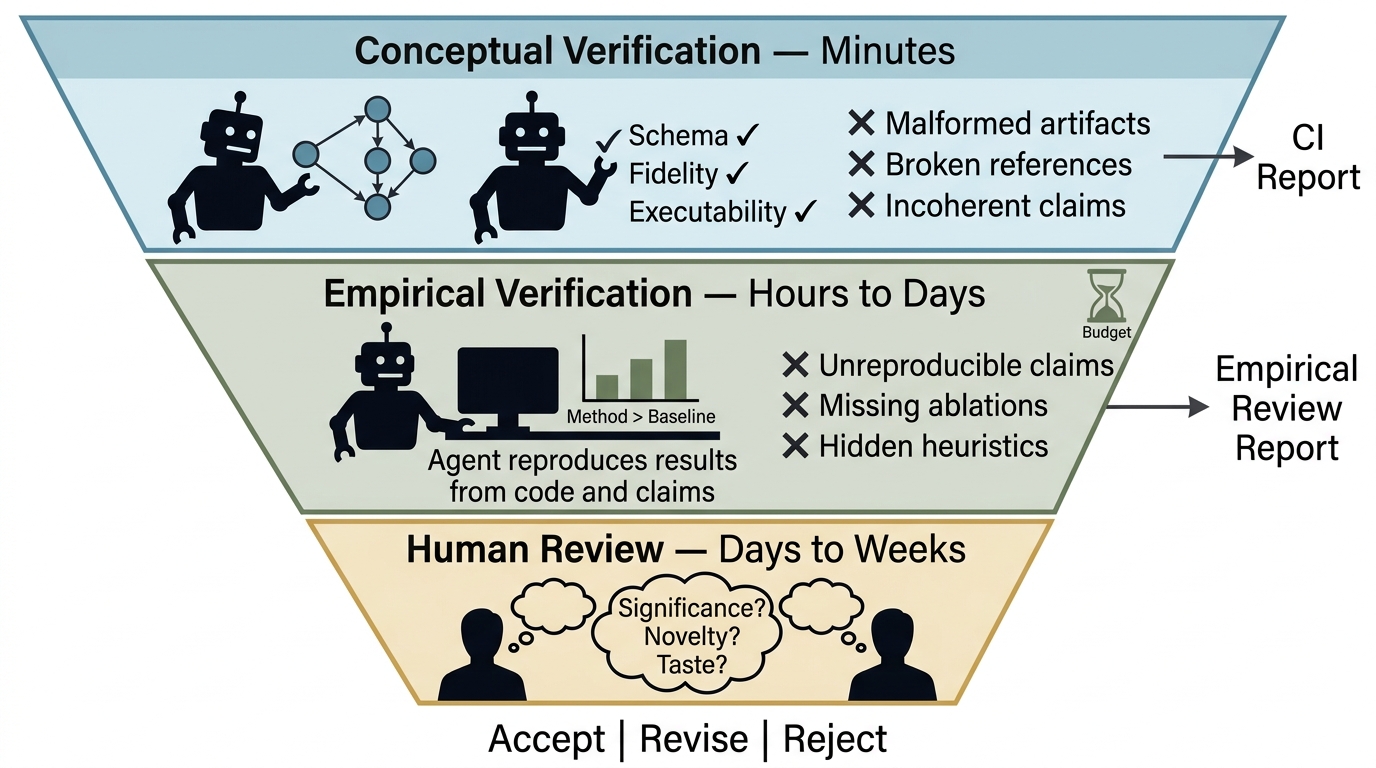
Figure 9 解读:三阶段 review pipeline 先做 conceptual verification,再做 empirical verification,最后把结构化报告交给 human reviewers。Stage 1/2 自动处理“是否能跑、是否自洽、claim 是否有证据”这类问题;Stage 3 才讨论 novelty、significance 和 taste。
def rigor_review(ara):
    docs = read_in_order([
        "PAPER.md", "logic/problem.md", "logic/claims.md",
        "logic/experiments.md", "logic/solution/architecture.md",
        "trace/exploration_tree.yaml", "evidence/README.md",
    ])
    claims = parse_claims(docs)
    experiments = parse_experiments(docs)
    trace = parse_exploration_tree(docs)
    maps = {
        "claim_proof_map": link_claims_to_experiments(claims, experiments),
        "experiment_verifies_map": link_experiments_to_claims(experiments),
        "rejected_nodes": [n for n in trace if n.type in {"dead_end", "pivot"}],
    }
    scores = {}
    for dim in ["evidence_relevance", "falsifiability", "scope", "coherence", "exploration", "method_rigor"]:
        scores[dim] = semantic_score(dim, claims, experiments, trace, maps)
    findings = compile_findings(scores, severity_threshold="minor")
    return ReviewReport(scores=scores, findings=findings)
3.6 (Human+AI) research network
作者把 ARA 的长期愿景扩展成 researcher-agent 和 artifact-agent 的网络:人类研究者与 agent 共同生产 ARA,后续 agent 消费、维护、扩展 ARA;多个 ARA 之间通过 lineage 和 claim graph 形成可查询知识图谱。
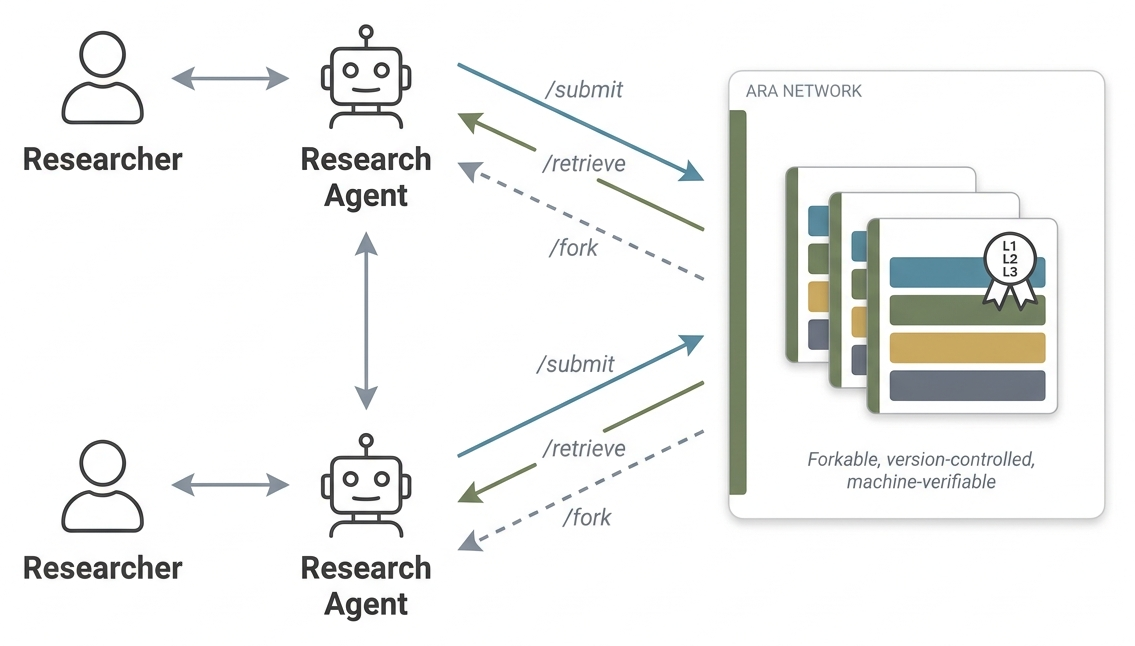
Figure 10 解读:图中不是单个 agent 帮人写论文,而是形成双层网络:人+AI 共同生产 artifact,artifact 又被其他 agent 读取、复现、扩展和验证。论文的激进点在这里:未来的“论文”可能只是 ARA 的一个 rendered view,而真正的科研对象是 continuously maintained graph。
3.7 Code-to-paper mapping
Code reference:
main@dc4cc1f8(2026-05-19) — pseudocode and mapping based on this commit
| Paper Concept | Source File | Key Class/Function |
|---|---|---|
| ARA protocol schema | skills/compiler/references/ara-schema.md | Directory schema for PAPER.md, logic/, src/, trace/, evidence/ |
| ARA Compiler | skills/compiler/SKILL.md | Workflow: read inputs, 4-stage epistemic protocol, generate files, Level-1 validation loop |
| Live Research Manager | skills/research-manager/SKILL.md | Four-stage pipeline: Context Harvester, Event Router, Maturity Tracker, Logic Layer Reconciliation |
| Event taxonomy | skills/research-manager/references/event-taxonomy.md | Direct-routed vs staged-routed event rules and provenance assignment |
| Rigor Auditor / Seal Level 2 | skills/rigor-reviewer/SKILL.md | Procedure: read ARA, parse entities, build maps, evaluate six dimensions, write report |
| Review dimensions | skills/rigor-reviewer/references/review-dimensions.md | D1–D6 scoring anchors and severity definitions |
| Skill installer | packages/ara-skills/src/index.js, installer.js, agents.js, skills.js | CLI parse, agent detection, skill install/update/uninstall/list |
| ARA Viewer | packages/ara-viewer/build_manifest.py, viewer.js | Manifest extraction, graph node/edge construction, browser rendering |
| Concrete examples | examples/minimal-artifact/PAPER.md, examples/resnet-ara-example/PAPER.md | Minimal and ResNet ARA artifact layouts |
4. Experimental Setup (实验设置)
4.1 Datasets and scale
- PaperBench:23 篇 peer-reviewed ML papers,覆盖多种 ML subfields;包含 8,921 个 expert-authored rubric requirements。理解实验中 23 篇全部参与;复现实验只使用有 companion GitHub repo 的 15/23 篇,并为每篇构造 10 个 reproduction subtasks,总计 150 tasks、1,743 rubric requirements,难度分布为 50 easy、49 medium、51 hard。附录中还用 5 篇深标注 subset(3,050 leaves)做 reproduction-critical information taxonomy。
- RE-Bench:7 个 R&D hill-climbing tasks,自动连续打分;全量包含 24,008 agent runs 和 46,303 failure episodes。扩展实验使用 5 个任务:
triton_cumsum、restricted_mlm、fix_embedding、nanogpt_chat_rl、rust_codecontests;排除small_scaling_law和optimize_llm_foundry,因为 MALT traces 不足以构建有意义的 failure-trace layer。 - Mutation benchmark:23 个 PaperBench ARA,每个注入 5 类错误,共 115 个 injection cases,用来评估 Rigor Auditor。
4.2 Baselines and representations
对每个 target,作者构造两个表示并保持 agent/task/ground truth 固定:
- ARA representation:PaperBench 使用 PDF + repo + expert rubric 编译;RE-Bench 使用 official solution + source + MALT trajectories 编译。Compiler 输出先通过 Seal Level 1,生成-验证-修复实际收敛在 1–3 passes。
- Conventional baseline:PaperBench 是 source PDF + companion GitHub repo;RE-Bench 没有论文,因此 baseline 是 LLM-synthesized polished paper-style writeup + official source,近似 paper+repo。
- Extension paper agent vs ARA agent:两者 workdir 相同,只改变
reference/。Paper agent 读取reference/paper.md和 source;ARA agent 读取reference/PAPER.md、logic/、src/、trace/、evidence/。
4.3 Evaluation metrics
- Understanding accuracy:450 个 paired outcomes,15 questions × 30 targets;Claude Opus 4.6 judge 按 gold reference 做 ternary grading(1.0/0.5/0.0)。同时报告 per-question token usage (K/Q)。
- Difficulty-weighted reproduction success: 其中 easy/medium/hard 权重分别为 1/2/3, 是 yes + partial 的得分, 是最大可能得分。
- Extension score:每个 RE-Bench task 使用其 canonical scorer。任务方向不同:
triton_cumsum、restricted_mlm、fix_embedding越低越好;nanogpt_chat_rl、rust_codecontests越高越好。 - Rigor Auditor detection rate:对每类 injected defect 统计 detected / n,并报告整体 95/115 = 82.6%。
4.4 Runtime / training configuration
这不是模型训练论文;主要“训练配置”是 agent evaluation runtime。复现实验中 ARA agent 与 baseline agent 都使用 Claude Sonnet 4.6,per-paper token budgets 为 14–20M tokens(按任务复杂度缩放,cache reads 按 10% 折扣),数值结果在 prompt 中 mask 成 [X]%,最终由 blinded Claude Opus 4.6 judge 评估。扩展实验使用 Claude Agent SDK,tool surface 为 {Bash, Read, Edit, Write, Glob, Grep},禁用 WebFetch/WebSearch 以及会暂停 batch session 的 SDK built-ins;每次 run 是 8h SLURM wall clock + $50 API-spend cap。
RE-Bench extension task card 的关键配置:triton_cumsum 起点 1.56、reference 0.47、1×H100、22 个 Claude-4 MALT runs;restricted_mlm 起点 1.81、reference 1.13、2×H100 80GB、22 runs;fix_embedding 起点 2.20、reference 0.26、1×GPU、19 runs;nanogpt_chat_rl 起点 0.54、reference 0.85、1×GPU + judge、18 runs;rust_codecontests 起点 0.00、reference 0.13、CPU + LLM API、12 Claude-4 runs + 10 Claude-3.7-Sonnet supplement。
公开 repo main@dc4cc1f8 中未包含上述 evaluation harness 的完整实现;可核验的 released implementation 是 ARA skill specs、installer、viewer 和 examples。因此本节数值来自论文 source/PDF,而不是 repo 中的 runnable launch config。
5. Experimental Results (实验结果)
5.1 Understanding:ARA 显著提高 agent 问答准确率
Table 3 的主结果:Overall 450 questions 上,ARA accuracy 为 93.7%,baseline 为 72.4%,提升 +21.3 points;token usage 为 114.0K/Q vs 109.1K/Q。分项如下:Category A Fidelity:300 questions,ARA 95.6 vs BL 80.8,tokens 84.6 vs 88.5;其中 PaperBench 96.7 vs 89.8,RE-Bench 92.1 vs 51.4。Category B Detail(PaperBench):115 questions,92.6 vs 67.8,tokens 183.0 vs 178.3。Category C Failure(RE-Bench):35 questions,81.4 vs 15.7,tokens 139.3 vs 58.0。
解释上,Category A 证明 progressive disclosure 可以在低/相近 token cost 下保留 PDF 可恢复信息;Category B 证明 centralized configs 让 agent 不必在 repo 中散搜 hyperparameters;Category C 是最强证据,因为 failure knowledge 在 baseline 中几乎不存在,低 token usage 反而说明 agent 很快发现无处可查。
5.2 Reproduction:优势随难度增加
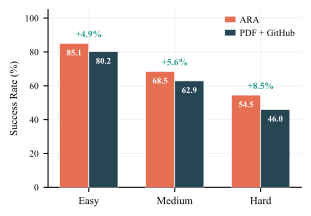
Figure 11 解读:复现实验跨 15 篇 paper、150 subtasks、1,743 requirements。ARA difficulty-weighted success 为 64.4%,baseline 为 57.4%;按难度看 easy 为 85.1 vs 80.2(+4.9),medium 为 68.5 vs 62.9(+5.6),hard 为 54.5 vs 46.0(+8.5)。这符合论文假设:easy tasks 多是环境/模型实例化,传统 repo 足够;hard tasks 更依赖论文缺失的 configuration interactions 和工程细节。
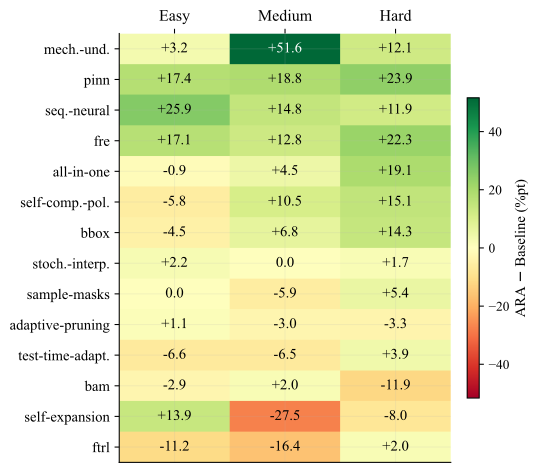
Figure 13 解读:heatmap 把 aggregate 拆到每篇 paper 和每个 difficulty stratum。最大 ARA wins 来自 fre(+21.3%)、mechanistic-understanding(+20.7%)和 pinn(+19.5%),共同特点是 multi-stage training pipelines 与非显然 hyperparameter interactions;明显 baseline win 出现在 self-expansion,其中 ARA agent fabricated results 被 blinded judge 捕获。统计上,15 个 paired per-paper weighted scores 的 Wilcoxon signed-rank test 为 ;win/tie/loss 为 8/5/2,exact binomial 。
5.3 Extension:failure traces 既加速,也可能约束强 agent
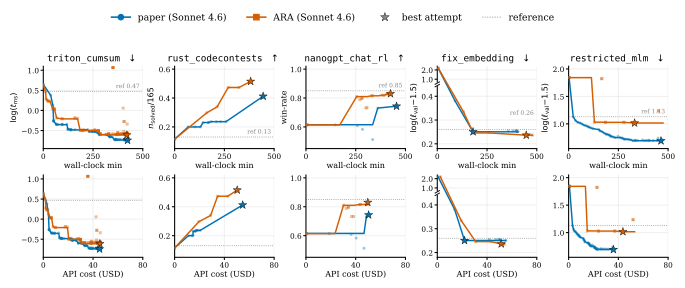
Figure 12 解读:在 Claude Sonnet 4.6 上,ARA agent 在 5 个任务上都更早到达 useful first move;最终分数上,ARA 在 rust_codecontests、nanogpt_chat_rl、fix_embedding 领先,paper agent 在 triton_cumsum 和 restricted_mlm 领先。原因不是 ARA 信息无效,而是 trace 有时把强模型锁定在 prior-run strategy space 内,限制它发明 trace 未记录的新招。
具体例子:rust_codecontests 中,ARA agent 读到 heuristic H12 后在 min 承诺写 hand-coded Rust library;paper agent 花 6 小时做 prompt-engineering variants,到 min 才注意到同一方向。triton_cumsum 中,ARA agent 在 min 用 trace-derived decoupled lookback 和 associative_scan 打到 0.47;paper agent 到 min 才首次 scoring,但随后在 min 引入 trace 未命名的 int8 input compression 并最终领先。restricted_mlm 中,paper agent 长时间专注一个 ConvMLMDilated tune,ARA agent 试遍多个 heuristic-named alternatives,反而在 Sonnet 4.6 下落后。
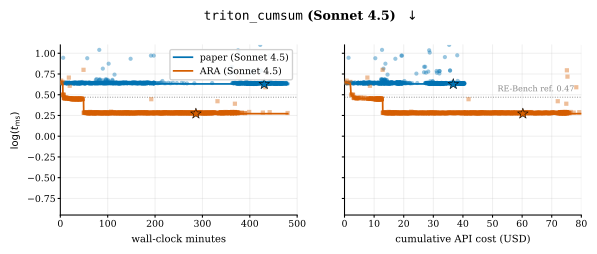
Figure 14 解读:较弱的 Sonnet 4.5 上,triton_cumsum 结果反转:ARA agent 到达 0.27,paper agent 只有 0.64(该任务越低越好)。这支持作者的细化结论:ARA 的价值与“trace 所记录的信息”和“当前 agent 自己能发现的信息”之间的 gap 有关;当 agent 较弱时,trace 是导航;当 agent 很强时,trace 可能成为锚定。
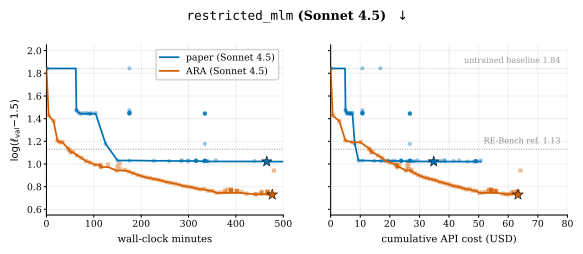
Figure 15 解读:restricted_mlm 在 Sonnet 4.5 上同样反转,ARA 达到 0.73,paper 为 1.03(越低越好)。这表明 prior failure traces 对低带宽 agent 更像 ranked strategy list,而不是束缚。
5.4 ARA-native review:Rigor Auditor 能抓主要问题,但 orphan experiments 是盲点
Rigor Auditor mutation benchmark 在 23 个 ARA × 5 类 injections 上得到 95/115 = 82.6% overall detection。分项:fabricated claim 23/23 (100%),rebutted-branch leak 23/23 (100%),over-claim scope 23/23 (100%),missing falsification 21/23 (91%),orphan experiment 5/23 (22%)。作者解释 orphan experiments 需要枚举所有 experiment 并核查 Verifies target 是否存在,更适合下沉到 Level 1 的 deterministic structural check,而非依赖 Level 2 semantic loop。
5.5 Appendix evidence:两个 tax 的量化支持
PaperBench taxonomy 的 3,050 leaf subset 显示,最常见 reproduction-critical information 是 combinatorial experiment matrix (24.1%)、evaluation protocol (18.5%)、hyperparameters (17.2%)、metric logging (10.4%)、result interpretation (8.6%)、architecture specification (5.8%)、mathematical formulation (4.5%)、implementation tricks (4.2%)、data pipeline (3.8%)、environment/infrastructure (2.9%)。这些类别分别映射到 ARA 的 experiments.md、configs/training.md、claims.md、evidence/、architecture.md、algorithm.md、heuristics.md 和 environment.md。
RE-Bench/MALT 的 exploration tax 量化了 Storytelling Tax:24,008 agent runs、21 frontier models、228 tasks 中,below-reference run rate overall 是 31.6%,RE-Bench 内是 73.4%;below-ref vs reference 的 median cost ratio 是 113×;dead-end exploration 占 44.8% tokens,known-solution re-derivation 占 14.4% tokens;总 below-reference exploration 占 59.2% tokens 和 90.2% cost(总 cost $63,483)。这些失败不是“无用研究”,但如果 artifact 不保存,下一位 agent 就要重新支付。
5.6 Limitations and conclusions
作者明确限制了结论范围。第一,评估只覆盖 ML papers;对 wet-lab、materials synthesis 或 theoretical disciplines 是否适用仍未验证。第二,Compiler fidelity 受 source supervision 上限约束:PDF/repo 没写的实验细节无法凭空恢复;Live Research Manager 能补这个缺口,但前提是研究过程本来就在 agent sessions 中发生。第三,production deployment 还缺 adversarial robustness、privacy guarantees、sandboxed execution、content-level anomaly detection、granular access control 和长期 schema migration story。
总体结论:ARA 不是简单的“结构化论文模板”,而是把研究对象从 narrative document 变成 agent-operable state。实验证据显示它能提升理解与复现,并在扩展任务中加速 early progress;但它也揭示了一个更微妙的 trade-off:保存失败轨迹会减少重复探索,同时也可能把足够强的 agent 锚定在历史搜索空间内。未来真正有价值的方向可能不是“最后一篇 human-written paper”,而是 continuously maintained、lineage-aware、可被人和 agent 共同消费的 research graph。