GrandCode: Achieving Grandmaster Level in Competitive Programming via Agentic Reinforcement Learning
Paper: arXiv:2604.02721 Code: deepreinforce-ai/codeforces Code reference:
main@47e2e93d(2026-04-01)
1. Motivation (研究动机)
现有 AI 编程系统的缺口
Competitive programming 仍然是代码生成里最难的实战场景之一:模型不仅要读懂长题面、隐藏约束、样例和图示,还要在严格时间与内存限制下产出能通过 hidden tests 的高效程序。论文把这个问题放在 Codeforces live contest 上,而不是离线 benchmark 上,原因是 live contest 同时考验四件事:解题正确性、算法复杂度、提交时间、以及只拿到有限 judge feedback 时的在线修正能力。
作者指出,已有强系统仍没有稳定在 live contest 中超过最强人类选手:AlphaCode 约为 Codeforces rating 1300、AlphaCode2 达到约 85th percentile,OpenAI o3 进入全球第 175 名;Gemini 3 Deep Think 曾达到第 8 名,但不是在 live competition 条件下完成。GrandCode 要解决的不是“能不能生成一段代码”这个窄问题,而是“能不能在真实竞赛窗口内,通过 agentic reasoning、verification、test generation 和 online adaptation,稳定赢过 legendary grandmasters”。
论文要解决的具体问题
GrandCode 的目标是构建一个面向竞赛编程的 multi-agent RL system:主 solver 负责推理和代码生成,hypothesis model 先提出结构性 conjecture,summarization model 压缩超长 thinking trace,test-case generator 主动制造 adversarial edge cases,并用 post-training RL 与 test-time RL 把这些模块接成闭环。
这件事值得研究的核心原因是:如果一个 AI 系统能在 live Codeforces 中稳定超过顶级人类,那么它说明 code agent 已经不仅是“离线 benchmark 解题器”,而是具备了接近真实工程 agent 的循环能力:理解问题、提出假设、生成候选实现、构造反例、吸收反馈、快速再优化。这个能力可迁移到更广泛的软件工程 agent:debugging、optimization、formal-ish verification、online patch search 等。
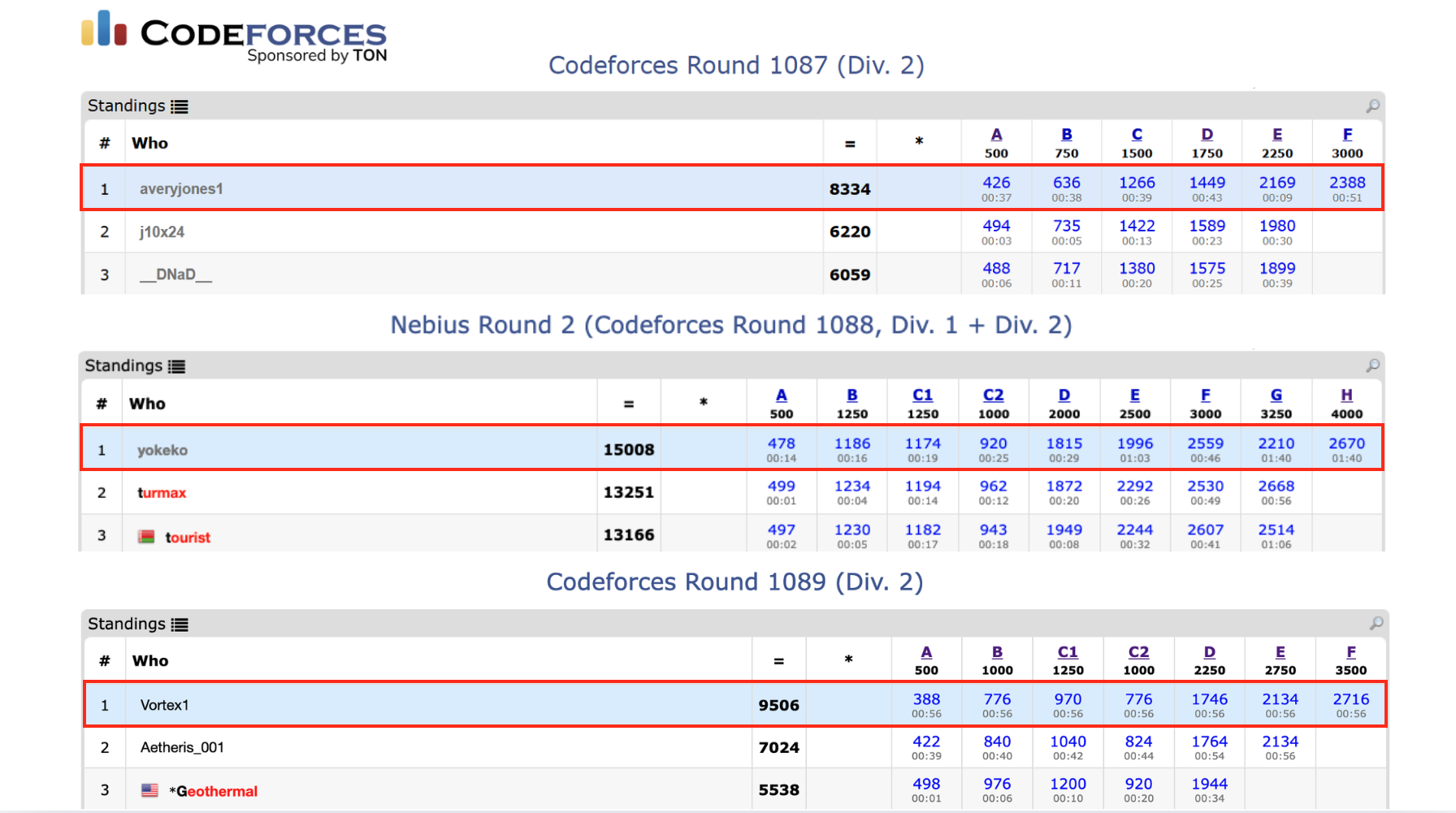
Figure 1 解读:这张图展示 GrandCode 参与的三场 Codeforces live contests 的 standings overview。论文强调 GrandCode 在 Round 1087、1088、1089 中都获得第一,并且都是最先完成全部题目的参赛者。这里的关键不是单题 pass,而是完整 contest-level scoring:提交越早分数越高,且错误提交会带来惩罚;因此它直接衡量系统在实时约束下的综合 agent 能力。
2. Idea (核心思想)
GrandCode 的核心 insight 是:顶级竞赛编程不能只靠一个大模型直接生成最终代码,而要把“假设提出—小规模验证—候选解生成—对抗测试—judge feedback—在线更新”做成可学习的 agentic loop。真正的创新点在于把这个 loop 作为 RL 对象来优化,并针对 multi-stage rollout 的 delayed rewards 与 off-policy drift 设计 Agentic GRPO。
与 AlphaCode / AlphaCode2 这类更偏向大规模采样、排序、筛选的系统相比,GrandCode 的差异在于它不是只把验证当成后处理,而是把 hypothesis model、summary model、test generator、main solver 都纳入训练与 test-time adaptation。与普通 GRPO / post-training RL 相比,Agentic GRPO 不等待最终 reward 才更新整个 trajectory,而是在中间 stage reward 可用时立即给 credit,再用 delayed correction 修正早期 stage 对最终结果的边际贡献。
这使得系统能同时处理两种困难:一是长链路 agent rollout 里 reward 很晚才出现,训练效率低且 off-policy 严重;二是真实竞赛中 hidden tests 不可见,必须靠自生成 adversarial tests 和有限在线反馈来逼近真实 judge。
3. Method (方法)
3.1 Overall framework:post-training + live-contest test-time RL
GrandCode 由三个 learned policies 和一个测试生成模块组成:
πmain:主 solver,生成 reasoning traces 与最终 C++ code。πhypothesis:提出中间 conjectures、结构性质或数学刻画,并先在小规模实例上验证。πsummary:压缩很长的 thinking trace,使 hard problems 的推理和 RL 训练仍然可处理。- Test-case generation:生成 adversarial tests、solution-attack tests 和 large-size stress cases,用来在提交前挑战候选程序。
系统分两大阶段。第一阶段是 post-training,包括 noisy competitive-programming data 上的 continued pretraining、基于高质量 (question, thinking, solution) triples 的 SFT、以及 multi-component RL。第二阶段是 test-time / live-contest solving:先用 difficulty classifier 把题目分成 Level 1–5;简单题走 direct generation 并行采样,难题进入 online test-time RL,使用验证反馈快速适配当前题目。
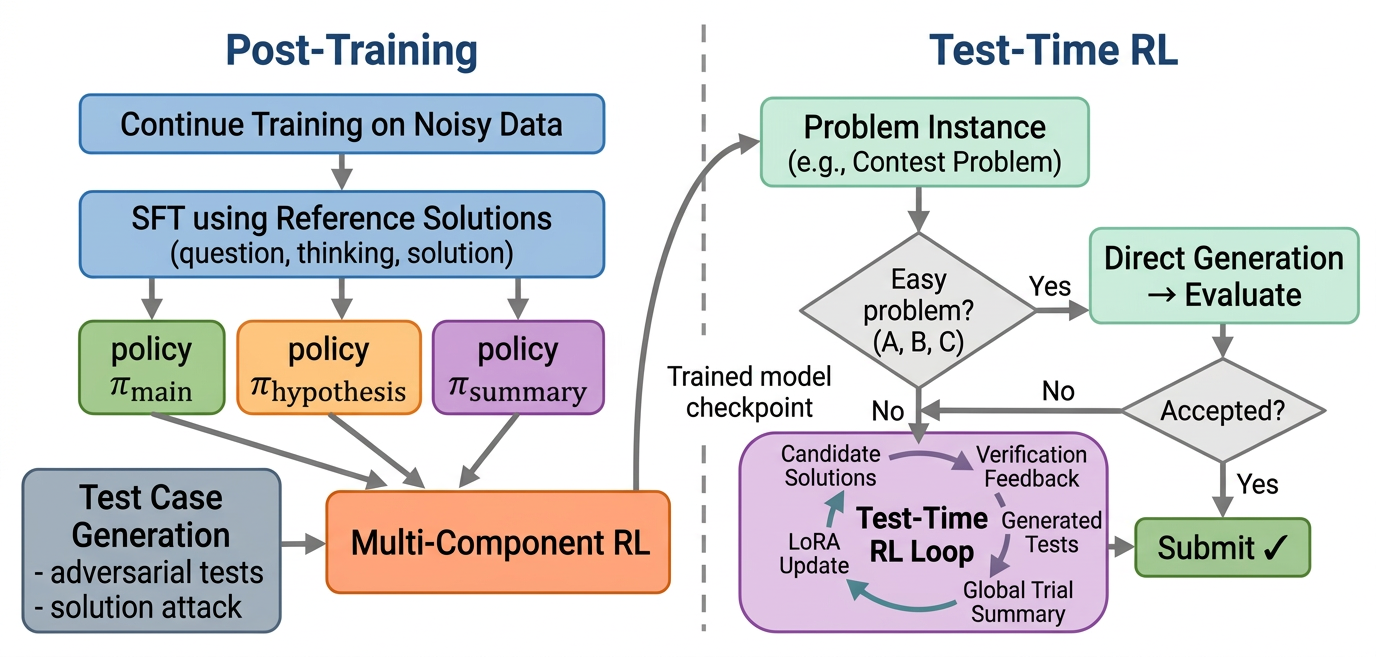
Figure 2 解读:左侧是 post-training pipeline:继续训练 noisy data,SFT 学习高质量推理,分别训练 πmain、πhypothesis、πsummary,再做 multi-component RL。右侧是 live contest pipeline:difficulty classifier 决定是否直接生成;如果 direct generation 不足,系统进入 test-time RL loop,持续生成、验证、重新采样,直到接受候选解并提交。图中最重要的是把“训练时的模块协作”和“测试时的在线反馈”连接起来,而不是把 test generator 当成一次性过滤器。
直觉上,GrandCode 能工作的原因是:竞赛题的失败通常不是语言模型完全不会写代码,而是某个关键结构假设、边界条件、复杂度判断或图示理解错了。把 hypothesis 和 adversarial tests 提前显式化,相当于让模型在真正提交前不断自造“反例压力”;再用 RL 学会哪些假设、摘要和候选实现最终更可能通过 hidden judge。
3.2 Agentic GRPO:Immediate Reward + Delayed Correction
普通 GRPO 会把完整 trajectory 的所有 token 都用最终 reward 更新,而 GrandCode 的 rollout 是 multi-stage: 如果每个 stage 都要等待最终 judge-like reward,训练会很慢;但如果只用 intermediate reward,又可能忽略早期决策对最终成功的贡献。因此 Agentic GRPO 把每个 stage 的更新拆成两步。
Immediate Reward. 对第 个 stage,在 个 rollouts 内按当前 stage reward 归一化: 对应的 clipped GRPO loss 为: 其中 这里的 behavior policy version 可以随 token 变化,因为 asynchronous pipeline training 里 sampling 与 training 并行,旧 token 可能由不同版本的 policy 生成。
Delayed Correction. 当最终 reward 出现后,对更早 stage 定义 correction: 再对 correction 做 group normalization,并用更保守的 clipping range 更新旧 stage: Appendix C 进一步解释:Agentic GRPO 的 immediate signal 与 delayed correction 在未归一化时可分解为最终 advantage,但二者分别用自己的 和 归一化,因此不等同于普通 GRPO 的单一 normalization。这不是 bug,而是让“当前 stage 质量”和“未来 marginal contribution”都有自己的尺度,避免某一类信号方差过大而压制另一类。
import torch
import torch.nn.functional as F

def agentic_grpo_stage_update(logp_new, logp_beh, reward_t, eps=0.2):
    """Paper-level sketch of immediate reward update for one rollout stage."""
    advantage = (reward_t - reward_t.mean()) / (reward_t.std(unbiased=False) + 1e-6)
    ratio = torch.exp(logp_new - logp_beh)
    clipped = torch.clamp(ratio, 1.0 - eps, 1.0 + eps)
    token_loss = -torch.minimum(ratio * advantage[:, None], clipped * advantage[:, None])
    return token_loss.mean()


def agentic_grpo_delayed_correction(logp_current, logp_beh, reward_final, reward_t, eps2=0.1):
    """Paper-level sketch of delayed correction after the final reward arrives."""
    delta = reward_final - reward_t
    corr_advantage = (delta - delta.mean()) / (delta.std(unbiased=False) + 1e-6)
    ratio = torch.exp(logp_current - logp_beh)
    clipped = torch.clamp(ratio, 1.0 - eps2, 1.0 + eps2)
    token_loss = -torch.minimum(ratio * corr_advantage[:, None], clipped * corr_advantage[:, None])
    return token_loss.mean()
论文公式与 released code 实现差异:官方 deepreinforce-ai/codeforces 仓库在 main@47e2e93d 只发布了三场 Codeforces 的 C++ submitted solutions,没有发布 Agentic GRPO、pipeline-RL、test-case generation、hypothesis model、summarizer 或训练配置代码;因此以上 pseudocode 是严格依据论文公式的 paper-level sketch,不是从 released training implementation 反推得到。
3.3 Test-case generation:difference-driven tests + solution attack
真实 Codeforces 的 hidden tests 不可见,所以 GrandCode 必须在提交前构造自己的高强度测试集。论文把 test generation 分成两类。
Difference-driven test generation. 给定训练/搜索中采样到的多个候选解,系统提示 Claude、GPT、DeepSeek V3、Kimi 2.5 等模型生成可能触发 corner cases 的输入。此时不把候选解直接给 LLM,而是让 generator-validator 框架先筛选或 refine 测试。随后把测试跑在所有候选解上:如果某个输入让不同候选解产生不同输出,就保留该测试,并把“可能触发的边界条件”反馈给 LLM,继续生成同类测试。
Solution attack. 当训练集中有 gold solution 时,系统把 gold solution 和 candidate solution 同时给 LLM,让它分析差异、定位潜在 bug、提出能区分两者的 edge cases。每个生成测试都实际执行,只有确实能区分 gold/candidate 行为的测试才被保留。作者还用这些 verified adversarial examples 继续 fine-tune 一个 Qwen-3.5-27B test generator。
def build_adversarial_tests(problem, candidate_solutions, llm_generators, validator, gold=None):
    """Paper-level sketch of GrandCode's adversarial test construction."""
    test_pool = set(problem.public_tests)
    for _ in range(problem.test_generation_rounds):
        proposals = []
        for llm in llm_generators:
            proposals += llm.generate_corner_cases(problem, hints=None)
        proposals = validator.filter_or_refine(problem, proposals)

        for test in proposals:
            outputs = [run_cpp(sol, test) for sol in candidate_solutions]
            if len(set(outputs)) > 1:
                test_pool.add(test)
                edge_hint = llm_generators[0].describe_trigger(problem, test, outputs)
                proposals += llm_generators[0].generate_similar_cases(problem, edge_hint)

        if gold is not None:
            for sol in candidate_solutions:
                attacked = llm_generators[0].attack_solution(problem, gold, sol)
                for test in attacked:
                    if run_cpp(gold, test) != run_cpp(sol, test):
                        test_pool.add(test)
    return test_pool
在 50 个真实 Codeforces problems 上,base test suite 的通过数是 42/50;加入 difference-driven generation + solution attack 后变成 48/50;再利用 submission feedback 做 continued online generation 后达到 50/50。这说明 test generator 不是锦上添花,而是把“看起来通过自测”的候选代码推向真实 hidden judge 的关键桥梁。
3.4 Hypothesis generation:先验证结构性 conjecture,再进入 solution synthesis
Hypothesis generation 是解题 workflow 的第一步。模型先提出中间 claims、结构性质或紧凑数学刻画,比如“这题本质上是 dynamic programming”或“输入图满足某种结构”。这些 hypothesis 不直接信任,而是在小规模 random instances 上用 brute-force solver 验证;如果 mismatch,就修正 hypothesis,直到所有小规模测试一致后才注入主 solver 的 prompt。
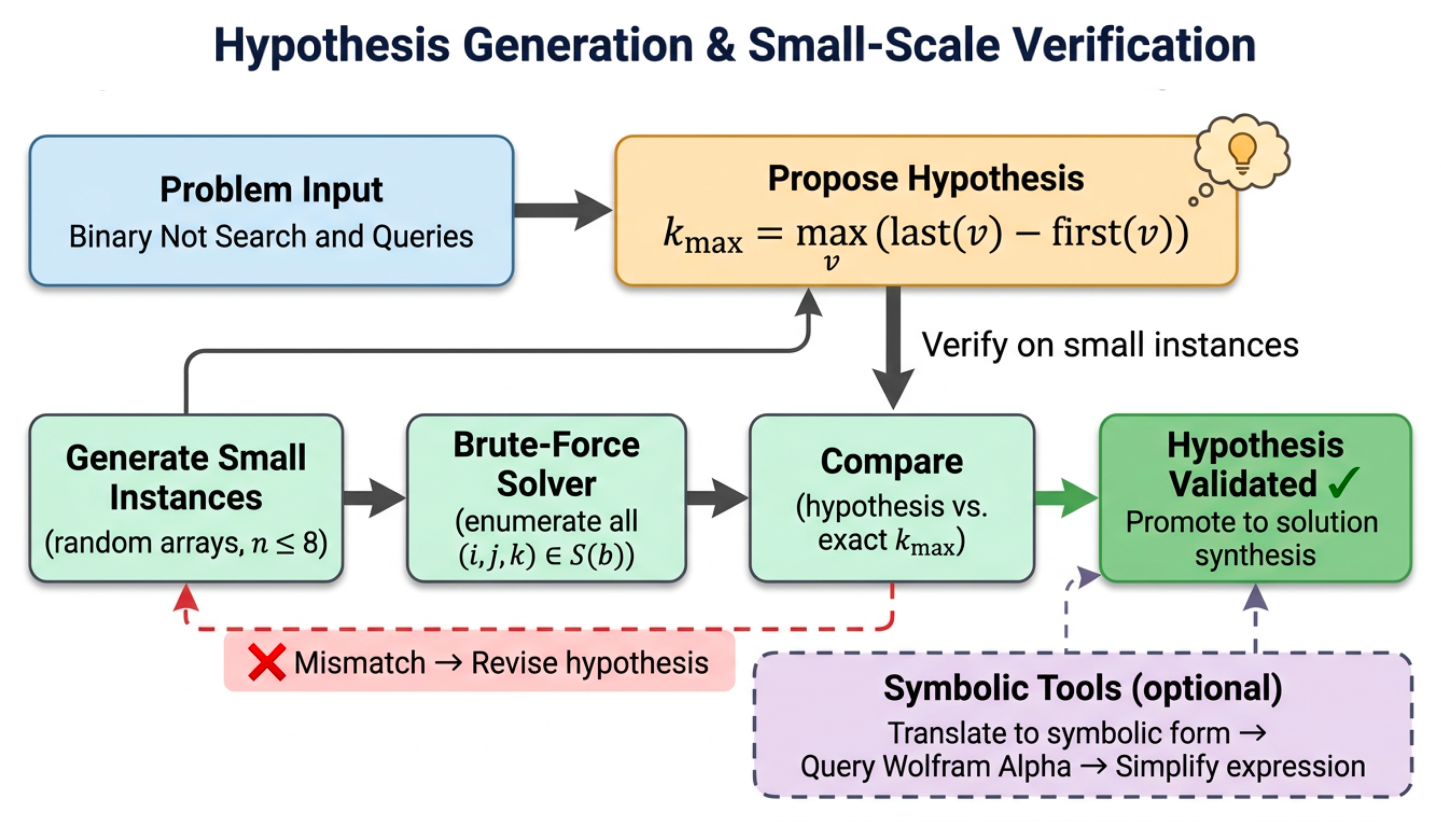
Figure 3 解读:图中以一个 compact characterization 为例,πhypothesis 先提出形如 的假设;系统生成小规模实例,用 brute-force 枚举所有 tuples 计算精确答案,再比较 hypothesis output 与 brute-force output。红色路径表示 mismatch 后回到 hypothesis revision,绿色路径表示通过验证后进入 solution synthesis。这等价于把“先想一个关键性质”变成可检验的中间状态。
def verify_and_refine_hypothesis(problem, hypothesis_model, brute_force_solver, max_rounds=8):
    """Paper-level sketch of hypothesis proposal with small-scale verification."""
    history = []
    hypothesis = hypothesis_model.propose(problem, history=history)
    for _ in range(max_rounds):
        small_tests = generate_small_random_instances(problem)
        failures = []
        for test in small_tests:
            exact = brute_force_solver(test)
            predicted = evaluate_hypothesis(hypothesis, test)
            if predicted != exact:
                failures.append((test, predicted, exact))
        if not failures:
            return hypothesis
        history.append({"hypothesis": hypothesis, "failures": failures})
        hypothesis = hypothesis_model.revise(problem, history=history)
    return None
论文还允许调用 symbolic tools:如果子问题可被翻译成 symbolic form,可查询 Wolfram Alpha;对于 integer sequence,也会把结果送到 OEIS,若查到 pattern / formula / structural hint,就放入后续 solving prompt。
3.5 Continued training、SFT 与 summarization model
GrandCode 以 Qwen 3.5 作为 foundation model。continued training 使用 TACO、LeetCode、USACO、CodeContests、IOI 以及爬取的 online problems 作为 seed,再由 Gemini 3.1 Pro 扩展成更大的 corpus,并用 Claude 4.6 与 Gemini 3.1 生成 detailed thinking processes。为了让模型熟悉 hypothesis-conditioned solving,20% 的 continued-pretraining examples 被随机改造成带 πhypothesis 的 prompt。
SFT 阶段只使用有 reference solutions 的非合成题。对于较容易题,作者从 Gemini 3.1 Pro、Claude Opus 4.6、GPT-5.4、GLM 4.5、Kimi K2.5、DeepSeek V3.2 多次采样 reasoning trace 和 solution;如果生成解等价于 gold solution,或者效率可比/更好,就保留对应 thinking trace。对于更难题,简单 matching 不够,论文为每个 hard (x,y) 生成 个候选 reasoning contexts ,再用长度归一化 score 选择:
第一项偏好能让 post-trained model 解释出目标 reasoning 和 solution 的 context;第二项要求 context 本身仍然能预测原问题,防止 reasoning trace 退化成直接泄漏答案。
Hard problems 的 thinking trace 可能超过 100K tokens,因此论文训练独立的 πsummary。给定长 trace ,拆成 chunks ,progressive summary state 满足:
Stage 1 用局部 RL 训练 summary step,使 summary 既能保留后续推理和 final answer 所需的信息,也能重建当前 chunk:
Stage 2 再对完整 progressive chain 做 end-to-end GRPO,用 normalized final answer likelihood(如 )作为 terminal reward。Stage 3 把 πsummary 接入 πmain 的全局 RL pipeline。
def train_progressive_summarizer(summary_policy, chunks, answer, grpo_update):
    """Paper-level sketch of two-stage summarizer training."""
    states = []
    prev_summary = None
    local_rewards = []
    for chunk in chunks:
        summary = summary_policy.sample(prev_summary, chunk)
        preserve_future = score_future_likelihood(summary, chunks, answer)
        reconstruct_chunk = score_reconstruction(summary, chunk)
        local_rewards.append(preserve_future + reconstruct_chunk)
        states.append(summary)
        prev_summary = summary
    grpo_update(summary_policy, trajectories=states, rewards=local_rewards)

    final_reward = normalized_logprob_answer(answer, context=states[-1])
    grpo_update(summary_policy, trajectories=states, rewards=[final_reward])
    return states[-1]
3.6 Multi-component RL orchestration
最终 RL 阶段同时优化 πmain、πhypothesis、πsummary。作者选择分模块而非单一大 policy,有三个理由:小 auxiliary models 更省算力;它们已通过前序阶段初始化,不需要从零学;模块化让错误来源更可诊断,避免 summary 差和 solver 差混在一个 terminal reward 里。
πmain 的 code reward 分三层:executability、correctness、efficiency。Appendix B 形式化为:如果程序 不能编译/执行,或 correctness check 失败,则 ;否则对每个 efficiency test case 比较 brute-force solver 与候选程序运行时间,取平均 speedup。如果 timeout,单个 test case 的 efficiency score 设为 0.1。
对 πhypothesis,先用验证测试集 定义局部 reward:
若 hypothesis 通过所有测试,再比较带 hypothesis 的 solver 平均分 与无 hypothesis 的平均分 :
这让 πhypothesis 不只学会“局部正确”,还要学会提出能真正提高 downstream solution quality 的假设。πsummary 只在长 reasoning sequence 触发,训练中随 curriculum 向 harder problems 转移逐步提高触发频率;当 summary-conditioned rollout 产生最终程序 时,πsummary 使用和 πmain 相同的 final rollout score 。
3.7 RL infrastructure:asynchronous training、pipelined CP 与 batching
为了处理长 reasoning trace 与异步 rollout,GrandCode 把 Agentic GRPO 与 pipeline-RL 结合。对于过旧的 off-policy tokens,使用 staleness weight: 这和 Agentic GRPO 互补:intermediate rewards 因为很快被用来更新,不太受 staleness 影响;delayed correction 如果到达太晚,就可能被 drop。
GrandCode 的 foundation architecture 包含 DeltaNet + softmax attention mixture。由于 DeltaNet 是 linear recurrent operator,标准 context parallelism 会被 recurrent state 的顺序依赖限制。论文提出 pipelined CP:在 DeltaNet phase 中让多个 micro-batches staggered through CP ranks,softmax attention phase 再同步 all-to-all。4 个 CP ranks + 4 个 micro-batches 的代表性设置整体 utilization 约 90.3%;micro-batches 增至 16 时 overall efficiency 约 97%。
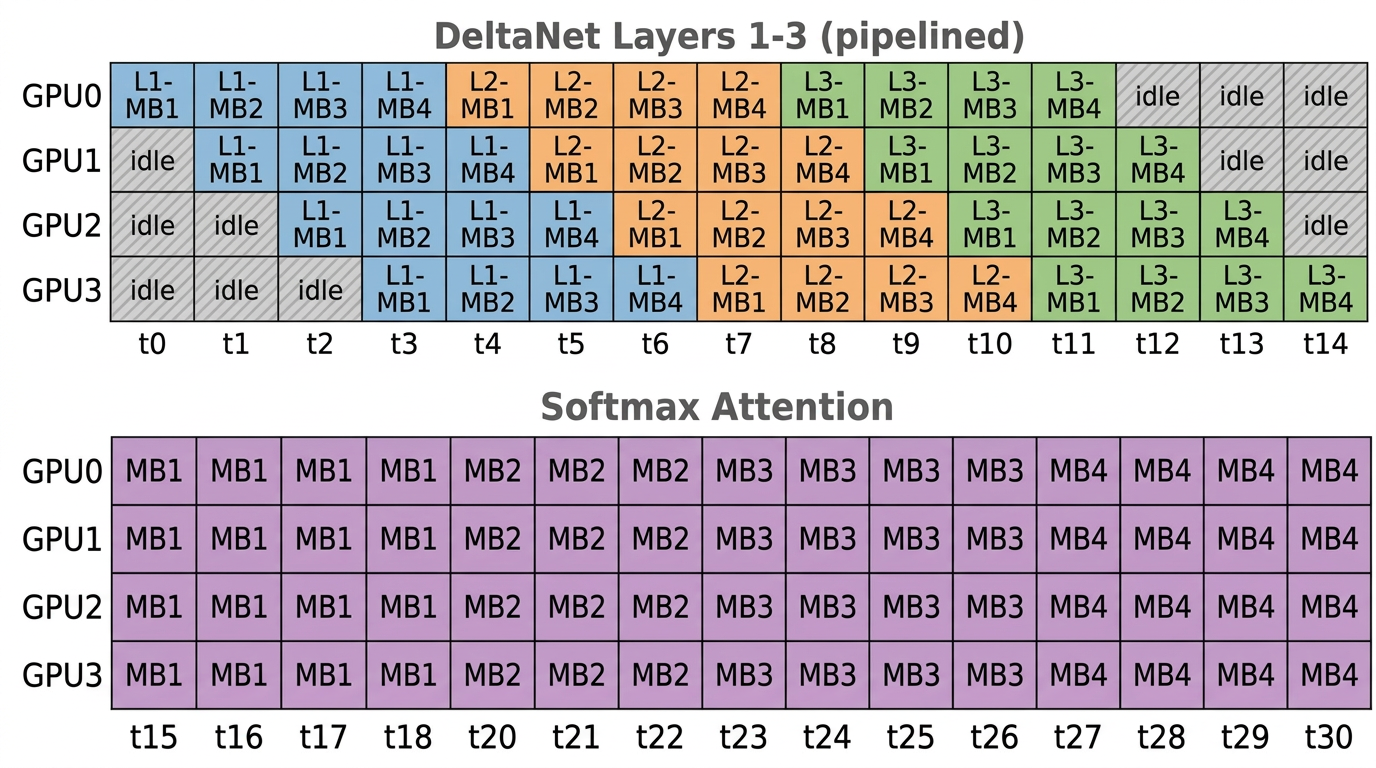
Figure 5 解读:图中上半部分是 3 个 DeltaNet layers 在 4 个 CP ranks 与 4 个 micro-batches 上的 staggered pipeline,灰色三角表示 startup/drain bubbles;下半部分是 softmax attention 层,需要 synchronized all-to-all。核心意义是:GrandCode 的 hard-problem reasoning 很长,若不解决 long-context training 的吞吐问题,Agentic GRPO 的多轮 rollout 会被训练系统瓶颈吞掉。
3.8 Test-time RL:从 average reward 平滑过渡到 best-of-N
Post-training RL 的目标是提高跨问题的平均能力:
Test-time RL 的目标不同:对当前单个题目,只需要找到一个最好的可提交解,更接近 best-of-N:
直接只保留 best rollout 会让 reward 过稀疏,所以论文采用 rank-based relaxation。将 个 rollouts 的 reward 排序为 ,优化:
当 时退化为 average reward;随着 增大,权重集中到 top-ranked rollouts,逐步逼近 best-of-N。Test-time 阶段只优化 LoRA 参数,不更新全模型;πhypothesis 和 πsummary 固定,只更新 πmain。系统还维护一个 global summary of search history,记录哪些策略尝试过、哪些有效、哪些失败,并把它喂给后续 rollouts。
def rank_weighted_test_time_rl(policy_lora, problem, verifier, lam_schedule):
    """Paper-level sketch of GrandCode's rank-smoothed test-time RL."""
    history_summary = ""
    best_solution, best_reward = None, float("-inf")
    for lam in lam_schedule:
        rollouts = policy_lora.sample_batch(problem, context=history_summary)
        rewards = torch.tensor([verifier.score(r.code) for r in rollouts], dtype=torch.float32)
        order = torch.argsort(rewards, descending=True)
        ranks = torch.arange(1, len(rollouts) + 1, dtype=torch.float32)
        weights = torch.softmax(-lam * ranks, dim=0)
        objective = (weights * rewards[order]).sum()
        policy_lora.update_with_policy_gradient([rollouts[i] for i in order], objective)
        top = order[0].item()
        if rewards[top].item() > best_reward:
            best_solution, best_reward = rollouts[top].code, rewards[top].item()
        history_summary = summarize_search(history_summary, rollouts, rewards)
        if verifier.ready_to_submit(best_solution):
            break
    return best_solution
3.9 Multimodal problem solving
许多 Codeforces 题面包含图示。论文指出,把图像转成文字描述再输入模型显著差于直接 multimodal processing,因为很多空间结构很难被 faithful textual description 捕捉。GrandCode 因此遵循 Qwen 的 native multimodal input protocol 处理带图题。
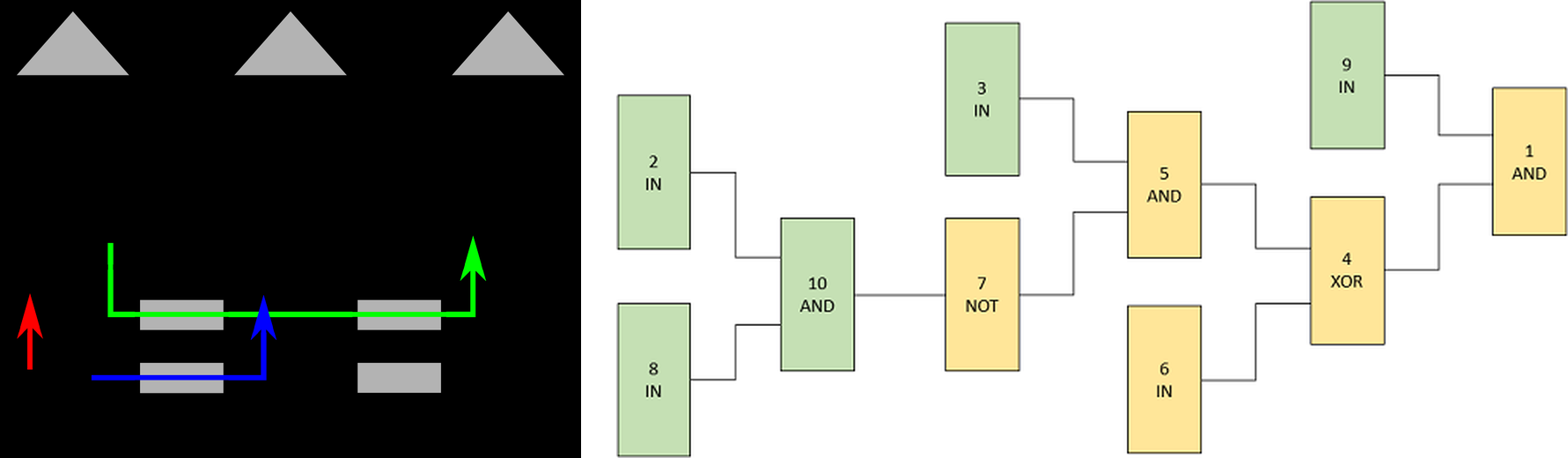
Figure 4 解读:这组例子展示了题面图像中包含的空间关系、箭头、局部结构和 grid 状态。作者用它解释为什么 text-only conversion 会失败:文字摘要很容易丢失“哪个元素连到哪个元素”“黑白格如何变化”这类关系,而这些关系正是竞赛题推理所需的约束。

Figure 9 解读:这是 Round 1088 Problem G Toothless 的样例图示,展示三个 test panels 中 grid 在 moves 前后的变化。论文用它作为 multimodal contest problem 的具体例子:题面并不只是文本约束,还包含需要视觉理解的状态变化;如果 agent 只依赖 OCR 或人工转写式描述,可能错过 move validity 与目标状态之间的结构关系。
3.10 Released code inspection and mapping
Code reference:
main@47e2e93d(2026-04-01) — pseudocode and mapping based on this public commit where applicable
官方仓库是 deepreinforce-ai/codeforces。我检查的 main@47e2e93d 包含 22 个 C++ 文件,分别对应 GrandCode 在 Round 1087、1088、1089 中提交的 accepted/contest solutions;仓库没有 README、训练脚本、Agentic GRPO 实现、test generator、hypothesis/summarization policy、LoRA test-time RL 或 launch configs。因此本 note 对 paper method 的伪代码来自论文公式与描述;released code 只能作为“最终提交代码证据”,不能作为训练实现证据。
| Paper Concept | Source File | Key Class/Function |
|---|---|---|
| Round 1087 final submitted solutions | codeforces-round-1087-div2/A.cpp–F.cpp | C++ main() per problem |
| Round 1088 final submitted solutions | codeforces-round-1088-div1-div2/A.cpp–H.cpp | C++ main() per problem; includes more complex implementations such as E.cpp with custom fast input / solver structs |
| Round 1089 final submitted solutions | codeforces-round-1089-div2/A.cpp–F.cpp | C++ main() per problem |
| Appendix D submitted-code examples | codeforces-round-1089-div2/A.cpp, codeforces-round-1088-div1-div2/E.cpp, codeforces-round-1088-div1-div2/F.cpp | Matches paper appendix examples at solution-code level |
| Agentic GRPO training loop | Not released in this repo | No source file available |
| Test-case generator / solution attack | Not released in this repo | No source file available |
| Hypothesis generation and summarization policies | Not released in this repo | No source file available |
| Test-time RL / LoRA adaptation | Not released in this repo | No source file available |
Released repo file inventory checked at main@47e2e93d: codeforces-round-1087-div2/A.cpp, codeforces-round-1087-div2/B.cpp, codeforces-round-1087-div2/C.cpp, codeforces-round-1087-div2/D.cpp, codeforces-round-1087-div2/E.cpp, codeforces-round-1087-div2/F.cpp; codeforces-round-1088-div1-div2/A.cpp, codeforces-round-1088-div1-div2/B.cpp, codeforces-round-1088-div1-div2/C1.cpp, codeforces-round-1088-div1-div2/C2.cpp, codeforces-round-1088-div1-div2/D.cpp, codeforces-round-1088-div1-div2/E.cpp, codeforces-round-1088-div1-div2/F.cpp, codeforces-round-1088-div1-div2/G.cpp, codeforces-round-1088-div1-div2/H.cpp; codeforces-round-1089-div2/A.cpp, codeforces-round-1089-div2/B.cpp, codeforces-round-1089-div2/C1.cpp, codeforces-round-1089-div2/C2.cpp, codeforces-round-1089-div2/D.cpp, codeforces-round-1089-div2/E.cpp, codeforces-round-1089-div2/F.cpp.
4. Experimental Setup (实验设置)
Evaluation setting and datasets
论文使用三类 evaluation settings:
| Setting | Scale / source | Purpose |
|---|---|---|
| Live Codeforces contests | Round 1087 Div.2, Round 1088 Div.1+2, Round 1089 Div.2 | 检验真实竞赛条件下的 ranking、score、finish time |
| Codeforces test-case generation evaluation | 50 real Codeforces problems | 用真实 Codeforces judge 判断 generated tests 是否足以筛出 hidden-test failures |
| Internal benchmark | 100 questions, five difficulty categories equally distributed | 比较 frontier models、post-training / SFT / RL / test-time RL 阶段增益 |
| Hypothesis generation evaluation | 200-problem evaluation set | 衡量 πhypothesis 的 pass@1 / pass@5 |
Training data 包括 TACO、LeetCode、USACO、CodeContests、IOI,以及额外 crawled online problems;continued training 时用 Gemini 3.1 Pro 扩展 seed set,并用 Claude 4.6 / Gemini 3.1 生成 detailed thinking processes。SFT 阶段只保留有 reference solutions 的非合成题,并通过 solution matching 与 hard-problem context scoring 选择高质量 thinking traces。
Baselines and compared models
论文比较的 baseline / reference systems 包括 AlphaCode、AlphaCode2、OpenAI o3、Gemini 3 Deep Think 作为 historical context;在 100-question benchmark 表 3 中直接评估 Gemini 3.1 Pro、Claude Opus 4.6、GPT-5.4、Kimi K2.5、DeepSeek V3.2、Qwen 3.5-397B。训练阶段 ablation 以 Qwen 3.5-397B 为 base,再逐步加入 continued training、SFT、summary、full RL、test-time RL。
Metrics
- Codeforces score:按 Codeforces contest scoring;早提交分数更高,错误尝试有小惩罚。论文报告 与 。
- Accept Rate:100-problem benchmark 中最终 accepted 的比例。
- Level 5 Solved:最难 Level 5 problems 的 solved count,分母为 20。
- Weighted Score (0–100):五个 difficulty levels 分别赋权 1–5 后归一化的得分。
- Pass@1 / Pass@5:hypothesis generation 在 200-problem set 上一次/五次采样中通过验证的概率。
- Test-case pass count:50 个 Codeforces problems 中,candidate solution 通过 generated tests 后也通过 hidden official tests 的数量。
Training and systems configuration
- Foundation model:Qwen 3.5 / Qwen 3.5-397B;summarizer 从 Qwen-3.5-27B 开始训练;test generator 也 fine-tune Qwen-3.5-27B。
- Data generation models:Gemini 3.1 Pro、Claude 4.6、Claude Opus 4.6、GPT-5.4、GLM 4.5、Kimi K2.5、DeepSeek V3.2 等用于生成 reasoning traces、candidate solutions 或 adversarial tests。
- Difficulty routing:轻量 classifier 将任务分为 Level 1–5。
- Test-time adaptation:只优化
πmain的 LoRA 参数;πhypothesis与πsummary固定。 - Systems details:
πmain放在 dedicated distributed GPU mesh;πhypothesis和πsummary是 smaller dense models,异步服务在 separate small GPU pools;code execution、brute-force checking、test generation 使用 CPU sandbox pool。论文未详细说明 GPU 型号、GPU 数量、learning rate、batch size、总训练 steps 或 LoRA rank。 - Released code caveat:官方 GitHub 没有 launch script / experiment config;因此 training-config numbers 不能从代码中核验,note 只记录论文明确给出的设置。
5. Experimental Results (实验结果)
Live Codeforces results
GrandCode 在三场 live contests 中均排名第一,并且最早完成全部题目:
| Round | Div. | Date | ID | Finish time | ||
|---|---|---|---|---|---|---|
| 1087 | 2 | Mar. 21, 2026 | averyjones1 | 9269 | 8334 | 00:51:11 |
| 1088 | 1+2 | Mar. 28, 2026 | yokeko | 16511 | 15008 | 01:40:35 |
| 1089 | 2 | Mar. 29, 2026 | Vortex1 | 11596 | 9506 | 00:56:43 |
低于 ,因为论文为了遵守/规避 Codeforces 对 suspected AI-generated content 的审查风险,会等人类参赛者接近完成后再提交完整版本。作者认为 multiple-submission penalty 影响较小,因为所有题目最多四次提交内解决,且 Codeforces 的多次尝试惩罚相对早提交分数较小。
Test-case generation results
| Stage | Passed | Total |
|---|---|---|
| Base test suite | 42 | 50 |
| After difference-driven generation + solution attack | 48 | 50 |
| After submission feedback + continued online generation | 50 | 50 |
结果说明:只靠 base tests 会漏掉 8/50 个 hidden-judge failures;difference-driven tests 与 solution attack 能额外筛出 6 个;最后对剩余失败用真实 submission feedback 继续在线生成 tests,达到 50/50。这个结果支撑了论文的核心判断:competitive programming agent 的关键瓶颈不是单次生成,而是能否主动构造高价值反例。
Hypothesis generation results
| Model for Hypothesis Gen | pass@1 | pass@5 |
|---|---|---|
| Qwen-3.5-27B | 34% | 44% |
| +SFT | 45% | 52% |
| +SFT+RL | 52% | 57% |
在 200-problem evaluation set 上,SFT 让 pass@1 从 34% 提到 45%,pass@5 从 44% 提到 52%;继续用 GRPO 做 RL 后,pass@1 提到 52%,pass@5 提到 57%。这说明 πhypothesis 不是简单 prompt trick,而是一个可通过 verified hypotheses 数据和 RL 持续改进的独立模块。
Frontier model benchmark results
| Model | Accept Rate | Level 5 Solved | Weighted Score (0–100) |
|---|---|---|---|
| Gemini 3.1 Pro | 75% | 7/20 | 64.3 |
| Claude Opus 4.6 | 73% | 8/20 | 63.7 |
| GPT-5.4 | 72% | 7/20 | 63.0 |
| Kimi K2.5 | 65% | 5/20 | 53.3 |
| DeepSeek V3.2 | 65% | 4/20 | 52.7 |
| Qwen 3.5-397B | 64% | 4/20 | 52.3 |
这个表的作用是给 GrandCode 的训练起点定标:frontier proprietary models 在该 benchmark 上大约 70%–75% accept rate,但 Level 5 仍明显困难。
Continued training / SFT / summary ablation
| Model / Stage | Accept Rate | Level 5 Solved | Weighted Score (0–100) |
|---|---|---|---|
| Qwen 3.5-397B | 64% | 4/20 | 52.2 |
| +continue training | 71% | 6/20 | 61.0 |
| +continue training + SFT | 73% | 7/20 | 62.5 |
| +continue training + SFT + summary | 72% | 7/20 | 61.7 |
Continued training 是最大增益来源:accept rate 从 64% 到 71%,weighted score 从 52.2 到 61.0。SFT 继续带来小幅增益到 73% / 62.5。加入 summary 后该 100-problem benchmark 上略降到 72% / 61.7;论文没有把它解释为 summary 无用,而是强调 hard questions 的超长 trace 需要 summary 才能让后续 RL 和 inference 可计算。
Full RL and test-time RL results
| Stage | Accept Rate | Level 5 Solved | Weighted Score (0–100) |
|---|---|---|---|
| Post-training | 72% | 7/20 | 61.7 |
| Full RL training | 81% | 13/20 | 72.3 |
| After test-time RL | 85% | 15/20 | 73.5 |
Full RL training 带来最大后期提升:accept rate 从 72% 到 81%,Level 5 solved 从 7/20 到 13/20。Test-time RL 进一步把 accept rate 提到 85%,Level 5 solved 提到 15/20,说明 online adaptation 对最难题尤其有效。
Pipelined CP efficiency
| Micro-batches | DeltaNet Efficiency | Overall Efficiency | Bubble Overhead |
|---|---|---|---|
| 2 | 67% | 87% | 13% |
| 4 | 80% | 90.3% | 9.7% |
| 8 | 89% | 94% | ~6% |
| 16 | 94% | 97% | ~3% |
| large |
这组结果说明系统工程优化对 GrandCode 不是外围细节:若 long-context RL 的吞吐不够,multi-agent rollout 和 delayed correction 的训练成本会失控。
Limitations and caveats
- 论文没有发布完整训练 / inference / RL infrastructure 代码;官方 GitHub 只包含最终提交的 C++ solutions,因此方法实现无法从 released code 复现。
- 关键训练超参(GPU 型号/数量、LR、batch size、训练步数、LoRA rank 等)论文未详细说明。
- Summary module 在 100-problem ablation 中带来轻微指标下降,说明 summary 的计算必要性和 benchmark-level accuracy 之间存在 trade-off。
- Codeforces live contest 涉及 AI content policy,论文采用延迟提交 joint setup;因此 更保守,但也意味着成绩解释需要区分 separate / joint 两种分数。
整体结论是:GrandCode 的成绩主要来自 agentic RL + verification + online adaptation 的组合,而不是某一个单独模型或单次采样策略。论文最有价值的贡献是把竞赛编程解题过程拆成可验证、可奖励、可在线优化的多模块闭环,并提出 Agentic GRPO 来处理这个闭环中 unavoidable 的 delayed reward 与 off-policy drift。