Live Avatar: Streaming Real-time Audio-Driven Avatar Generation with Infinite Length
Authors: Yubo Huang, Hailong Guo, Fangtai Wu, Shifeng Zhang, Shijie Huang, Qijun Gan, Lin Liu, Sirui Zhao, Enhong Chen, Jiaming Liu, Steven Hoi Affiliations: University of Science and Technology of China, Alibaba Group, Beijing University of Posts and Telecommunications, Zhejiang University arXiv: 2512.04677 Project Page: liveavatar.github.io GitHub: Alibaba-Quark/LiveAvatar
1. Motivation (研究动机)
- 实时性与质量的矛盾:现有基于 Diffusion 的视频生成模型(如 14B 参数的 DiT)虽然视觉质量卓越,但其顺序去噪的推理方式导致延迟极高,无法满足实时交互场景(≥20 FPS)的需求。现有实时方案(如 CausVid、LongLive)通过大幅缩减模型规模(1.3B)和激进量化来提速,但牺牲了生成质量。
- 长时序一致性问题:无限长度视频生成中,身份漂移(identity drift)、颜色偏移(color shift)和时序不稳定会随时间累积,严重影响 avatar 的视觉连贯性。现有方法在分钟级生成后质量显著退化。
- 算法-系统协同设计的缺失:目前尚无方法能同时实现 streaming、real-time、infinite-length 和 high-fidelity 四个目标,尤其是在大规模(14B)Diffusion 模型上。
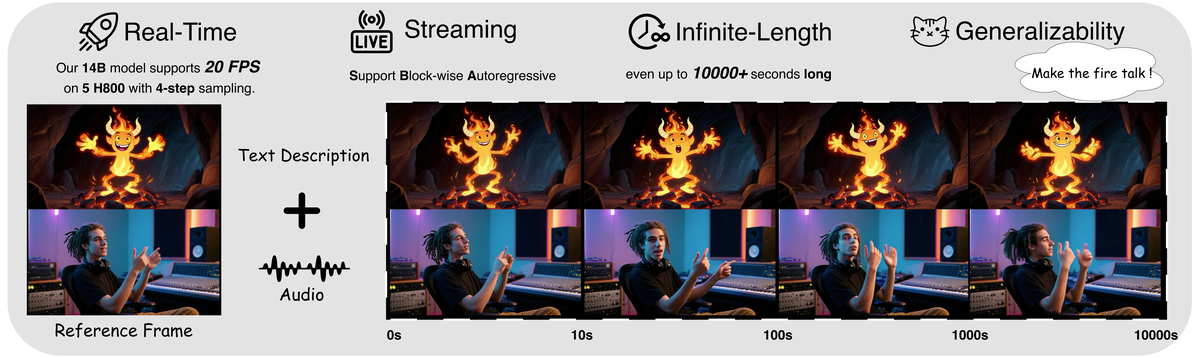
Figure 1 解读:展示了 Live Avatar 的核心能力——支持实时 20 FPS(5 H800 GPU,4步采样)、流式 block-wise 自回归生成、超过 10000 秒的无限长度生成,以及对非人类角色(如火焰人)的泛化能力。输入为参考图像 + 音频 + 文本描述,输出为时间轴上持续生成的高保真 avatar 视频。
2. Idea (核心思想)
Live Avatar 的核心创新是算法-系统协同设计:在算法层面,通过 Self-Forcing Distribution Matching Distillation 将非因果教师模型蒸馏为因果少步学生模型,使其适配流式推理;在系统层面,提出 Timestep-forcing Pipeline Parallelism (TPP) 将顺序去噪步骤分配到不同 GPU 上并行执行,将吞吐量瓶颈从”所有去噪步之和”降低为”单次前向传播”。同时引入 Rolling Sink Frame Mechanism (RSFM) 解决长时序身份漂移问题。
与现有方法的根本区别:不是通过缩小模型来提速,而是通过分布式 pipeline 并行和蒸馏,在保持 14B 大模型质量的同时实现实时推理。
3. Method (方法)
3.1 整体框架
Live Avatar 的训练和推理框架分为两个阶段:
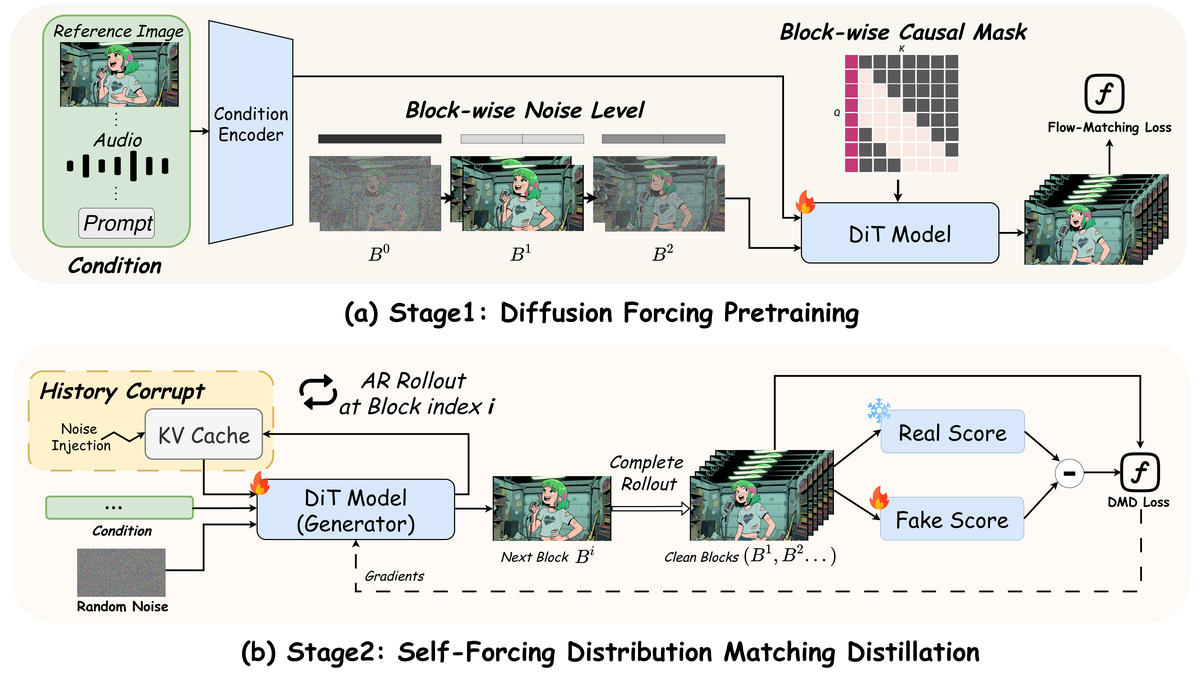
Figure 2 解读:(a) Stage 1: Diffusion Forcing Pretraining — 采用 block-wise 独立噪声调度和因果局部注意力掩码,将非因果模型适配为因果生成。输入包括 Reference Image、Audio 和 Prompt,经过 Condition Encoder 后,对 block 施加不同噪声级别,通过 block-wise causal mask(block 内部全连接,block 之间单向因果)送入 DiT 模型,用 Flow-Matching Loss 训练。(b) Stage 2: Self-Forcing Distribution Matching Distillation — 基于 Self-Forcing 范式,DiT Generator 自回归生成 block 序列,通过 History Corrupt(向 KV Cache 注入噪声)保持训练与推理的一致性。完整 rollout 的输出经 Real Score 和 Fake Score 网络计算 DMD Loss,蒸馏为少步(4步)生成器。
3.2 模型架构
模型基于 WanS2V(14B 参数的 DiT),采用 block-wise 自回归生成。每个 block 包含 3 帧 latent(对应物理帧数通过 VAE 的时间压缩比决定)。生成的联合分布被分解为:
其中 为 rolling sink frame(提供外观参考), 和 分别为第 个 block 的音频和文本 embedding, 为 KV cache 窗口大小。关键设计:KV cache 与当前 noisy block 共享相同噪声级别,这使得 timestep-forcing pipeline 并行成为可能。
3.3 训练流程
Stage 1: Diffusion Forcing Pretraining
- 使用 block-wise 独立噪声调度:每个 block 独立采样噪声级别
- 应用因果注意力掩码:block 内部全连接(intra-block full attention),block 之间单向因果(inter-block causal attention)
- 采用 Flow Matching 目标:
目标速度:
损失函数:
Stage 2: Self-Forcing DMD with History Corrupt
基于 Distribution Matching Distillation (DMD) 进行少步蒸馏,包含三个关键模型:
- Real Score Model(固定的双向教师模型):提供目标分布
- Fake Score Model(动态更新):跟踪学生输出的分布
- Causal Generator(因果学生模型):从 Stage 1 初始化,优化为少步生成
DMD 梯度:
History Corrupt 机制:在训练时向 KV cache 注入随机噪声,使模型学会区分来自历史帧的动态运动信息和 sink frame 的静态身份特征。这弥合了训练(clean cache)和推理(noisy cache)之间的 gap。
Block-wise Gradient Accumulation:由于 DMD 训练显存需求巨大,采用分 block 反向传播 + 梯度累积策略,在保持训练行为一致的同时显著降低峰值显存。
# Stage 1: Diffusion Forcing pretraining
while not converged:
    x0 = sample_video_clip(dataset)
    blocks = partition_video(x0, block_size=3)

    noisy_blocks = []
    timesteps = []
    noises = []
    for block in blocks:
        t = uniform(0.0, 1.0)                 # 每个 block 独立采样噪声级别
        eps = gaussian_like(block)
        block_t = (1 - t) * block + t * eps

        noisy_blocks.append(block_t)
        timesteps.append(t)
        noises.append(eps)

    mask = build_blockwise_causal_mask(num_blocks=len(blocks))
    v_pred = v_theta(noisy_blocks, timesteps, conditions, mask=mask)

    loss = 0.0
    for i, block in enumerate(blocks):
        target = noises[i] - block           # flow-matching target
        loss += squared_l2(v_pred[i], target)

    optimize(loss, params=theta)
# Self-Forcing DMD with History Corrupt
T = len(timesteps)
while not converged:
x_theta = []
kv_cache = []
s = randint(0, T - 1) # 随机选择一个需要反传的 timestep
for frame_idx in range(N):
x_t = gaussian_latent()
for step_idx in range(T - 1, s - 1, -1):
t = timesteps[step_idx]
if step_idx == s:
with grad_enabled():
kv_i, x0_hat = G_theta.kv_forward(x_t, t, kv_cache, conditions[frame_idx])
x_theta.append(x0_hat)
kv_cache.append(detach(kv_i)) # History Corrupt: noisy KV cache
else:
with no_grad():
x0_hat = G_theta(x_t, t, kv_cache, conditions[frame_idx])
eps = gaussian_like(x_t)
x_t = psi(x0_hat, eps, timesteps[step_idx - 1])
loss = dmd_loss(x_theta)
optimize(loss, params=theta)# Block-wise gradient accumulation for DMD training
T = len(timesteps)
while not converged:
x_theta = []
x_cache = []
kv_cache = []
s = randint(0, T - 1)
# Phase 1: rollout without gradient
with no_grad():
for frame_idx in range(N):
x_t = gaussian_latent()
for step_idx in range(T - 1, s - 1, -1):
t = timesteps[step_idx]
if step_idx == s:
kv_i, x0_hat = G_theta.kv_forward(x_t, t, kv_cache, conditions[frame_idx])
x_cache.append(detach(x_t)) # 保存 x_{t_s} 供 replay
x_theta.append(detach(x0_hat))
kv_cache.append(detach(kv_i))
else:
x0_hat = G_theta(x_t, t, kv_cache, conditions[frame_idx])
eps = gaussian_like(x_t)
x_t = psi(x0_hat, eps, timesteps[step_idx - 1])
# Phase 2: replay one block at a time with gradient
for frame_idx in reversed(range(N)):
partial_outputs = []
for j in range(N):
if j == frame_idx:
with grad_enabled():
x0_hat = G_theta(x_cache[j], timesteps[s], kv_cache, conditions[j])
partial_outputs.append(x0_hat)
else:
partial_outputs.append(x_theta[j])
loss = dmd_loss(partial_outputs)
loss.backward()
kv_cache.pop() # 逆序释放 KV,控制峰值显存
optimizer.step()
optimizer.zero_grad()3.4 Timestep-forcing Pipeline Parallelism (TPP)
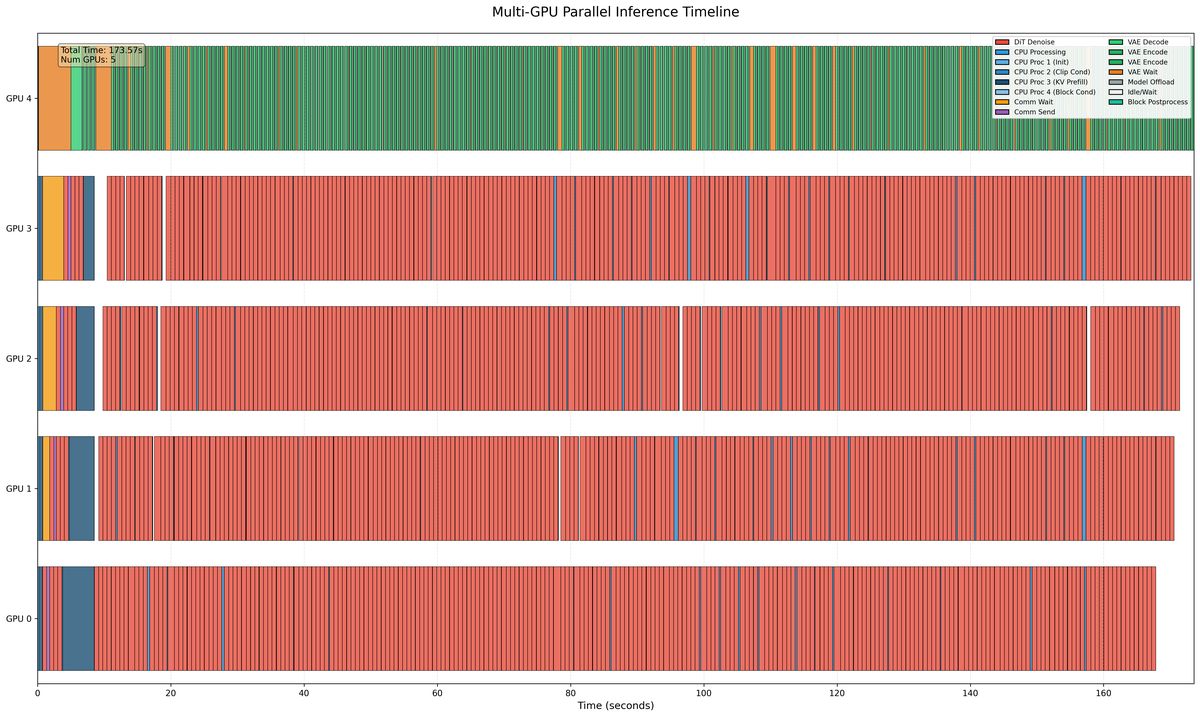
Figure 3 解读:TPP 的核心思想是将 4 步去噪的顺序执行转化为跨 GPU 的流水线并行。左侧展示了 warmup 阶段(第一个 block 填充 pipeline),之后进入 fully pipelined streaming 阶段——所有 GPU 同时处理不同 block 的不同 timestep。例如:GPU0 处理 ,GPU1 处理 ,GPU2 处理 ,GPU3 处理 ,GPU4 负责 VAE decode。右侧说明了通信方式:GPU 内复用本地 KV Cache(Very Fast),GPU 间仅传递 latent(Fast),而不传递 KV Cache(Slow,被避免)。
TPP 的关键设计:
- 每个 GPU 固定一个 timestep: 始终执行 的变换
- Warmup 阶段:第一个 block 依次通过所有 GPU 填充 pipeline
- Fully pipelined 阶段:每个 GPU 完成当前 block 后,将 latent 传给下一个 GPU,立即处理新 block
- KV Cache 完全本地化:每个 GPU 仅使用自己 timestep 的 KV cache,无需跨 GPU 传输(因为 KV cache 与当前 block 共享噪声级别)
- VAE Decode 独立 GPU:防止解码成为 pipeline 瓶颈
吞吐量由单次模型前向传播决定,而非所有去噪步之和:
# TPP multi-GPU inference with AAS and Rolling RoPE
def tpp_inference(gpu_idx, timesteps, max_kv, num_frames, conditions, ref_image):
    T = len(timesteps)
    video = []
    kv_cache = []
    sink = ref_image
    dt = -1.0 / T

    for frame_idx in range(num_frames):
        if gpu_idx == 0:
            x_t = gaussian_latent()            # 第一个 DiT 设备负责采样初始噪声
        else:
            x_t = dist.recv()

        if gpu_idx == T:
            frame = vae_decode(x_t)            # 最后一张卡专门做 VAE decode
            video.append(frame)

            if frame_idx == 0:
                sink = frame                   # AAS: 用首帧更新 sink
                dist.broadcast(sink)
            continue

        if frame_idx == 1:
            sink = dist.recv()                 # AAS: 接收首帧作为新的 sink

        step_idx = T - 1 - gpu_idx
        v_pred, kv_i = v_theta.kv_forward(
            x_t,
            timesteps[step_idx],
            kv_cache,
            conditions[frame_idx],
            rope=rolling_rope(sink),
        )

        if len(kv_cache) == max_kv:
            kv_cache.pop(0)
        kv_cache.append(kv_i)

        x_t = x_t + dt * v_pred
        dist.send(x_t)

    return video
3.5 Rolling Sink Frame Mechanism (RSFM)
长时序生成面临两类漂移问题:
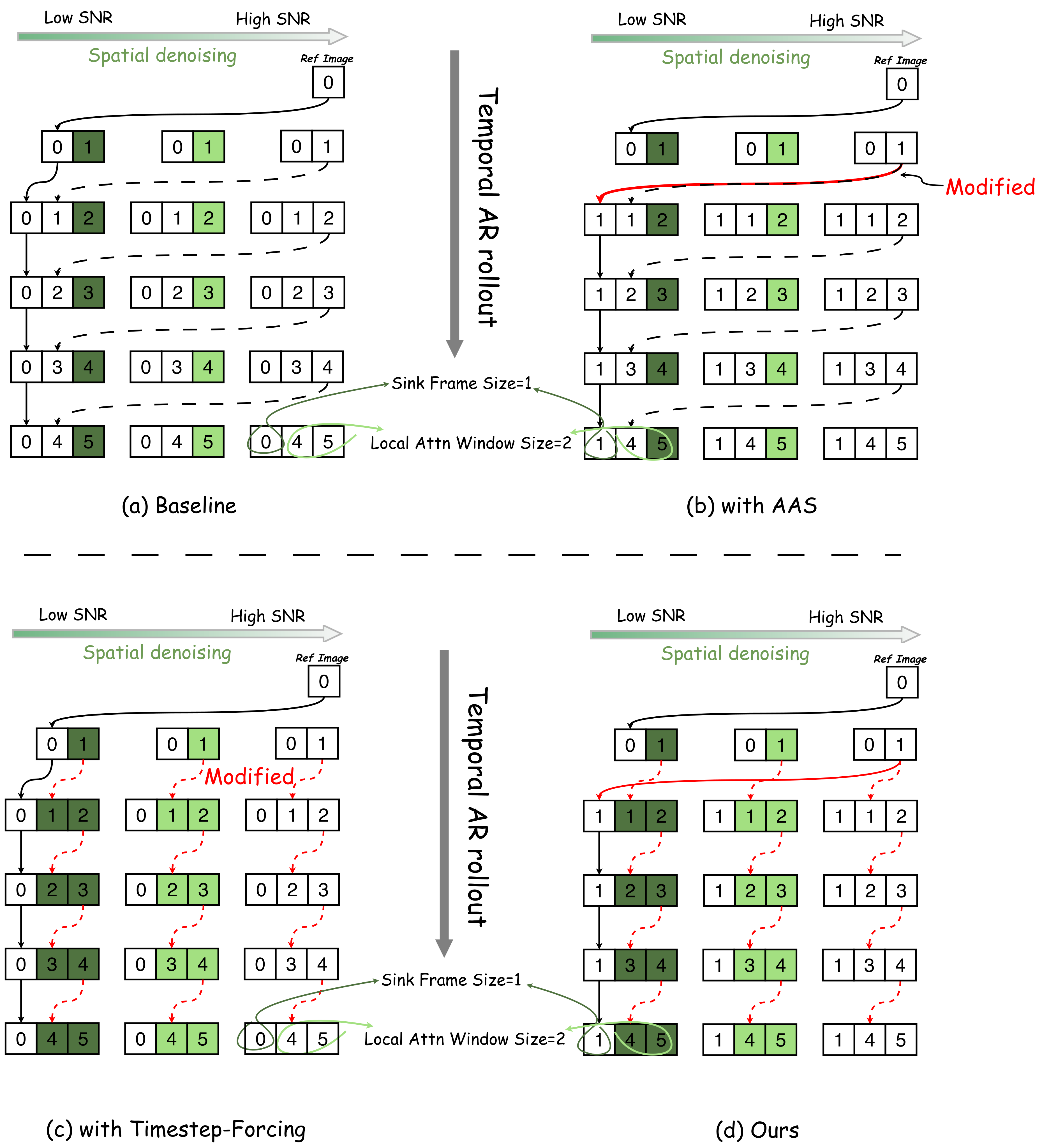
Figure 6 解读:对比四种推理设置。(a) Baseline:使用固定 sink frame 和标准 rolling-kv-cache,KV cache 通过虚线箭头传递。(b) with AAS:将 sink 替换为第一个生成帧(红色标记),解决 distribution drift。(c) with Timestep-Forcing:每个 noisy latent 仅关注相同 timestep 的 KV cache(绿色标记),实现 pipeline 并行。(d) Ours:结合 AAS 和 timestep-forcing 的完整方案。
Adaptive Attention Sink (AAS)
解决 distribution drift 问题:原始 sink frame(参考图像的 VAE 编码)来自真实图像分布,但生成帧来自模型的学习分布,两者存在系统性偏差。AAS 在生成第一个 block 后,用模型自己生成的第一帧替换原始 sink frame,使后续所有 block 的条件都来自模型分布内部,抑制分布漂移。
Rolling RoPE
解决 inference-mode drift 问题:sink frame 与当前 block 之间的 RoPE 相对位置会随生成长度线性增长,远超训练分布。Rolling RoPE 动态调整 sink frame 的 RoPE 位置,使其始终保持在当前 block 之前固定距离,确保相对位置编码落在训练分布内。
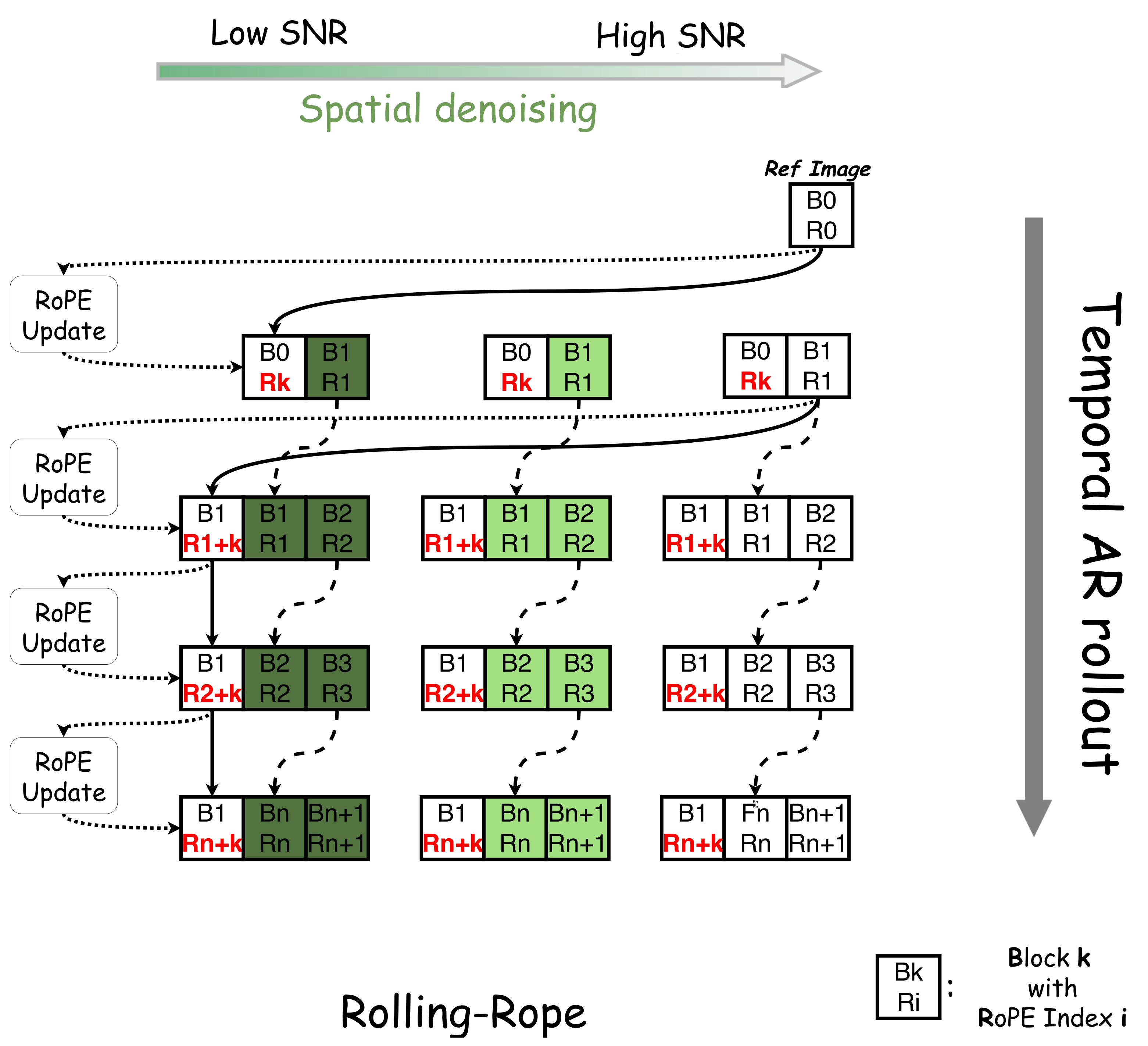
Figure 7 解读:Rolling RoPE 的可视化。每个矩形内的数字表示 block index 和 RoPE index。随着自回归 rollout 进行,每次 RoPE Update 时 sink frame (B1) 的 RoPE index 动态递增(),保持 sink frame 的 RoPE index 始终略大于当前 noisy block,确保全程维持稳定的相对位置距离。
# Single-GPU inference with AAS and Rolling RoPE
def single_gpu_inference(timesteps, max_kv, num_frames, conditions, ref_image):
    video = []
    kv_caches = [[] for _ in timesteps]        # 每个 timestep 单独维护 KV cache
    sink = ref_image
    dt = -1.0 / len(timesteps)

    for frame_idx in range(num_frames):
        x_t = gaussian_latent()

        for step_idx in reversed(range(len(timesteps))):
            v_pred, kv_i = v_theta.kv_forward(
                x_t,
                timesteps[step_idx],
                kv_caches[step_idx],
                conditions[frame_idx],
                rope=rolling_rope(sink),
            )
            x_t = x_t + dt * v_pred

            if len(kv_caches[step_idx]) == max_kv:
                kv_caches[step_idx].pop(0)
            kv_caches[step_idx].append(kv_i)

        frame = vae_decode(x_t)
        video.append(frame)

        if frame_idx == 0:
            sink = x_t                          # AAS: 改用模型生成的首帧 latent

    return video
3.6 Code-to-Paper 映射表
| Paper Concept | Source File | Key Class/Function |
|---|---|---|
| 因果 DiT 模型 | liveavatar/models/wan/causal_model_s2v.py | CausalWanModel_S2V, CausalWanS2VSelfAttention |
| Block-wise Causal Mask | liveavatar/models/wan/causal_model_s2v.py | _prepare_blockwise_causal_attn_mask() |
| Single-GPU Pipeline | liveavatar/models/wan/causal_s2v_pipeline.py | WanS2V.generate() |
| TPP Multi-GPU Pipeline | liveavatar/models/wan/causal_s2v_pipeline_tpp.py | WanS2VTPP pipeline, dist.send()/dist.recv() for latent passing |
| Rolling KV Cache | liveavatar/models/wan/causal_model_s2v.py | _initialize_kv_cache(), circular buffer via current_start % kv_cache_size |
| AAS (Adaptive Attention Sink) | liveavatar/models/wan/causal_s2v_pipeline_tpp.py | ref_latents = block_latents[:,:,0:1] at block_index=0 |
| Rolling RoPE | liveavatar/models/wan/causal_model_s2v.py | rope_precompute(), freqs_cond with dynamic offset |
| History Corrupt | liveavatar/models/wan/causal_model_s2v.py | trainable_cond_mask embedding, noise injection into KV |
| S2V Model Config | liveavatar/models/wan/wan_2_2/modules/s2v/model_s2v.py | S2V model definition |
| Scheduler | liveavatar/scheduler.py | SchedulerInterface, X0/noise/velocity conversions |
| Gradio Demo | minimal_inference/gradio_app.py | Web UI for inference |
4. Experimental Setup (实验设置)
数据集
- 训练集:AVSpeech 数据集,经过 OmniAvatar 的预处理流程过滤(仅保留 >10s 的片段),最终得到 400,000 个高质量样本
- 测试集 GenBench:使用 Gemini-2.5 Pro、Qwen-Image、CosyVoice 合成生成,包含:
- GenBench-ShortVideo:100 个约 10 秒的测试样本
- GenBench-LongVideo:15 个超过 5 分钟的测试视频
- 涵盖写实人类、动画角色、拟人化非人类,正面和侧面视角
- In-domain 测试:从 AVSpeech 中抽取 5% 的 50 个片段(5-10s)
Baselines
- Ditto (0.2B), EchoMimic-V2, Hallo3 (5B), StableAvatar (1.3B), OmniAvatar (14B), WanS2V (14B)
评估指标
- 图像质量:FID, FVD
- 感知质量:ASE↑(Q-align 美学分数), IQA↑(Q-align 图像质量)
- 音视频同步:Sync-C↑, Sync-D↓
- 语义一致性:Dino-S↑(DINOv2 相似度)
- 效率:FPS↑, TTFF↓(Time-to-First-Frame)
训练配置
- 硬件:128 NVIDIA H800 GPUs
- 分辨率:720×400,84 帧
- 训练步数:Stage 1: 25K steps, Stage 2: 2.5K steps(共约 500 GPU days)
- Batch size:per-GPU batch size = 1,使用 FSDP + gradient accumulation
- 学习率:Student 1e-5, Fake Score 2e-6
- Block 设置:每 3 帧一个 block,KV cache 长度 4 blocks,单个 rolling sink frame
- LoRA:rank=128, alpha=64
5. Experimental Results (实验结果)
主要性能对比
GenBench-ShortVideo (10s):
| Model | ASE↑ | IQA↑ | Sync-C↑ | Sync-D↓ | Dino-S↑ | FPS↑ |
|---|---|---|---|---|---|---|
| Ditto | 3.31 | 4.24 | 4.09 | 10.76 | 0.99 | 21.80 |
| Hallo3 | 3.12 | 3.97 | 4.74 | 10.19 | 0.94 | 0.26 |
| StableAvatar | 3.52 | 4.47 | 3.42 | 11.33 | 0.93 | 0.64 |
| OmniAvatar | 3.53 | 4.49 | 6.77 | 8.22 | 0.93 | 0.16 |
| WanS2V | 3.36 | 4.29 | 5.89 | 9.08 | 0.95 | 0.25 |
| Ours | 3.44 | 4.35 | 5.69 | 9.13 | 0.95 | 20.88 |
GenBench-LongVideo (7min):
| Model | ASE↑ | IQA↑ | Sync-C↑ | Sync-D↓ | Dino-S↑ | FPS↑ |
|---|---|---|---|---|---|---|
| OmniAvatar | 2.36 | 2.86 | 8.00 | 7.59 | 0.66 | 0.16 |
| WanS2V | 2.63 | 3.99 | 6.04 | 9.12 | 0.80 | 0.25 |
| Ours | 3.38 | 4.73 | 6.28 | 8.81 | 0.94 | 20.88 |
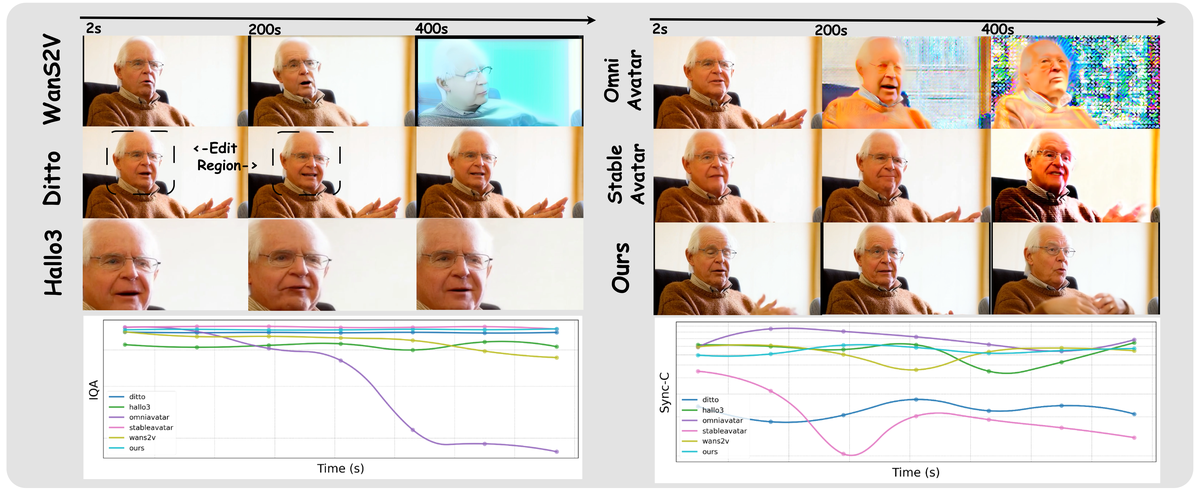
Figure 4 解读:长视频生成的定性对比。左右两组分别展示两个不同角色在 2s、200s、400s 时间点的生成帧。WanS2V 和 Ditto 在长时间后出现明显的画质退化和身份漂移(如 Ditto 的 Edit Region 标注区域),OmniAvatar 和 StableAvatar 也出现颜色偏移。Live Avatar(Ours)在整个序列中保持稳定的身份和高画质。下方的 IQA 和 Sync-C 曲线图显示 Live Avatar 的指标随时间保持平稳,而其他方法逐渐下降。
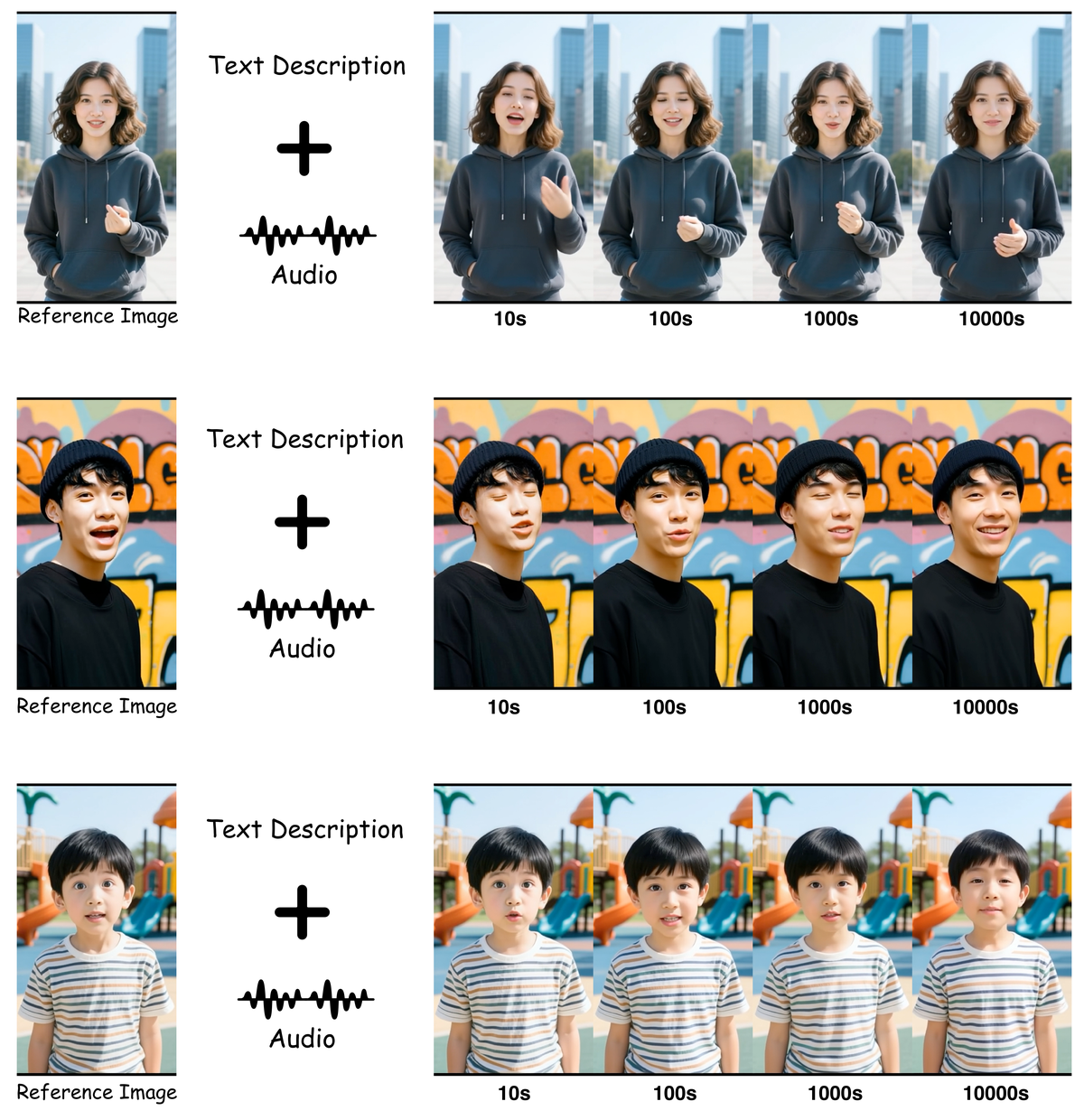
Figure 5 解读:GenBench-ShortVideo 上的定性对比。展示了 reference image 与 Live Avatar(Ours)、OmniAvatar、EchoMimic-V2 的生成结果。Live Avatar 在保真度和自然度上均表现最优,OmniAvatar 在某些角色上出现不自然的姿态,EchoMimic-V2 因依赖固定骨骼模板导致面部变形。
关键发现:
- Live Avatar 在长视频场景下优势更为显著,ASE 和 IQA 大幅领先所有 baseline
- FPS 达到 20.88,相比最快的 baseline Ditto(21.80 FPS, 0.2B)仅略低,但质量远超
- 长视频中其他方法的 Dino-S 显著下降(OmniAvatar: 0.93→0.66),Live Avatar 保持稳定(0.95→0.94)
推理效率消融 (Table 3)
| Methods | GPUs | NFE | FPS↑ | TTFF↓ |
|---|---|---|---|---|
| w/o TPP | 2 | 5 | 4.26 | 3.88 |
| w/o TPP, w/ SP_4GPU | 5 | 5 | 5.01 | 3.24 |
| w/o VAE Parallel | 4 | 4 | 10.16 | 4.73 |
| w/o DMD | 2 | 80 | 0.29 | 45.50 |
| Ours | 5 | 4 | 20.88 | 2.89 |
- DMD 蒸馏贡献最大(80步→4步),TPP 实现 pipeline 并行(4.26→20.88 FPS)
- 序列并行(SP)仅提供边际增益,因 block 序列长度短,通信开销抵消了并行收益
- VAE 独立 GPU 解码消除了 pipeline 瓶颈
Rolling Sink Frame 消融 (Table 4, Long Video)
| Methods | ASE↑ | IQA↑ | Sync-C↑ | Dino-S↑ |
|---|---|---|---|---|
| w/o AAS | 3.13 | 4.44 | 6.25 | 0.91 |
| w/o Rolling RoPE | 3.38 | 4.71 | 6.29 | 0.86 |
| w/o History Corrupt | 2.90 | 3.88 | 6.14 | 0.81 |
| Ours | 3.38 | 4.73 | 6.28 | 0.93 |
- History Corrupt 对质量影响最大(IQA 下降 0.85)
- Rolling RoPE 对身份一致性(Dino-S)至关重要(0.93→0.86)
- 注:Table 4 中完整模型 Dino-S 为 0.93,Table 2 主实验为 0.94,差异源于 Table 4 使用不同的长视频评估子集
10,000 秒超长生成 (Table 7)
| Time Segment | ASE↑ | IQA↑ | Sync-C↑ | Dino-S↑ |
|---|---|---|---|---|
| 0-10s | 3.37 | 4.72 | 6.20 | 0.94 |
| 100-110s | 3.38 | 4.71 | 6.44 | 0.93 |
| 1000-1010s | 3.37 | 4.69 | 5.98 | 0.93 |
| 10000-10010s | 3.38 | 4.71 | 6.26 | 0.93 |
- 各指标在 10000 秒时间跨度内几乎无退化,证明 RSFM 的有效性
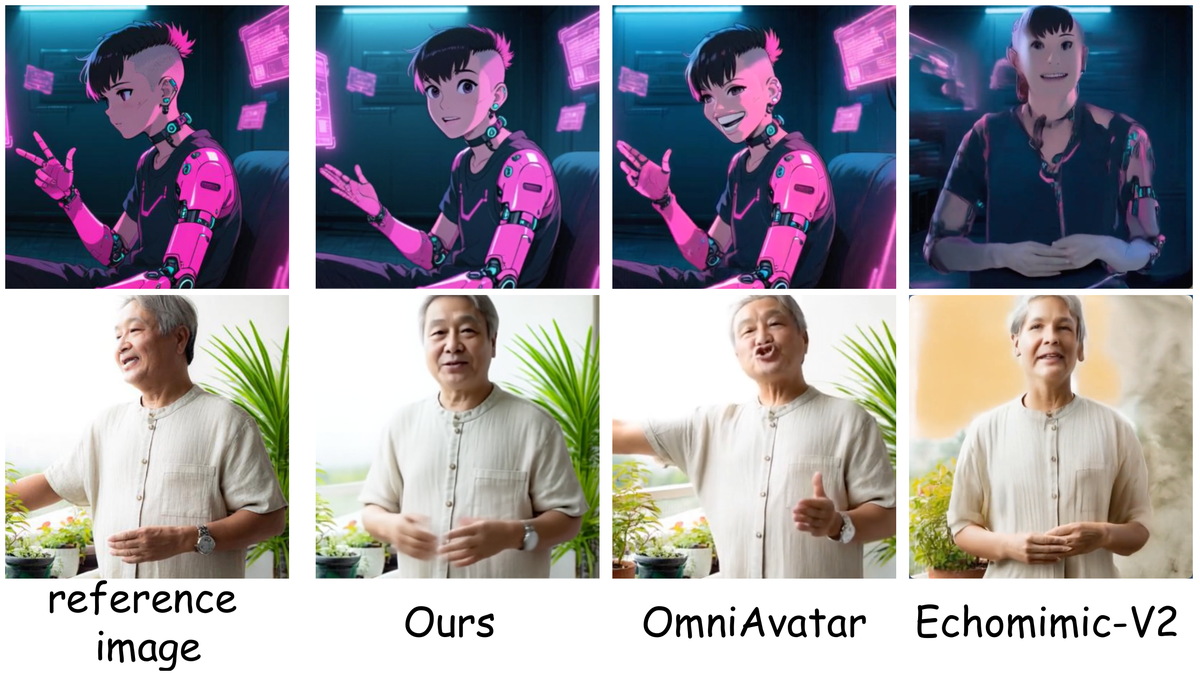
Figure 8 解读:Multi-GPU Parallel Inference Timeline,展示 5 个 GPU(GPU 0-4)的计算和等待时间分布。左侧两段白色间隙为 warmup 阶段(包括 AAS 的二次 warmup)。此后大部分时间被红色的 DiT 计算占据,显示各 GPU 利用率高且帧率稳定。偶尔出现的白色间隙(idle time)由帧率波动引起,对整体性能影响可忽略。
用户研究 (Table 5)
| Model | Naturalness↑ | Synchronization↑ | Consistency↑ |
|---|---|---|---|
| Ditto | 78.2 | 40.5 | 90.2 |
| OmniAvatar | 71.1 | 78.5 | 90.8 |
| WanS2V | 84.3 | 85.2 | 92.0 |
| Ours | 86.3 | 80.6 | 91.1 |
- Live Avatar 在 Naturalness 上最优,在三项指标上最为均衡
- OmniAvatar 虽然客观 Sync-C 最高,但人类评估的同步性仅 78.5,说明过度优化唇动反而损害自然感
局限性
- TPP 提升 FPS 但不降低 TTFF(首帧延迟),限制交互响应性
- 对 RSFM 的强依赖在复杂场景下可能影响长期时序一致性