VideoAlign: Improving Video Generation with Human Feedback
Authors: Jie Liu*, Gongye Liu*, Jiajun Liang†, Ziyang Yuan, Xiaokun Liu, Mingwu Zheng, Xiele Wu, Qiulin Wang, Menghan Xia, Xintao Wang, Xiaohong Liu, Fei Yang, Pengfei Wan, Di Zhang, Kun Gai, Yujiu Yang✉, Wanli Ouyang Affiliations: MMLab CUHK, Tsinghua University, Kling Team (Kuaishou Technology), Shanghai Jiao Tong University, Shanghai AI Laboratory arXiv: 2501.13918 Project Page: gongyeliu.github.io/videoalign GitHub: KwaiVGI/VideoAlign Venue: NeurIPS 2025
1. Motivation(研究动机)
当前基于 Rectified Flow 的视频生成模型(如 Kling、Gen3 等)已能生成逼真的视频,但仍存在两类核心问题:
- 运动不流畅(Unsmooth Motion):生成视频存在抖动、不自然的动态变化等问题。
- 文本-视频不对齐(Text Misalignment):生成内容与文本 prompt 之间存在语义偏差,尤其是复杂提示词场景。
将 RLHF 引入视频生成面临两大瓶颈:
- Reward Model 不可靠:现有视频偏好数据集(如 VideoScore 等)基于早期低分辨率、短时长的 T2V 模型收集,reward model 在现代高质量 T2V 模型上泛化性差;VLM-based reward model 的设计空间(标注范式、token 位置、tie 处理)未被充分探索。
- Alignment 算法不兼容:现代 T2V 模型采用 Rectified Flow 而非传统 diffusion,直接迁移 Diffusion-DPO 会引入 timestep-dependent KL 系数 ,导致模型在高噪声层级过度优化,产生 reward hacking。
本文系统性地解决上述两个问题:构建大规模偏好数据集 + 多维度 VideoReward 模型 + 三种 Flow-based Alignment 算法。
2. Idea(核心思想)
一句话总结:构建 182k 多维度视频偏好数据集训练 VLM-based VideoReward,并从统一 RL 视角推导出三种 Flow Matching 对齐算法(Flow-DPO / Flow-RWR / Flow-NRG),其中 Flow-DPO 使用常数 替代 timestep-dependent 以避免 reward hacking。
核心发现:
- Bradley-Terry with Ties (BTT) 优于普通 BT 和回归损失,因为 tie 标注包含有价值的偏好信息。
- Token Positioning 策略:将 VQ/MQ token 放在视频后、prompt 前(context-agnostic),TA token 放在 prompt 后(context-aware),消除 context leakage。
- 常数 优于 :timestep-dependent KL 系数在 时趋近于 0,允许模型在高噪声步骤自由偏离 reference policy,导致 reward hacking;固定 则全局约束偏离程度。
3. Method(方法)
3.1 整体框架
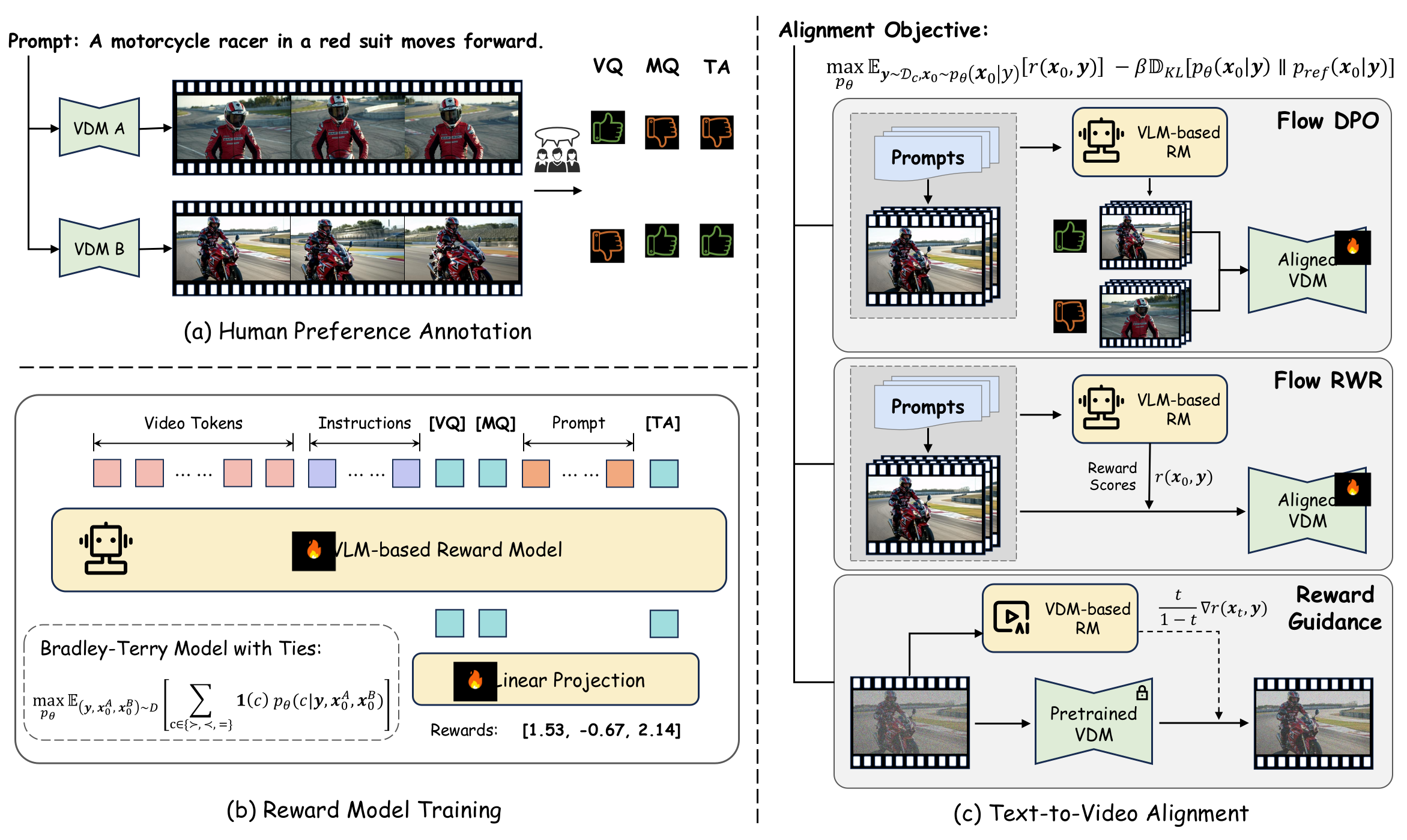
Figure 1 解读:VideoAlign 框架全貌。(a) Human Preference Annotation:收集 16k 高质量 prompts,通过 12 个 T2V 模型生成 108k 视频,配对形成 182k triplets,每个 triplet 在 VQ(Visual Quality)、MQ(Motion Quality)、TA(Text Alignment)三个维度独立标注偏好(A wins / Tied / B wins)。(b) Reward Model Training:将视频帧序列 token 化后输入 VLM(Qwen2-VL-2B),在视频后插入 [VQ] [MQ] context-agnostic token,在 prompt 后插入 [TA] context-aware token,通过 Linear Projection 输出三维奖励分数,使用 BTT loss 训练。(c) Text-to-Video Alignment:三种对齐算法——Flow-DPO(训练时直接偏好优化)、Flow-RWR(训练时奖励加权回归)、Flow-NRG(推理时奖励梯度引导)。
3.2 偏好数据集构建
Prompt 收集:从互联网收集 prompts,按 8 大类(animal, architecture, food, people, plants, scenes, vehicles, objects)分类,经 GPT-4o 扩写后去重、过滤,最终得到 16,000 个高质量 prompts。
视频生成与标注:
| 模型类型 | T2V 模型 | 视频数量 | Triplets 数量 | 分辨率 | 时长 |
|---|---|---|---|---|---|
| Pre-Sora 时代 | Gen2, SVD, Pika 1.0, Vega, PixVerse v1, HiDream | 6k each (HiDream 0.3k) | 13k each (HiDream 0.3k) | 576-768 px | 3-5s |
| 现代模型 | Dreamina, Luma, Gen3, Kling 1.0, PixVerse v2, Kling 1.5 | 6k-16k | 28k-68k | 384-768 px | 5-6s |
总计:108k 视频,182k 标注 triplets,验证集保留 13,000 triplets。
标注方式:
- 每个 triplet 在 VQ / MQ / TA 三维度分别标注 pairwise preference(A wins / Tied / B wins)
- 同时为每个视频赋 1-5 Likert 分数(支持 pointwise vs pairwise 对比实验)
3.3 VideoReward 模型
骨干网络:Qwen2-VL-2B-Instruct
三个关键设计决策:
(1) Bradley-Terry with Ties (BTT) vs Score Regression
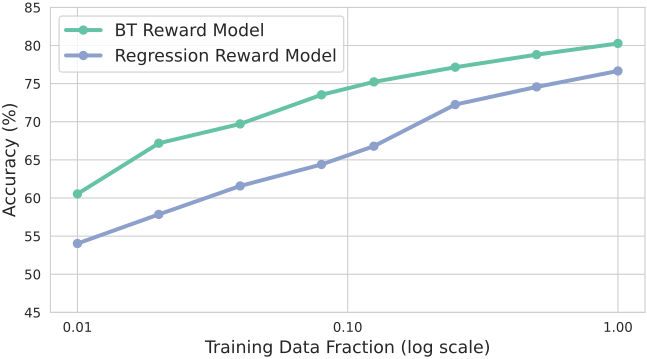
Figure 2 解读:BT reward model 和 Regression reward model 在不同训练数据比例下的验证精度对比。横轴为训练数据占比(log scale),纵轴为 accuracy (%)。BT 模型在所有数据规模下均优于 Regression 模型,尤其在数据量较大时差距更为明显(~83% vs ~75%),说明 pairwise comparison 天然更适合捕捉细微偏好差异。
Bradley-Terry (BT) loss:
Score Regression loss:
结论:BT 模型始终优于 Regression 模型,因为 pairwise annotation 能捕捉到 pointwise 分数无法区分的微妙偏好差异。
(2) Bradley-Terry with Ties (BTT)
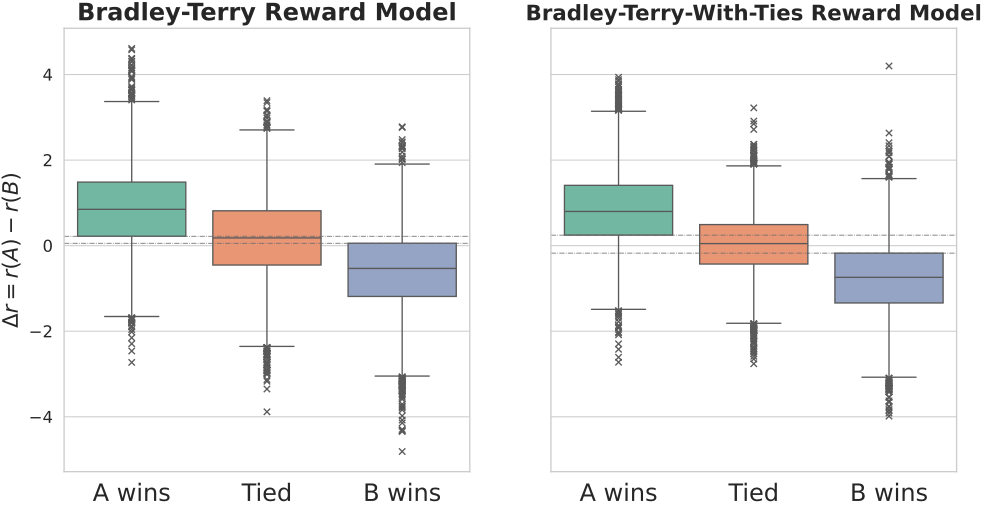
Figure 3 解读:BT 和 BTT 模型在验证集上的 score difference 分布箱线图。左侧 BT 模型中,Tied 对的 分布散乱,与 win/lose 对高度重叠,说明 BT 模型无法有效区分 tie 情况。右侧 BTT 模型中,Tied 对的 紧密聚集在 0 附近,win/lose 对则保持较大间隔,说明 BTT 学到了更清晰的决策边界。
BTT 定义三类偏好分布( 控制 tie 倾向,实验中设 ):
BTT loss:
(3) Token Positioning 策略
解决 context leakage 问题:传统方法将所有维度的分数预测 head 放在最后一个 token 上,导致 VQ 分数受 prompt 影响。
本文的解决方案:
- [VQ] 和 [MQ] token 插入在视频 token 之后、prompt 之前(context-agnostic,只关注视觉内容)
- [TA] token 插入在完整 prompt 之后(context-aware,需同时关注视觉和文本)
- 三个 token 的 final-layer embedding 经共享 Linear Projection 映射为三维分数
输入序列: [Video Tokens] ... [VQ] [MQ] [Instructions] [Prompt] [TA]
                              ↓    ↓                           ↓
                         视觉质量  运动质量                  文本对齐
VideoReward 训练伪代码
# VideoReward 训练伪代码
def train_video_reward(model, dataset, theta=5.0):
    """
    model: Qwen2-VL-2B + Linear Projection
    dataset: 182k triplets with VQ/MQ/TA pairwise labels
    theta: BTT tie probability parameter
    """
    for (prompt, video_A, video_B, labels) in dataset:
        # 1. 视频预处理: 2fps 采样, 448x448 分辨率, 保持宽高比
        frames_A = sample_frames(video_A, fps=2, resolution=448)
        frames_B = sample_frames(video_B, fps=2, resolution=448)

        # 2. 构造输入序列 (Token Positioning)
        input_A = [frames_A, "[VQ]", "[MQ]", instructions, prompt, "[TA]"]
        input_B = [frames_B, "[VQ]", "[MQ]", instructions, prompt, "[TA]"]

        # 3. 前向传播获取三维 reward
        r_A = model(input_A)  # [r_vq_A, r_mq_A, r_ta_A]
        r_B = model(input_B)  # [r_vq_B, r_mq_B, r_ta_B]

        # 4. 对每个维度 d ∈ {VQ, MQ, TA} 计算 BTT loss
        loss = 0
        for d in [VQ, MQ, TA]:
            if labels[d] == "tie":
                p = (theta**2 - 1) * exp(r_A[d]) * exp(r_B[d]) / \
                    ((exp(r_A[d]) + theta*exp(r_B[d])) * (theta*exp(r_A[d]) + exp(r_B[d])))
            elif labels[d] == "A_wins":
                p = exp(r_A[d]) / (exp(r_B[d]) + theta * exp(r_A[d]))
            else:  # B_wins
                p = exp(r_B[d]) / (theta * exp(r_A[d]) + exp(r_B[d]))
            loss -= log(p)

        loss.backward()
        optimizer.step()
3.4 Flow-DPO
Rectified Flow 基础
Rectified Flow 定义 “noisy” data 为 ,其中 为真实数据, 为噪声。Flow Matching 目标为:
其中目标速度场 。
RLHF 统一目标
从 Diffusion-DPO 到 Flow-DPO 的推导
Diffusion-DPO 的目标(在噪声预测框架下):
关键引理(Lemma B.1):在 Rectified Flow 中,噪声预测误差和速度场预测误差的关系为:
将此代入 Diffusion-DPO 目标,得到 Flow-DPO loss:
其中 。
核心发现:常数 替代
问题分析: 在 (高噪声)时趋近于 0,导致 KL 约束几乎消失,模型在高噪声步骤自由偏离 reference policy,造成 reward hacking。
解决方案:受 DDPM 中丢弃时间权重可改善样本质量的启发,直接使用常数 替代 :
其中 , 类似。
Flow-DPO 伪代码(论文 Appendix C)
def flow_dpo_loss(model, ref_model, x_w, x_l, c, beta):
    """
    model: 当前 Flow 模型(可训练)
    ref_model: 冻结的 reference Flow 模型
    x_w: 偏好视频 latent (preferred)
    x_l: 非偏好视频 latent (non-preferred)
    c: 文本条件 (prompt)
    beta: 常数 KL 正则化系数
    """
    # 1. 随机采样 timestep 和噪声
    timestep = torch.rand(len(x_w))
    noise = torch.randn_like(x_w)

    # 2. 构造 noisy latent: x_t = (1 - t) * x_0 + t * noise
    noisy_x_w = (1 - timestep) * x_w + timestep * noise
    noisy_x_l = (1 - timestep) * x_l + timestep * noise

    # 3. 预测速度场
    velocity_w_pred = model(noisy_x_w, c, timestep)
    velocity_l_pred = model(noisy_x_l, c, timestep)
    velocity_ref_w_pred = ref_model(noisy_x_w, c, timestep)
    velocity_ref_l_pred = ref_model(noisy_x_l, c, timestep)

    # 4. 计算目标速度场: v = noise - x_0
    velocity_w = noise - x_w
    velocity_l = noise - x_l

    # 5. 计算各项误差
    model_w_err = (velocity_w_pred - velocity_w).norm().pow(2)
    model_l_err = (velocity_l_pred - velocity_l).norm().pow(2)
    ref_w_err = (velocity_ref_w_pred - velocity_w).norm().pow(2)
    ref_l_err = (velocity_ref_l_pred - velocity_l).norm().pow(2)

    # 6. 计算 DPO loss (常数 beta,非 beta_t)
    w_diff = model_w_err - ref_w_err
    l_diff = model_l_err - ref_l_err
    inside_term = -0.5 * beta * (w_diff - l_diff)
    loss = -1 * log(sigmoid(inside_term))

    return loss
3.5 Flow-RWR
从 RLHF 统一目标(Eq. 3)出发,其最优闭式解为:
对应的 RWR loss(用于 Rectified Flow 模型):
与 Flow-DPO 类似,省略 因子以获得更好的性能。本质上是用 reward 对 Flow Matching loss 进行加权。
3.6 Flow-NRG(Noisy Reward Guidance)
推理时对齐方法,无需训练。从闭式解出发:
对于 Rectified Flow,通过偏移速度场实现引导:
Noisy Latent Reward Model:在像素空间计算 需要通过完整 VAE decoder 反向传播,代价极高。因此训练一个轻量级的 time-dependent reward model 直接在 latent space 上工作:
- 对每个偏好对 施加相同噪声
- 使用 BTT loss 在 noisy latent 上训练
- 复用预训练 VDM 的前几层作为 backbone
Flow-NRG 伪代码(论文 Appendix C)
def reward_guidance(model, reward_model, prompt_embeds, latents,
                    timesteps, reward_weight, rg_scale, cfg_scale):
    """
    model: 预训练 Flow 模型
    reward_model: Noisy latent reward model r_phi(x_t, prompt, t)
    reward_weight: 多维奖励的加权系数 (e.g., [0.1, 0.1, 0.8] for VQ:MQ:TA)
    rg_scale: reward guidance 强度 w
    cfg_scale: classifier-free guidance 强度
    """
    dts = timesteps[:-1] - timesteps[1:]  # 步长
    for i, t in enumerate(timesteps):
        # 1. 速度场预测 (含 CFG)
        v_pred = model(latents, prompt_embeds, t)
        if cfg_scale != 1.0:
            v_pred_uncond = model(latents, None, t)
            v_pred = v_pred_uncond + cfg_scale * (v_pred - v_pred_uncond)

        # 2. 计算 reward gradient
        latents = latents.detach().requires_grad_(True)
        reward = reward_model(latents, prompt_embeds, t)
        reward = (reward * reward_weight).sum()  # 加权求和
        reward_guidance = torch.autograd.grad(reward, latents)

        # 3. 引导速度场 (t != 1 时)
        if t != 1:
            v_pred = v_pred - rg_scale * t / (1 - t) * reward_guidance

        # 4. Euler 积分更新
        latents = latents - dts[i] * v_pred

    return latents
3.7 三种方法对比
| 特性 | Flow-DPO | Flow-RWR | Flow-NRG |
|---|---|---|---|
| 阶段 | 训练时 | 训练时 | 推理时 |
| 需要 reference model | 是 | 否 | 否 |
| 需要 reward score | 否(隐式) | 是(显式加权) | 是(gradient) |
| 偏好数据 | pairwise pairs | reward-labeled data | 无需偏好数据 |
| 多维度可控 | 需重新训练 | 需重新训练 | 推理时自由调节权重 |
| 效果 | 最优 | 中等 | 灵活 |
4. Experimental Setup(实验设置)
4.1 Reward Model 训练
- 骨干:Qwen2-VL-2B-Instruct
- 损失函数:BTT loss()
- 视频采样:2 fps,固定帧间隔,约 分辨率(保持宽高比)
- 训练数据:182k triplets(16k prompts × 12 T2V models)
- 验证集:13k triplets
4.2 Reward Model 评估
- VideoGen-RewardBench(本文提出):26.5k 标注 video pairs,来自现代 T2V 模型,分 VQ/MQ/TA/Overall 四类
- GenAI-Bench:Pre-Sora 时代短视频(2s),用于跨代泛化评估
- 指标:ties-included 和 ties-excluded pairwise accuracy
4.3 Video Alignment 训练
- 基座模型 :内部基于 Transformer 的 Rectified Flow T2V 模型
- 微调方式:LoRA(following SD3)
- Reward 来源:VideoReward 作为 ground-truth reward 重新标注训练集
- SFT baseline:仅使用 “chosen” 数据训练
4.4 Video Alignment 评估
- 自动指标:
- Win rate(VideoReward 分数 vs pretrained model)
- VBench score(Quality / Semantic 等子项)
- 人工评估:2 名标注员 + 1 名仲裁员
- Prompt 来源:VBench、VideoGen-Eval、TA-Hard(本文构建的高难度 TA 测试集)
5. Results(实验结果)
5.1 VideoReward 性能
| Method | GenAI-Bench (w/ Ties) | GenAI-Bench (w/o Ties) | VideoGen-RewardBench Overall (w/ Ties) | Overall (w/o Ties) | VQ (w/o Ties) | MQ (w/o Ties) | TA (w/o Ties) |
|---|---|---|---|---|---|---|---|
| Random | 33.67 | 49.84 | 41.86 | 50.30 | 49.86 | 49.64 | 50.40 |
| VideoScore | 49.03 | 71.69 | 41.80 | 50.22 | 51.09 | 50.34 | 50.34 |
| LiFT | 37.06 | 58.39 | 39.08 | 57.26 | 54.91 | 55.43 | 55.43 |
| VisionReward | 51.56 | 72.41 | 56.77 | 67.59 | 59.03 | 60.98 | 61.15 |
| Ours (VideoReward) | 49.41 | 72.89 | 61.26 | 73.59 | 75.66 | 74.70 | 72.20 |
关键发现:
- VideoReward 在 VideoGen-RewardBench 上全面领先,Overall accuracy (w/o Ties) 达 73.59%,比 VisionReward 高 6 个百分点
- 在 GenAI-Bench(Pre-Sora 时代模型)上也保持可比性能(72.89% w/o Ties),说明跨代泛化能力强
- VQ 维度领先幅度最大(75.66% vs 59.03%),说明现有 reward model 难以评估现代 T2V 模型的视觉质量
5.2 Video Alignment 性能
多维度对齐(VQ:MQ:TA = 1:1:1)
| Method | VBench Total | VBench Quality | VBench Semantic | VQ | MQ | TA | VideoGen-Eval VQ | MQ | TA | TA-Hard VQ | MQ | TA |
|---|---|---|---|---|---|---|---|---|---|---|---|---|
| Pretrained | 83.19 | 84.37 | 78.46 | 50.0 | 50.0 | 50.0 | 50.0 | 50.0 | 50.0 | 50.0 | 50.0 | 50.0 |
| SFT | 82.31 | 83.13 | 79.04 | 51.28 | 65.21 | 52.84 | 61.27 | 76.13 | 46.35 | 57.75 | 76.06 | 57.75 |
| Flow-RWR | 82.27 | 83.19 | 78.59 | 51.55 | 63.9 | 53.43 | 59.05 | 69.7 | 48.35 | 61.97 | 78.87 | 55.71 |
| Flow-DPO () | 80.90 | 81.52 | 78.42 | 87.78 | 82.36 | 51.02 | 88.44 | 91.23 | 28.14 | 84.29 | 83.10 | 38.03 |
| Flow-DPO (常数 ) | 83.41 | 84.19 | 80.26 | 93.42 | 69.08 | 75.43 | 90.95 | 81.01 | 68.26 | 77.46 | 71.43 | 73.24 |
关键发现:
- Flow-DPO()出现严重 reward hacking:VQ/MQ win rate 极高(87.78%/82.36%),但 TA 大幅下降(51.02%),VBench Total 也降至 80.90
- Flow-DPO(常数 )全面均衡:VQ 93.42%、TA 75.43%,VBench Total 83.41(高于 pretrained 的 83.19)
- Flow-DPO > SFT > Flow-RWR,SFT 虽不错但无法利用 rejected 数据的信息
单维度对齐(仅优化 TA)
| Method | VBench Total | Quality | Semantic | TA | VideoGen-Eval TA | TA-Hard TA |
|---|---|---|---|---|---|---|
| Pretrained | 83.19 | 84.37 | 78.46 | 50.00 | 50.00 | 50.00 |
| SFT | 82.71 | 83.48 | 79.62 | 52.88 | 53.81 | 64.79 |
| Flow-RWR | 82.40 | 83.36 | 78.58 | 59.66 | 49.50 | 66.20 |
| Flow-DPO () | 82.35 | 83.00 | 79.75 | 63.67 | 55.95 | 71.83 |
| Flow-DPO (常数 ) | 83.38 | 84.28 | 79.80 | 69.09 | 65.49 | 84.51 |
常数 的 Flow-DPO 在 TA-Hard 上达到 84.51% win rate,远超其他方法。
5.3 人工评估
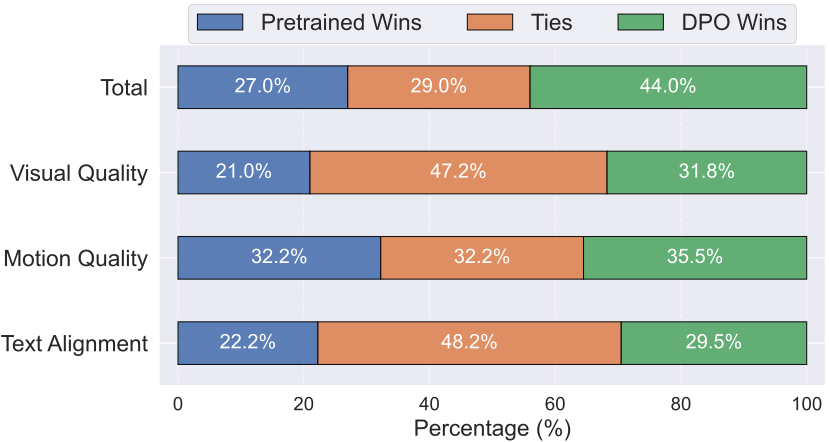
Figure 5 解读:Flow-DPO aligned model vs pretrained model 在 VideoGen-Eval 上的人工评估结果。总体上 DPO Wins 占 44.0%,Pretrained Wins 仅 27.0%。按维度看:Visual Quality 上 DPO 以 31.8% vs 21.0% 领先(47.2% 为平局),Motion Quality 上 DPO 以 35.5% vs 32.2% 微幅领先,Text Alignment 上 DPO 以 29.5% vs 22.2% 显著领先(48.2% 为平局)。人工评估验证了 Flow-DPO 的全面提升。
5.4 Reward Guidance 结果
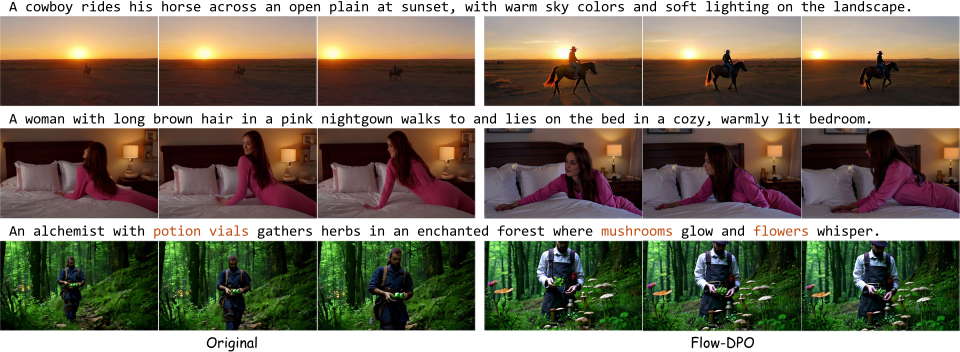
Figure 4 解读:Flow-DPO 对齐前后的视频生成对比。三组示例中,Flow-DPO 模型在文本语义对齐和视觉质量上均有显著提升:第一组中马匹运动更自然、色调更和谐;第二组中女性动作更流畅、光照更自然;第三组中 “mushrooms glow and flowers whisper” 的语义得到更好体现(蘑菇发光效果明显改善)。
Flow-NRG 的灵活性(Table 5, VideoGen-Eval, guidance strength ):
| VQ:MQ:TA 权重 | VQ win rate | MQ win rate | TA win rate |
|---|---|---|---|
| 0:0:1 | 60.56 | 46.48 | 70.42 |
| 0.1:0.1:0.8 | 66.50 | 63.73 | 60.86 |
| 0.1:0.1:0.6 | 68.94 | 67.59 | 53.28 |
| 0.5:0.5:0 | 86.43 | 93.23 | 26.65 |
用户可通过调节权重在推理时实现自定义的多目标 trade-off。
5.5 消融实验
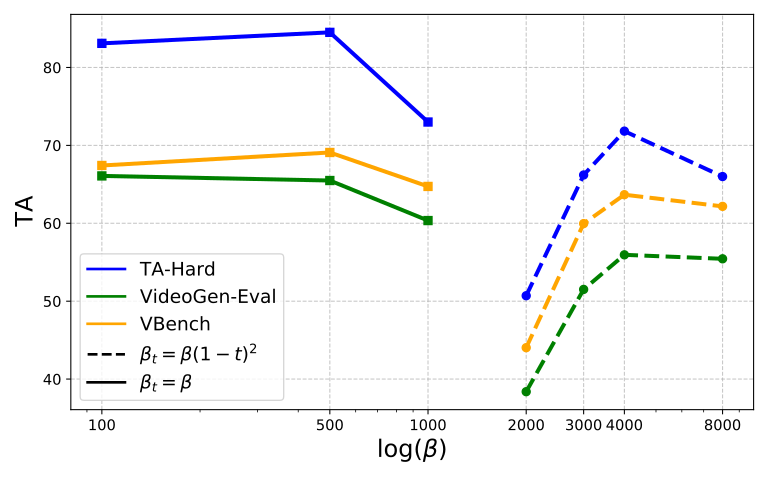
Figure 6 解读:在不同 值下,timestep-dependent (虚线)和常数 (实线)在 TA 维度的性能对比。横轴为 (从 100 到 8000),纵轴为 TA accuracy。在所有三个评估集(TA-Hard、VideoGen-Eval、VBench)上,常数 始终优于 变体,且在较大 值时差距更为明显。这验证了 timestep-dependent KL 约束导致高噪声步骤过度自由偏离 reference policy 的分析。
代码-论文对应关系 (Code-to-Paper Mapping)
| 论文内容 | 代码位置 (GitHub: KwaiVGI/VideoAlign) | 说明 |
|---|---|---|
| VideoReward 推理(Sec 3.2) | inference.py | 单视频三维度评分 |
| VideoReward 训练(Sec 3.2, BTT loss) | train_reward.py | 基于 TRL + Qwen2-VL-2B |
| VideoGen-RewardBench 评估 | eval_videogen_rewardbench.py | Table 2 结果复现 |
| Token Positioning 模板(Sec 3.2) | Appendix K (论文) | 完整 input template |
| Flow-DPO loss(Eq. 6) | Appendix C 伪代码 (论文 p.20) | PyTorch 实现已开源用于 T2I |
| Flow-NRG 引导(Eq. 11) | Appendix C 伪代码 (论文 p.20) | PyTorch 实现 |
| DeepSpeed 配置 | ds_config/ | 分布式训练支持 |
| 模型权重 | HuggingFace: KwaiVGI/VideoReward | Qwen2-VL-2B based |
| Flow-DPO T2I 训练 | 仓库中提供(参考 README) | 文生图版本实现 |
| Flow-DPO T2V 训练 | 未开源 | 使用内部 T2V 模型,依赖 LoRA |
| Flow-RWR / Flow-NRG 完整训练 | 未开源 | 论文提供伪代码 |
注意:GitHub 仓库主要开源了 VideoReward 模型(训练 + 推理 + 评估)及 Flow-DPO 的 T2I 实现。T2V alignment 部分因依赖内部模型未完整开源,但论文 Appendix C 提供了 Flow-DPO 和 Flow-NRG 的完整 PyTorch 伪代码。