TeleBoost: A Systematic Alignment Framework for High-Fidelity, Controllable, and Robust Video Generation
Authors: TeleBoost Team Affiliations: Institute of Artificial Intelligence, China Telecom (TeleAI) arXiv: 2602.07595 Project Page: tele-ai.github.io/TeleBoost GitHub: Tele-AI/TeleBoost
1. Motivation (研究动机)
TeleBoost 不是一篇单点算法论文,而是一篇关于 video generation post-training 的系统性技术报告。作者的出发点是:预训练视频生成模型距离真实部署还有一大段距离。即使 backbone 已经很强,模型在真实场景里仍然经常出现:
- 对 prompt phrasing 敏感;
- 长时间生成时容易不稳定;
- 局部伪影明显(如手部、文字、快速运动区域);
- 指令跟随与 controllable editing 能力不足。
论文进一步指出,视频后训练比语言和图像后训练更难,主要因为:
- 高 rollout 成本:一段视频生成往往需要数十到数百步 diffusion sampling;
- 时序误差会累积:局部错误会扩散成长期退化;
- 监督天然模糊:文本到视频是一对多映射,alignment reward 往往弱判别;
- 评估器脆弱:VLM / CLIP / 手工时序指标都容易因 fps、resolution、sampling strategy 等因素而失真。
因此 TeleBoost 的核心问题不是“如何设计一个更强 reward”,而是:如何把 SFT、RL、DPO、reward system、infra 组织成一条稳定、可诊断、可扩展的视频后训练流水线?
2. Idea (核心思想)
TeleBoost 把视频后训练拆成三个阶段:
- Stage I: SFT —— 先把策略塑造成稳定、可控的 reference policy;
- Stage II: GRPO / RL with automatic feedback —— 利用自动奖励提升对齐、时序一致性和感知质量;
- Stage III: DPO / preference alignment —— 用人类偏好做最后一跳的整体感知优化。
它的关键创新并不在于提出某一个新的单独算法,而在于把若干已有/扩展组件放在一个统一框架中,形成一个“先稳定、再细化、再做人偏好修正”的 staged optimization pipeline。
TeleBoost 的思路和很多零散后训练工作不同:它把视频生成的失败模式看成系统工程问题,而不是把所有目标直接扔给同一个 RL loss。
3. Method (方法)
3.1 Overall staged pipeline

Figure 1 解读: Figure 1 是 TeleBoost 的总览图。它从一个 pretrained video generator 出发,先做 Stage I SFT,把 controllability、instruction following、结构稳定性和 physics priors 先注入策略;然后进入 Stage II RL,通过自动反馈继续优化 perceptual fidelity、temporal coherence 和 alignment;最后用 Stage III human preference alignment 捕捉那些难以显式写成 reward 的整体偏好。图中还特别强调 evaluation 和 diagnostics 是跨阶段组件,这说明 TeleBoost 的重点是“系统性流程管理”,而不是单一阶段的最优。
3.2 Stage I: Supervised Fine-Tuning (SFT)
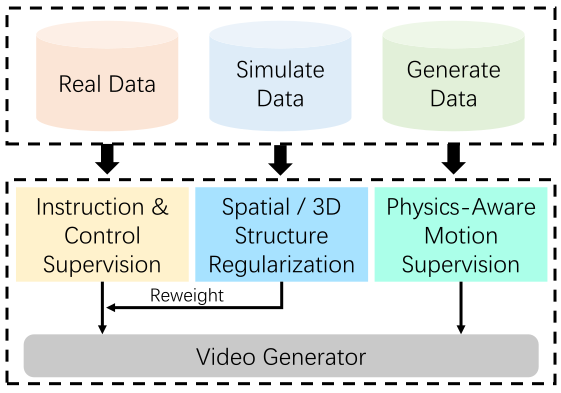
Figure 2 解读: Figure 2 展示了 SFT 阶段的作用:从 pretrained backbone 出发,通过统一的 supervised objective 同时引入 instruction / control supervision、spatial-structure–aware constraints 和 physics-aware motion supervision。作者强调所有结构先验都以较保守的方式注入 decoder level,目的是先建立一个稳定、可控、结构一致的 reference policy,而不是在 SFT 阶段就激进追求指标极限。
论文把 SFT 设计成整个系统的“policy shaping”阶段,而不是普通 warmup。作者的逻辑是:
- 如果 reference policy 本身不稳定,那么后续 RL 和 DPO 的 reward 只会更 noisy;
- 因此 SFT 的主要目标不是最大化视觉质量,而是定义模型允许做什么、不允许做什么。
Stage I 里又细分为三类 supervision:
- Instruction and Control-Oriented SFT:增强 prompt-following、camera behavior、compositional constraints;
- Spatial-Structure–Aware SFT:提升大视角变换下的 3D / spatial stability;
- Physics-Aware SFT:通过辅助 motion branch 与 optical flow supervision,改善液体、变形材料等动态现象。
这意味着 TeleBoost 的 SFT 已经不是简单 imitation,而是在主动为 Stage II 打地基。
3.3 Stage II: Reinforcement Learning via GRPO
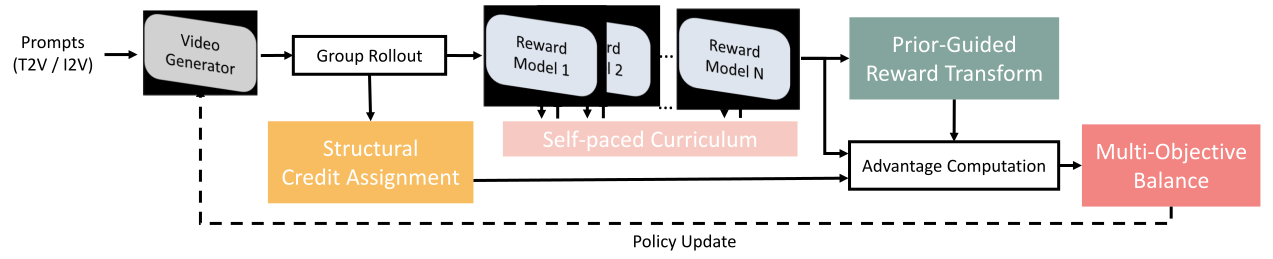
Figure 3 解读: Figure 3 展示了 TeleBoost 第二阶段的 GRPO optimization stack。底层是标准 GRPO:对同一 prompt 采样一组视频,利用 group-relative normalization 得到 advantage;在其上叠加三个 refinement module:ViPO 负责把标量 reward 转成时空 advantage map,解决“where to learn”;BPGO 负责根据 prior 可信度去调节 noisy reward 的权重,解决“what to trust”;Self-Paced GRPO 负责按模型能力调整奖励课程,解决“when to learn”。图中还显示了 Joint Reward 层负责协调多目标冲突。
(1) GRPO backbone
TeleBoost 采用 critic-free 的 GRPO 作为 Stage II 基础。给定同一 prompt 的一组采样视频 ,每个视频得到标量分数 ,然后做组内标准化:
这一步的作用是:
- 不依赖单独训练 critic;
- 把绝对打分问题改写成相对排序问题;
- 对视频这种 reward 本身易漂移的任务更稳。
(2) ViPO
ViPO 的目标是解决 scalar reward 无法回答“错误发生在何处”的问题。它引入一个 Perceptual Structuring Module,用冻结的 DINOv2 / VideoMAE 等 backbone 抽取时空特征,再构造局部 advantage map:
这样,policy gradient 不再均匀作用于整段视频,而会重点更新 failure region。
(3) BPGO
BPGO 关注的是奖励本身的可信度问题。作者认为视频任务存在很多 many-to-many ambiguity,因此 reward model 对某些样本高置信、对另一些样本低置信。BPGO 通过 prior-guided trust allocation 来调节这种不确定性:
- RAS(Reliability-Adaptive Scaling):根据当前组 reward 分布与 prior 的偏差,决定该组优化权重;
- CRT(Contrastive Reward Transformation):在组内把高置信正样本拉开,把模糊样本压缩,增强差异性。
(4) Self-Paced GRPO
Self-Paced GRPO 处理 reward saturation:随着生成器能力变强,静态 reward 逐渐失去判别力。作者因此引入 competence-aware curriculum,把不同奖励维度按训练阶段动态调度,让模型先学稳定性和结构,再学精细 semantic alignment。
3.4 Stage III: DPO
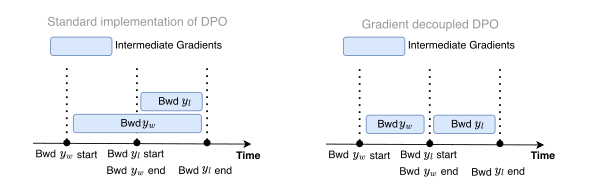
Figure 4 解读: Figure 4 讨论的是 DPO 的工程实现问题。左边是标准 DPO:chosen 和 rejected 两条分支共享参数图,导致中间梯度生命周期叠加,显存峰值高;右边是 gradient-decoupled DPO:把两条分支拆开反传,使得每一条分支的中间梯度能更快释放,从而显著降低峰值显存。这张图说明 TeleBoost 在 DPO 阶段不只关注算法目标,也关心大规模训练时的系统可行性。
对于 preference optimization,TeleBoost 沿用 diffusion 版 DPO:
同时,论文在 Stage III 的重点还包括 preference data construction:
- policy-on-policy hard negatives
- synthetic temporal negatives(倒放、打乱、freeze)
- holistic human ranking
这说明 TeleBoost 并不把 DPO 看成“直接套公式”,而是强调偏好数据如何构造才有足够信息量。
3.5 Pseudocode(基于论文报告结构整理)
TeleBoost 官方仓库当前主要是 project page,训练代码尚未公开。以下伪代码依据论文中的框架描述整理,而不是源码复现。
组件 A:Stage-I policy shaping
# Algorithm: Stage-I SFT policy shaping
# Input: pretrained video generator G
# Output: stable and controllable reference policy pi_ref

def stage1_sft(generator, instruction_data, structure_data, physics_data):
    for batch in mixed_loader(instruction_data, structure_data, physics_data):
        loss_inst = instruction_control_loss(generator, batch)
        loss_struct = structure_aware_loss(generator, batch)
        loss_phys = physics_aware_motion_loss(generator, batch)
        loss = loss_inst + loss_struct + loss_phys
        update(generator, loss)
    return generator
组件 B:Stage-II GRPO backbone
# Algorithm: Group Relative Policy Optimization
# Input: prompt c, group size G
# Output: group-relative advantages

def compute_grpo_advantage(rewards):
    mu = mean(rewards)
    sigma = std(rewards) + 1e-6
    return [(r - mu) / sigma for r in rewards]
组件 C:BPGO reliability-aware optimization
# Algorithm: BPGO with RAS and CRT
# Input: group rewards, prior rewards
# Output: reliability-aware transformed rewards

def bpgo_transform(group_rewards, prior_rewards):
    reliability = estimate_group_reliability(group_rewards, prior_rewards)   # RAS
    transformed = contrastive_reward_transform(group_rewards, prior_rewards) # CRT
    return reliability * transformed
组件 D:Self-Paced GRPO
# Algorithm: Self-paced reward curriculum
# Input: current policy competence statistics
# Output: active reward schedule

def self_paced_schedule(model_state):
    if model_state.is_unstable():
        return ['structure', 'stability']
    elif model_state.is_stable_but_not_aligned():
        return ['motion', 'temporal_coherence']
    else:
        return ['semantic_alignment', 'aesthetics']
3.6 Code-to-paper mapping table
| Paper Concept | Source File | Key Class/Function |
|---|---|---|
| Stage I SFT framework | 未公开 | 代码未发布 |
| Stage II GRPO stack | 未公开 | 代码未发布 |
| ViPO / BPGO / Self-Paced GRPO | 未公开 | 代码未发布 |
| Gradient-decoupled DPO | 未公开 | 代码未发布 |
| 项目页与可视化资源 | README.md, index.html, main.js | GitHub Pages assets |
4. Experimental Setup (实验设置)
4.1 Overall evaluation philosophy
TeleBoost 的 evaluation 不是单一 benchmark,而是按模块拆分验证:
- SFT slice:验证 geometry / physics-aware initialization 是否更稳;
- Stage II slice:验证 BPGO、ViPO、Self-Paced GRPO 是否真的带来更稳定的 reward optimization;
- Global human eval:直接比较整套后训练系统与强基线 Wan2.2-14B I2V。
4.2 Important concrete settings
- BPGO evaluation:
- T2V:Wan2.1-1.3B
- I2V:Wan2.2-14B
- group size
- reward model:VideoCLIP-XL
- 训练 200 steps
- 数据:iStock dataset 10K samples
- 测试:1000 samples
- ViPO evaluation:
- 集群:32 × NVIDIA H100 GPUs
- T2V:Wan2.1 / DanceGRPO / ViPO 对比
- Self-Paced GRPO evaluation:
- Wan2.1-T2V-1.3B:训练 220 steps
- Wan2.1-T2V-14B:训练 100 steps
- group size:1.3B 用 8,14B 用 32
4.3 Metrics
论文中混合使用:
- GSB human evaluation
- Optical flow metrics(EPE, >1px, >3px, F1-all)
- VideoClipXL
- VideoAlign-TA / VideoAlign-overall
- Qwen3-VL-Embedding
- VBench 多维指标
- LAION aesthetic score
这也再次说明 TeleBoost 是系统报告:它并不试图用一个单一指标覆盖全问题,而是针对不同 slice 用最相关的评价方式。
5. Experimental Results (实验结果)
5.1 Human evaluation against Wan2.2-14B I2V
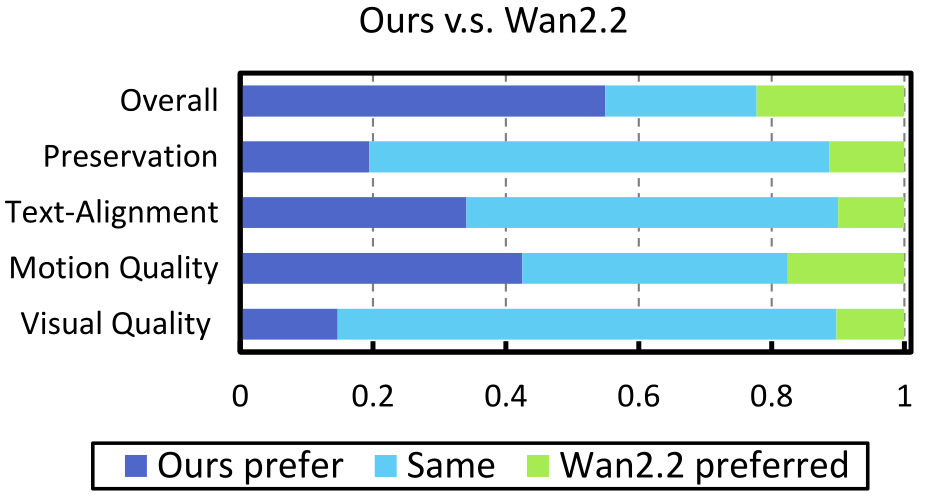
Figure 5 解读: Figure 5 可视化了 GSB(Good–Same–Bad)人评结果,对比对象是 Wan2.2-14B I2V。可以看到在 motion quality、text alignment 和 overall 三项上,“Good”占比显著高于“Bad”,说明 TeleBoost 的改进不是某个细分 metric 上的小幅提升,而是能被人类整体感知到的质量改善,尤其体现在长程运动一致性和 prompt 对齐上。
精确人评结果如下(WinRate / Preference / Margin):
| Aspect | WinRate | Preference | Margin |
|---|---|---|---|
| Visual quality | 58.71 | 52.17 | 4.35 |
| Motion quality | 70.72 | 62.47 | 24.90 |
| Text alignment | 77.39 | 62.15 | 24.13 |
| Preservation | 63.28 | 54.15 | 8.15 |
| Overall | 71.18 | 66.38 | 32.71 |
其中最显著的优势体现在:
- Motion quality
- Text alignment
- Overall
这与 TeleBoost 对 Stage II / III 的设计目标高度一致。
5.2 Physics-aware SFT
在 fluid effects 测试上:
| Test Set | EPE | >1px | >3px | F1-all |
|---|---|---|---|---|
| Real-world fluid effects | 0.538 | 14.7% | 0.0% | 4.680 |
| Simulation fluid effects | 1.541 | 21.8% | 10.0% | 10.040 |
这说明 Stage I 的 physics-aware SFT 在真实和模拟流体场景里都能给出更稳定的 motion prior,减少后续 RL 阶段里 reward 的噪声来源。
5.3 BPGO
BPGO 是 TeleBoost 里最容易量化的 Stage-II 模块,其主表结果为:
| Task | Method | VideoClipXL | VideoAlign-TA | VideoAlign-overall | Qwen3-VL-Embedding |
|---|---|---|---|---|---|
| T2V | Wan2.1 | 2.6563 | 1.0638 | 0.0939 | 0.6741 |
| T2V | GRPO | 2.6714 | 0.8984 | -0.5411 | 0.6722 |
| T2V | BPGO | 2.6788 | 1.1193 | -0.0478 | 0.6754 |
| I2V | Wan2.2 | 2.6726 | 1.0633 | -0.7623 | 0.6885 |
| I2V | GRPO | 2.0713 | 0.2307 | -1.8932 | 0.4513 |
| I2V | BPGO | 2.6855 | 1.0589 | -1.0491 | 0.6890 |
几个关键信号:
- T2V 上,BPGO 在 VideoAlign-TA 上比 GRPO 提升 24.6%;
- I2V 上,GRPO 出现明显 collapse,而 BPGO 仍维持稳定;
- 人评(100 pairs)里,BPGO 在 overall / text alignment 上都明显优于 GRPO:
- Overall Quality:34 / 48 / 18
- Text Alignment:27 / 56 / 17
5.4 ViPO
ViPO 的代表性数值如下:
| Method | VQ | MQ | Semantic | Quality | Total |
|---|---|---|---|---|---|
| Wan2.1 | 2.6219 | 0.5896 | 83.36 | 71.20 | 80.92 |
| DanceGRPO | 3.0935 | 0.8639 | 83.63 | 69.68 | 80.84 |
| ViPO | 3.5501 | 1.1515 | 83.98 | 72.59 | 81.70 |
ViPO 最显著的改进来自 motion quality (MQ):
- 从 Wan2.1 的 0.5896
- 提升到 ViPO 的 1.1515
这说明把 scalar reward back-project 到时空区域,确实比全局一刀切的 credit assignment 更有效。
5.5 Self-Paced GRPO
Self-Paced GRPO 的整体结果:
- Wan1.3B Total score:79.58 → 80.22
- Wan14B Total score:81.46 → 82.09
在 ablation 中:
| Method | VQ | MQ | TA | LAION | QS | SC | OA |
|---|---|---|---|---|---|---|---|
| Wan2.1-1.3B-T2V | 3.448 | 0.2911 | -1.914 | 5.224 | 83.15 | 65.31 | 79.58 |
| Joint train | 3.366 | 0.3011 | -1.077 | 5.222 | 82.69 | 66.38 | 79.80 |
| Self-paced GRPO | 3.501 | 0.3090 | -0.7114 | 5.252 | 83.53 | 66.94 | 80.22 |
它说明 Self-Paced GRPO 的优势来自 curriculum design 本身,而不是“换了一个更强的 reward model”。
5.6 Limitations / 总结
TeleBoost 的一个重要特点是:它不是一个可以单独拿出来部署的模型,而是一套后训练 recipe / blueprint。
从这个角度看,它的局限也很明确:
- 它更像系统报告,结果分散在不同模块与 slice 里,缺少统一单模型 benchmark;
- 官方仓库目前只有 project page 和 demo 资源,完整代码尚未公开;
- Stage III DPO 有方法说明,但评测部分没有给出独立 DPO slice 的完整量化表。
但它的价值同样明显:
- 它把视频后训练从“零散 tricks”上升为阶段化、诊断驱动、基础设施感知的 pipeline 设计问题;
- 它系统回答了三个问题:
- where to learn(ViPO)
- what to trust(BPGO)
- when to learn(Self-Paced GRPO)
对做 video post-training 的人来说,TeleBoost 更像一份高质量 roadmap,而不是单点 benchmark paper。