AnyFlow: Any-Step Video Diffusion Model with On-Policy Flow Map Distillation
Paper: arXiv:2605.13724 PDF: arXiv PDF;local:
/Users/bytedance/ai-skills/papers/2605.13724.pdfCode: NVlabs/AnyFlow Code reference:main@549236a(2026-05-14)
1. Motivation(研究动机)
现有少步视频扩散蒸馏主要依赖 consistency model:它在很少采样步数时很快,但训练目标偏向端点映射 。当推理时给更多 NFE,模型会反复把中间状态 re-noise 再投影到端点,轨迹不再沿原始 probability-flow ODE 稳定 refinement,因此 rCM / Self-Forcing 这类方法会出现“步数越多质量反而下降”的 test-time scaling 失败。
AnyFlow 的核心问题定义是:能否训练一个单一视频扩散模型,让它在任意推理步数下都可用,并且随采样预算增加继续变好,而不是只为固定 1/2/4 步做蒸馏。它把目标从端点一致性改为任意时间对之间的 flow-map transition:
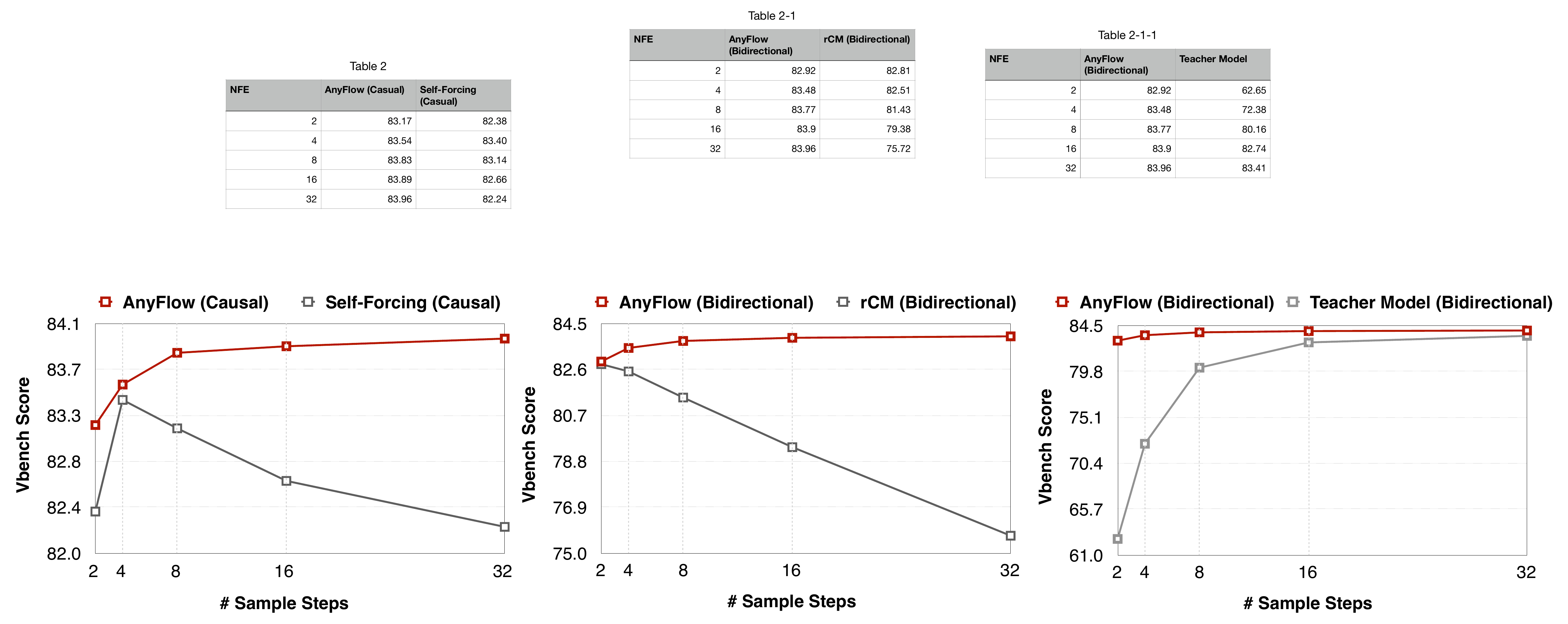
Figure 1 解读:AnyFlow 在 causal、bidirectional、teacher-distilled 三组曲线上都保持随采样步数增加而上升或基本不退化;对照方法 Self-Forcing 和 rCM 在多步时明显下滑,说明问题不是“少步不够好”,而是 consistency trajectory 与 PF-ODE trajectory 的结构性偏移。
本文贡献可以压缩成三点:第一,提出首个基于 flow maps 的 any-step video diffusion distillation 框架;第二,提出 Flow Map Backward Simulation,把 on-policy DMD 所需的自回放轨迹拆成可反传的 shortcut transition;第三,在 1.3B/14B、bidirectional/causal、T2V/I2V/V2V 设置上验证任意步数扩展性。
2. Idea(核心思想)
AnyFlow 的核心 insight 是:少步视频扩散蒸馏不应该只学习“任意噪声时刻到干净样本”的 endpoint consistency,而应该学习任意两个时间点之间可组合的 flow-map transition。这样同一个 student 在 1-step / 2-step / 4-step / 多步推理时共享同一套 transition 语义,采样步数增加时仍能沿 teacher ODE 轨迹继续 refinement。
关键创新可以概括为两点:第一,用 forward flow map training 把 teacher probability-flow ODE 上的跨时间迁移显式蒸馏出来;第二,用 on-policy flow map distillation 在 student 自己 roll out 的状态分布上继续校正,避免 student 一旦偏离 teacher 轨迹后误差累积。
与 rCM / shortcut consistency 这类 endpoint-oriented 方法相比,AnyFlow 的本质差异是优化对象从 的端点映射变成 的时间迁移算子。前者适合固定少步采样,后者天然支持任意 step budget 下的分段组合,因此更适合 video diffusion 中“速度—质量可调”的部署场景。
3. Method(方法)
3.1 从 consistency distillation 到 flow-map distillation
Consistency distillation 学的是“从任意 回到 ”,多步推理时需要反复 re-noise;AnyFlow 学的是“从 到任意较小 ”,因此同一个模型既可以执行大步 shortcut,也可以在更多 NFE 下做小步 refinement。采样器在 released code 中直接实现为:
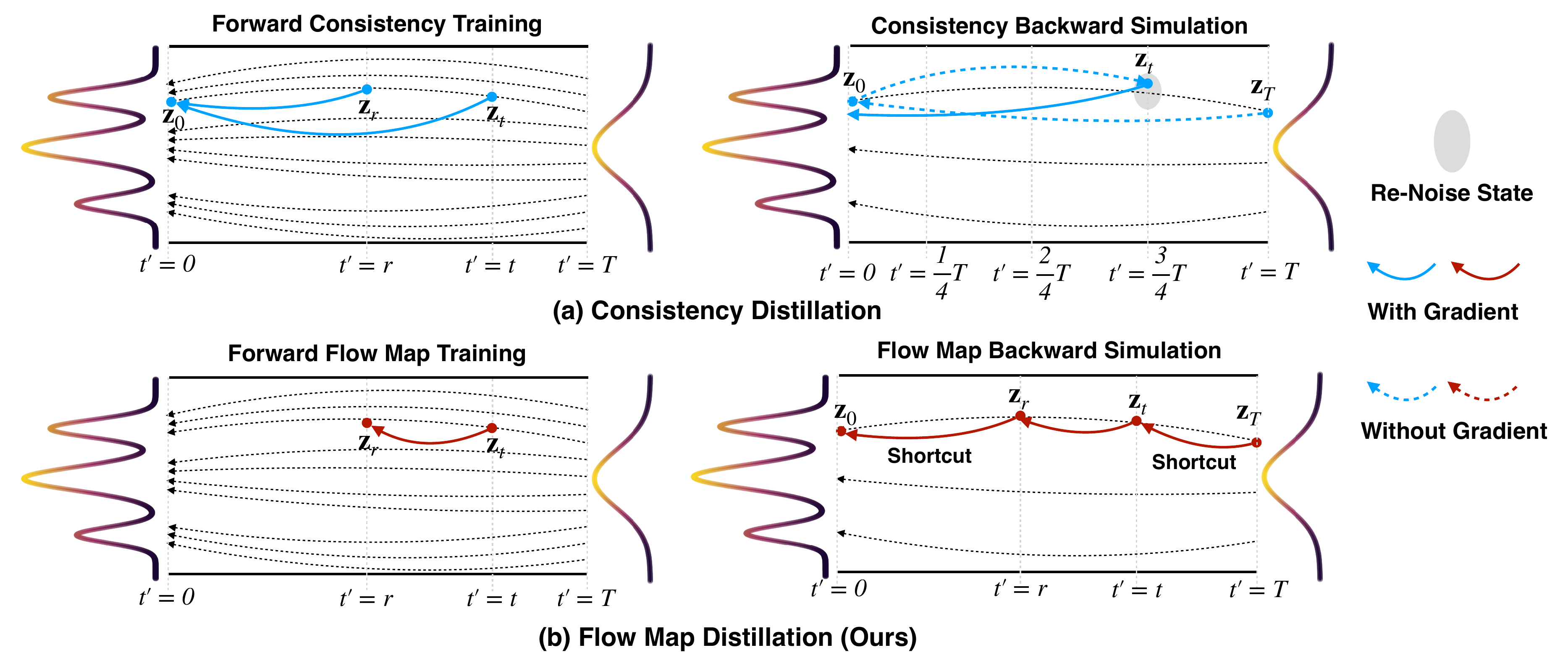
Figure 2 解读:上半部分的 consistency 路线把多个状态都拉向 ,再经 re-noise 进入下一个状态;下半部分的 AnyFlow 直接学习 transition,并在 backward simulation 中用 的 shortcut 保留梯度链路。
3.2 整体训练流水线
AnyFlow 两阶段训练:Stage 1 做 forward flow map training,用 teacher-synthesized 数据把 Wan2.1 类视频扩散模型改造成 transition operator;Stage 2 从 Stage-1 checkpoint 出发,联合 forward objective 与 DMD-based on-policy objective,用 teacher 的 distribution matching 纠正自回放轨迹中的 discretization error 与 causal exposure bias。
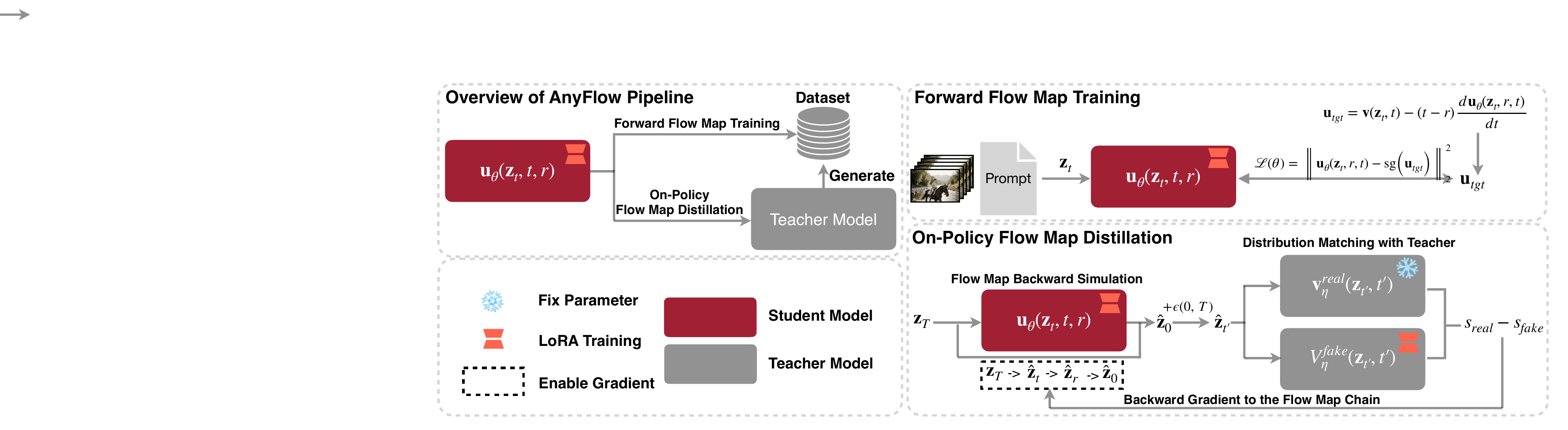
Figure 4 解读:左侧是数据生成与 LoRA student/teacher 参数冻结关系;右上是 forward flow map training,把 prompt/video/noise 时间对送入 student 预测 transition velocity;右下是 on-policy distillation,student 先通过 flow-map chain rollout 到 ,再 re-noise 给 real/fake teacher score 做 DMD 梯度监督。
3.3 Forward Flow Map Training
基础目标沿用 MeanFlow 风格:模型预测平均速度 ,目标速度由瞬时 velocity 与导数校正构成:
为避免 JVP 与 FSDP 兼容/开销问题,AnyFlow 使用中心差分近似:
两个工程化细节很关键:
- Interpolated timestep conditioning:用 引入第二时间 ,paper 和 released config 均使用 ,避免 zero-init 新 embedding 在训练中 norm 爆涨导致过饱和。
- Guidance-fused training:把 CFG 融进预测而不是 target velocity:
- Loss reweighting:对非边界 transition 使用
其中 来自边界样本的平均 regression loss;实验固定 。
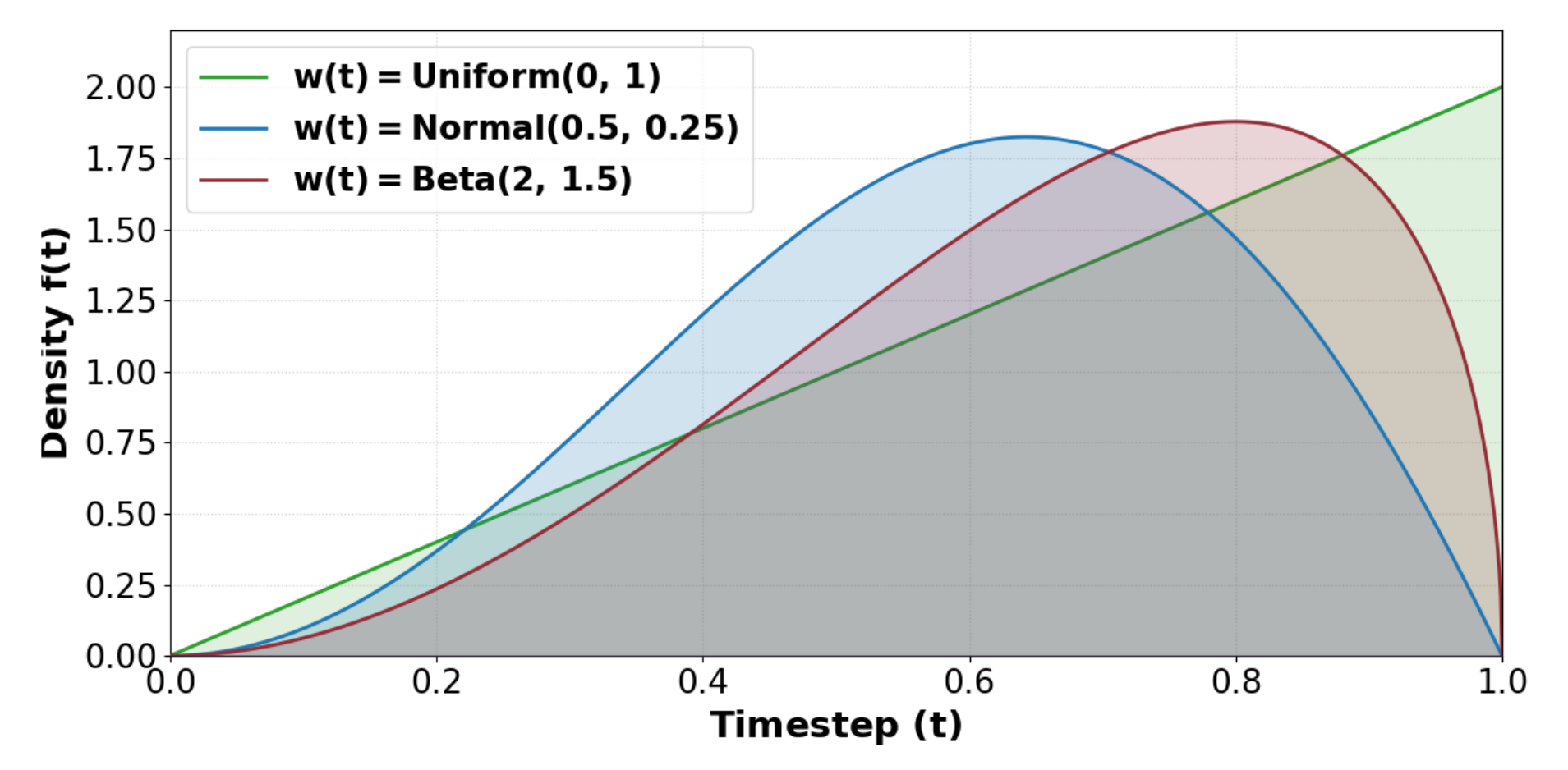
Figure 10 解读:不同 timestep weighting 会改变少步与多步的折中;作者最终选 Beta(2,1.5),让训练更多覆盖高噪声但不完全牺牲低噪声区域,从而稳定 4/32 NFE 两端的 VBench。
3.4 On-Policy Flow Map Distillation
Forward training 只让 transition operator 拟合 teacher/ODE 的局部关系,仍然没有直接优化“模型自己按推理 scheduler rollout 后会落到哪里”。Stage 2 用 DMD 在 student self-rollout 上做 reverse-divergence correction。Flow map 的可组合性是关键:
对于目标采样预算 ,AnyFlow 采样中间 并令 ,把完整 rollout 拆为 、、 三段;第一和第三段可用 learned flow map shortcut,第二段是目标 gradient step。这样训练不同 NFE 的 self-rollout 时计算量基本不随 线性增长。
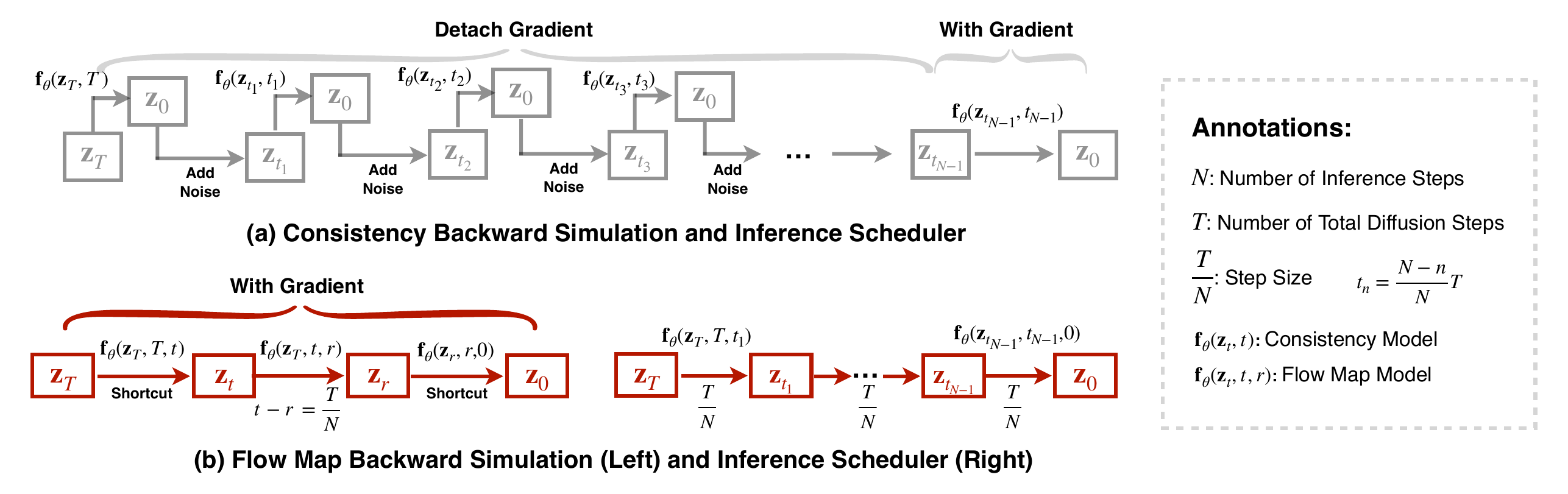
Figure 5 解读:consistency backward simulation 为了到达 往往截断较长 rollout 的梯度;flow-map simulation 只用三段 transition 就能覆盖同一个 training target,并把梯度回传到整条 shortcut chain,因此在 16/32 NFE 下不会像 consistency simulation 一样退化。
3.5 下游与 causal/bidirectional 适配
Bidirectional 版本直接套用上述两阶段;causal 版本接入 FAR pipeline:保留前三个 full-token chunks,后续 chunks 用更大 patchify kernel 压缩,以降低 teacher-forcing 训练成本和采样 KV cache。一个 causal AnyFlow-FAR 模型同时支持 T2V、I2V、V2V;I2V 通过 conditioning 首帧,V2V 通过下游 fine-tuning 使用 source video 的 compact context。
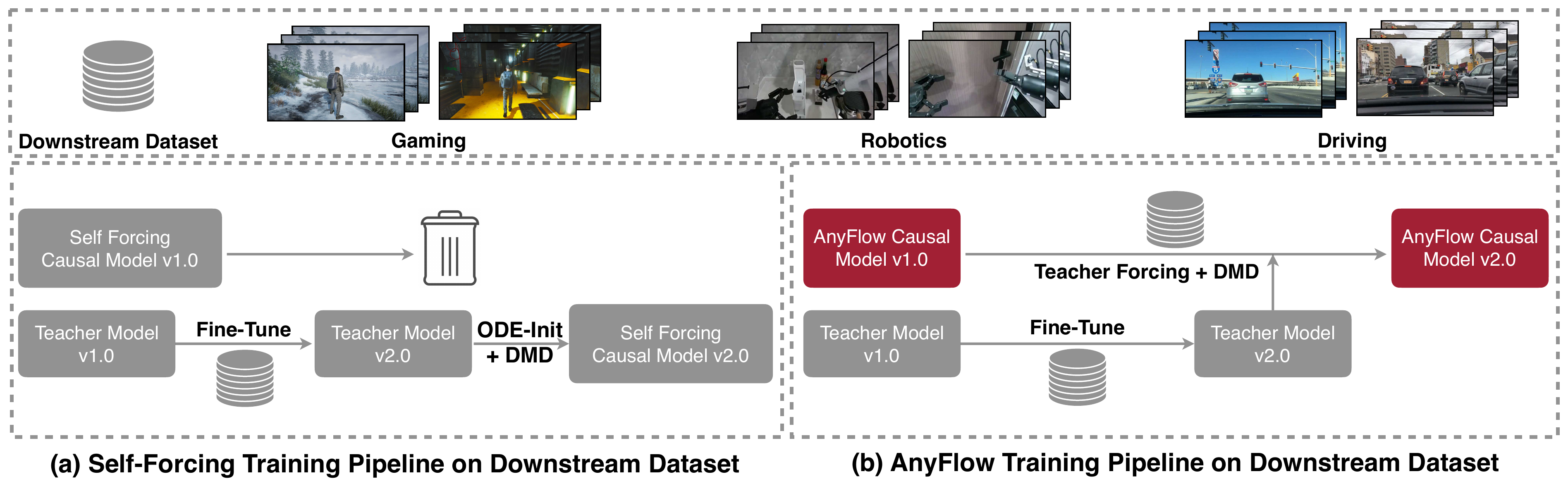
Figure 7 解读:下游 fine-tuning 不重新设计 distillation 目标,而是在 causal context 中加入 image/video 条件,把同一个 any-step transition operator 迁移到 I2V/V2V;这也是 AnyFlow 能用一个 FAR backbone 覆盖多任务的原因。
3.6 伪代码(按 released code 对齐)
import torch
import torch.nn.functional as F


def flowmap_euler_step(sample, model_output, t, r, num_train_timesteps=1000):
    # far/schedulers/scheduling_flowmap_euler_discrete.py
    t = t / num_train_timesteps
    r = r / num_train_timesteps
    while t.ndim < model_output.ndim:
        t = t[..., None]
        r = r[..., None]
    return sample - (t - r) * model_output
def forward_flow_map_pretrain_step(transformer, scheduler, latents, noise, prompt_embeds,
neg_embeds, cfg_scale=3.0, eps=5, diffusion_ratio=0.5,
consistency_ratio=0.25):
# far/trainers/trainer_wan_anyflow_pretrain.py
b = latents.shape[0]
t1, t2 = torch.rand(b, device=latents.device), torch.rand(b, device=latents.device)
t, r = torch.maximum(t1, t2), torch.minimum(t1, t2)
# released sampler mixes boundary diffusion, consistency, and arbitrary flow-map transitions
n_diff = round(diffusion_ratio * b)
n_cons = round(consistency_ratio * b)
r[:n_diff] = t[:n_diff] # diffusion boundary: t == r
r[n_diff:n_diff+n_cons] = 0 # consistency boundary: r == 0
t = scheduler.apply_shift(t) * scheduler.config.num_train_timesteps
r = scheduler.apply_shift(r) * scheduler.config.num_train_timesteps
noisy = scheduler.scale_noise(latents, t, noise)
v = noise - latents
u_c = transformer(noisy, timestep=t, r_timestep=r, encoder_hidden_states=prompt_embeds)[0]
with torch.no_grad():
u_empty = transformer(noisy, timestep=t, r_timestep=r, encoder_hidden_states=neg_embeds)[0]
u = (u_c - (1 - cfg_scale) * u_empty.detach()) / cfg_scale
z_plus = noisy + v * (eps / scheduler.config.num_train_timesteps)
z_minus = noisy - v * (eps / scheduler.config.num_train_timesteps)
du_dt = (transformer(z_plus, t + eps, r, prompt_embeds)[0]
- transformer(z_minus, t - eps, r, prompt_embeds)[0]) / (2 * eps)
u_tgt = v - (t - r) * du_dt
return F.mse_loss(u, u_tgt.detach())def onpolicy_flowmap_distill_step(rollout_pipe, discriminator, dmd_scheduler, prompt_embeds,
num_steps_choices=(2, 4, 8, 16, 50), dmd_weight=1.0):
# far/trainers/trainer_wan_anyflow_onpolicy.py
sample_steps = int(torch.tensor(num_steps_choices)[torch.randint(len(num_steps_choices), ())])
z_T = torch.randn_like(prompt_embeds.new_empty((prompt_embeds.shape[0], 16, 81, 60, 104)))
# Pipeline internally calls FlowMapDiscreteScheduler, so each step is z_t -> z_r.
pred_video = rollout_pipe(prompt_embeds=prompt_embeds, latents=z_T,
num_inference_steps=sample_steps).latents
t = torch.rand(pred_video.shape[0], device=pred_video.device)
t = dmd_scheduler.apply_shift(t) * dmd_scheduler.config.num_train_timesteps
noisy = dmd_scheduler.scale_noise(pred_video, t, torch.randn_like(pred_video)).detach()
grad = discriminator.compute_kl_grad(noisy_latent=noisy, pred_video=pred_video,
timesteps=t, prompt_embeds=prompt_embeds)
return dmd_weight * F.mse_loss(pred_video.double(), (pred_video.double() - grad.double()).detach())3.7 Code-to-paper mapping
Code reference:
main@549236a(2026-05-14)
| Paper component | Released code path | 对应关系 / 差异 |
|---|---|---|
| Flow-map Euler transition | far/schedulers/scheduling_flowmap_euler_discrete.py | step() 将 timestep 和 r_timestep 除以 num_train_timesteps 后执行 prev_sample = sample - (timestep-r_timestep)*model_output。 |
| Stage-1 forward flow map training | far/trainers/trainer_wan_anyflow_pretrain.py, far/trainers/trainer_far_wan_anyflow_pretrain.py | sample_timestep() 随机采两次并排序;released config 设置 diffusion_ratio=0.5、consistency_ratio=0.25、epsilon=5、gate_value=0.25。 |
| Guidance-fused + differential derivation | trainer_*_pretrain.py | 代码先算 conditional/unconditional prediction,再中心差分 t+epsilon / t-epsilon;与论文 Algorithm 1 对齐。 |
| Stage-2 on-policy DMD | far/trainers/trainer_wan_anyflow_onpolicy.py, far/trainers/trainer_far_wan_anyflow_onpolicy.py | rollout_cfg.num_inference_steps_list=[2,4,8,16,50],dmd_weight=1.0,real_guidance_scale=3.0;train_generator() 生成 self-rollout 后用 _compute_kl_grad() 构造 DMD loss。 |
| Training configs | options/train/anyflow/.../*.yml | Stage 1: 1.3B 6000 iter、14B 4000 iter、lr=5e-5;Stage 2: released configs total_iter=1200、lr=2e-6。paper 正文写 Stage 2 为 800 iter,因此笔记按 paper 与 code 分别记录。 |
| Demo / inference | demo.py, options/test/anyflow/*.yml, far/pipelines/pipeline_*_anyflow.py | README 提供 HF model download 与 demo/eval config;pipeline 调用 flow-map scheduler 支持 arbitrary num_inference_steps。 |
开源实现覆盖训练、推理、模型转换、VBench eval 与 demo;不是仅发布 checkpoint。需要注意的是 training dataset 仍需按 docs/DATA.md 自行准备,paper 中 synthetic 256K 数据没有作为普通文件随 repo 直接发布。
4. Experimental Setup(实验设置)
论文在 Diffusers/Wan2.1 上实现,训练数据是 Wan2.1-T2V-14B 生成的 256K prompt-video pairs,最长 81 frames,分辨率 。Stage 1 使用 AdamW、学习率 ,1.3B/14B 的 global batch 分别为 32/16,训练 6000/4000 iterations;Stage 2 使用 AdamW、学习率 ,paper 写 800 iterations。released configs 中 1.3B/14B on-policy 文件名含 1k,实际 total_iter: 1200;这属于 code-paper gap,见第 4 节映射表。两阶段都使用 LoRA rank 256。
- Datasets used and scale:Wan2.1-T2V-14B 生成的 256K prompt-video pairs;I2V 下游实验使用 Wan-I2V-14B 相关设置;具体额外数据规模若论文未逐项展开,则按论文原表记录为未详细说明。
- Baselines:T2V 对比 rCM、sCM、Shortcut Model、Phased Consistency Model、Traj Consistency Distillation 等少步/任意步蒸馏方法;下游 I2V 对比对应 Wan-I2V teacher/student 与 consistency-family baselines。
- Metrics:VBench total / quality / semantic;I2VBench;推理效率用 NFE、latency、吞吐相关指标衡量。
- Training config:训练配置来自论文与 released config;Stage 1 使用 AdamW、学习率 ,1.3B/14B global batch 分别为 32/16,训练约 3K iterations;Stage 2 使用 on-policy flow-map distillation,论文与 released config 对 iteration 数存在差异,已在 Method/code mapping 中标注。
5. Experimental Results(实验结果)
5.2 T2V 主结果
| Model | Params | NFEs | Quality | Semantic | Total |
|---|---|---|---|---|---|
| rCM-Wan2.1-T2V-14B | 14B | 4 | 85.47 | 76.72 | 83.73 |
| AnyFlow-Wan2.1-T2V-14B | 14B | 4 | 85.70 | 77.38 | 84.04 |
| AnyFlow-Wan2.1-T2V-14B | 14B | 32 | 85.76 | 77.44 | 84.10 |
| Self-Forcing | 1.3B | 4 | 85.23 | 76.01 | 83.39 |
| AnyFlow-FAR-Wan2.1-1.3B | 1.3B | 4 | 85.60 | 75.30 | 83.54 |
| AnyFlow-FAR-Wan2.1-1.3B | 1.3B | 32 | 85.92 | 76.12 | 83.96 |
| Krea-Realtime-Wan2.1-14B | 14B | 4 | 84.80 | 77.07 | 83.25 |
| AnyFlow-FAR-Wan2.1-14B | 14B | 4 | 85.82 | 76.97 | 84.05 |
| AnyFlow-FAR-Wan2.1-14B | 14B | 32 | 86.12 | 77.55 | 84.41 |
关键观察:AnyFlow 的 14B bidirectional 在 4 NFE 已超过 rCM,32 NFE 继续涨;14B causal 在 4 NFE 达 84.05,32 NFE 到 84.41,而同类实时 causal 模型多停在 83.x。它不是单纯“4 步蒸馏更好”,而是恢复了随 NFE 增加的 scaling trend。
5.3 I2V / 下游结果
| Model | Params | Resolution | NFEs | Quality | I2V | Total |
|---|---|---|---|---|---|---|
| Wan2.1-I2V-14B | 14B | 80.30 | 95.12 | 87.71 | ||
| FastVideo-CausalWan2.2-A14B-Preview | 14B | 8 | 78.82 | 94.81 | 86.82 | |
| AnyFlow-FAR-Wan2.1-14B | 14B | 4 | 80.39 | 95.35 | 87.87 |
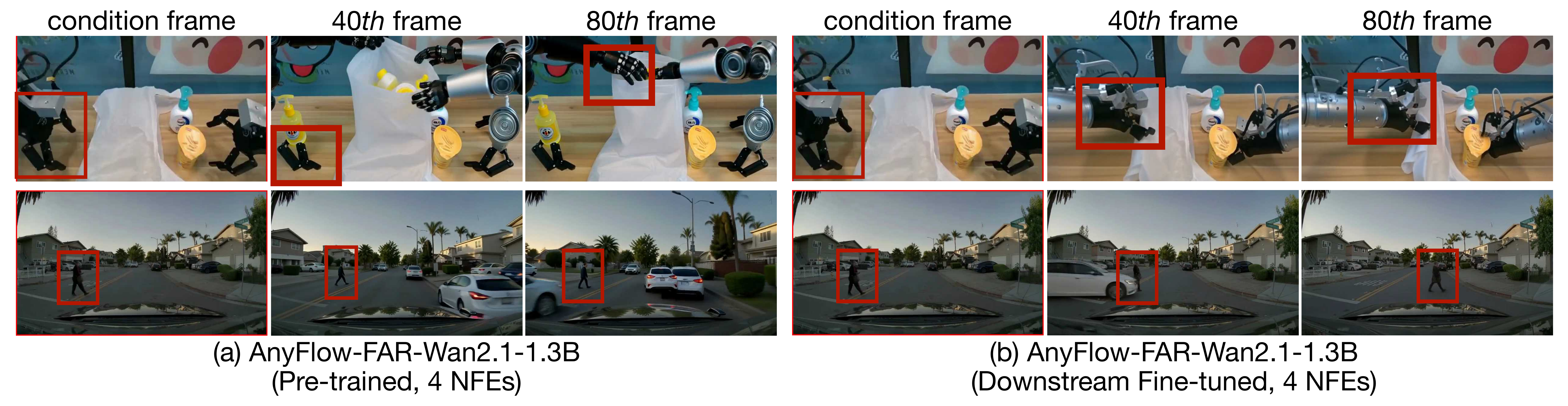
Figure 8 解读:下游可视化强调同一个 causal AnyFlow-FAR backbone 在 T2V/I2V/V2V 中都能保持多步可用;I2V 总分 87.87 只用 4 NFE,已接近或略高于 50×2 NFE 的 Wan2.1-I2V-14B。
5.4 消融与效率
| Design | NFEs | Bidirectional Overall | Causal Overall |
|---|---|---|---|
| Flow Matching Training | 74.64 | 76.80 | |
| Flow Matching Training | 83.83 | 83.50 | |
| Consistency ODE-Init | 4 | 80.44 | 73.97 |
| Consistency ODE-Init | 32 | 82.86 | 77.55 |
| Flow Map Training | 4 | 81.75 | 80.48 |
| Flow Map Training | 32 | 83.40 | 83.13 |
| Consistency ODE-Init + Consistency Backward Simulation | 4 / 32 | 82.96 / 79.80 | 82.49 / 79.64 |
| Flow Map Training + Consistency Backward Simulation | 4 / 32 | 83.55 / 82.96 | 82.99 / 83.49 |
| Flow Map Training + Flow Map Backward Simulation | 4 / 32 | 83.48 / 83.96 | 83.54 / 83.96 |
训练开销表显示:forward training 中 differential derivation 把 causal/bidirectional 成本推到 10.4/16.8 s/iter;on-policy 中 4-step Flow Map Backward Simulation 比 consistency simulation 贵 15.7%/22.5%,但在 16 steps 时成本仍为 53.1/51.2 s/iter,比 consistency 的 93.8/96.6 低 43.4%/47.0%。这支持作者的核心效率论点:shortcut simulation 对大 NFE 更划算。
5.5 Limitations and conclusions
局限:训练仍依赖强 teacher 和 teacher-generated video 数据;Stage 2 需要 real/fake teacher score,工程复杂度高;VBench/I2V 分数不能完全覆盖长视频时序一致性和用户偏好;released config 与 paper Stage-2 iteration 数存在 800 vs 1200 的差异,复现实验时应以目标 checkpoint 对应 config 为准。
核心 takeaway:AnyFlow 的创新点不是更复杂的 reward 或更强 teacher,而是把 distillation 的几何对象从 endpoint consistency 换成 flow map transition,并让 on-policy correction 也沿这个 transition space 反传。这个改动直接修复了少步蒸馏模型“多给步数不变好”的失败模式。
为什么有效:forward flow map training 提供可组合的 transition operator;flow map backward simulation 把 DMD 的 endpoint KL 梯度变成短链路可反传的 self-rollout correction;interpolated timestep conditioning 与 loss weighting 则让从 pretrained Wan2.1 迁移到 双时间输入时不破坏原模型稳定性。
局限:训练仍依赖强 teacher 和 teacher-generated video 数据;Stage 2 需要 real/fake teacher score,工程复杂度高;VBench/I2V 分数不能完全覆盖长视频时序一致性和用户偏好;released config 与 paper Stage-2 iteration 数存在 800 vs 1200 的差异,复现实验时应以目标 checkpoint 对应 config 为准。
可复用点:若已有视频扩散 backbone 的少步蒸馏在大 NFE 退化,可以优先检查目标是否过度端点化;把 scheduler 改成显式 transition,再用 on-policy self-rollout 做 DMD/RL-like correction,可能比继续调 consistency loss 更直接。