Qwen-Image-VAE-2.0 Technical Report
Paper: arXiv:2605.13565 Code: alibaba/OmniDoc-TokenBench — 公开 repo 包含 benchmark/evaluation scripts;未找到 Qwen-Image-VAE-2.0 training/model implementation。 Code reference:
main@f2815a7(2026-05-14)
1. Motivation (研究动机)
Latent Diffusion Models 通常用 VAE 把图像压缩到 latent space,再让 DiT 或 diffusion model 在 latent 上建模。业界常用的 spatial compression 是 ,但 native high-resolution synthesis 继续扩大时,latent token 数仍然很大,计算成本会成为瓶颈。直接把 compression 提到 或 又会导致 reconstruction fidelity 下降,尤其是文字、细线、页面布局和高频边缘会糊掉。
这篇报告的目标是做一组 high-compression VAEs,在 和 下同时保持 reconstruction fidelity 与 diffusability。它关心的不只是像素重建好看,还关心 latent space 是否容易被下游 diffusion/DiT 建模;因此引入 semantic alignment,并专门构建 text-rich benchmark 来衡量 OCR-level 可读性。
问题值得研究的原因在于:如果 VAE 能在更高 compression ratio 下保持可读文字和稳定 latent semantics,后续 image generation model 的 token 数、显存和推理成本都会下降,同时不会把 typography 和 document-like visual content 牺牲掉。
2. Idea (核心思想)
核心 insight 是:高压缩 VAE 的瓶颈不是单纯 decoder 不够强,而是 spatial information 被过早下采样后丢失、latent semantic structure 又不够适合 diffusion。Qwen-Image-VAE-2.0 用 Global Skip Connections 把 pixel-level 高频信号直接折叠到深层 latent,同时用 DINOv2 middle-layer semantic alignment 让 latent 更 generation-friendly。
关键创新包括:expanded latent channels 弥补 spatial compression 带来的信息损失;GSC 提供直接细节恢复路径;attention-free/asymmetric backbone 降低高分辨率 encoder/decoder 开销;去掉 KL/GAN,只保留 reconstruction、LPIPS 和 semantic alignment;再用 synthetic document rendering 与 OmniDoc-TokenBench 专门解决文字重建。
与传统 KL-regularized VAE 或 adversarial VAE 相比,这篇的差异是把 VAE 从「接近 Gaussian prior 的压缩器」转成「高保真且适合 diffusion 的 latent tokenizer」。与只看 ImageNet/FFHQ 的评测不同,它用 OCR-based NED 直接衡量 text-rich reconstruction 是否还能读。
3. Method (方法)
3.1 Overall framework:GSC + expanded channels + attention-free backbone
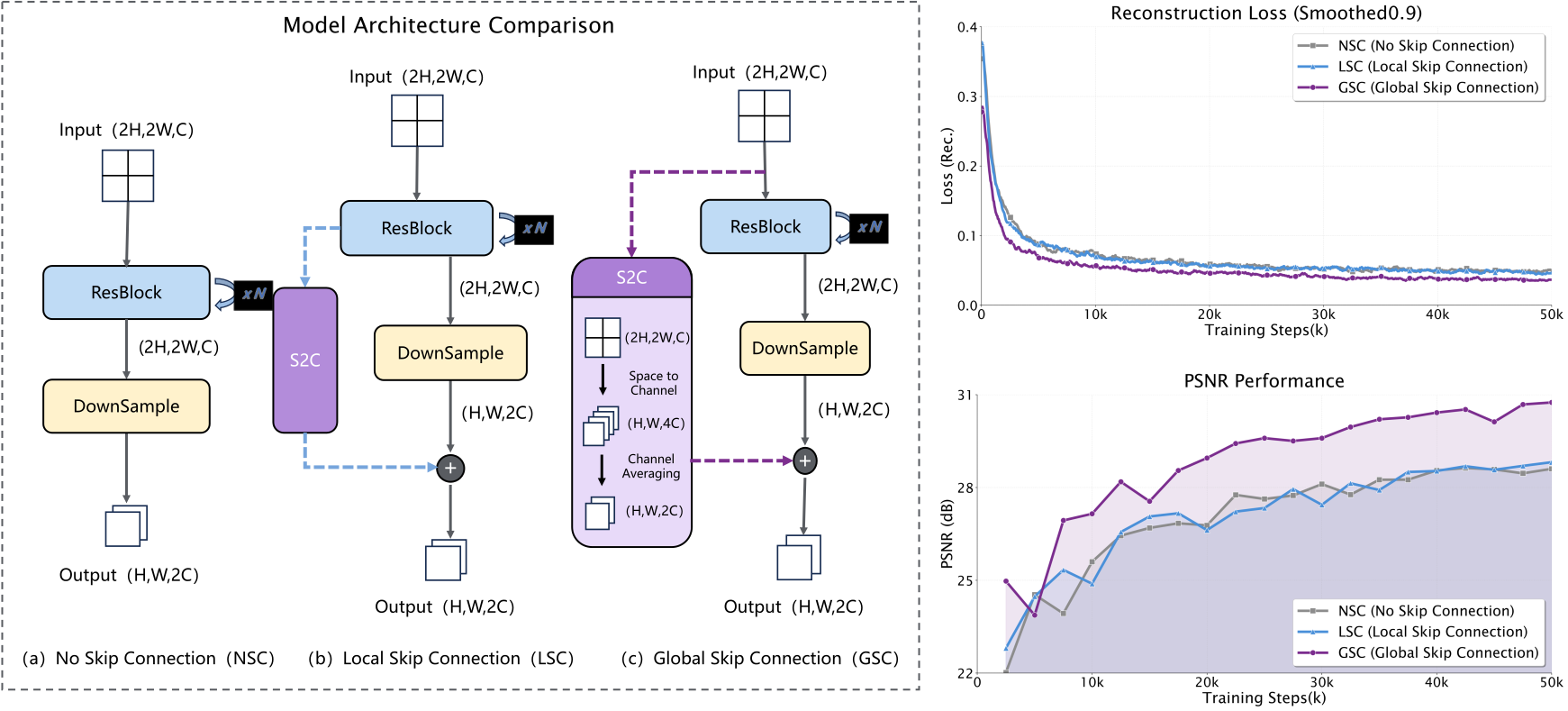
Figure 1 解读:图比较 No Skip Connection (NSC)、Local Skip Connection (LSC) 与 Global Skip Connection (GSC)。GSC 通过 Space-to-Channel (S2C) 把输入图像的局部像素信息折叠进 channel 维度,绕过早期 downsampling 的信息瓶颈;右侧 loss/PSNR 曲线显示 GSC 在 f16c64 从零训练时收敛更快、重建更好。该设计随后被用于全系列 Qwen-Image-VAE-2.0。
直觉上,/ compression 的危险在于:一个 latent cell 要承载更大 image patch 的结构与文字细节。如果所有信息都必须经过连续 downsampling,细线和字符 stroke 会先被抹掉;GSC 像一条高频旁路,把 pixel-level detail 提前送到深层,让 decoder 不必从过度压缩的表示中凭空恢复文字边缘。
Table 1 给出的模型族配置如下:
| Model | f | C | denc | ddec | nlayer | Residual | Params Enc/Dec |
|---|---|---|---|---|---|---|---|
| Qwen-Image-VAE-2.0-f16c64 | 16 | 64 | 96 | 144 | 5 | GSC | 76M / 248M |
| Qwen-Image-VAE-2.0-f16c128 | 16 | 128 | 96 | 144 | 5 | GSC | 76M / 248M |
| Qwen-Image-VAE-2.0-f32c128 | 32 | 128 | 96 | 144 | 6 | GSC | 77M / 250M |
| Qwen-Image-VAE-2.0-f32c192 | 32 | 192 | 96 | 144 | 6 | GSC | 78M / 250M |
3.2 Data:billion-scale general images + text-rich real/synthetic documents
训练数据先扩展到 billions of images,覆盖多类别、分辨率和 aspect ratios,并用 clarity/blur filters 去掉边缘模糊和 compression artifacts。针对 text-rich 场景,论文再用 OCR filter 选出高字符密度样本,并 curated document corpus:academic papers、presentation slides、posters、complex web pages 等。
合成数据部分不是只渲染黑字白底,而是把 English/Chinese 文本渲染到从 general-domain images 随机采样的背景上。字符大小覆盖 5 到 20 pixels,以适配不同 compression settings;这让模型在 下也要学会保留细粒度 stroke。
3.3 Loss:去掉 KL/GAN,保留 reconstruction + LPIPS + semantic alignment
总 loss 是:
其中 是 pixel-level L1 reconstruction loss, 是 perceptual loss。论文明确去掉 KL loss,因为 KL 会限制 latent capacity,并与 semantic alignment 的目标冲突;也去掉 GAN loss,因为在大训练预算下 GAN 对 sharpness 的收益不必要,反而增加 optimization difficulty 与训练不稳定。
Semantic alignment 采用 DINOv2-L 的 middle-layer feature。给定 target semantic feature map ,先把 latent 投影成同空间的 ,再用两个 margin losses:
对齐局部 latent 与 DINOv2 feature 的方向; 保留相对空间布局。训练早期使用更 strict margins 强化 diffusability,后期逐渐放松 margins,让模型在 semantic consistency 与 pixel-level fidelity 之间重新平衡。
3.4 OmniDoc-TokenBench:OCR-based text reconstruction benchmark
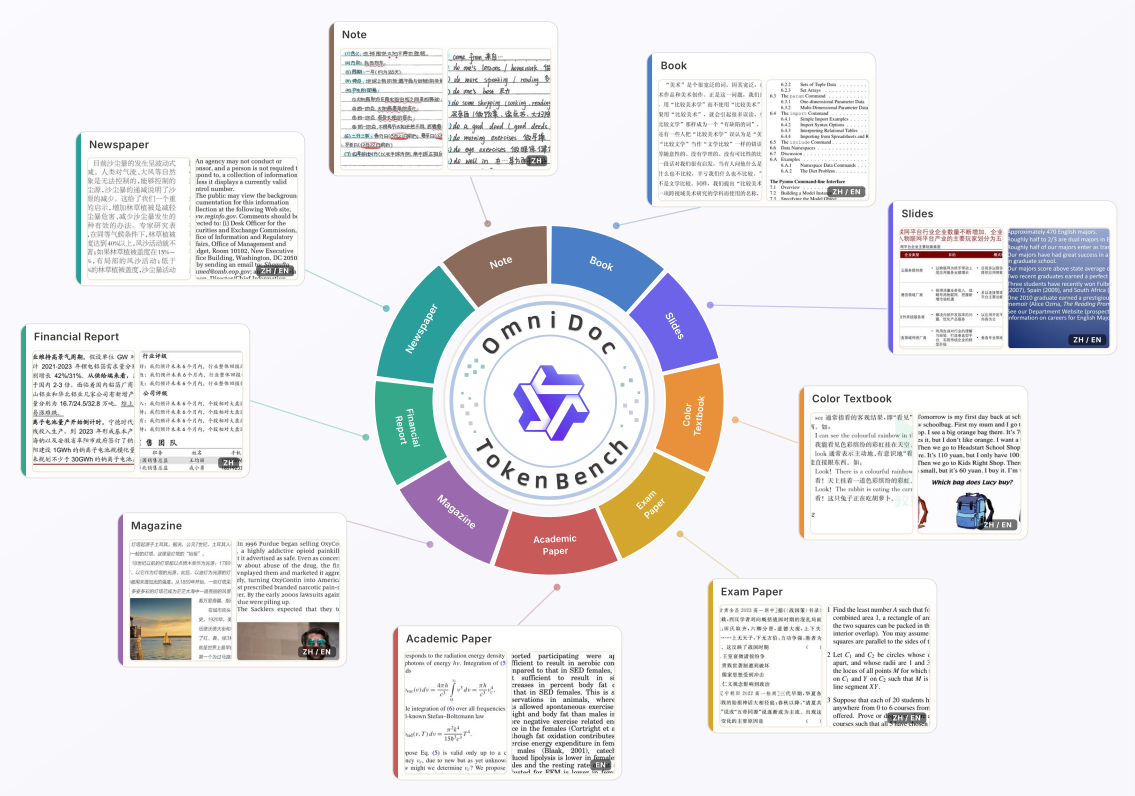
Figure 2 解读:OmniDoc-TokenBench 是约 3K text-rich images,覆盖 book、slides、color textbook、exam paper、academic paper、magazine、financial report、newspaper、note 九类,并包含 English 与 Chinese。它不是用 word boxes 做复杂标注,而是对原图和重建图做 full-page OCR,再比较 OCR 输出文本。
核心指标是 Normalized Edit Distance (NED):如果 OCR 文本完全一致,NED 接近 1;字符级错误越多,NED 越低。论文指出传统 PSNR/SSIM 对单字错误不敏感,例如 “orange” 变成 “orango” 的 PSNR 损失小于 0.5 dB,但 NED 会下降 16.7%。
3.5 Pseudocode
def gsc_encode(x, encoder_stages, space_to_channel, latent_proj):
    # Conceptual pseudocode from Figure 1; model source code is not released.
    high_freq = space_to_channel(x)          # fold spatial pixels into channels
    h = x
    for stage in encoder_stages:
        h = stage(h)                         # progressive downsampling
    h = torch.cat([h, high_freq], dim=1)      # global residual path
    z = latent_proj(h)
    return z
def vae_training_loss(x, vae, lpips_fn, dinov2, align_proj, lambda_lpips, lambda_align):
# Conceptual pseudocode from Equations (1)-(4).
z = vae.encode(x)
x_hat = vae.decode(z)
l_recon = F.l1_loss(x_hat, x)
l_lpips = lpips_fn(x_hat, x).mean()
f = dinov2.middle_layer_features(x).detach()
z_prime = align_proj(z, output_hw=f.shape[-2:])
l_mcos = F.relu(1 - cosine(z_prime, f) - margin_cos).mean()
l_mdms = F.relu(pairwise_cos(z_prime) - pairwise_cos(f) - margin_dist).mean()
l_align = l_mcos + l_mdms
return l_recon + lambda_lpips * l_lpips + lambda_align * l_align@torch.no_grad()
def public_repo_reconstruct_folder(gt_dir, recon_dir):
# Based on alibaba/OmniDoc-TokenBench example_recon.py.
vae = AutoencoderKL.from_pretrained(
"black-forest-labs/FLUX.1-dev", subfolder="vae", torch_dtype=torch.float32
).cuda().eval()
for img_path in sorted(Path(gt_dir).glob("*.png")):
img = Image.open(img_path).convert("RGB")
x = to_tensor(img).unsqueeze(0).cuda() * 2 - 1
latent = vae.encode(x).latent_dist.mode()
recon = vae.decode(latent).sample.squeeze(0).clamp(-1, 1)
recon = ((recon + 1) / 2 * 255).round().to(torch.uint8)
Image.fromarray(recon.permute(1, 2, 0).cpu().numpy()).save(Path(recon_dir) / img_path.name)def public_repo_compute_ned(gt_dir, recon_dir, files):
# Based on alibaba/OmniDoc-TokenBench eval_metrics.py.
ocr = PaddleOCR(use_doc_orientation_classify=False,
use_doc_unwarping=False,
use_textline_orientation=False)
scores = []
details = []
for name in files:
text_gt = "".join(ocr.predict(np.asarray(Image.open(Path(gt_dir) / name)))[0].get("rec_texts", []))
text_rec = "".join(ocr.predict(np.asarray(Image.open(Path(recon_dir) / name)))[0].get("rec_texts", []))
max_len = max(len(text_gt), len(text_rec), 1)
ned = 1.0 - Levenshtein.distance(text_gt, text_rec) / max_len
scores.append(ned)
details.append({"file": name, "gt_text": text_gt, "recon_text": text_rec, "ned": round(ned, 4)})
return float(np.mean(scores)), details论文公式与 released code 实现差异:paper 描述了 Qwen-Image-VAE-2.0 的 GSC architecture、semantic alignment training 和 multi-stage training strategy;alibaba/OmniDoc-TokenBench @ f2815a7 公开的是 benchmark/evaluation code 与 reconstruction example,未公开 VAE model/training implementation。因此训练 loss/GSC pseudocode 是 paper-level,NED/reconstruction pseudocode 是 released code-derived。
Code reference:
main@f2815a7(2026-05-14) — pseudocode and mapping based on this commit
| Paper Concept | Source File | Key Class/Function |
|---|---|---|
| OmniDoc OCR/NED metric | eval_metrics.py | compute_ned |
| Pixel reconstruction metrics | eval_metrics.py | compute_pixel_metrics, compute_fid |
| Folder reconstruction demo | example_recon.py | AutoencoderKL.encode/decode loop |
| Benchmark usage docs | README.md | CLI examples for eval_metrics.py |
| VAE training/model architecture | Not released | 代码搜索未找到开源实现 |
4. Experimental Setup (实验设置)
Datasets
- Training corpus: billions of images,覆盖 diverse categories、resolutions、aspect ratios;具体样本数未详细说明。
- Text-rich real data: OCR-filtered high-character-density samples + curated document corpus,包括 academic papers、presentation slides、posters、complex web pages。
- Synthetic text data: English/Chinese rendered documents,带 random background,字符大小 5–20 pixels。
- OmniDoc-TokenBench: 约 3K text-rich document images,九类文档,English + Chinese。
Baselines
Reconstruction/generation baselines 包括 VTP-Large、RAE-DINOv2-B、RAE-SigLIP2-B、FLUX.1-dev、HunyuanVideo、Qwen-Image、Wan2.1、Cosmos-0.1-CI8x8、Cosmos-0.1-CI16x16、HunyuanVideo-1.5、HunyuanImage-3.0、Wan2.2、Stepvideo-T2V、DC-AE-sana、LTX-2、HunyuanImage-2.1、LTX-Video、FLUX.2-dev。
Evaluation metrics
- PSNR / SSIM: pixel-level reconstruction quality。
- LPIPS: perceptual similarity,lower is better。
- FID / gFID: reconstructed/generated image distribution quality,lower is better。
- IS: ImageNet generation quality for downstream SiT experiments,higher is better。
- NED: OCR text similarity,,higher is better。
Training config
- Architecture config: f16c64、f16c128、f32c128、f32c192;GSC residual;encoder params 76M/76M/77M/78M;decoder params 248M/248M/250M/250M。
- Training strategy: curriculum from low resolution to 2K;progressive text-rich data infusion;semantic alignment margins from strict to relaxed。
- Loss: L1 reconstruction + LPIPS + semantic alignment;no KL loss;no GAN loss。
- Hardware / optimizer / LR / steps: 论文未详细说明;公开 repo 未提供 training config。
5. Experimental Results (实验结果)
Public reconstruction and generation benchmarks (Table 2)
| Model | Setting | IS ↑ | gFID ↓ | ImageNet PSNR / SSIM | FFHQ PSNR / SSIM |
|---|---|---|---|---|---|
| Qwen-Image-VAE-2.0-f16c64 | f16c64 | 102.76 | 9.52 | 32.72 / 0.9086 | 39.14 / 0.9541 |
| Qwen-Image-VAE-2.0-f16c128 | f16c128 | 92.42 | 10.29 | 35.90 / 0.9519 | 43.10 / 0.9795 |
| Qwen-Image-VAE-2.0-f32c128 | f32c128 | 81.23 | 15.05 | 29.69 / 0.8423 | 35.91 / 0.9177 |
| Qwen-Image-VAE-2.0-f32c192 | f32c192 | 72.31 | 18.33 | 31.13 / 0.8785 | 37.52 / 0.9381 |
关键结论:f16c128 在 ImageNet 达 35.90 PSNR / 0.9519 SSIM,在 FFHQ 达 43.10 PSNR / 0.9795 SSIM;f32c192 虽是 compression,ImageNet 仍有 31.13 PSNR / 0.8785 SSIM,论文称其与部分 VAE 可比。
OmniDoc-TokenBench text-rich reconstruction (Table 3)
| Model | Setting | SSIM ↑ | PSNR ↑ | LPIPS ↓ | FID ↓ | NED ↑ |
|---|---|---|---|---|---|---|
| Qwen-Image-VAE-2.0-f16c64 | f16c64 | 0.9279 | 26.00 | 0.0382 | 1.94 | 0.9244 |
| Qwen-Image-VAE-2.0-f16c128 | f16c128 | 0.9706 | 30.45 | 0.0167 | 0.79 | 0.9617 |
| Qwen-Image-VAE-2.0-f32c128 | f32c128 | 0.8442 | 22.13 | 0.0642 | 3.36 | 0.7065 |
| Qwen-Image-VAE-2.0-f32c192 | f32c192 | 0.8908 | 23.84 | 0.0497 | 1.98 | 0.8555 |
关键发现:f16c128 的 NED=0.9617,超过所有评测的 VAEs,包括 FLUX.1-dev 的 0.9546;f32c192 的 NED=0.8555,也超过多个 baselines。论文还指出 pixel metrics 与 text fidelity 不完全相关:Stepvideo-T2V 在 f16 的 NED 0.8838 高于 HunyuanImage-3.0 的 0.7753,尽管 SSIM 差距较小;LTX-Video 在 f32 的 NED 0.5651 高于 HunyuanImage-2.1 的 0.4895,尽管 FID 更差。
[Large figure omitted: fig3_group.svg exceeded Cloudflare Pages single-file limit.]
Figure 3a–3b 解读:该 composite 保留 source 中 f16 与 f32 两个 panel 的横向对比。f16 panel 中,多数 baselines 会出现 character blurring、stroke merging 或局部 unreadable;Qwen-Image-VAE-2.0-f16 系列能保留更清晰字符。f32 panel 更极端,baseline 常把文档结构和文字压坏;Qwen-Image-VAE-2.0-f32c192 在高压缩下仍保持相对可读的页面结构。
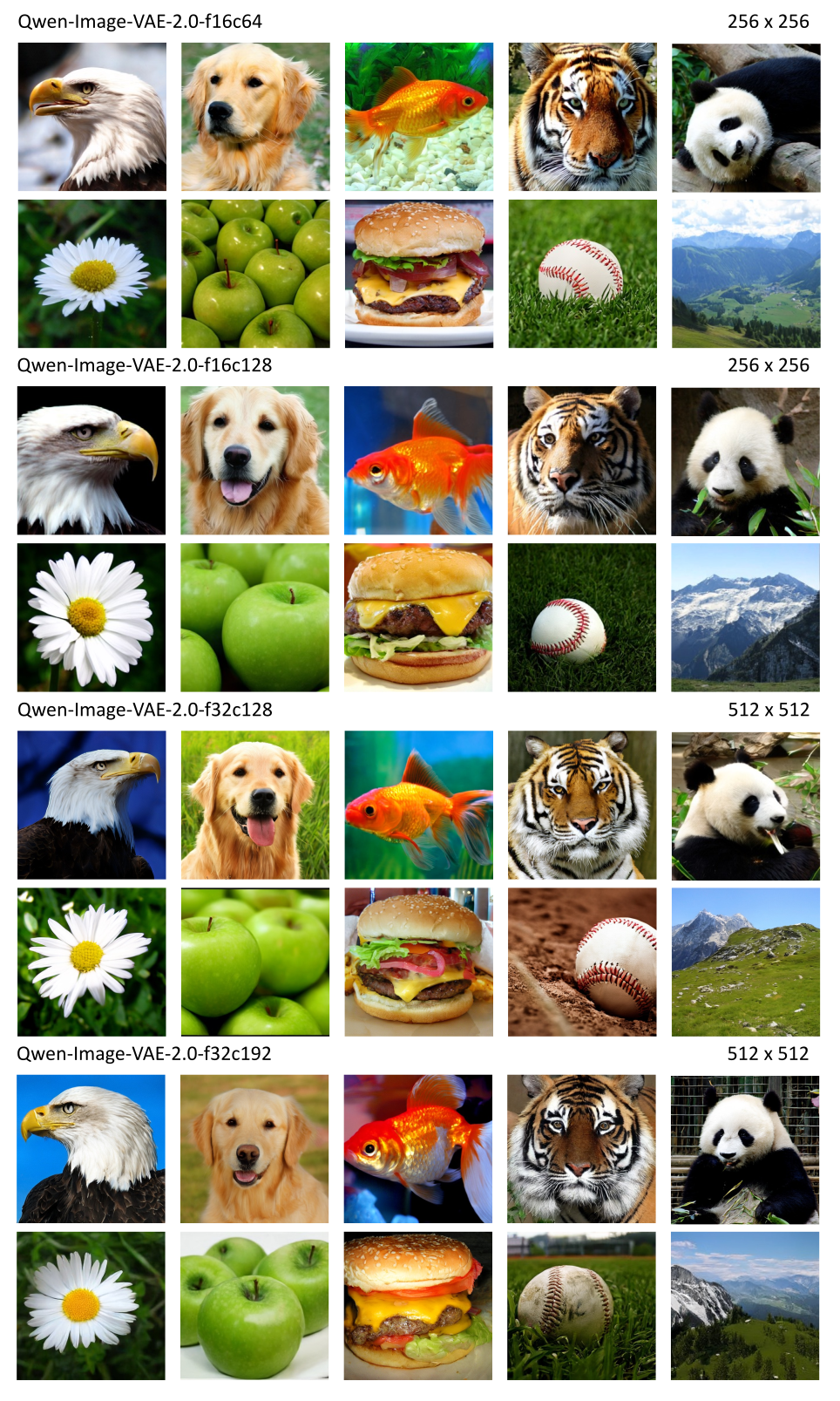
Figure 4 解读:SiT on ImageNet 的 samples 用于验证 latent diffusability。VAE 不只是重建器;如果 latent 对下游 DiT 不友好,即便 reconstruction 指标不错,generation training 也可能慢或不稳定。图中 samples 说明 Qwen-Image-VAE-2.0 的 latent 可以支持 downstream generation。
Limitations
论文未单列 limitations。作者明确提到 NED 使用 raw OCR outputs、没有 text normalization,minor spacing artifacts may inflate edit distance;此外 training hardware、optimizer/LR/steps、VAE training code 与模型实现未公开,公开 repo 只支持 benchmark evaluation/reconstruction example。