Streaming Autoregressive Video Generation via Diagonal Distillation
Authors: Jinxiu Liu, Xuanming Liu, Kangfu Mei, Yandong Wen, Ming-Hsuan Yang, Weiyang Liu Affiliations: South China University of Technology, Westlake University, Johns Hopkins University, UC Merced, CUHK Venue: ICLR 2026
机构: South China University of Technology, Westlake University, Johns Hopkins University, UC Merced, CUHK
链接: arXiv:2603.09488 | GitHub: Sphere-AI-Lab/diagdistill
关键词: Diffusion Distillation, Autoregressive Video Generation, Streaming, Flow Distribution Matching, KV Cache
1. Motivation (研究动机)
核心问题
现有 diffusion-based 视频生成模型在实时流式生成方面存在重大限制:
- 双向注意力的局限: 主流视频扩散模型 (如 Wan2.1) 使用 bidirectional attention 同时去噪所有帧, 要求未来帧可用, 无法用于实时流式场景 (游戏模拟、机器人学习等)
- 自回归扩散模型的推理瓶颈: 虽然 AR 扩散模型天然适合流式生成, 但每个 chunk 仍需多步去噪, 导致延迟高
- 现有蒸馏方法的缺陷: 图像蒸馏方法 (如 DMD) 直接用于视频效果差, 因为:
- 忽略时间维度的上下文信息
- 减少步数后运动连贯性下降
- 长序列生成时误差累积导致过饱和 (oversaturation)
关键观察
隐式噪声级别预测 (Exposure Bias):

Figure 2 解读: 当训练数据使用显式噪声帧作为条件 (如 Causvid), 下一个 chunk 的预测本质上是在做隐式的”下一步噪声级别预测”。图中展示了即使使用单步预测, 随着 chunk 推进图像也逐渐变清晰。这说明后续 chunk 可以利用前面已充分去噪的 chunk 作为结构先验, 从而使用更少的去噪步骤。这一观察直接启发了”前多后少”的非对称去噪策略。
2. Idea (核心思想)
核心思想: Diagonal Distillation
提出一种 flow-aware 对角蒸馏框架, 同时在时间维度 (chunk 间) 和去噪步数维度上利用信息, 包含三个核心创新:
- Diagonal Denoising (对角去噪): 非对称步数分配 — 前面的 chunk 用更多去噪步, 后面的 chunk 逐步减少到 2 步
- Diagonal Forcing (对角强制训练): 在训练时显式模拟对角去噪轨迹, 通过受控噪声注入弥合训练-推理分布差距
- Flow Distribution Matching (光流分布匹配): 将显式时序建模引入蒸馏 loss, 确保运动一致性
与现有方法的关系
| 方法 | 训练策略 | 问题 |
|---|---|---|
| Teacher Forcing | 条件为 clean ground-truth 帧 | 训练-推理不一致, 长序列误差累积 |
| Diffusion Forcing | 条件为 noisy latents | 去噪基于噪声上下文, 但推理时用 clean 上下文 |
| Self Forcing | 条件为模型自身预测 | 早期低质量预测影响学习 |
| Diagonal Forcing (Ours) | 混合 clean + model-generated, 对角排列 | 兼顾鲁棒性和质量 |
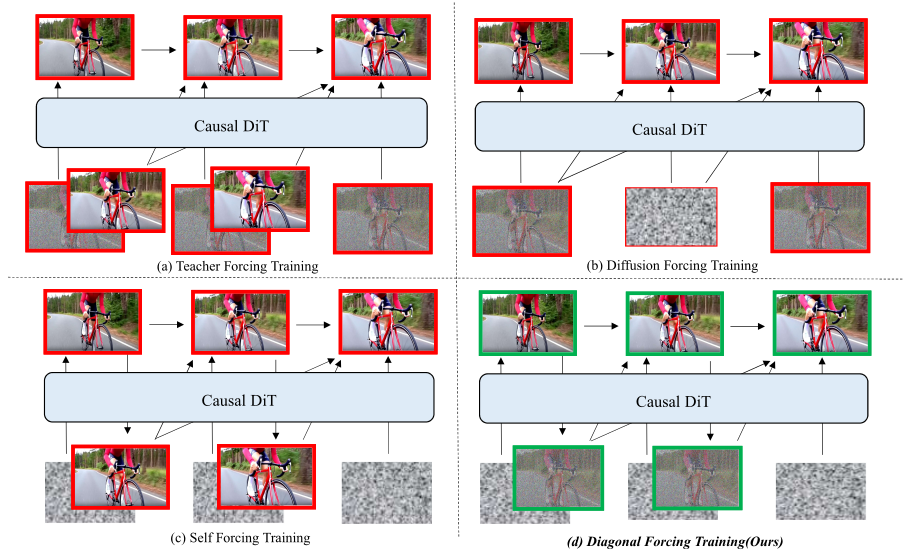
Figure 10 解读: 四种时序训练策略的对比可视化。(a) Teacher Forcing: 绿框表示 ground-truth 帧; (b) Diffusion Forcing: 红框表示 noisy latents; (c) Self Forcing: 红框表示模型自身预测; (d) Diagonal Forcing (本文): 绿框和红框按对角线混合排列。Diagonal Forcing 的核心创新在于: 对于当前目标帧, 最近的帧来自模型自身预测 (红), 更早的帧来自 ground-truth (绿), 这种对角模式精确模拟了 Diagonal Denoising 的推理场景, 从而对齐训练和推理分布。
3. Method (方法)
3.1 Overall Framework
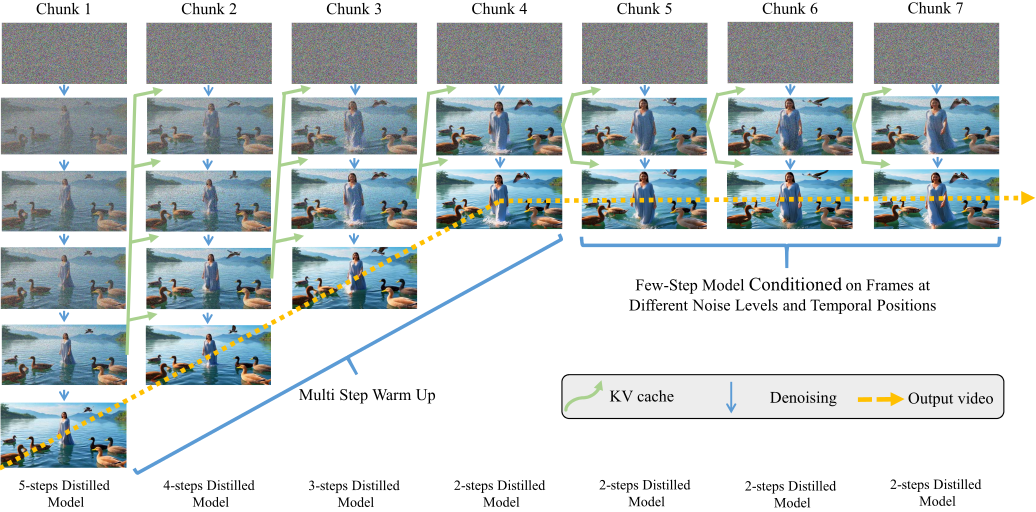
Figure 3 解读: Diagonal Denoising 的完整流程示意。从 Chunk 1 到 Chunk 7, 去噪步数从 5 步逐渐减少到 2 步 (步数配置 = [5, 4, 3, 2, 2, 2, 2])。关键细节: (1) 前 3 个 chunk 使用不同步数的蒸馏模型; (2) 从 Chunk 4 开始固定使用 2-step 蒸馏模型; (3) 每个 chunk 的倒数第二步输出被加噪后作为 KV cache 传递给下一个 chunk (黄色虚线框); (4) 这种设计使后续 chunk 可以继承前面 chunk 丰富的外观信息。
3.2 Preliminary: Distribution Matching Distillation (DMD)
Score Function:
DMD Loss Gradient:
Regression Loss:
3.3 Diagonal Denoising: Progressive Step Reduction
前 3 个 chunk () 使用递减步数 ():
其中 是高斯噪声, 是之前已加噪的 chunk。
Chunk 使用固定 2-step 去噪:
def diagonal_denoising(M: int, step_schedule: list, models: dict) -> list:
    """Diagonal Denoising with Noisy KV Cache (Algorithm 1)
    Args:
        M: number of chunks
        step_schedule: e.g. [5, 4, 3, 2, 2, 2, 2]
        models: distilled models {s: Theta_s, 2: Theta_2}
    """
    outputs = []      # output buffer
    kv_cache = []      # cached KV states

    for k in range(1, M + 1):
        eps = sample_gaussian()  # eps ~ N(0, I)

        if k <= 4:  # Base Phase: progressive step reduction
            x_k = sample_gaussian()  # X_k^(0) ~ N(0, I)
            s_k = step_schedule[k - 1]
            for t in range(1, s_k + 1):
                x_k = denoise_step(x_k, outputs[:k-1], kv_cache, models[s_k])
                if t == s_k - 1:  # penultimate step: cache noisy result
                    cache_noisy_result(x_k, kv_cache)
            x_tilde_k = mix(x_k, eps)

        else:  # Extension Phase: fixed 2-step generation
            c_k = compute_condition(outputs[k - 2])  # condition from previous chunk
            x_step1 = denoise_step(sample_gaussian(), c_k, kv_cache, models[2])
            cache_noisy_result(x_step1, kv_cache)  # cache after step 1
            x_step2 = denoise_step(x_step1, c_k, kv_cache, models[2])
            x_tilde_k = mix(x_step2, eps)

        outputs.append(x_tilde_k)

    return outputs

def cache_noisy_result(x, kv_cache: list, alpha_k: float):
    """Add noise to intermediate result and cache its KV representation."""
    eps = sample_gaussian()
    x_interim = sqrt(alpha_k) * x + sqrt(1 - alpha_k) * eps
    kv_cache.append(compute_kv(x_interim))
3.4 Diagonal Forcing: Contextual Prior Propagation
训练时通过受控噪声注入模拟对角去噪轨迹:
其中 控制对角路径上的噪声 schedule。这显式维护了去噪轨迹: , 其中 作为 chunk 的 KV cache 输入。
def diagonal_forcing_training(chunks_gt: list, alpha_schedule: list, t_noise: int = 100):
    """Diagonal Forcing Training: simulate diagonal denoising trajectory during training."""
    for iteration in training_iterations:
        for k in range(1, len(chunks_gt)):
            # Step 1: Add controlled noise to previous chunk's clean output
            eps = sample_gaussian()  # eps ~ N(0, I)
            alpha_prev = alpha_schedule[t_noise]  # alpha_{k-1} at timestep=100
            x_tilde_prev = sqrt(alpha_prev) * chunks_gt[k-1] + sqrt(1 - alpha_prev) * eps

            # Step 2: Use noisy result as KV cache condition
            kv_cache = compute_kv(x_tilde_prev)

            # Step 3: Standard DMD training on current chunk
            z = sample_gaussian()
            x_pred = generator(z, text_cond, kv_cache)

            # Step 4: Combined loss (spatial DMD + regression + flow matching)
            loss = L_DMD(x_pred) + L_reg(x_pred) + gamma * (L_flow_DMD(x_pred) + L_flow_reg(x_pred))
            loss.backward()
3.5 Flow Distribution Matching
运动分布散度度量:
Flow DMD Loss Gradient:
Flow Score Function:
Flow Regression Loss:
运动特征提取器 的实现: 轻量级 Conv-MLP, 直接在 latent space 操作:
- 计算连续 latent 帧之间的差值 (latent difference)
- 通过 2 层卷积提取局部运动模式
- MLP 进行特征自适应
- Student 通过梯度反传更新, Teacher 通过 EMA 更新
class MotionFeatureExtractor:
    """Flow Distribution Matching: lightweight Conv-MLP on latent space."""
    def __init__(self):
        self.conv_layers = Conv2d(...)  # 2 convolutional layers
        self.mlp = MLP(...)            # feature adaptation

    def forward(self, latent_sequence):
        # latent_sequence: [B, F, C, H, W]
        # Step 1: Frame-wise difference (temporal motion signal)
        diff = latent_sequence[:, 1:] - latent_sequence[:, :-1]  # [B, F-1, C, H, W]
        # Step 2: Convolutional motion extraction
        motion_features = self.conv_layers(diff)
        # Step 3: MLP adaptation
        return self.mlp(motion_features)

def flow_distribution_matching_step(G_student, G_teacher, F_student, F_teacher, eps, t: float):
    """One training step of Flow Distribution Matching."""
    # Extract motion features from student and teacher generators
    flow_student = F_student(G_student(eps, t))
    flow_teacher = F_teacher(G_teacher(eps, t))

    # Flow DMD gradient: score difference (analogous to spatial DMD)
    flow_dmd_loss = compute_score_diff(s_data_flow=flow_teacher, s_gen_flow=flow_student)
    # Flow regression loss
    flow_reg_loss = (flow_teacher - flow_student).pow(2).mean()

    return flow_dmd_loss, flow_reg_loss

# Training setup
F_student = MotionFeatureExtractor()       # updated via gradient descent
F_teacher = EMA(F_student, momentum=0.99)  # updated via EMA: theta^- <- mu*theta^- + (1-mu)*theta
3.6 Total Loss
其中 , , (flow loss weight)。
4. Experimental Setup (实验设置)
训练配置
| 配置项 | 值 |
|---|---|
| Base Model | Wan2.1-T2V-1.3B (Flow Matching) |
| 初始化模型 | LongLive-1.3B (long-context video) |
| 分辨率 | 832 x 480 |
| 帧率 | 16 FPS |
| Chunk Size | 3 帧 |
| KV Cache Window | 4 chunks (12 帧) |
| Denoising Steps | [1000, 100] (warped timesteps) |
| Timestep Shift | |
| Learning Rate | 2e-6 (generator), 4e-7 (critic) |
| Optimizer | Adam (, ) |
| EMA Weight | 0.99, start at step 200 |
| Training Iterations | 600 |
| 训练时间 | < 2h (64 H100), < 16h (8 H100 w/ grad accum) |
| Mixed Precision | BF16 |
| FSDP Strategy | Hybrid Full Sharding |
| Gradient Checkpointing | Enabled |
| Noise Schedule | Flow Matching (, ) |
| Diagonal Forcing Timestep | 100 (最优, 见 ablation) |
| Prompts | VidProM filtered + LLM-extended |
推理配置
| 配置项 | 值 |
|---|---|
| GPU | Single NVIDIA H100 |
| VAE | Tiny VAE (9.84M params, 10x faster decoding) |
| Step Schedule (5s video) | [4, 3, 2, 2, 2, 2, 2] → 总 NFEs = 34 |
| KV Cache Memory | 17.5 GB |
| Latent Overlap | 9 帧 |
| torch.compile | 可选 (进一步加速) |
评估指标
使用 VBench 评估框架:
- Temporal Quality: Subject Consistency, Background Consistency, Temporal Flickering, Motion Smoothness, Dynamic Degree 的均值
- Frame Quality: Aesthetic Quality, Imaging Quality 的均值
- Text Alignment: Object Class, Multiple Objects, Human Action, Color, Spatial Relationship, Scene, Appearance, Style, Temporal Style 的均值
5. Experimental Results (实验结果)
5.1 Main Comparison (Table 1)
| Model | Throughput (FPS) | First-Frame Latency (s) | Speedup | Total Score | Quality | Semantic |
|---|---|---|---|---|---|---|
| Wan2.1 | 0.78 | 103 | 1.0x | 84.26 | 85.30 | 80.09 |
| SkyReels-V2 | 0.49 | 112 | 0.91x | 82.67 | 84.70 | 74.53 |
| MAGI-1 | 0.19 | 282 | 0.36x | 79.18 | 82.04 | 67.74 |
| Causvid | 17.0 | 0.69 | 149.3x | 81.20 | 84.05 | 69.80 |
| Self-Forcing | 17.0 | 0.69 | 149.3x | 84.31 | 85.07 | 81.28 |
| DiagDistill (Ours) | 31.0 | 0.37 | 277.3x | 84.48 | 85.26 | 81.73 |
关键数据:
- 相比 Wan2.1 baseline 实现 277.3x 加速, 5 秒视频生成仅需 2.61 秒 (31 FPS)
- 相比之前最快的 Self-Forcing, 延迟降低 1.53x (0.37s vs 0.69s)
- 保持与 full-step model 接近的视觉质量 (85.26 vs 85.30)
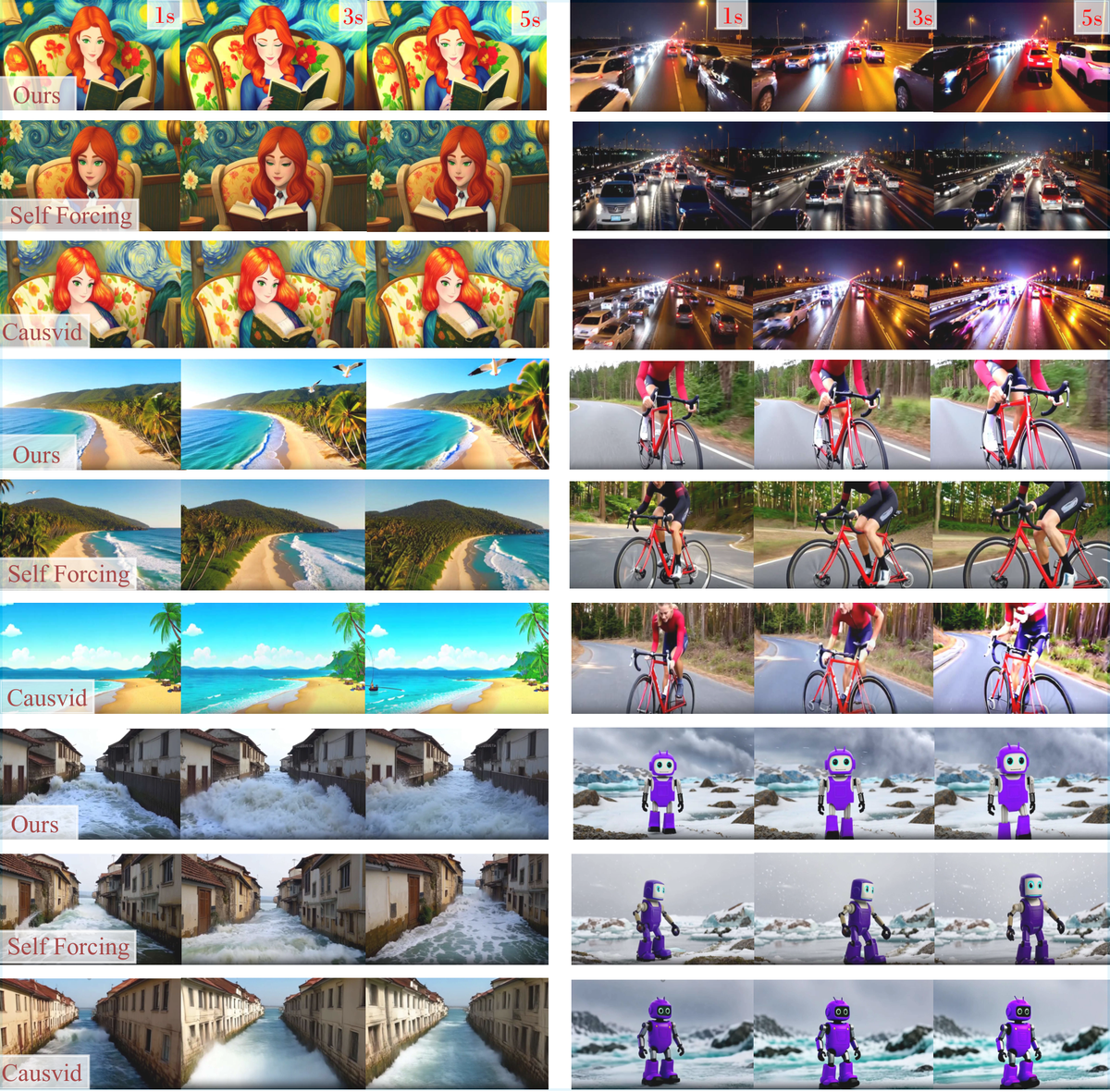
Figure 4 解读: 三种方法的视觉质量对比。每组 3 行分别展示 Ours / Self Forcing / Causvid 的结果。可以观察到: (1) 本文方法在复杂运动和纹理场景中表现更好, 帧过渡更平滑; (2) Causvid 在长序列中出现明显的饱和度失真和动态伪影; (3) Self-Forcing 在部分场景中出现模糊和变形。
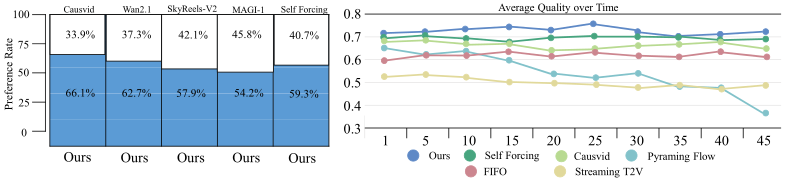
Figure 1 解读: Diagonal Distillation 与 Causvid、Self-Forcing 的主要对比。左侧展示三种方法的速度差异, 右侧展示 5 秒视频在 1s/3s/5s 时刻的帧质量。DiagDistill 仅需 2.61 秒完成生成, 比 Causvid 和 Self-Forcing (4.91 秒) 快 1.88 倍, 同时保持可比的视觉质量。
5.2 Ablation Studies
Key Components (Table 2):
| Ablation Variant | Temporal Quality | Frame Quality | Text Alignment | Total Score |
|---|---|---|---|---|
| Without Diagonal Forcing | 92.1 | 60.1 | 26.9 | 83.58 |
| Without Flow Loss | 92.5 | 60.8 | 27.8 | 84.18 |
| Without Diagonal Denoising | 95.1 | 63.2 | 28.6 | 84.46 |
| Full Method (Ours) | 94.9 | 63.4 | 28.9 | 84.48 |
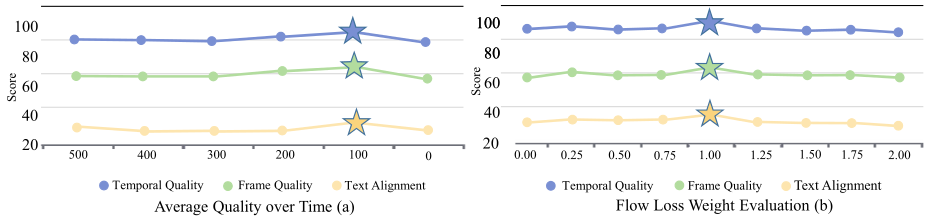
Figure 5 解读: 两个关键超参数的 ablation 分析。(a) Diagonal Forcing 的噪声注入 timestep: timestep=100 在所有指标上达到最优, 太大 (1000) 导致结构先验模糊、运动幅度下降, 太小 (0) 等价于使用 clean 帧导致过饱和; (b) Flow loss weight: weight=1.0 在时序质量、帧质量和文本对齐之间达到最佳平衡, 过大的 flow 约束反而有害。
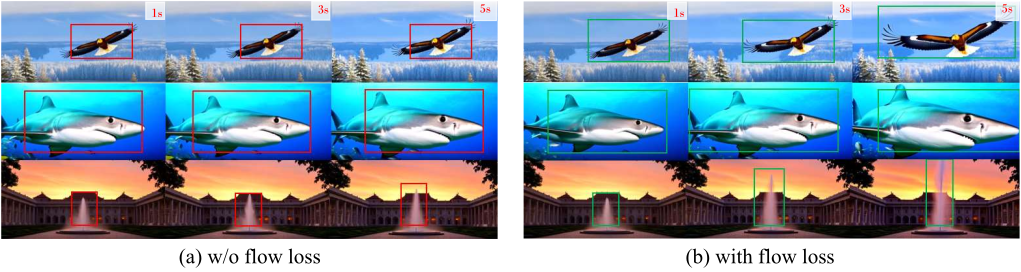
Figure 6 解读: Flow Distribution Matching 的运动效果对比。(a) 无 motion loss: 物体运动幅度极小, 几乎是静止的; (b) 有 motion loss: 整个画面运动幅度显著增大。这验证了 Flow Distribution Matching 在保持少步去噪下运动动态性方面的关键作用。
Denoising Configurations (Table 3):
| Steps Config | Temporal | Frame | Text | NFEs | Latency (s) | Throughput (FPS) |
|---|---|---|---|---|---|---|
| 5333333 | 95.0 | 63.9 | 29.1 | 46 | 0.34 | 22.5 |
| 4322222 | 94.9 | 63.4 | 28.9 | 34 | 0.23 | 31.0 |
| 4222222 | 93.4 | 62.3 | 27.8 | 32 | 0.23 | 32.0 |
| 5432222 | 94.8 | 63.1 | 29.0 | 40 | 0.23 | 29.7 |
最终选择 4322222 配置: 仅 34 NFEs, 质量接近最优 (5333333), 但延迟和吞吐量显著更优。
5.3 Long Video Generation
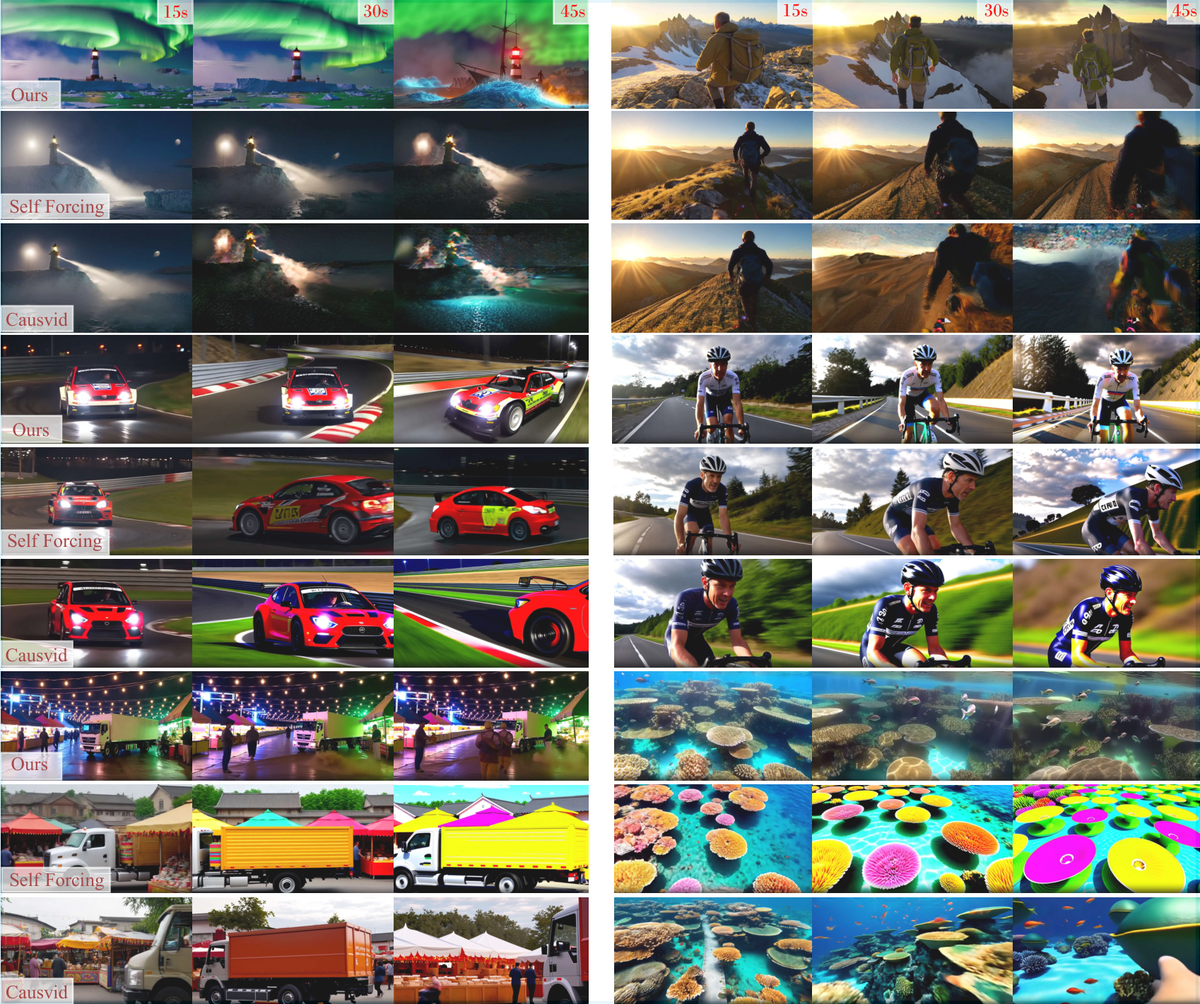
Figure 7 解读: 45 秒长视频生成的定性对比。每组 3 行: Ours / Self-Forcing / Causvid。可以明显看到其他方法在长序列中出现饱和度失真和质量衰减, 而本文方法在整个 45 秒内保持细节和一致性。
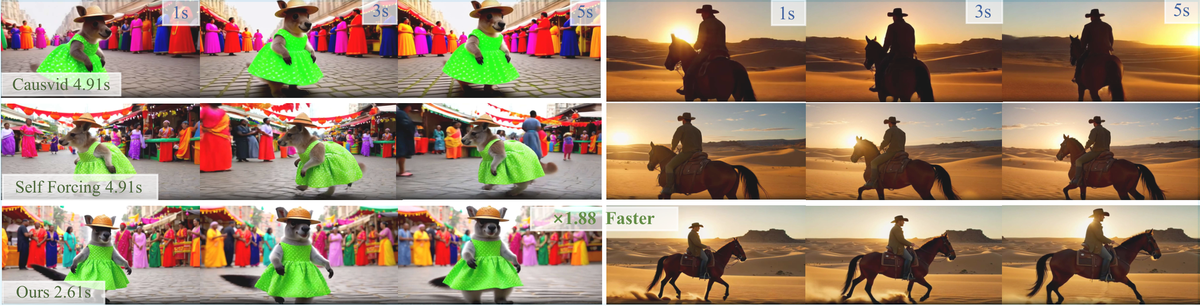
Figure 8 解读: 长视频生成的定量评估。左图: 用户偏好率 — DiagDistill 在与所有 baseline 的对比中均获得多数偏好 (vs Causvid 66.1%, vs Wan2.1 62.7%, vs SkyReels-V2 57.9%, vs MAGI-1 54.2%, vs Self-Forcing 59.3%)。右图: 随时间推移的平均质量 — 本文方法在 45 秒内保持稳定的高质量 (>50%), 而其他方法质量随时间明显下降。
5.4 Dynamic Prompting
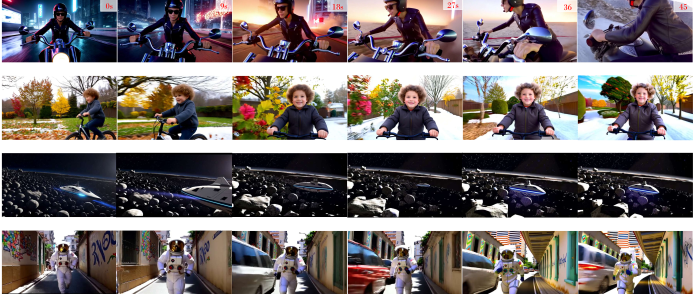
Figure 9 解读: 动态 prompting 的长视频生成示例。该功能允许用户在时间轴的任意点引入新的文本描述, 创建包含场景变换和动作演变的复杂叙事。图中展示了四个不同的动态 prompting 视频: 人物行走穿越不同场景、打扫房间、海边电话亭随时间变化、以及赛博朋克摩托车追逐。
5.5 Acceleration Analysis (Appendix E)
四大加速源:
- 去噪步数减少: 从 uniform 多步 → 前多后少, 总 NFEs 从 ~48 降至 34
- 高效 KV Cache: 直接在 noisy latent 上做 KV caching (不需额外 clean frame 计算), 消除冗余计算
- 优化注意力窗口: KV cache 窗口从 Self-Forcing 的 6 chunks 减至 4 chunks, 显存从 19.2GB 降至 17.5GB
- Tiny VAE: 解码参数从 73.3M 降至 9.84M, 解码时间从 1.67s 降至 0.12s (10x+)
Code-to-Paper Mapping
| Paper 概念 | 代码位置 | 说明 |
|---|---|---|
| DMD Loss (Eq. 2) | model/dmd.py: _compute_kl_grad() | 计算 real/fake score 差值作为 KL gradient, 包含 spatial 和 motion gradient |
| Regression Loss (Eq. 3) | model/dmd.py: compute_distribution_matching_loss() | 在 DMD loss 之外还计算 x0 prediction regression |
| Diagonal Denoising (Eq. 4-5) | pipeline/causal_inference.py: inference() | use_diagonal_denoising flag 控制步数递减, block_index 决定 step schedule |
| Diagonal Forcing (Eq. 6) | pipeline/streaming_training.py | use_dia_forcing flag, 加噪 timestep 由 context_noise 控制 |
| Flow Distribution Matching (Eq. 7-11) | model/dmd.py: _compute_kl_grad() | grad_motion 计算帧间差分的 score 差异 |
| Flow Regression (Eq. 11) | Motion feature extractor in training | Conv-MLP on latent diff, EMA teacher-student |
| Total Loss (Eq. 12) | trainer/distillation.py | 组合 spatial DMD + reg + flow DMD + flow reg |
| Noisy KV Cache (Algorithm 1) | pipeline/causal_inference.py | CacheNoisyResult: 对中间结果加噪后缓存 KV |
| Step Schedule [4,3,2,2,2,2,2] | configs/diadistill_inference.yaml | denoising_step_list + use_diagonal_denoising |
| Tiny VAE | taehv.py + inference.py: TinyVAEWrapper | 包装 TAEHV 进行快速解码 |
| Streaming Training | model/streaming_training.py: StreamingTrainingModel | 管理流式生成状态、KV cache 复用、chunk-wise loss |
| Training Config | configs/diadistill_train_init.yaml | lr=2e-6, batch=1, 21 frames, local_attn=12 |