Radial Attention: O(n log n) Sparse Attention with Energy Decay for Long Video Generation
Authors: Xingyang Li*, Muyang Li*, Tianle Cai, Haocheng Xi, Shuo Yang, Yujun Lin, Lvmin Zhang, Songlin Yang, Jinbo Hu, Kelly Peng, Maneesh Agrawala, Ion Stoica, Kurt Keutzer Affiliations: MIT, NVIDIA, Princeton, UC Berkeley, Stanford, First Intelligence Venue: NeurIPS 2025
1. Motivation (研究动机)
核心问题
视频 Diffusion Model 的核心瓶颈在于 3D dense attention 的 O(n^2) 计算复杂度。随着视频帧数增加,token 数量线性增长(例如 HunyuanVideo 生成 5 秒 720p 视频需要约 110K tokens),attention 计算量呈二次方增长,使得长视频的训练和推理代价极高。
现有方法的不足
- SVG (Sparse VideoGen):动态地将每个 attention head 分类为 spatial 或 temporal,分别施加对应的 sparse mask。但存在两个问题:(a) runtime profiling 在未见过的视频长度上不可靠;(b) 无法加速训练,只能加速推理;(c) 忽略了 temporal decay,对远帧分配了不必要的计算。
- Linear Attention (SANA 等):用线性复杂度替代 softmax attention,但需要大幅修改模型架构,且往往难以捕捉局部细节,导致质量下降。
- STA (Sliding Tile Attention):固定 3D sliding window 提供局部注意力,但限制了 long-range dependency。
- PowerAttention:虽然也是 O(n log n),但忽略视频数据固有的时空结构,效果不佳。
物理直觉
自然界中信号和波随距离传播时会损失能量。作者在 video diffusion model 的 post-softmax attention score 中发现了类似的现象:attention score 随 token 间的时空距离增大而指数衰减。作者称此现象为 Spatiotemporal Energy Decay。这一发现直接启发了 Radial Attention 的设计——将 energy decay 转化为 compute density decay。
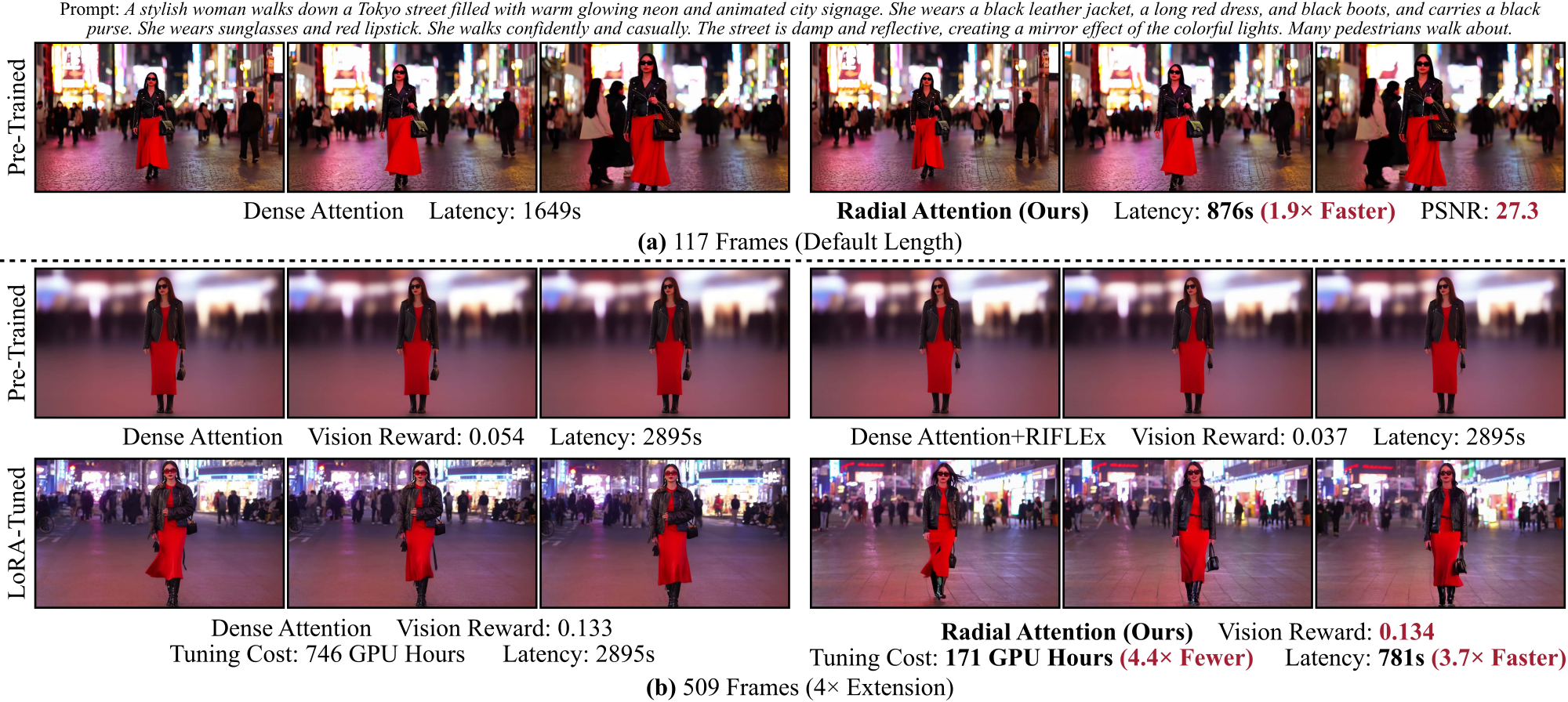
Figure 1 解读:Figure 1 展示了 Radial Attention 的核心效果。上半部分 (a) 是 pre-trained HunyuanVideo 在默认 117 帧长度下的对比:Dense Attention 需要 1649s,Radial Attention 仅需 876s(1.9x 加速),PSNR 达到 27.3,视觉质量几乎无损。下半部分 (b) 是 4x 长度扩展(509 帧)场景:Dense Attention + Full fine-tuning 需要 746 GPU hours 训练和 2895s 推理;Radial Attention + LoRA 仅需 171 GPU hours(4.4x 节省)和 781s 推理(3.7x 加速),且 Vision Reward 更高(0.134 vs 0.133)。
2. Idea (核心思想)
核心洞察
Radial Attention 的核心思想可以用一句话概括:attention score 随时空距离指数衰减,因此计算密度也应该随时空距离指数衰减。
具体而言,作者将 energy decay 建模为指数函数:对于 frame i 中位置 k0 的 query token,frame j 中位置 l 的 key token 的 attention score 满足上界:
其中 alpha 控制 temporal decay,beta 控制 spatial decay。这意味着:
- Temporal 维度:距离当前帧越远的帧,attention score 越低,可以分配更少的计算
- Spatial 维度:同一帧内距离越远的 token,attention score 越低,可以用更窄的 diagonal window
与 SVG 的统一
SVG 将 attention head 二分为 spatial head 和 temporal head,分别施加不同的 sparse mask。Radial Attention 用一个统一的 static mask 同时建模 spatial 和 temporal 的 sparsity:
- 中心 band(band 0,即相同帧或相邻帧)保留完整的 spatial interaction,相当于 SVG 的 spatial attention
- 外层 band 逐步减少 spatial window width 和 temporal sampling frequency,实现 temporal decay
设计优势
- Static mask:无需 runtime profiling,可同时加速训练和推理
- O(n log n) 复杂度:介于 O(n^2) dense 和 O(n) linear 之间的最佳平衡
- 保留 softmax attention:不修改底层 attention 机制,只剪枝不重要的 token pair,因此可以用 LoRA 轻量微调扩展到更长视频
- Block-friendly:以 128x128 block 为粒度计算,适配现代 GPU 硬件
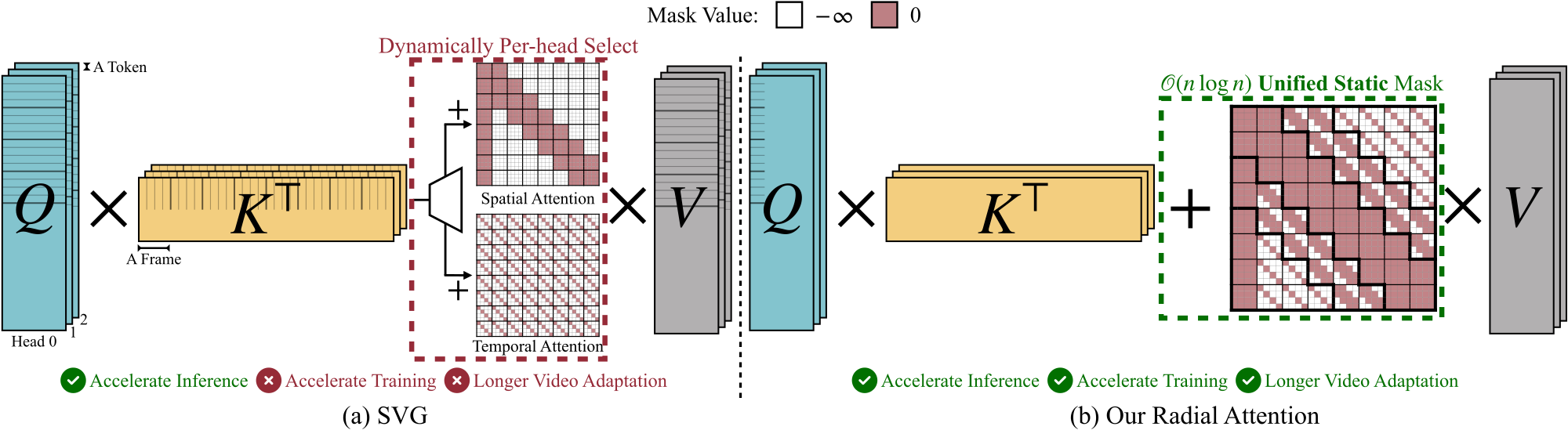
Figure 2 解读:对比 SVG 和 Radial Attention 的 pipeline。左侧 (a) SVG 需要为每个 head 动态选择 spatial 或 temporal mask,每个 head 只能是其中一种;右侧 (b) Radial Attention 使用一个统一的 static mask,所有 head 共享,同时包含 spatial 和 temporal 信息。关键区别在于:SVG 只能加速推理,不能加速训练,也不支持更长视频适配;Radial Attention 三者皆可。
3. Method (方法)
3.1 Spatiotemporal Energy Decay 的观测
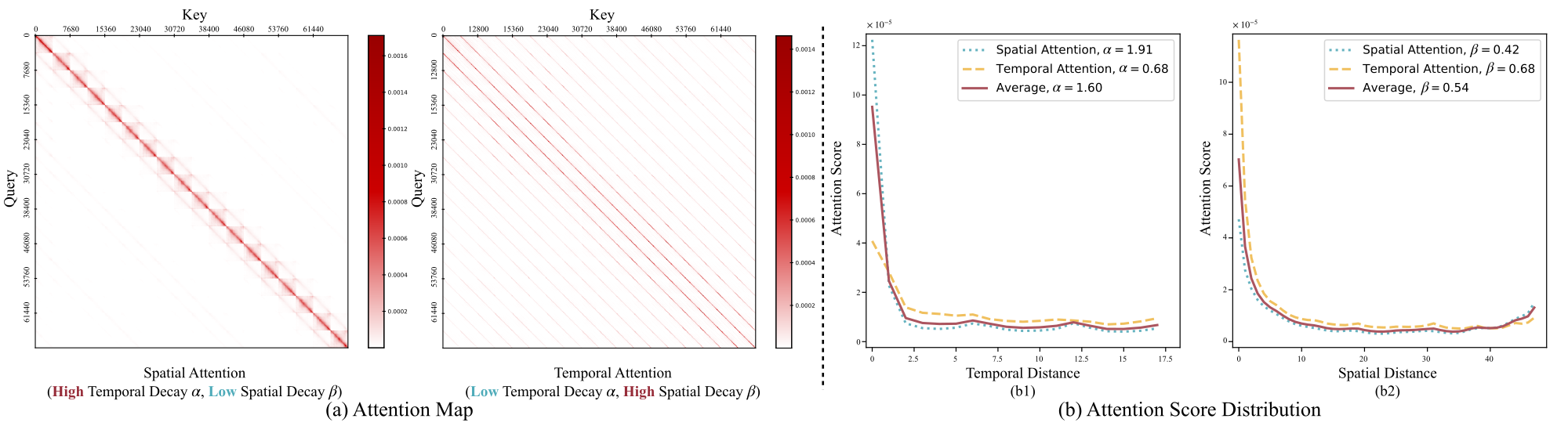
Figure 3 解读:(a) 展示了 HunyuanVideo 的两种 post-softmax attention map:左侧是 spatial attention(高 temporal decay alpha,低 spatial decay beta),每个 token 主要关注相邻帧的邻近位置;右侧是 temporal attention(低 temporal decay,高 spatial decay),每个 token 主要关注跨帧的相同空间位置。(b) 定量展示了 decay 分布:(b1) 随 temporal distance 增大,相同空间位置的平均 attention score 下降;(b2) 随 spatial distance 增大,同帧内的平均 attention score 下降。红色虚线为指数函数拟合,R^2 > 0.985,验证了指数衰减假设。
3.2 Radial Attention Mask 构建
Radial Attention mask 的构建包含两个维度的 decay:
Temporal Density Decay
沿时间维度,frame i 到 frame j 之间的计算密度为:
这形成了 2*ceil(log2(max(f,2))) - 1 个 band 的结构,以主对角线(band 0)为中心。Band 0 保持 100% 计算密度,每向外一层 band 宽度翻倍但密度减半。
Spatial Density Decay
在每个 frame-to-frame attention block 内部,attention 集中在空间位置相似的 token 上,形成对角线结构。随着帧间距离增大,对角线的宽度缩小:
当宽度小于 1 时,不再缩窄对角线,而是降低对角线的采样频率。
形式化定义
4D attention mask 的构建规则:
此外还加入 attention sink(第一帧保持全连接)以提升质量。
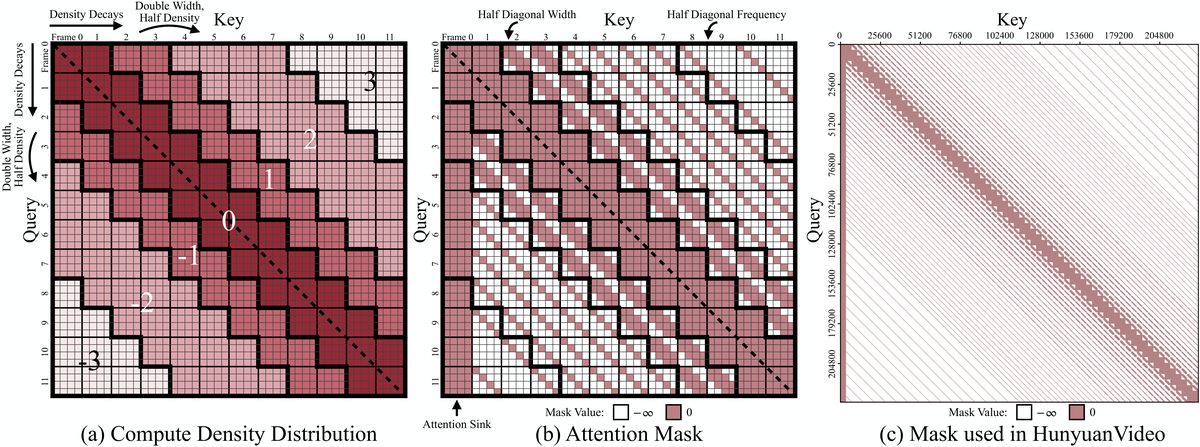
Figure 4 解读:(a) Compute Density 分布图:以 12 帧为例,中心 band 保持 100% 密度(最深红色),向外每层 band 宽度翻倍、密度减半(颜色逐渐变浅),形成”辐射状”衰减——这正是 Radial Attention 名称的由来。(b) 对应的 Attention Mask:白色为 0(允许 attend),红色为 -inf(masked)。可以看到中心 band 的 frame-to-frame block 有宽对角线,外层 band 对角线变窄且采样变稀疏。底部有 attention sink。(c) 实际在 HunyuanVideo 上使用的 253 帧 720p 视频的完整 mask,展示了大规模场景下 mask 的稀疏性。
3.3 复杂度分析
Mask 中零元素(允许计算的 token pair)数量的上界为:
对于长视频(f 很大,s 固定),复杂度为 O(n log n),其中 n = f * s。
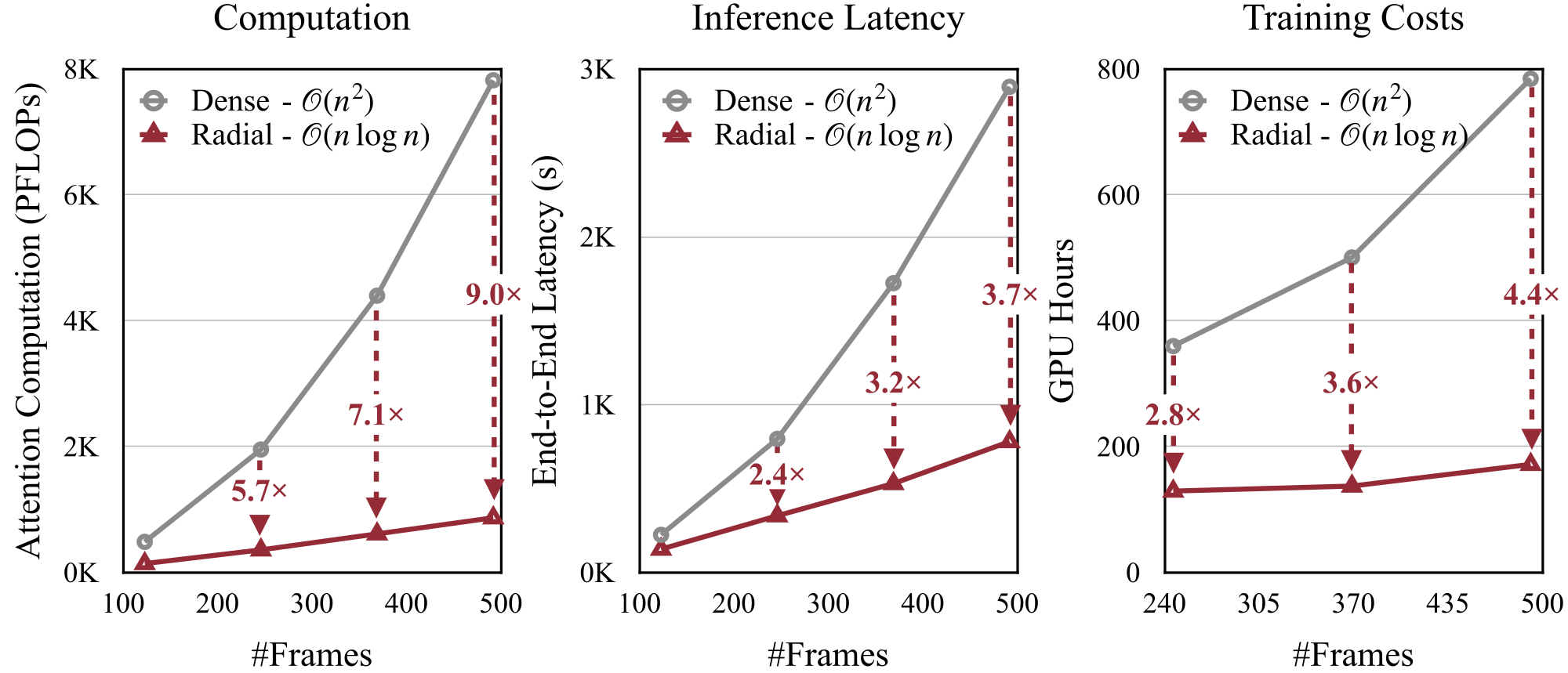
Figure 5 解读:三组图分别展示 Computation(PFLOPs)、Inference Latency(秒)、Training Costs(GPU hours)随帧数的增长趋势。Dense attention 为 O(n^2)(红色),Radial Attention 为 O(n log n)(蓝色)。在 509 帧 720p 视频上,Radial Attention 将 attention 计算量减少 9x,推理加速 3.7x,训练成本节省 4.4x。
3.4 Error Analysis
近似误差的 L1 bound 为:
误差随 alpha 和 beta 的增大指数衰减。实验中 Radial Attention 的 attention output MSE 为 3.9e-3,低于 SVG 的 4.4e-3 和 STA 的 1.5e-2。
3.5 LoRA-based Long Video Adaptation
Radial Attention 保留了 softmax attention 的基本结构,因此 pre-trained weights 大部分可以复用。通过在 Q, K, V, O projection 上加 LoRA adapter 进行轻量微调,即可适配更长视频。经验上 LoRA fine-tuning + Radial Attention 的效果甚至优于 full fine-tuning + dense attention。
Pseudocode
Radial Attention Mask 生成
def gen_radial_mask(num_frames, tokens_per_frame, block_size=128):
    """生成 Radial Attention 的 block-sparse mask"""
    n_blocks = (num_frames * tokens_per_frame) // block_size
    mask = zeros(n_blocks, n_blocks, dtype=bool)

    for i in range(num_frames):
        for j in range(num_frames):
            dist = abs(i - j)

            # Attention sink: 第一帧保持全连接
            if j == 0:
                local_mask = ones(tokens_per_frame, tokens_per_frame)
            else:
                # Temporal density decay: window width 随距离指数缩小
                group = bit_length(dist)  # = floor(log2(dist)) + 1
                window_width = tokens_per_frame // (2 ** group)
                window_width = max(window_width, block_size)

                # Spatial decay: 对角线 window
                local_mask = |col - row| <= window_width

                # 当 window_width < block_size 时,降低采样频率
                if window_width < block_size:
                    split_factor = block_size // window_width
                    if dist % split_factor != 0:
                        local_mask = zeros(...)  # 跳过此 frame pair

            # Shrink to block-level mask
            block_mask = shrink_to_blocks(local_mask, block_size)

            # 写入最终 mask
            mask[i_block_start:i_block_end, j_block_start:j_block_end] |= block_mask

    return mask
Radial Attention 推理
def radial_attention(Q, K, V, mask_map, block_size=128):
    """
    Q, K, V: [batch, seq_len, num_heads, head_dim]
    mask_map: 预计算的 MaskMap 对象
    """
    # Step 1: 获取 block-sparse mask(首次调用时生成并缓存)
    video_mask = mask_map.query_log_mask(Q, sparse_type="radial")

    # Step 2: 转换为 BSR (Block Sparse Row) 格式
    indptr = get_indptr_from_mask(video_mask, Q)   # [num_blocks + 1]
    indices = get_indices_from_mask(video_mask, Q)  # [nnz_blocks]

    # Step 3: 使用 FlashInfer BlockSparseAttention 执行
    bsr_wrapper = flashinfer.BlockSparseAttentionWrapper(workspace)
    bsr_wrapper.plan(indptr, indices, M, N, R=128, C=128, ...)

    # Video tokens: block-sparse attention
    output_video = bsr_wrapper.run(Q_video, K_video, V_video)

    # Text tokens: dense attention (text 部分 token 少,无需稀疏化)
    output_text = flashinfer.prefill(Q_text, K_all, V_all)

    return concat(output_video, output_text)
代码映射 (Code Mapping)
| 论文概念 | 代码文件 | 关键函数/类 |
|---|---|---|
| Radial Attention mask 生成 | radial_attn/attn_mask.py | gen_log_mask_shrinked() |
| Temporal density decay | radial_attn/attn_mask.py | get_window_width() |
| Spatial diagonal + frequency sampling | radial_attn/attn_mask.py | get_diagonal_split_mask() |
| Block-level mask 压缩 | radial_attn/attn_mask.py | shrinkMaskStrict() |
| Mask 缓存管理 | radial_attn/attn_mask.py | MaskMap class |
| FlashInfer BSR attention backend | radial_attn/attn_mask.py | FlashInferBackend() |
| SageAttention sparse backend | radial_attn/attn_mask.py | SpargeSageAttnBackend() |
| 统一入口 | radial_attn/attn_mask.py | RadialAttention() |
| HunyuanVideo 集成 | radial_attn/models/hunyuan/ | 模型适配代码 |
| Wan2.1 集成 | radial_attn/models/wan/ | 模型适配代码 |
核心代码逻辑(attn_mask.py中的关键片段):
get_window_width — 计算 frame i 到 frame j 的 spatial diagonal width:
def get_window_width(i, j, token_per_frame, sparse_type, num_frame, decay_factor=1, block_size=128, model_type=None):
    dist = abs(i - j)
    if dist <= 1:
        return token_per_frame  # 相邻帧保持全宽度
    group = dist.bit_length()   # floor(log2(dist)) + 1
    decay_length = 2 ** token_per_frame.bit_length() / 2 ** group * decay_factor
    return max(decay_length, block_size)  # 不低于 block_size
get_diagonal_split_mask — 当 window width 低于 block_size 时通过降低采样频率实现进一步稀疏化:
def get_diagonal_split_mask(i, j, token_per_frame, sparse_type, query):
    dist = abs(i - j)
    group = dist.bit_length()
    decay_length = 2 ** token_per_frame.bit_length() / 2 ** group
    if decay_length >= 128:  # threshold = block_size
        return ones(token_per_frame, token_per_frame)
    split_factor = int(128 / decay_length)
    if dist % split_factor == 0:
        return ones(...)  # 保留此 frame pair
    else:
        return zeros(...)  # 跳过此 frame pair
4. Experimental Setup (实验设置)
模型
| Model | Parameters | Resolution | Default Length |
|---|---|---|---|
| Mochi 1 | 10B | 480p | 5s, 162 frames |
| HunyuanVideo | 13B | 720p (768x1280) | 5s, 117/125 frames |
| Wan2.1-14B | 14B | 720p | 5s, 69/81 frames |
评估指标
- Vision Reward:近似人类评分(越高越好)
- PSNR / SSIM / LPIPS:与 original model output 的数值/感知相似度
- VBench-long:Subject Consistency, Aesthetic Quality, Image Quality
Baselines
- SVG(动态 spatial/temporal mask)
- STA(sliding tile attention,使用 FlashAttention-3)
- PowerAttention(power-of-two 距离 sparse attention)
- LongLoRA(shifted local attention)
- SANA(linear attention)
- RIFLEx(RoPE frequency 调整)
- Full fine-tuning with dense attention
实现细节
- 推理 backend: FlashInfer(BSR block-sparse attention)
- 训练 backend: FlashAttention-2
- Block size: 128 x 128
- 第一个 DiT block 保持 dense attention(质量考虑)
- 前 12 步 warmup 使用 dense attention
- 长视频微调:8x H100 GPU, OpenVid-1M 数据集中采样 2k 高质量视频
- 训练时间:HunyuanVideo 16
21h, Mochi 817h, Wan2.1 15h
5. Experimental Results (实验结果)
5.1 Default Length Inference Acceleration (Table 1)
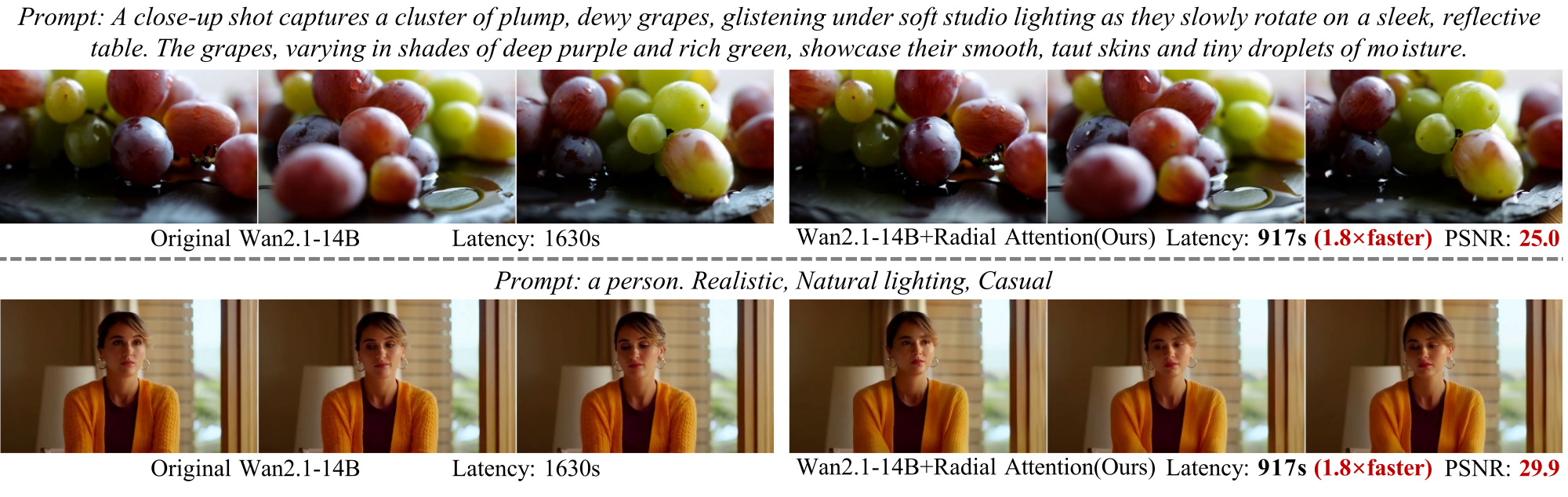
Figure 6 解读:Table 1 展示默认长度下的对比结果。Radial Attention 在相同计算预算下一致地在 PSNR、SSIM、LPIPS 上优于 STA 和 PA,同时匹配 SVG 的视觉保真度。在 HunyuanVideo 上实现 1.88x 加速(876s vs 1649s),在 Wan2.1 上实现 1.77x 加速(917s vs 1630s)。注意 STA 虽然速度稍快(2.29x),但使用了 FA3 而非 FA2,且视觉质量明显下降。
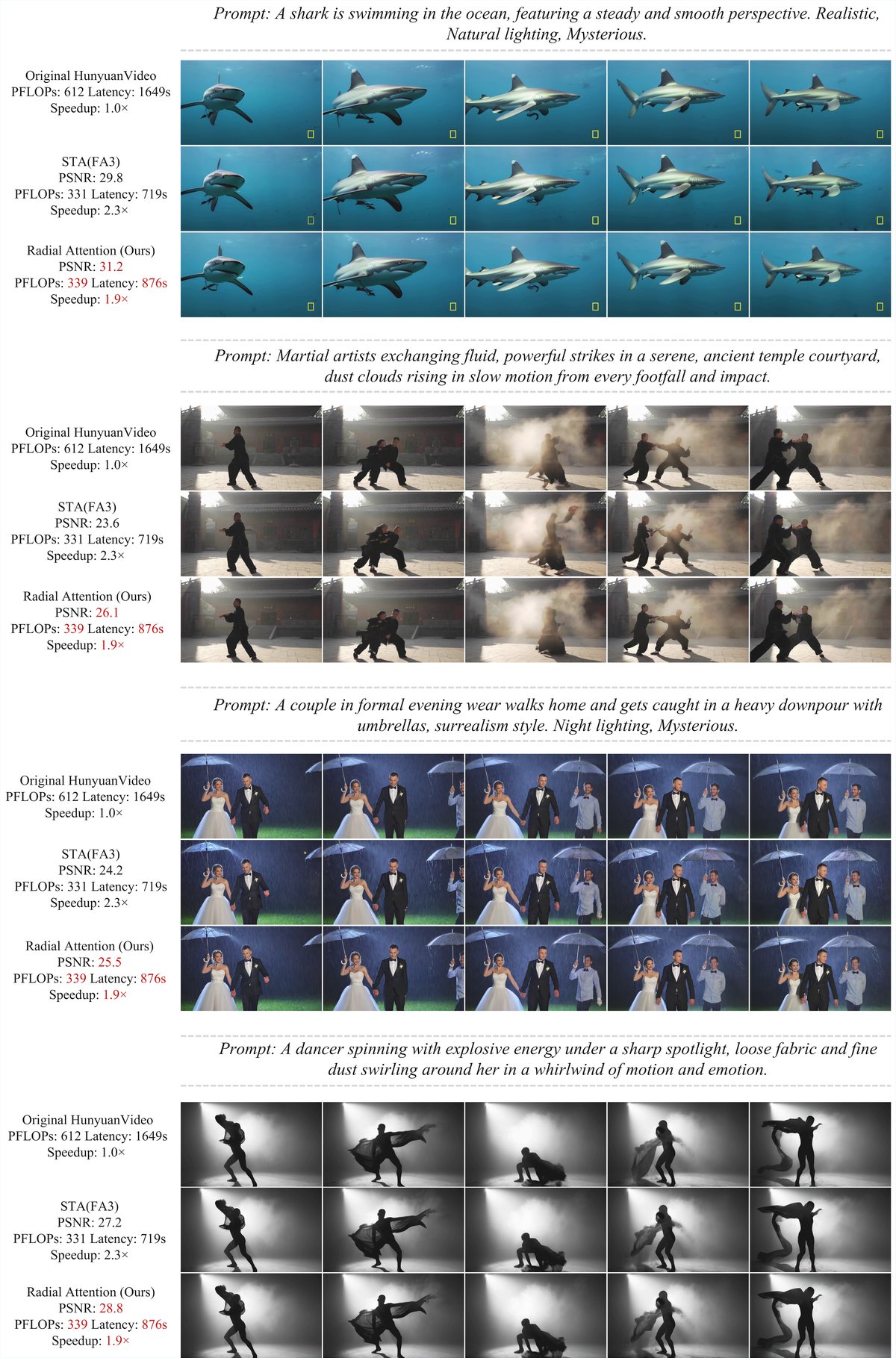
Figure 7 解读:HunyuanVideo 默认长度视觉对比。Radial Attention 在 HunyuanVideo 默认 117 帧上的生成结果与原始模型视觉质量几乎一致,PSNR 达到 27.3,同时延迟从 1649s 降至 876s(1.9x 加速)。
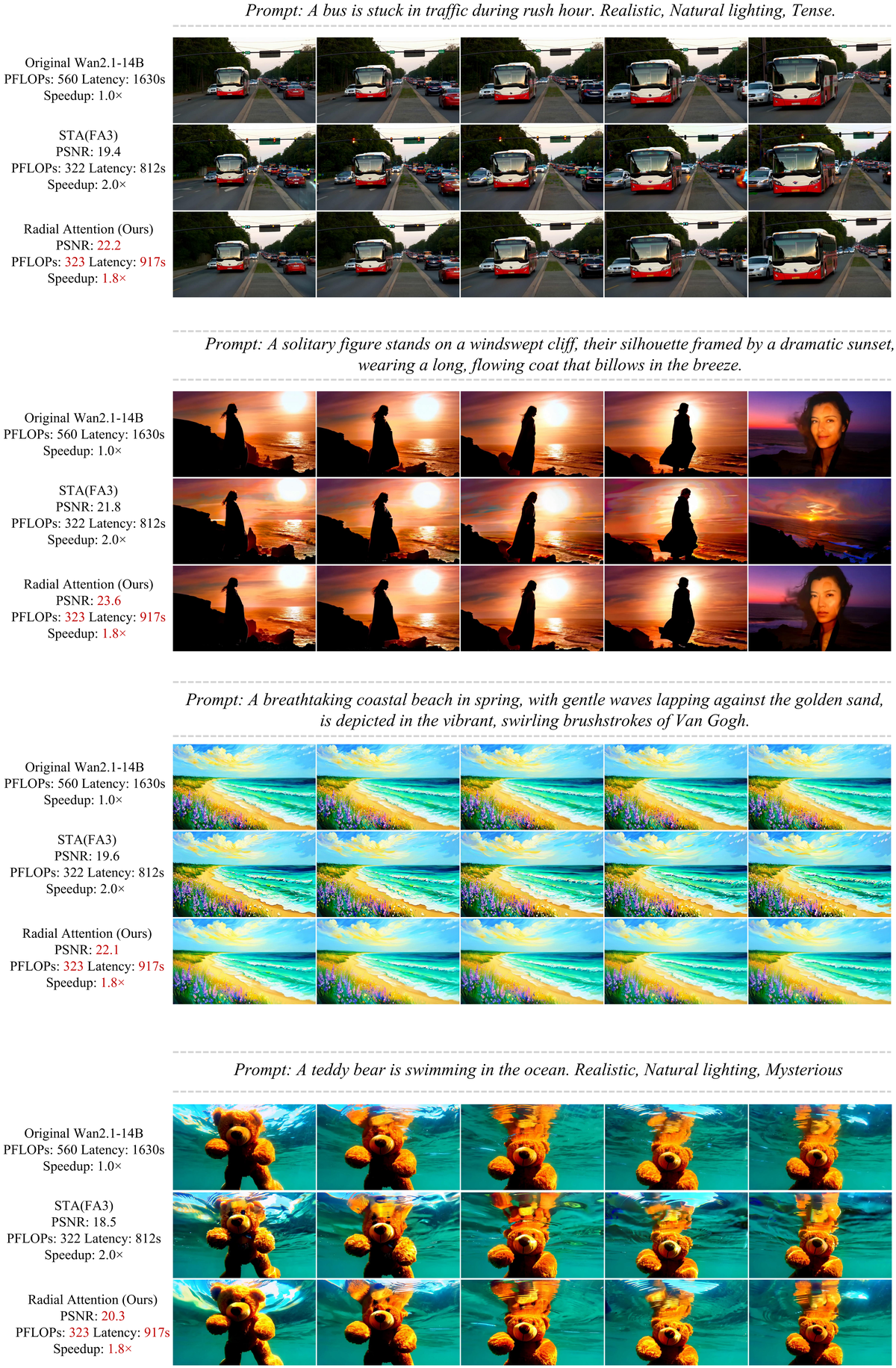
Figure 8 解读:Wan2.1-14B 默认长度视觉对比。Radial Attention 在 Wan2.1-14B 上同样保持了与原始模型高度一致的视觉质量,PSNR 达到 25.0,延迟从 1630s 降至 917s(1.8x 加速)。
| Model | Method | PSNR | SSIM | LPIPS | Vision Reward | Speedup |
|---|---|---|---|---|---|---|
| HunyuanVideo | Original | - | - | - | 0.141 | - |
| STA (FA3) | 26.7 | 0.866 | 0.167 | 0.132 | 2.29x | |
| SVG | 27.2 | 0.895 | 0.114 | 0.144 | 1.90x | |
| Ours | 27.3 | 0.886 | 0.114 | 0.139 | 1.88x | |
| Wan2.1-14B | Original | - | - | - | 0.136 | - |
| STA (FA3) | 22.9 | 0.830 | 0.171 | 0.132 | 2.01x | |
| SVG | 23.2 | 0.825 | 0.202 | 0.114 | 1.71x | |
| Ours | 23.9 | 0.842 | 0.163 | 0.128 | 1.77x |
5.2 Long Video Generation (Table 2)
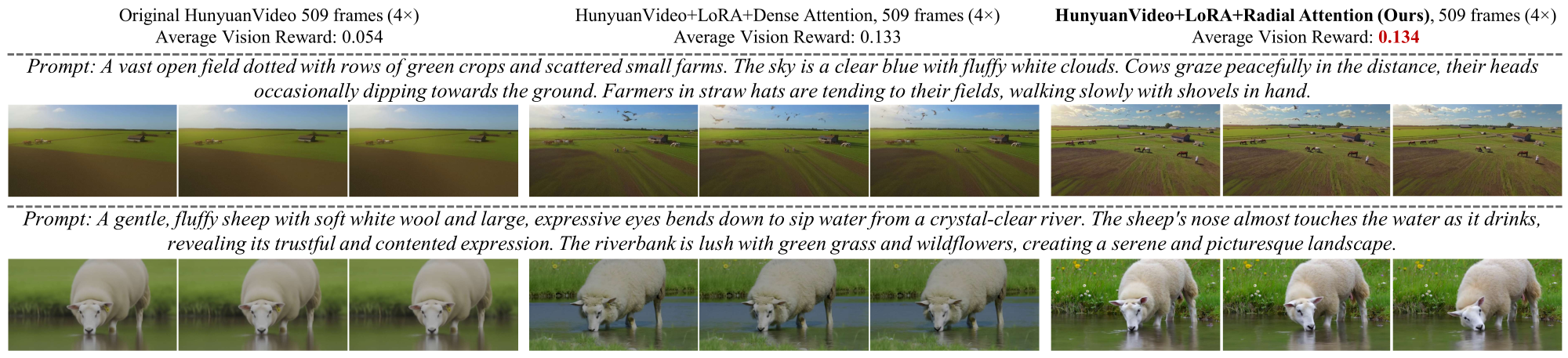
Figure 9 解读:HunyuanVideo 4x 长度扩展(509 帧)的视觉对比。左侧为原始 HunyuanVideo(0.054 Vision Reward),中间为 Dense Attention + LoRA(0.133),右侧为 Radial Attention + LoRA(0.134)。Radial Attention 的 LoRA 微调结果在视觉质量上与 dense attention 相当甚至更优,但训练成本低 4.4x,推理快 3.7x。
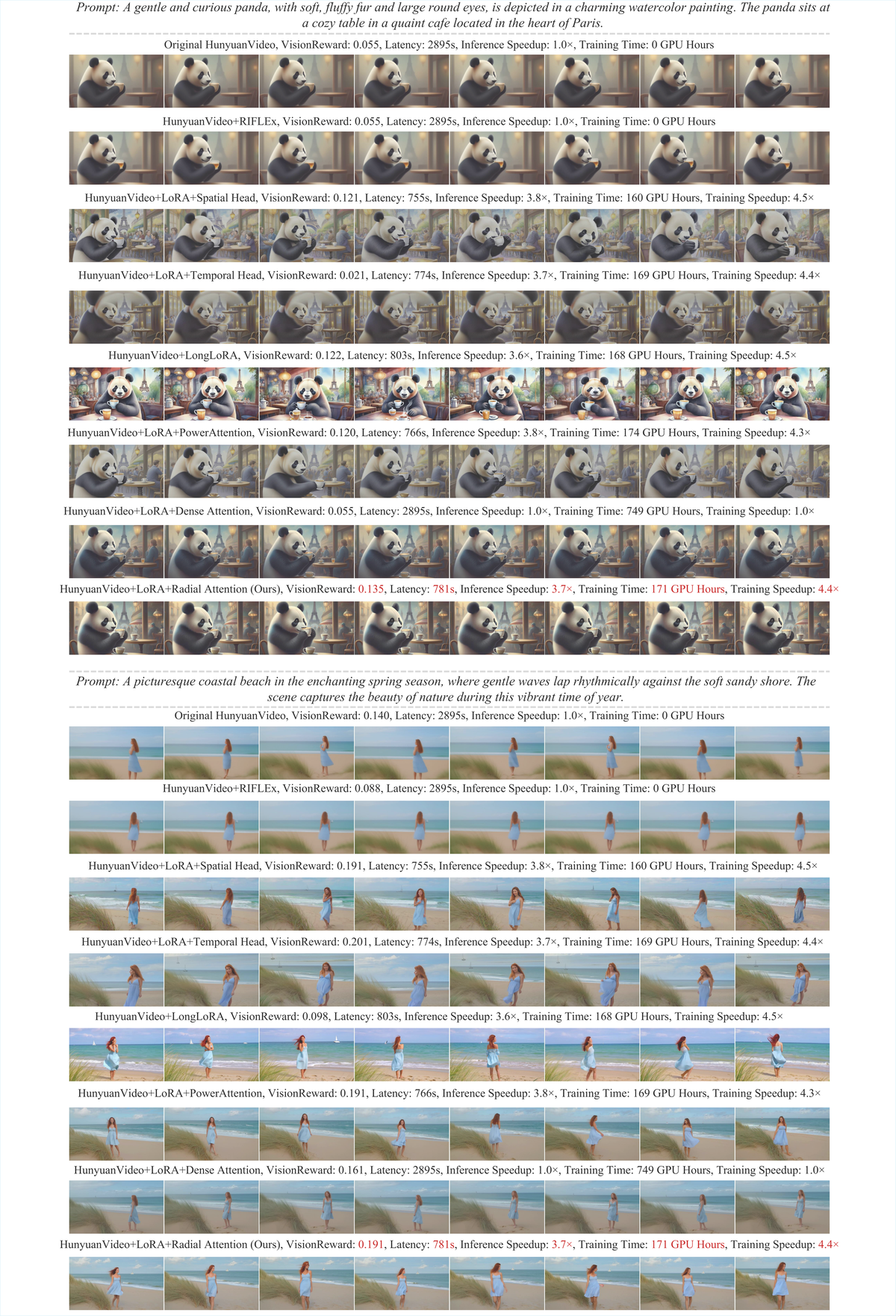
Figure 10 解读:HunyuanVideo 4x 扩展视觉对比。509 帧长视频生成效果。Radial Attention + LoRA 在视觉保真度和运动一致性上与 Dense Attention + LoRA 相当,但训练成本降低 4.4x,推理速度提升 3.7x。
关键结果(HunyuanVideo 4x = 509 帧):
| Method | Sparsity | Training Time (h) | Training Speedup | Inference Speedup | Vision Reward |
|---|---|---|---|---|---|
| Original | 0.0% | - | - | 1.0x | 0.054 |
| Full FT | 0.0% | 93.6 | 1.0x | 1.0x | 0.133 |
| Ours | 88.3% | 16.2 | 2.78x | 3.71x | 0.134 |
Radial Attention 在 4x 长度扩展下达到 88.3% sparsity,推理加速 3.71x,训练加速 2.78x(成本节省 4.37x)。
5.3 Ablation Study
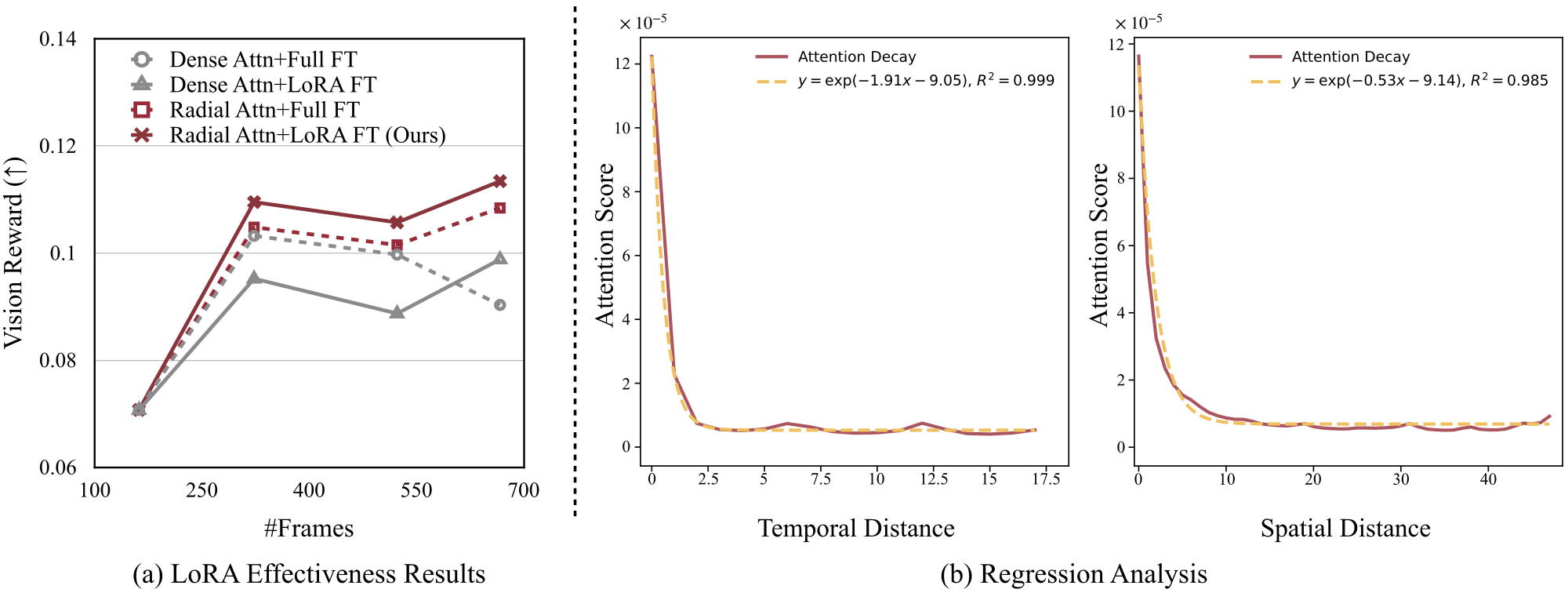
Figure 11 解读:(a) LoRA vs Full FT 的效果对比。Dense attention 下 LoRA 在 4x 长度时明显落后于 Full FT;但 Radial Attention 下 LoRA fine-tuning 反而匹配甚至超越 Full FT,说明 Radial Attention 使得模型更容易通过 LoRA 适配长视频。(b) Regression Analysis:用 y = exp(-ax + b) 拟合 attention score 的衰减曲线,temporal 和 spatial 两个方向的 R^2 均超过 0.985,验证了指数衰减假设。
Attention Error 对比
| Method | Attention MSE |
|---|---|
| Radial Attention | 3.9 x 10^-3 |
| SVG | 4.4 x 10^-3 |
| STA | 1.5 x 10^-2 |
与 Style LoRA 的兼容性

Figure 12 解读:Radial Attention 可以与现有的 style LoRA(如艺术风格迁移)无缝兼容。通过直接 merge Radial Attention 的 length-extension LoRA 和 style LoRA 的权重,可以同时实现长视频生成和风格化,无需额外训练。
其他模型上的结果
Mochi 1:
- 默认长度(163 帧):加速推理至可用
- 2x 扩展(331 帧):Sparsity 76.4%, 推理 1.63x, Vision Reward 0.110(最优)
- 4x 扩展(667 帧):Sparsity 85.5%, 推理 2.57x, Vision Reward 0.113(最优)
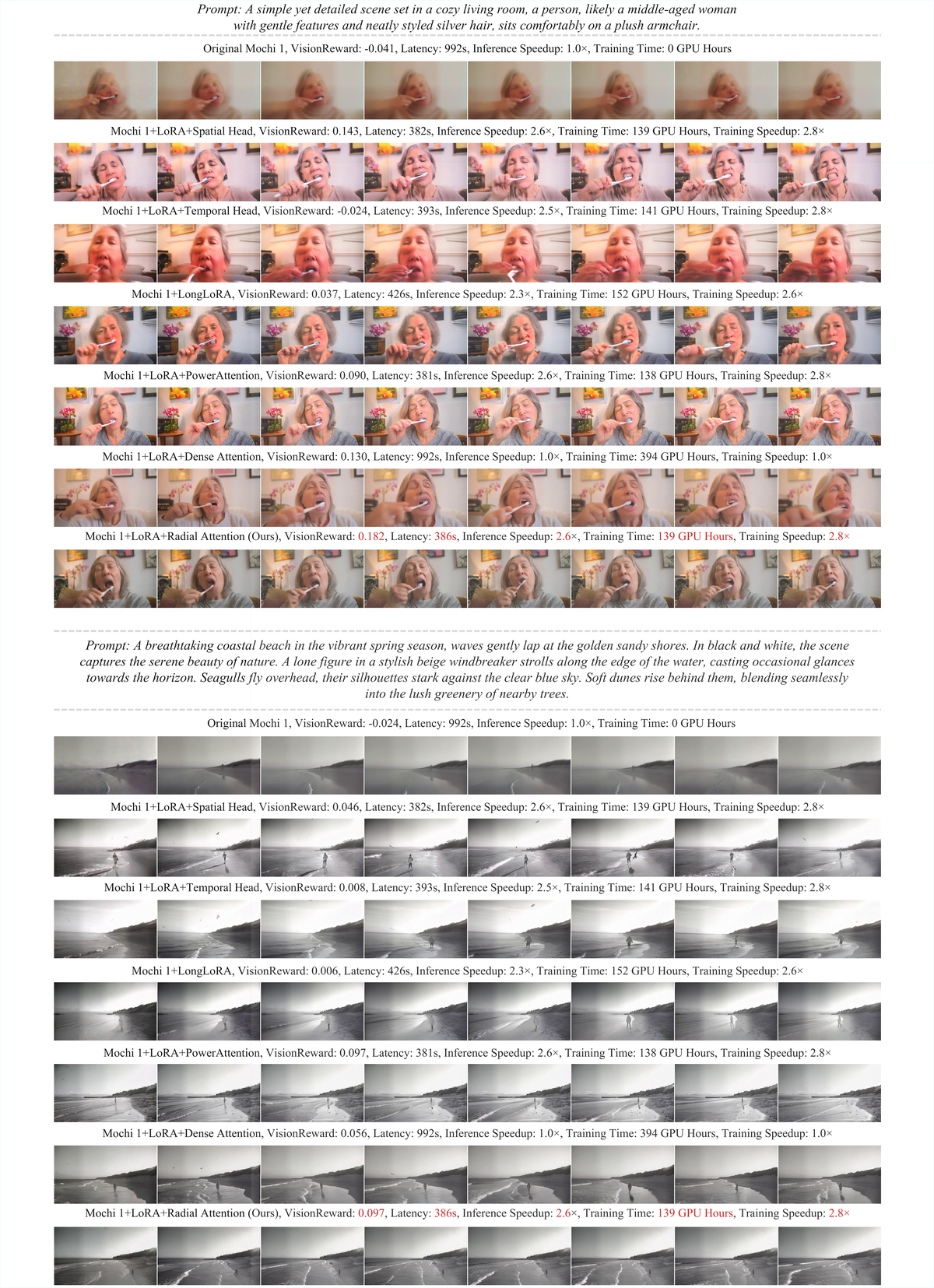
Figure 13 解读:Mochi 1 4x 扩展视觉对比。667 帧长视频生成。Radial Attention 在 Mochi 1 上同样实现了高质量的长视频生成,Vision Reward 达到所有方法中最优的 0.113,推理加速 2.57x。
Wan2.1-14B:
- 2x 扩展(161 帧):Sparsity 73.6%, 推理 2.01x, Vision Reward 0.145(最优)
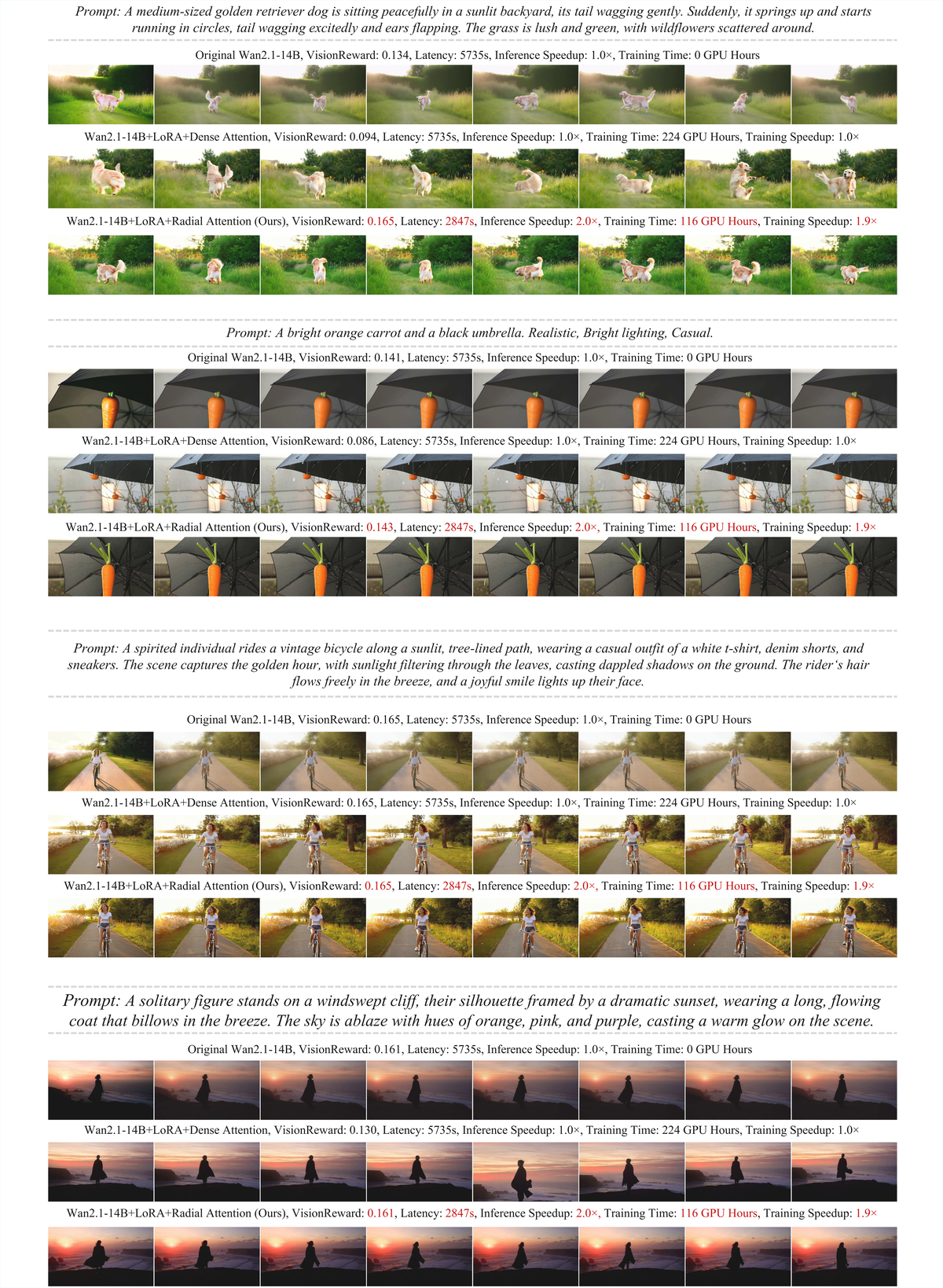
Figure 14 解读:Wan2.1-14B 2x 扩展视觉对比。161 帧长视频生成。Radial Attention + LoRA 以 73.6% sparsity 实现 2.01x 推理加速,Vision Reward 0.145 为所有方法最优。
Limitations
- 假设 attention score 的指数衰减简化了自然视频数据中复杂的时空依赖关系
- 方法对 spatial resolution 仍具有二次复杂度(O(n log n) 中 n = f*s,对 s 的复杂度为 O(s^2))
- 当前实现使用 FA2 backend,升级到 FA3 有望进一步加速