Adam’s Law: Textual Frequency Law on Large Language Models
Paper: arXiv:2604.02176 Code: HongyuanLuke/frequencylaw Code reference:
main@515c88ec(2026-04-14)
1. Motivation (研究动机)
这篇论文要回答一个被 prompt engineering 和数据筛选长期绕开的具体问题:当两个输入是同义 paraphrase、但表达方式的文本频率不同,LLM 更应该看到哪一个?已有工作已经知道 prompt wording 会显著改变输出质量,也知道数据质量、数据量、课程学习顺序会影响训练;但它们通常没有把“同义语义下的文本频率”作为一个可测量变量来研究。
作者的核心假设是:高频表达更接近预训练分布,模型在预训练中见过相似 token/phrase 的概率更高,因此更容易“读懂”并稳定地执行下游任务;低频表达可能包含更复杂、更少见的词汇或结构,语义虽然相同,但会让模型落到更不熟悉的输入区域。这个问题值得研究,因为它同时影响两类常见场景:推理时的 prompt paraphrasing(零训练成本)和 LoRA/SFT 时有限训练预算下的数据选择与排序。
论文因此提出一个 frequency-centric 框架:先定义 Textual Frequency Law (TFL),再用 Textual Frequency Distillation (TFD) 改善闭源模型训练语料不可见时的频率估计,最后用 Curriculum Textual Frequency Training (CTFT) 把频率从“选择哪个 paraphrase”扩展到“训练样本按什么顺序喂给模型”。
2. Idea (核心思想)
核心 insight:在语义保持不变时,文本频率不是表面风格特征,而是模型熟悉度的代理变量;高频 paraphrase 通常让模型获得更低输入 NLL、更稳定的表示与更好的任务输出。它和传统 “easy-to-hard” curriculum 的差别是,TFL 不直接用句法复杂度或长度定义难度,而是用语料频率估计模型对表达方式的熟悉程度。
方法上,论文把一个输入 扩展成多个同义 paraphrase 集合 ,为每个候选估计 sentence-level frequency,然后选择更高频的候选用于 prompting 或 fine-tuning。由于实际 LLM 训练语料往往不可得,论文先用开放在线资源估计频率,再让目标 LLM 对数据做 story completion 生成 ,用这批“模型自己会延展出的语料”调整频率估计。
与 synonym replacement、普通 paraphrase augmentation 或传统 curriculum learning 相比,TFL/TFD/CTFT 的根本区别是:它不是随机替换、更不是把所有 paraphrase 都混进训练;它先把同义表达按频率排序,并在推理和训练中显式偏向高频表达,同时在训练顺序上利用低频到高频的 curriculum。
3. Method (方法)
3.1 总体框架
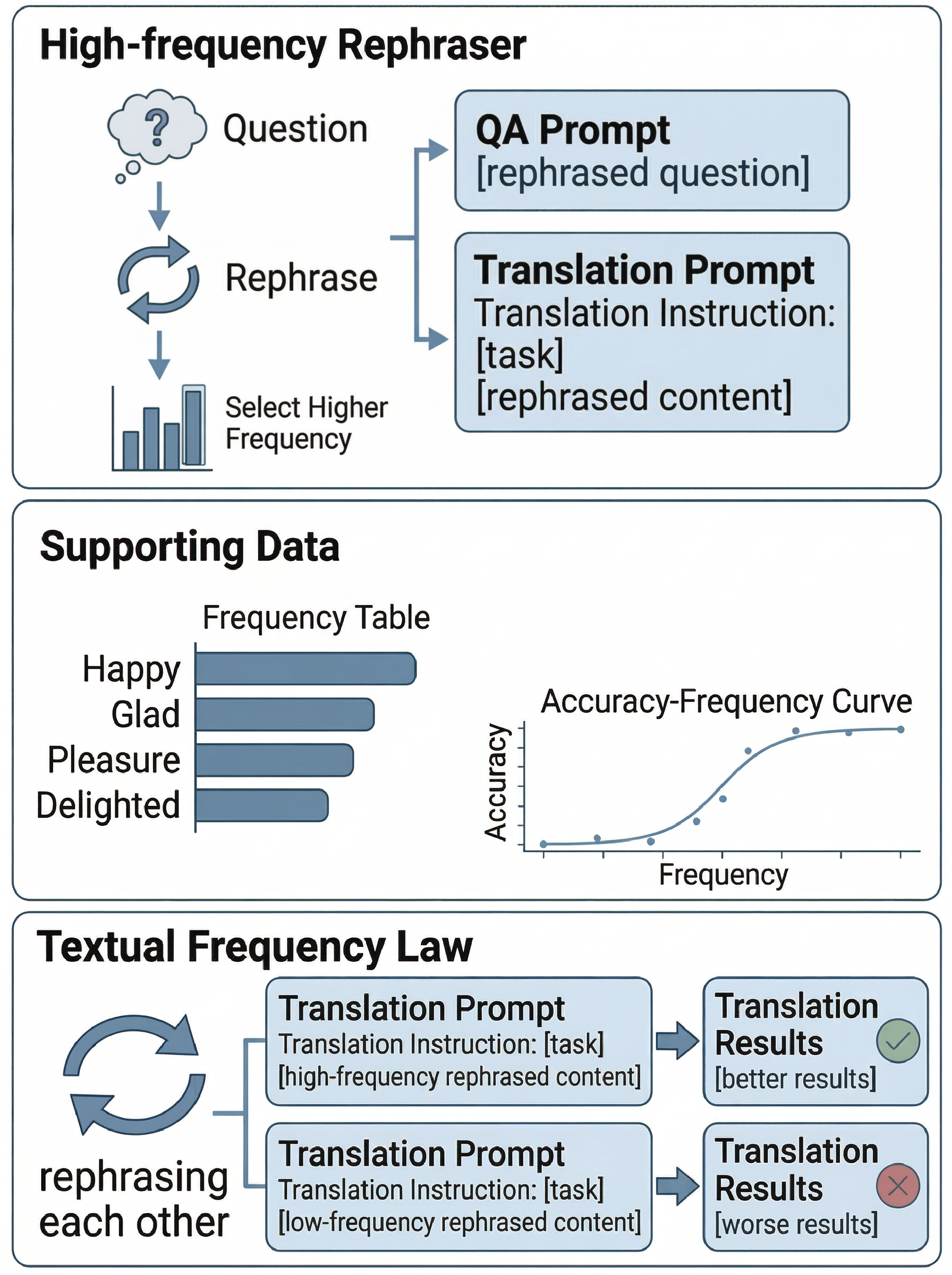
Figure 1 解读:上半部分展示 High-frequency Rephraser:原始 question/input 先被 paraphrase,再从候选表达中选择更高频版本,最后拼入 QA prompt 或 translation prompt。中间部分说明频率来自词级 frequency table 的句级估计;下半部分给出直觉:同义 translation prompt 中,高频版本更容易得到正确 translation results,低频版本更容易失败。
直觉上,这个框架把“模型是否熟悉输入表达”从不可观测变量转成可操作的频率分数。对 prompting,它只改写输入,不改模型;对 fine-tuning,它把同义输入和原始标签配对,让模型在有限 LoRA/SFT 预算内优先学习更贴近预训练分布的表达;对 CTFT,它又利用低频表达的多样性,先训练低频再过渡到高频,使模型既看到困难/多样表达,又最终对高频表达形成稳定映射。
3.2 任务形式化与 TFL
LLM 被写成 instruction + input 到 output 的 autoregressive Seq2Seq:
论文把 instruction 和 actual input 合并记作 。给定同义 paraphrase 集合 ,TFL 选择句级频率最高的表达:
句级频率由词级频率估计。论文正文写为:
论文公式与 released code 实现差异:正文一方面说选择 argmax sfreq,另一方面公式和代码都把分数写成“词频倒数的几何/乘积型分数”;在 released code 中,frequency.py 会把 最大 inverse-frequency score 写入 *_lowfrequency.txt,把 最小 inverse-frequency score 写入 *_highfrequency.txt,即代码实际语义是“score 越小越高频”。因此阅读公式时要把 理解为论文命名上的 frequency score,而复现实验时要遵循代码的 min/max 方向;这是一个需要显式记录的 paper-vs-code gap。
3.3 TFD:用目标 LLM 生成语料修正频率估计
TFD 的动机是:闭源 LLM 的真实训练语料不可见,开放资源只能给出近似频率。论文让 LLM 对现有文本做 story completion:
Please conduct story completion on the following data:
<textual data>
生成语料记为 ,并从中得到第二个频率估计:
设开放资源估计为 ,最终频率为:
其中 是 strengthening factor:当开放语料中某些词频几乎为 0 时,提高 distilled frequency 的作用。released code 里的 newfrequency.py 使用 Brown corpus 与 your_new_generate_file.txt 生成的新语料,先对新旧概率做 scale/align,再把概率合并;MT-SFT/sort_frequency.py 进一步用 unigram/bigram 混合频率(默认 UNIGRAM_WEIGHT=0.6, BIGRAM_WEIGHT=0.4, ALPHA=0.15)计算 sentence score。
3.4 CTFT:频率 curriculum
CTFT 将普通训练集 中每个样本按频率排序:
论文定义的训练顺序是从低 sentence-level frequency 到高 sentence-level frequency。直觉是:低频表达更复杂、更多样,先训练可以让模型覆盖困难输入;随后过渡到高频表达,最终让模型在更熟悉、更稳定的输入分布上收敛。released code 的 MT-SFT/sort_frequency.py 是 CTFT 数据排序的实现入口,但 as released 版本存在一个复现风险:第 153 行引用了未定义变量 freq_dict_low,且输出文件名 *_highTolow_all.json 与论文 “low-to-high” 描述需要人工核对。
3.5 TFPD 数据构造
论文构建 Textual Frequency Paired Dataset (TFPD):用 GPT-4o-mini 对 GSM8K、FLORES-200、CommonsenseQA 等数据生成高频/低频 paraphrase,随后由 3 名英语语言学相关背景标注者检查原句、高频句、低频句是否同义;只有 3 人都认为语义一致的样本被保留。论文正文给出的最终数据规模是:GSM8K 从 1,319 个 test instances 中保留 738 对,FLORES-200 从 1,012 个 dev-test instances 中保留 526 对;表格还列出 CR 为 575 对、TC 为 114 对。
3.6 理论证明要点
附录证明把 TFL 写成“频率更高的 paraphrase 倾向于更低 NLL”。Token-level 假设采用 Zipf law:
理想 self-information 为:
如果模型 marginal probability 与真实 marginal probability 的 log-domain 误差满足 ,则 marginal token NLL 满足:
句级损失分解为:
其中 是 marginal approximation error, 是 marginal-to-conditional contextual discrepancy。对两个同义句 ,若 ,一个充分条件是:
则 。作者也明确说明:从低 NLL 到更好 task performance 不是严格 theorem,而是由实验支持的经验假设。
3.7 Released code 对应关系
Code reference:
main@515c88ec(2026-04-14) — pseudocode and mapping based on this commit
| Paper Concept | Source File | Key Class/Function |
|---|---|---|
| TFL 词频/句频打分 | frequency.py, newfrequency.py | clean_and_tokenize, compute_zipf_frequency, compute_sentence_score |
| 高频/低频 paraphrase 生成 | rephrase.py | process_questions, process_file |
| TFD 新语料合并 | newfrequency.py, MT-SFT/sort_frequency.py | load_and_normalize_corpus, align_and_merge, get_ngram_frequencies |
| TFPD 数据集 | datasets/*.txt, issame.py | 高频/低频文本文件;语义一致性检查脚本 |
| Math Reasoning 推理 | reply_mr.py, get_correct_answer.py, judge.py | GPT-style 请求、答案数字提取、正确性判断 |
| Machine Translation 推理 | reply_mt.py, MT-SFT/runmodel.py | 翻译 prompt、LoRA adapter 推理、生成翻译输出 |
| CTFT 数据排序 | MT-SFT/sort_frequency.py, MT-SFT/merge.py | calculate_weighted_score_new, main, JSON 数据合并 |
实现导向伪代码如下,保留 released code 的关键方向与复现风险:
from collections import Counter, defaultdict
import math
import re
import numpy as np

STOP_WORDS = set()
MIN_FREQ = 1
UNIGRAM_WEIGHT = 0.6
BIGRAM_WEIGHT = 0.4
ALPHA = 0.15

def clean_and_tokenize(text: str, remove_stopwords: bool = True) -> list[str]:
    text = re.sub(r"[^a-zA-Z'-]", " ", text.lower())
    text = re.sub(r"(?<!\w)['-]|['-](?!\w)", "", text)
    words = re.sub(r"\s+", " ", text).strip().split()
    expanded = []
    for word in words:
        expanded.extend([w for w in word.split("-") if w] if "-" in word else [word])
    return [w for w in expanded if (not remove_stopwords or w not in STOP_WORDS)]


def inverse_frequency_score(sentence: str, word_counts: Counter) -> float:
    # frequency.py: smaller score means more frequent in released file naming.
    words = clean_and_tokenize(sentence)
    if not words:
        return 0.0
    inv_freqs = [1.0 / word_counts.get(w, 1) for w in words]
    return float(np.prod(inv_freqs) / len(words))


def split_high_low_paraphrases(paraphrases: list[str], word_counts: Counter) -> tuple[str, str]:
    scored = [(s, inverse_frequency_score(s, word_counts)) for s in paraphrases]
    scored.sort(key=lambda x: x[1])
    high_frequency = next(s for s, _ in scored if len(s) >= 10)       # min inverse score
    low_frequency = next(s for s, _ in reversed(scored) if len(s) >= 10)  # max inverse score
    return high_frequency, low_frequency
def align_and_merge_probabilities(old_probs: dict[str, float], new_probs: dict[str, float], eps: float = 1e-8) -> dict[str, float]:
# newfrequency.py: align model-distilled corpus scale to Brown/open-resource corpus.
common = {w for w in old_probs if w in new_probs and old_probs[w] > 1e-10 and new_probs[w] > 1e-10}
gamma = np.median([(old_probs[w] + eps) / (new_probs[w] + eps) for w in common]) if len(common) > 10 else 1.0
merged = {}
for word in set(old_probs) | set(new_probs):
p_old = old_probs.get(word, eps)
p_new = new_probs.get(word, eps) * gamma
merged[word] = p_old * p_new # released code uses product, not beta-weighted sum.
total = sum(merged.values()) or 1.0
return {w: p / total for w, p in merged.items()}
def tfd_sentence_score(sentence: str, probs: dict[str, float], eps: float = 1e-8) -> float:
words = clean_and_tokenize(sentence)
if not words:
return 0.0
return float(np.exp(np.mean(np.log([1.0 / probs.get(w, eps) for w in words]))))def weighted_ngram_score(sentence: str, freq_dict: dict) -> float:
# MT-SFT/sort_frequency.py: larger combined score means higher observed unigram/bigram frequency.
words = clean_and_tokenize(sentence)
bigrams = list(zip(words, words[1:]))
uni = [freq_dict["unigram"].get(w, MIN_FREQ) for w in words]
bi = [freq_dict["bigram"].get(b, MIN_FREQ) for b in bigrams] or [MIN_FREQ]
uni_score = math.exp(sum(math.log(x) for x in uni) / len(uni)) if uni else MIN_FREQ
bi_score = math.exp(sum(math.log(x) for x in bi) / len(bi))
return (uni_score ** UNIGRAM_WEIGHT) * (bi_score ** BIGRAM_WEIGHT)
def build_ctft_epoch(entries: list[dict], freq_dict: dict) -> list[dict]:
# Paper CTFT: train from lower sentence-level frequency to higher frequency.
# As released, sort_frequency.py has an undefined freq_dict_low variable near final sorting,
# so this is the intended low-to-high curriculum rather than a guaranteed runnable script path.
return sorted(entries, key=lambda e: weighted_ngram_score(e["input"], freq_dict))4. Experimental Setup (实验设置)
4.1 数据集与任务
论文覆盖四类任务:Math Reasoning (MR)、Machine Translation (MT)、Commonsense Reasoning (CR)、Tool Calling (TC)。TFPD 表格给出的 paired data 规模为:MR 738 对、MT 526 对、CR 575 对、TC 114 对;正文还说明 GSM8K 从 1,319 个原始 test instances 保留 738 对,FLORES-200 从 1,012 个 dev-test instances 保留 526 对。MT prompting 随机选取 FLORES-200 的 100 种语言,其中按 Joshi et al. 语言资源分类,class 0/1 合计 62 种(16 + 46),超过一半是低资源语言;CTFT fine-tuning 只使用 Kabuverdianu (kea_Latn)、Kikuyu (kik_Latn)、Pangasinan (pag_Latn) 和 Standard Latvian (lvs_Latn)。
4.2 Baselines 与模型
Prompting 实验使用 GPT-4o-mini、DeepSeek-V3、doubao-1.5-pro-32k、qwen2.5-7b-instruct、Llama-3.3-70B-Instruct 等模型;DeepSeek-V3 被描述为 671B MoE。Fine-tuning 实验全部在 qwen2.5-7b-instruct 上进行,采用 LoRA fine-tuning。对比包含 low-frequency partition、high-frequency partition、synonym replacement baseline、原始 FLORES-200 fine-tuned model、easy-to-hard curriculum(Max Dependency Tree Depth)、high-to-low baseline、只用 LF/HF 或 1/2 LF + 1/2 HF 的 fine-tuning 组合。
4.3 指标
MR 与 CR 使用 accuracy;MT 使用 sacreBLEU 的 chrF 和 BLEU,并使用 COMET wmt22-comet-da 做 neural evaluation。论文给出 chrF 参数 nworder=6, ncorder=6, beta=2,BLEU 使用 ngram=4、权重 (0.25,0.25,0.25,0.25)、method1 smoothing、nltk_word_tokenize tokenizer。COMET 只支持 37/100 种语言。
4.4 Fine-tuning 配置
论文附录 Table np 给出的 fine-tuning 超参为:quantization_bit=4,stage=sft,do_train=true,finetuning_type=lora,lora_target=all,template=qwen,cutoff_len=1024,max_samples=3000,overwrite_cache=true,preprocessing_num_workers=16,logging_steps=10,save_steps=500,per_device_train_batch_size=1,gradient_accumulation_steps=8,learning_rate=1.0e-4,num_train_epochs=10.0,lr_scheduler_type=cosine,warmup_ratio=0.1,bf16=true。
Released code 中没有对应的完整 LLaMA-Factory/YAML launch config,也没有 GPU type/count;MT-SFT/runmodel.py 只给出推理配置:BASE_MODEL_PATH="Qwen2.5-7B-Instruct",LoRA adapter path 示例为 ./saves/qwen-7b/lora/sft_kea_Latn_hightolow,max_length=2048,max_new_tokens=512,temperature=0.7,top_p=0.9,repetition_penalty=1.2,do_sample=True。因此硬件配置与完整训练命令属于“论文未详细说明 / released code 未提供”。
5. Experimental Results (实验结果)
5.1 Prompting:Math Reasoning
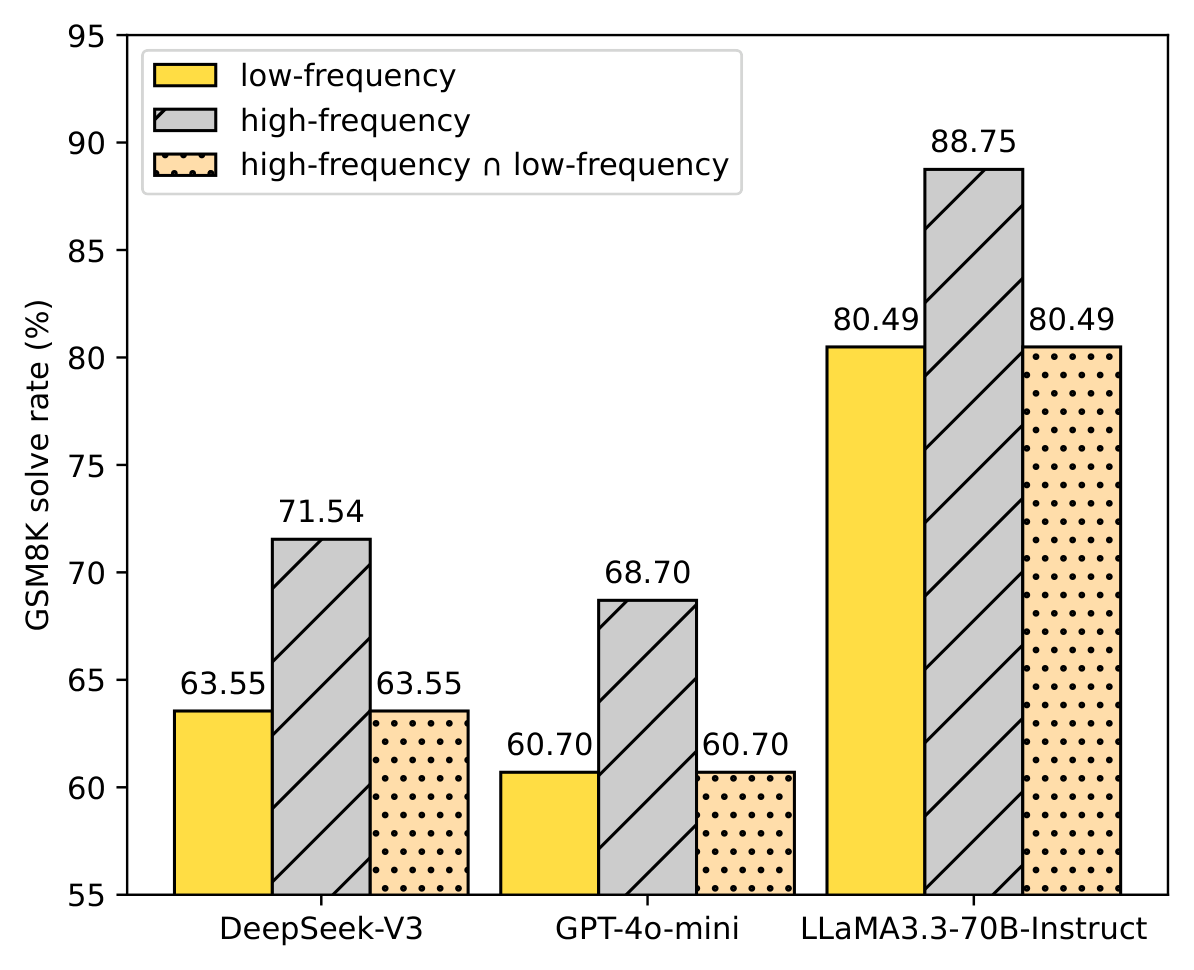
Figure 2 解读:GSM8K 上,高频 paraphrase 在三个模型上都提升 solve rate:DeepSeek-V3 从 63.55% 到 71.54%,GPT-4o-mini 从 60.70% 到 68.70%,Llama-3.3-70B-Instruct 从 80.49% 到 88.75%。图中的 “high-frequency ∩ low-frequency” 与 low-frequency 数值相同,说明作者观察到:低频版本已经做对的样本,高频版本也保持正确;高频主要修复原本低频做错的样本。
附录模型尺度实验显示,qwen-2.5 从 0.5B 到 72B 均满足 high > low:0.5B 为 0.325 vs 0.273,1.5B 为 0.484 vs 0.442,3B 为 0.581 vs 0.528,7B 为 0.671 vs 0.595,14B 为 0.690 vs 0.600,32B 为 0.680 vs 0.612,72B 为 0.686 vs 0.610。CoT 过程质量也提升:chrF 32.873 vs 18.823,ROUGE 0.310 vs 0.175,BERTScore 0.838 vs 0.492。
5.2 Prompting:Machine Translation 与 Commonsense Reasoning
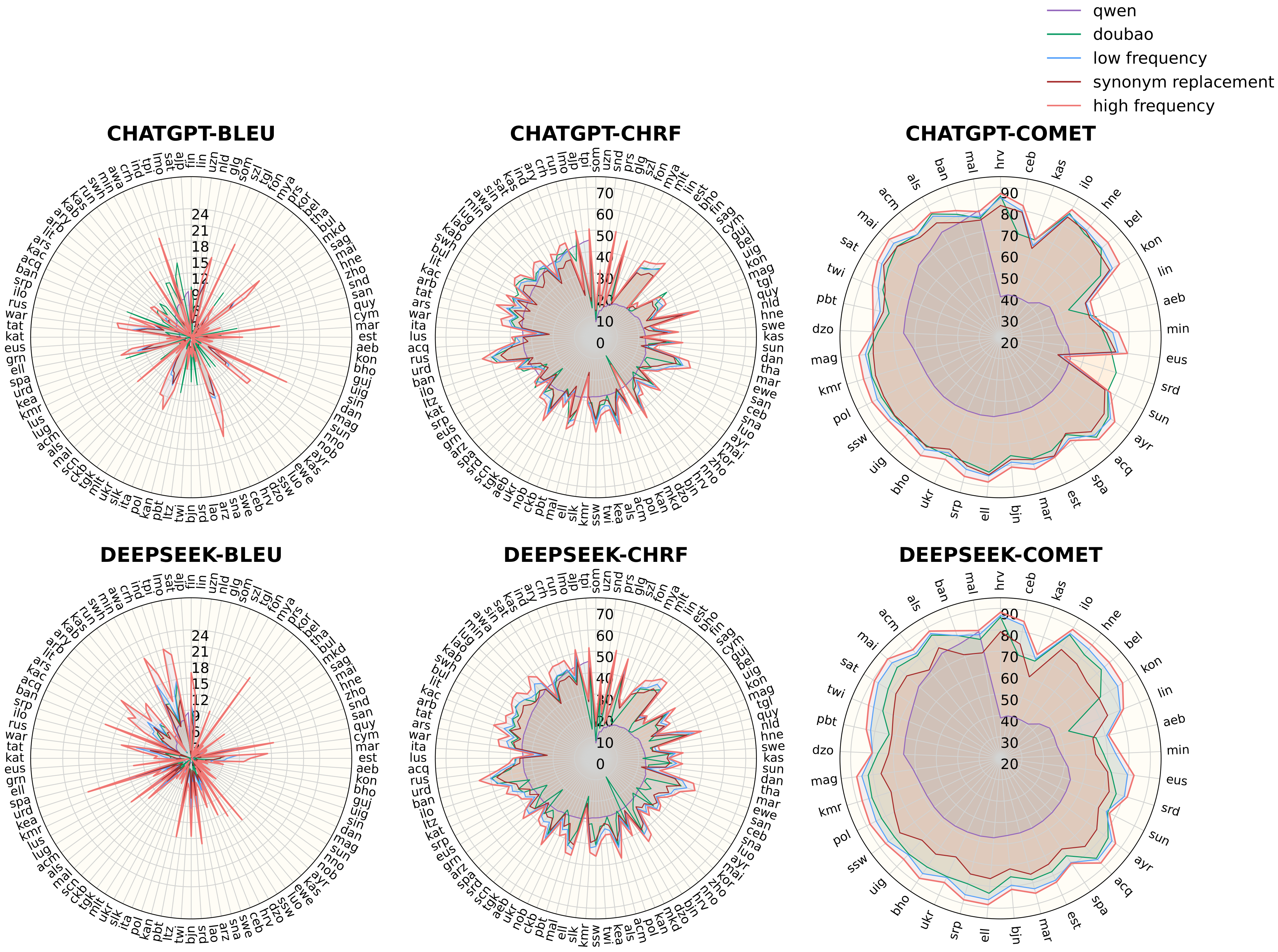
Figure 3 解读:FLORES-200 的 100 语言雷达图按 ChatGPT/DeepSeek 与 BLEU/chrF/COMET 展开;红色 high frequency 曲线在大多数语言和指标上位于 low frequency、synonym replacement、qwen、doubao 等 baseline 外侧。最直观的结论是:简单 synonym replacement 并不能稳定替代 TFL,因为 TFL 选择的是同义候选中频率最高的整体表达,而不是随机局部替换。
MT 汇总表显示:DeepSeek-V3 在 BLEU 上 99/100 种语言提升,其中 63/99 超过 1 pt、31/99 超过 3 pts、12/99 超过 5 pts;GPT-4o-mini 在 BLEU 上 95/100 提升,其中 49/95 超过 1 pt、27/95 超过 3 pts、5/95 超过 5 pts。chrF 上 DeepSeek-V3 为 100/100 提升,GPT-4o-mini 为 91/100 提升;COMET 上 DeepSeek-V3 为 37/37 提升,GPT-4o-mini 为 36/37 提升。所有发生 degradation 的情形都小于 1 point。
CR accuracy 也一致支持 high-frequency partition:GPT-4o-mini 从 0.6747 到 0.6974,DeepSeek-V3 从 0.7043 到 0.7235,Llama-3.3-70B-Instruct 从 0.7530 到 0.7704。
5.3 Fine-tuning:HF + CTFT 最强
Fine-tuning on FLORES-200 translation 的主表显示,FT on HF w/ CTFT 在 4 种语言 × 2 个指标上取得 8/8 最优。关键数值如下:
| Setting | kea BLEU | kik BLEU | pag BLEU | lvs BLEU | kea chrF | kik chrF | pag chrF | lvs chrF |
|---|---|---|---|---|---|---|---|---|
| Fine-tuned original | 4.6772 | 1.2811 | 4.5129 | 4.1954 | 39.3714 | 25.6175 | 34.4672 | 34.0584 |
| FT on LF w/o CTFT | 4.3899 | 1.4223 | 3.9073 | 3.2221 | 39.4022 | 26.2465 | 33.9848 | 33.5538 |
| FT on HF w/o CTFT | 5.2466 | 1.2432 | 3.7781 | 3.9156 | 40.6515 | 26.4975 | 33.4990 | 35.0732 |
| FT on HF w/ CTFT | 5.3992 | 1.6570 | 4.9102 | 4.6027 | 41.6206 | 27.7719 | 36.5285 | 37.0171 |
作者强调三个观察:第一,高频 TFPD fine-tuning 甚至可超过原始 FLORES-200 ground-truth fine-tuning,例如 kea_Latn BLEU 从 4.6772 到 5.2466(+12.17%)。第二,HF 通常优于 LF,1/2 LF + 1/2 HF 也能提高 pag_Latn BLEU,从 3.9073 到 4.4291(+13.35%)。第三,CTFT 进一步把 pag_Latn BLEU 从 HF w/o CTFT 的 3.7781 提升到 4.9102(+29.96%)。
5.4 Ablation:TFD 有用,频率不等价于句法复杂度
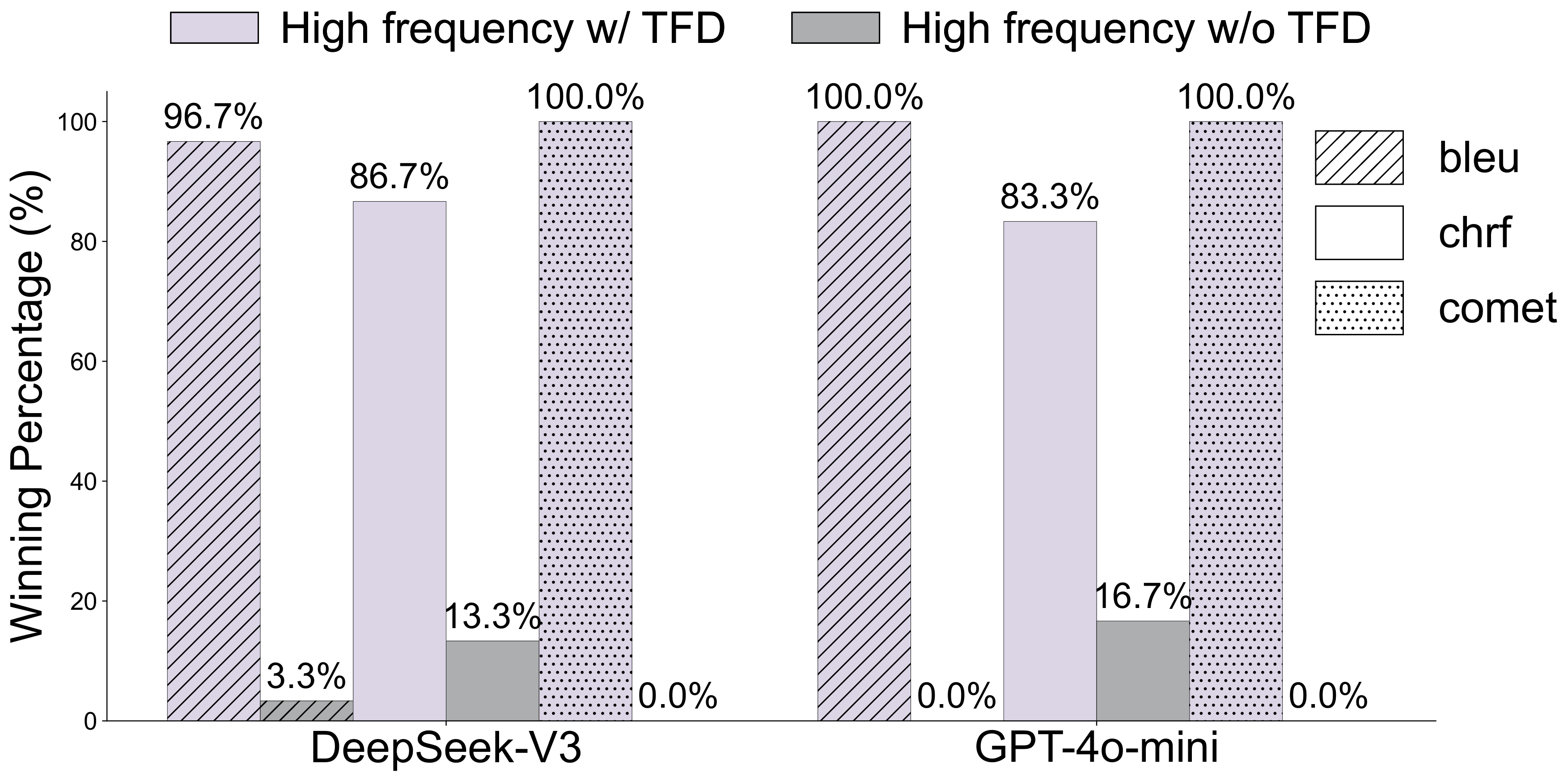
Figure 4 解读:TFD ablation 统计的是 “winning percentage”。DeepSeek-V3 中,High frequency w/ TFD 在 BLEU/chrF/COMET 上分别赢 96.7%、86.7%、100.0%,w/o TFD 仅为 3.3%、13.3%、0.0%;GPT-4o-mini 中,w/ TFD 分别为 100.0%、83.3%、100.0%,w/o TFD 为 0.0%、16.7%、0.0%。这说明用目标 LLM 生成语料修正频率估计确实比只用开放语料更强。
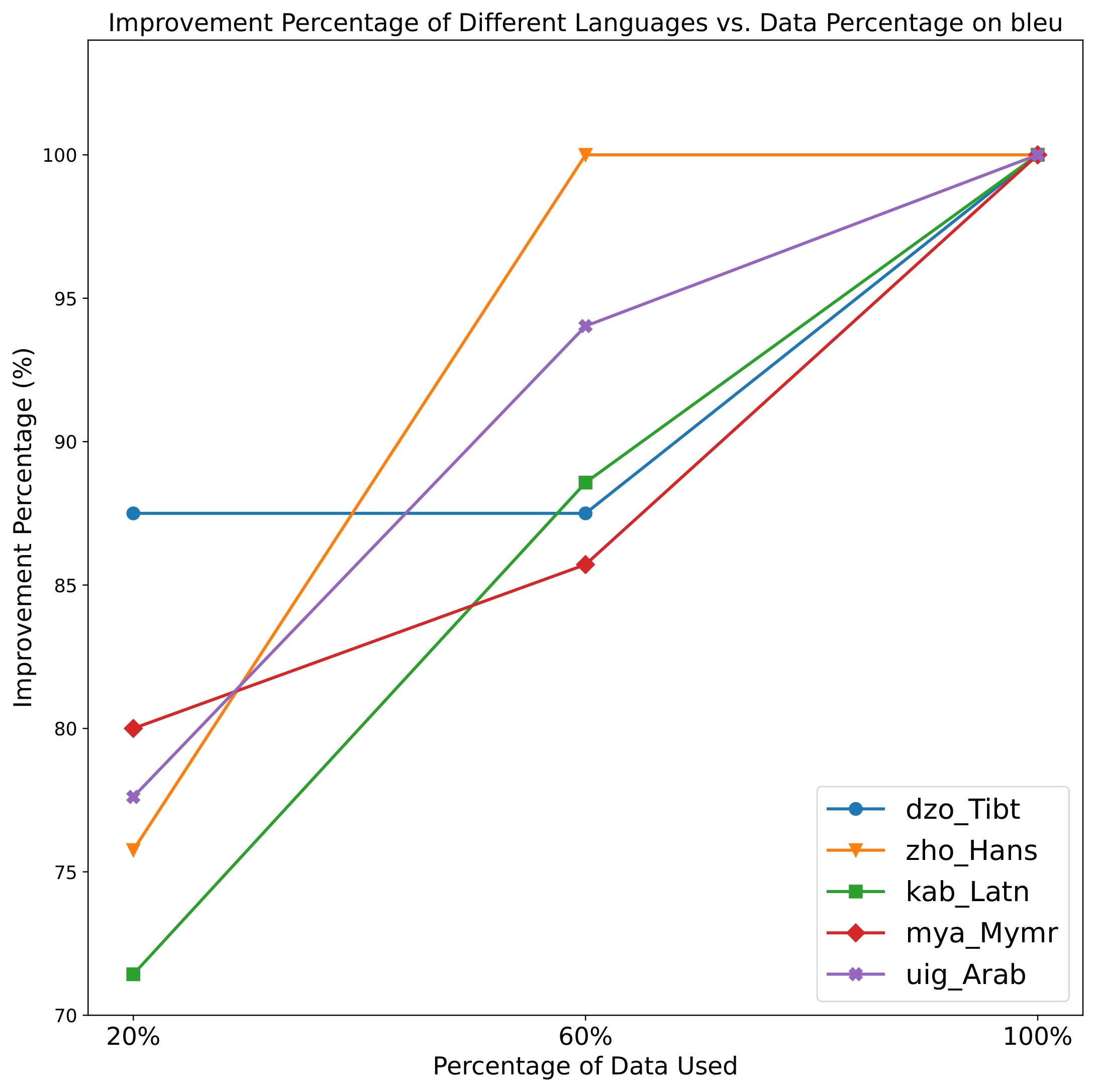
Figure 5 解读:随着 TFD 使用数据比例从 20% 到 60% 再到 100% 增加,多个语言的 BLEU improvement percentage 趋于 100%。图中 zho_Hans 在 60% 已到 100%,dzo_Tibt 在 20%/60% 约 87% 后到 100%,kab_Latn、mya_Mymr、uig_Arab 也在 100% 数据时达到 100%,说明 distilled corpus 越充分,频率估计越可靠。
复杂度分析显示,高频表达和低频表达的句法复杂度相关性很弱:MR 中 Max Dependency Tree Depth 的 Pearson/Spearman 仅 -0.0447/-0.0285,Mean Dependency Distance 为 -0.0086/0.0094,Flesch-Kincaid 为 -0.0799/-0.0545;MT 中三者分别为 -0.2713/-0.2822、-0.1137/-0.1257、-0.1673/-0.1528。因此 TFL 不是传统 easy-to-hard 的改名版。
5.5 Case study、结论与限制
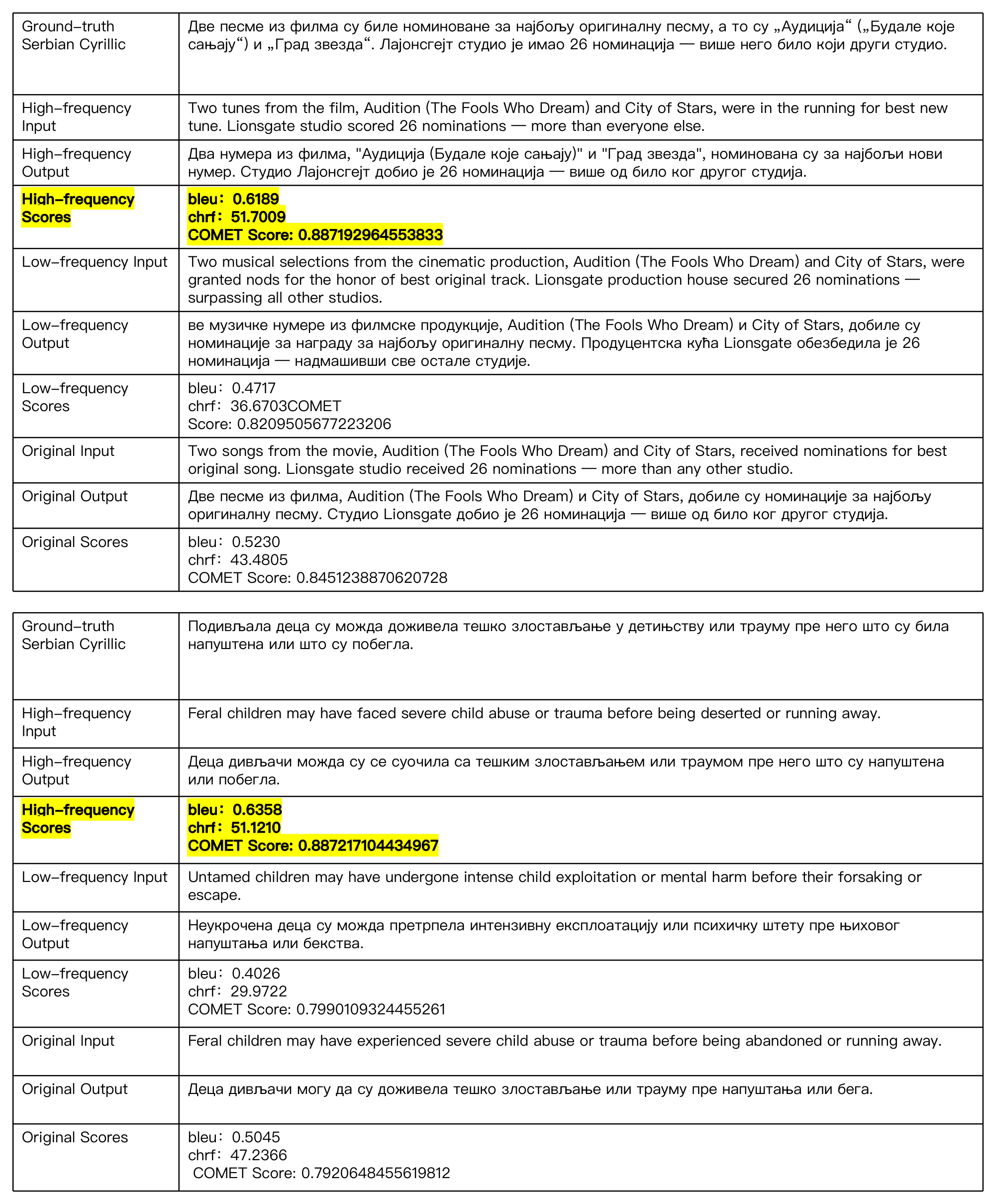
Figure 6 解读:case study 展示同一语义下,高频 input 产生的 Serbian Cyrillic 翻译在 BLEU/chrF/COMET 上高于低频 input 和 original input。例如第一个 case 中,高频输出 BLEU 0.6189、chrF 51.7009、COMET 0.887192964553833;低频输出 BLEU 0.4717、chrF 36.6703、COMET 0.8209505677223206;原始输出 BLEU 0.5230、chrF 43.4805、COMET 0.8451238870620728。
整体结论是:TFL 在 prompting 和 fine-tuning 中都成立得相当稳定;TFD 能提升频率估计质量;CTFT 让高频数据优势进一步转化为 fine-tuned model 的收益。限制也很明确:TFD 需要调用 LLM 做 story completion,因此有额外计算成本;理论证明只严格支撑 frequency 与 NLL ordering,不严格证明 task performance ordering;released code 目前也缺少完整训练 launch config,并存在 CTFT 排序脚本变量未定义/方向需要核对的复现风险。