StreamMem: Query-Agnostic KV Cache Memory for Streaming Video Understanding
Authors: Yanlai Yang, Zhuokai Zhao, Satya Narayan Shukla, Aashu Singh, Shlok Kumar Mishra, Lizhu Zhang, Mengye Ren Affiliations: Meta AI, New York University arXiv: 2508.15717 Project Page: yangyanl.ai/streammem
1. Motivation (研究动机)
StreamMem 关注的是 query-agnostic streaming video understanding。作者指出,长视频理解面临两类同时存在的困难:
- 视觉 token 太多:长视频会产生海量 visual tokens,KV cache 的存储与解码开销非常高;
- 未来问题未知:在真实 streaming / multi-turn QA 场景中,模型在编码视频时通常还不知道未来用户会问什么,因此很多 query-aware 压缩方法并不现实。
现有方案存在明显局限:
- 一类方法要先看完整个视频再压缩;
- 一类方法需要已知 query 才能做重要性筛选;
- streaming 方法里,要么像 ReKV 一样存全部 KV(需要 offloading),要么像某些 FIFO 策略那样直接丢弃旧 KV,容易遗忘早期信息。
因此论文要解决的问题是:能否在完全不知道未来 query 的情况下,仅通过视频本身和系统模板,就对 streaming KV cache 进行高质量的、固定预算的压缩?
2. Idea (核心思想)
StreamMem 的核心想法是:把 chat template tokens 当作通用 proxy query。作者观察到,在 MLLM 预训练中,chat template 往往隐式触发“描述视频内容”的倾向,因此这些模板 token 对视觉 token 的 cross-attention 可以近似反映“通用重要性”。
基于这个观察,作者提出一套 training-free 框架:
- Input Frame Filtering:先在输入层面去除高度相似的邻近帧;
- Attention-based KV Pruning:用 chat template token 对 visual token 的 cross-attention 做 top-k 保留;
- Frame-wise KV Merging:每帧再生成一个 prototype key/value,保留全局摘要;
- YaRN Position Extension:尽量不破坏原本的时空位置信息。
和 query-aware 方法相比,StreamMem 的最大优势是:它不需要等问题出现之后再压缩,也不需要重跑完整视觉上下文。
3. Method (方法)
3.1 Overall framework
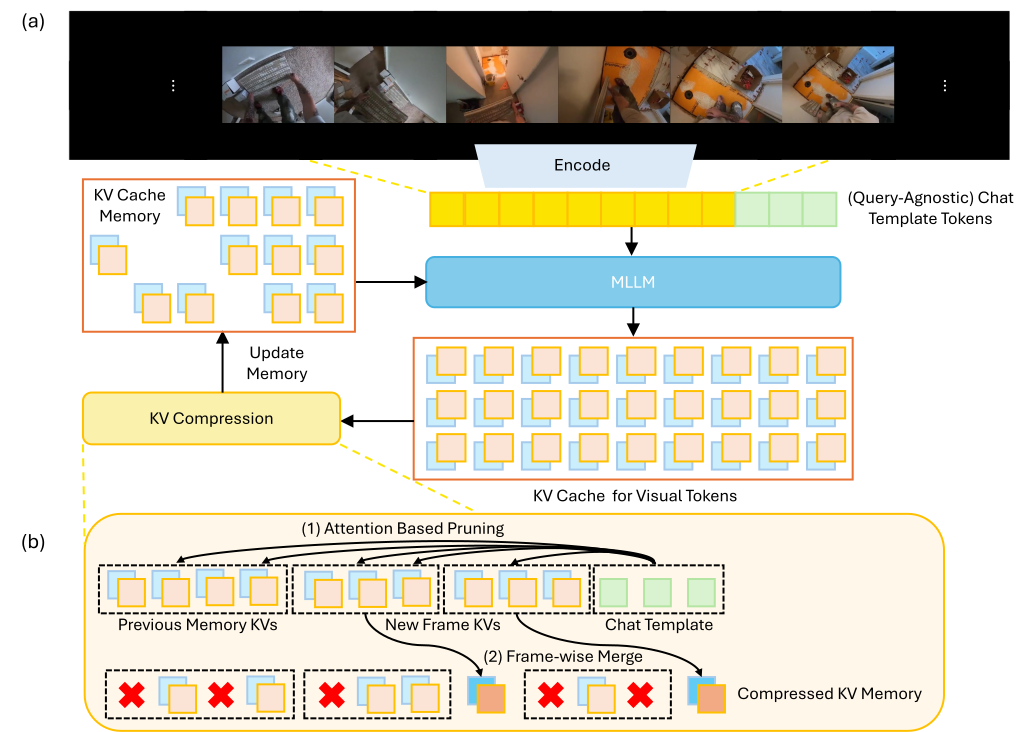
Figure 1 解读: Figure 1(a) 展示了 StreamMem 的整体流程:新到达的视频 clip 先做 frame filtering,再送入 vision encoder 与 MLLM;生成的 KV 与历史 memory 合并后,交给 KV compression 模块更新固定大小的 KV cache memory。Figure 1(b) 展示 compression 细节:一方面用 proxy query attention 做 token pruning,另一方面对每帧做 frame-wise prototype merging,把若干 token 合成更紧凑的帧级摘要。这样既保留 salient local token,也保留 frame-level global signal。
3.2 Input Frame Filtering
作者首先在输入层面做简单但有效的去冗余。对连续帧,先用 vision encoder 提取 embedding,然后计算相邻帧 cosine similarity:
- 如果相似度超过阈值 ,就认为两帧过于冗余;
- 直接对两帧表示做平均合并。
这一步与 LongVU 的 temporal compression 有点相似,但 StreamMem 的目标是为后续 KV cache 节省预算,而不是单纯减少帧数。
3.3 Query-agnostic KV pruning
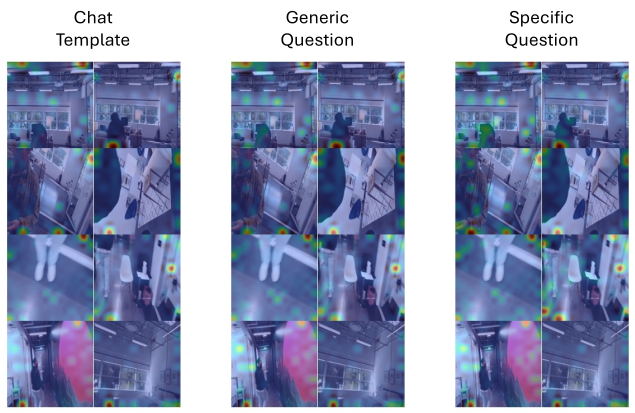
Figure 2 解读: Figure 2 对比了三种 query:chat template、generic question、specific question。可以看到三者关注的视觉区域高度重叠,说明即便没有真实用户问题,仅靠 chat template token,也能让模型聚焦到大体相同的重要区域。这个实验支撑了 StreamMem 最关键的假设:chat template 可以作为 query-agnostic compression 的 proxy query。
具体来说,作者把如下 chat template token 追加到视觉 token 后面:
<|im_end|><|im_start|>assistant\n然后令其 query 表示为 ,当前 clip 第 层的 key 为 ,则 cross-attention 为:
对这些 attention 权重在 query 维度上做聚合后,得到每个 visual token 的 importance score,并保留 top-k token。
作者强调,这种 proxy query 并不是 arbitrary trick,而是利用了 MLLM 在视频 captioning 预训练中的归纳偏好:没有显式问题时,系统往往也会倾向生成一个“视频中发生了什么”的通用描述。
3.4 Frame-wise KV Merging
仅靠 pruning 仍然可能丢掉每帧的整体语义,因此 StreamMem 再额外生成 frame-level prototype。对于第 层第 帧:
其中 是归一化后的 token 重要性。这样每一帧不仅有若干保留下来的显著 token,还有一个 frame-level summary token,兼顾局部细节与全局概括。
3.5 KV cache memory under global budget
作者把压缩后每层的 memory 写成:
并要求满足全局 memory constraint:
这意味着 StreamMem 的目标不是局部最优地压某一层,而是让整个模型在固定总预算下持续更新 memory。
3.6 Positional embedding / YaRN
许多 streaming 方法在压缩后会重新分配保留 token 的位置 ID,这会破坏原有时空位置信息。StreamMem 选择另一条路线:
- 用 YaRN 扩展视觉上下文窗口;
- 尽量保留原始 positional consistency;
- 避免因为简单重排 position 而损伤长视频理解能力。
作者实验表明,合适的 YaRN scaling factor 可以显著提高性能。
3.7 Pseudocode(代码搜索未找到开源实现,以下基于论文描述整理)
代码搜索未找到公开仓库。以下伪代码依据论文
paper.tex中的方法部分整理,而不是作者源码复现。
组件 A:Input frame filtering
# Algorithm: Input frame filtering
# Input: consecutive frames f_1 ... f_T
# Output: filtered frames

def frame_filter(frames, vision_encoder, delta=0.95):
    embeds = [vision_encoder(f) for f in frames]
    kept = [frames[0]]
    for i in range(1, len(frames)):
        sim = cosine_similarity(embeds[i - 1], embeds[i])
        if sim > delta:
            kept[-1] = average_frame(kept[-1], frames[i])
        else:
            kept.append(frames[i])
    return kept
组件 B:Query-agnostic KV pruning
# Algorithm: Query-agnostic KV pruning with chat template
# Input: visual tokens, chat template tokens, keep budget k
# Output: top-k salient visual tokens

def kv_prune(visual_tokens, chat_template_tokens, model, k):
    Q = model.query(chat_template_tokens)
    K, V = model.kv(visual_tokens)
    A = softmax(Q @ K.T / sqrt(d))
    scores = aggregate_over_query_dim(A)
    idx = topk(scores, k)
    return K[idx], V[idx], scores[idx]
组件 C:Frame-wise KV merging
# Algorithm: Frame-wise KV prototype merging
# Input: K_t, V_t, normalized importance alpha
# Output: prototype key and value

def kv_merge(K_t, V_t, alpha):
    K_bar = sum(alpha[j] * K_t[j] for j in range(len(K_t)))
    V_bar = sum(alpha[j] * V_t[j] for j in range(len(V_t)))
    return K_bar, V_bar
组件 D:Streaming memory update
# Algorithm: Streaming video encoding and memory update
# Input: incoming clip, previous compressed memory, memory budget M
# Output: updated fixed-size KV memory

def streammem_step(clip, memory, model, M):
    clip = frame_filter(clip, model.vision_encoder)
    K_t, V_t = model.encode(clip)
    K_keep, V_keep, alpha = kv_prune(K_t, chat_template_tokens(), model, k=M)
    K_proto, V_proto = kv_merge(K_t, V_t, normalize(alpha))
    memory = compress(memory, K_keep, V_keep, K_proto, V_proto, budget=M)
    return memory
3.8 Code-to-paper mapping table
| Paper Concept | Source File | Key Class/Function |
|---|---|---|
| Full method implementation | 未公开 | 代码搜索未找到开源实现 |
| Input frame filtering | 论文 paper.tex | Input Frame Filtering section |
| Query-agnostic KV pruning | 论文 paper.tex | KV Cache Memory section |
| Frame-wise merging | 论文 paper.tex | Eq. (2) |
| Streaming loop | 论文 paper.tex | Algorithm 1 |
4. Experimental Setup (实验设置)
4.1 Benchmarks
作者评测了三类 offline benchmark 和两类 streaming benchmark:
- Offline
- MLVU
- EgoSchema
- VideoMME
- Streaming
- RVS-Ego
- RVS-Movie
4.2 Models
StreamMem 适配了三种开源 MLLM:
- LLaVA-OneVision-7B
- Qwen2-VL-7B
- Qwen2.5-VL-3B
4.3 Main settings
- 视频流默认以 0.5 FPS 处理(follow ReKV)
- 每个视频 clip = 8 frames
- 主要 KV budget:6K
- 所有实验都可以在 单张 A100 GPU 上运行
4.4 Baselines
作者比较了以下强 baseline:
- LiveVLM
- InfiniPot-V
- ReKV(oracle-like upper bound because full KV cache)
- MovieChat+
- Dispider
- LongVU
5. Experimental Results (实验结果)
5.1 Offline long-video understanding
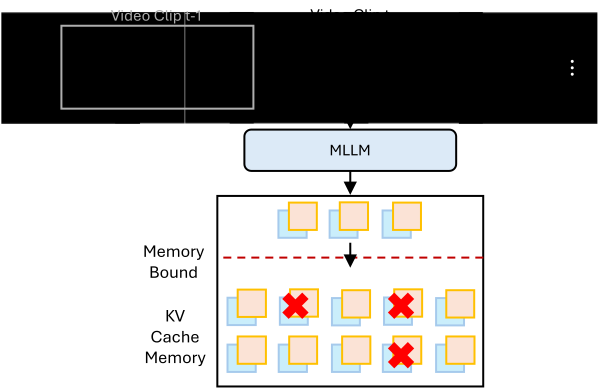
Figure 3 解读: Figure 3 用概念图说明 StreamMem 的应用场景:在固定 memory bound 下,模型不断接收新 clip,并持续压缩 KV cache memory,而不是无限存储所有历史信息。它直观强调了 StreamMem 的目标:在“query 未知 + 流式输入 + 有限显存”这三个约束同时成立时,仍然保持视频理解能力。
论文主表结果如下:
| Base MLLM | KV Size | MLVU | EgoSchema | VideoMME Medium | Long | All |
|---|---|---|---|---|---|---|
| LLaVA-OneVision-7B + StreamMem | 6K | 66.9 | 63.0 | 56.6 | 50.1 | 59.4 |
| Qwen2-VL-7B + StreamMem | 6K | 65.9 | 67.2 | 62.4 | 52.3 | 62.1 |
| Qwen2.5-VL-3B + StreamMem | 6K | 62.3 | 62.2 | 60.1 | 49.1 | 59.5 |
和关键 baseline 的比较:
- LLaVA-OneVision-7B
- LiveVLM: 66.3 / 63.0 / 56.4 / 48.8 / 57.3
- ReKV (upper bound): 68.5 / 60.7 / - / - / -
- Qwen2-VL-7B
- InfiniPot-V: 65.8 / 65.6 / 60.8 / 53.4 / 62.8
- Full KV: 65.8 / 65.2 / - / - / 63.9
- Qwen2.5-VL-3B
- InfiniPot-V: 62.1 / 61.8 / - / - / 59.3
- Full KV: 63.3 / 64.4 / - / - / 60.3
这些结果说明:
- StreamMem 在 LLaVA-OneVision-7B 上明显优于 LiveVLM;
- 在 Qwen2-VL-7B 上,与 InfiniPot-V 大体竞争,但并不在所有 VideoMME 指标上都领先;
- 论文正文说 Qwen2-VL 只在 VideoMME-long 落后,但从表格看,VideoMME-All 62.1 也低于 InfiniPot-V 的 62.8,所以阅读时要以表格为准。
5.2 Streaming Video QA
| Method | RVS-Ego Acc | RVS-Ego Score | RVS-Movie Acc | RVS-Movie Score |
|---|---|---|---|---|
| StreamMem | 57.6 | 3.8 | 52.7 | 3.4 |
| ReKV | 63.7 | 4.0 | 54.4 | 3.6 |
| ReKV w/o offloading | 55.8 | 3.3 | 50.8 | 3.4 |
| Flash-VStream | 57.0 | 4.0 | 53.1 | 3.3 |
| InfiniPot-V | 57.9 | 3.5 | 51.4 | 3.5 |
Streaming QA 下,StreamMem 的优势没有 offline benchmark 那么大,但它至少说明:
- 在固定 memory 预算下,query-agnostic compression 可以做到与 query-aware 或 full-cache baselines 接近;
- 说明它更适合做“稳定、通用、可部署”的 streaming memory mechanism,而不是追求某个 benchmark 的极致单点最优。
5.3 KV budget 扩展:为什么它能超过 Full KV
在 Qwen2-VL-7B + MLVU 上:
- StreamMem: 6K = 65.9, 12K = 66.0, 24K = 66.3
- InfiniPot-V: 6K = 65.8, 12K = 66.0, 24K = 65.7
- Full KV 50K = 65.9
这说明一个很有意思的现象:更大的原始 KV cache 不一定更好。当 StreamMem 的 budget 增加到 24K 时,它反而超过 Full KV。这说明 selective compression 不只是“省显存”,还可能起到去噪和去冗余的作用。
5.4 Ablation studies
(1) Proxy query
| Query Type | Holistic | S.D. | M.D. | All |
|---|---|---|---|---|
| True Query | 68.1 | 71.6 | 46.4 | 68.1 |
| Generic Text Query | 66.7 | 71.3 | 43.0 | 66.7 |
| Chat Template Query | 66.9 | 71.5 | 43.0 | 66.9 |
这个实验直接说明:虽然真实 query 最好,但 chat template query 已经非常接近 generic question,因而确实可以作为 query-agnostic proxy。
(2) KV merging
| KV Merging Strategy | Holistic | S.D. | M.D. | All |
|---|---|---|---|---|
| No Merging | 77.3 | 69.7 | 42.8 | 65.6 |
| Avg. Merging | 80.5 | 70.4 | 41.3 | 66.3 |
| Weighted Merging | 78.8 | 71.5 | 43.0 | 66.9 |
weighted merging 整体最好,说明利用 attention score 做 prototype 加权比简单平均更有效。
(3) Input filtering
| Input Filtering | All |
|---|---|
| No Filtering | 65.4 |
| 66.1 | |
| 66.9 | |
| 66.6 |
阈值 是 sweet spot。
(4) YaRN scaling
- : 61.5
- : 65.4
- : 66.8
- : 66.9
说明在长视频 streaming 场景中,恰当的上下文扩展非常关键。
5.5 Limitations / 结论
StreamMem 的优点很明确:
- 真正满足 query-agnostic streaming 设定;
- 完全 training-free;
- 在固定 KV budget 下取得了很强的 offline long-video 表现。
但从结果看,它也有边界:
- 在部分 benchmark 上并没有稳定超过 query-aware 或 full-KV 方法;
- 它的上限仍受 proxy query 质量限制,毕竟 chat template 只是“近似通用 query”;
- 截至 2026-03-09,项目页已公开,但未找到明确开源代码仓库,因此复现仍有门槛。
总体来看,StreamMem 的主要贡献在于给出了一个很干净的答案:即使未来问题未知,也可以通过 proxy query + pruning + merging,在固定 memory 下保留足够强的视频长期记忆。