SparseVILA: Decoupling Visual Sparsity for Efficient VLM Inference
Authors: Samir Khaki (NVIDIA/U of Toronto), Junxian Guo (MIT), Jiaming Tang (MIT), Shang Yang (MIT), Yukang Chen (NVIDIA), Konstantinos N. Plataniotis (U of Toronto), Yao Lu (NVIDIA), Song Han (NVIDIA/MIT), Zhijian Liu (NVIDIA/UC San Diego) Affiliations: NVIDIA, MIT, UC San Diego, University of Toronto Venue: ICCV 2025 | arXiv: 2510.17777
机构: NVIDIA, MIT, UC San Diego, University of Toronto
发表: ICCV 2025 | arXiv: 2510.17777
代码: 暂未公开(截至 2026-03-12 未找到官方 GitHub 仓库)
一句话总结: SparseVILA 将视觉 token 稀疏化解耦到 prefill 和 decoding 两个阶段——prefill 阶段用 query-agnostic 方式剪枝冗余视觉 token,decoding 阶段用 query-aware 方式仅检索与当前问题相关的 token,实现最高 4.0x prefill / 2.5x decoding / 2.6x 端到端加速,同时保持甚至提升多轮对话和长视频理解的精度。
1. Motivation (研究动机)
1.1 VLM 推理瓶颈
VLM(Vision Language Models)处理高分辨率图像、长视频时,视觉 token 数量可达数万甚至数十万,导致:
- Prefill 阶段:compute-bound,视觉 token 主导计算量
- Decoding 阶段:memory-bound,KV cache 中大量视觉条目导致内存带宽瓶颈
- 多轮对话:每轮需重新处理同一视觉上下文,延迟累积严重
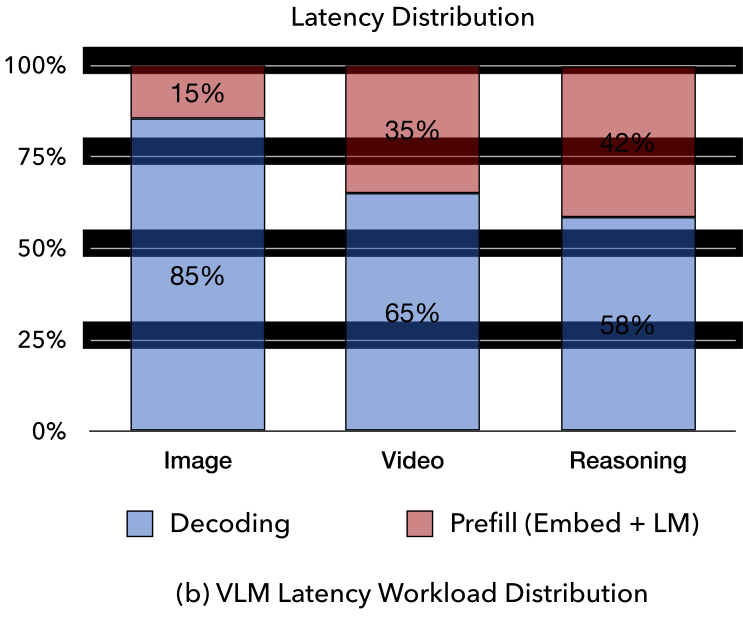
Figure 3 解读: 不同任务中 prefill 与 decoding 的延迟占比差异显著。Image 任务 prefill 占 85%,Video 任务 decoding 占 65%,Reasoning 任务 decoding 占 58%。这表明不能用统一的稀疏策略处理两个阶段——需要根据各阶段的计算特性分别优化。
1.2 现有方法的局限
现有 token 剪枝方法分为两类,各有致命缺陷:
| 类别 | 代表方法 | 优点 | 致命缺陷 |
|---|---|---|---|
| Query-Agnostic | VisionZip, PruMerge, HIRED | 不依赖文本输入,多轮稳定 | 无法适应不同 query 的需求,高稀疏率下丢失细粒度信息 |
| Query-Aware | FastV, PDrop, SparseVLM | 根据 query 动态选择相关 token | 永久删除 token 后无法恢复,多轮对话性能急剧下降 |
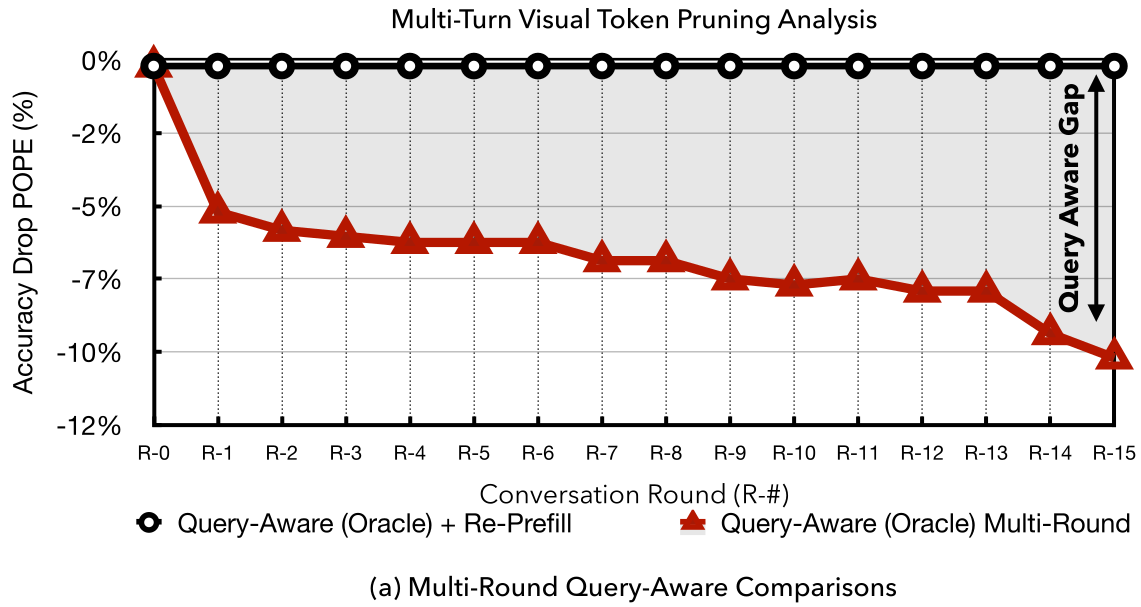
Figure 2 解读: 即使使用 query-aware oracle(贪心选择使输出与完整模型一致的最优 token 子集),在多轮对话中精度仍持续下降(POPE 数据集上从 R-0 到 R-15 下降约 10%)。这说明 query-aware 在 prefill 阶段做的 token 剪枝是不可逆的——一旦删除,后续轮次无法恢复。
2. Idea (核心思想)
2.1 核心洞察
关键洞察: 视觉稀疏性不应在推理流水线中统一施加,而应根据 prefill 和 decoding 两个阶段的不同计算特性进行解耦。
- Prefill 阶段:轻量级 query-agnostic 剪枝,移除全局冗余 token,保留足够的视觉覆盖
- Decoding 阶段:激进的 query-aware 检索,从完整 KV cache 中仅激活与当前 query 相关的 token
2.2 Decoupled Sparsity 的设计动机
┌─────────────────────────────────────────────────────────────┐
│                    SparseVILA Pipeline                       │
│                                                             │
│  ┌──────────────────────┐   ┌────────────────────────────┐  │
│  │   Prefill Stage      │   │   Decoding Stage (per turn)│  │
│  │                      │   │                            │  │
│  │  Visual Encoder      │   │  Query Embedding           │
│  │       ↓              │   │       ↓                    │
│  │  Salience Score      │   │  Attn(Q, V_KV) → r_i      │
│  │       ↓              │   │       ↓                    │
│  │  Prune low-salience  │   │  Select top-r_d tokens     │
│  │  (query-agnostic)    │   │  (query-aware)             │
│  │       ↓              │   │       ↓                    │
│  │  LLM Prefill         │   │  Pack into contiguous KV   │
│  │  → Full Visual KV    │   │       ↓                    │
│  │    Cache retained    │   │  Autoregressive Decoding   │
│  └──────────────────────┘   └────────────────────────────┘  │
│                                                             │
│  Sparsity: 轻量级 (60-75%)      Sparsity: 激进 (75-95%)      │
│  执行一次,多轮复用               每轮动态调整                   │
└─────────────────────────────────────────────────────────────┘
Table 1 验证: 在 RoboVQA 上对比 prefill-only 与 decoupled sparsity:
| Prefill Sparsity | Decode Sparsity | Prefill 加速 | Decode 加速 | E2E 加速 | RoboVQA |
|---|---|---|---|---|---|
| 0% | 0% | 1.0x | 1.0x | 1.0x | 86.4 |
| 90% | 0% | 14.6x | 1.1x | 1.4x | 80.0 |
| 70% | 85% | 4.9x | 1.2x | 1.4x | 89.1 |
将稀疏性从 prefill 重新分配到 decoding 后,在相同 E2E 加速下精度从 80.0 提升到 89.1(甚至超过无稀疏 baseline 86.4)。
2.3 Visual Attention Sink 与 Retrieval Token 的发现
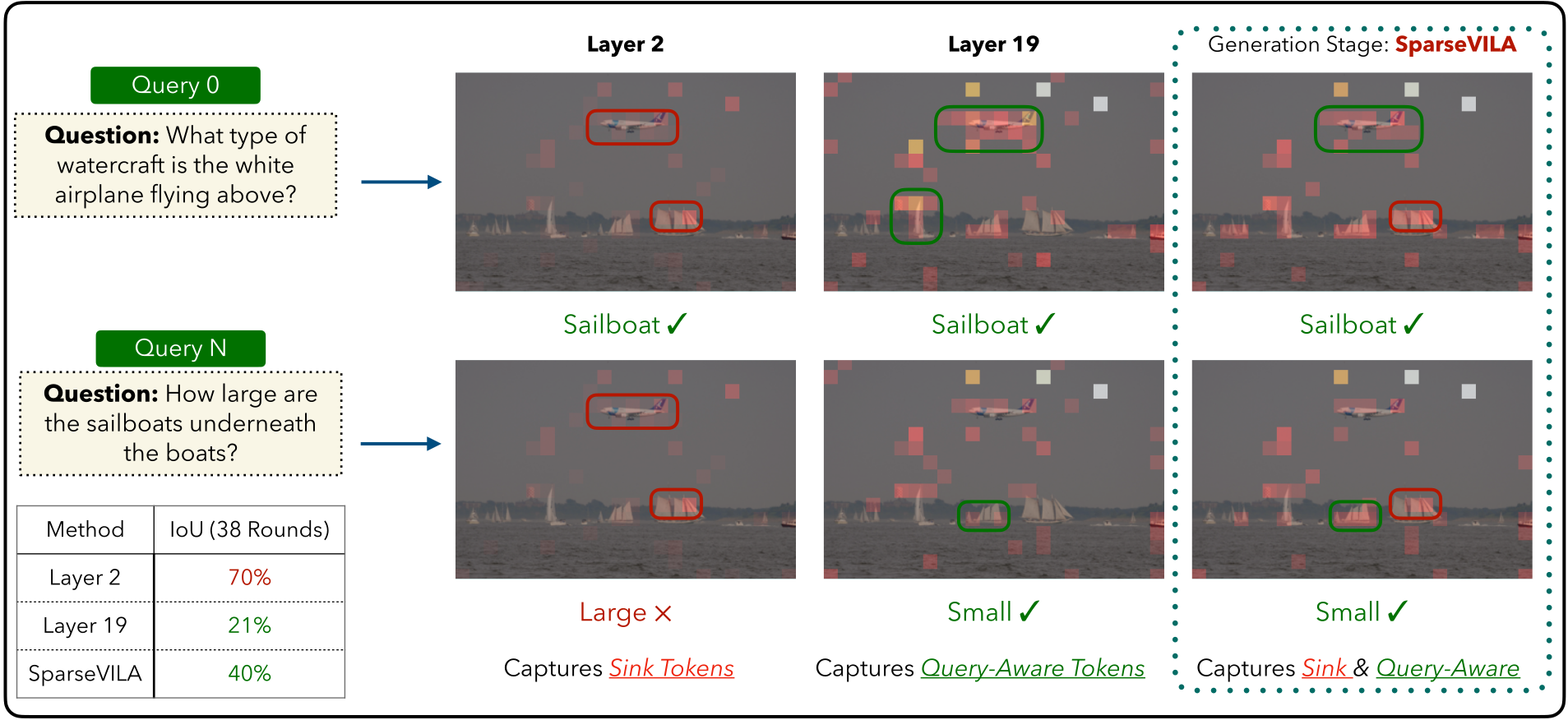
Figure 8 解读: LLaVA-1.5 不同 LLM 层中视觉 token 的 attention 分析。Layer 2(浅层)中 attention 集中在少数固定 token 上,这些是 Visual Attention Sink——跨 query 保持稳定的”锚点”token。Layer 19(深层)中 attention 模式随 query 变化,出现 Visual Retrieval Token——动态响应 query 内容。SparseVILA 的 decoupled 设计同时捕获两种 token:prefill 保留 sink token(全局重要性高),decoding 检索 retrieval token(query 相关性高)。IoU 分析:Layer 2 的跨 query IoU 为 70%(sink 稳定),Layer 19 为 21%(retrieval 多变),SparseVILA 整体为 40%。
3. Method (方法)
3.1 Prefill 阶段:Query-Agnostic Pruning
目标: 在不知道用户 query 的情况下,基于视觉冗余性移除不重要的 token。
Token Salience Estimation
根据视觉编码器类型,采用不同的 salience 计算策略:
Case 1: 有 summary token 的编码器(如 CLIP)
其中 表示第 个视觉 token 对全局 [CLS] token 的 attention 贡献。
Case 2: 有多个 summary token 的编码器(如 RADIO)
对所有 summary token 的 attention 取平均。
Case 3: 无 summary token 的编码器(如 SigLIP, QwenVL)
对所有 token 之间的 intra-visual attention 取平均。
剪枝规则: 按 salience 排序,移除 salience 最低的 个 token( 为 prefill 保留比例)。
高效 Triton Kernel 实现
对长视频(数十万 token),显式构建完整 attention 矩阵会导致内存爆炸。论文实现了自定义 Triton kernel:
- 流式 softmax 归一化 + salience 累加,无需显式构建完整 attention 矩阵
- SigLIP 类编码器加速 3x,QwenVL 类编码器加速 10x
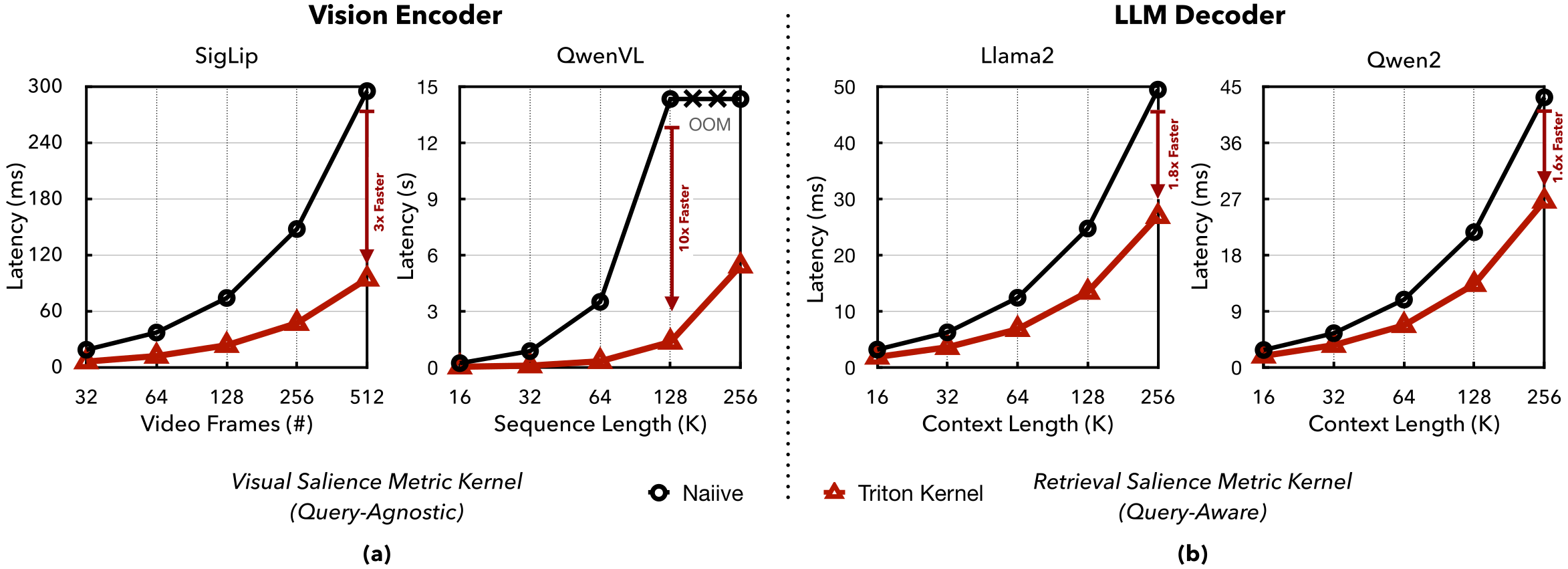
Figure 5 解读: Triton kernel 的性能对比。(a) Vision Encoder 端:SigLIP 在 512 帧时 naive 实现约 300ms,Triton kernel 约 100ms(3x 加速);QwenVL 在 256K 序列长度时 naive 实现约 15s,Triton kernel 约 1.5s(10x 加速)。(b) LLM Decoder 端:Llama2 backbone 上 Triton kernel 实现约 1.5x 加速,Qwen2 backbone 上约 1.8x 加速。
3.2 Decoding 阶段:Query-Aware Retrieval
目标: 在 decoding 生成时,从保留的视觉 KV cache 中仅检索与当前 query 最相关的 token。
Query-Aware Token Selection
在 decoding 开始前,计算 query embedding 与视觉 KV cache 条目之间的 aggregate attention strength:
其中 为 query token 集合, 为第 个视觉 token 的 KV cache 条目。选择 最高的 个 token( 为 decoding 稀疏率)。
关键设计:
- 被选中的 KV 条目被紧凑打包到连续内存区域,避免稀疏访问模式
- 未被选中的 token 不被删除——仍保留在 KV cache 中,可在后续轮次被检索
- 该操作与 FlashAttention2 的 prefill path 并发执行,额外开销仅 1.5x naive 实现
Rotary Position Embedding 处理
不同 VLM 使用不同的位置编码方案,剪枝后需要特殊处理:
| 位置编码类型 | 使用模型 | 处理方式 |
|---|---|---|
| 统一 RoPE | LLaVA-NeXT, LongVILA | 保留被选 token 的连续位置索引范围 |
| Multimodal RoPE | Qwen2.5-VL | 沿 temporal/height/width 维度重建最小连续位置网格,后移文本位置以保持全局连续性 |
3.3 整体实现要点
- Prefill 负责一次性完成全局剪枝,并保留完整视觉 KV cache
- Decoding 按轮次检索相关 token,并将其打包成连续 KV cache
- 两阶段 sparsity 分别面向 compute-bound 与 memory-bound 瓶颈优化
4. Experimental Setup (实验设置)
4.1 评测模型与稀疏配置
- Image benchmark: LLaVA-NeXT-7B,Prefill 60% / Decode 75%
- Video understanding: LongVILA-7B (256f)、Qwen2.5-VL-7B (4fps)、Nemotron-Nano-VL-8B (256f)
- Video captioning: LongVILA-7B (256f),Prefill 75% / Decode 90%
- Physical reasoning: Cosmos-Reason1-7B (24fps),Prefill 75% / Decode 95%
4.2 评测任务与基准
- Image benchmarks: AI2D, ChartQA, DocVQA, GQA, InfoVQA, MME, POPE, ScienceQA, TextVQA
- Video understanding: LVB, MLVU, NExT-QA, Video-MME
- Video captioning: Video-ChatGPT 指标 CI, DO, CU, TU, C, Overall
- Physical reasoning: HoloAssist, RoboFail, RoboVQA
- Visual retrieval: V-NIAH(Visual Needle-in-a-Haystack)
- Efficiency analysis: kernel runtime、overhead、理论加速与实测加速
4.3 备注
- 论文展示了不同任务下 prefill 与 decoding 的延迟占比,但具体 prompt 模板、解码超参与部分实现细节在当前 note 中未详细说明。
- 以下结果均沿用论文中的表格与图示信息整理。
5. Experimental Results (实验结果)
5.1 Image Benchmark(Table 2)
| 方法 | P | D | E2E 加速 | AI2D | ChartQA | DocVQA | GQA | InfoVQA | MME | POPE | SQA | TextVQA |
|---|---|---|---|---|---|---|---|---|---|---|---|---|
| Baseline | 0 | 0 | 1.0x | 63.9 | 53.0 | 63.6 | 63.5 | 28.4 | 1857.8 | 84.5 | 69.3 | 58.2 |
| FastV | .80 | 0 | 1.2x | 61.8 | 31.6 | 33.5 | 55.3 | 22.0 | 1568.2 | 76.7 | 66.7 | 52.7 |
| SparseVLM | .75 | 0 | 1.2x | 63.2 | 39.9 | 41.8 | 59.7 | 22.2 | 1823.9 | 83.4 | 69.6 | 57.6 |
| VisionZip | .80 | 0 | 1.2x | 62.9 | 38.2 | 48.5 | 60.3 | 24.2 | 1727.4 | 84.1 | 67.9 | 57.1 |
| SparseVILA | .60 | .75 | 1.2x | 64.1 | 47.8 | 58.0 | 62.7 | 25.6 | 1831.0 | 85.8 | 69.6 | 59.1 |
关键发现: 在相同 1.2x E2E 加速下,SparseVILA 在 document/chart 理解任务上比 prior art 降低 >15% 的精度退化。在 AI2D、POPE、ScienceQA、TextVQA 上甚至超过 baseline。
5.2 Video Understanding(Table 3)
| 模型 | P | D | P 加速 | D 加速 | E2E | LVB | MLVU | NExT-QA | Video-MME |
|---|---|---|---|---|---|---|---|---|---|
| LongVILA-7B (256f) baseline | 0 | 0 | 1.0x | 1.0x | 1.0x | 53.8 | 64.9 | 78.6 | 58.8 |
| + SparseVILA | .75 | .90 | 5.1x | 1.6x | 2.1x | 54.1 | 65.3 | 79.0 | 58.7 |
| Qwen2.5-VL-7B (4fps) baseline | 0 | 0 | 1.0x | 1.0x | 1.0x | 59.2 | 65.5 | 76.0 | 62.3 |
| + SparseVILA | .75 | .90 | 6.0x | 2.0x | 1.9x | 60.1 | 70.7 | 81.9 | 66.3 |
| Nemotron-Nano-VL-8B (256f) baseline | 0 | 0 | 1.0x | 1.0x | 1.0x | 55.3 | 60.9 | 75.8 | 55.2 |
| + SparseVILA | .75 | .95 | 4.0x | 2.5x | 2.6x | 55.9 | 63.1 | 76.6 | 56.6 |
关键发现:
- 在所有视频理解 benchmark 上,SparseVILA 不仅保持精度还普遍提升(Qwen2.5-VL 上 MLVU +5.2, NExT-QA +5.9)
- 最高实现 6.0x prefill / 2.5x decoding / 2.6x E2E 加速
- 精度提升归因于紧凑 KV cache 使模型更聚焦于关键视觉线索
5.3 Video Captioning(Table 4)
模型: LongVILA-7B (256f) | Prefill 75% / Decode 90%
| 方法 | P 加速 | D 加速 | E2E | CI | DO | CU | TU | C | Overall |
|---|---|---|---|---|---|---|---|---|---|
| Baseline | 1.0x | 1.0x | 1.0x | 2.34 | 2.21 | 2.81 | 1.70 | 2.46 | 2.31 |
| VisionZip | 28.5x | 1.5x | 2.1x | 2.04 | 2.03 | 2.56 | 1.71 | 2.11 | 2.09 |
| PruMerge | 28.5x | 1.5x | 2.1x | 2.07 | 2.00 | 2.57 | 1.75 | 2.10 | 2.10 |
| SparseVILA | 5.1x | 1.6x | 2.1x | 2.35 | 2.27 | 2.85 | 1.90 | 2.39 | 2.35 |
SparseVILA 在相同 2.1x 加速下将 Video-ChatGPT 总分从 2.31 提升到 2.35(temporal understanding +0.2)。
5.4 Physical Reasoning(Table 6)
模型: Cosmos-Reason1-7B (24fps) | Prefill 75% / Decode 95%
| 方法 | P 加速 | D 加速 | E2E | HoloAssist | RoboFail | RoboVQA | Average |
|---|---|---|---|---|---|---|---|
| Baseline | 1.0x | 1.0x | 1.0x | 72.0 | 54.0 | 88.2 | 71.4 |
| FastV | 1.0x | 1.1x | 1.3x | 46.0 | 37.0 | 80.9 | 52.5 |
| SparseVILA | 0.4x | 2.0x | 1.9x | 75.0 | 58.0 | 94.5 | 75.9 |
SparseVILA 实现 1.9x E2E 加速 + 4.5% 精度提升(平均从 71.4 到 75.9)。
5.5 Visual Retrieval (V-NIAH)

Figure 6 解读: Visual Needle-in-a-Haystack 检索准确率热力图。SparseVLM 和 FastV 在超过 32 帧后即失效(8K context 限制),出现大面积绿色/黄色区域表示检索失败。SparseVILA 在 200 帧内保持近乎完美的检索准确率(几乎全绿),展示了其在长上下文场景下的显著优势。这得益于 decoupled 设计——prefill 保留完整 KV cache,decoding 时动态检索。
5.6 Efficiency Analysis

Figure 7 解读: Decoding attention kernel 的加速效果。SparseVILA 在所有模型/任务组合上都实现显著加速:LLaVA-NeXT [Image] 3.3x, InternVL-3.5 [Image] 4.7x, LongVILA [Video] 4.2x, Nemotron [Video] 11.4x, Qwen2.5-VL [Video] 4.2x, Cosmos [Reason] 6.8x。加速来源于减少 KV cache 的有效大小,降低 memory-bound decoding 的内存访问量。
Overhead 对比(Table 7):
| 方法 | LongVILA-7B CUDA Time | Overhead % | 理论加速 | 实测加速 |
|---|---|---|---|---|
| PruMerge | 448.3ms | 1.84% | 7.41x | 6.49x |
| VisionZip | 206.3ms | 0.85% | 7.41x | 6.94x |
| SparseVILA | 94.9ms | 0.39% | 3.98x | 3.91x |
SparseVILA 的 overhead 仅为 PruMerge 的 1/5,实测加速与理论加速的 gap 最小(3.98x vs 3.91x),说明其 kernel 设计高效。
内存节省: Prefill 阶段 token 剪枝额外减少 KV memory 72.5%,linear FLOPs 减少 87.6%(LongVILA-7B)。
6. 代码实现映射
注:截至 2026-03-12,SparseVILA 官方代码尚未公开。以下为根据论文描述推测的关键实现模块。
| 论文组件 | 推测实现位置 | 关键技术 |
|---|---|---|
| Token Salience Estimation | visual_encoder/salience.py | Triton kernel 流式 softmax + accumulation |
| Prefill Pruning | prefill/prune.py | Top-k selection on salience scores |
| Query-Aware Retrieval | decode/retrieval.py | Attn(Q, V_KV) 计算 + 与 FlashAttention2 并发 |
| KV Cache Packing | decode/kv_packing.py | 连续内存打包,避免稀疏访问 |
| RoPE Reconstruction | decode/rope_handler.py | 统一 RoPE: 保留连续 index;M-RoPE: 重建最小 T/H/W 网格 |
| Multi-Turn KV Eviction | eval/multi_turn.py | 每轮仅删除前一轮 Q/A 的 KV 条目 |
| Inference Pipeline | 基于 TinyChat | W8A8 (SmoothQuant) + W4A16 (AWQ) 量化 |
相关开源项目:
- SparseVLMs: 不同论文(SparseVLM),但思路相关的 query-aware token pruning
- mit-han-lab/Block-Sparse-Attention: 同组的稀疏 attention kernel