UNIVERSE: Adapting Vision-Language Models for Evaluating World Models
Authors: Mariya Hendriksen, Tabish Rashid, David Bignell, Raluca Georgescu, Abdelhak Lemkhenter, Katja Hofmann, Sam Devlin, Sarah Parisot Affiliations: University of Oxford, Microsoft Research Venue: NeurIPS LAW 2025 (Oral) Code: 未公开(截至 2026 年 3 月,未找到官方 GitHub 仓库)

Figure 1 解读: 左图和中图展示了 UNIVERSE(橙色柱状图)与 task-specific baselines 在 Action Recognition (AR) 和 Character Recognition (CR) 两个任务上的对比,跨越 binary、multiple-choice、open-ended 三种格式。UNIVERSE 在 AR 上超越所有 baselines,在 CR 上排名第三。右图显示 UNIVERSE 的训练样本量远小于 task-specific 模型(每个 epoch 仅需约 3,894 / 1,298 / 973 个 AR 样本和 5,192 / 324 个 CR 样本),体现了极高的数据效率。
论文信息:
- 标题: Adapting Vision-Language Models for Evaluating World Models
- 作者: Mariya Hendriksen, Tabish Rashid, David Bignell, Raluca Georgescu, Abdelhak Lemkhenter, Katja Hofmann, Sam Devlin, Sarah Parisot
- 机构: University of Oxford, Microsoft Research
- 会议: NeurIPS LAW 2025 (Oral)
- 链接: arXiv:2506.17967
- 代码: 未公开(截至 2026 年 3 月,未找到官方 GitHub 仓库)
1. Motivation (研究动机)
核心问题
World models(世界模型)是用于模拟环境动态的生成模型,被广泛应用于游戏引擎(如 Dreamer、DIAMOND)、自动驾驶(GAIA-1)和 embodied AI 领域。然而,评估这些模型生成的 rollouts(模拟轨迹)面临根本性挑战:
- 现有指标不足: FID、IS、SSIM 等分布级指标只关注低层视觉特征,无法捕捉 action alignment 和语义一致性
- 时序依赖缺失: FVD 等视频指标忽略 timestamp-level 的动作条件对齐
- 多模态指标盲区: Jayasumana et al. (2024) 等多模态指标不考虑动作条件
- 人工评估成本高: 人类评估虽是金标准,但昂贵且难以扩展
- 通用 VLM 表现差: 即使是 GPT-5 在 binary AR 任务上 6 个样本中答错 5 个,说明需要 task-specific adaptation
需要解决的挑战
- 如何构建一个 细粒度、时序感知 的自动化评估器?
- 如何在 数据和计算受限 的条件下高效适配 VLM?
- 如何用 单一统一模型 替代多个 task-specific checkpoints?
2. Idea (核心思想)
核心思想
提出 UNIVERSE (UNIfied Vision-language Evaluator for Rollouts in Simulated Environments),将 world model rollout 评估形式化为视觉问答(VQA)任务,通过三大核心设计实现轻量级、高效的统一评估:
- Partial Fine-tuning: 仅微调 projection head(),只更新模型 0.07% 的参数(2.66M / ~3B)
- Efficient Frame Sampling: 从 14 帧 rollout 中 uniform 采样 帧,保持时间覆盖
- Mixed Supervision: 使用层次化的 task + format 混合训练,单一模型覆盖 2 个任务 × 3 种格式
评估协议设计
定义两个结构化识别任务:
- Action Recognition (AR): 判断生成序列是否准确反映了 agent 的动作
- Character Recognition (CR): 评估实体在时间维度上的身份和外观一致性
每个任务有三种问答格式:
- Binary: “Is the character evading right? Answer yes or no”
- Multiple-Choice: “What is the character doing? A) jumping B) evading…”
- Open-Ended: “What is the character doing?“
3. Method (方法)
3.1 形式化定义
World model 定义为:,其中 是 timestep 的感知观测, 是历史动作序列。
UNIVERSE 评估器形式化为函数:
其中 是从 rollout 采样的帧序列, 是自然语言问题, 是预测答案。通过将 与参考答案 比较来度量评估质量。
3.2 模型架构
基于 PaliGemma 2 3B 模型,由三个模块组成:
| 组件 | 架构 | 参数量 |
|---|---|---|
| Vision Encoder () | SigLIP-So400m, 27 层 Transformer Encoder | 400M |
| Projection Head () | Linear(1152 → 2304) | 2.66M |
| Language Decoder () | Gemma 2 2B, 26 层 Transformer Decoder | ~2B |
输入格式:
- 图像分辨率: pixels → 每帧 256 个 patches
- 输入序列:
- : 来自 帧的 visual tokens
- :
<BOS>, answer en, <QUESTION>, <SEP>(task cue + question) - :
<ANSWER>, <EOS>, <PAD>,...(expected answer, 仅训练时)
3.3 训练目标
优化 answer suffix tokens 上的 causal language modeling loss:
其中 是 suffix 中第 个 token, 是在展平序列中的位置。
3.4 适配策略探索
论文系统性地探索了三个维度的设计空间:
(a) Fine-tuning 配置
| 策略 | 更新参数 | 说明 |
|---|---|---|
| Zero-shot | 无 | 直接 prompting |
| Full FT () | 全参数微调 | |
| Two-component | 三选二 | 如 , , |
| Single-component | 三选一 | , , |
| LoRA | Low-rank adapters | , , |
关键发现: 仅微调 projection head () 即可达到第二好的性能,仅次于 vision encoder tuning () 但参数量从 ~11% 降至 0.07%。
(b) 帧采样策略
比较两种采样方法:
- First-n: 选取前 帧
- Uniform-n: 从整个序列均匀采样 帧
关键发现: Uniform-n 在所有格式上一致优于 First-n,尤其在低帧数时优势显著。2 帧时: Binary 84.42% → 90.47%, MC 65.53% → 83.93%, OE 65.38% → 82.68%。
(c) 数据混合优化
三阶段层次化 grid search:
- 固定 format 分布为均匀,调节 task ratio vs
- 固定 ,调节 open-ended 比例
- 固定 ,分配 binary 和 MC 比例
最优配置:
- Task ratio: ,
- Format ratio: , ,
3.5 UNIVERSE 最终配置
UNIVERSE Configuration:
├── Base Model: PaliGemma 2 3B
├── Adaptation: Partial fine-tuning (projection head only, 2.66M params, 0.07%)
├── Frame Sampling: Uniform-8 from 14-frame rollout
├── Training Mix:
│   ├── Task: α_AR = 0.8, α_CR = 0.2
│   └── Format: β_binary = 0.15, β_MC = 0.05, β_OE = 0.8
└── Evaluation: Exact Match (EM) + ROUGE-F1
3.6 评估指标
Exact Match (EM):
ROUGE-F1:
其中 Binary 使用 bigram,MC 和 OE 使用 trigram。
3.7 伪代码
数据构建流程:
def DatasetCreation(S, L=14):
    """S: gameplay sessions, L: clip length"""
    # Stage 1: Preprocessing
    S_valid = Preprocessing(S)  # filter corrupted sessions
    V = []
    for (v, c, m) in S_valid:
        V_s = Segment(v, c, m, L)  # segment into 14-frame clips
        V.extend(V_s)

    # Stage 2: Description Generation
    Z = []
    for (frames, controls, meta) in V:
        d = Describe(meta, controls)  # structured NL description
        Z.append((frames, d))

    # Stage 3: QA Pair Construction
    Y_AR, Y_CR = GetAnswerSpace(Z)  # action & character label sets
    D = []
    for (frames, d) in V:
        QA = GenerateQAPairs(d, Y_AR, Y_CR)  # 6 QA pairs per clip
        for (Q, A) in QA:
            D.append((frames, Q, A))
    return D  # 194,718 train + 48,678 val QA pairs

def GenerateQAPairs(d, Y_AR, Y_CR):
    QA = []
    for task in [AR, CR]:
        y = ExtractLabel(d, task)
        # Binary: positive + negative
        y_neg = SampleDistractor(Y_task \ {y})
        QA.append(FormatBinaryPrompt(task, y), "yes")
        QA.append(FormatBinaryPrompt(task, y_neg), "no")
        # Multiple-Choice
        O = FormatOptions(Y_task)
        QA.append(FormatMCPrompt(task, O), y)
        # Open-Ended
        QA.append(FormatOEPrompt(task), y)
return QA适配与评估流程:
class AdaptationDatasetBuilder:
    def build(self, alpha_task, beta_format, context_length, sampling_strategy):
        """
        alpha_task: {AR: 0.8, CR: 0.2}
        beta_format: {binary: 0.15, MC: 0.05, OE: 0.8}
        context_length: k=8 frames
        sampling_strategy: 'uniform'
        """
        samples = stratified_sample(self.data, alpha_task, beta_format)
        dataset = []
        for sample in samples:
            frames = sample_visual_context(sample, context_length, sampling_strategy)
            dataset.append((frames, sample.question, sample.answer))
        return dataset

class VLMAdapter:
    def adapt(self, base_vlm, adaptation_data, strategy='projection_only', num_steps=N):
        # Freeze all except projection head
        for name, param in base_vlm.named_parameters():
            param.requires_grad = (name in projection_head_params)

        for step in range(num_steps):
            batch = sample_batch(adaptation_data)
            loss = compute_loss(base_vlm, batch)  # causal LM loss on suffix
            loss.backward()
            update_model(base_vlm)

class Universe:
    def evaluate_rollout(self, rollout, target, complexity):
        question = generate_question(target, complexity)  # AR/CR × binary/MC/OE
        # Majority vote over 5 greedy decodings
        responses = [self.adapted_vlm(rollout, question) for _ in range(5)]
        return majority_vote(responses)
4. Experimental Setup (实验设置)
4.1 数据集
| 属性 | 值 |
|---|---|
| 数据来源 | Bleeding Edge 游戏录制(Skygarden 环境) |
| 训练集 | 32,453 clips → 194,718 QA pairs |
| 验证集 | 8,113 clips → 48,678 QA pairs |
| Clip 长度 | 14 帧(60 FPS 视频) |
| 标注方式 | 6 QA pairs / clip (2 tasks × 3 formats) |
4.2 Baselines
Zero-shot VLMs (7 个):
- VideoLLaMA3: 2B, 7B
- PaliGemma 1 3B, PaliGemma 2 3B, PaliGemma 2 10B
Fine-tuned PaliGemma 2 变体 (8 个策略):
- Single-component: , ,
- Two-component: , ,
- Full:
- LoRA: ,
4.3 训练超参数
| 超参数 | 值 |
|---|---|
| GPU | 8× NVIDIA A100 (40GB) |
| Batch size | 1/device × 4 gradient accumulation = 32 effective |
| Optimizer | AdamW (, ) |
| Learning rate | , cosine annealing |
| LR warmup | 10% of training steps |
| Weight decay | |
| Gradient clipping | Global norm, threshold 1.0 |
| Epochs | 1-10 |
| Precision | bfloat16 |
| 输入分辨率 | |
| 总计算量 | 5,154 GPU-days (14.12 GPU-years) |
4.4 人类评估设置
| 属性 | 值 |
|---|---|
| 评估环境 | 8 个(1 个 in-domain + 7 个 unseen) |
| World models | 大模型 1.6B (300×180) + 小模型 140M (128×128) |
| 每个 setting | 30 rollouts × 6 QA pairs |
| 总 rollouts / QA instances | 240 / 1,440 |
| 标注者 | 2 主标注 + 1 仲裁 |
| 评分标准 | Correct (1.0), Partially Correct (0.5), Incorrect (0.0), Unclear |
| 一致性度量 | Cohen’s |
5. Experimental Results (实验结果)
5.1 Zero-shot 性能
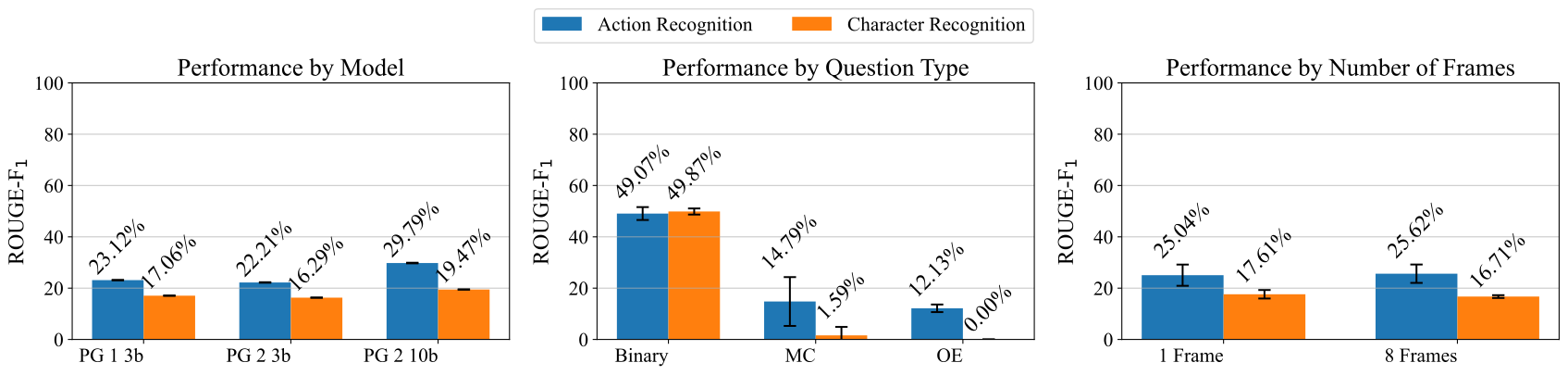
Figure 16 解读: PaliGemma 三个变体在 zero-shot 设置下的 ROUGE-F1 表现。按 model、question type 和 frame 数量分析。整体性能有限(AR 最高约 30%,CR 更低),PaliGemma 2 10B 在绝对值上略优但与 2 3B 差距不大。增加帧数对 AR 有轻微提升但对 CR 收益递减,确认需要 task-specific adaptation。
关键数据:
- VideoLLaMA3: AR ≤ 12.7%, CR ≤ 6.4%
- PaliGemma 2 3B (best zero-shot): AR 29.7%, CR 17.2%
- GPT-5: Binary AR 6 个样本中答错 5 个
5.2 Fine-tuned Baselines 对比
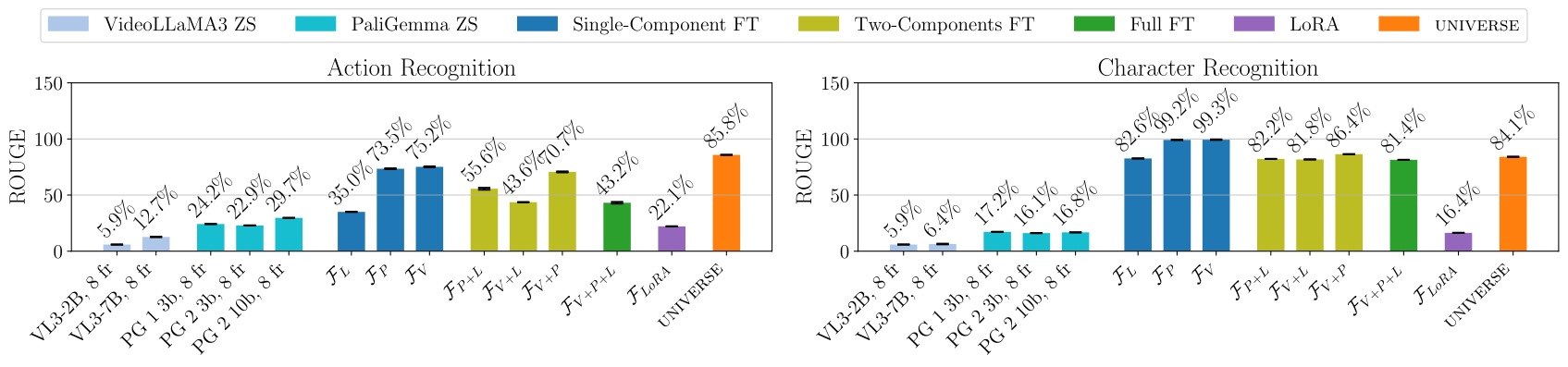
Figure 2 解读: 左图 (AR): UNIVERSE 在所有适配策略中表现最优。右图 (CR): UNIVERSE 排名第三,仅次于 vision encoder tuning () 和 ,但后者需更新约 11% 参数且使用 5 倍以上的 task-specific CR 数据。关键发现是 LoRA 在此设置下表现极差,而仅微调 projection head 即可获得极佳性价比。
核心对比数据 (Table 5, 1 epoch, 8 frames):
| 策略 | AR-Binary EM | AR-MC EM | AR-OE EM | CR-Binary EM | CR-MC EM | CR-OE EM |
|---|---|---|---|---|---|---|
| 50.00 | 13.13 | 13.13 | 50.00 | 98.92 | 98.98 | |
| (UNIVERSE) | 83.97 | 61.43 | 61.68 | 99.09 | 99.22 | 99.15 |
| 83.70 | 63.40 | 66.03 | 99.31 | 99.14 | 99.61 | |
| 74.35 | 13.13 | 13.13 | 50.00 | 97.67 | 96.55 | |
| 44.66 | 0.02 | 0.00 | 48.76 | 0.00 | 0.00 |
5.3 Supervision & Temporal Context 分析
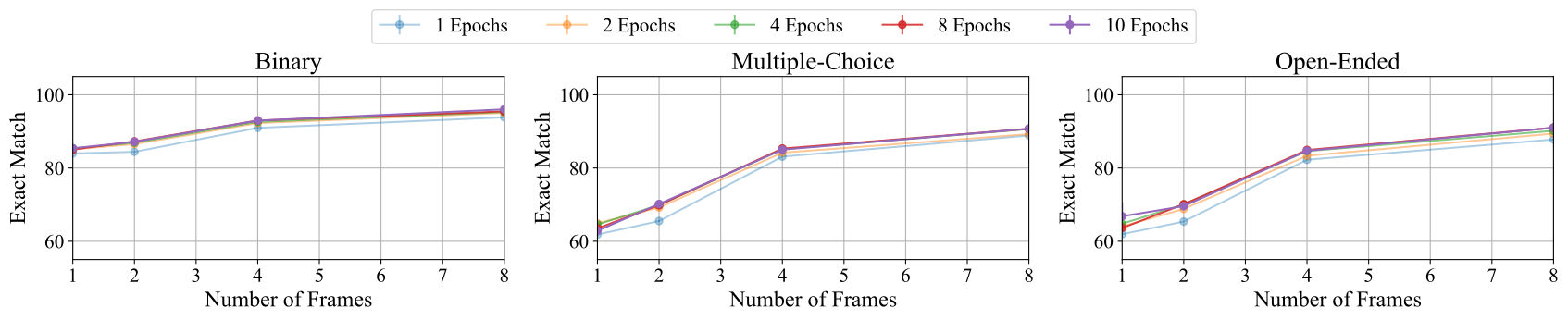
Figure 3 解读: AR 性能随训练 epochs 和输入帧数 jointly 提升。三种格式(Binary、MC、OE)均在两个维度上呈现单调增长趋势,最佳结果在 10 epochs + 8 frames 时取得。这表明 AR 需要充分的 temporal context 和训练。
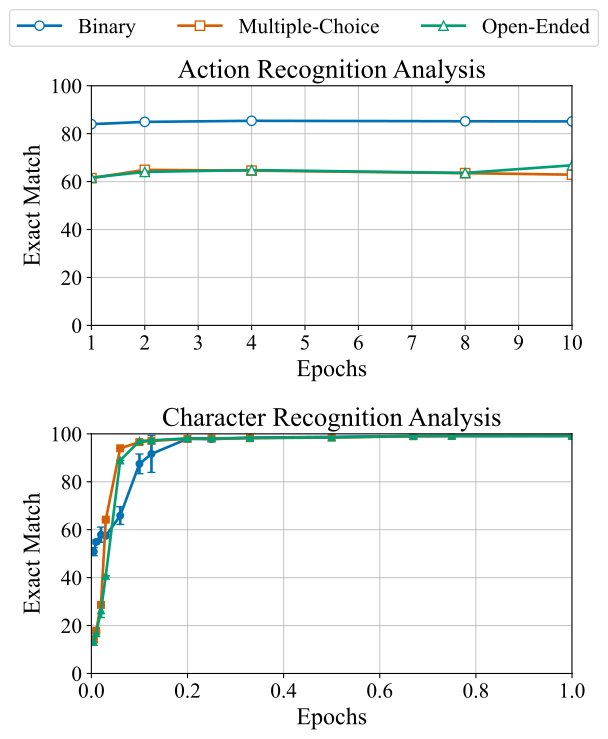
Figure 5 解读: AR(上)和 CR(下)的 Exact Match 准确率随 epoch 变化。CR 收敛极快,在约 12.5% epoch(~4K 样本)即达到 >97% EM;而 AR 需要更多训练且仅在有 temporal input 时才有显著提升(1 帧时即使 10 epochs 改善也有限)。
关键数据:
- CR: 0.125 epoch → 91.63% EM (Binary), 97.08% EM (MC), 97.28% EM (OE)
- AR (10 epochs): Binary 85.11%, MC 62.88%, OE 66.82%
5.4 帧采样策略
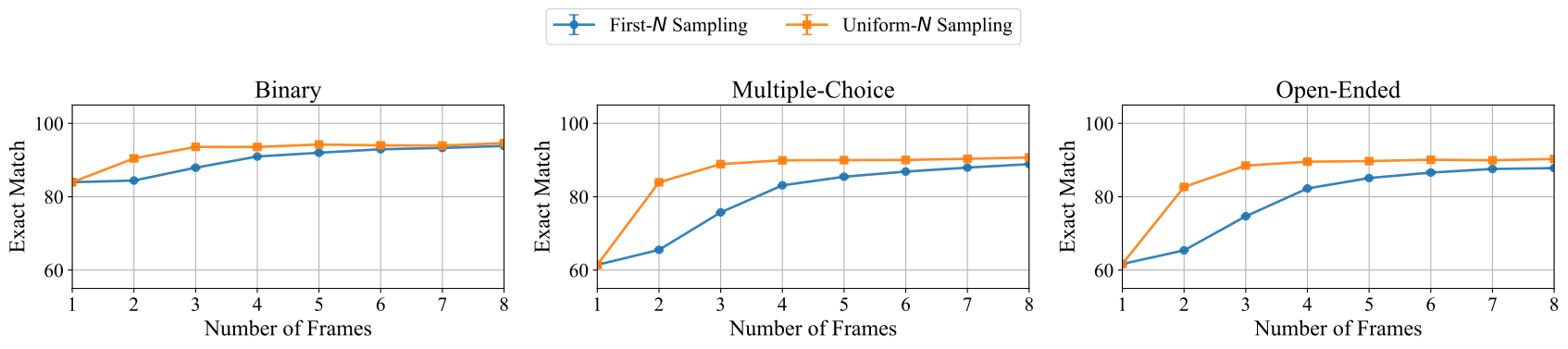
Figure 4 解读: Uniform-n(橙色)在所有帧数和所有格式上均优于 First-n(蓝色)。在低帧数时差距最大(2 帧时约 6-18 个百分点),8 帧时优势缩小但仍然存在。这验证了均匀时间覆盖对 AR 的重要性。
关键数据 (2 frames):
- Binary: First-n 84.42% → Uniform-n 90.47% (+6.05%)
- MC: First-n 65.53% → Uniform-n 83.93% (+18.4%)
- OE: First-n 65.38% → Uniform-n 82.68% (+17.3%)
5.5 数据混合优化
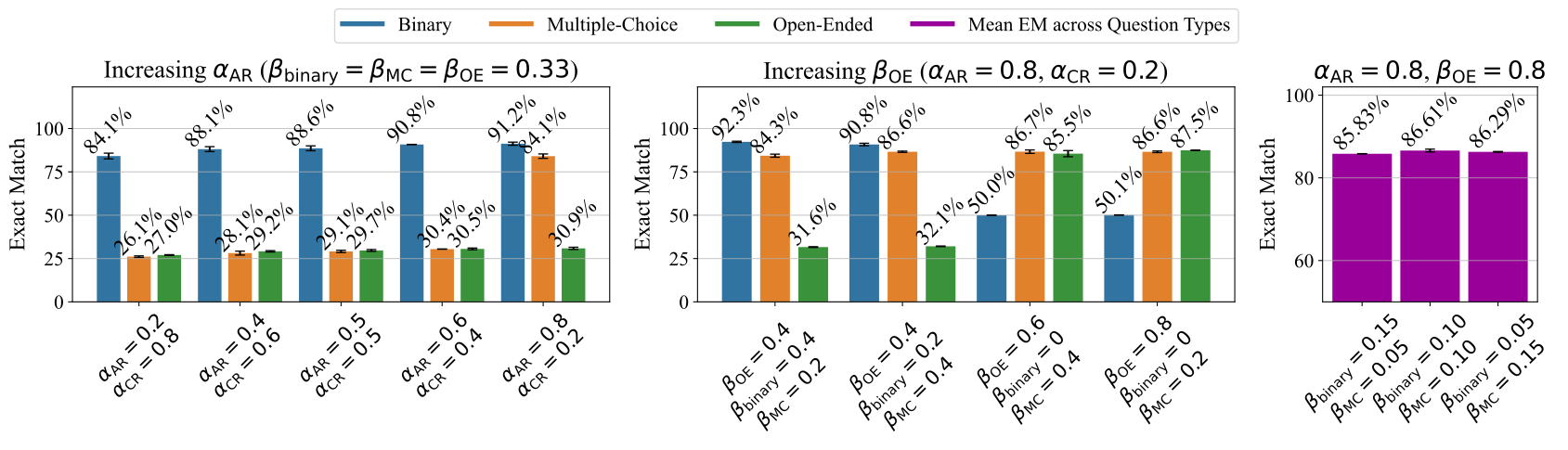
Figure 6 解读: 三阶段层次化 ablation。左图:增加 到 0.8 显著提升 AR(尤其 MC),CR 基本稳定。中图:固定 ,增加 到 0.8 提升 AR-OE 性能。右图:在 下,binary 和 MC 分配比较 robust, 略优。
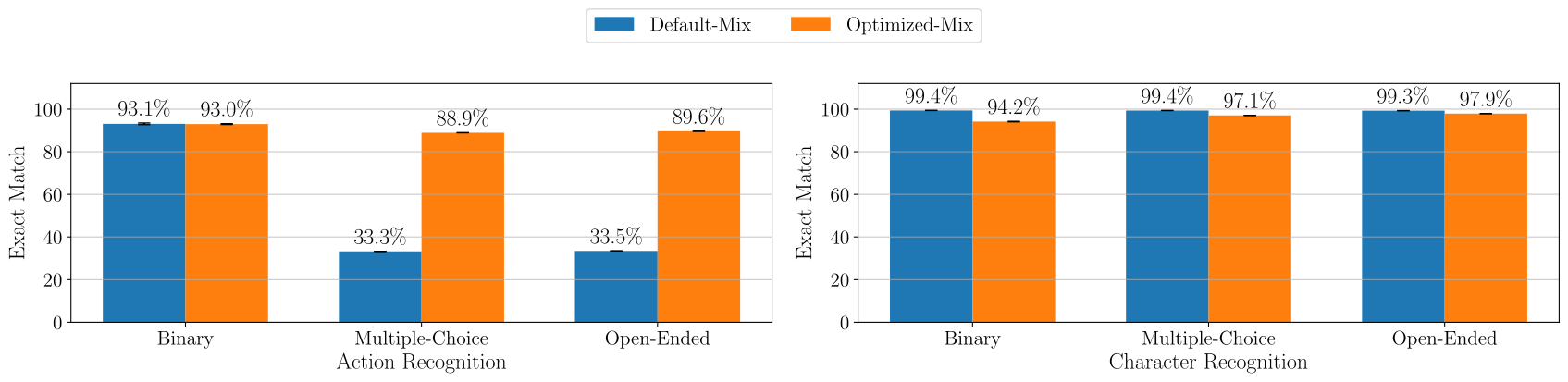
Figure 7 解读: Default-Mix(等比例)vs Optimized-Mix 的对比。优化后的数据混合在 AR 上获得显著提升(MC: 33.4% → 88.9%, OE: 33.5% → 89.6%),同时 CR 性能保持竞争力。这充分说明了数据混合优化的重要性。
Optimized vs Default Mix (4 epochs):
| 格式 | AR Default | AR Optimized | CR Default | CR Optimized |
|---|---|---|---|---|
| Binary | 99.1% | 94.6% | 99.1% | 94.2% |
| MC | 33.4% | 88.9% | 99.1% | 97.1% |
| OE | 33.5% | 89.6% | 99.3% | 97.9% |
5.6 人类评估
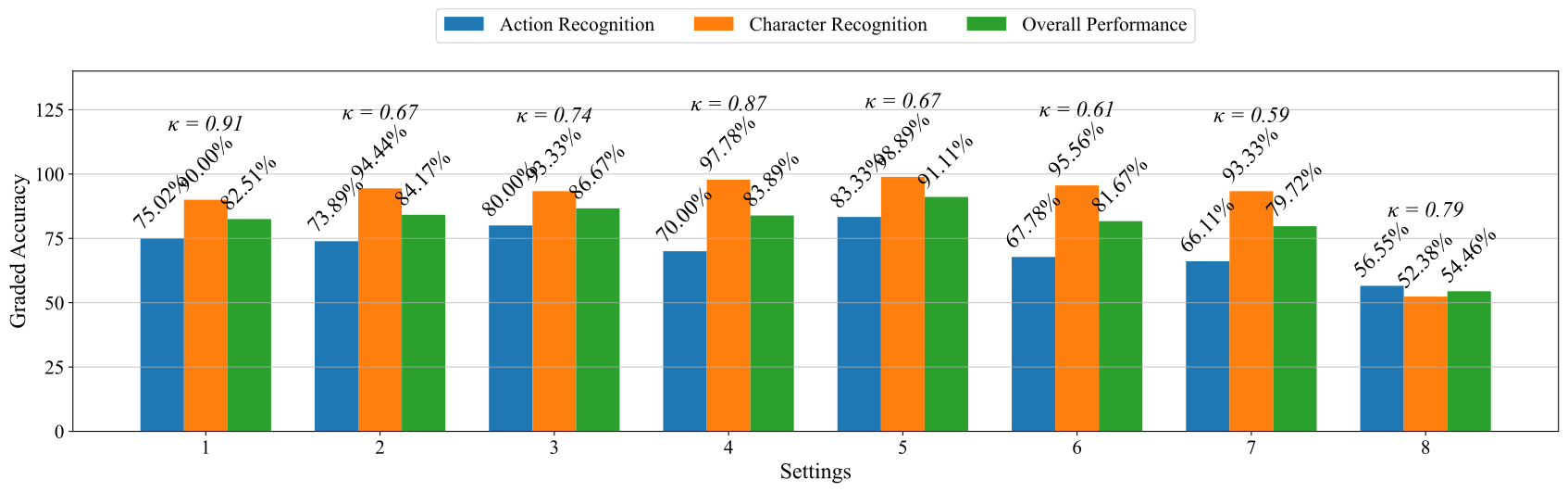
Figure 9 解读: UNIVERSE 在 8 个评估 settings 上的 graded accuracy。Settings 1-7 使用大模型(1.6B, 300×180),Setting 8 使用小模型(140M, 128×128)。高分辨率 rollouts 的评估效果更好。跨环境(settings 2-7 为 unseen environments)性能保持稳定。Cohen’s 范围 0.59-0.91,表示 “substantial” 一致性。
关键数据:
- In-domain (Setting 1): AR graded ~75.0%, CR ~82.0%, Overall ~73.0%
- Unseen envs (Settings 2-7): AR 68-85%, CR 90-99%
- Low-res Setting 8: 整体下降明显(AR 35.7%, CR 10.7-60.7%),因 128×128 上采样至 224×224 导致模糊
- Cohen’s : 0.59-0.91(substantial agreement)
5.7 计算成本分解
| 实验类别 | GPU-days |
|---|---|
| Zero-shot evaluation | 136 |
| Baseline fine-tuning | 864 |
| Analysis experiments | 2,554 |
| Human evaluation | 1,125 |
| Development/failed runs | 1,599 |
| 总计 | 5,154 (14.12 GPU-years) |
代码-论文对应表
| 论文组件 | 实现模块 | 说明 |
|---|---|---|
| Section 3 - Dataset | AdaptationDatasetBuilder | 从 ground truth 构建 QA pairs,支持 alpha_task, beta_format, context_length, sampling_strategy |
| Section 3 - Training | VLMAdapter | 对 base VLM 应用适配策略,通过 strategy 参数控制(projection_only for UNIVERSE) |
| Section 3 - Rollout Gen | RolloutsGenerator | 自回归采样 world model rollouts,维护 o_lt 和 a_lt 列表 |
| Section 6 - Evaluation | Universe | 推理引擎,evaluate_rollout 方法接受 rollout + specification,通过 generate_question 构建 prompt |
| Algorithm 1 | DatasetCreation | 三阶段 pipeline: Preprocessing → Description → QA Construction |
| Eq. (1) | compute_loss | Causal LM loss on answer suffix tokens |
| Table 3 | Training config | AdamW, lr=, cosine, bfloat16, 8×A100 |
| Figure 1 | Evaluation comparison | Universe.evaluate_rollout on validation set |
注: 截至 2026 年 3 月,该论文未公开官方代码仓库。以上模块名称来自论文 Appendix C.1 的实现描述。