Kimi K2.5: Visual Agentic Intelligence
Authors: Kimi Team (325+ contributors, alphabetical order) Affiliations: Moonshot AI, The University of Hong Kong arXiv: 2602.02276 Project Page: www.kimi.com/ai-models/kimi-k2-5 GitHub: MoonshotAI/Kimi-K2.5
1. Motivation (研究动机)
当前大语言模型正在快速向 agentic intelligence 方向演进。GPT-5.2、Claude Opus 4.5、Gemini 3 Pro 等模型在 tool calling 和多步推理方面展现了强大能力,但仍存在两个核心瓶颈:
-
文本与视觉的割裂优化:传统多模态模型通常将视觉能力作为语言模型的后期附加(post-hoc add-on),在后期引入大比例视觉 token。这种方式导致两种模态之间无法充分协同增强,视觉推理和文本推理存在能力断层。
-
单 agent 顺序执行的延迟瓶颈:现有 agentic 系统依赖顺序的 tool calling 和推理步骤,推理时间随任务复杂度线性增长。当任务涉及大规模研究、设计、开发等异构子问题时,单 agent 范式变得低效且不可扩展。
Kimi K2.5 针对这两个问题提出了系统性解决方案:通过 joint text-vision optimization 实现两种模态的双向增强,通过 Agent Swarm 框架实现并行 agent 编排,将任务复杂度从线性扩展转为并行处理。
2. Idea (核心思想)
Kimi K2.5 的核心创新思想可总结为三点:
-
Joint Optimization 双向增强:文本和视觉不应独立优化,而应在 pre-training、SFT、RL 三个阶段全程联合优化。关键发现是 early fusion with lower vision ratio 比 late fusion with high vision ratio 效果更好;text-only SFT(zero-vision SFT)反而能激活视觉 agentic 能力;visual RL 不仅提升视觉性能,还能通过 cross-modal transfer 提升文本推理。
-
Zero-Vision SFT 范式:后训练阶段仅用纯文本 SFT 数据,通过 IPython 编程操作代理图像处理,即可激活视觉 tool-use 能力。这避免了人工标注视觉 CoT 数据的局限性。
-
Agent Swarm 并行编排:不再将复杂任务作为推理链顺序执行,而是由可训练的 orchestrator 动态分解任务、创建领域专用 subagent、并行调度执行。通过 Parallel-Agent Reinforcement Learning (PARL) 训练 orchestrator 学习何时、如何并行化。
3. Method (方法)
3.1 总体框架
Kimi K2.5 基于 Kimi K2 构建,是一个 1.04 万亿参数的 Mixture-of-Experts (MoE) transformer 模型,每个 token 激活 32B 参数(384 experts,sparsity 8/48)。训练流程包含:ViT Training → Joint Pre-training → Long-context Mid-training → SFT → Joint RL。
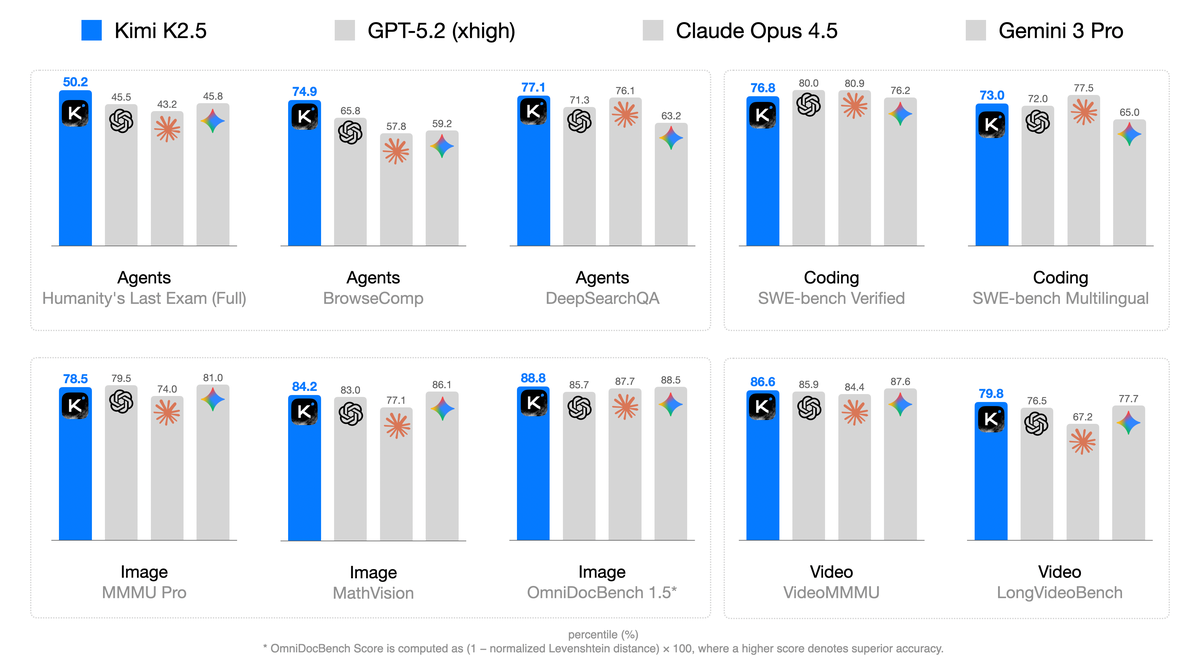
Figure 1 解读:Kimi K2.5 在 Agent、Coding、Image、Video 四大类共 10 个 benchmark 上与 GPT-5.2、Claude Opus 4.5、Gemini 3 Pro 的对比(percentile 排名)。K2.5 在 Agents 类别(HLE Full、BrowseComp、DeepSearchQA)和 Video 类别(LongVideoBench)上取得最优或接近最优表现,在 Coding(SWE-bench Verified/Multilingual)和 Image(MMMU Pro、MathVision、OmniDocBench)上与顶级闭源模型竞争力相当。
3.2 模型架构 - MoonViT-3D
多模态架构包含三个组件:
- MoonViT-3D:三维原生分辨率视觉编码器,基于 SigLIP-SO-400M 初始化,采用 NaViT packing strategy 支持变分辨率输入
- MLP Projector:连接视觉编码器和语言模型
- Kimi K2 MoE LLM:1.04T 参数的 MoE 语言模型
MoonViT-3D 的核心设计是将 “patch n’ pack” 理念推广到时间维度:将最多 4 个连续视频帧作为 spatiotemporal volume 处理,2D patches 联合展平并打包为单一 1D 序列。这实现了:
- 图像和视频共享同一参数空间和特征表示
- 无需专门的视频模块或架构分叉
- 通过 temporal pooling 实现 时间压缩,显著延长可处理的视频长度
# MoonViT-3D: 3D Vision Transformer with temporal compression
class MoonViT3D:
    def __init__(self, base_model="SigLIP-SO-400M"):
        self.vit = load_pretrained(base_model)  # NaViT packing strategy
        self.temporal_pool = TemporalPooling(factor=4)

    def encode(self, visual_input):
        """Process images or videos with shared parameters."""
        if visual_input.is_video:
            # Group consecutive frames into chunks of 4
            chunks = group_frames(visual_input, chunk_size=4)
            all_patches = []
            for chunk in chunks:
                # Treat 4 frames as spatiotemporal volume
                # Flatten 2D patches from all frames into 1D sequence
                patches = self.vit.patchify_3d(chunk)  # [N_patches, D]
                all_patches.append(patches)
            features = self.vit.forward(concat(all_patches))
            # Lightweight temporal pooling: 4x compression
            features = self.temporal_pool(features)
        else:
            # Native resolution image processing
            patches = self.vit.patchify(visual_input)
            features = self.vit.forward(patches)
        return features
3.3 Native Multimodal Pre-Training
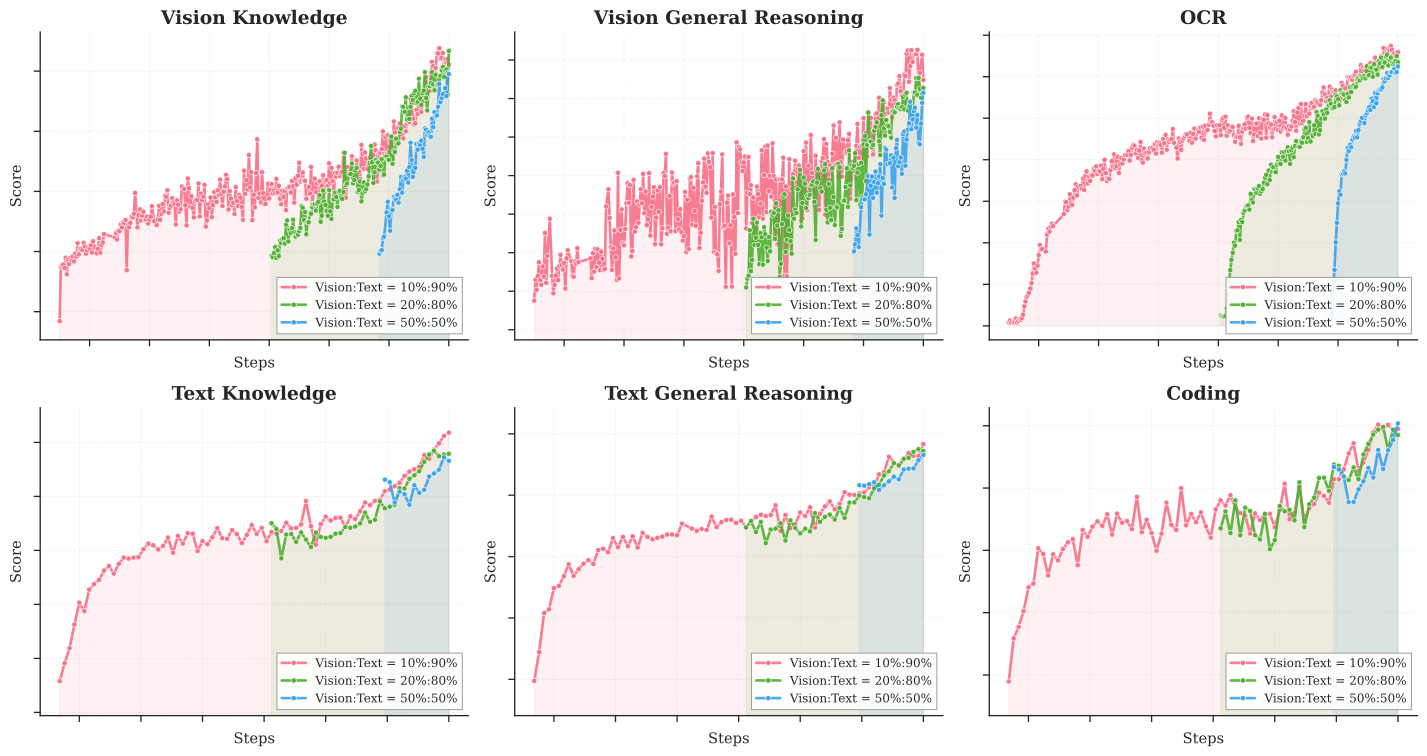
Figure 9 解读:不同 vision-text 联合训练策略的对比。传统方法在训练后期引入高比例视觉 token(Late fusion, 50%:50%),而 Kimi K2.5 采用 early fusion with low vision ratio(10%:90%),在固定的 vision-text token 预算下取得更优的多模态性能。
关键发现:在总 vision-text token 预算固定的前提下,early fusion with lower vision ratio 效果更好。
| Vision Injection Timing | Vision-Text Ratio | Vision Knowledge | Vision Reasoning | OCR | Text Knowledge | Text Reasoning | Code |
|---|---|---|---|---|---|---|---|
| Early (0%) | 10%:90% | 25.8 | 43.8 | 65.7 | 45.5 | 58.5 | 24.8 |
| Mid (50%) | 20%:80% | 25.0 | 40.7 | 64.1 | 43.9 | 58.6 | 24.0 |
| Late (80%) | 50%:50% | 24.2 | 39.0 | 61.5 | 43.1 | 57.8 | 24.0 |
Pre-training 共三个阶段,处理约 15T tokens:
| 阶段 | ViT Training | Joint Pre-training | Long-context Mid-training |
|---|---|---|---|
| 数据 | Alt text, Synthesis Caption, Grounding, OCR, Video | + Text, Knowledge, Interleaving, Video, OS Screenshot | + High-quality Text & Multimodal, Long Video, Reasoning, Long-CoT |
| 序列长度 | 4096 | 4096 | 32768 → 262144 |
| Tokens | 1T | 15T | 500B → 200B |
| 训练模块 | ViT | ViT & LLM | ViT & LLM |
# Pre-training pipeline for Kimi K2.5
class KimiK25PreTraining:
    def __init__(self):
        self.vit = MoonViT3D()          # Stage 1: ViT-only training
        self.projector = MLPProjector()
        self.llm = KimiK2MoE()          # 1.04T params, 32B activated

    def stage1_vit_training(self, data):
        """ViT training on image-text and video-text pairs.
        Uses cross-entropy caption loss (no contrastive loss).
        Two sub-stages: (1) align ViT with Moonlight-16B-A3B,
        (2) update only MLP projector to bridge ViT with 1T LLM."""
        for batch in data:  # ~1T tokens, seq_len=4096
            visual_features = self.vit.encode(batch.images)
            projected = self.projector(visual_features)
            loss = cross_entropy_caption_loss(
                self.llm(projected, batch.text), batch.targets
            )
            loss.backward()  # Only update ViT parameters

    def stage2_joint_pretraining(self, data):
        """Joint pre-training with early vision fusion at 10%:90% ratio.
        Introduces unique tokens, increased coding weight."""
        for batch in data:  # ~15T tokens, seq_len=4096
            loss = self.forward_multimodal(batch)
            loss.backward()  # Update ViT & LLM jointly

    def stage3_midtraining(self, data):
        """Long-context mid-training with YaRN interpolation.
        Extends context from 32K to 262K tokens."""
        for batch in data:  # 500B->200B tokens, seq_len=32768->262144
            loss = self.forward_multimodal(batch)
            loss.backward()  # Update ViT & LLM
3.4 Zero-Vision SFT
传统多模态 SFT 需要人工标注视觉 CoT 数据(如 crop、rotate、flip 操作),数据有限且多样性不足。Kimi K2.5 提出 zero-vision SFT:仅用纯文本 SFT 数据即可激活视觉 agentic 能力。
核心机制是将所有图像处理操作通过 IPython 编程接口代理,例如:
- 通过 binarization 和 counting 实现像素级操作
- 通过编程实现 object localization、counting、OCR
这种 “zero-vision” 激活之所以有效,是因为 joint pre-training 已经建立了强大的 vision-text alignment,文本 SFT 的能力可以自然泛化到视觉模态。
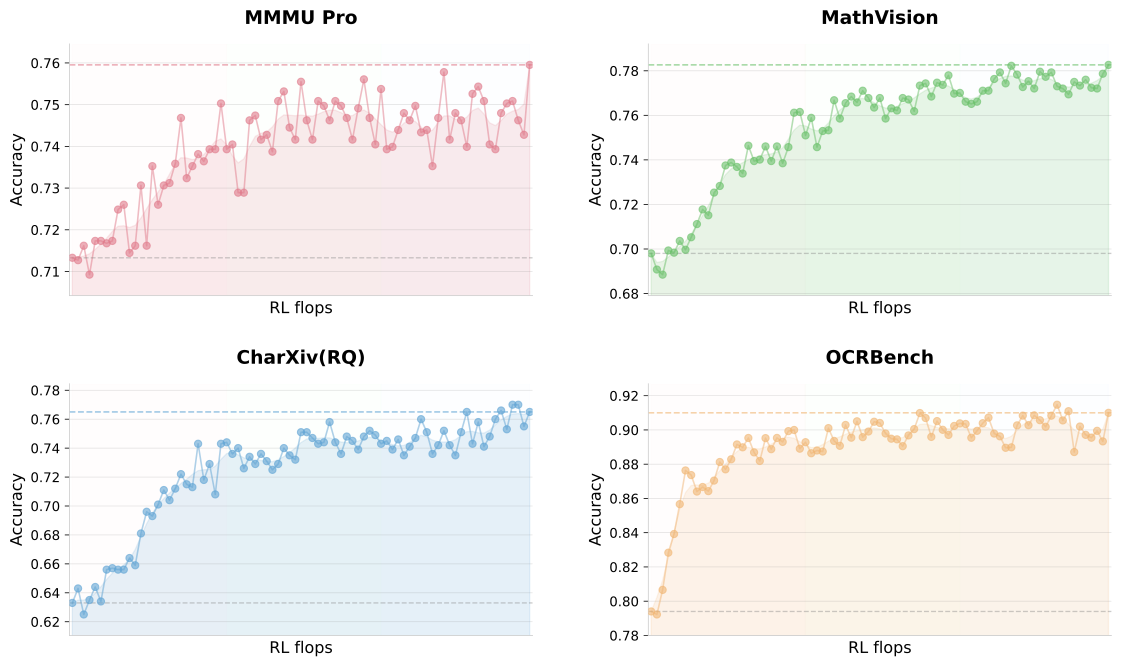
Figure 2 解读:从 zero-vision SFT 出发的 vision RL 训练曲线。四个 benchmark(MMMU Pro、MathVision、CharXiv(RQ)、OCRBench)的性能随 RL FLOPs 增加持续提升,证明 zero-vision 激活配合长期 RL 训练足以获得强大的视觉能力。
# Zero-Vision SFT: activate visual capabilities using text-only data
class ZeroVisionSFT:
    def __init__(self, model):
        self.model = model

    def create_training_data(self):
        """Use only text SFT data. Image manipulations are proxied
        through programmatic operations in IPython."""
        text_sft_data = load_text_sft_corpus()
        # No vision-specific SFT data needed!
        # All image operations expressed as code:
        # e.g., "Use Python to count objects in the image"
        #       "Write code to extract text via OCR"
        #       "Compute bounding boxes programmatically"
        return text_sft_data

    def train(self, data):
        """Standard SFT on text-only data.
        Joint pre-training ensures cross-modal generalization."""
        for batch in data:
            logits = self.model(batch.input_ids)
            loss = cross_entropy(logits, batch.targets)
            loss.backward()
3.5 Joint Multimodal Reinforcement Learning
RL 阶段包含两个关键创新:outcome-based visual RL 和 joint multimodal RL。
Outcome-Based Visual RL 针对三类任务:
- Visual grounding and counting
- Chart and document understanding
- Vision-critical STEM problems
Cross-Modal Transfer:visual RL 不仅提升视觉性能,还意外改善了文本基准:
| Benchmark | Before Vision-RL | After Vision-RL | Improvement |
|---|---|---|---|
| MMLU-Pro | 84.7 | 86.4 | +1.7 |
| GPQA-Diamond | 84.3 | 86.4 | +2.1 |
| LongBench v2 | 56.7 | 58.9 | +2.2 |
Joint Multimodal RL 按能力域(而非模态)组织 RL 训练:knowledge、reasoning、coding、agentic 等 domain experts 同时从纯文本和多模态查询学习,Generative Reward Model (GRM) 跨异构 traces 优化。
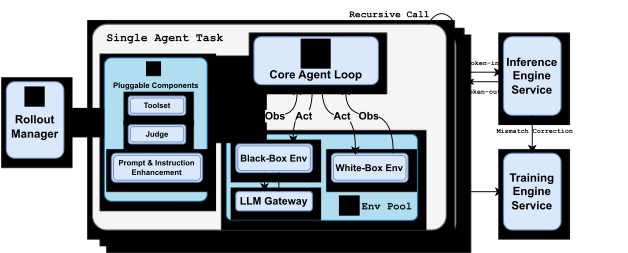
Figure (RL Framework) 解读:Kimi K2.5 的强化学习框架示意图,展示了 joint text-vision RL 的整体流程,包括 policy optimization、reward function、以及 GRM 的协同工作方式。
Policy Optimization 使用 token 级别的 clipping 机制:
其中 为超参数, 是第 个 response 中前 个 token 的前缀, 是 batch 中生成 token 的总数, 是所有生成 response 的 reward 均值。
关键区别于标准 PPO clipping:本方法严格依赖 log-ratio 本身(而非 advantage 的符号)来 bound off-policy drift,log-ratio 在 范围内正常计算梯度,超出范围则梯度归零。
Reward Function 设计:
- Rule-based outcome reward:用于可验证任务(数学、编程等)
- Budget-control reward:优化 token 效率
- GRM(Generative Reward Models):用于开放式任务的细粒度评估
- 视觉特定 reward:grounding 用 F1-based soft matching(IoU),point localization 用 Gaussian-weighted distance,polygon segmentation 用 rasterize + IoU,OCR 用 normalized edit distance,counting 用 absolute difference
# Joint Multimodal RL with token-level clipping
class JointMultimodalRL:
    def __init__(self, model, reward_fn, grm):
        self.policy = model
        self.old_policy = deepcopy(model)
        self.reward_fn = reward_fn
        self.grm = grm
        self.optimizer = MuonClipOptimizer()

    def compute_loss(self, x, responses, alpha, beta, tau):
        """Token-level clipped policy optimization."""
        rewards = [self.reward_fn(x, y) for y in responses]
        mean_reward = mean(rewards)
        total_loss = 0
        N = sum(len(y) for y in responses)

        for j, y in enumerate(responses):
            advantage = rewards[j] - mean_reward
            for i in range(len(y)):
                prefix = y[:i]
                log_ratio = (
                    self.policy.log_prob(y[i], x, prefix)
                    - self.old_policy.log_prob(y[i], x, prefix)
                )
                # Clip: gradients zeroed if log_ratio outside [alpha, beta]
                ratio = clip(exp(log_ratio), alpha, beta)
                policy_loss = ratio * advantage
                kl_penalty = tau * log_ratio ** 2
                total_loss += (policy_loss - kl_penalty) / N
        return -total_loss

    def compute_visual_reward(self, task_type, prediction, ground_truth):
        """Task-specific visual rewards."""
        if task_type == "grounding":
            return f1_soft_match_iou(prediction, ground_truth)
        elif task_type == "point_localization":
            return gaussian_weighted_distance(prediction, ground_truth)
        elif task_type == "polygon_segmentation":
            mask = rasterize_polygon(prediction)
            return compute_iou(mask, ground_truth)
        elif task_type == "ocr":
            return 1.0 - normalized_edit_distance(prediction, ground_truth)
        elif task_type == "counting":
            return 1.0 - abs(prediction - ground_truth) / max(ground_truth, 1)
3.6 Token Efficient RL - Toggle
Toggle 是一种交替训练启发式方法,在 inference-time scaling 和 budget-constrained optimization 之间切换:
其中 budget 由正确 response 长度的 -th percentile 估计:
- Phase 0 (budget limited):在任务相关的 token budget 内求解,仅当模型平均 accuracy 超过阈值 时强制执行
- Phase 1 (standard scaling):生成到最大 token 限制,鼓励 inference-time scaling
Toggle 平均减少输出 token 25~30%,性能几乎无损。
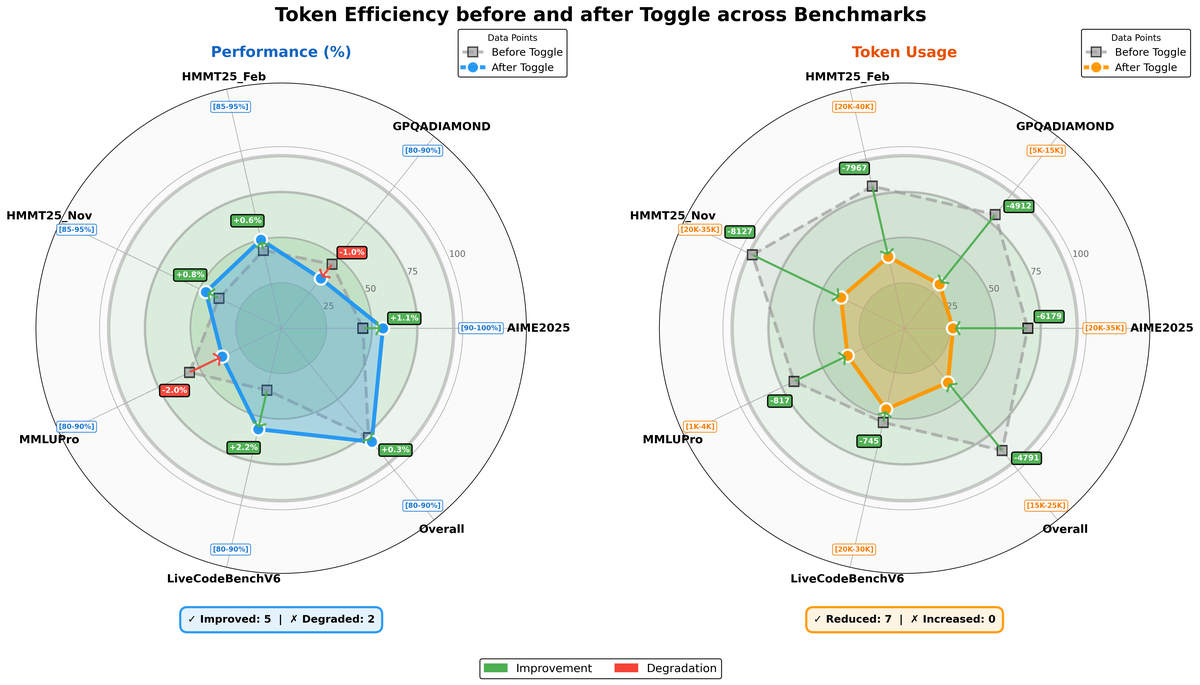
Figure 5 解读:Toggle 前后在多个 benchmark 上的性能和 token 使用量对比(雷达图)。左图显示性能基本维持(5 improved, 2 degraded),右图显示 token 使用量在所有 benchmark 上均有明显减少(7 reduced, 0 increased),证明 Toggle 有效提升了 token 效率。
# Toggle: alternating inference-time scaling and budget-constrained RL
class ToggleRL:
    def __init__(self, lambda_threshold, rho_percentile, m_period):
        self.lambda_t = lambda_threshold  # accuracy threshold
        self.rho = rho_percentile         # budget percentile
        self.m = m_period                 # alternation period

    def estimate_budget(self, x, responses, rewards):
        """Estimate problem-dependent token budget from correct responses."""
        correct_lengths = [
            len(y) for y, r in zip(responses, rewards) if r == 1
        ]
        if not correct_lengths:
            return float('inf')
        return percentile(correct_lengths, self.rho)

    def compute_reward(self, x, y, t, K, all_responses, all_rewards):
        """Toggle reward: alternate between budget-limited and scaling."""
        r = base_reward(x, y)
        phase = (t // self.m) % 2

        if phase == 0:  # Budget limited phase
            mean_acc = mean(all_rewards)
            budget = self.estimate_budget(x, all_responses, all_rewards)
            if mean_acc < self.lambda_t or len(y) <= budget:
                return r
            else:
                return 0  # Penalize exceeding budget when accuracy is high
        else:  # Standard scaling phase
            return r
3.7 Agent Swarm 与 PARL
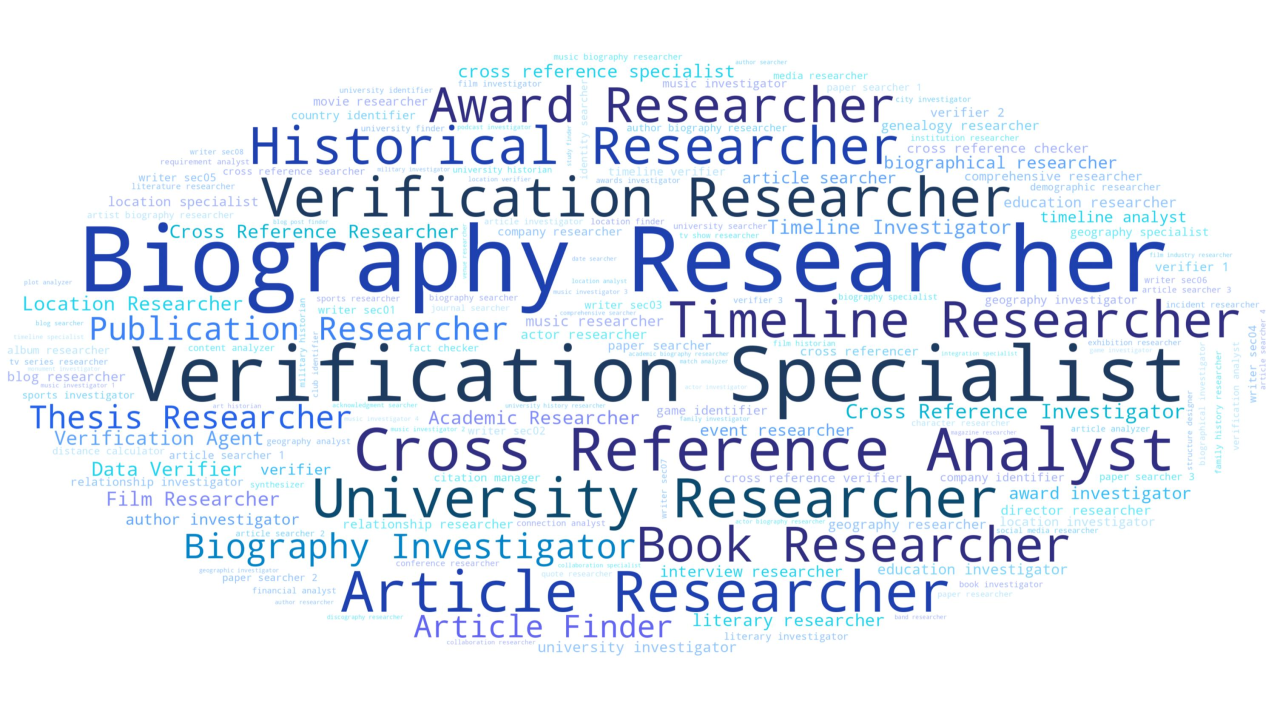
Figure 3 解读:Agent Swarm 架构图。一个可训练的 Orchestrator 动态创建领域专用 subagent(AI Researcher、Physics Researcher、Life Sciences Researcher、Fact Checker、Web Developer 等),将复杂任务分解为可并行执行的子任务。Orchestrator 拥有 create_subagent、assign_task、search、browser 等工具。子任务结果汇聚回 Orchestrator 进行最终整合。
架构设计:
- Orchestrator:可训练的,负责任务分解、subagent 创建和调度
- Subagents:冻结的,从固定的中间策略 checkpoint 实例化,执行具体子任务
- 训练时仅更新 orchestrator,subagent 的输出被视为环境观测(environmental observations)
PARL Reward 定义为三项之和:
- :鼓励并行 subagent instantiation,防止 serial collapse(退化为单 agent 顺序执行)
- :防止 spurious parallelism(大量 spawn subagent 但无实际完成)
- :任务级最终性能 reward
- 在训练过程中退火到零,确保最终策略优化主目标
Critical Steps 指标:
其中 为执行阶段数, 为第 阶段主 agent 步数(通常为 1), 为第 个 subagent 的步数。该指标衡量关键路径长度(wall-clock time),鼓励均衡的任务分解以缩短最长并行分支。
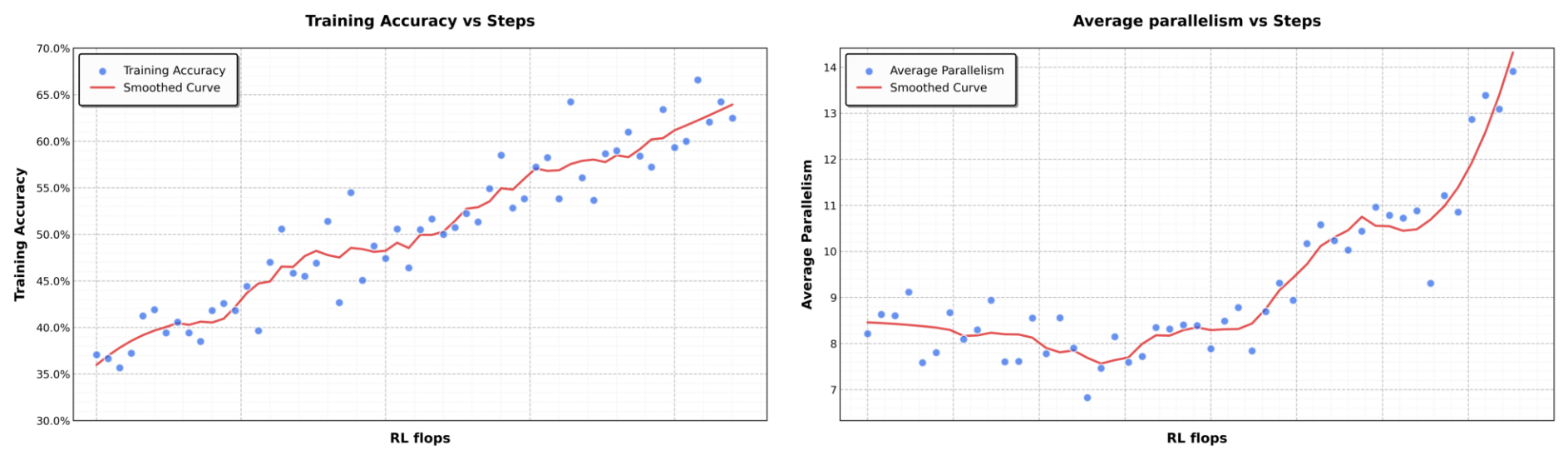
Figure 4 解读:PARL 训练过程中 training accuracy(左)和 average parallelism(右)随 RL FLOPs 的变化。两个指标同步平滑增长,说明 orchestrator 通过 RL 逐步学会更有效的并行任务分解策略。
# Agent Swarm with Parallel-Agent Reinforcement Learning (PARL)
class AgentSwarm:
    def __init__(self, orchestrator, subagent_checkpoint):
        self.orchestrator = orchestrator        # Trainable
        self.subagent_policy = subagent_checkpoint  # Frozen

    def execute(self, task):
        """Orchestrator decomposes task and manages parallel subagents."""
        # Step 1: Orchestrator analyzes task and creates subagents
        plan = self.orchestrator.plan(task)
        subagents = []
        for spec in plan.subagent_specs:
            agent = self.create_subagent(spec.role, spec.tools)
            subagents.append(agent)

        # Step 2: Assign tasks to subagents (parallel execution)
        futures = []
        for agent, subtask in zip(subagents, plan.subtasks):
            future = parallel_execute(agent, subtask)  # Non-blocking
            futures.append(future)

        # Step 3: Collect results and synthesize final answer
        results = [f.result() for f in futures]
        return self.orchestrator.synthesize(task, results)

    def create_subagent(self, role, tools):
        """Dynamically instantiate domain-specific frozen subagent."""
        return SubAgent(
            policy=self.subagent_policy,  # Fixed checkpoint
            role=role,       # e.g., "AI Researcher", "Fact Checker"
            tools=tools      # e.g., [search, browser, code_exec]
        )


class PARLTrainer:
    def __init__(self, lambda1, lambda2):
        self.lambda1 = lambda1  # Annealed to 0 during training
        self.lambda2 = lambda2  # Annealed to 0 during training

    def compute_parl_reward(self, x, y, subagent_results):
        """PARL reward = instantiation + finish rate + performance."""
        r_parallel = self.parallel_instantiation_reward(y)
        r_finish = self.subagent_finish_rate(subagent_results)
        r_perf = self.task_performance_reward(x, y)
        return self.lambda1 * r_parallel + self.lambda2 * r_finish + r_perf

    def compute_critical_steps(self, episode):
        """Measure wall-clock proxy: critical path length."""
        total = 0
        for stage in episode.stages:
            main_steps = stage.main_agent_steps  # typically 1
            max_sub_steps = max(
                (sub.steps for sub in stage.subagents), default=0
            )
            total += main_steps + max_sub_steps
        return total
3.8 Decoupled Encoder Process (DEP)
针对多模态训练中 Pipeline Parallelism 的 load imbalance 问题,提出 Decoupled Encoder Process (DEP):
- Balanced Vision Forward:先对全局 batch 中所有视觉数据执行 forward pass,在所有 GPU 上均匀分配(按 image/patch count 负载均衡),丢弃中间激活仅保留最终输出
- Backbone Training:主 transformer backbone 执行标准的 forward/backward pass,可完全复用纯文本训练的高效并行策略
- Vision Recomputation & Backward:重计算视觉 encoder forward pass,然后执行 backward pass 计算视觉参数梯度
DEP 实现了多模态训练效率达到纯文本训练的 90%。
# Decoupled Encoder Process (DEP) for efficient multimodal training
class DecoupledEncoderProcess:
    def __init__(self, vit, llm, num_pp_stages):
        self.vit = vit
        self.llm = llm

    def training_step(self, batch):
        # Phase 1: Balanced Vision Forward (all GPUs)
        # Distribute visual data evenly across all GPUs by load metrics
        visual_data = distribute_by_load(batch.visual, metric="patch_count")
        with no_grad():  # Discard intermediate activations
            vit_outputs = self.vit(visual_data)
        # Gather outputs back to PP Stage-0
        vit_features = all_gather_to_stage0(vit_outputs)

        # Phase 2: Backbone Training (standard PP strategy)
        # Forward + backward for main transformer
        llm_output = self.llm.forward(batch.text, vit_features)
        llm_output.backward()  # Gradients accumulated at ViT output

        # Phase 3: Vision Recomputation & Backward
        # Recompute ViT forward (needed for gradients)
        vit_outputs_recomputed = self.vit(visual_data)
        vit_outputs_recomputed.backward(grad_from_llm)
3.9 代码到论文映射表
| Paper Concept | Source File | Key Class/Function |
|---|---|---|
| 模型权重 | HuggingFace: moonshotai/Kimi-K2.5 | 模型 checkpoint |
| 部署指南 | docs/deploy_guidance.md | 部署配置 |
| 技术报告 PDF | tech_report.pdf | 完整技术报告 |
注:GitHub 仓库仅包含模型权重发布和部署指南,未公开训练代码。上述 pseudocode 基于论文描述编写。
4. Experimental Setup (实验设置)
Benchmarks 分类
- Reasoning & General: HLE, AIME 2025, HMMT 2025 (Feb), IMO-AnswerBench, GPQA-Diamond, MMLU-Pro, SimpleQA Verified, AdvancedIF, LongBench v2
- Coding: SWE-Bench Verified, SWE-Bench Pro (public), SWE-Bench Multilingual, Terminal Bench 2.0, PaperBench (CodeDev), CyberGym, SciCode, OJBench (cpp), LiveCodeBench (v6)
- Agentic: BrowseComp, WideSearch, DeepSearchQA, FinSearchCompT2&T3, Seal-0, GDPVal
- Image Understanding: MMMU-Pro, MMMU (val), CharXiv (RQ), MathVision, MathVista (mini), SimpleVQA, WorldVQA, ZeroBench, BabyVision, BLINK, MMVP, OmniDocBench 1.5, OCRBench, InfoVQA (test)
- Video Understanding: VideoMMU, MMVU, MotionBench, Video-MME (with subtitles), LongVideoBench, LVBench
- Computer Use: OSWorld-Verified, WebArena
Baselines
- 闭源模型: Claude Opus 4.5 (extended thinking), GPT-5.2 (xhigh reasoning effort), Gemini 3 Pro (high reasoning-level)
- 开源模型: DeepSeek-V3.2 (thinking mode enabled), Qwen3-VL-235B-A22B-Thinking
评估配置
- Temperature = 1.0, top-p = 0.95
- Context length = 256k tokens
- 无公开分数的 benchmark 使用相同条件重新评估(标记 *)
5. Experimental Results (实验结果)
5.1 主要结果(Table 4 精选)
| Benchmark | Kimi K2.5 | Claude Opus 4.5 | GPT-5.2 | Gemini 3 Pro |
|---|---|---|---|---|
| Reasoning | ||||
| HLE-Full | 30.1 | 30.8 | 34.5 | 37.5 |
| HLE-Full w/ tools | 50.2 | 43.2 | 45.5 | 45.8 |
| AIME 2025 | 96.1 | 92.8 | 100 | 95.0 |
| HMMT 2025 (Feb) | 95.4 | 92.9* | 99.4 | 97.3* |
| GPQA-Diamond | 87.6 | 87.0 | 92.4 | 91.9 |
| MMLU-Pro | 87.1 | 89.3* | 86.7* | 90.1 |
| Coding | ||||
| SWE-Bench Verified | 76.8 | 80.9 | 80.0 | 76.2 |
| SWE-Bench Multilingual | 73.0 | 77.5 | 72.0 | 65.0 |
| LiveCodeBench (v6) | 85.0 | 82.2* | - | 87.4* |
| Agentic | ||||
| BrowseComp | 60.6 | 37.0 | 65.8 | 37.8 |
| BrowseComp (Agent Swarm) | 78.4 | - | - | - |
| WideSearch | 72.7 | - | 76.2* | 57.0 |
| WideSearch (Agent Swarm) | 79.0 | - | - | - |
| DeepSearchQA | 77.1 | 76.1* | 71.3* | 63.2* |
| Image | ||||
| MMMU-Pro | 78.5 | 74.0 | 79.5* | 81.0 |
| MathVision | 84.2 | 77.1* | 83.0 | 86.1* |
| OmniDocBench 1.5 | 88.8 | 87.7* | 85.7 | 88.5 |
| OCRBench | 92.3 | 86.5* | 80.7* | 90.3* |
| Video | ||||
| VideoMMU | 86.6 | 84.4* | 85.9 | 87.6 |
| LongVideoBench | 79.8 | 67.2* | 76.5* | 77.7* |
| MotionBench | 70.4 | 60.3* | 64.8* | 70.3 |
| Computer Use | ||||
| OSWorld-Verified | 63.3 | 66.3 | 8.6* | 20.7* |
| WebArena | 58.9 | 63.4* | - | - |
5.2 Token Efficiency(Table 5)
Kimi K2.5 在保持竞争力性能的同时显著降低 token 消耗:
| Benchmark | Kimi K2.5 (tokens) | Kimi K2 Thinking | Gemini-3.0 Pro | DeepSeek-V3.2 Thinking |
|---|---|---|---|---|
| AIME 2025 | 96.1 (25k) | 94.5 (30k) | 95.0 (15k) | 93.1 (16k) |
| HMMT Feb 2025 | 95.4 (27k) | 89.4 (35k) | 97.3 (16k) | 92.5 (19k) |
| LiveCodeBench | 85.0 (18k) | 82.6 (25k) | 87.4 (13k) | 83.3 (16k) |
| GPQA Diamond | 87.6 (14k) | 84.5 (13k) | 91.9 (8k) | 82.4 (7k) |
5.3 Agent Swarm Results(Table 6)
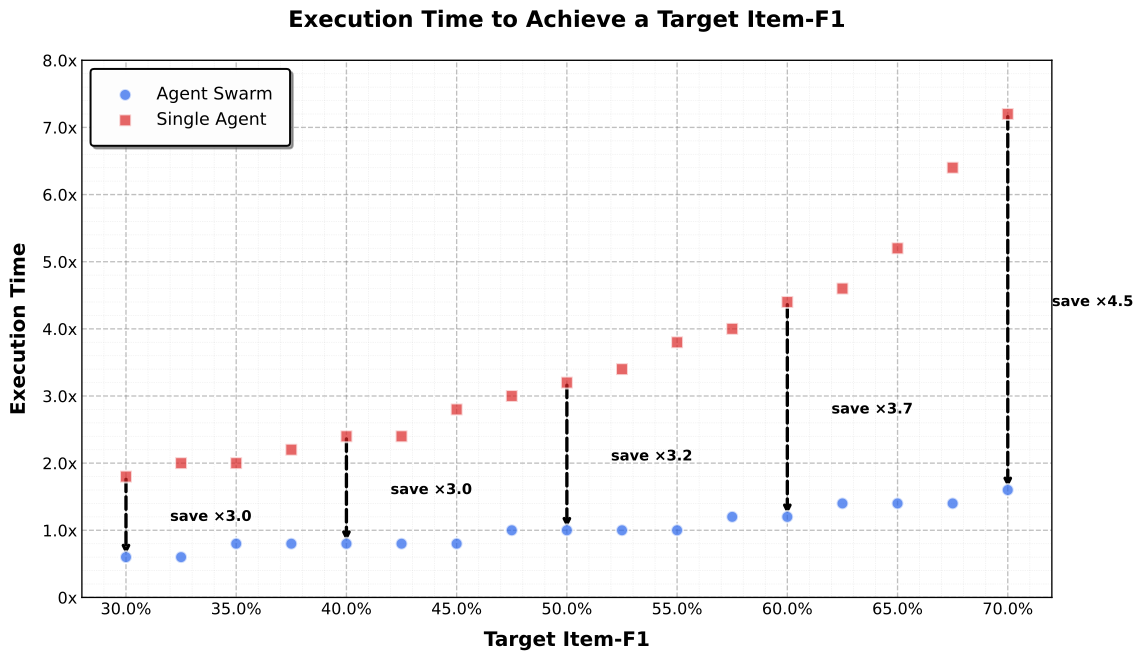
Figure 8 解读:Agent Swarm vs. Single Agent 在 WideSearch 上的执行时间对比。横轴为目标 Item-F1(30%70%),纵轴为执行时间倍数。Single Agent(红点)时间随复杂度线性增长(1.8x → 7.0x),而 Agent Swarm(蓝点)保持近常数低延迟(0.6x1.6x),实现 3x~4.5x 加速。
| Benchmark | K2.5 Agent Swarm | Kimi K2.5 | Claude Opus 4.5 | GPT-5.2 | GPT-5.2 Pro |
|---|---|---|---|---|---|
| BrowseComp | 78.4 | 60.6 | 37.0 | 65.8 | 77.9 |
| WideSearch | 79.0 | 72.7 | 76.2 | - | - |
| In-house Swarm Bench | 58.3 | 41.6 | 45.8 | - | - |
关键结论:
- Agent Swarm 在 BrowseComp 上比单 agent 提升 17.8%(60.6% → 78.4%),超越 GPT-5.2 Pro(77.9%)
- WideSearch 上 Item-F1 从 72.7% 提升到 79.0%,超越 Claude Opus 4.5(76.2%)
- 执行延迟降低 3x~4.5x
- Agent Swarm 同时起到 proactive context management 的作用,优于 Discard-all context management
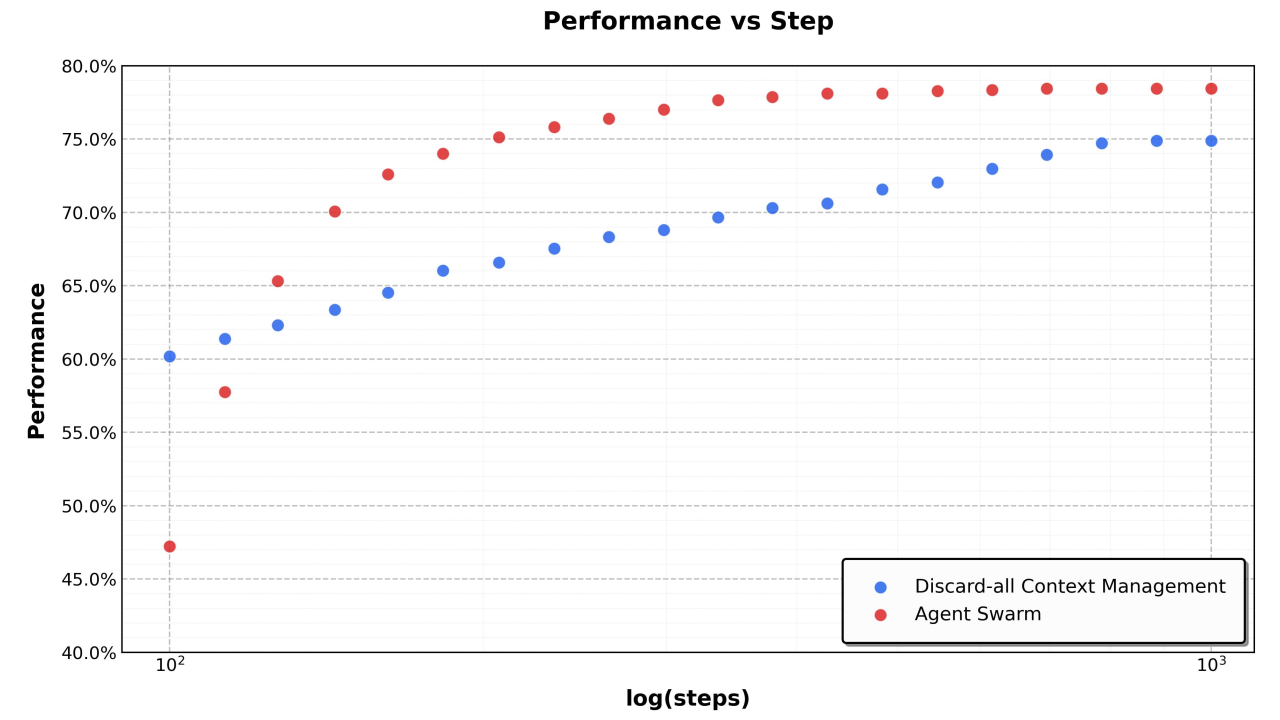
Figure 7 解读:在 BrowseComp 上,Agent Swarm(蓝线)与 Discard-all Context Management(橙线)的性能随步数的对比。Agent Swarm 通过主动的上下文分片(context sharding)始终优于被动的上下文截断策略,在更少的 critical steps 下达到更高准确率。